Limited Gray Marble Vinyl. This vinyl edition includes two EPs, one on each side: 'By the Ash Tree' and 'Upstream Dream', originally recorded and released in 2020 and 2021 respectively. To connect these compositions, Matt Kidd (Slow Meadow) composed new segues/crossfades from song to song, allowing the pieces to be experienced in one cohesive and harmonious flow. From Marc Weidenbaum's 'Disquiet' review: "Slow Meadow's new album, 'By the Ash Tree', opens with cascades of delays and proceeds through three tracks of reflective piano". The title track of 'By the Ash Tree' is one of Slow Meadow's most popular and enduring compositions. 'Upstream Dream' was composed around the time of 2019's Happy Occident. Soft electronics, bearing otherworldly tones and, at times, a sense of playful mischief, subtly shift expectations and bring discovery and wonder at every turn. It bookends a period of creative output that introduced Kidd's vision of calming and meditative ambient music. With a foundation of piano, string orchestration, and an ever-evolving electronic palette, Slow Meadow traverses the borders of neoclassical and minimalist electronics and delivers a deeply personal and transportive experience that speaks directly to the ebbs and flows and mundanity and marvels of life.
Cerca:creative sens
Lukas de Clerck brings us the ancient greek instrument, the aulos, of which his new interpretation of long form expression is coaxed forth on this tremendous recording. Lukas de Clerck explores a niche of archaeological research in music; the aulos is a historical Greek instrument that Lukas analyzed and reinterpreted by a luthier in modern times_navigating this impression as an artwork or living sculptural object, as there is an absence of historical partitions or written information about how to recreate technique on the instrument. Lukas de Clerck has interpreted information from the rare archaeological resources and visual art of the classical Greek period to recreate both playing technique and possible sound timbres with the instrument. With his contemporary approach to drone, post-minimalist music, and contemporary folk, we find a deeply satisfying and compelling, even playful set of songs, timbral exercises and compositions. An important document of new music meets contemporary archaemusicological research via Stephen O'Malley of SUNN O)))'s label Ideologic Organ. _ The telescopic aulos is speculative: might it have existed? It takes on features from the historical aulos, a double-reed instrument of which we know how it looked but little about what music was played on it or how it would have really sounded. It's an instrument without the limitations of canon or manual, providing creative freedom and awakening curiosity. The new instrument featured on this album is ancient and futuristic at once. The aulos has no tone holes; instead, each of the two tubes consists of three parts that can slide into each other. In this sense, the metal pipes bear a certain resemblance to the principle of a trombone. However, since both hands are already in use to hold both tubes, the sliding has to be done by way of gravity and the help of a «phorbeia», a leather mask which helps keep the reeds in place. The aulos's material is metal (instead of wood), which gives it a certain electronic allure and intensity, as well as a variety of sonic possibilities and textures. It produces overtones efficiently and allows them to play with their microtonality. The aulos Lukas plays on this recording was developed at Brasserie Atlas, a temporary occupation of a former brewery in the heart of Brussels where Lukas lives. It is quite a poetic coincidence that the birthplace of the instrument is named after the Greek titan condemned to carry the sky, while this instrument needs to be turned skywards to lower its pitch with the help of gravity. At Brasserie Atlas, Lukas has found collaborators who have shared in the process of building this new instrument: the collective Noir Métal has constructed the tubes, in this way becoming instrument builders; the phorbeia has been manufactured by Jot Fau; a former water reservoir in the vast cellar of the building carried the instruments' resonance for its first sounds. The place has left an imprint on this new instrument. With all of the telescopic aulos' layers, its sonic, musical and extra-musical components are still unfolding their potential as a medium for discovery and research, next to being an instrument of great musical potential. The music on The Telescopic Aulos of Atlas reflects this spirit. In several miniature pieces, it presents an encyclopaedia of musical possibilities that the instrument offers while keeping an intense and corporeal sonic specificity. The short pieces are studies that reflect on the sonic possibilities of this instrument that are yet to be explored. It meanders, searches and interacts with itself and the space. It needs to answer common expectations of old instruments being harmonious or pleasing. It transports a kind of experimental archaeology that, by formulating hypotheses in the present, allows us to reflect on what might have been in the past and simultaneously questions concepts of beauty, harmony or virtuosity. However, in the end, this instrument might have never existed before. -Julia Eckhardt
Santana III is an album of 'lasts'. It was the last album recorded with the original Woodstock-line up and the last to hit #1 in the Billboard charts until 1999's Supernatural. But there are also a number of important 'firsts' on this album; Coke Escovedo joins in for the first time on percussion, as does Neal Schon (Journey) - who was a mere 17 of age when they recorded the album - on guitar. Santana III is viewed by many as the band's commercial and creative highpoint. The band sounds darker, rawer, and more eager with the doubling up on guitar of Schon's Rock 'n' Roll sensibilities and Santana's ecstatic high notes and soulful fills. Escovedo and Chepito's percussion are as fast as it is furious, and the minimal production adds greatly to the timeless appeal of this album. Santana III is available as a limited edition of 1500 individually numbered copies on translucent yellow coloured vinyl, housed in a deluxe heavyweight gatefold sleeve.
- Ocean Motion Mildew Mind
- Yes Sir Ree
- I Can’t Stand It
- Country Time
- If I Were A Poet
- Torero Piece
- Peachy Keen-O
Carving an unlikely and elaborate niche in the stoney academic landscape
which she once shared with the likes of Phill Niblock, John Cage and Sorel
Hayes, the excitable proto-punk poèmes sonores of the linguistic loose
cannon known as Beth Anderson first rolled through New York in the mid-
1970s (from Kentucky via San Francisco) like a jumbled tumbleweed of lost
Letterism, face paint and threadbare drummy funk to astonish gallery floors,
lecture theatres and loft apartment stages.
One thousand leagues under the radar of the commercial music industry,
with a sense of humour that elevated way above her highbrow peer group,
the music of Beth Anderson has successfully evaded the pressing plant for
most of her creative career, and not unlike fellow New York gallery actionist
Suzanne Ciani, it has taken decades to successfully collect and contextualise
these early recordings - expanding her elusive discography beyond the rare
and mysterious solo single entry in the process.
When uttered amongst the type of vinyl vampires that haplessly gravitate
between both art school vintage vanity pressings and family funded plunder
funk, there’s an outside chance that the name Beth Anderson might muster
some vague recognition on account of her one and only solo wax sojourn
into the expansive DIY market. In 1980 the 45rpm single, ‘I Can’t Stand It’,
combusted into the consciousness of adventurous participants with its deep
rhythmic backbeat (courtesy of future Sonic Youth / Dinosaur Jr producer
Wharton Tiers, member of the new wave band Theoretical Girls), climaxing
with two colourful and commanding linguistic tantrums before disappearing in
a puff of smoke leaving would-be fans dumbstruck without so much as a
label name or distribution contact to explain what they had just heard.
For those who have spent the subsequent years on the edge of that same
seat, it might come as some comfort knowing that somewhere out there,
there is also a contrasting world of gallery patrons and experimental sound
poetry enthusiasts that similarly didn’t know that their regular performance
poet Beth Anderson even made the ambitious pop record. For the uninitiated,
the enigmatic Beth Anderson has straddled both sides of the art / rock fence
placed between two equally niche pastures.
Hopefully this first ever vinyl compendium will succeed in joining the dots,
loops, yelps, squeaks, beats and repeats. Let us follow Beth’s lineage, along
her magnetic tape highways crossing multiple boundaries in a hope to bridge
unlikely anti-genres like ‘yoga punk’, ‘ramble rap’, ‘combustion pop’ and
‘formroom funk’… all of which were officially neatly bracketed under the
curious Text-Sound movement where Beth garnered utmost respect as a key
practitioner.
Get ready for a musical revolution! The Antwerp Gipsy Ska Orkestra is back, and this time, they're turning the music world upside down with their electrifying new album, "Revolution (Never Has Been Simple)." This groundbreaking project, produced by the modern genius Lunaman, features an infusion of new energy and talent with the remarkable addition of 18-year-old sensation Ramadan Sali, who has been a fan of the band since the tender age of three. But before we dive into the future, let's take a moment to appreciate the rich history of the Antwerp Gipsy Ska Orkestra.
A Journey Through Time and Sound: The Antwerp Gipsy Ska Orkestra Story
The Antwerp Gipsy Ska Orkestra's journey is a testament to the transformative power of music. Rooted in the vibrant city of Antwerp, Belgium, this innovative collective began its musical voyage decades ago. Their story is one of passion, diversity, and an unshakable commitment to crafting unforgettable sounds.
The band's unique blend of Gypsy and Ska, along with an eclectic mix of world influences, has earned them a dedicated global following. With each album, they pushed the boundaries of musical fusion, forging a path where genres intertwined, creating something entirely unique. Their evolution has been an ongoing exploration of culture, rhythms, and the unifying language of music.
"Revolution (Never Has Been Simple)": A New Era of Sound
And now, they're back with "Revolution (Never Has Been Simple)" – a title that perfectly encapsulates their journey. Produced by Lunaman, known for his innovative approach to modern soundscapes, this album is a breath of fresh air for the music world. It's a bold step forward, a revolution of their own creation, and a testament to their constant willingness to reinvent themselves.
Meet the Prodigy: Ramadan Sali
But that's not all that makes this album special. The Antwerp Gipsy Ska Orkestra has also welcomed a young prodigy into their ranks: Ramadan Sali. At just 18 years old, he's not only an extraordinary talent but a lifelong fan of the band, having followed their music since he was three years old. His fresh energy and creative spirit have injected new life into the band, making "Revolution" a truly remarkable chapter in their history.
"Revolution (Never Has Been Simple)" Unveiled
This album is more than just a collection of songs; it's a testament to the band's enduring spirit, their journey of growth, and their unyielding commitment to the craft of music. The tracks on "Revolution" are a thrilling mix of genres, emotions, and messages. From the high-energy dance anthems to soul-searching ballads, this album encapsulates the complexities of life and the raw power of music to connect with our hearts.
Get Ready for the Revolution!
As we eagerly await the release of "Revolution (Never Has Been Simple)," mark your calendars and prepare to join the musical revolution. This album is a testament to the Antwerp Gipsy Ska Orkestra's ongoing legacy, a fusion of the past and the future, and a celebration of the unifying power of music. Stay tuned for release dates, sneak peeks, and all the excitement surrounding this revolutionary musical masterpiece. The Antwerp Gipsy Ska Orkestra is back, and the world is about to witness a "Revolution" like never before!
"WINDSWEPT is yet another creative vehicle for the esteemed Roman Saenko, known worldwide for his pioneering work in Drudkh, Precambrian and Hate Forest among others. While most of his musical creations stem from black metal, thankfully, WINDSWEPT is consistent in this regard and unapologetically restrictive, retaining Saenko's characteristically hypnotic riffing coasting atop a wintry atmosphere.
Now, after a couple albums with Season of Mist, WINDSWEPT join forces with PRIMITIVE REACTION, who released the debut album of his PRECAMBRIAN project in 2020, with the brand-new mini-album "Der eine, wahre König". Uniquely, this four-song / 28-minute recording features two equally esteemed vocalists - Winterherr of Paysage D' Hiver, and Meilenwald of Ruins of Beverast - with both men splitting duties evenly.
Indeed, with such a structure, "Der eine, wahre König" is a portrait of evenness: unwavering, unflinching, immovable, engrossing. Movement manifests in subtlety, as is Saenko's stock in trade; further and deeper listens reveal a wealth of nuance even if it's not always apparent. All four tracks comprising the record feature all-German lyrics, evoking a different-yet-related sense of austerity from the mainman's proudly Ukrainian ruminations, and both vocalists rise to the challenge of pushing their respective throats to the limit whilst remaining rooted to WINDSWEPT's core consistency. That "Der eine, wahre König" attacks from the very first second and successively expands, concluding with the near-11-minute "Jedes Todes Lohn", and retains its a stute balance of urgency and epicness speaks to Saenko's never-faltering mastery.
From the furnaces of Stoke-On-Trent comes the super-limited debut EP from Formal Sppeedwear, a wonky new wave teacup ready to be sipped.
Taking creative cues from Brian Eno’s Oblique Strategies and Conny Plank’s experimental recording techniques to flesh out synthpop-oriented melodies, the EP stomps along with Scary Monsters-era Bowie guitar lines, early 80s Numan basslines and surreal lyrics - “Ready, set on my mark: Tesco Extra, Marks and Sparks” cries Clewlow on 6 Lofty Ash. There’s a versatility to the tracks; with the jolting staccato of The Line counter punched by EP closer and highlight Dismount’s soaring synth slow burn.
Defying the seas of young musicians moving to London and Manchester to find their path, Beck Clewlow (Bass, Vocals, Synthesisers) Charlie Ball (Guitar, synthesisers), and Connor Wells (Drums, Guitar, Synthesisers) stuck it out in Stoke, using the city as a blank canvas - devoting their spare time to writing and experimenting, building their own studio out of charity shop finds and cash-converter synths and recording equipment.
Out in the creative wilderness of Staffordshire there’s a healthy DIY scene brewing with bands waiting to make their mark; fly posting their own shows, making one-off merch for each gig, sharing lineups with one another. “There is no sense of geographical confinement here, there’s a wealth of talent who act indifferently to their surroundings. It’s particularly nice that some of our friends from here are starting to receive attention from elsewhere” say the band. As fellow locals University and Christian Music start to garner attention from the rest of the UK, it’s time for Formal Sppeedwear to follow suit.
Stoke-on-Trent might not be the first place you’d look to find your favourite new band - The Bootleg Beatles are one of its finest exports if you ask Google - but Formal Sppeedwear are here to show you the kilns are alright.
"Justin Townes Earle released Kids In The Street, his first record on New West Records, in May of 2017. The album received critical acclaim and further cemented Justin’s legacy as one of the best active songwriters in music. Songs like, “Champagne Corolla” showcased his wry sense of humor as well as his deft ability to build upon the music that came before him while at the same time creating something unique and new. Familiar, inventive, creative, and clever.
Justin would release his second album with New West Records in May of 2019. The Saint of Lost Causes was hailed as one of the best albums of 2019 by Rolling Stone Magazine with “half a dozen or so career classics.” “I was trying to look through the eyes of America,” Earle says. “Because I believe in the idea of America - that everybody’s welcome here and has a right to be here.” Earle tells these American stories in detail and without judgement. While some songs cite historic events like “Flint City Shake It,” and “Don’t Drink The Water,"" other tracks present fictionalized narratives that are no less harrowing, or true-to-life , as heard in ""Appalachian Nightmare,” “The Saint Of Lost Causes,” and “Over Alameda.""
Justin Townes Earle was always a champion of the underdog and All In features in depth looks at the hopeful, and the hopeless. Fueled by empathy, baked in the blues, Justin was never without something poignant or humorous to say. Sadly, Justin passed away in 2020 at the age of 38. ALL IN: Unreleased & Rarities (The New West Years) is a fitting tribute to Justin’s legacy. The collection features many never heard before songs, demos, and cover tunes, spanning his time as a New West Records recording artist."
One of the hottest talents emerging from the New Zealand underground, Brassic, returns to DDD with a tour de force of a record, Into Chaos EP.
Switching from the sublime to the ridiculous, while simultaneously traversing a mental cliff edge under the constant threat of experimental torture - this EP is a no hold bars attack on all your senses.
Out on a limited edition six track vinyl and digital EP, come and get lost in the deep caves of Brassic’s warped and psychoactive mind.
Ranging from the grunge-influenced broody opener, Antagonist, to the outright naughty system banger, Alienated, through to the string punctuated grime influences of title track Into Chaos and the epic EP closer I Am - this body of work is a true gaze into the mind of a truly visionary creative and at points the producer’s soul.
Will you step Into Chaos?
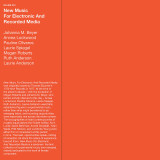
Marking its first decade of activity, Blume returns with the first ever vinyl reissue of the seminal “New Music for Electronic and Recorded Media”, from 1977, the third and final instalment in a suite of releases that includes James Tenney’s “Postal Pieces” and Ben Vida’s “Vocal Trio”. Unquestionably among the most important collections of experimental music to emerge during the 20th Century, “New Music for Electronic and Recorded Media” is the original feminist presentation in its context, releasing the work of Johanna M. Beyer, Annea Lockwood, Pauline Oliveros, Laurie Spiegel, Megan Roberts, Ruth Anderson, and Laurie Anderson under its collective banner. Includes newly commissioned liner notes by Jennifer Lucy Allen and Bradford Bailey.
Since its founding back in 2014, Blume has carved a unique place in cultural landscape, issuing free standing works, spanning the historical and contemporary, that represent singular gestures of creativity within the field of experimental sound. Joining their broad efforts in building networks of context and understanding that already includes the efforts of efforts of Werner Durand, Sarah Hennies, Bruce Nauman, John Butcher, Jocy de Oliveira, Mary Jane Leach, Valentina Magaletti, Alvin Curran, Julius Eastman, Alvin Lucier, and others, Blume delivers their third release in their first suite of releases for 2024, the fist ever vinyl reissue of the seminal “New Music for Electronic and Recorded Media” compilation, originally issued by Thomas Buckner's 1750 Arch Records in 1977. Out of print for decades on vinyl and arguably the most important feminist statement in the history of experimental music, illuminating the work of Johanna M. Beyer, Annea Lockwood, Pauline Oliveros, Laurie Spiegel, Megan Robert, Ruth Anderson, and Laurie Anderson - in a number of cases representing their recording debuts - during a crucial moment in the history of experimental music. Blume’s brand new edition - complete with newly commissioned liner notes by Jennifer Lucy Allen and Bradford Bailey, as well as reproducing Charles Amirkhanian’s original accompanying text - radically shifts perceptions of the past and present day with its truly revolutionary sounds.
Issued by Thomas Buckner's 1750 Arch Records in 1977, and out of print nearly the entire time since, “New Music for Electronic and Recorded Media” can be understood within two simple frameworks. On one hand, it is an astounding document of the landscape of experimental music toward the end of the 1970s. On the other, it is a historically significant feminist statement, being the first collection of experimental music entirely dedicated to female composers, a number of whom were grossly under-celebrated at the time, but have since gone on to be regarded as among the most important composers of their generation.
The eight pieces gathered by “New Music for Electronic and Recorded Media” - Johanna M. Beyer’s “Music of the Spheres”, Annea Lockwood’s “World Rhythms”, Pauline Oliveros’ “Bye Bye Butterfly”, Laurie Spiegel’s “Appalachian Grove I”, Megan Roberts’ “I Could Sit Here All Day”, Ruth Anderson’s “Points”, and Laurie Anderson’s “New York Social Life” and “Time To Go (For Diego)” - might be regarded as the first cohesive vision of alternate proximity or expression of experimental music to what has always been a frustratingly male dominated environment, and to the tropes, temperaments, and sensibilities that have been historically perceived to define it. It is an expanded vision of truth. While the presence of feminine sensibilities and temperaments in experimental music, however they may present themselves, were anything but new in 1977, “New Music for Electronic and Recorded Media” was the first opportunity, beyond the temporal limitations of live performance, to view them collectively, rather than as individualised expressions within a larger body of similar gestures (as was the case of Oliveros’ inclusion in Odyssey’s 1967 “New Sounds In Electronic Music” and “Extended Voices” compilations) where they might be confused for something else; to regard and celebrate a radical notion of feminine sonority for its unique characteristics and through its interrelations.
While its historical significance and groundbreaking nature can not be debated in its totality, nearly half a century on “New Music for Electronic and Recorded Media” remains compelling in both its musicality and the palpable sense of its lasting influence. Every composition across the album’s two sides is not only engrossing and deeply compelling - feeling as fresh and relevant as the day it was laid to tape - but clearly tangible in their lasting influence. Viewed in context, the album’s eight works feel like breath of fresh air when compared to much of what came before, and laid the groundwork for much of what was to come, introducing a new, often more holistic temperament and more sensitive and inclusive sensibility into the landscape of experimental music.
Particularly in the case of Annea Lockwood, Pauline Oliveros, Laurie Spiegel, Ruth Anderson, and Laurie Anderson, it's hard to throw ourselves back in time and imagine a moment when these composers rested in a fairly marginalised corner of the creative landscape. Blume’s brand new edition of “New Music for Electronic and Recorded Media” - complete with newly commissioned liner notes by Jennifer Lucy Allen and Bradford Bailey, as well as reproducing Charles Amirkhanian’s original accompanying text - brings us back to this confounding moment and points us toward a crucial moment of change set forth by these incredible composers and their sounds. Absolutely seminal and not to be missed.
- A1: Prayer (From Xabo: Father Boniecki)
- A2: In Between (From Xabo: Father Boniecki)
- A3: Journey (From Xabo: Father Boniecki)
- A4: Trip To Ireland (From I Never Cry)
- A5: The Beach (From I Never Cry)
- A6: The Locker Room (From I Never Cry)
- A7: At The Hospital (From I Never Cry)
- B1: Waiting (From At Home)
- B2: Wildfires (From Truth In Fire)
- B3: Ghosts (From Pradziady)
- B4: Soleil Pâle
- B5: Nora (From Nora)
Writing music for film and theatre has always been a big part of Hania Rani's musical world. It is also a part of the creative process that can be tantalisingly out of reach for listeners, either the project doesn't come to fruition or the music simply isn't available away from the film or play. From early collaborations with friends, to last year's two scores for full length films (xAbo: Father Boniecki directed by Aleksandra Potoczek and I Never Cry directed by Piotr Domalewski') Rani has been involved in many such projects, each representing an important step in her artistic development and life as a composer and artist:
"Composing for motion picture or theatre is for me a very different kind of work than writing for my own projects. Firstly, I need to collaborate with somebody else who sees the world through the lense of their own art and craft. That's why these kinds of encounters can be so exciting - they are a promise of creating something very new, as a result of creative work of so many people from all walks of life. Secondly, I feel that music in film is an invisible character, a missing emotion that creates a special atmosphere and sensation. It doesn't illustrate, it completes the work of art. I think it is an extremely sensitive matter that rejects banal associations and easy solutions. I feel like composing for film works like an exercise for my imagination."
It is the nature of these collaborations though, that sometimes the composers own preferred compositions don't make the final cut. This is where Music for Film and Theatre comes in as it allows Rani to present a selection of her own personal favourite pieces composed for film and plays. Pieces that made it to the final cut and pieces that were rejected by the director or the producer. Bringing the music together as an album offers a chance for Rani to share her music with her listeners on her own terms and a chance for her fans to hear a different side of her art.
"I put them in one place, as a collection of precious objects that were kept for years in a drawer. Some of them were composed a couple years ago, some are the result of recent research. I am very happy to finally be able to present them as a separate project."
Rani is of course grateful to all of the directors who have entrusted her to create music for their projects, but she professes especially warm feelings for the pieces composed for her first 'real' theatre play, Pradziady, directed by Michał Zdunik. The title comes from 'Dziady' a term in Slavic folklore for the spirits of the ancestors and a collection of pre-Christian rites, rituals and customs that were dedicated to them. The essence of these rituals was the 'communion of the living with the dead', namely, the establishment of relationships with the souls of the ancestors. "I felt this story needed extremely dark and fragile music, and at the same time a sound that could express the mixture of the two worlds - the living and the dead. I decided to compose part of the soundtrack with a string quartet but including two cellos, viola and only one violin. We recorded in a little house, completely built from wood, mostly from Finnish pine. I always felt this space has a very special, warm and natural acoustics - especially when it is combined with string instruments. The track composed for this theatre play is called Ghosts but actually didn't finally make it to the performance, although I like it so much that I thought it would perfectly fit
this compilation". Other highlights include the enchanting Soleil Pâle written for a collaboration with director Neels Castillon, and improvising dancers Alt Take, the beautiful melancholy of In Between (from the film score for xAbo: Father Boniecki) and the magical bliss of The Beach (from I Never Cry) and together they create a beautiful offering from an artist whose every note is worth hearing, but for whom the journey is just beginning:
"I am very happy to see that many artists consider my music as the right soundtrack for their works, because film music was always a huge inspiration for any of my compositions. I find there a lot of life and real emotions, but also a feeling of freedom. Freedom from my own thinking patterns and prejudices. I also believe strongly in collaboration between people, I always feel this is the way to create something really new, based on a mixture of different ways of thinking, feeling, expressing."
This then is Hania Rani, Music for Film and Theatre – enjoy!
“Todavía No”, La Paloma’s debut album, consolidates the young band from Madrid as one of the realities of the current scene. Undoubtedly, it’s definitely a bold step forward in all senses: compositional, interpretative, and artistic. Noise-rock to combat all the noise out there.
In “Una idea, pero es triste”, their celebrated debut EP, La Paloma expounded something very serious, but they explained it only once. Five songs that instantly connected with an audience eager for new references. In “Todavía no” there is more depth; here practically each cut shows a different shade of being La Paloma. “Tiré una piedra al aire” is far from “Algo ha cambiado”, but both are unequivocally La Paloma. Surely, this is something that can be attributed to the baggage acquired during this time lapse, but it certainly speaks very well of the artistic ambition of a band to which now seems to have no ceiling.
We are not, therefore, facing a mere extension of their 2021 EP, although musically they pick it up from where they left off. “Todavía no” is an accessible and contagious work, equal qualities shared with “Una idea, pero es triste”. It’s a work that conveys discontent and liberation, ambition and boredom. In large part, it’s due to the accredited ability of its composers Nico Yubero and Lucas Sierra to observe the world with the right dose of skepticism and disappointment, avoiding tormented gesticulation.
The presentation tour that followed the publication of the EP was extensive and led La Paloma to defend their songs throughout the Spanish geography, as well as visits to Portugal, Mexico and the United States. That state of grace was transferred to the studio, where they tried to reflect their live sound and proposal. With an elegant production and without undue frills, the mission of preserving the sharp fang shown in concert halls was achieved, ensuring, in turn, that the elements, arrangements and the proposal of each instrument were heard crystal clear.
Right from the start, we notice in the sequence many of the virtues that make La Paloma one of the most advantaged groups of the current scene: gushing guitars, the solidity of its rhythm section with Rubén Almonacid on bass and Juan Rojo on drums and the color tone provided by the voices of Nico and Lucas, who share the vocal tasks on alternate tracks.
But there’s more: songs that destroy the most generic canon of noise-rock to take it to little-explored territories, frantic guitar games and a cascade of imaginative arrangements. It combines popular song constructions with unpredictable structures that prevent you from anticipating what twist is to come next, making listening experience exhilarating and addictive.
“Todavía no” is a tightly cohesive album, a remarkable fact considering the two creative inputs from which the band draws from and the artistic ambition with which they faced the building of this work. Because we are talking about a complete work, conceived as such. The first chords of “Sigo aquí” sound and the disorganization of reality… is still disorganized, but somehow it makes sense now.
Introducing ATA's latest Disco sensation: "United Disco Organisation's 'Feel It For Yourself'". Following the success of "Send The Rain/Funky Thing," this release features Kweku Sackey and his phenomenal backing singers, delivering a sun-soaked 70s afrobeat hit perfect for those endless Summer nights! Crafted during a creative session for an upcoming United Disco Organisation project, bassist Neil Innes conceived a captivating Afro-Disco concept. Picture a rhythmic journey, laden with percussion, reminiscent of Manu Dibango with a dash of Tony Allen's flair. With the UDO lineup of Neil on bass, Chris Dawkins on guitar, Joost Hendrickx on drums, and Danny Templeman on percussion, the foundation was set. Adding a distinctive touch, ATA regular Richard Ormrod contributed a mesmerizing alto sax solo, steering the track towards instrumental brilliance. However, it didn't quite align with the album's theme, so it took a brief hiatus. Enter Kweku Sackey (K.O.G.), who, during a studio visit....
Ex-Here We Go Magic frontman Luke Temple emerges with a new project, Luke Temple and The Cascading Moms. Debut album, Certain Limitations. Lauded for his contributions to Here We Go Magic and Art Feynman, Luke Temple brings his signature off-kilter grooves and melodies to his new project's debut album Certain Limitations. The trio's sound takes influence from the likes of Dire Straits and The Velvet Underground, weaving together intricate guitar work, and a propulsive rhythm section, with a touch of jazz sensibility that recalls the ECM catalog. A product of serendipity, The Cascading Moms were formed when in need of a band for an upcoming show, Temple brought together Kosta Galanopolous, a collaborator from his Art Feynman project, and Stuart, a musician he already knew in LA. When these three came together to rehearse, a spark ignited, revealing a creative connection that transcended that first show that brought them together. The album's lead single, "I Can Dream," originally appeared on Art Feynman's Half Price At 3:30. However, aer reworking it with the Cascading Moms, the song took on a new life. This reinvention exemplifies Certain Limitations' core concept: a collection of songs honed and reshaped through the improvisations and collaborative spirit of three musicians creating and exploring a new sonic world.
Hannah Mohan’s new album is a first in more ways than one. Time Is a Walnut is the first solo release from the Western Massachusetts singer and songwriter, after nearly a decade fronting indie-pop band And the Kids. The album also comes amid the longest stretch Mohan has spent in one place since she left home at 16 to hop freight trains and hitchhike across North America.
Making music has been at the center of Mohan’s life ever since, even as other circumstances have changed—sometimes radically. A long-term relationship crumbled in 2019. Then the pandemic arrived, bringing an end to her band. After writing a batch of new songs taking stock of her situation, Mohan asked Alex Toth of Rubblebucket and Tōth to produce them, the latest installment of a longtime friendship and occasional creative collaboration.
Although Time Is a Walnut is a breakup album, don’t go in expecting tearjerkers. Mohan draws from a richer palette here, with themes of messy eroticism on the sultry “Soaked,” altered consciousness on the buzzy rocker “Heaven and Drugs,"" and navigating personal hells with Lady Lamb on “Hell.” Throughout, the songs showcase Mohan’s powerful voice, prismatic melodicism and distinctive lyrical sensibility as she processes major events in her life.
Rain/Water is the fourth album by Tokyo's Kariu Kenji. Following 2021's Sekai, also on Bruit Direct Disques, rain/water is a gorgeous haze of song, a modern driftwork that's creatively rich, and full of fleeting sensation. These twelve lush pop songs point in multiple directions, outwards to bossa nova, modern R&B and soul, ambient bliss-outs, city pop confections, and electronica. But rain/water also has a sly experimentalism at its core, the kind of experimentation that doesn't need to call attention to itself, but that exists 'between the cracks' of the songs - in small, curious gestures of arrangement, in a sudden twist in melody, or an unexpected detour in a song's narrative. In this way, they share something of the stylistic free range in other great recent avant-pop moments - think, perhaps, of the music of Maher Shalal Hash Baz; Stereolab's more late-night, hermetic moments, or High Llamas' recent Hey Panda.
Cloudy Vinyl[25,00 €]
Baby Blue & Halloween Orange Vinyl. In their decade-plus together, the four-piece_Julia Shapiro (guitar, vocals), Lydia Lund (guitar, vocals), Gretchen Grimm (drums, vocals), and Annie Truscott (bass, vocals)_have created a resonant body of work. Live Laugh Love is a natural continuation. Against the bizarre backdrop of the past few years, Chastity Belt remained a supportive space for the members to grow and experiment, drawing on the ingredients most essential to their process since the beginning: authenticity and levity. Recorded over three sessions in as many years (January 2020, November 2021 and 2022), the focus became more about enjoying their time together in the studio than making it feel like work. Their ease and familiarity with engineer Samur Khouja in LA, who also recorded their last album, made for a particularly enjoyable process. Once completed, they returned to renowned engineer Heba Kadry who mastered the album.Album opener "Hollow" sets the tone with a gently driving rhythm while guitar layers stream like sun rays through an open car window. A warmth radiates through Shapiro's voice, even while grappling with feeling lost and stuck. "The older I get," Shapiro says of the lyrics, "the more I realize that I might just always feel this way, and it's more about sitting with the feeling and accepting it, rather than trying to fight it." That wisdom seems to anchor Live Laugh Love. Chastity Belt has never shied from navigating the spectrum of difficult emotions, and an existential thread weaves throughout the subject matter. And yet the songs feel more grounded than ever; there's a sense of quiet confidence and self-assurance that comes with being less numb and more present. Facing discomfort takes more fortitude, after all.Live Laugh Love finds the members in their prime as musicians. Their parts trace intricate patterns over one another, but there's room to breathe between the layers. Everyone contributes to the writing, sometimes switching instruments, and for the first time, all four members sing a song. It's never been more apparent that they are creative siblings, cut from the same belt. "We've been playing music with each other for over a decade," says Shapiro, "so it really does feel like we're all fluent in the same language, and a lot of it just happens naturally.""Laugh" seeks in the balm of friendship, aware of the anticipatory nostalgia that hits during a good time that you're already missing before it's gone; the heavier guitar tones on "Chemtrails" streak ominous chord progressions over Grimm's precision timekeeping, lamenting memories that won't fade easily. During a transitional time, Truscott came across a note in their phone that read, "it's not hard all day, just sometimes," which inspired a poignant line in the chorus of "Kool-Aid," their first song as lead vocalist on a Chastity Belt recording. Another standout, "I-90 Bridge" shines with a silvery melody that soars as Lund belts one of the most resounding moments on the album: "Tell your girlfriend she's got nothing to fear/I'm set in my head/My body's a different story." The track "Blue" saunters nonchalantly with a wink; you can almost hear Shapiro's smile as she sings "Faking it big time/So I can hit my stride/Man, it feels good to be alive," channeling early Chastity Belt channeling early '90s before channeling the late Elliott Smith in a spiral of distortion and insight: "Don't get upset about it/It's gonna pass/Tell all your friends about it/They're gonna laugh.""We have such a strong sense of each other's musical inclinations" says Lund. "I think this allows for a lot of playfulness_we can kinda surprise each other, like a good punchline would."
Released in 1999 on Taylor Deupree’s 12k label, »optimal.lp« was the debut album by Dan Abrams under his Shuttle358 moniker. For its 25th anniversary, Keplar presents it on vinyl for the first time with three previously unreleased tracks—the digital version also includes a alternative version of »Tank«—as well as a new artwork recreated by Daniel Castrejón and a remaster by Andreas LUPO Lubich based on the original pre-masters that were been restored and cleaned up for the reissue project by Abrams. »optimal.lp« was inspired by the rich tradition of ambient music and the rhythmic complexity of 1990s electronica while also sharing many traits with the then-emerging clicks’n’cuts movement, making it a true sui generis piece of work—both informed by tradition and visionary, idiosyncratic and seminal for many artists after him.
Abrams developed an interest in ambient music when he was still a child, scouring through cassette tapes of environmental sounds, new age music, and world percussion. Discovering Brian Eno’s »Thursday Afternoon« as a young teenager marked a turning point for him. »It gave me the idea that ambient music could be an intentional creative act, that tone itself is a legitimate form of expression,« he says today. During the 1990s, he increasingly immersed himself in the electronica scene and the output of labels such as Instinct, where Deupree worked as an Art Director and released his first records as Human Mesh Dance. Abrams found a home on 12k after sending Deupree a demo tape that would later evolve into »optimal.lp,« released as the label’s fifth catalogue number.
Abrams was still in college when he started experimenting with a sound module, his laptop and a mixer as well as a MIDI card and a small controller. »Each note was composed in MIDI and played back when I was ready to record,« he explains his working process at the time. »The tracks could be replayed, but the sound interactions with glitches and noise would be a little different each time. I decided to base the concept of the album on these interactions.« Each piece started with a single sound or tone that, as Abrams puts it, already contained the entire composition: »I let these interactions guide me, and tried to complement them as I added sounds. It’s a conversation of sorts with the medium.«
While refining this technique that he would go on to use on every album until 2004’s »Chessa,« reissued by Keplar in 2021, he also used the first-ever Native Instrument product, the Generator soft synth, to write the record’s title track—possibly making it the first album on which it was being used. »optimal.lp« is marked by this curious interplay of cutting-edge technology, the limitations with which every college student with a small budget is faced, and boundless creativity. »I’ve talked with other artists about how we feel about our early work,« Abrams says today. »We all agreed that there were elements that remain a part of us in a timeless way, despite our techniques—or lack thereof—at the time. ›optimal.lp‹ has a lot of things that will always be with me, that are me. I think I left some clues in there for my future self.«
This sense of timelessness remains tangible after a quarter of a century after the album’s original CD release and is even being expanded upon by the vinyl reissue, which is complemented by three pieces that were made while Abrams was working on the album. The digital release even features an entirely new take on the original album’s final piece, »Tank.« While Abrams let one of the masters go through his customised reverb unit when preparing the reissue, he started recording the results of this accidental dialogue between past and present. It’s a fitting tribute to an album whose delicate circular rhythms, rich textures, and ethereal melodies are precisely so exhilarating because their interplay seems to suspend the passing of time altogether.
For fans of: Spectrum / Recurring Era Spacemen 3, Loop, AR Kane, MBV, bdrmm, Cocteau Twins, Telescopes and early 90s Creation records.
Following a series of meditative explorations in the form of the Singularity Zone series of releases, The Oscillation have returned with a new sense of vigour and purpose. Refreshed and re-energized, the result is The Start Of The End, an album that casts more light and shade than ever before to create a mood of hope and re-birth.
At once warm and welcoming, The Start Of The End is an album quite unlike anything that The Oscillation have ever released before. Fuelled by optimism and taking stock of what’s good about life and what needs to be jettisoned, the record is a result of spiritual and physical re-charging and cleansing.
Leaving the claustrophobic environs of the big city for a more bucolic backdrop, the change in location has left a profound mark on Demian Castellanos, the creative force behind The Oscillation. Where the exorcism of dark emotions of previous album Untold Futures left Castellanos wondering if he’d ever make music again, his new surroundings stirred something within him.
“When I made my new home, I allowed myself time to do nothing for a while,” says Castellanos, “and I then started some new songs without worrying about them being on an album. I just wrote with the mindset to put out something positive.”
He continues: “I did a lot of reflecting on the past and really wanted to change something in myself, but not knowing how and thinking that a lot of people must be feeling the same way.”
Recalling the creation of The Start Of The End, Castellanos says, “Writing and recording in an environment where I had little contact with people, no hanging out or partying or even having conversations was very interesting.”
The result is an album that’s recognisably the work of The Oscillation while pointing to a variety of new directions. Be it the celestial majesty of the title track, the melodic infusions that drive opening track ‘War On The Mind’ or the pulsing grooves underpinning ‘Faraway’ and ‘Body Electric’ or even hypnotic repetition at the heart of ‘Mantra’ and ‘The Eternal’, this music brimming with zeal and confidence. And to crown it all, closer ‘Sovereign’ is akin to communing with angels.
The Start Of The End is a line in the sand and one that points to a better tomorrow.
One can hardly imagine the genre-busting, culture-crossing musical magic of Outkast, Prince, Erykah Badu, Rick James, The Roots, or even the early Red Hot Chili Peppers without the influence of R&B pioneer Betty Davis. Her style of raw and revelatory punk-funk defies any notions that women can’t be visionaries in the worlds of rock and pop. In recent years, rappers from Ice Cube to Talib Kweli to Ludacris have rhymed over her intensely strong but sensual music.
There is one testimonial about Betty Davis that is universal: she was a woman ahead of her time. In our contemporary moment, this may not be as self-evident as it was thirty years ago – we live in an age that’s been profoundly changed by flamboyant flaunting of female sexuality: from Parlet to Madonna, Lil Kim to Kelis. Yet, back in 1973 when Betty Davis first showed up in her silver go-go boots, dazzling smile and towering Afro, who could you possibly have compared her to? Marva Whitney had the voice but not the independence. Labelle wouldn’t get sexy with their “Lady Marmalade” for another year while Millie Jackson wasn’t Feelin’ Bitchy until 1977. Even Tina Turner, the most obvious predecessor to Betty’s fierce style wasn’t completely out of Ike’s shadow until later in the decade.
Ms. Davis’s unique story, still sadly mostly unknown, is unlike any other in popular music. Betty wrote the song “Uptown” for the Chambers Brothers before marrying Miles Davis in the late ’60s, influencing him with psychedelic rock, and introducing him to Jimi Hendrix — personally inspiring the classic album Bitches Brew.
But her songwriting ability was way ahead of its time as well. Betty not only wrote every song she ever recorded and produced every album after her first, but the young woman penned the tunes that got The Commodores signed to Motown. The Detroit label soon came calling, pitching a Motown songwriting deal, which Betty turned down. Motown wanted to own everything. Heading to the UK, Marc Bolan of T. Rex urged the creative dynamo to start writing for herself. A common thread throughout Betty’s career would be her unbending Do-It-Yourself ethic, which made her quickly turn down anyone who didn’t fit with the vision. She would eventually say no to Eric Clapton as her album producer, seeing him as too banal.
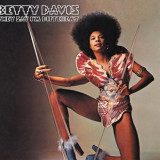
Her 1974 sophomore album They Say I’m Different features a worthy-of-framing futuristic cover challenging David Bowie’s science fiction funk with real rocking soul-fire, kicked off with the savagely sexual “Shoo-B-Doop and Cop Him” (later sampled by Ice Cube). Her follow up is full of classic cuts like “Don’t Call Her No Tramp” and the hilarious, hard, deep funk of “He Was A Big Freak.”