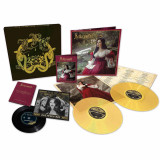
*REMASTERED ROUGH TRADE DEBUT LP LIMITED TO JUST 500 COPIES WITH EMBOSSED OUTER SLEEVE AND ORIGINAL INNER SLEEVE ON BLACK VINYL*
Dream POP, they called it. Given AR Kane’s Alex Ayuli once worked for advertising agency Saatchi & Saatchi, it’s no surprise that he and collaborator Rudy Tambala invented their own genre before critics could stick their oar in. It was a canny move, but more importantly, it was accurate: the music of AR Kane was made for dreamers, by dreamers, and its languor and longing made it particularly bewitching listening; their music is often smeared and blurry, happily lost in its own indefinable pleasures. “We wanted dream pop,” Tambala says, “that feeling of a dream where the rules are different. Dream logic.”
-UNCUT REISSUE OF THE MONTH
"A.R. Kane carved out a unique musical path, welding elements of pop, psych, dub, electronica, funk, noise, jazz, ambient and more in a way that had never been done before. Or since. Their debut in particular is a work of unbridled brilliance."
*Electronic Sound*
‘Sixty Nine’ the group’s debut LP that emerged in 1988 had critics and listeners struggling to fit language around A.R. Kane’s sound. As a title it was telling - the year of ‘Bitches Brew’, the year of ‘In A Silent Way’, the erotic möbius between two lovers - and as originally coined by the band themselves, ‘dream pop’ (before it became a free-floating signifier of vague import) was entirely apposite for the music A.R. Kane were making. Crafted in a dark small basement studio in which Tambala recalls the duo had “complete freedom - We wanted to go as far out as we could, and in doing so we discovered the point where it stops being music”. There was an irresistibly dreamy, somnambulant, sensual and almost surreal flow to ‘sixty nine’s sound, but also real darkness/dankness, the ruptures of the primordial and the reverberations of the subconscious, within the grooves of remarkable songs like ‘Dizzy’ and ‘Crazy Blue’. Alex’s plangent vocals floated and surged amidst exquisite peals of refracted feedback but crucially there was BASS here, lugubrious and funky and full of dread, sonic pleasure and sonic disturbance crushed together to make music with a center so deep it felt subcutaneous, music constructed from both the accidental and the deliberate, generous enough to dance with both serendipity and chaos. ‘sixty nine’ remains - especially in this remastered iteration - ravishing, revolutionary – Neil Kulkarni
"A.R. Kane made some of the most exciting, forward-thinking, and science fictional music of their era".s*
Suche:crucial
- A1: The Sonics - Have Love Will Travel
- A2: Count Five - Psychotic Reaction
- A3: The Paragons - Abba
- A4: Kim Fowley - The Trip
- A5: The Preachers - Who Do You Love
- A6: The Strangeloves - Night Time
- A7: The Monks - Oh, How To Do Now
- A8: The Bogeymen - Electrocution
- B1: Harry Nilsson - Jump Into The Fire (Single Version)
- B2: The Eyes - When The Night Falls
- B3: 13Th Floor Elevators - Reverberation (Doubt)
- B4: The Poets - That’s The Way It’s Gotta Be
- B5: The Squires - Going All The Way
- B6: The Electric Prunes - I Had Too Much To Dream (Last Night)
- B7: The Chocolate Watch Band - I’m Not Like Everybody Else
- B8: Mc5 - Gotta Keep Movin’
- C1: The Stairs - Weed Bus
- C2: The Hives - Main Offender
- C3: Pond - Fantastic Explosion Of Time
- C4: Novella - Something Must Change
- C5: Thee Oh Sees - Web
- C6: Allah-Las - Catamaran
- D1: Moon Duo - Eye 2 Eye
- D2: White Hills, Gnod - Run-A-Round
- D3: Goat - Gathering Of Ancient Tribes
- D4: Tame Impala - Half Full Glass Of Wine
Two-Piers, the label that brought you ‘Pop Psychédélique (The Best of French Psychedelic Pop 1964-2019)’ brings you the second instalment in the series ‘Garage Psychédélique (The Best of Garage Psych and Pzyk Rock 1965-2019)’. A thrill-a-minute dive into the crazy awesome world of Garage Psychedelic Rock.
From the Psych sound explosion onto the underground club scene in the US and UK in the mid 1960s, to its discovery by a wider audience via the exceptional Nuggets and Pebbles compilation series in the 1970-1980s. Through its mainstream revival with the Garage sound of the late 1990 - early 2000s, to the current crop of exceptional bands flying the Garage Psych flag today, ‘Garage Psychédélique’ takes you on a journey and gives you a little taste of some of the finest music from the scene and the bands that blazed a trail for others to follow…..Sit back and enjoy the ride!
From the opening bars of The Sonics ‘Have love Will Travel’ through the Psych workout that is Count Five’s ‘Psychotic Reaction’ to the joys of ‘60s Beat Psych groups from the US such as The Paragons, The Preachers, The Strangeloves, The Squires, and the eccentric stylings of The Monks. The album careers along at a blistering pace of Garage Psych brilliance, jammed packed full of underground floor fillers a plenty.
US legendary underground acts such as The Electric Prunes, The Chocolate Watch Band and MC5 all deliver classic tracks for the cause, and singer-songwriter Harry Nilsson even makes a foray into the psych rock sound with ‘Jump into the Fire’.
In recent years such bands as Thee Oh Sees, Moon Duo and Allah-Las from the US have taken the Garage Psych influence and ‘60s sound and made it their own. A whole crop of bands such as White Hills, Gnod and Goat from the scene have evolved the music into a ‘Pzyk Rock’ feel with a darker and heavier vibe, but crucially still with the joyous undertones that the scene brings to its devotees.
The Garage Psych sound has influenced groups from around the globe with bands like Liverpool’s The Stairs ‘Weed Bus’, Scotland’s finest The Poets with ‘That’s the Way It’s Gotta Be’, The Bogeymen, a largely undiscovered ‘90s Psych Hammond band from France with ‘Electrocution’. Hailing from Sweden Goat bring us ‘Gathering of Ancient Tribes’ and The Hives their dancefloor anthem ‘Main Offender’. From Perth, Australia Pond’s Psych leanings on ‘Fantastic Explosion of Time’ are clear to see. Finally, Kevin Parker’s band Tame Impala were very influenced by the whole garage psych sound in their early band incarnation, as perfectly showcased here on the epic wig-out that is ‘Half Full Glass of Wine’ that closes the album.
This isn’t meant to be a ‘crate diggers’ album or a compilation of ‘obscure hard to find tracks’ to out-do your mates. It is quite simply a celebration of the Garage Psychédélique scene and a chance to revel in its brilliance and dance around your kitchen. If it means you go down a rabbit warren of discovery to unearth more gems and brilliant bands from the Garage Psych scene then job done!
Desmond Dekker’s unique high voice backed up with crucial contributions from the Aces.
- A1: Hello 00 27
- A2: A Love From Outer Space 05 08
- A3: Crack Up 04 12
- A4: Timewind 00 15
- A5: What's All This Then? 04 03
- A6: Snow Joke 04 46
- A7: Off Into Space 00 04
- B1: And I Say 02 42
- B2: Yeti 00 11
- B3: Conundrum 02 32
- B4: Honeysuckleswallow 03 20
- B5: Long Body 01 21
- B6: In A Circle 04 37
- C1: Fast Ka 00 27
- C2: Miles Apart 03 01
- C3: Pop 03 40
- C4: Mars 00 20
- C5: Spook 03 10
- C6: Sugarwings 03 37
- D1: Back Home 00 07
- D2: Down 05 14
- D3: Supervixens 05 40
- D4: Insect Love 02 52
- D5: Sorry 00 05
- D6: Catch My Drift 05 40
- D7: Challenge 00 06
*REMASTERED ROUGH TRADE DEBUT LP LIMITED TO JUST 500 COPIES WITH EMBOSSED OUTER SLEEVE AND ORIGINAL INNER SLEEVE ON BLACK VINYL*
Dream POP, they called it. Given AR Kane’s Alex Ayuli once worked for advertising agency Saatchi & Saatchi, it’s no surprise that he and collaborator Rudy Tambala invented their own genre before critics could stick their oar in. It was a canny move, but more importantly, it was accurate: the music of AR Kane was made for dreamers, by dreamers, and its languor and longing made it particularly bewitching listening; their music is often smeared and blurry, happily lost in its own indefinable pleasures. “We wanted dream pop,” Tambala says, “that feeling of a dream where the rules are different. Dream logic.”
-UNCUT REISSUE OF THE MONTH
"A.R. Kane carved out a unique musical path, welding elements of pop, psych, dub, electronica, funk, noise, jazz, ambient and more in a way that had never been done before. Or since. Their debut in particular is a work of unbridled brilliance."
*Electronic Sound*
‘Sixty Nine’ the group’s debut LP that emerged in 1988 had critics and listeners struggling to fit language around A.R. Kane’s sound. As a title it was telling - the year of ‘Bitches Brew’, the year of ‘In A Silent Way’, the erotic möbius between two lovers - and as originally coined by the band themselves,
‘dream pop’ (before it became a free-floating signifier of vague import) was entirely apposite for the music A.R. Kane were making. Crafted in a dark small basement studio in which Tambala recalls the duo had “complete freedom - We wanted to go as far out as we could, and in doing so we discovered the point where it stops being music”. There was an irresistibly dreamy, somnambulant, sensual and almost surreal flow to ‘sixty nine’s sound, but also real darkness/dankness, the ruptures of the primordial and the reverberations of the subconscious, within the grooves of remarkable songs like ‘Dizzy’ and ‘Crazy Blue’. Alex’s plangent vocals floated and surged amidst exquisite peals of refracted feedback but crucially there was BASS here, lugubrious and funky and full of dread, sonic pleasure and sonic disturbance crushed together to make music with a center so deep it felt subcutaneous, music constructed from both the accidental and the deliberate, generous enough to dance with both serendipity and chaos. ‘sixty nine’ remains - especially in this remastered iteration - ravishing, revolutionary – Neil Kulkarni
"A.R. Kane made some of the most exciting, forward-thinking, and science fictional music of their era".
*Reissue Of The Week In The Quietus*
"I wish I could turn or turn back" "Sometimes it’s hard to resist the feeling that there was a crucial turn in life out of which everything else flowed. Maybe in our more reasonable frames of mind we can dismiss that thought and take our plans and intentions very seriously. But, there’s often a lurking conviction that, like the oak from the acorn or the movie from its opening scene, it is already all there. In the first moment of Relics of Our Life, anything could happen, anything could come next. But as the suspense is broken with the first notes, the world of the record springs up as both an internal experience and a landscape of which we will learn something, but definitely not everything. The songs induce a swimming sense of cycling repetition and variation where shifting details tilt the ground under us. The round and round doesn’t make us dizzy; like breathing the right way, it makes us both heavier and higher. "Pawliczek’s songs can be located in the company of the greats of Flying Nun Records – maybe the delicacy of The Great Unwashed with the heavy heart of The Verlaines and smartness of The Chills. But, ultimately, his interests are elsewhere – a heart-break song over an earthly lover feels like only the tipping point for longing and devotion that outstrips the personal. In this sense, Popul Vuh for their hymnal geometry and switched-on Palestrina, and Terry Riley for cosmic elation come to mind. The songs have sweeping and cinematic proportions and depths of field constrained by a pop economy love of leanness. "But who’s supplicating whom here? The songs’ devotional quality is not upward to the sacred or even outward to the profane. It’s more like a magnetism between its elements – sounds, voices and rhythms. The track No Talk intones “why don’t you talk to me?” over a driving guitar and one feels visited by some kind of archaic god on whom the tables have been turned, finding himself jealous of our thousand little thoughts. The record finishes with his distorted lilting dance, trying to seduce us with some red red wine that is no one’s blood, but everyone’s favorite drug." -- Karina Gill (Cindy, Flowertown) 2024
With Pere Ubu on hiatus since 1982’s excellent ‘Song Of The Bailing Man’, David Thomas had recorded a` much-praised solo album and the band had now signed to a major label. In a period of rampant world commercialism, what would happen next? Another crucial era for the band unravelled, Pere Ubu’s journey charted new undulating territory and so began a three-album escapade that retooled our understanding of what pop music is. Things were further obscured with ‘Cloudland’ when they released “their industrial strength equivalent of a class Beach Boys album from musicians more familiar with factories than surf.” (Greg Kot, Chicago Sun Times).
Gabriel Birnbaum cuts straight to the spiritual essence of the characters he inhabits, painting affecting and lovingly drawn scenes bolstered by cathartic hooks. Like one of his own espoused patron saints, Paul Simon, Birnbaum sets new challenges for himself with each recording, honing the nuts and bolts of his songcra and pinpointing unexpected new aesthetic contexts for it. The lush and psychedelic folk-rock songs on his new album Patron Saint of Tireless Losers confidently cut to the essence of his artistry, highlighting a mature narrative voice, and a consistently surprising musical syntax. As much as anything Birmbaum has put into the world, it's a tour de force that thrives on both self-assuredness and restlessness_marks of a crucial and constantly evolving artist whose work it's impossible to turn away from once you tap into its frequency.
Mick Harris is one of the world's greatest compositional treasures. Starting his career as the energy dynamo behind the drum kit of the UK's Napalm Death, he made the term Blastbeat a household reference, wrote the band's music on his mother's one string guitar, and joined the Guinness Book of World Records for composing the world's shortest song. In the decades succeeding, he has re-inventedmusic several more times, from the wild abstract jazz of Painkiller with John Zorn and Bill Laswell, to the drowning ambience of his Lull project, all while continuing to build a world that he can truly call his own - the dark post-dub of SCORN. "Reaching 54 this year - this won't stop the challenge, driving me more so now than ever" - says Mick Harris, commenting on the recent phase in his creativity. The pandemic isolation and lockdown pushed the work of the maestro more than anything else could have. In 2021, his output is ever-increasing, releasing the newest collabs with Justin K. Broadrick and the single "Distortion", featuring one of the most outstanding voices of hip-hop - Kool Keith - his closest collaborator, Ohm Resistance founder - Submerged. Commenting on the release of "Distortion", Mick Harris said to mxdwn: "I enjoy collabs - they bring something different to the swim." Working on his own and collaborating with everyone from Sleaford Mods' James Williamson, on the previous SCORN release or with Kool Keith and Submerged on "Distortion", Mick Harris never had problems with putting energy into beats and sound landscapes, combining various surreal elements with three basic elements that always push Harris further, that are extremely crucial for both Mick Harris and SCORN as a project - frustration, anger and anxiety. Combining the signature soundscapes of Scorn with tartareous textures, the newest album "The Only Place" reaches a psychedelic groove, based on what Harris calls "Pushing an original idea further" with his own shades of light and dark and celestial electricity of what SCORN is. These 10 new tracks add elements unheard in Scorn since Evanescense and Gyral - ethereal ambiences and floating, near-melodic-but-not-quite moments, a signature of Harris' abilities to generate feelings in a lost world of his own creation. 2024 vinyl version on orange coloured vinyl!
"The Red Room Crystal-Ruby Splatter Vinyl". Netherworld marks a considerable step onwards from the territory that Louise Patricia Crane explored on her debut long player Deep Blue, crafting audial landscapes that go further into both inner and outer space; hallucinatory and surrealistic yet also grittier and more direct. For all that this stemmed in part from early Genesis and The Beatles, Netherworld also sits in alignment with the luxurious but oddly intimate realm of modern classics, by the likes of Tears For Fears, Tori Amos and Joni Mitchell, with passionate intensity set in a bold, cinematic vista. In realising these romantic and expansive visions, Crane not only wrote or co-wrote the entire album, but arranged, co-produced and played a wide variety of instruments on it. Yet as a supporting cast, she has surrounded herself with a formidable selection of mercurial contributors. Once again, Jakko M. Jakszyk (King Crimson) brings his fiery and mellifluous solo guitar work, as well as contributing backing vocals, keyboards and co-production. Elsewhere, the flute soliloquies of Tiny Bard are the work of Jethro Tull's Ian Andersonwhile saxophone duties are handled by Mel Collins, whose work with King Crimson marks only one chapter in an incredibly storied life in music. Providing violin and viola across the stylistic expanse of the album, Shir-Ran Yinon (New Model Army / Eluveitie) returns as a collaborator. The rhythm section for the lion's share of the record consists of the dream team of Tony Levin (King Crimson / Peter Gabriel) and Gary Husband (John McLaughlin / Billy Cobham / Allan Holdsworth) with Nick Beggs stepping in on bass for Dance With The Devil and upright bass on Long Kiss Goodnight. Crucially however, even amidst this kind of company, Louise's voice and vision is never remotely overshadowed-with the talents on offer only serving to make the backdrop to her songs still more vivid, sharp and intense. In as much as Netherworld is a work that exists on a lineage of progressive music and the visionary artists who've expanded their boundaries of exploration to form sound-worlds as big as their imagination, it's also a work of magical realism in the tradition of Pan's Labyrinth, The Company Of Wolves or the work of Gabriel Garcia Marquez and Haruki Murakami-in which the supernatural and otherworldly, lead to a shortcut to the essence of being human. In this World, Louise Patricia Crane is our Storyteller.
- Dance With The Devil
- Tiny Bard
- Celestial Dust
- Little Ghost In The Room
- Toil And Trouble
- The Red Room
- Lady Peregrine's Concubine
- Spirit Of The Forest
- Bête Noire
- Long Kiss Goodnight
- Thieves Fools And Crows
- Midnight View
- (Japanese Doll)
- Ladies Of The Road (King Crimson)
- Dirty (Johnny Winter)
- Dance With The Devil (5.1 Mix)
- Tiny Bard (5.1 Mix)
- Celestial Dust (5.1 Mix)
- Little Ghost In The Room (5.1 Mix)
- Toil And Trouble (5.1 Mix)
- The Red Room (5.1 Mix)
- Lady Peregrine's Concubine (5.1 Mix)
- Spirit Of The Forest (5.1 Mix)
- Bête Noire (5.1 Mix)
- Long Kiss Goodnight (5.1 Mix)
- Thieves Fools And Crows (5.1 Mix)
- Midnight View (5.1 Mix)
- (Japanese Doll) (5.1 Mix)
2x12"[42,65 €]
Netherworld Double Gatefold Vinyl in 'Celestial Dust' transparent gold CD / DVD - 5.1 Surround mixed by Jakko M. Jakszyk: 'Storybook' Edition 'Ladies' Double A-Side 7" Single - Ladies Of The Road / Dirty (Black Vinyl) Netherworld A6 illustrated 'Little Stories' book All housed in a Black Textured Box with Gold Hot Foil Embossing Netherworld marks a considerable step onwards from the territory that Louise Patricia Crane explored on her debut long player Deep Blue, crafting audial landscapes that go further into both inner and outer space; hallucinatory and surrealistic yet also grittier and more direct. For all that this stemmed in part from early Genesis and The Beatles, Netherworld also sits in alignment with the luxurious but oddly intimate realm of modern classics, by the likes of Tears For Fears, Tori Amos and Joni Mitchell, with passionate intensity set in a bold, cinematic vista. In realising these romantic and expansive visions, Crane not only wrote or co-wrote the entire album, but arranged, co-produced and played a wide variety of instruments on it. Yet as a supporting cast, she has surrounded herself with a formidable selection of mercurial contributors. Once again, Jakko M. Jakszyk (King Crimson) brings his fiery and mellifluous solo guitar work, as well as contributing backing vocals, keyboards and co-production. Elsewhere, the flute soliloquies of Tiny Bard are the work of Jethro Tull's Ian Andersonwhile saxophone duties are handled by Mel Collins, whose work with King Crimson marks only one chapter in an incredibly storied life in music. Providing violin and viola across the stylistic expanse of the album, Shir-Ran Yinon (New Model Army / Eluveitie) returns as a collaborator. The rhythm section for the lion's share of the record consists of the dream team of Tony Levin (King Crimson / Peter Gabriel) and Gary Husband (John McLaughlin / Billy Cobham / Allan Holdsworth) with Nick Beggs stepping in on bass for Dance With The Devil and upright bass on Long Kiss Goodnight. Crucially however, even amidst this kind of company, Louise's voice and vision is never remotely overshadowed_with the talents on offer only serving to make the backdrop to her songs still more vivid, sharp and intense.
With Pere Ubu on hiatus since 1982’s excellent ‘Song Of The Bailing Man’, David Thomas had recorded a` much-praised solo album and the band had now signed to a major label. In a period of rampant world commercialism, what would happen next? Another crucial era for the band unravelled, Pere Ubu’s journey charted new undulating territory and so began a three-album escapade that retooled our understanding of what pop music is. “Solid as the band can be, it's also likely to dissolve songs from the bottom up. For all Pere Ubu's uncertainty, the band isn't arbitrary; its music has the off-the-wall unity of a Marx Brothers routine,” said Jon Pareles of The New York Times. In 1991, ‘Worlds In Collision’ became “the most atmospheric, carefully sculpted recording in the band's 13-album catalog.” (Tom Moon, Spin).
Plasma Color Vinyl. 'The way Bloomsday's Iris James Garrison writes songs feels like somewhere between a mirror and a memory. Spacious, full-bodied folk songs, they are an ode to things that are good no matter how small; they sometimes feel like the ghost of a Mary Oliver poem. Bloomsday's new record, 'Heart of the Artichoke', is a relic of unfettered creativity and community. They recount the miracles of the mundane, the memories that become sacred, an ode to all that is holy: nightswimming, songs plucked from the ether, the ways friendship can endure. Like earlier Bloomsday songs, the work here is threaded with warmth; it's simmering, crisp and deeply human, an encapsulation of the present moment. Recorded across 10 days in June 2023 in upstate New York at duo Babehoven's studio and co-produced by Babehoven's Ryan Albert, with mixing by Henry Stoehr of Slow Pulp. The record was built out with a wideranging group of collaborators, including inventive drumming from Andrew Stevens (Lomelda, Hovvdy), Alex Harwood, Richard Orofino, Babehoven's Maya Bon, Hannah Pruzinsky (h.pruz, Sister.), and Chris Daley. It was an insulated and collaborative experience: all family dinners on the back porch, bonfires, feeling a full sense of joy, of friendship, of purity in the artistic self. Collaboration is an integral part of Bloomsday's musical process. Garrison is malleable in the studio, their songwriting generous and spacious. But in listening to the record, there's a sense that Garrison leaves room for the players, for the listener; for songs to find the shapes they're meant to take. Garrison's role as maestro is crucial, singular - it's a collaborative, exploratory spirit harnessed by Garrison's intuition, and by an honest commitment to carve out creative space for play, to delve into what's known - or pushing past that, into unknown. "The ghosts of the past still come up and haunt me," Garrison says, "but I sit in what I have and see it. All of these songs are about loved ones, about personal struggles with getting out of my head and being present." Heart of the Artichoke was written from a healed, matured place - written in a moment of safety from chaos. It's a prayer for the present, an appreciation of tenderness and what happens once we give ourselves the space to really see, and really feel - becoming free and whole - an ode to the way healing allows us to bloom.
'The way Bloomsday's Iris James Garrison writes songs feels like somewhere between a mirror and a memory. Spacious, full-bodied folk songs, they are an ode to things that are good no matter how small; they sometimes feel like the ghost of a Mary Oliver poem. Bloomsday's new record, 'Heart of the Artichoke', is a relic of unfettered creativity and community. They recount the miracles of the mundane, the memories that become sacred, an ode to all that is holy: nightswimming, songs plucked from the ether, the ways friendship can endure. Like earlier Bloomsday songs, the work here is threaded with warmth; it's simmering, crisp and deeply human, an encapsulation of the present moment. Recorded across 10 days in June 2023 in upstate New York at duo Babehoven's studio and co-produced by Babehoven's Ryan Albert, with mixing by Henry Stoehr of Slow Pulp. The record was built out with a wideranging group of collaborators, including inventive drumming from Andrew Stevens (Lomelda, Hovvdy), Alex Harwood, Richard Orofino, Babehoven's Maya Bon, Hannah Pruzinsky (h.pruz, Sister.), and Chris Daley. It was an insulated and collaborative experience: all family dinners on the back porch, bonfires, feeling a full sense of joy, of friendship, of purity in the artistic self. Collaboration is an integral part of Bloomsday's musical process. Garrison is malleable in the studio, their songwriting generous and spacious. But in listening to the record, there's a sense that Garrison leaves room for the players, for the listener; for songs to find the shapes they're meant to take. Garrison's role as maestro is crucial, singular - it's a collaborative, exploratory spirit harnessed by Garrison's intuition, and by an honest commitment to carve out creative space for play, to delve into what's known - or pushing past that, into unknown. "The ghosts of the past still come up and haunt me," Garrison says, "but I sit in what I have and see it. All of these songs are about loved ones, about personal struggles with getting out of my head and being present." Heart of the Artichoke was written from a healed, matured place - written in a moment of safety from chaos. It's a prayer for the present, an appreciation of tenderness and what happens once we give ourselves the space to really see, and really feel - becoming free and whole - an ode to the way healing allows us to bloom.
When Man Man released its last album, "Dream Hunting in the Valley of the In Between," frontman Honus Honus (née Ryan Kattner) was in a state of unrest, oscillating between hope and cynicism. Perhaps fittingly, the album dropped during the pandemic, a time at which we could all relate. But, much like that bizarre turn of events, the ennui now seems so distant to Man Man. A revived sense of purpose washes through Man Man's new album, Carrot on Strings, radiating a mix of calm and confidence. Kattner always embodied a wild-man pied-piper vibe: his melodic, unhinged art-rock was at once intriguing and angsty. He was so alluringly creative that you went along with it, even if you were never sure where Man Man would take you. Carrot on Strings is no less inventive, but its ethos is radical in context of the band's two-decade career. "When I was younger, I would feed off of chaos. I would, you know, be upset and get drunk and smash chairs," Kattner explains. "Now those chairs are in my head: It's less of an outward projection, more of an interior monologue." The name "Carrot on Strings" came to Kattner while experimenting with the sound of someone munching on the vegetable, which you can hear in the cacophonous, similarly named song. It alludes to how success always seemed to dangle uncertainly before him, often just out of reach. But listen intently and you'll hear a more content Kattner finding an uneasy peace: "Life, as far as I've known it, has always been side hustles. Would it be great if I could go into a studio and record for a year without figuring out how to finance it? Yeah, it would be," he says. "But ultimately, I need to keep making music because art is an extension of my psyche. It's how I have learned to translate the palpitations of my heart. Simply put, I'd go insane without it." Growing up as a multiracial Hapa kid (half Filipino, half white) with a father in the U.S. Air Force, Kattner lived an itinerant childhood that included a few pivotal years in Germany, where he honed in on an appreciation for out there German cinema and art. His film obsessions and screenwriting background were crucial to Carrot on Strings. The album nods to the films of Werner Herzog and Rainer Werner Fassbinder as much as Italo-disco, Randy Newman, goth rock, and avant pop. (Kattner continues to work in the film industry with an acting role in the upcoming horror-comedy movie Destroy All Neighbors, for which he also served as composer; music supervising season 1 & 2 of the Interview With The Vampire AMC TV series; and shopping around, with director Matthew Goodhue, a script he wrote that he describes as a Wim Wenders road movie on acid.) In a bid to not overthink anything - his last album took seven years to make - he recorded the bulk of Carrot On Strings in five days in Mant Sounds studio in Glassell Park, Los Angeles with "very chill" producer Matt Schuessler, who had worked on Man Man's cover of Neu!'s "Super" for the seminal Krautrock band's box set. The resulting album represents a newfound sense of self for Kattner, who finds himself inspired and at peace both personally and artistically in ways that eluded him for most of his first 15 years playing music. When, on Carrot On Strings, you hear Kattner croon humbly, or sing of the tension between his outsize stage persona and the thoughtful, soulful guy he actually is, you're hearing Kattner liberate himself. "I first got into music to escape from myself," he says. "And now, it sounds so corny, but I have zero doubt that music ended up saving my life."
A home, a house, has countless frequencies. Each room, each corner feels different. Swings differently. And as you grow older, you realize which corner is yours. But yeah, it takes time…
It certainly marks the end of an era when the house one called home as a kid no longer exists. This home, it was the starting point of so many journeys. Of one big, ongoing journey. And so it feels good, soothing, reassuring to at least return to a spot nearby – to that (proverbial) hill from where you can see it. Feel the vibe that made you.
Andi Haberl’s debut solo album as Sun is sort of dedicated to that house. It’s a journey leading to that hill overlooking everything that made him. It’s not about nostalgia, not about actually returning to a specific place. Instead, it’s about finding a personal frequency, an overlapping of sounds and samples, an open space that mirrors and extends whatever frequencies felt right at different points in time.
“To me, the results feel like Gold Panda/Four Tet meets Steve Reich meets Krautrock meets film scores. I just really wanted to create moods that touch me – and ideally others, too.”
Talking about his first solo album, Haberl recalls many stages: early compositions that ended up on Alien Ensemble’s albums, early DIY/home studio/multi-instrumentalist inspirations (Le Millipede), new technologies that came and went, even a set of wildly convincing arrangements (done with Cico Beck’s crucial input) that ultimately became stepping stones for yet another round of DIY takes. “It was a long, recurring process, and the songs went through so many different versions,” he says, talking about phases of growth (“I added more and more equipment over time”) and pruning, “cleaning up my music a bit.” Tending towards instruments that open up space, and slowly falling in love with sampling, he certainly didn’t rush things once it was time for interior design decisions ;)
“During this whole process I got to learn so much about my own taste, how I prefer to listen to the pieces, which musical elements really matter to me… and what my own voice is. For example, that acoustic elements are most important to me: the banjo, piano, drums, my voice, glockenspiel, trumpet, melodica. Anything that opens up some space.”
Every journey begins with a search: “Missing” with its plucked chords opens like a sunrise over pastoral plains, gently leading the way towards the intricate, playful explosion that occurs once a certain amount of energy (“Sun”) hits dirt and other surfaces: things grow, clot and curdle into new shapes, like new buds; layers of sound move forward, drenched in Spring’s new light. Relying on samples to ask for precipitation (“Rain On Me”), robotic “Low” goes from barren to bass-heavy after its midway shift in pace, full of loops plucked from the shade.
Towards the album’s midpoint, things are suddenly reversed: “Cluster” has that backwards pull, you can’t tell what’s what, yet everything is perfectly locked in, as the pace increases once again. And before the title song shimmers with densified cheering (to eventually stand tall like early Lymbyc Systym), “Beside Me” swipes you off your feet with its booming bass drum. The beat returns once again (“Daydream”), full of searching voices underneath, and at “Dawnday,” we can finally catch a melancholy view of the house. Voices hum. It’s the score moment of the album. Everything makes sense now. A happy end of sorts?
“I want to take people on a journey. A personal journey, too, because when my parents split up and sold the house I grew up in, I felt a bit like the ground had fallen out from under my feet. But I have dedicated the album title and the accompanying piece to this house… so I can keep it in good memory.”
“I Can See Our House From Here” has been a long time coming. It’s been a long journey. Homeward-bound. Leading to a place that’s really Haberl’s – his sound. His frequencies.
Known as a long-time member of The Notwist and various other bands/projects (Alien Ensemble, AMEO, jersey, Ditty etc.), Berlin-based drummer/composer Andi Haberl has also worked with My Brightest Diamond, Till Brönner, Owen Pallet, and Kurt Rosenwinkel, to name a few. “I Can See Our House From Here” is his first solo offering.
"The debut longplayer from Washington, DC-based Ekko Astral is a complex mesh of bubblegum noise punk and no-wave art rock that holds an elastic space for the knotty, tangled horrors of living in the imperial core. Their songs thrash with intense, necessary defiance against codified gender-based violence, their distortion and sibilance a direct response to the dangers outside our front doors.
pink balloons opener “head empty blues” specifically bites back against the terrors of the normative male gaze that dominates so much of American culture. Over a post-punk passage that plays call and response with a wall of harsh noise, frontwoman Jael Holzman belts playfully morbid details of the head-exploding anxieties that haunt her daily: “is it bon eye-ver or bon iver? / i don’t care / i’ve got stalkers outside / not going out tonight / gonna sit and take pics / in my underwear.”
Holzman formed the band in 2021 with best friend Liam Hughes (guitar), and eventually rounded out the band’s lineup with Miri Tyler (drums), Guinevere Tully (bass), and Sam Elmore (guitar). Ekko Astral’s local scene quickly welcomed the band for their wildly fierce live presence, emboldened by the community-building message behind the band’s mascara mosh pit brand.
Ultimately, Ekko Astral are here to uplift, a mission exemplified by the frenetic and bewitching pre-release singles “baethoven” and “devorah,” cornerstones of pink balloons in both style and theme. The former serves as a reminder to keep your larger than life personality in a world that wants to downsize you, where the latter proclaims urgent solidarity with missing and murdered people. Such crucial messages of upliftment are the foundation of pink balloons, and, by extension Ekko Astral, whose thrashing debut leaves no stone of solidarity unturned."
- A1: All I Really Want From You Is Love 04:26
- A2: Nowhere To Go But Home 05:48
- A3: In My Time (We Don't Belong) 03:13
- A4: Tonight (I Wanna Make It Out) 05:52
- B1: (I Gotta) Get It Together Again 04:22
- B2: Stara Paris Rescued Me 06:22
- B3: Just Get It Down 02:25
- B4: Let's Throw Some Mud Against The Wall 02:42
- B5: You Know I Feel Alright Now 04:33
Remastered vinyl of the original album which came out on CD only in 2005. Limited to 200 copies on classic black vinyl. This is an album that’s as alive as any could be. Indeed, far from sounding like the last desperate set of half-baked ideas from a once vital band (hello Oasis?) Artists Cannibals Poets Thieves is more like a debut album from a bunch of teenage upstarts: free from cynicism, fired with worldly wonder and chock full of ideas. This is certainly a different outfit from that of 1998, when they first wowed us (via John Peel, naturally) with the utterly essential sprawling noise that was The Things We Make. Long since stripped down by a series of resignations from a five strong collective to a taut three piece featuring founding members Chris Olley, James Flower and Chris Davis, the music has simplified considerably. Gone are the soundscapes of old, and in their place we have a series of sharp basslines, swirling keyboards, cutting guitar lines and the passionate hollering of frontman Olley. Opener All I Really Want From You Is Love is a perfect introduction to proceedings – a truly wonderfully distorted slab of indie rock, recalling early Jesus And Mary Chain in both its fuzz and, crucially, its wonderfully crafted tune. Next, Nowhere To Go But Home sounds like New Order if they’d emerged from Detroit in 1966. Tonight (I Wanna Make It Out) follows likewise with the best bassline Peter Hook never plucked. Throughout, Six By Seven manage to sound so natural, so refreshing free of the flab and introspection that a band on its last legs would usually succumb to. And whilst the momentum is momentarily lost as the drum machine makes an appearance to fashion the Suicide-esque trawl of Stara Paris Rescued Me, it’s not long before Just Get It Down muscles things back on course with a whispered Olley diatribe perched on top of more raw cacophony, before we reach the bitter end via the Depeche Mode-on-smack You Know I Feel Alright Now. Tracklisting:
In The Red Records is proud to announce a previously unreleased new album by Brooklyn-born master of minimalism Alan Vega, Insurrection. The eleven songs here showcase the unparalleled vision and uncompromising force from one of the most influential artists of all time. Alan Vega was born in Brooklyn in 1938. He co-founded the legendary New York City punk band Suicide with Martin Rev in 1970. Suicide’s groundbreaking 1977 debut is considered one of the most influential albums of all time. Vega considered his solo records the audio counterpoint to his visual art that reflected the world around him while simultaneously exploring universal themes. It makes his work as relevant today as it was when he created them. It was during his highly experimental period beginning in the late ’80s that he began working with Liz Lamere, who became the most crucial collaborator of his solo career until his death in 2016. Lamere, along with Jared Artaud, resurrected these newly unearthed collection of lost recordings, which they co-produced and mixed. Lamere and Artaud spearhead the Vega Vault project, which aims to bring rare, unreleased and back catalog work spanning Alan Vega and Suicide’s career to the public for the first time. On Insurrection, Lamere says: “Insurrection was created in the time period around 1997/98, after Mutator and prior to Vega’s 1999 release of 2007 and captures the intense energy of NYC in the ’90s rife with crime, killing, hate, fascism, racism, and moral bankruptcy. You can hear the tortured souls floating through this album. Post-Gulf War angst still enveloped Alan. He was having premonitions about a major terror attack in the US, well before 9/11. The upcoming birth of his son raised further awareness of the state of our world. All these emotions are mirrored in the sounds he magnetized. And true to Vega form, there remains hope and empowerment coursing through the tracks. In the almost three decades of going into the studio with Vega, we recorded significantly more material than the seven albums released. Vega’s intention was to experiment with sound which would become the canvas for the poetry that reflected his vision of the universe. Because the goal wasn’t to make albums, he had no timeline or constraints and would freely follow new paths uncovered along the way.”
Roland Leesker has kept the legendary Get Physical label right at the forefront of the scene in his years at the helm. His music has been a small but vital part of that: he doesn't release often, but when he does it is timeless house music that always makes its mark. As well as a steady stream of singles, he also curated and mixed the crucial 20 x Get Physical compilation back in 2022. He has collaborated with greats of the scene like DJ Pierre, Roland Clark and Terrence Parker and will soon serve up his latest sonic statement with new full-length 'Searching For Peace' which will arrive in August following two more singles after this one.
The brilliant 'Respect' is a spritely and serene deep techno journey. The shimmering chords echo early Detroit techno and the supple drums are packed with warmth and bounce. Together they make for a cut that subtly uplifts as it unfolds in an engaging fashion over seven fantastic minutes.
Remixer Robert Hood is one of the foundational figures of techno. The Motor City innovator works under his own name and as Floorplan and has mastered the art of seductive loops, whether making stripped-back minimal or gospel-laced house. Here, he flips 'Respect' into a thumping and emotionally intense cut with faster drums than the original but just as much machine soul and a little extra texture in the percussion.
Suffering can be a borderline experience, opening doors to the divine. Canadian black-metal-outfit GIVRE has dedicated its fourth album to this concept, well known throughout Christian history: On "Le Cloitre" (engl. "The Cloister") the band continues its exploration of the atoning side of pain and the austere aspects of faith through music that goes all the way from elegiac elegance to disturbing outbursts. Even the band deals with Christianity, through a historic lense, they should not be understood as religious band in any way!
The group was founded back in 2010 in Rouyn-Noranda by David Caron-Proulx (Composition, guitars, keys), Jean-Lou David (research, vocals), and Mathieu Garon (bass) when they were just 16 years old. They self-produced a demo album, then moved away from their hometowns. David is now a composer for film and mixed media and Jean-Lou is a writer and historian. In October 2020, ten years after their first collaborative endeavors, they reunited and recorded two more albums: "Le Pressoir mystique" and "Destin Messianique".
The creation of "Le Cloitre" was a lengthy process. While most recordings were made right after "Destin Messianique" in 2021, extensive work was done over an extended period of time to add layers and perfect the album's concept. Each of the six songs corresponds to a holy woman from Christian history. The lyrics are taken directly from their writings or hagiography (an idealized biography), delving into their connection to the divine through suffering. The words are sometimes rearranged, but they are all direct citations without anything new added to them, from the symbolic poetry of Hildegard Von Bingen (1098-1179) to the disturbing and factual depictions of Marthe Robin (1902-1981).
The compositions vary to reflect these different perspectives: sometimes dark and eerie, other times blissful or sorrowful. Therefore, a crucial addition to the album's atmosphere was the inclusion of female vocal performances. Additionally, samples from the French film "Le dialogue des Carmelites" from 1959 are incorporated. Excerpts of a piece by Hildegard von Bingen are used in the song dedicated to her. The album was recorded in the band members'home studios. Mixing and mastering were done by long-time-collaborator Gael Poisson-Lemay (Gris, Sombre Forets, Miserere Luminis), who also contributed guitars to the song about Marthe Robin. Vinyl mastering was done by Greg Chandler (Esoteric) at Priory Recording Studios.