
13
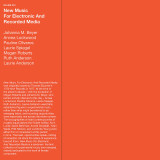
Marking its first decade of activity, Blume returns with the first ever vinyl reissue of the seminal “New Music for Electronic and Recorded Media”, from 1977, the third and final instalment in a suite of releases that includes James Tenney’s “Postal Pieces” and Ben Vida’s “Vocal Trio”. Unquestionably among the most important collections of experimental music to emerge during the 20th Century, “New Music for Electronic and Recorded Media” is the original feminist presentation in its context, releasing the work of Johanna M. Beyer, Annea Lockwood, Pauline Oliveros, Laurie Spiegel, Megan Roberts, Ruth Anderson, and Laurie Anderson under its collective banner. Includes newly commissioned liner notes by Jennifer Lucy Allen and Bradford Bailey.
Since its founding back in 2014, Blume has carved a unique place in cultural landscape, issuing free standing works, spanning the historical and contemporary, that represent singular gestures of creativity within the field of experimental sound. Joining their broad efforts in building networks of context and understanding that already includes the efforts of efforts of Werner Durand, Sarah Hennies, Bruce Nauman, John Butcher, Jocy de Oliveira, Mary Jane Leach, Valentina Magaletti, Alvin Curran, Julius Eastman, Alvin Lucier, and others, Blume delivers their third release in their first suite of releases for 2024, the fist ever vinyl reissue of the seminal “New Music for Electronic and Recorded Media” compilation, originally issued by Thomas Buckner's 1750 Arch Records in 1977. Out of print for decades on vinyl and arguably the most important feminist statement in the history of experimental music, illuminating the work of Johanna M. Beyer, Annea Lockwood, Pauline Oliveros, Laurie Spiegel, Megan Robert, Ruth Anderson, and Laurie Anderson - in a number of cases representing their recording debuts - during a crucial moment in the history of experimental music. Blume’s brand new edition - complete with newly commissioned liner notes by Jennifer Lucy Allen and Bradford Bailey, as well as reproducing Charles Amirkhanian’s original accompanying text - radically shifts perceptions of the past and present day with its truly revolutionary sounds.
Issued by Thomas Buckner's 1750 Arch Records in 1977, and out of print nearly the entire time since, “New Music for Electronic and Recorded Media” can be understood within two simple frameworks. On one hand, it is an astounding document of the landscape of experimental music toward the end of the 1970s. On the other, it is a historically significant feminist statement, being the first collection of experimental music entirely dedicated to female composers, a number of whom were grossly under-celebrated at the time, but have since gone on to be regarded as among the most important composers of their generation.
The eight pieces gathered by “New Music for Electronic and Recorded Media” - Johanna M. Beyer’s “Music of the Spheres”, Annea Lockwood’s “World Rhythms”, Pauline Oliveros’ “Bye Bye Butterfly”, Laurie Spiegel’s “Appalachian Grove I”, Megan Roberts’ “I Could Sit Here All Day”, Ruth Anderson’s “Points”, and Laurie Anderson’s “New York Social Life” and “Time To Go (For Diego)” - might be regarded as the first cohesive vision of alternate proximity or expression of experimental music to what has always been a frustratingly male dominated environment, and to the tropes, temperaments, and sensibilities that have been historically perceived to define it. It is an expanded vision of truth. While the presence of feminine sensibilities and temperaments in experimental music, however they may present themselves, were anything but new in 1977, “New Music for Electronic and Recorded Media” was the first opportunity, beyond the temporal limitations of live performance, to view them collectively, rather than as individualised expressions within a larger body of similar gestures (as was the case of Oliveros’ inclusion in Odyssey’s 1967 “New Sounds In Electronic Music” and “Extended Voices” compilations) where they might be confused for something else; to regard and celebrate a radical notion of feminine sonority for its unique characteristics and through its interrelations.
While its historical significance and groundbreaking nature can not be debated in its totality, nearly half a century on “New Music for Electronic and Recorded Media” remains compelling in both its musicality and the palpable sense of its lasting influence. Every composition across the album’s two sides is not only engrossing and deeply compelling - feeling as fresh and relevant as the day it was laid to tape - but clearly tangible in their lasting influence. Viewed in context, the album’s eight works feel like breath of fresh air when compared to much of what came before, and laid the groundwork for much of what was to come, introducing a new, often more holistic temperament and more sensitive and inclusive sensibility into the landscape of experimental music.
Particularly in the case of Annea Lockwood, Pauline Oliveros, Laurie Spiegel, Ruth Anderson, and Laurie Anderson, it's hard to throw ourselves back in time and imagine a moment when these composers rested in a fairly marginalised corner of the creative landscape. Blume’s brand new edition of “New Music for Electronic and Recorded Media” - complete with newly commissioned liner notes by Jennifer Lucy Allen and Bradford Bailey, as well as reproducing Charles Amirkhanian’s original accompanying text - brings us back to this confounding moment and points us toward a crucial moment of change set forth by these incredible composers and their sounds. Absolutely seminal and not to be missed.


Repress.
The re-release series of original Ethiopian classic vinyl continues -- the finest Ethio jazz by Mahmoud Ahmed and his band from 1975 plus two tracks from 1978.The liner notes: 'Melancholy blues, piercingly minimalist country airs, brassy, danceable urban jazz, heart-wrenching, off-key crooners: a rich and stirring patchwork of sounds, crossing Afro-beat, Latino-swing moves and Eastern arabesques (Ana�s Prosa�c).' Such were the first -- informed and enthusiastic -- opinions of the music press when the first strains of modern Ethiopian music sounded on our shores. This was in 1984-1985. Such a positive note, struck about such a country at such a time, created plenty of reverb. The country had been so thoroughly trashed by the media's feeding-frenzy, which spewed out a mix of horror and pious pity, bitter denunciation and humanitarian appeals, wallet-tickling clich�s and refusal of identity. In one brutal swoop, TV-reality transformed Ethiopia into a cursed nation, forsaken by God and by man. In contrast to these tragedies, but in the same hackneyed tones, Mahmoud Ahmed's life resembles an edifying fairy-tale where destiny, talent and achievement combine to triumph over poverty, fate and the evil eye. Biography, history and legend, with the help of God, infallibly weave the lesson of merit rewarded. But who can argue, in spite of the mockery that celebrities invariably draw, when faced with one of the greatest voices in all of Africa? Once upon a time, there was a street urchin in Addis Ababa, who started off as a shoe-shine boy and went on to become one of his country's biggest stars, opening the door to Ethiopian music to Western audiences. --Francis Falceto

Comes with insert and download coupon.
Imagine a Latin remake of Back to the Future. The mad scientist is Arsenio Rodriguez (the godfather of salsa) and the young student who travels through time with him is Eblis Alvarez (Meridian Brothers). This album can only be described as the perfect soundtrack for that movie that never was.
After the massive buzz generated by his first solo album, Mentallogenic, Alex Figueira got back in the studio to work in a more collective fashion this time, carefully assembling the second album of his largest project to date, Conjunto Papa Upa; a team of 6 musicians, spanning 3 generations of some of the best talent in the Latin and avant-garde scenes.
In an era where tropical music is dominated by purely electronic and rhythmically uniform sounds, the ten songs encompassed in “Fruta Madura” (“Ripe Fruit”) wander through the most diverse tempos, rhythms, and motifs effortlessly. A real breath of fresh air that gracefully incorporates soul, funk, jazz, psychedelia, and electronics into a solid tropical, irresistibly polyrhythmic foundation, without ever succumbing to the many genre clichés.
The distinctive production and catchy songwriting of Figueira shine in a very distinctive light on this second full-length. Living up to his reputation (Miles Cleret, founder of Soundway Records, called him “one of the scene's truly authentic and eccentric producers”), he takes the opportunity to show he’s not afraid to keep walking his own path.
Taking the band for a wild ride through the traditions of Africa, America, and the Caribbean; contrasting them with a ridiculously wide plethora of vintage, contemporary, and futuristic sounds, and pivoting on the exuberant musicality displayed by his musicians; the result leaves no doubt: this album is destined to be considered a future classic of the exciting tropical psychedelic music of the 21st century.
Addressing the most diverse themes in this new collection of songs, things take on a much more mature tone, as the title clearly suggests.
The opening track “El segundo es más sabroso” (“The second one is tastier”) sets the tone in the most assertive way imaginable, with the band boldly declaring, through multiple metaphorical references (laid upon a crazy mix of Dominican merengue, Detroit techno, classic and free jazz, dub, and electro), that the bar will be set higher with this second album.
The remaining compositions touch upon the most diverse subjects, with a fair dose of humor, sarcasm, and postmodern “magic realism”. “El Algoritmo” (The Algorithm) is a parranda-cumbia hybrid (for lack of a specific term) about the omnipresence of technology in our lives. The sophisticated Latin soul of the titling track “Fruta Madura” makes a case for the beauty of the maturity process. Some key philosophical teachings of Marcus Aurelius (the role of causality, the impositions of “the logos” and the importance of self-control) get a twisted cumbia treatment on “Reos del Deseo” (Prisoners of Desire). “No le pongas Coca-Cola” (“Don’t put Coca Cola in it”) shows us the most satirical side of the band, accusing those who mix Coca Cola with Rum of committing "sacrilege", on a powerful base of Dem Bow (the grandfather of Reggaeton), intertwined with touches of soul, salsa, and Cuban comparsa.
"Háblame Claro" (“Talk to me clearly”) is a story of heartbreak that evokes in its first part the spirit of the erotic salsa of the 80s (a subgenre deeply despised by purists), and after an unexpected samba interlude, leads to the hardest salsa of the 70s (a subgenre adored by purists), to end up in the surprising form of pure Afro-Cuban ceremonial music.
“Tu mamá tenía razón” ("Your Mom Was Right") is an attempt to exalt the spirit of the Latin American soap opera in the key of “acid bachata”, to recount a real-life case, witnessed by the band on countless occasions: the partying woman who arrives at the show accompanied by her bitter husband, who obviously does not like to dance. A very cheeky song to talk about the very serious and pertinent topic of female empowerment.
“La misma vaina” (“The same thing”) with its indescribable blend of bantú, candomblé, and Mozambique rhythms with abstract synthesizers, is an ode to adventure in favor of the aversion to taking risks and seeking predictability.
“Amigas picadas” (“Salty friends”) is another humorous song recounting another real-life case witnessed by the band on countless occasions: a love encounter sabotaged by the girlfriend's friends, who all happen to fancy the same guy. A jazzy take on the ancient Dominican rhythm of pambiche (grandfather of merengue), with generous psychedelic touches, resembling the classy late 60s releases of Guadeloupe's legendary producer / label owner Henri Debs.
“Vinimos a hablar” (“We came to talk”) takes sarcasm to the highest level, to ridicule the absurdity (also experienced by the band firsthand) seen in live music venues where people pay a ticket to go and have conversations that could be carried out much better on any bar, where no band is playing. The music alternates between a delicate melody with loose, sparse percussion and a full-on, pumping Angolan semba, with a techno kick drum included; bringing things to an apotheotic grooving finale, where the peculiar swing of Venezuelan calypso from the Callao region is thrown on top of all the precedent elements; closing the album in the most uplifting, “end of the carnival parade” feel.
The artwork is a delicate and impactful oil painting by Colombian artist Kevin Simón Mancera, who has collaborated many times with the label before (“Maracas, tambourines and other hellish things” tape and the Lola’s Dice LP).
What the experts are saying:
“Alex (Figueira) dove into this work with a brutal cohesion between lyrics and synths. Timbre poetry, sound poetry (you name it). And that, superimposed on his always impeccable percussive base, confirms the title of “avant-garde visionary of our beautiful Latin music”".
EBLIS ALVAREZ (MERIDIAN BROTHERS)
“Papa Upa's infectious quirkiness is a balm against boredom. A mature album, but without an expiration date”.
GLADYS PALMERA
“Here there is a lot of strength, drum, cadence and psychedelia, lost dance rhythms, united in an intercontinental Latin/African/and Caribbean journey, a unique winning combination that we could consider the new “Ritmo Figueira”.
DISCODELIC
Conjunto Papa Upa are:
Alex Figueira - Timbales, percussion, vocals.
Gerardo Rosales - Congas, percussion, vocals.
Ramón Mendeville - Bongos, percussion, vocals.
Randy Winterdal - Bass.
Andrew Moreno - Guitar.
Nico Chientarolli - Organ, piano, synths.
All songs written by Alex Figueira.
Arranged and performed by Conjunto Papa Upa.
Recorded, produced, mixed and mastered by Alex Figueira at Heat Too Hot, Amsterdam.

OTOROKU is proud to reissue Evan Parker's first solo LP "Saxophone Solos". Recorded by Martin Davidson in 1975 at the Unity Theatre in London, at that time the preferred concert venue of the Musicians' Co-operative, Parker's densely woven and often cyclical style has yet to form; instead throaty murmurs appear under rough hewn whistles and calls - the wildly energetic beginnings of an extraordinary career. Reissued with liner notes from Seymour Wright in an edition of 500. "The four pieces across the two sides of Saxophone Solos - Aerobatics 1 to 4 - are testing, pressured, bronchial spectaculars of innovation and invention and determination. Evan tells four stories of exploration and imagination without much obvious precedent. Abstract Beckettian cliff-hanging detection/logic/magic/mystery. The conic vessel of the soprano saxophone here recorded contains the ur-protagonists: seeds, characters, settings, forces, conflicts, motions, for new ideas, to delve, to tap and to draw from it story after story as he has on solo record after record for 45 years. 'Aerobatics 1-3' were recorded on 17 June 1975, by Martin Davidson at Parker's first solo performance. This took place at London's Unity Theatre in Camden. 'Aerobatics 4' was recorded on 9 September the same year, by Jost Gebers in the then FMP studio in Charlottenburg, Berlin. Music of balance and gravity, fulcra, effort, poise and enquiry. Sounds thrown and shaken into and out of air, metal and wood. It is - as the titles suggest - spectacular." - Seymour Wright, 2020.

Original members of Sheffield’s Human League, Martyn Ware and Ian Craig Marsh left after the first two albums
and formed Heaven 17 in 1980. Named after a fictional band in Anthony Burgess’s “A Clockwork Orange”, they
recruited Glenn Gregory on vocals (who had been the original choice for lead singer of the Human League).
Signed to Virgin Records, debut single “(We Don’t Need This) Fascist Groove Thang” attracted a lot of attention in
March 1981, and a BBC Radio 1 ban. Recorded in Sheffield and London, debut album “Penthouse And Pavement”
was released in September 1981 and was certified Gold the following year, and also contained the singles “Play To
Win”, “Penthouse And Pavement”, and “The Height Of The Fighting”.
This new edition has been expertly mastered by Barry Grint at AIR Mastering from the original stereo tapes using
precision half-speed mastering. Half-speed mastering is a vinyl cutting technique that improves groove accuracy
and transient information creating an incredibly detailed stereo image with a natural high frequency response.
Presented in its original sleeve, pressed on 180-gram heavyweight black vinyl, featuring an obi strip and housed
in a poly-lined inner sleeve, with all the lyrics and credits plus photos on the 4-page insert.
Filipovich is one of a kind. The Belarus-born, Paris-based artist works in a multitude of media - found footage films, painting, silkscreening and performance to name a few. It's her musical output that has caught the attention of late, though, with Filipovich dropping a run of releases in recent years which began with 2021's Magnificat on Time Released Sound. Filipovich takes as much of a novel approach to her music-making as she does with her other artistic endeavours - Magnificat was centred around treated samples of Sergei Rachmaninov's All-Night Vigil, and she's also combined classical composition with contemporary electronic techniques on her subsequent drops.
For Idealized, Filipovich's debut on Sheffield's Central Processing Unit, she maintains the gothic air which characterised her previous releases and applies it to a record of widescreen contemporary techno joints. These tracks represent something of a gear shift for CPU, a label which has long made its name by delivering top-quality electro and machine-funk jams, but such is the quality of Idealized that these superbly-executed techno productions are sure to win over label fans both old and new.
Idealized is very much schooled in the German tradition of minimal/dub techno. Tracks like 'Physical', 'Wave' and 'Dance Minor' all anchor themselves on single, steady drum pulses and delay-drenched single-chord loops. Filipovich generally lets the central idea of these tracks play out across several minutes while introducing increasingly disorientating elements into the rest of the mix - wiccan atmospherics, clashing chords, spiralling delays and so forth. It's an approach at once respectful of Filipovich's predecessors - Basic Channel, Deepchord, Ellen Allien and so on - but also full of idiosyncrasies and individuality.
Many of the club cuts here hardwire us into the moody, murky environs of the darkest Berlin Basements. 'Ultra Red' rides forward on a crisp drum machine snap, a menacing burble of bassline and an eerie single-note synth whistle in the upper end of the mix; 'Dance Minor' shows off a bit of KiNK in the brain-bending modular loop that waxes and wanes at its centre; the second-half run from 'Wave' to closer 'Small Cave' travels ever-further out into deep space - the kick drums remain insistent, yet the textural elements are delivered with an edge and flair that evidences Filipovich's ability to think outside the box.
Filipovich's unusual methods, and the influence of sound art and electroacoustic composition on her music, are drawn out further when Idealized steps away from the dancefloor. 'Hydra' comes off like a more gothic version of Pole - its central pulse draws from dub techno but never quite settles into a danceable groove, and this beat is combined with the kind of unnerving keyboard work that would make John Carpenter proud. Although closer 'Small Cave' eventually locks into another dark-room techno roller, the opening section of the track delivers a weightless soundscape of bright, tinny chords and a scene-setting field recording.
Idealized, the first drop on Central Processing Unit from Paris-based Belarusian Lina Filpovich, broadens the label's horizons with a selection of finely crafted minimal/dub techno joints.
RIYL: Andy Stott, Deepchord, Ellen Allien, Moritz von Oswald

A holy grail for fans of French boogie, early hip hop, Arabic funk and Balearic bops,"Ettika" has been seriously sought after since Vidal Benjamin found it in the 1€ bin back in 2006. Teasing the ears of the underground via Vidal's 'Balearic Nightmare' mix for Noncollective, copies of the original were soon snapped up completely, and the later adopters were sated by a Blackdisco edit from Alexis Le-Tan (himself gifted Vidal's second copy), which is now also rare as hen's teeth. The fervour for the track is easy to understand. Underpinned by an endlessly buoyant bass groove, chanted female vocals dart out the speakers like a post- modern mantra while synth vamps flare in stuttering stereo.
Middle-Eastern motifs add an air of mystery, but this truly belongs in a dance floor utopia. That the track was the product of a 'back-to-work' scheme aimed at unemployed immigrant youth in Rouen only adds to the appeal. Led by teacher Bernard Guégan, a quartet of students delivered lyrics in French and Arabic inspired by their rejection letters, serving a little social commentary and a lot of funk. If you're mad on Ahmed Fakroun and Shams Dinn, or even those folks in the Bush of Ghosts, then this is a must have for you.
Archeology isn't just about excavation, there should be interpretation too, and in this case it comes from Italian duo Hear & Now and Leeds' The Veteran Delinquents. The former furnish the 12" with two radical takes, the dreamy downtempo stroll of their French Remix - all unhurried percussion, Gilmour-riffing and coastal élan - and the peaktime pump of their Arab Remix, which transports the original vocal into a land of desert new beat and Balearic trance with a little space left for some frazzled fretwork. If you've followed their work with Claremont you know the quality on show.
The Veteran Delinquents, the collaborative vehicle of Leeds stalwarts Craig Christon and Tim Hutton, condense a lifetime of club experiences into their remix, establishing the infectious groove of the original before subverting with chugging bass and winking acid, all augmented with their own slick synth work. The original was an all time classic at Craig's Joe's Bakery nights way back when, and this new interpretation is both respectful and revolutionary.

Warehouse Find!
Avision storms into 2020 in fine fashion with his first EP for Maceo Plex's Ellum Audio label.
Playing the decks since just 12 years of age, this American artist grew up in the musically rich New York City scene and is now at the sharp end of it with his own new school techno sound. He has released on key labels like Ben Sims’ Hardgroove, Mark Broom’s Beardman and Teksupport, and is someone that icons like Adam Beyer and Chris Liebing often reach for in their own sets.
He starts off his latest offering with 'Innocence', a bustling techno track with bulky drum programming that is brilliantly loose. It jostles you into action as dark vocals add intensity and makes for a perfectly physical dance floor workout.
Keeping up the pressure is 'Time Lapse', with big hi hats and a driving bassline all interwoven with thundering kick drums that will get the whole club up on its toes. A rising synth in the background adds an air of cosmic exploration and means this tasteful techno trip is enthralling from start to finish.
These are two superbly stylish and high powered techno cuts from this contemporary tastemaker.


“Todavía No”, La Paloma’s debut album, consolidates the young band from Madrid as one of the realities of the current scene. Undoubtedly, it’s definitely a bold step forward in all senses: compositional, interpretative, and artistic. Noise-rock to combat all the noise out there.
In “Una idea, pero es triste”, their celebrated debut EP, La Paloma expounded something very serious, but they explained it only once. Five songs that instantly connected with an audience eager for new references. In “Todavía no” there is more depth; here practically each cut shows a different shade of being La Paloma. “Tiré una piedra al aire” is far from “Algo ha cambiado”, but both are unequivocally La Paloma. Surely, this is something that can be attributed to the baggage acquired during this time lapse, but it certainly speaks very well of the artistic ambition of a band to which now seems to have no ceiling.
We are not, therefore, facing a mere extension of their 2021 EP, although musically they pick it up from where they left off. “Todavía no” is an accessible and contagious work, equal qualities shared with “Una idea, pero es triste”. It’s a work that conveys discontent and liberation, ambition and boredom. In large part, it’s due to the accredited ability of its composers Nico Yubero and Lucas Sierra to observe the world with the right dose of skepticism and disappointment, avoiding tormented gesticulation.
The presentation tour that followed the publication of the EP was extensive and led La Paloma to defend their songs throughout the Spanish geography, as well as visits to Portugal, Mexico and the United States. That state of grace was transferred to the studio, where they tried to reflect their live sound and proposal. With an elegant production and without undue frills, the mission of preserving the sharp fang shown in concert halls was achieved, ensuring, in turn, that the elements, arrangements and the proposal of each instrument were heard crystal clear.
Right from the start, we notice in the sequence many of the virtues that make La Paloma one of the most advantaged groups of the current scene: gushing guitars, the solidity of its rhythm section with Rubén Almonacid on bass and Juan Rojo on drums and the color tone provided by the voices of Nico and Lucas, who share the vocal tasks on alternate tracks.
But there’s more: songs that destroy the most generic canon of noise-rock to take it to little-explored territories, frantic guitar games and a cascade of imaginative arrangements. It combines popular song constructions with unpredictable structures that prevent you from anticipating what twist is to come next, making listening experience exhilarating and addictive.
“Todavía no” is a tightly cohesive album, a remarkable fact considering the two creative inputs from which the band draws from and the artistic ambition with which they faced the building of this work. Because we are talking about a complete work, conceived as such. The first chords of “Sigo aquí” sound and the disorganization of reality… is still disorganized, but somehow it makes sense now.

The Cutter & The Clan was the breakthrough album from Scottish Celtic rock band Runrig. Their fifth full length and the first with what is considered the classic line-up of the band. This record marked their debut for Chrysalis and took them to another level internationally, going Silver in the process. This was the beginning of a run of hit albums and features the song, 'An Ubhal as Airde', which was heard in the popular Carlsberg advert. The Cutter & The Clan has been mastered by Peter Beckmann at Technology Works, from the original pre-production 1/2" master and overseen by band member Malcolm Jones. Once In A Lifetime, originally released in 1988 and reaching Gold status, is considered to be one of the best live albums of the era. It's inclusion here gives listeners an insight into the excitement surrounding their live performances during this period.

LTD WHITE EDITION[24,58 €]
Mit ihrem neuen Album Megafauna in Sichtweite und seit fast 20 Jahren dabei, haben die irischen Experimentierfreaks And So I Watch You From immer wieder neue Ideen aufgenommen und die Grenzen ihrer komplizierten und ekstatischen gitarrenbasierten Posteverything-Kompositionen erweitert. Aber nichts in ihrem Repertoire kommt an den Ehrgeiz und das Ausmaß ihres 2022 entstandenen multimedialen Langform-Ensembleprojekts Jettison heran. Jettison wurde von Rory Friers, dem Gitarristen von And So I Watch You From Afar, konzipiert und von der Band, dem Orchestrator Connor O'Boyle, dem Arco String Quartet und dem bildenden Künstler Sam Wiehl zum Leben erweckt. Jettison ist eine Verschmelzung von ASIWYFAs lebensbejahender musikalischer Akrobatik, der mitreißenden Größe von Filmmusik und den surrealen und erhabenen Möglichkeiten von bewegten Bildern. Die Bühne für Jettison wird mit den friedlichen Klavierakkorden und den orchestralen Klängen von ,Dive Pt1" eröffnet, bevor es mit ,Dive Pt2" richtig losgeht, wo Friers und Kennedy von ihren Landsleuten Chris Wee am Schlagzeug und Johnny Adger am Bass unterstützt werden. Von da an durchläuft die 40-minütige, neunteilige Reise von Jettison die verschiedenen Schattierungen der euphorischen Instrumentalstücke von ASIWYFA, die von der ätherischen Eleganz des Arco String Quartet durchdrungen sind. Kurze Schnipsel kryptischer Dialoge von Emma Ruth Rundle und Neil Fallon sind über das ganze Album verstreut und weisen dem Hörer den Weg wie Wegweiser, die eine größere Geschichte andeuten und das Erlebnis weiter färben, während sie der Komposition insgesamt ein Gefühl des Geheimnisses verleihen. Ob es die Stakkato-Gitarren und Pedalboard-Manipulationen von ,Lung", der dubbige Bass und die spärlichen Folk-Melodien von ,In Air", der hymnische Geist von ,Emerge" oder die perfekte Symbiose aus klassischem ASIWYFA-Elektrojubel und der zarten Anmut des Arco String Quartetts sind, die verschiedenen Kapitel von Jettison bewahren den Geist und die Klangfarbe von ASIWYFA, während sie die Möglichkeiten ihres Sounds erweitern und die Sinne durch zusätzliche Instrumentierung übersättigen.Jettison ist auf keinen Fall ein gewöhnliches ASIWYFA-Album. Vielmehr handelt es sich um eine sehr bewusste Abkehr und nicht um einen evolutionären Schritt hin zu einem immer komplexeren und konzeptionelleren Werk. Die ehemals nur begrenzt verfügbare Veröffentlichung wird nun neu aufgelegt!

Black Vinyl[20,38 €]
Mit ihrem neuen Album Megafauna in Sichtweite und seit fast 20 Jahren dabei, haben die irischen Experimentierfreaks And So I Watch You From immer wieder neue Ideen aufgenommen und die Grenzen ihrer komplizierten und ekstatischen gitarrenbasierten Posteverything-Kompositionen erweitert. Aber nichts in ihrem Repertoire kommt an den Ehrgeiz und das Ausmaß ihres 2022 entstandenen multimedialen Langform-Ensembleprojekts Jettison heran. Jettison wurde von Rory Friers, dem Gitarristen von And So I Watch You From Afar, konzipiert und von der Band, dem Orchestrator Connor O'Boyle, dem Arco String Quartet und dem bildenden Künstler Sam Wiehl zum Leben erweckt. Jettison ist eine Verschmelzung von ASIWYFAs lebensbejahender musikalischer Akrobatik, der mitreißenden Größe von Filmmusik und den surrealen und erhabenen Möglichkeiten von bewegten Bildern. Die Bühne für Jettison wird mit den friedlichen Klavierakkorden und den orchestralen Klängen von ,Dive Pt1" eröffnet, bevor es mit ,Dive Pt2" richtig losgeht, wo Friers und Kennedy von ihren Landsleuten Chris Wee am Schlagzeug und Johnny Adger am Bass unterstützt werden. Von da an durchläuft die 40-minütige, neunteilige Reise von Jettison die verschiedenen Schattierungen der euphorischen Instrumentalstücke von ASIWYFA, die von der ätherischen Eleganz des Arco String Quartet durchdrungen sind. Kurze Schnipsel kryptischer Dialoge von Emma Ruth Rundle und Neil Fallon sind über das ganze Album verstreut und weisen dem Hörer den Weg wie Wegweiser, die eine größere Geschichte andeuten und das Erlebnis weiter färben, während sie der Komposition insgesamt ein Gefühl des Geheimnisses verleihen. Ob es die Stakkato-Gitarren und Pedalboard-Manipulationen von ,Lung", der dubbige Bass und die spärlichen Folk-Melodien von ,In Air", der hymnische Geist von ,Emerge" oder die perfekte Symbiose aus klassischem ASIWYFA-Elektrojubel und der zarten Anmut des Arco String Quartetts sind, die verschiedenen Kapitel von Jettison bewahren den Geist und die Klangfarbe von ASIWYFA, während sie die Möglichkeiten ihres Sounds erweitern und die Sinne durch zusätzliche Instrumentierung übersättigen.Jettison ist auf keinen Fall ein gewöhnliches ASIWYFA-Album. Vielmehr handelt es sich um eine sehr bewusste Abkehr und nicht um einen evolutionären Schritt hin zu einem immer komplexeren und konzeptionelleren Werk. Die ehemals nur begrenzt verfügbare Veröffentlichung wird nun neu aufgelegt!

Two times UK Blues Award winner second album for APM Records released on CD. HSLB carries the narrative of a bluesman upto no good who when his world falls apart, admits what he’s done and atones. Produced by Phil Dearing (Eliza Carthy, Gretchen Peters, Lauran Cantrell). Features special guest Vaneese Thomas (daughter of Rufus and sister to Carla Thomas). Radio for HSLB : no.1 IBBA radio chart two months running , Top 50 iTunes Blues album chart (US) / no.3 Roots Music Report Blues Album (Global)/ no.1 Roots Music Report Blues song ‘Blind Leading The Blind’ (Global) / Top10 Living Blues radio chart (US) / Top 20 National College Radio (US), airplay on 50 stations (US) / airplay in Netherlands, Australia, Canada, Switzerland, Croatia, France, Italy, Germany, Israel Press for HSLB : Blues In Britain front cover, reviews Blues Matters, Blues in Britain, Rock & Reel, Living Blues (US), Blues Blast (US), Charlotte Blues Society (US), Blues Roadhouse (US), Big City R&B (US) Bluestown (NL) “Mississippi MacDonald riffs like a fabulous Albert King circa his Stax days”. • Mississippi MacDonald is playing: Love Fields Stage-Glastonbury, Linton Blues Festival, Dereham Blues Festival, Brightlingsea Festival, Over The Hill Festival, Mississippi MacDonald won Traditional Blues Artist of the Year 2024 and Acoustic Blues Artist of the Year 2024 at the UK Blues Awards in April. HSLB Nominated for UK Blues album of the year

Original members of Sheffield’s Human League, Martyn Ware and Ian Craig Marsh left after the first two albums
and formed Heaven 17 in 1980. Named after a fictional band in Anthony Burgess’s “A Clockwork Orange”, they
recruited Glenn Gregory on vocals (who had been the original choice for lead singer of the Human League).
Released in April 1983, second album “The Luxury Gap” featured the Top 5 hits “Temptation” and “Come Live
With Me”, as well as “Crushed By The Wheels Of Industry” and “Let Me Go”. The album was certified Platinum in
February 1984 for sales of over 300,000.
This new edition has been expertly mastered by Barry Grint at AIR Mastering from the original stereo tapes using
precision half-speed mastering. Half-speed mastering is a vinyl cutting technique that improves groove accuracy
and transient information creating an incredibly detailed stereo image with a natural high frequency response.
Presented in its original sleeve, pressed on 180-gram heavyweight black vinyl, featuring an obi strip and housed
in a poly-lined inner sleeve, with all the lyrics and credits plus photos on the 4-page insert.

Following up on Ohm Hourani’s infectious single “Barbara” which included a remix from Ricardo Villalobos and Amir Javasoul, We R The Aliens is happy to present its fifth release this June with another V/A from all-star cast: Boronas & Snad, Bärtaub, Mountain People and Nesta. Tap in and make some space in your record bag
mid short >>>
Following up on Ohm Hourani’s infectious single “Barbara” which included a remix from Ricardo Villalobos and Amir Javasoul, We R The Aliens is happy to present its fifth release this June with another all-star cast: Boronas & Snad, Bärtaub, Mountain People and Nesta.
Boronas & Snad set the tone with ‘Affliction,’ laden with haunting synth work, rolling MPC percussion, meticulous backspins and mind bending delays. Fresh off an outing for Yoyaku’s main label, Istanbul duo Bärtaub give a strong nod to the 90s and the cult E- MU rompler with ‘Orbit The Dance Planet.’ Their track fuses bumpy breaks and robotic voices with ghastly chords, a snaking bass groove and of course, one-shots from the Orbit.
Mountain People kicks off the flip side with ‘I Am The Void,’ characterized by shuffled drum grooves and soft chord sequences intertwined with murky, dubbed out stabs. Beirut’s Nesta rounds out the release with ‘Tarte Citron,’ a late 90's tech house reminiscent track with crisp percussion, airy synth flutters, swelling sub bass tones and a catchy vocal hook.

White/Blue Marble Reissue!
BAFTA winning Icelandic composer, musician and producer Ólafur Arnalds’ fourth solo studio album, re:member, was originally released by Mercury KX on the 24th August 2018. Released on special marble vinyl for the first time. The album uses the Stratus Pianos as well as string quatet, synths, electronics, live drums and a string orchestra recorded at London’s Air Studios. Plummeting the listener into a subversive world full of unexpected moods and emotions, Ólafur explored foreign musical soundscapes in every facet of re:member.

Limited edition 300 only cyan coloured vinyl LP, housed in a reverse board sleeve with hype sticker, polylined inner bag and download code. Non-Returnable.
Stars align and Oli Heffernan brings his ever-(d)evolving Ivan The Tolerable to Riot Season for two LPs of sublime entropic drift.
Having this time recruited Christian Alderson (The Unit Ama) on drums, John Pope (Ponyland) on double bass, Kevin Nickles (Ecstatic Vision) on flute and saxophone and Ben Hopkinson on electric piano - both works were recorded as a quintet almost instantaneously, the players barely brushing or breathing a note before the whole thing was done.
‘Vertigo’, is all claustrophobic, dense and disorientating - like Sun Ra sitting in with Exploding Star Orchestra
John Hubner (Complex Distractions) on ‘Vertigo’
“An expansive collection of free-flowing sound and mood bringing to mind Coltrane (John and Alice) as well as the great Albert Ayler, while touching on the forward thinking compositions of Rob Mazurek's Exploding Star Orchestra.
From the titanic soundscape of "New Worlds On Earth" to the Marc Moulin touches of "Liquid Voices" and the mysterious eccentricities of "Swimming", 'Vertigo' hangs in the air long after the final note plays.”
