Wrapped Up In Time is the fourth vinyl release by Night Foundation; the solo project of Intermedia artist and Noir Age label owner Richard Vergez. An existential suite of sounds comprised of analogue synth and drum machine, guitar, clarinet, tape loops and other assorted space racket.
The LP offers solo, instrumental passages punctuated by duets with Noir Age alumni: Underground vocal legend Little Annie reputable for her past collaborations with Coil, Nurse With Wound, Swans and countless others, lends her lived-in pipes for Blue Garage; along with Belgrade-based sound artist Zhe Pechorin for Night Blooming Jasmine; a tribute to our passed brother David Lynch.
Both rhythmic and expansive, Hinterland searching; Wrapped Up In Time is a processing of grief, memory, and the current state of our revolving loop of life. Recorded in South Florida, 2024-2025.
Mastered by Giuseppe Ielasi of Senufo Editions.
For fans of: Coil, King Tubby, Dead Can Dance, Scorn, Sabres of Paradise, and Vicious Pink
Limited edition of 100 on black vinyl with full color matte jackets
Search:davi
- A1: The Jungle
- A2: Love That Boy
- A3: House On Fire
- A4: Sacrifice
- B1: Get My Mind
- B2: Le Queens
- B3: In Your Eyes
- B4: Bold
Montreal indie rock trio Plants and Animals announce "The Jungle", their fifth studio album set to be released October 23rd via Secret City Records. Their shortest album yet and certainly their boldest, "The Jungle" is eight acts in a world full of noise. The album is auto-produced and was recorded at Mixart, their studio in Montreal. The band explains : "We started working on this a couple of years ago. Warren was afraid for a friend's health. He thought he was self-medicating too much and not taking care of himself. He couldn't let go of this image of an overworked dude swallowing too many sleeping pills and falling asleep with the stove on. So it began as the place next door, sometime before Greta Thunberg turned the expression into a rallying cry, where Earth is the house and the people are sleeping. It's terrifying, and on the whole we're not unlike this friend, are we?" "The Jungle" starts with electronic drums that sound like insects at night. A whole universe comes alive in the dark. It's beautiful, complex and unsettling. Systematic and chaotic. All instinct, no plan. Voices taunt,"yeah yeah yeah." This tangled time in which we find ourselves is reflected back in shadows. Every song is such a landscape. The first one grinds to a halt and you become a kid looking out a car window at the moon, wondering how it's still on your tail as you speed past a steady blur of trees. You watch a house go up in a yellow strobe that echoes the disco weirdness of Giorgio Moroder, Donna Summer and David Bowie. You get pummelled by a rhythm then set free by a sudden change of scenery_the wind stops, clarity returns. You're under a streetlight in Queens, soft-focus, slow motion, falling in love. You speak French now too, in case you didn't already. Bienvenue. These are personal experiences made in a volatile world, and they reflect that world right back at us, even by accident. There's one song Nic sings to his teenage son who was dealing with climate change anxiety and drifting into uncharted independence. The band carries it out slowly together into a sweet blue horizon. Warren wrote the words to another shortly after losing his father. It's about the things we inherit not necessarily being the things we want. In a broader sense, that's where a lot of people find themselves right now.
- A1: No Such Place
- A2: London
- A3: Run Into The Sun
- A4: Shimmer
- B1: Shapeshifter
- B2: Borders
- B3: Sensory Overload
With their highly anticipated fourth album, The Third Sleep, Norwegian progressive rock band Oak delivers a striking exploration of societal complacency and the struggle of the individual. The album contrasts light and darkness, both thematically and musically, seamlessly blending folk-inspired acoustic passages with the raw intensity of progressive metal, evoking echoes of Opeth and beyond. Expanding on the lyrical themes of The Quiet Rebellion of Compromise, The Third Sleep ventures deeper into the subconscious, weaving suggestive and poetic storytelling with sharp social commentary. More outward-looking than its introspective predecessor, the album invites the listener to engage, interpret, and reflect. With a rich musical foundation that spans classical piano, electronica, progressive and hard rock, Oak has carved out a distinctive sound-both captivating and challenging in equal measure. Recorded in Ljugekroken (Oslo), the album was mixed by David Castillo (Katatonia, Leprous, Opeth) and mastered by Jacob Holm-Lupo (White Willow, Donner) at Dude Ranch Studio, Sandoya. Prepare to experience The Third Sleep, a thought-provoking journey through sound and emotion.
- A1: Dick Dale & His Del-Tones - Misirlou
- A2: The Coasters - Down In Mexico
- A3: Keith Mansfield - Funky Fanfare
- A4: The Tornadoes - Bustin' Surfboards
- A5: Nick Perito - The Green Leaves Of Summer
- A6: Dee Clark - Hey Little Girl
- A7: Zarah Leander - Davon Geht Die Welt Nicht Unter
- A8: Joe Tex - The Love You Save (May Be Your Own)
- B1: Link Wray And His Ray Men - Rumble
- B2: The 5 6.7.8'S - Woo Hoo
- B3: Annibale E I Cantori Moderni - Trinity (Titoli)
- B4: Charlie Feathers - Can't Hardly Stand It
- B5: David Hess - Now You're All Alone
- B6: Joe Tex - I Gotcha
- B7: Elvin Bishop - She Puts Me In The Mood
- B8: Jim Croce - I Got A Name
- B9: Johnny Cash - I Walk The Line
RANDOM COLOR VINYL[17,23 €]
Entdecken Sie eine Auswahl der kultigsten Songs aus Quentin Tarantinos Kultfilmen auf einer atemberaubenden Picture Disc Vinyl. Diese exklusive Zusammenstellung umfasst legendäre Künstler wie Dick Dale, Johnny Cash, The Coasters, The 5.6.7.8"s und viele mehr - und deckt Tarantinos gesamtes filmisches Universum von Pulp Fiction bis Once Upon a Time in Hollywood ab. Ein Sammlerstück voller Surf-Rock, Soul, Rockabilly und Retro-Vibes - genau so, wie Tarantino es liebt.
- Thinking Of You
- Into The Blue
- Fly Away
- Payback
- Dime Feat. Cancamusa
- Perfect Strangers
- Time Will Tell
- I Don't Wanna Stay
- Play On
- Easy To Love
- The Fool
Aaron Frazer - der in Los Angeles lebende Sänger, Songwriter, Multi-Instrumentalist und Mitglied der gefeierten Gruppe Durand Jones & the Indications - lässt mit "Into the Blue" eine gewagte Mischung aus Soul, Psychedelia, Spaghetti-Western, Disco, Gospel und Hip-Hop auf sein hochgelobtes Debütalbum "Introducing_" aus dem Jahr 2021 folgen. "Into The Blue" repräsentiert die beeindruckende Bandbreite von Frazers klanglichen Talenten. "Es ist das klarste Porträt dessen, was ich als Künstler bin", sagt Frazer über sein zweites Solo-Album, auf dem er die unverwechselbare Falsettstimme und das klassische Songwriting beibehält, für das er bekannt ist, aber mit einer Hip Hop inspirierten Mentalität im Kern, die Genres und Produktionstechniken miteinander verwebt und "Into The Blue" somit fest im Hier und Jetzt verankert. "Into The Blue" ist das Ergebnis eines gebrochenen Herzens. Nach dem Ende einer langen Beziehung zog Frazer quer durchs Land von Brooklyn nach Los Angeles und begab sich auf eine Reise, die sich in den Themen des Albums widerspiegelt: Trauer, Einsamkeit und die Suche nach Heilung. "Into The Blue" enthält Momente mit überragenden Arrangements, die an David Axelrod und Ennio Morricone erinnern, wird aber durch die Rohheit von iPhone-Aufnahmen und One-Take-Vocals ausgeglichen. Als Co-Produzent für das Album konnte Frazer den Grammy-Gewinner Alex Goose gewinnen, der für seine Crate-Digging-Samples und die Zusammenarbeit mit Hip-Hop-Künstler*innen wie Freddie Gibbs, Madlib und Brockhampton bekannt ist. Frazer experimentierte auch zum ersten Mal mit Samples, die er aus unerwarteten Quellen wie der R&B-Gruppe Hi-Five aus den 90ern bezog. Und Obwohl "Into the Blue" aus Herzschmerz entstanden ist, hofft Frazer, dass es die Zuhörer*innen mit einem Gefühl des Optimismus zurücklässt. "Weißt du, man kann auch an einem Tag, an dem man trauert, lachen", sagt er, "es gibt keine Gipfel ohne Täler" - aber mit "Into The Blue" erreicht Aaron Frazer neue Höhen.
- A1: (Part I)
- B1: Prelude (Part Ii)
- B2: Maiysha
- C1: Interlude
- C2: Theme From Jack Johnson
The capstone of Miles Davis’ electric period, Agharta reigns as a funk-rock fireball — a blazing comet streaked energy and elan, a fearless organism feasting on adventure and freedom, a seven-headed Godzilla stomping its way through Osaka, Japan. Recorded on February 1, 1975 at Osaka Festival Hall at the first of a two-show stand, the double album offers an endless abundance of surprises and shifts — as well as a road-proven ensemble whose chemistry and abilities equal that of any of Davis’ celebrated bands. If the true measure of jazz is the capacity to adapt to the moment and challenge perception, Agharta is consummate.
Sourced from the original master tapes, housed in a Stoughton gatefold jacket, and pressed at Fidelity Record Pressing in California, Mobile Fidelity’s numbered-edition 180g 33RPM 2LP set of this epic live release presents it in audiophile sound on a domestic pressing for the first time. Offering greater degrees of separation, detail, and richness than the compressed CD editions and more clarity, openness, and presence than older vinyl copies, this version of the 1975 release helps bring the concert stage to your home. Just make sure your turntable and speakers are up to the challenge of Davis and Co.’s explosive performances — and producing the decibels they demand.
Teeming with vibrant colors, tones, and pace, Mobile Fidelity’s reissue captures the hear-it-to-believe-it flow, sweep, and moodiness of the music. Though the group honors looseness and freedom with religious verve, the specificity and scale rendered by this remaster allows you to detect methods behind the alleged madness that are often otherwise harder to discern. This insight extends to the understated changes in volume, harmonics, and phrasings. In many ways, you can listen as Davis himself did that early February evening as he helped coordinate the overall direction and decided on whether to blow his wah-wah-wired trumpet or take a turn on the organ.
Tellingly, Agharta would likely never have been made if not for Davis’ ventures overseas and, specifically, to the Land of the Rising Sun. Having for years faced a backlash on his native soil for his choices to experiment and blow past all known borders, Davis was welcomed with open arms in Japan. The concert documented on Agharta — as well as the day’s later show, captured on the equally exciting Pangea — stemmed from a sold-out three-week tour that would ultimately mark Davis’ final public appearances for years, as he soon settled into semi-retirement and nursed the wounds connected to an unprecedented stretch of restless and relentless output.
For all the band-fueled merit of Agharta — and there’s plenty, given the cast of saxophonist Sonny Fortune, bassist Michael Henderson, drummer Al Foster, percussionist James Mtume, and guitarists Reggie Lucas and Pete Cosey seemingly blasts off to outer space and travels distant galaxies by the time this minimally edited record runs its course — Davis’ own playing often remains overlooked. As critics Richard Cook and Brian Morton observed, it is “often fantastically subtle, creating surges and ebbs in a harmonically static line, allowing him to build huge melismatic variations on a single note.” He attacks like a man on a mission, out to prove naysayers wrong and bent on trailblazing another new path forward. Convention and skeptics be damned.
Noisy and furious, dark and discordant, abstract and off-balance, radical and intense, abrasive and atmospheric, strangely beautiful and hypnotically eccentric: Agharta evades simple description, and refuses to be pinned down in any established category — rock, jazz, punk, ambient, prog, avante-garde, or otherwise. Shot through with trench-deep grooves, screaming riffs, scalding solos, and free-improv leads, its cosmic thrust comes on as the equivalent of an animated pointillist painting comprised of millions of textured dots, dashes, and dabs that hold your attention so raptly you want to revisit the ideas again and again.
Always steps ahead of everyone else, Davis knew what he was doing even when Agharta debuted in Japan before later hitting U.S. markets. Though “Maiysha” and “Theme from Jack Johnson” are identified in the track listing, the record contains a number of uncredited references to other Davis works, including a nod to “So What.” This decision to bypass labels only adds to the art of the reveal — the rare black magic in which Agharta expertly deals.
- My Baby Left Me
- Rollin And Tumblin
- Got Love If You Want It
- Gin House Blues
- Baby What You Want Me To Do
- When Things Go Wrong
- Matchbox
- Mystery Train
- So Glad You're Mine
- Bright Lights, Big City
- Lightnin's Boogie
- Lifeis Good
Throughout a professional career defined by early pop successes, every single one of Andy Fairweather Low's performances has been shaped by his blues, gospel and soul influences, and although the many hits he has enjoyed have to some extent overshadowed his undeniable credentials as a great bluesman - his talent for the blues hasn't escaped the notice of some of the world's finest artists who have drawn on his skills as a guitarist and singer Eric Clapton of course leads this impressive list of Andy's discerning employers and collaborators which includes, BB King, Benmont Tench, Bill Wyman, Bob Dylan, Bonnie Raitt, Buddy Guy, Charlie Dore, Charlie Watts, Chris Barber, Chris Rea, Clarence 'Gatemouth' Brown, Dave Edmunds, David Crosby, David Gilmour, David Sanborn, Donald 'Duck' Dunn, Edie Brickell, Elton John, Emmylou Harris, Garth Hudson, George Harrison, Georgie Fame, Gerry Rafferty, Helen Watson, Jackson Browne, Jeff Beck, Jimi Hendrix, Jimmy Page, Joe Cocker, Joe Satriani, John Mayall, Kate Bush, Levon Helm, Linda Ronstadt, Lonnie Donegan, Mary J. Blige, Mick Hucknall, Otis Rush, Paul Weller, Paul Young, Pete Townshend, Phil Collins, Richard and Linda Thompson, Rick Danko, Ringo Starr, Roger Waters, Ronnie Lane, Sheryl Crow, Steve Gadd, Steve Winwood, Stevie Nicks, The Impressions, The Who, Van Morrison, Warren Zevon, and hundreds more. But, despite the blues having become such a hugely popular genre internationally these days, and Andy having been in the thick of it for most of his professional life, he has largely missed the recognition he deserves in that field because up until now, he has never released a blues album. That's why I wanted to make a record that reveals the identity of the Invisible Bluesman to the world beyond his existing loyal fans. Meet Andy Fairweather Lowdown!
- A1: Little Old Lady
- A2: Village Blues
- B1: My Shining Hour
- B2: Fifth House
- C1: Harmonique
- C2: Like Sonny
- D1: I'll Wait And Pray
- D2: Some Other Blues
Analogue Productions (Atlantic 75 Series) Celebrating the 75th Anniversary of Atlantic Records! Coltrane playing with his former Miles Davis bandmates Featuring originals "Harmonique" and "Like Sonny" 180-gram 45 RPM double LP Pressed at Quality Record Pressings Tip-on old style gatefold double pocket jacket by Stoughton Printing The first album to hit the shelves after Giant Steps, Coltrane Jazz was recorded in November and December 1959, although one of the eight tracks ("Villiage Blues") was recorded in late 1960.
On everything save the aforementioned "Village Blues," Coltrane used the Miles Davis rhythm section of pianist Wynton Kelly, bassist Paul Chambers, and drummer Jimmy Cobb AllMusic describes Coltrane Jazz as the saxophone legend's preparation for his launch into his peak years of the 1960s. There are three standards aboard, but the group reaches their peak on Coltrane's original material, particularly "Harmonique" with its melodic leaps and upper-register saxophone strains and the winding, slightly Eastern-flavored principal riffs of "Like Sonny," dedicated to Sonny Rollins. The moody "Village Blues" features the lineup of McCoy Tyner on piano, Elvin Jones on drums, and Steve Davis on bass; with the substitution of Jimmy Garrison on bass, that personnel would play on Coltrane's most influential and beloved 1960s albums. Sound excellence can be found on this definitive deluxe 180-gram 45 RPM 2LP Analogue Productions (Atlantic 75 Series) reissue of Coltrane Jazz.
- Dumb Head - The Sharades
- Around The Corner - Eve Boswell
- Who's The Girl - Diane & The Javelines
- For Loving Me This Way - Kim Roberts
- Hobbies - Jenny Moss
- Something I've Got To Tell You - Glenda Collins
- Don't You Knock On My Door - Billie Davis
- Merry Go Round - Gunilla Thorn
- Please Let It Happen To Me - Jenny Moss
- Powercut - The Cameos
- I Lost My Heart At The Fairground - Glenda Collins
- Christmas Calling - Valerie Masters
More Tea Chest treasures, this time all girl bands, with Joe Meek at the controls
This series of releases has been a huge seller as the quality is superb and there are unreleased tracks, alternate takes and studio chat.
- A1: Let The Good Times Roll
- A2: It Had To Be You
- A3: Alexander's Ragtime Band
- B1: Two Years Of Torture
- B2: When Your Lover Has Gone
- B3: Deed I Do
- C1: Just For A Thrill
- C2: You Won't Let Me Go
- C3: Tell Me You'll Wait For Me
- D1: Don't Let The Sun Catch You Cryin
- D2: Am I Blue
- D3: Come Rain Or Come Shine
Analogue Productions (Atlantic 75 Series) Celebrating the 75th Anniversary of Atlantic Records! Rolling Stone list of 500 Greatest Albums 265/500 for 2012 180-gram 45 RPM double LP Pressed at Quality Record Pressings Tip-on old style gatefold double pocket jacket by Stoughton Printing The Genius of Ray Charles, his sixth studio album, released in 1959 by Atlantic Records, eschewed the the soul sound of his 1950s recordings, which fused jazz, gospel, and blues, for swinging pop with big band arrangements.
Charles is joined bymany ringers from the Count Basie and Duke Ellington bands for the first half of this program, featuring Charles belting out six songs arranged by Quincy Jones. "Let the Good Times Roll" and "Deed I Do" are highlights, and there are solos by tenorman David "Fathead" Newman, trumpeter Marcus Belgrave, and (on "Two Years of Torture") tenor Paul Gonsalves. The remaining six numbers are ballads, with Charles backed by a string orchestra arranged by Ralph Burns (including "Come Rain or Come Shine" and "Don't Let the Sun Catch You Cryin'"). Charles' voice is heard throughout in peak form, giving soul to even the veteran standards. Pressed on 180-gram vinyl at Quality Record Pressings, and housed in a tip-on old style gatefold double pocket jacket by Stoughton Printing.
The scottish singer-songwriter and multi-instrumentalist James Yorkston and the english guitarist with a fluid fingerpicking touch, David A. Jaycock, already played together in the first formation of the experimental folk ensemble Big Eyes Family Players. Their encounter with Swedish saxophonist Lina Langendorf gives rise to a little gem of pure acoustic candour, perfectly balanced between chamber avant-garde and neo-folk. As on an endless autumn evening in front of a lake in Finland or Estonia, the trio's nordic soul creates atmospheres that recall hidden nostalgia. In a process of rarefied sound matter, elegiac paintings spring up, moments that flow slowly and silently in a tension that is always suspended and unresolved. Soft, crepuscular passages, at times sharp and cold guitar, but also the velvety breath of the nickelharpa, combine with a saxophone that still blows dramas of distant Norwegian fjords, but can also become more Mediterranean and arabesque. The music becomes like a warm warmth around the fire, reflecting a hidden twilight zone of the soul, in a quiet, gentle whisper between poetic abstraction and arpeggiated themes of more recognisable narrative melody, typical of a certain Northern folklore.
Co-Release with We are busy bodies.
- Mean Street
- Dirty Movies
- Sinners Swing!
- Hear About It Later
- Unchained
- Push Comes To Shove
- So This Is Love?
- Sunday Afternoon In The Park
- One Foot Out The Door
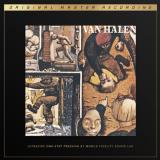
The song titles on Van Halen's aptly titled Fair Warning don't lie. The likes of "Unchained," "Mean Street," "Push Comes to Shove," "One Foot Out the Door," and more indicate the mood the band channels on its double-platinum 1981 record — the nastiest, darkest, and fiercest album of the group's storied career. For the fourth time in four years, Van Halen throws down the gauntlet to all challengers and emerges victorious.
Sourced from the original analog tapes, pressed on MoFi SuperVinyl at Fidelity Record Pressing, and strictly limited to 5,000 numbered copies, Mobile Fidelity's UltraDisc One-Step 180g 45RPM 2LP set plays with unfettered clarity, dynamics, and immediacy. Benefitting from superb groove definition, an ultra-low noise floor, and dead-quiet surfaces, this vinyl edition captures what went down in the studio with tremendous realism and involving presence.
Taking a more controlled approach in the studio and still completing everything in less than two weeks, Van Halen and producer Ted Templeman relied on studio amplifiers to direct the sound. Further diverging from the live-on-the-floor approach of its earlier albums, the ensemble also employed overdubs to great effect. The result: Dense, stacked architecture that underlines the hard-hitting tenor of the songs — and which comes alive like never before on this reference edition that looks as good as it sounds.
The premium packaging and gorgeous presentation befit the reissue's select status. Housed in a deluxe slipcase, it features special foil-stamped jackets and faithful-to-the-original graphics that illuminate the splendor of the recording. Aurally and visually, it is made for listeners who want to immerse themselves in everything involved with the album, including the iconic cover art adopted from William Kurelek's haunting painting, "The Maze."
Isolated frames from Kurelek's childhood-inspired work — including a man bashing his head into a brick wall, a guy pinning down an adversary as he delivers bare-fist blows to his face and others watch with apparent glee, a boy tied down on a conveyer belt and being sent through the equivalent of a meat saw — adorn the front and back covers. The sunnier visual disposition of Van Halen's prior efforts gives way to something sinister and tortured, traits reflective of the music within. The band members, too, are visually depicted not in glamorous shots but in a serious black-and-white portrait in which the quartet is clad in black leather jackets.
Tough, aggressive, stark: Fair Warning comes on like a series of bare-knuckled punches to the solar plexus and boasts lyrical narratives to match. Though not a concept record, the concise album revolves around themes of roughing it on the streets and struggling to survive amid dim prospects. Singer David Lee Roth reportedly penned many of the initial lyrics after traveling to Haiti and observing extreme poverty. The characters and situations populating Fair Warning reflect hardscrabble existence, last-chance desperation, and underlying danger.
Witness the crazies, poor folks, and hunters of “Mean Street”; the former prom queen turned pornographic actress on “Dirty Movies”; the menace and vice of “Sinners Swing!”; the streetwise hustle of “Unchained”; the isolation and alienation of “Push Comes to Shove”; the desire for escape on “One Foot Out the Door”: A carefree California beach party Fair Warning is not.
Having said he felt angry and frustrated during the sessions, guitarist Eddie Van Halen uses the forceful arrangements as a playground for his seemingly unlimited arsenal. Supported by a crack rhythm section and a hyped-up Roth, he performs with an almost impossible combination of punk-like intensity, technical finesse, lyrical fluidity, and unbridled emotion. The virtuoso was increasingly butting heads with Templeton and seeking a freedom in the studio he believed denied him.
No wonder he plays like a bat out of hell. Listen to the rapid-fire manner in which he slaps the high and low E strings on the 12th fret of his instrument on “Mean Street,” instilling the tune with funk flair and metal-spiked sharpness. For the pouty strut of “Dirty Movies,” Eddie Van Halen contributes slide guitar magic made possible after he sawed off the lower portion of a Gibson SG so he could reach further down the fretboard.
Related intensity, urgency, and daredevil momentum punctuate the surging “Sinner’s Swing!” A heavily flanged, delicately melodic introduction frames the attitudinal “Hear About It Later,” among the most creative arrangements of Van Halen’s career. And do riffs come any bigger or magnetic than those on the high-wire kick of “Unchained”? As for the out-of-left-field “Sunday in the Park,” an instrumental composed on an Electro-Harmonix micro-synthesizer: Who but Eddie Van Halen to supply creep factor in such an ingenious way?
Despite selling fewer quantities than Van Halen’s prior efforts, Fair Warning remains for many diehards the record that epitomizes all of the band’s immense strengths —Roth’s manic energy and tongue-wagging humor, Alex Van Halen’s rhythmic heartbeat-in-your-chest bombast, and Michael Anthony’s lucid bass lines included. Arriving when the New Wave of British Heavy Metal and new-wave movements were taking flight, it signaled a shot across the bow from a band determined to stay a step ahead and provide proof nobody could touch what it delivered.
More than four decades later, Fair Warning still sounds that alarm.
- A1: Military Madness
- A2: Better Days
- A3: Wounded Bird
- B1: I Used To Be A King
- B2: Be Yourself
- C1: Simple Man
- C2: Man In The Mirror
- C3: There's Only One
- D1: Sleep Song
- D2: Chicago
- D3: We Can Change The World
After finding fame with the Hollies and Crosby, Stills, Nash & Young, expatriate Englishman turned West Coast rock icon Graham Nash made an auspicious solo debut on this 1971 disc. It's an exemplary singer-songwriter effort, striking a vital balance between graceful introspection and political fervor — and while it's deeply personal, it still carries the harmonies, heart and politics that made CSN(Y) so essential.
With assistance from the likes of David Crosby, Jerry Garcia, and Dave Mason, highlights include the sensitive internal explorations "I Used to Be a King" and "Man in the Mirror" and the impassioned protest anthems "Chicago" and "Military Madness."
If Déjà Vu was a wild canyon party with four competing egos, Songs for Beginners is Nash's introspective morning after — a mix of heartbreak, hope, and a little bit of righteous protest. He recorded it while reeling from his split with Joni Mitchell, and you can feel that melancholy seeping through the grooves.
But don't mistake this for a wallowing breakup album — it's also a call to action, packed with the kind of folk-rock anthems that made Nash an indispensable voice of his era. If you love CSN's folk-rock harmonies but also crave a more personal, raw touch, this is a must-listen.
This Analogue Productions (Atlantic Series) reissue of Pain in My Heart is a standout for your collection. First, we turned to Bernie Grundman to cut lacquers from the original master tape. Pressing on 180-gram vinyl is by Quality Record Pressings, and the album is housed in a tip-on old style gatefold double pocket jacket by Stoughton Printing.
Alvorada is Montanha’s first long play: an ambient-leaning work, nocturnal in mood yet touched by electricity, tracing a journey from waking activity into dream logic. Recorded mostly in the late hours of the evening with windows open to the city, letting its air and sounds influence the music, it sometimes reached the early moments of sunrise. The title, meaning “dawn,” reflects both the liminal hours of its making and the band’s own renewal. These tracks are closer to drawings than songs: narratives written between instruments, moments of tension and release, fragments of memory and dream. The tracklist follows this nocturnal voyage with the patience of Eno, the disquiet of Uematsu, and the madness of Miles Davis’ Decoy, oscillating between streets and sleep, routine and reverie.
Montanha was formed in 2010 by André Azevedo, Nuno Oliveira, João Sarnadas, and Tito Silva, bonding over architecture school all-nighters on videogame soundtracks (Age of Empires, Super Mario). They began as a psychedelic rock combo and in 2013 released their self-titled EP which introduced a raw, improvised energy. But the album that was meant to follow was abandoned as the band entered hiatus. The four members turned their creative drive towards co-founding Favela Discos, where experimentation with media and form reshaped their ideas of music, and developed their taste, their way of playing, and a more personal sound that was more open and disconnected from a defined genre.
By 2017, Montanha had returned to the studio with new experience, no longer a rock band in the traditional sense but a project devoted to improvisation and electronic soundscapes. An ever gentrifying city forced them to abandon acoustic drums, and they embraced electronic beats instead, and became mobile; one guitar dissolved into full synths, leaving the other to converse with bass. Improvisation remained their compass. In improvisation there are no mistakes, only missed opportunities. Montanha found their opportunity in the routine of the studio to break routines of pop and experimental. The result is a body of nearly fifty hours of recordings, sculpted into an album.
Alvorada is not only Montanha’s first LP but also the dawn of their new phase. Improvised yet carefully sculpted, the record expands the territory of the song into nonlinear narratives, letting the language of night, dream, and city seep into its form.
- 1: The Box
- 2: The Wrote & The Writ
- 3: Tickle Me Pink
- 4: Brown Trout Blues
- 5: Eyeless
- 6: In Holloway
- 7: Shore To Shore
- 8: Cold Bread
- 9: Wayne Rooney
- 10: Leftovers
- 11: Sally
- Hong
- Kong Cemetry
- Tunnels
- All The Dogs Are Lying Down
- Shore To Shore (Reprise)
A Larum, the debut album by singer and actor Johnny Flynn, was recorded in Seattle and is one of those rare albums that immediately creates its own world - Originally released on Vertigo Records in May 2008, this re-issue faithfully replicates the original 2LP release's pop up gatefold sleeve and is pressed on 180g vinyl Backed by his band The Sussex Wit, the album's songs were likened to the work of Fairport Convention and Bert Jansch by Rolling Stone.
Flynn has been described as "a musical prodigy turned Shakespearean actor, with the soul of a poet," and his songs offer a sweet gentility in an increasingly loud time. Close mic'ed and intimate, Flynn cast his eye over romance, religion and celebrity. A Larum became something of a beacon for the burgeoning folk scene at the time, with fellow travellers such as Mumford & Sons, Laura Marling and Noah and the Whale. Since A Larum, Flynn has carved out a singular path as both a critically acclaimed musician and award- winning actor. He has released a string of celebrated albums including Been Listening, Country Mile, and Sillion, continually evolving his sound while maintaining his signature storytelling. As an actor, he's earned accolades for roles on stage and screen, notably portraying David Bowie in Stardust and starring in films like Emma (2020) and Netflix's The Dig. He also composed and performed the beloved theme song for the BAFTA-winning series Detectorists, where his evocative music became inseparable from the show's gentle, melancholic charm. ...
The second release on Samurai Music sub label Saibai welcomes Italian sound-world-builder Pianeti Sintetici for a richly rendered foray into dynamic electronica that moves like a set of vibrant ecosystems.
Davide Perrone has developed his Pianeti Sintetici ('synthetic planets') alias to explore the idea of creating imaginary worlds through teeming, densely layered arrangements of modulating synthesis. He's previously delivered spellbinding albums and EPs to respected labels like Astral Industries and Hypnus. On SAIBAI2, Perrone ably blurs the lines between percussive, textural and melodic parts, letting voices bend and warp as each sound evolves through the labyrinthe lattice of his constructions. This is electronic music so dynamic and ever-shifting, it sounds positively sentient, and yet there's a strong emotional sentiment that binds these fantastic visions together as sincere expressions from a grounded, human perspective.
True to Saibai's focus on deeper, mellower flights of fantasy away from the dancefloor, SAIBAI2 offers a kinetic, engaging listening experience dressed up in opulent tones that gleam, shimmer, bend and flex with hypnotising dexterity.
Joe Hisaishi, Japans einflussreichster Komponist für Film und klassische Musik, veröffentlicht A Symphonic
Celebration, sein Debüt bei Deutsche Grammophon. Hisaishis Klangschöpfungen wurden zum Synonym für
die erfolgreichen Animefilme des oscargekrönten Regisseurs, Animators und Studio-Ghibli-Gründers Hayao
Miyazaki. Schon in den 1980er-Jahren begann ihre kreative Partnerschaft, heute wird sie in einem Atemzug
genannt mit legendären Duos wie Hitchcock und Herrmann oder Spielberg und Williams. Nun sind die
Studio-Ghibli-Hits in symphonischen Arrangements zu hören, darunter Soundtracks von Chihiros Reise ins
Zauberland, Prinzessin Mononoke oder Mein Nachbar Totoro. Hisaishi hat sie in London mit dem Royal
Philharmonic Orchestra unter eigener Leitung eingespielt. Zu Gast sind Grace Davidson, Avi Avital, The
Bach Choir und Stephen Morris.
Dieser Release ist eine 180 g hochwertige Vinyl als limitierte Translucent Yellow Edition.