UILTY RAZORS, BONA FIDE PUNKS.
Writings on the topic that go off in all directions, mind-numbing lectures given by academics, and testimonies, most of them heavily doctored, from those who “lived through that era”: so many people today fantasize about the early days of punk in our country… This blessed moment when no one had yet thought of flaunting a ridiculous green mohawk, taking Sid Vicious as a hero, or – even worse – making the so-called alternative scene both festive and boorish. There was no such thing in 1976 or 1977, when it wasn’t easy to get hold of the first 45s by the Pistols or the Clash. Few people were aware of what was happening on the fringes of the fringes at the time. Malcolm McLaren was virtually unknown, and having short hair made you seem strange. Who knew then that rock music, which had taken a very bad turn since the early 1970s, would once again become an essential element of liberation? That, thanks to short and fast songs, it would once again rediscover that primitive, social side that was so hated by older generations? Who knew that, besides a few loners who read the music press (it was even better if they read it in English) and frequented the right record stores? Many of these formed bands, because it was impossible to do otherwise. We quickly went from listening to the Velvet Underground to trying to play the Stooges’ intros. It’s a somewhat collective story, even though there weren’t many people to start it.
The Guilty Razors were among those who took part in this initial upheaval in Paris. They were far from being the worst. They had something special and even released a single that was well above the national average. They also had enough songs to fill an album, the one you’re holding. In everyone’s opinion, they were definitely not among the punk impostors that followed in their wake. They were, at least, genuine and credible.
Guilty Razors, Parisian punk band (1975-1978). To understand something about their somewhat linear but very energetic sound, we might need to talk about the context in which it was born and, more broadly, recall the boredom (a theme that would become capital in punk songs) coupled with the desire to blow everything off, which were the basis for the formation of bands playing a rejuvenated rock music ; about the passion for a few records by the Kinks or the early Who, by the Stooges, by the Velvet mostly, which set you apart from the crowd.
And of course, we should remember this new wave, which was promoted by a few articles in the specialized press and some cutting-edge record stores, coming from New York or London, whose small but powerful influence could be felt in Paris and in a handful of isolated places in the provinces, lulled to sleep by so many appalling things, from Tangerine Dream to President Giscard d’Estaing...
In 1975-76, French music was, as almost always, in a sorry state ; it was still dominated by Johnny Hallyday and Sylvie Vartan. Local rock music was also rather bleak, apart from Bijou and Little Bob who tried to revive this small scene with poorly sound-engineered gigs played to almost no one.
In the working class suburbs at the time, it was mainly hard rock music played to 11 that helped people forget about their gruelling shifts at the factory. Here and there, on the outskirts of major cities, you still could find a few rockers with sideburns wearing black armbands since the death of Gene Vincent, but it wasn’t a proper mass movement, just a source of real danger to anyone they came across who wasn't like them. In August 1976, a festival unlike any other took place in Mont-de-Marsan – the First European Punk Festival as the poster said – with almost as many people on stage as in the audience. Yet, on that day, a quasi historical event happened, when, under the blazing afternoon sun, a band of unknowns called The Damned made an unprecedented noise in the arena, reminiscent of the chaotic Stooges in their early adolescence. They were the first genuine punk band to perform in our country: from then on, anything was possible, almost anything seemed permissible.
It makes sense that the four+1 members of Guilty Razors, who initially amplified acoustic guitars with crappy tape recorder microphones, would adopt punk music (pronounced paink in French) naturally and instinctively, since it combines liberating noise with speed of execution and – crucially – a very healthy sense of rebellion (the protesters of May 1968 proclaimed, and it was even a slogan, that they weren’t against old people, but against what had made them grow old. In the mid-1970s, it seemed normal and obvious that old people should now ALSO be targeted!!!).
At the time, the desire to fight back, and break down authority and apathy, was either red or black, often taking the form of leafleting, tumultuous general assemblies in the schoolyard, and massive or shabby demonstrations, most of the time overflowing with an exciting vitality that sometimes turned into fights with the riot police. Indeed, soon after the end of the Vietnam War and following Pinochet’s coup in Chile, all over France, Trotskyist and anarcho-libertarian fervour was firmly entrenched among parts of the educated youth population, who were equally rebellious and troublemakers whenever they had the chance. It should also be noted that when the single "Anarchy in the UK" was first heard, even though not many of us had access to it, both the title and its explosive sound immediately resonated with some of those troublemakers crying out for ANARCHY!!! Meanwhile, the left-wing majority still equated punks with reckless young neo-Nazis. Of course, the widely circulated photos in the mainstream press of Siouxsie Sioux with her swastikas didn’t necessarily help to win over the theorists of the Great Revolution. It took Joe Strummer to introduce The Clash as an anti-racist, anti-fascist and anti-ignorance band for the rejection of old-school revolutionaries to fade a little.
The Lycée Jean-Baptiste Say at Porte d’Auteuil, despite being located in the very posh and very exclusive 16th arrondissement of Paris, didn’t escape these "committed" upheavals, which doubled as the perfect outlet for the less timid members of this generation.
“Back then, politics were fun,” says Tristam Nada, who studied there and went on to become Guilty Razors’ frontman. “Jean-Baptiste was the leftist high-school in the neighbourhood. When the far right guys from the GUD came down there, the Communist League guys from elsewhere helped us fight them off.”
Anything that could challenge authority was fair game and of course, strikes for just about any reason would lead to increasingly frequent truancy (with a definitive farewell to education that would soon follow). Tristam Nada spent his 10th and 11th unfinished grades with José Perez, who had come from Spain, where his father, a janitor, had been sentenced to death by Franco. “José steered my tastes towards solid acts such as The Who. Like most teenagers, I had previously absorbed just about everything that came my way, from Yes to Led Zeppelin to Genesis. I was exploring… And then one day, he told me that he and his brother Carlos wanted to start a rock band.” The Perez brothers already played guitar. “Of course, they were Spanish!”, jokes their singer. “Then, somewhat reluctantly, José took up the bass and we were soon joined by Jano – who called himself Jano Homicid – who took up the rhythm guitar.” Several drummers would later join this core of not easily intimidated young guys who didn’t let adversity get the better of them.
The first rehearsals of the newly named Guilty Razors took place in the bedroom of a Perez aunt. There, the three rookies tried to cover a few standards, songs that often were an integral part of their lives. During a first, short gig, in front of a bewildered audience of tough old-school rockers, they launched into a clunky version of the Velvet Underground's “Heroin”. Challenge or recklessness? A bit of both, probably… And then, step by step, their limited repertoire expanded as they decided to write their own songs, sung in a not always very accurate or academic English, but who cared about proper grammar or the right vocabulary, since what truly mattered was to make the words sound as good as possible while playing very, very fast music? And spitting out those words in a language that left no doubt as to what it conveyed mattered as well.
Trying their hand a the kind of rock music disliked by most of the neighbourhood, making noise, being fiercely provocative: they still belonged to a tiny clique who, at this very moment, had chosen to impose this difference. And there were very few places in France or elsewhere, where one could witness the first stirrings of something that wasn’t a trend yet, let alone a movement.
In the provinces, in late 1976 or early 1977, there couldn’t be more than thirty record stores that were a bit more discerning than average, where you could hear this new kind of short-haired rock music called “punk”. The old clientele, who previously had no problem coming in to buy the latest McCartney or Aerosmith LP, now felt a little less comfortable there…
In Paris, these enlightened places were quite rare and often located nex to what would become the Forum des Halles, a big shopping mall. Between three aging sex workers, a couple of second-hand clothes shops, sellers of hippie paraphernalia and small fashion designers, the good word was loudly spread in two pioneering places – propagators of what was still only a new underground movement. Historically, the first one was the Open Market, a kind of poorly, but tastefully stocked cave. Speakers blasted out the sound of sixties garage bands from the Nuggets compilation (a crucial reference for José Perez) or the badly dressed English kids of Eddie and the Hot Rods. This black-painted den was opened a few years earlier by Marc Zermati, a character who wasn’t always in a sunny disposition, but always quite radical in his (good) choices and his opinions. He founded the independent label Skydog and was one of the promoters of the Mont-de-Marsan punk festivals. Not far from there was Harry Cover, another store more in tune with the new New York scene, which was amply covered in the house fanzine, Rock News (even though it was in it that the photos of the Sex Pistols were first published in France).
It was a favorite hang-out of the Perez brothers and Tristam Nada, as the latter explained. “It’s at Harry Cover’s that we first heard the Pistols and Clash’s 45s, and after that, we decided to start writing our first songs. If they could do it, so could we!”
The sonic shocks that were “Anarchy in the UK”, “White Riot” or the Buzzcocks’s EP, “Spiral Scratch” – which Guilty Razors' sound is reminiscent of – were soon to be amplified by an unparalleled visual shock. In April 1977, right after the release of their first LP, The Clash performed at the Palais des Glaces in Paris, during a punk night organised by Marc Zermati. For many who were there, it was the gig of a lifetime…
Of course, Guilty Razors and Tristam were in the audience: “That concert was fabulous… We Parisian punks were almost all dressed in black and white, with white shirts, skinny leather ties, bikers jackets or light jackets, etc. The Clash, on the other hand, wore colourful clothes. Well, the next day, at the Gibus, you’d spot everyone who had been at this concert, but they weren’t wearing anything black, they were all wearing colours.”
It makes sense to mention the Gibus club, as Guilty Razors often played there (sometimes in front of a hostile audience). It was also the only place in Paris that regularly scheduled new Parisian or Anglo-Saxon acts, such as Generation X, Siouxsie and the Banshees, the Slits, and Johnny Thunders who would become a kind of messed-up mascot for the venue. A little later, in 1978, the Rose Bonbon – formerly the Nashville – also attracted nightly owls in search of electric thrills… In 1977, the iconic but not necessarily excellent Asphalt Jungle often played at the Gibus, sometimes sharing the bill with Metal Urbain, the only band whose aura would later transcend the French borders (“I saw them as the French Sex Pistols,” said Geoff Travis, head of their British label Rough Trade). Already established in this small scene, Metal Urbain helped the young and restless Guilty Razors who had just arrived. Guitarist for Metal Urbain Hermann Schwartz remembers it: “They were younger than us, we were a bit like their mentors even if it’s too strong a word… At least they were credible. We thought they were good, and they had good songs which reminded of the Buzzcocks that I liked a lot. But at some point, they started hanging out with the Hells Angels. That’s when we stopped following them.”
The break-up was mutual, since, Guilty Razors, for their part, were shocked when they saw a fringe element of the audience at Metal Urbain concerts who repeatedly shouted “Sieg Heil” and gave Nazi salutes. These provocations, even still minor (the bulk of the skinhead crowd would later make their presence felt during concerts), weren’t really to the liking of the Perez brothers, whose anti-fascist convictions were firmly rooted. Some things are non-negotiable.
A few months earlier (in July 1978), Guilty Razors had nevertheless opened very successfully for Metal Urbain at the Bus Palladium, a more traditonally old-school rock night-club. But, as was sometimes the case back then, the night turned into a mass brawl when suburban rockers came to “beat up punks”.
Back then, Parisian nights weren’t always sweet and serene.
So, after opening as best as they could for The Jam (their sound having been ruined by the PA system), our local heroes were – once again – met outside by a horde of greasers out to get them. “Thankfully,” says Tristam, “we were with our roadies, motorless bikers who acted as a protective barrier. We were chased in the neighbouring streets and the whole thing ended in front of a bar, with the owner coming out with a rifle…”
Although Tristam and the Perez brothers narrowly escaped various, potentially bloody, incidents, they weren’t completely innocent of wrongdoing either. They still find amusing their mugging of two strangers in the street for example (“We were broke and we simply wanted to buy tickets for the Heartbreakers concert that night,” says Tristam). It so happened that their victims were two key figures in the rock business at the time: radio presenter Alain Manneval and music publisher Philippe Constantin. They filed a complaint and sought monetary compensation, but somehow the band’s manager, the skilful but very controversial Alexis, managed to get the complaint withdrawn and Guilty Razors ended up signing with Constantin with a substantial advance.
They also signed with Polydor and the label released in 1978 their only three-track 45, featuring “I Don't Wanna be A Rich”, “Hurts and Noises” and “Provocate” (songs that exuded perpetual rebellion and an unquenchable desire for “class” confrontation). It was a very good record, but due to a lack of promotion (radio stations didn’t play French artists singing in English), it didn’t sell very well. Only 800 copies were allegedly sold and the rest of the stock was pulped… Initially, the three tracks were to be included on a LP that never came to be, since they were dropped by Polydor (“Let’s say we sometimes caused a ruckus in their offices!” laughs Tristam.) In order to perfect the long-awaited LP, the band recorded demos of other tracks. There was a cover of Pink Floyd's “Lucifer Sam” from the Syd Barrett era – proof of an enduring love for the sixties’ greats –, “Wake Up” a hangover tale and “Bad Heart” about the Baader-Meinhof gang, whose actions had a profound impact on the era and on a generation seeking extreme dissent... On the album you’re now discovering, you can also hear five previously unreleased tracks recorded a bit later during an extended and freezing stay in Madrid, in a makeshift studio with the invaluable help of a drummer also acting as sound engineer. He was both an enthusiastic old hippie and a proper whizz at sound engineering. Here too, certain influences from the fifties and sixties (Link Wray, the Troggs) are more than obvious in the band’s music.
Shortly after a final stormy and rather barbaric (on the audience’s side) “Punk night” at the Olympia in June 1978, Tristam left the band ; his bandmates continued without him for a short while.
But like most pioneering punk bands of the era, Guilty Razors eventually split up for good after three years (besides once in Spain, they’d only played in Paris). The reason for ceasing business activities were more or less the same for everyone: there were no venues outside one’s small circuit to play this kind of rock music, which was still frightening, unknown, or of little interest to most people. The chances of recording an LP were virtually null, since major labels were only signing unoriginal but reassuring sub-Téléphone clones, and the smaller ones were only interested in progressive rock or French chanson for youth clubs. And what about self-production? No one in our small safety-pinned world had thought about it yet. There wasn’t enough money to embark on that sort of venture anyway.
So yes, the early days of punk in France were truly No Future!
Cerca:de la noise
- Uncanny Valley Girl
- Björk's Alarm Clock
- Awhile Ago, Alone
- Last Night In The Kitchen
- Nowhere Faster
- You Against You
- Formerly Fresh
- So It Goes
Wir denken gerne, dass unser Leben zu Geschichten geformt werden kann - klare Bögen, verständliche Bedeutungen, aber das Leben lässt sich nicht in Schubladen stecken. Stattdessen geht es unverblümt und ohne Entschuldigung weiter, ohne Rücksicht auf unser Ordnungsgefühl. El Ten Elevens ,Nowhere Faster", das 16. Album des Duos, entstand in diesem Unbehagen. In acht Tracks geht es nicht nur um das Nichts, sondern auch um Geschwindigkeit - diese seltsame Dringlichkeit, die uns vorantreibt, auch wenn das Ziel unklar bleibt. Das 33-minütige Album verlangsamt sich gerade so lange, um die schwierigen Fragen zu stellen: Wovor laufen wir weg und was glauben wir, überholen zu können? ,Nowhere Faster" entstand während der längsten Pause, die Kristian Dunn und Tim Fogarty in ihren 23 gemeinsamen Jahren von Tourneen und Aufnahmen gemacht haben, obwohl ,Pause" eigentlich nicht ganz richtig ist. Dunn ist bekannt dafür, dass er immer kreativ am Werk ist, und das hat er auch hier nicht aufgegeben. Stattdessen fing er an, nicht nur für einen, sondern für zwei Schlagzeuger zu schreiben, was Fogarty vor eine der größten Herausforderungen seiner Karriere stellte. Das Album ist auch eine Premiere für die Band, da es durchgehend echte Streicher und Klavier einbindet und damit die Klangpalette eines ihrer vielschichtigsten Werke noch erweitert. Nowhere Faster ist kein Rückzug in Nostalgie. El Ten Eleven setzt weiterhin auf Risiko und Neuerfindung. Das Album konzentriert sich weiterhin auf Fogartys treibendes Schlagzeugspiel und Dunn's bassgetriebene Experimente: Die ersten vier Tracks (,Seite A") zeichnen sich durch E-Bass aus, während die zweite Hälfte (,Seite B") zu akustischem Bass wechselt, der durch Pedale verarbeitet wird und so die emotionale Schwere des Albums subtil verändert. Letztendlich ist ,Nowhere Faster" ein Album über das Abrechnen - über Zeit, Ausdauer und die Ungewissheit, wie lange eine Band oder ein Leben dauern kann. Wir alle tasten uns an die Endlichkeit heran. Die Frage ist nicht, ob wir dort ankommen, sondern was wir auf dem Weg dorthin hören wollen. Zu welcher Musik werden wir tanzen, wenn sich der Boden unter uns zu verschieben beginnt? Wenn schon nichts anderes, dann vielleicht zu etwas, das wie ,Nowhere Faster" klingt.
- 1: Fear
- 2: Dreads And Spikes
- 3: Die Human Race
- What A Wonderful World
- 5: Creature Of Inhuman Power
- 6: Dead Dream
- 7: Desensitized
- 8: Ghetto Europa
- 9: Narcissism Of Mankind
- 10: Kranenwald
- 11: Der Pabst
- 12: Fuck Cancer
- 13: Collapse
- 14: Intox Not Detox
- 15: Das Hohelied Der Larmoyanz
- 16: Mankind Is The Reason
- 17: Drug Schools
- 18: Loser
- 19: Theodicy
- 20: Odin - Jesus
Die legendären Accion Mutante kehren mit einem neuen Album zurück! Sie kamen 1994 aus der Crust-Szene und prägten schon früh den Begriff "Metal Punk". "The Time Machine" verspricht erneut eine brutale, menschenunfreundliche Reise durch drei Jahrzehnte der Geschichte von Accion Mutante, darunter zehn brandneue Tracks plus zehn neu aufgenommene Songs, die von den Anfängen der Band bis zur Gegenwart reichen. Ehrliche Punk-Wut, gemischt mit rauem Metal-Sound und kombiniert mit einem unerbittlichen D-Beat sowie der kehligen Wut zweier Shouter. Auf "The Time Machine" thematisieren Accion Mutante textlich nach wie vor ihre Themen wie religiöser Blödsinn, Verbrechen gegen die Menschlichkeit oder Umweltzerstörung mit ihrem eigenen sarkastischen Ton und einer 100 % antifaschistischen Haltung. Das ist verdammt wütend und verdammt roh. Auch nach mehr als 30 Jahren sind ACCION MUTANTE noch immer Crustasfuck-Vertreter einer großartigen Mischung aus kaputtem Metal, Punk-Gestus, unerbittlichem D-Beat und den lauten Attacken beider Sänger. ACCION MUTANTE in ihrer ganzen Pracht, direkt ins Gesicht, für Fans von Britcore und Bands wie Extreme Noise Terror oder Ripcord.
- 1: Former Shells
- 2: Coiled (Ft. Patrick Shiroishi)
- 3: Black Sheep
- 4: Slow Motion Somnia
- 5: Remain/Remind
LAVENDER Vinyl[24,79 €]
Amulets is the solo project of Portland-based audio and visual artist Randall Taylor. Amulets employs handmade cassette tape loops and live processed guitar loops to create live, lush soundscapes and immersive drones. Through the recontextualisation of cassettes, sampling, field recording, and looping, these long-form compositions blur the genres of ambient, drone, noise, and electronic music. Amulets has steadily built a catalog defined by tactile intimacy and patient exploration. Deeply immersive, the album navigates the dreamy boundaries between the tangible and the ethereal, where sound behaves as memory itself: unstable, layered, and quietly transformative. Known for his ability to weave soundscapes that evoke powerful emotions with minimalistic instrumentation, Taylor's newest project is a masterful exploration of mood, atmosphere, and texture.Throughout the ambient soundscapes is introspection, melancholy, and an almost hypnotic calm. The album resists forward motion, instead inviting the listener to linger inside its evolving textures, to sit with what's left behind rather than rush toward resolution. Central to Amulets' identity is Taylor's insistence on working, quite literally, outside the box. While many contemporary experimental artists rely heavily on software, Taylor's process remains rooted in physical interaction with sound. "This album differs from previous albums because it's a lot of found sounds, song fragments, and other samples that I have that I wanted to fuse together. I also heavily relied on a lot of ambient guitar and live guitar recording to marry all the sounds together." (Randall Taylor) FOR FANS OF Tim Hecker * Ben Frost * Lawrence English * Alessandro Cortini * This Will Destroy You * Mono * Windy & Carl
Amulets is the solo project of Portland-based audio and visual artist Randall Taylor. Amulets employs handmade cassette tape loops and live processed guitar loops to create live, lush soundscapes and immersive drones. Through the recontextualisation of cassettes, sampling, field recording, and looping, these long-form compositions blur the genres of ambient, drone, noise, and electronic music. Amulets has steadily built a catalog defined by tactile intimacy and patient exploration. Deeply immersive, the album navigates the dreamy boundaries between the tangible and the ethereal, where sound behaves as memory itself: unstable, layered, and quietly transformative. Known for his ability to weave soundscapes that evoke powerful emotions with minimalistic instrumentation, Taylor's newest project is a masterful exploration of mood, atmosphere, and texture.Throughout the ambient soundscapes is introspection, melancholy, and an almost hypnotic calm. The album resists forward motion, instead inviting the listener to linger inside its evolving textures, to sit with what's left behind rather than rush toward resolution. Central to Amulets' identity is Taylor's insistence on working, quite literally, outside the box. While many contemporary experimental artists rely heavily on software, Taylor's process remains rooted in physical interaction with sound. "This album differs from previous albums because it's a lot of found sounds, song fragments, and other samples that I have that I wanted to fuse together. I also heavily relied on a lot of ambient guitar and live guitar recording to marry all the sounds together." (Randall Taylor) FOR FANS OF Tim Hecker * Ben Frost * Lawrence English * Alessandro Cortini * This Will Destroy You * Mono * Windy & Carl The single colour edition comes as Lavender vinyl!
4/5 Mojo review: ‘Sparse, hypnotic big-room techno that builds from the bass drum up
Double LP is released on 140gm black vinyl in a transparent gloss foil sleeve, artwork and design by Ian Anderson for Designers Republic. Circuitry Electronic launches with a release that stands as a statement of intent - an artist with few true peers within English electronic music, with an album that jumps out of the speakers and slaps you around the chops. G-Man is Gez Varley - one half of Sheffield pioneers LFO, and thirty years into his solo career, with his first vinyl album release since Avanti on Force Inc way back in 2002. Speaking to DJ magazine in 2014 Gez recalled his early days working with Mark Bell as LFO: “We were influenced by groups like 808 State. Unique 3, Nightmares On Wax and also stuff like Kraftwerk, Detroit techno and early electro. So when we first hooked up and made tunes together we just wanted to rock the dancefloor at our local club The Warehouse”.
Their eponymous track ‘LFO’ – a classic of the bleep and bass techno movement – was one of the first releases on the Warp label, gate- crashing the UK’s Top 20 whilst annoying Simon Mayo along the way. Having worked with the likes of Richie Hawtin, Karl Bartos, Laurent Garnier, Art of Noise, Radiohead, YMO and Alan Wilder, in addition to the LFO output, you'd expect Gez to know his way around a techno dancefloor rhythm and drum pattern, and this is an inventive funk-filled journey that never veers too far into experimental territory yet avoids the cliches and generic tropes that too often lose the listener when techno manifests in album form.
Seamus Fogarty is the brilliant Irish singer/songwriter who previously released two critically acclaimed albums on Domino Records and his debut album via Scottsh cult label Fence records.
DIY pop, electronic noises and heartfelt ballads and stories is mixed on this amazing new album where Seamus once again prove to be a one of a kind songwriter and artist.
Black Vinyl[31,51 €]
Defying labels across the board, and turning old-style ancestral narratives into brutal and harrowing portraits of life on the edge of nowhere, the Fibbers wrap each of Lost Somewhere Between the Earth and My Home\'s 12 songs into a ball of fury and toss it against the wall of tradition, just to see what happens. Chaotic noise breakdowns give way to melodic singalongs, songs twist and turn through several side paths before reaching their destination, and everything sounds as if total annihilation is imminent. Scary, thoughtful and highly inventive, Lost is the sound of country gone to hell.
Magenta w/ black smoke Vinyl[31,51 €]
Defying labels across the board, and turning old-style ancestral narratives into brutal and harrowing portraits of life on the edge of nowhere, the Fibbers wrap each of Lost Somewhere Between the Earth and My Home\'s 12 songs into a ball of fury and toss it against the wall of tradition, just to see what happens. Chaotic noise breakdowns give way to melodic singalongs, songs twist and turn through several side paths before reaching their destination, and everything sounds as if total annihilation is imminent. Scary, thoughtful and highly inventive, Lost is the sound of country gone to hell.
HYPER GAL are restless. Since 2019, Kansai’s minimalist duo has been in persistent, perpetual motion.
In January of 2024, SKiN GRAFT Records introduced HYPER GAL to western audiences, giving the previously self-released album “Pure” a worldwide release. It was followed by “After Image”; a new full-length record; in September of that same year. In short order HYPER GAL left Japan to embark on a month-long European tour, performing at festivals such as Left of the Dial in Rotterdam and Le Guess Who? in Utrecht.
Consisting of Koharu Ishida (vocals) and Kurumi Kadoya (drums), HYPER GAL craft a sound all their own, characterized by avant-garde rhythms, looping landscapes, and hypnotic vocals. Their music resists traditional genre boundaries to carve out a truly singular sonic space.
With their fourth album “Our Hyper”, HYPER GAL thrust their sound into a deeper, harder core. Songs unfold into surprising shapes, embracing shadowy turns emboldened by a heavier low-end, while unearthing sharp takes on Japan’s harsh noise roots. The drums have grown even more acrobatic and unorthodox, while the vocals take on new colors, shifting from mesmerizing repetition to melodic, pop-tinged expression.
The album’s artwork is no less adventurous and features masks created by contemporary artist Tokiyoshi Akina and photographed in the band’s own hands, signaling resistance to the performative dualities of social media and a commitment to authenticity.
Despite the lean, unadorned two-piece setup, HYPER GAL’s music attains an intense and unmistakable presence - an unwavering momentum driven by an unrelenting intent. “Our Hyper” is HYPER GAL amplified.
"With each release they appear as mirage sculptors, using simple tools (drums, keyboards, vocals) in craft of multi-genre spanning work which only becomes more captivating the simpler their execution becomes...”
– MYSTIFICATION
Wendy Eisenberg hat die letzten zehn Jahre als feste Größe der Independent-Musikszene und als Künstlerin von inspirierender Vielseitigkeit verbracht. Als Singer-Songwriterin, Improvisatorin und virtuose Gitarristin sind die Koordinaten ihrer Kunst ständig im Wandel, von Art-Rock über Jazz bis hin zu mitreißender freier Improvisation und ausdrucksstarker Folk-Musik. Mit Höhepunkten wie dem 2020 erschienenen Album Auto" und dem 2024 Free-Jazz-Album Viewfinder" hat sie sich einen Namen als ambitionierte Künstlerin gemacht. Nachdem sie die letzten fünf Jahre damit verbracht hat, in verschiedenen Bands, Genres und kreativen Herausforderungen zu experimentieren, und nach einer Phase der Selbstkonfrontation, die sie mit einem persönlichen Exorzismus vergleicht, hat Eisenberg einen Meilenstein erreicht. Die poetischen und formal gewagten Folksongs von Wendy Eisenberg sind ihre bisher klarste Vision. Die Songs begannen 2020 Gestalt anzunehmen, als Eisenberg aus West-Massachusetts wegzog, wo sie nach ihrem Studium am New England Conservatory in Boston einige Jahre gelebt hatte, und nach Brooklyn zog. Aus Sehnsucht nach der ländlichen Atmosphäre ihres früheren Zuhauses fühlte sich Eisenberg zu den warmen Klängen von Country und Folk hingezogen. Die Songs sind echte Folk-Lieder", sagt Eisenberg über ihr Album. Bei der Produktion geht es weniger darum, zu sehen, was die Gitarre leisten kann, sondern vielmehr darum, die inhärente Fremdartigkeit der Sprachen zu akzeptieren, die sie seit anderthalb Jahrhunderten spricht." Auf Wendy Eisenberg schafft die Künstlerin ihr eigenes Paradigma mit einem eng verbundenen Kreis von langjährigen Freunden und Mitwirkenden, darunter Bassist Trevor Dunn, Schlagzeuger Ryan Sawyer und Co-Produzentin Mari Rubio (more eaze), die für Pedal Steel, Synthesizer und Streicharrangements zuständig war. Die Aufnahmen fanden oft in Eisenbergs Haus statt und verliehen jeder Note eine wunderschöne Ensemble-Textur. Endlich war ich von Menschen umgeben, die mich akzeptierten", sagt Eisenberg. Viele der Songs auf diesem Album sind in diesem neuen Gefühl entstanden. Ich wollte, dass es unglaublich beruhigend wirkt, da es einige massive Veränderungen im Selbstverständnis und Selbstwertgefühl beschreibt. Es geht um Erleichterung."
London Based Deadbeat is a techno label founded in 2000 as an outlet for the more eclectic, risk taking and aggressive elements of the genre. Dedicated to unveiling forward thinking new talent, championing cult underground producers and celebrating established global acts the label has created a loyal fan base and now after more than two decades presents its first vinyl release, a massive six track EP that covers a lot of creative ground and features three artists well known for pushing boundaries while delivering face melting, dancefloor destroying beats.
Sane ( Don't Recordings / Fun In The Murky ) is a Uk based producer and techno DJ who has featured multiple times on the 'Best electronic music on bandcamp' pages. Described there by music journalist Joe Muggs as 'Filthy, dirty, vile and brilliant. His techno will tear the top off your head and make soup with the contents. It screeches, it blurts, it whistles, and it roars. Above all, it crashes and clangs like a dancing mech warrior, crushing all before it. What more do you need to know?'
TSR ( Analog Records / Hörspielmusik ) are a highly regarded creative force of Swedish musical mentalists, a crazed, technologically berserk band of electronic wizards who relentlessly conjure up the most brilliant, silliest, toughest, most dance bootable funky techno on this train of existence. Known for high-energy, raw, and sometimes humorous tracks they have released to high acclaim on many notable labels and played all over the world.
DJ Ze MigL ( Djax-Up-Beats / Minimalistix ) is first and foremost a DJ, but also a producer & a Dude! Creating crazy, funky and sometimes brutal techno mayhem. Residentially from Portugal, he’s been the one of most prolific Portuguese techno producer/ DJ during the last 25 years. Producing and Spinning his own special brand of honkin’ techno, not changing a single cowbell. Never too serious or dark, always with proper party ON!
The record additionally features full sleeve artwork by Ed Twist ( of the influential 'Ugly Funk' label ) and is pressed on yellow vinyl.
Grady Steele (Formant Soundsystem) debuts on FELT with the tender spectre of Nausea, poignant patterns captured through the dusk-hued window pane.
Co-founder of the Formant Soundsystem, a travelling rig that’s powered forward-thinking dances in London and Paris, Grady Steele has championed both experimental and club music at the cutting edge. Concurrently to this, he debuted his own productions back in 2024 for Archaic Vaults. Uniquely intimate, his music shone lowkey and warm with an assured glow. It’s no surprise then to find his inimitable sounds land neatly on Fergus Jones’ FELT imprint.
Nausea extends across seven movements, narrating sentimental parallels of familiarity. Grady posits concentrated pangs of post-rave nostalgia with rich melodic sustenance, a vivid introspection tempered with field recordings and live instrumentation. Strummed guitars and aching pads move purposefully with the suspended pace, an immersive beatless vista from its opening quiet moments through to the guttural noise-laden finale. It’s a brief, beautiful collection from Grady Steele and another string to FELT’s unpredictable bow.
Written, recorded and produced by Grady Steele
Mastered by Miles Whittaker
Cover photo by Alex Kurunis
- 1: Mr. Sentimental
- 2: Saran Wrapped Cash
- 3: Ladies' Night (Feat. Luxury Skin)
- 4: Pay Pigs
- 5: Bedrot
- 6: Monet
- 7: Pretty In Pink (Feat. Luxury Skin)
- 8: Pliers (Feat. Luxury Skin)
- 9: Screentime
- 10: I Have A Key To Your House
- 11: Camgirl
- 12: Sweet Talk (Feat. Ameokama)
- 13: Taravista (Feat. Luxury Skin)
- 14: Mary Kate & Ashley
- 15: Despair (Feat. Latter)
Pleasure, shame, and survival often arrive tangled together, indistinguishable in the moment. Camgirl, from Crippling Alcoholism, takes that entanglement as its starting point. Rather than separating desire from damage, the record allows them to coexist, tracing a path through obsession, performance, and persistence without offering clean resolution.
Camgirl is the 2025 breakthrough album from Boston’s Crippling Alcoholism, a record that frames pop immediacy against obsession, endurance, and collapse. Built from ear-wormy hooks and abrasive noise rock textures, the album smuggles grotesque and confrontational subject matter into songs that remain deliberately melodic. Pleasure and revulsion blend throughout, with choruses that linger even as the lyrics refuse comfort.
Released on September 12, 2025, Camgirl follows a loose narrative centered on a sex worker moving through cycles of exploitation and survival, treating intimacy as spectacle and visibility as threat. Songs flicker between desire and despair, confession and performance, flooded with artificial light. Despite its subject matter, the record resists nihilism. Its closing moments arrive quietly triumphant, not through escape or redemption, but through persistence itself.
Originally released on vinyl by Portrayal of Guilt Records, the first pressing of Camgirl sold out quickly. The Flenser reissue makes the album widely available for the first time, reaffirming it as a defining statement from a band operating at the intersection of pop form, noise, and lived experience.
Press Quotes
Camgirl proves that Crippling Alcoholism can evolve without losing their edge, and this record is a dark, irresistible bop. - Lambgoat
Elements of goth rock and melancholic vocals call back to loud rock while blending with an overall instrumental field brimming with energy. - Outside noise
Blurring the lines between outsider noise rock and dark glamorous synth-laden pop under a deceptively alluring glow… compulsively, squirmingly catchy. - The Progressive
- 1: Mr. Sentimental
- 2: Saran Wrapped Cash
- 3: Ladies' Night (Feat. Luxury Skin)
- 4: Pay Pigs
- 5: Bedrot
- 6: Monet
- 7: Pretty In Pink (Feat. Luxury Skin)
- 8: Pliers (Feat. Luxury Skin)
- 9: Screentime
- 10: I Have A Key To Your House
- 11: Camgirl
- 12: Sweet Talk (Feat. Ameokama)
- 13: Taravista (Feat. Luxury Skin)
- 14: Mary Kate & Ashley
- 15: Despair (Feat. Latter)
Pleasure, shame, and survival often arrive tangled together, indistinguishable in the moment. Camgirl, from Crippling Alcoholism, takes that entanglement as its starting point. Rather than separating desire from damage, the record allows them to coexist, tracing a path through obsession, performance, and persistence without offering clean resolution.
Camgirl is the 2025 breakthrough album from Boston’s Crippling Alcoholism, a record that frames pop immediacy against obsession, endurance, and collapse. Built from ear-wormy hooks and abrasive noise rock textures, the album smuggles grotesque and confrontational subject matter into songs that remain deliberately melodic. Pleasure and revulsion blend throughout, with choruses that linger even as the lyrics refuse comfort.
Released on September 12, 2025, Camgirl follows a loose narrative centered on a sex worker moving through cycles of exploitation and survival, treating intimacy as spectacle and visibility as threat. Songs flicker between desire and despair, confession and performance, flooded with artificial light. Despite its subject matter, the record resists nihilism. Its closing moments arrive quietly triumphant, not through escape or redemption, but through persistence itself.
Originally released on vinyl by Portrayal of Guilt Records, the first pressing of Camgirl sold out quickly. The Flenser reissue makes the album widely available for the first time, reaffirming it as a defining statement from a band operating at the intersection of pop form, noise, and lived experience.
Press Quotes
Camgirl proves that Crippling Alcoholism can evolve without losing their edge, and this record is a dark, irresistible bop. - Lambgoat
Elements of goth rock and melancholic vocals call back to loud rock while blending with an overall instrumental field brimming with energy. - Outside noise
Blurring the lines between outsider noise rock and dark glamorous synth-laden pop under a deceptively alluring glow… compulsively, squirmingly catchy. - The Progressive
- 1: Mr. Sentimental
- 2: Saran Wrapped Cash
- 3: Ladies' Night (Feat. Luxury Skin)
- 4: Pay Pigs
- 5: Bedrot
- 6: Monet
- 7: Pretty In Pink (Feat. Luxury Skin)
- 8: Pliers (Feat. Luxury Skin)
- 9: Screentime
- 10: I Have A Key To Your House
- 11: Camgirl
- 12: Sweet Talk (Feat. Ameokama)
- 13: Taravista (Feat. Luxury Skin)
- 14: Mary Kate & Ashley
- 15: Despair (Feat. Latter)
Pleasure, shame, and survival often arrive tangled together, indistinguishable in the moment. Camgirl, from Crippling Alcoholism, takes that entanglement as its starting point. Rather than separating desire from damage, the record allows them to coexist, tracing a path through obsession, performance, and persistence without offering clean resolution.
Camgirl is the 2025 breakthrough album from Boston’s Crippling Alcoholism, a record that frames pop immediacy against obsession, endurance, and collapse. Built from ear-wormy hooks and abrasive noise rock textures, the album smuggles grotesque and confrontational subject matter into songs that remain deliberately melodic. Pleasure and revulsion blend throughout, with choruses that linger even as the lyrics refuse comfort.
Released on September 12, 2025, Camgirl follows a loose narrative centered on a sex worker moving through cycles of exploitation and survival, treating intimacy as spectacle and visibility as threat. Songs flicker between desire and despair, confession and performance, flooded with artificial light. Despite its subject matter, the record resists nihilism. Its closing moments arrive quietly triumphant, not through escape or redemption, but through persistence itself.
Originally released on vinyl by Portrayal of Guilt Records, the first pressing of Camgirl sold out quickly. The Flenser reissue makes the album widely available for the first time, reaffirming it as a defining statement from a band operating at the intersection of pop form, noise, and lived experience.
Press Quotes
Camgirl proves that Crippling Alcoholism can evolve without losing their edge, and this record is a dark, irresistible bop. - Lambgoat
Elements of goth rock and melancholic vocals call back to loud rock while blending with an overall instrumental field brimming with energy. - Outside noise
Blurring the lines between outsider noise rock and dark glamorous synth-laden pop under a deceptively alluring glow… compulsively, squirmingly catchy. - The Progressive
Relapse presents a remastered reissue from the undisputed king of Japanese noise-MERZBOW. "Pulse Demon" is one of the most celebrated releases of Masami Akita's storied 4 decade long career. Composed entirely by live noise concrete and the use of a fuzz box, "Pulse Demon" eschews all overdubs and studio trickery, laying MERZBOW bare. What follows in these recordings is the pure essence of unfettered noise. The rawness in "Pulse Demon" is palpable; praised as "genuinely extreme, downright torturous sounds that are strangely compelling in their shredding intensity." (A.V. Club) upon its original release in 1996. Remastered by James Plotkin (ISIS, ELECTRIC WIZARD, FULL OF HELL, and more,) the "Pulse Demon" reissues features "Extract 1", a never-before released track that was recorded as part of the original "Pulse Demon" sessions.
- A1: Rock You Gently
- A2: Somewhere, Somebody
- A3: Big Noise New York
- A4: True Emotion
- A5: Pretending To Care
- B1: The Whole Of The Moon
- B2: Lights Of Lousianne
- B3: Way Down Deep
- B4: The Hunter
- B5: I Can’t Hide
Celebrating the 30th Anniversary of Jennifer Warnes' Pop Classic on Crystal Clear Green Vinyl!
All-Tube Mastering by Chris Bellman at Bernie Grundman Mastering from the Original Master Analog Tapes on 180 Gram Vinyl!
One-Time Pressing of 3,000 Individually Numbered Copies!
New Inner Sleeve and LP Labels!
Pressed at RTI!
Impex Records is celebrating the 30th Anniversary of The Hunter with a one-time, individually-numbered pressing of 3,000 in crystal clear green vinyl! Jennifer Warnes’ acclaimed follow-up to Famous Blue Raincoat features a Grammy-nominated recording by Elliot Scheiner and all-tube mastering by Chris Bellman at Bernie Grundman Mastering using Jennifer’s personal original analogue master tapes.
‘The Hunter’ was released five years after her breakthrough with ‘Famous Blue Raincoat’. A TOP 100 LP when first released in 1992, The Hunter’s audiophile credibility is best summed up by Elliot Scheiner’s Grammy-nominated recording and mix. It contains the charting single “Rock You Gently,” a sonically dense yet expansive cover of The Waterboy’s classic “The Whole of the Moon,” a soulful Jennifer Warnes/Leonard Cohen composition “Way Down Deep,” Todd Rundgren’s “Pretending to Care” and even a Donald Fagen tune (“Big Noise, New York”). She owns every tune here, backed by a-list session players who ground the songs with solid and unobtrusive authority, letting Jennifer’s peerless interpretive skills bring the soul of every lyric to the forefront. Ms. Warnes uses her voice to serve the lyrics, allowing the song to return the favour.
“The follow-up to Warnes’ FBR offers crisp percussion cues, solid bass throughout – but especially during “Way Down Deep” – and a surprise chamber quartet on the title track” – Neil Gader, TAS Guide to Audiophile Demo Disc
Arista (now Sony/BMG) never released The Hunter on vinyl in the U.S. A regular-weight LP floated around Europe for a while but is not noted for exceptional sound or quiet vinyl.
“Remastered by Chris Bellman at Bernie Grundman Mastering, the sonics are luscious. Warnes has always had an audiophile’s ear and was hands-on with this effort–one of the last from now-defunct Cisco Records. It soars effortlessly, restoring warmth and delicacy and easily besting the earth-bound but otherwise excellent CD. It’s an example of both an artist in full charge of her powers, and analogue art its very best.” – Greg Cahill, The Absolute Sound
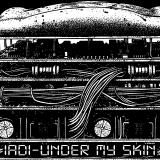
Between flesh and silicon. “Under My Skin” (2026) is the first album by IADI, released by Neo Life. A record like few
others, highly conceptual, cover art included. Its essence lies in the folds of the increasingly ambiguous relationship
between man and machine, where the former designs the latter and, perhaps without fully realizing it, is gradually
destined to adapt and be reprogrammed by it. Each track of “Under My Skin” is, in fact, a sort of interface, connector, or
any other imaginative point of contact between two creative phases, amid emotional impulses and binary calculations.
The sonic architecture oscillates between analog warmth and algorithmic coldness, constructing landscapes in which
pulsating synthesizers and mechanical rhythms seem to question each other. There's no linear narrative, but rather a
progressive immersion in a zone of near-friction, where the comfort of technology coexists with more than a faint
musical uneasiness, like a background noise that never ceases to remind you who's truly in charge. In “Under My Skin”,
the machine is neither an enemy nor a simple instrument: it's a real presence, intimate, even tactile, amplifying desires,
fears, and dreams of dawns beyond the digital realm. Intelligent dance music. Less noise, more sensations. Electronic,
but profoundly human.
The final result, then, is a music project that speaks to the present, yet sounds like an X-ray of the future, capturing that
fragile moment when humanity and technology stop observing each other from afar and begin to merge, track after
track. It's no coincidence that IADI's album opens with “Impulse”, an immediate expression of an electrical impulse, for
both humans and machines, which is also the language of the nervous system, as fast as it is vital—pure energy and
rhythm, a track as intense as it is irregular. And after this introduction, it's the turn of the equally erratic “Axon”, whose
title describes the neuron that transmits the signal over distance, telling the listener to sit back and relax for a new
journey through the notes toward the more melodic “Cortex”. The cerebral cortex, the ultimate seat of thought and
memory, becomes the source from which the musical flow of the first part of the work is drawn.
Then, suddenly, an automatic, or instinctive, response to the constant succession of impulses: “Reflex”, or zerotemperature techno, with a fragmented pace, featuring vocal samples, breaks, and restarts. In the producer's
imagination, the subsequent, and conversely placid, “Neuron” represents the emotional core of the second part of the
work, providing a kind of respite from the seething vibrations. While the neuron is the basic unit of the nervous system,
the synapse is the functional connection point between one neuron and another effector cell, essential for the
transmission of nerve impulses and communication in the nervous system, enabling functions such as learning and
movement. Likewise, a track like “Synapse” once again illuminates the path traced by IADI. The more experimental and
streamlined “Static” instead suggests true ordered chaos. “Dreamstate” is the conclusion suspended in the void, relating
to that dreamlike state between waking and sleeping, where consciousness fades toward infinity and visions begin. Pure
fading into the subconscious. Eternal return to where it all began. Dancing is a form of consciousness. Every beat is a
question. IADI, however, holds all the answers you need.
- A1: Choir Of Horrors
- A2: Akasha Chronicle
- A3: Weeping Willow
- A4: Lycantropus Erectus
- B1: Münchhausen Syndrom
- B2: Cautio Criminalis
- B3: Northern Command
- B4: Weena
- C1: Choir Of Horrors (Coh Pre-Production)
- C2: Weeping Willow (Coh Pre-Production)
- C3: Münchhausen Syndrom (Coh Pre-Production)
- C4: Lycantropus Erectus (Coh Pre-Production)
- C5: Northern Command (Coh Pre-Production)
- C6: Indescent Assault Of The Tribe (Coh Pre-Production)
- D1: Birth Of A Second Individual
- D2: Psychomorphia
- D3: Right For Unright
- D4: M.a.n.i.a.c
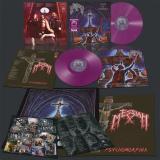
With bands such as Hellhammer/Celtic Frost and Coroner, but also more obscure formations such as Fear Of God, Excruciation, and Infected, Switzerland has always been a fertile breeding ground for extreme metal. Messiah, originally formed in 1984, also played a major role in the development of thrash and death metal in Switzerland. They released two groundbreaking albums on Chainsaw Murder Records: “Hymn To Abramelin” in 1986 and “Extreme Cold Weather” a year later. In the early nineties, Messiah signed a contract with Karl Walterbach's label Noise Records, on which three more albums were released: “Choir Of Horrors” (1991), “Rotten Perish” (1992), and “Underground” (1994). The classic lineup of Messiah during the Noise era consisted of vocalist Andy Kaina, who passed away far too early in 2022, Steve Karrer on drums, Patrick Hersche on bass, and band founder Brögi on guitar. Many consider “Choir Of Horrors” from 1991, produced by Sven Conquest at Sky Trak Studios in Berlin, to be the pinnacle of Messiah's work. Messiah Infernal Thrashing Records (MITR) is now releasing the 35th anniversary edition of this classic on vinyl