UILTY RAZORS, BONA FIDE PUNKS.
Writings on the topic that go off in all directions, mind-numbing lectures given by academics, and testimonies, most of them heavily doctored, from those who “lived through that era”: so many people today fantasize about the early days of punk in our country… This blessed moment when no one had yet thought of flaunting a ridiculous green mohawk, taking Sid Vicious as a hero, or – even worse – making the so-called alternative scene both festive and boorish. There was no such thing in 1976 or 1977, when it wasn’t easy to get hold of the first 45s by the Pistols or the Clash. Few people were aware of what was happening on the fringes of the fringes at the time. Malcolm McLaren was virtually unknown, and having short hair made you seem strange. Who knew then that rock music, which had taken a very bad turn since the early 1970s, would once again become an essential element of liberation? That, thanks to short and fast songs, it would once again rediscover that primitive, social side that was so hated by older generations? Who knew that, besides a few loners who read the music press (it was even better if they read it in English) and frequented the right record stores? Many of these formed bands, because it was impossible to do otherwise. We quickly went from listening to the Velvet Underground to trying to play the Stooges’ intros. It’s a somewhat collective story, even though there weren’t many people to start it.
The Guilty Razors were among those who took part in this initial upheaval in Paris. They were far from being the worst. They had something special and even released a single that was well above the national average. They also had enough songs to fill an album, the one you’re holding. In everyone’s opinion, they were definitely not among the punk impostors that followed in their wake. They were, at least, genuine and credible.
Guilty Razors, Parisian punk band (1975-1978). To understand something about their somewhat linear but very energetic sound, we might need to talk about the context in which it was born and, more broadly, recall the boredom (a theme that would become capital in punk songs) coupled with the desire to blow everything off, which were the basis for the formation of bands playing a rejuvenated rock music ; about the passion for a few records by the Kinks or the early Who, by the Stooges, by the Velvet mostly, which set you apart from the crowd.
And of course, we should remember this new wave, which was promoted by a few articles in the specialized press and some cutting-edge record stores, coming from New York or London, whose small but powerful influence could be felt in Paris and in a handful of isolated places in the provinces, lulled to sleep by so many appalling things, from Tangerine Dream to President Giscard d’Estaing...
In 1975-76, French music was, as almost always, in a sorry state ; it was still dominated by Johnny Hallyday and Sylvie Vartan. Local rock music was also rather bleak, apart from Bijou and Little Bob who tried to revive this small scene with poorly sound-engineered gigs played to almost no one.
In the working class suburbs at the time, it was mainly hard rock music played to 11 that helped people forget about their gruelling shifts at the factory. Here and there, on the outskirts of major cities, you still could find a few rockers with sideburns wearing black armbands since the death of Gene Vincent, but it wasn’t a proper mass movement, just a source of real danger to anyone they came across who wasn't like them. In August 1976, a festival unlike any other took place in Mont-de-Marsan – the First European Punk Festival as the poster said – with almost as many people on stage as in the audience. Yet, on that day, a quasi historical event happened, when, under the blazing afternoon sun, a band of unknowns called The Damned made an unprecedented noise in the arena, reminiscent of the chaotic Stooges in their early adolescence. They were the first genuine punk band to perform in our country: from then on, anything was possible, almost anything seemed permissible.
It makes sense that the four+1 members of Guilty Razors, who initially amplified acoustic guitars with crappy tape recorder microphones, would adopt punk music (pronounced paink in French) naturally and instinctively, since it combines liberating noise with speed of execution and – crucially – a very healthy sense of rebellion (the protesters of May 1968 proclaimed, and it was even a slogan, that they weren’t against old people, but against what had made them grow old. In the mid-1970s, it seemed normal and obvious that old people should now ALSO be targeted!!!).
At the time, the desire to fight back, and break down authority and apathy, was either red or black, often taking the form of leafleting, tumultuous general assemblies in the schoolyard, and massive or shabby demonstrations, most of the time overflowing with an exciting vitality that sometimes turned into fights with the riot police. Indeed, soon after the end of the Vietnam War and following Pinochet’s coup in Chile, all over France, Trotskyist and anarcho-libertarian fervour was firmly entrenched among parts of the educated youth population, who were equally rebellious and troublemakers whenever they had the chance. It should also be noted that when the single "Anarchy in the UK" was first heard, even though not many of us had access to it, both the title and its explosive sound immediately resonated with some of those troublemakers crying out for ANARCHY!!! Meanwhile, the left-wing majority still equated punks with reckless young neo-Nazis. Of course, the widely circulated photos in the mainstream press of Siouxsie Sioux with her swastikas didn’t necessarily help to win over the theorists of the Great Revolution. It took Joe Strummer to introduce The Clash as an anti-racist, anti-fascist and anti-ignorance band for the rejection of old-school revolutionaries to fade a little.
The Lycée Jean-Baptiste Say at Porte d’Auteuil, despite being located in the very posh and very exclusive 16th arrondissement of Paris, didn’t escape these "committed" upheavals, which doubled as the perfect outlet for the less timid members of this generation.
“Back then, politics were fun,” says Tristam Nada, who studied there and went on to become Guilty Razors’ frontman. “Jean-Baptiste was the leftist high-school in the neighbourhood. When the far right guys from the GUD came down there, the Communist League guys from elsewhere helped us fight them off.”
Anything that could challenge authority was fair game and of course, strikes for just about any reason would lead to increasingly frequent truancy (with a definitive farewell to education that would soon follow). Tristam Nada spent his 10th and 11th unfinished grades with José Perez, who had come from Spain, where his father, a janitor, had been sentenced to death by Franco. “José steered my tastes towards solid acts such as The Who. Like most teenagers, I had previously absorbed just about everything that came my way, from Yes to Led Zeppelin to Genesis. I was exploring… And then one day, he told me that he and his brother Carlos wanted to start a rock band.” The Perez brothers already played guitar. “Of course, they were Spanish!”, jokes their singer. “Then, somewhat reluctantly, José took up the bass and we were soon joined by Jano – who called himself Jano Homicid – who took up the rhythm guitar.” Several drummers would later join this core of not easily intimidated young guys who didn’t let adversity get the better of them.
The first rehearsals of the newly named Guilty Razors took place in the bedroom of a Perez aunt. There, the three rookies tried to cover a few standards, songs that often were an integral part of their lives. During a first, short gig, in front of a bewildered audience of tough old-school rockers, they launched into a clunky version of the Velvet Underground's “Heroin”. Challenge or recklessness? A bit of both, probably… And then, step by step, their limited repertoire expanded as they decided to write their own songs, sung in a not always very accurate or academic English, but who cared about proper grammar or the right vocabulary, since what truly mattered was to make the words sound as good as possible while playing very, very fast music? And spitting out those words in a language that left no doubt as to what it conveyed mattered as well.
Trying their hand a the kind of rock music disliked by most of the neighbourhood, making noise, being fiercely provocative: they still belonged to a tiny clique who, at this very moment, had chosen to impose this difference. And there were very few places in France or elsewhere, where one could witness the first stirrings of something that wasn’t a trend yet, let alone a movement.
In the provinces, in late 1976 or early 1977, there couldn’t be more than thirty record stores that were a bit more discerning than average, where you could hear this new kind of short-haired rock music called “punk”. The old clientele, who previously had no problem coming in to buy the latest McCartney or Aerosmith LP, now felt a little less comfortable there…
In Paris, these enlightened places were quite rare and often located nex to what would become the Forum des Halles, a big shopping mall. Between three aging sex workers, a couple of second-hand clothes shops, sellers of hippie paraphernalia and small fashion designers, the good word was loudly spread in two pioneering places – propagators of what was still only a new underground movement. Historically, the first one was the Open Market, a kind of poorly, but tastefully stocked cave. Speakers blasted out the sound of sixties garage bands from the Nuggets compilation (a crucial reference for José Perez) or the badly dressed English kids of Eddie and the Hot Rods. This black-painted den was opened a few years earlier by Marc Zermati, a character who wasn’t always in a sunny disposition, but always quite radical in his (good) choices and his opinions. He founded the independent label Skydog and was one of the promoters of the Mont-de-Marsan punk festivals. Not far from there was Harry Cover, another store more in tune with the new New York scene, which was amply covered in the house fanzine, Rock News (even though it was in it that the photos of the Sex Pistols were first published in France).
It was a favorite hang-out of the Perez brothers and Tristam Nada, as the latter explained. “It’s at Harry Cover’s that we first heard the Pistols and Clash’s 45s, and after that, we decided to start writing our first songs. If they could do it, so could we!”
The sonic shocks that were “Anarchy in the UK”, “White Riot” or the Buzzcocks’s EP, “Spiral Scratch” – which Guilty Razors' sound is reminiscent of – were soon to be amplified by an unparalleled visual shock. In April 1977, right after the release of their first LP, The Clash performed at the Palais des Glaces in Paris, during a punk night organised by Marc Zermati. For many who were there, it was the gig of a lifetime…
Of course, Guilty Razors and Tristam were in the audience: “That concert was fabulous… We Parisian punks were almost all dressed in black and white, with white shirts, skinny leather ties, bikers jackets or light jackets, etc. The Clash, on the other hand, wore colourful clothes. Well, the next day, at the Gibus, you’d spot everyone who had been at this concert, but they weren’t wearing anything black, they were all wearing colours.”
It makes sense to mention the Gibus club, as Guilty Razors often played there (sometimes in front of a hostile audience). It was also the only place in Paris that regularly scheduled new Parisian or Anglo-Saxon acts, such as Generation X, Siouxsie and the Banshees, the Slits, and Johnny Thunders who would become a kind of messed-up mascot for the venue. A little later, in 1978, the Rose Bonbon – formerly the Nashville – also attracted nightly owls in search of electric thrills… In 1977, the iconic but not necessarily excellent Asphalt Jungle often played at the Gibus, sometimes sharing the bill with Metal Urbain, the only band whose aura would later transcend the French borders (“I saw them as the French Sex Pistols,” said Geoff Travis, head of their British label Rough Trade). Already established in this small scene, Metal Urbain helped the young and restless Guilty Razors who had just arrived. Guitarist for Metal Urbain Hermann Schwartz remembers it: “They were younger than us, we were a bit like their mentors even if it’s too strong a word… At least they were credible. We thought they were good, and they had good songs which reminded of the Buzzcocks that I liked a lot. But at some point, they started hanging out with the Hells Angels. That’s when we stopped following them.”
The break-up was mutual, since, Guilty Razors, for their part, were shocked when they saw a fringe element of the audience at Metal Urbain concerts who repeatedly shouted “Sieg Heil” and gave Nazi salutes. These provocations, even still minor (the bulk of the skinhead crowd would later make their presence felt during concerts), weren’t really to the liking of the Perez brothers, whose anti-fascist convictions were firmly rooted. Some things are non-negotiable.
A few months earlier (in July 1978), Guilty Razors had nevertheless opened very successfully for Metal Urbain at the Bus Palladium, a more traditonally old-school rock night-club. But, as was sometimes the case back then, the night turned into a mass brawl when suburban rockers came to “beat up punks”.
Back then, Parisian nights weren’t always sweet and serene.
So, after opening as best as they could for The Jam (their sound having been ruined by the PA system), our local heroes were – once again – met outside by a horde of greasers out to get them. “Thankfully,” says Tristam, “we were with our roadies, motorless bikers who acted as a protective barrier. We were chased in the neighbouring streets and the whole thing ended in front of a bar, with the owner coming out with a rifle…”
Although Tristam and the Perez brothers narrowly escaped various, potentially bloody, incidents, they weren’t completely innocent of wrongdoing either. They still find amusing their mugging of two strangers in the street for example (“We were broke and we simply wanted to buy tickets for the Heartbreakers concert that night,” says Tristam). It so happened that their victims were two key figures in the rock business at the time: radio presenter Alain Manneval and music publisher Philippe Constantin. They filed a complaint and sought monetary compensation, but somehow the band’s manager, the skilful but very controversial Alexis, managed to get the complaint withdrawn and Guilty Razors ended up signing with Constantin with a substantial advance.
They also signed with Polydor and the label released in 1978 their only three-track 45, featuring “I Don't Wanna be A Rich”, “Hurts and Noises” and “Provocate” (songs that exuded perpetual rebellion and an unquenchable desire for “class” confrontation). It was a very good record, but due to a lack of promotion (radio stations didn’t play French artists singing in English), it didn’t sell very well. Only 800 copies were allegedly sold and the rest of the stock was pulped… Initially, the three tracks were to be included on a LP that never came to be, since they were dropped by Polydor (“Let’s say we sometimes caused a ruckus in their offices!” laughs Tristam.) In order to perfect the long-awaited LP, the band recorded demos of other tracks. There was a cover of Pink Floyd's “Lucifer Sam” from the Syd Barrett era – proof of an enduring love for the sixties’ greats –, “Wake Up” a hangover tale and “Bad Heart” about the Baader-Meinhof gang, whose actions had a profound impact on the era and on a generation seeking extreme dissent... On the album you’re now discovering, you can also hear five previously unreleased tracks recorded a bit later during an extended and freezing stay in Madrid, in a makeshift studio with the invaluable help of a drummer also acting as sound engineer. He was both an enthusiastic old hippie and a proper whizz at sound engineering. Here too, certain influences from the fifties and sixties (Link Wray, the Troggs) are more than obvious in the band’s music.
Shortly after a final stormy and rather barbaric (on the audience’s side) “Punk night” at the Olympia in June 1978, Tristam left the band ; his bandmates continued without him for a short while.
But like most pioneering punk bands of the era, Guilty Razors eventually split up for good after three years (besides once in Spain, they’d only played in Paris). The reason for ceasing business activities were more or less the same for everyone: there were no venues outside one’s small circuit to play this kind of rock music, which was still frightening, unknown, or of little interest to most people. The chances of recording an LP were virtually null, since major labels were only signing unoriginal but reassuring sub-Téléphone clones, and the smaller ones were only interested in progressive rock or French chanson for youth clubs. And what about self-production? No one in our small safety-pinned world had thought about it yet. There wasn’t enough money to embark on that sort of venture anyway.
So yes, the early days of punk in France were truly No Future!
Поиск:designer
Все
- A1: Firkit Americana Show - Seeb Alby
- A2: Al Massrieen - Afifa El Hawa
- A3: Firkit Hany Shenoda - Lounga 85
- A4: Mostafa El Sakka - Rezq El Ein
- A5: Hamid El Shaeri - Ouda
- B1: Firkit El Pharana - Ya Habiby
- B2: Omar Fathy - Beteghdaby
- B3: Ammar El Sherei - Souq
- B4: Medhat Saleh - El Milionerat
- B5: Aida El Ayoubi - Asfour
- B6: Ahmed Adaweya - Little Up
Wewantsounds is delighted to release Ayam El Disco, a new selection of Egyptian 1980s disco and boogie cassette tracks curated by Egyptian DJ Disco Arabesquo, following his highly acclaimed Sharayet El Disco. Most tracks make their vinyl debut in this set. A journey through the funky sounds of 1980s Egypt, Ayam El Disco ("Disco Days") features Ammar El Sherei, Al Massrieen, and other underground artists from Cairo's vibrant cassette culture. The audio has been remastered for vinyl by David Hachour at Colorsound Studio in Paris, and the LP features artwork by Egyptian graphic designer Heba Tarek, along with a 2-page insert showcasing the original cassette artwork and insightful liner notes by Moataz Rageb.
Building upon the striking elegance of their first collaboration, Tobias Freund and Shun Watanabe reunite as Tobias. Doltz. for another extended excursion into designer electronica with a warm, dubby glow at its centre. Their first album Versus arrived on Delsin in early 2025 as a result of a chance meeting at Eden Festival the year before. The spark of inspiration led quickly to a complete and coherent first body of work, and the same can be said for its prompt, equally inspired follow-up. Dealing in the gentle hum of digitally sculpted ambience and needlepoint micro-pulses, Freund and Watanabe evoke the experimental spirit and mellow immersion of golden-era clicks n' cuts techno. While that early 00s phenomenon sometimes cracked around the edges of its DSP limitations, here a rich and porous sound world blooms out from the crisply defined structure of each track. At times the palette opens up to more organic sound matter, and there is ample space for full-bodied synths to ratchet down the rhythm, but a strong digital core of granular processing and exacting sound design form the bedrock of the album's subtle, sublime sound. Even though its calm demeanour radiates an instant charm, like all great electronica Frontiers Of Science is an album of hidden depths to be absorbed steadily over subsequent trips.
- A1: Intro
- A2: Off The Turnpike
- A3: Tripleback Tuck
- A4: New Dance Show (Feat. Boldy James)
- B1: Youngblood Priest
- B2: Just The Three Of Us
- B3: Large Step! (Feat. Blu)
- B4: Perceived Merits
- C1: Calculated Risks (Feat. Theravada)
- C2: Coffee Into Coins (Feat. Dreamcastmoe)
- C3: Thx-1138 (Feat. Genevieve Artadi)
- C4: Flick Of The Wrist (Feat. Grip)
- D1: The Amazing Randi (Feat. Kool Keith & Fatboi Sharif)
- D2: This Or That
- D3: Tell Me Something Different
Real Bad Man and YUNGMORPHEUS are excited to announce their new album The Chalice & The Blade is out now. The album features Boldy James, Kool Keith, Grip, Blu, Fatboi Sharif, and more.
YUNGMORPHEUS is a highly innovative rapper that consistently endeavors to redefine the boundaries of originality and elevate the art of lyricism. Earlier this year, YUNGMORPHEUS dropped his critically acclaimed album “From Whence It Came” which received praise from The FADER, NPR, SPIN, and was hailed by QUIP Mag as “Everything you need from a hip-hop record.”
Since 2020, Prolific LA-based producer and designer Adam Weissman (Real Bad Man) has been on a sensational run releasing albums with Boldy James, Smoke DZA, and Pink Siifu. The Chalice & The Blade will be Real Bad Man’s third album of the year following his remarkable collaborations with Blu (“Bad News”) and Kool Keith (“Serpent”).
The Chalice & The Blade showcases a unique ambiance marked by a stoney and atmospheric quality, interspersed with elements of funk. Real Bad Man explains the album making process, "I always tailor the music to the artist I’m collaborating with. I sent Morpheus a bunch of beats that he’d sound good over and once he started picking them, that set the path. We’d record and I’d make more beats, and move stuff around, get rid of some songs and record new ones. It was a good process. I like being able to adjust as we go, I think that makes for a good album. We left some songs on the cutting room floor. Cream rises."
YUNGMORPHEUS discussing the new album, “‘The Chalice & The Blade’ is an album primarily rooted in dichotomies; contemplation of action vs action itself, inner locus vs outer locus, pursuit for self vs pursuit for others. Honesty is always the centerpiece. Play if you want cause I’m not!”
On The Chalice & The Blade, the seamless synergy between Real Bad Man and YUNGMORPHEUS takes center stage, showcasing an extraordinary chemistry that elevates every track to new heights of musical innovation.
Audaciously innovative sound designer/producer/live artist Enrico Sangiuliano reaches #0 in his countdown from ‘NINETOZERO’ on his eponymous ephemeral imprint, triggering its built-in autodestruct by the release of provocative 3-track EP ‘Absence’, out March 19th on vinyl & digital. The digital EP will also feature an Edit of ‘Step Into The End’.
The Italian tech maestro and artistic pioneer eschews populism, yet still storms charts & wins hearts – notably/recently in his unsettling, compelling manifesto x battle cry ‘The Techno Code’. Says Enrico of his label, ‘NINETOZERO is a cycle of listening, making, and letting go. Born from silence, shaped by space, directed by reflection, altered by change, revealed by glitch, unified through interconnection, lifted toward transcendence, refined by discipline, clarified by chaos, and finally returned to absence.’
On his ‘Absence’ EP: ‘With ‘Absence’ we come full circle, back to the womb of nothingness but charged with the echo of everything we have experienced. It is an ending, yes, but also an invitation. A new kind of silence is born, shaped by the memory of every frequency we unleashed.’ Enrico Sangiuliano can thrill listeners with his music, but dares to challenge, to trust them.
Main track ‘Step Into The End’: a full-on barrage of trustworthy techno danceability & energy, bookended by soulful violin, high horns & sirens, with spoken incantations as if summoning to a sacred rite. A ten-minute timeless dance track as ‘all we’ve learned converges into a single point where presence & silence merge.’
Title track ‘Absence’: The (Techno Code-esque) Voice speaks of sound, space, absence, trace... the track’s background noise is the almost- silence of his studio ‘through a magnifying glass’.. His breathing can just be heard in the recording. Melodic, beautiful, free-form chords in the middle section act like a breakdown in reverse. ‘A provocation, a track of silence, incidental noise. A tale of a story that just finished, but also a background for a story to be shaped. No one is intentionally performing for us. Here, the responsibility and work of listening is on you, to figure out what you can hear and what to make of it, to craft your own soundtrack based on the sounds that surround you, beyond the track. You can perform your own version yourself. Close your eyes and just listen. Engage with your environment. Be present. Expand your senses. Enjoy absence.’
‘The Aftermath’: a 40-second provocative coda. A snatch of stirring conversation signing off the EP and label alike. What will be launched post-zero by Enrico Sangiuliano? Watch this space, this absence.
- 1: Live From Mumbai 00:36
- 2: No Other Than 04:03
- 3: Powerman & Iron Fist (Fighting Without Fighting Version) 0:00
- 4: Sure Shot! 03:32
- 5: Fresh Like Dougie 04:42
- 6: How To Cut & Paste (Lesson 1) 04:54
- 7: Audobahn 03:56
- 8: All Out War 03:46
- 9: Break Down 03:24
- 10: Golden Crown (Feat. Oxygen) 04:52
- 11: Fashion Plate 04:13
- 12: Sister Of Phyllis Diller 04:01
- 13: Heroes Of The East (Feat. Paten Locke) 04:21
- 14: The Pack Up (Part 3) 02:44
RED & YELLOW SPLATTER Vinyl[29,20 €]
Expanded Edition Double Cassette Box Set including main album and Bonus Cassette with unique download cards
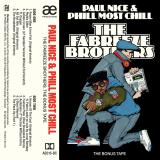
AE Productions in association with Sure Shot Recordings and In Effect Recordings are pleased to announce a 10 Year Anniversary Edition of the critically acclaimed Phill Most Chill and Paul Nice album as the Fabreeze Brothers.
The hugely successful first edition which was pressed on colour vinyl and supplied in double fold out sleeve sold out in only 2 weeks from release date and then the 2nd pressing black vinyl edition sold out a little while later but has for years been out of print but is increasingly requested by shops, via email, social media, AE Productions website back in stock requests, etc…
As it has been 10 years since original release back in 2015 at the time of proceeding with manufacturing, it was the perfect opportunity to do a 3rd pressing to mark the anniversary but we had to pull out all the stops for a 3rd run of this incredible album and also make it subtly different again in packaging design from the 1st and 2nd pressings so that each has it’s own particular feel and quality.
With help from the original designer and all-round vinyl artwork supremo Mr Krum we have found some nice adjustments for the gatefold sleeve where the detail from the insert sheet found in the original issues is incorporated into the inside panels of the sleeve. We have also tweaked the hype sticker to mark the 10th Anniversary Edition and updated the vinyl labels so as to work better with the new Splatter vinyl which follows the original red and yellow vinyl but each splattered with the opposite colour.
For something a little extra we have compiled a Limited Expanded Edition Double Cassette Box Set that includes the original album and also a ‘Bonus Tape’ which features all of the remixes, alternate versions, Original Versions of album cuts and bonus tracks found on B-sides of the array of singles and we included for good measure 2 tracks that only appeared on the promotional only LP sampler that ended up being different on the final release. This is limited to cassette just for the non-vinyl heads as all of these tracks already appear on vinyl. The outer box is A5 card in black with gold foil Fabreeze Brothers logo and comes with discography booklet.
‘The Bonus Tape’ from the box set is also available as a standalone cassette release with alternate j-card art work so that it has it’s own flavour and so that anyone that purchased one of the original run of cassettes that sold out before we could even ship any copies, did not need to purchase the main album again unnecessarily and to make it noticeable from the Expanded Edition Box Set version.
This version also has an alternate shell design in keeping with the clear shell with dark liner that was commonplace back in the 90’s and the cassette geeks may note the red text on the spine as was also a common design back then – giving this a pseudonym of ‘the 90’s tape’ during the design process.
We couldn’t stop there so we also have an extremely low quantity Limited Edition Mini Disc version which is the main album plus 8 of the bonus tracks from The Bonus Tape – only missing the 2 least significant alternate versions but clocking in at just a few seconds under 80 minutes – the absolute maximum for the format! Mini Disc???!!! You’re probably asking – yes!
While looking into the cassette duplication options we realised that the duplicator also offers Mini Disc production so we thought that it may be worth doing a very small run just because not only are professionally manufactured Mini Disc’s rare in Hip Hop, they are rare within the entire music industry as they never really took off as a medium to purchase music but ended up as the choice for home recorded Walkman and car use. Indeed, AE boss Mr Fantastic still has his main machine, portable and old discs. Amazingly also, the sleeve artwork transferred brilliantly to the Mini Disc template. They are manufactured using high quality Sony discs using ATRAC 4.5 codec.
All releases are supplied with unique free download codes on cards that are included inside the packaging but also with the Expanded Edition cassette and Mini Disc having 2 cards – 1 for the main album and a 2nd card for ‘The Bonus Tape’. The free downloads are supplied direct from Phill Most Chill’s Bandcamp page keeping it independent.
I Made It All Up For You is the new record by Hugo Race Fatalists, their 6th studio album, set for release March 20, 2026 thru Gusstaff Records / Helixed on LP/CD and digital.
"In his 40-year career, Hugo Race has lived a thousand lives and played the role of songwriter, producer, musician, performer, head of a record label (Helixed). His music went from folk to lounge, from "trance industrial blues" to psychedelia, from world music to electronics. Starting from post-punk Melbourne in the 1980s, he took fascinating paths that led him from Africa to Turkey, from Berlin to Romagna…"
Hugo Race returns after highly successful collaborative albums with Michelangelo Russo (100 Years), The Church frontman Steve Kilbey (Speed of the Stars) and Gianni Maraccolo (The Vigil, winner of the prestigious Premio Ciampi) with I Made It All Up For You, an epic album with his Italian band Fatalists - existential songwriting framed by the band's signature fusion of roots music, electronica, Italian soundtracks and desert rock.
"I wanted to create something melodic and beautiful in defiance of our current reality. The songs started as bare acoustic sketches written in a remote mountain cabin in Italy where I had two weeks off during a solo tour. The weather turned into a raging blizzard, the days a struggle to keep the wood fire lit and the smoke out of the house. I wrote about twelve songs, threw them all away, started again with an unplugged electric guitar in front of that
damp fire, searching for the album's theme. When the smoke cleared, I was at the crossroads of a long term relationship unraveling under a blazing antipodean sun.
Fatalists recorded the basic tracks at the floating studio on the Puccini lake an hour out of Florence - Giovanni Ferrario (Scisma, PJ Harvey) on guitars and synth, Francesco Giampaoli (Brutture Moderne) on bass and Diego Sapignoli (Sacri Cuori) on percussion.
Violinist Massimiliano Gallo met me in Sicily for a short tour to learn the new songs, adding layers of his Calabrian magic to the mix. Jennifer Charles (singer of New York band Elysian Fields) and I had been talking for a long time about making new music and this was the occasion when we made it happen. Jennifer's distinctive voice graces this
album on the songs I Collide and Broken Love, the lyrics of which were written by author and designer Alannah Hill. My longtime road brother Michelangelo Russo also dusts the tracks with his otherworldly electric harmonica on Against The World, Born To Fly and Open Field. A lot of joy and pain and reflection went into the making of this album and I hope that comes across; this is about the darkness yes, but also the light. Everything changes and every ending is a new beginning but it's how we experience transformation that really matters. I hope you love this album. I made it all up for you."
Hugo Race, Naples, 2025
I Made It All Up For You is the new record by Hugo Race Fatalists, their 6th studio album, set for release March 20, 2026 thru Gusstaff Records / Helixed on LP/CD and digital.
"In his 40-year career, Hugo Race has lived a thousand lives and played the role of songwriter, producer, musician, performer, head of a record label (Helixed). His music went from folk to lounge, from "trance industrial blues" to psychedelia, from world music to electronics. Starting from post-punk Melbourne in the 1980s, he took fascinating paths that led him from Africa to Turkey, from Berlin to Romagna…"
Hugo Race returns after highly successful collaborative albums with Michelangelo Russo (100 Years), The Church frontman Steve Kilbey (Speed of the Stars) and Gianni Maraccolo (The Vigil, winner of the prestigious Premio Ciampi) with I Made It All Up For You, an epic album with his Italian band Fatalists - existential songwriting framed by the band's signature fusion of roots music, electronica, Italian soundtracks and desert rock.
"I wanted to create something melodic and beautiful in defiance of our current reality. The songs started as bare acoustic sketches written in a remote mountain cabin in Italy where I had two weeks off during a solo tour. The weather turned into a raging blizzard, the days a struggle to keep the wood fire lit and the smoke out of the house. I wrote about twelve songs, threw them all away, started again with an unplugged electric guitar in front of that
damp fire, searching for the album's theme. When the smoke cleared, I was at the crossroads of a long term relationship unraveling under a blazing antipodean sun.
Fatalists recorded the basic tracks at the floating studio on the Puccini lake an hour out of Florence - Giovanni Ferrario (Scisma, PJ Harvey) on guitars and synth, Francesco Giampaoli (Brutture Moderne) on bass and Diego Sapignoli (Sacri Cuori) on percussion.
Violinist Massimiliano Gallo met me in Sicily for a short tour to learn the new songs, adding layers of his Calabrian magic to the mix. Jennifer Charles (singer of New York band Elysian Fields) and I had been talking for a long time about making new music and this was the occasion when we made it happen. Jennifer's distinctive voice graces this
album on the songs I Collide and Broken Love, the lyrics of which were written by author and designer Alannah Hill. My longtime road brother Michelangelo Russo also dusts the tracks with his otherworldly electric harmonica on Against The World, Born To Fly and Open Field. A lot of joy and pain and reflection went into the making of this album and I hope that comes across; this is about the darkness yes, but also the light. Everything changes and every ending is a new beginning but it's how we experience transformation that really matters. I hope you love this album. I made it all up for you."
Hugo Race, Naples, 2025
- 1: Skull Chamber
- 2: The Venus And The Sorcerer
- 3: Panel Of The Lions
- 4: Hillaire Chamber
- 5: Candle Gallery
- 6: Chamber Of The Bear Hollows (North)
- 7: Chamber Of The Bear Hollows (South) & Brunel Chamber
- 8: Entrance Chamber
Demetrio Castellucci and Massimo Pupillo present the music of Sleep Technique, a performance by Dewey Dell inspired by the Chauvet cave and its ancient cave paintings.
The music comes to life anew on record, an immersion into the depths of sonic particles, moist electroacoustic rhythms, the repeated forms of speleothems, and the electric bass that scrapes the walls, shaping them into concave or convex surfaces. A voice that moves incredibly slowly, yet is in constant motion, like the millennia-old, unceasing erosion of water.
The album’s journey follows the geography of the cave in reverse, moving from its deepest chamber back to the entrance.
Demetrio Castellucci is a composer and sound designer who has been involved in theater productions, choreography, and film since 2004. Around the same time, he began performing as a DJ, favoring an omnitemporal approach geared toward dance that transcends musical genres. Since 2006, he has been a member of the dance company Dewey Dell, and since 2007, he has been active as Black Fanfare, a maximalist electroacoustic project. He has collaborated on performances by Andreco and Enrico Ticconi/Ginevra Panzetti, as well as on films by Ahmed Ben Nessib, Beatrice Pucci, and Ilaria di Carlo. After living in London and Berlin, he settled in Vilnius, where in 2018 he founded Unarcheology, a digital platform that publishes music and radio programs. He is also active as Airport Gad, an ambient project which, together with Unarcheology, launched its own “Airline Company”: concerts in a flight simulator built from cardboard, where the pilots are also the musicians.
Massimo Pupillo is best known as a founding member of the band Zu, with whom he has released 18 albums and performed over 2,000 live shows worldwide. He has maintained a highly open and multidisciplinary approach that has led him to work with some of the most acclaimed figures in the contemporary art world: South African photographer Roger Ballen, actors Malcolm McDowell and Marton Csokas, Romeo Castellucci and Chiara Guidi of Societas Raffaello Sanzio, American choreographer Meg Stuart, poet Anne Waldman, and Italian poet Gabriele Tinti, among others. He has collaborated live and in the studio with avant-garde musicians and composers such as Alvin Curran, piano duo Katia & Marielle Labèque, and classical virtuosos like Viktoria Mullova and Giovanni Sollima. He has also worked with some of the most influential names in the international rock scene, including Mike Patton, Thurston Moore, Jim O’Rourke (Sonic Youth), Guy Picciotto & Joe Lally (Fugazi), Buzz Osborne (Melvins), and Damo Suzuki (CAN).
In the field of improvised music, he has collaborated with Peter Brötzmann, Toshinori Kondo, Mats Gustafsson, Ken Vandermark, and Tony Buck, among others. Within the experimental music scene, his collaborations include Oren Ambarchi, David Tibet (Current 93), Thighpaulsandra (Coil), Stephen O’Malley (Sunn O))), Abul Mogard, Mick Harris (Scorn), Gordon Sharp (This Mortal Coil), FM Einheit (Einstürzende Neubauten), and many more. In cinema, he composed the score for Kirill Serebrennikov’s film LIMONOV, presented at Festival de Cannes in 2024.
Slippery Yard’s second ecosystem lands with “Induction”, a delicate hypnotic pack from Berlin based producer Danieli. With remarkable tribal sound aesthetics, the EP is an evolution of polimetrics and driving essence. This time Utrecht based fellow producer Vand provide us another trancy perspective of the surface of Slippery Yard biome. Biggest mention to our beloved ecosystem designer @fredonne for delivering such a high quality 3D exploration of the new discovered ecosystem, incredible match!
- Side A. Gtg Feat. Reina
- Side B. Gtg Feat. Reina (Instrumental)
DJ Mitsu the Beats, a globally active member of the Sendai-based hip-hop crew GAGLE, teams up with R&B singer reina from the creative collective and label w.a.u for
the new track "Gtg" now released as a 7-inch single.
The song is a bittersweet and ephemeral love track that expresses straightforward emotions and feelings, as if wandering toward the endlessly stretching sea.
The laid-back, jazzy beats and piano by DJ Mitsu the Beats, reina’s smooth and comforting vocals, and Kzyboost’s emotional talk box blend together into a mellow groove,
creating an alternative R&B sound that evokes the chill of the ocean.
The jacket artwork is a collaborative design featuring ocean photography by Yasuma Miura, a photographer based in Shonan and Kamakura who travels the world while surfing,
and design by So Iguchi (soiguchi design), a designer known for his work on outdoor brand catalogs and lookbooks.
clear vinyl[11,35 €]
Sun Electric - the legendary Berlin duo of Tom Thiel and Max Loderbauer - returns with Episodes, an enticing new album. While the pair has been active and creating over the years (remember their track 'Every Now And Then' on the 10 Years De:tuned compilation in 2019), Episodes marks their first album of original material in nearly 20 years. Now, with a renewed way of working together, they present fresh and captivating music on the Belgian De:tuned label, built from recordings made with the vintage 1960s Subharchord Synthesizer. Across 6 tracks, Sun Electric takes listeners on a strange yet wonderful journey through shifting moods and sonic textures, capturing their unmistakable sense of exploration and atmosphere. With kind support of the Studio for Electroacoustic Music of the Akademie der Kunste. Stay tuned!
The wonderful Ian Anderson at The Designers Republic created all the graphic work. Mastered by Mike Grinser at Manmade Mastering. Available on 180g vinyl and CD, with a separate digital release through all the usual online stores.
black vinyl[10,88 €]
Sun Electric - the legendary Berlin duo of Tom Thiel and Max Loderbauer - returns with Episodes, an enticing new album. While the pair has been active and creating over the years (remember their track 'Every Now And Then' on the 10 Years De:tuned compilation in 2019), Episodes marks their first album of original material in nearly 20 years. Now, with a renewed way of working together, they present fresh and captivating music on the Belgian De:tuned label, built from recordings made with the vintage 1960s Subharchord Synthesizer. Across 6 tracks, Sun Electric takes listeners on a strange yet wonderful journey through shifting moods and sonic textures, capturing their unmistakable sense of exploration and atmosphere. With kind support of the Studio for Electroacoustic Music of the Akademie der Kunste. Stay tuned!
The wonderful Ian Anderson at The Designers Republic created all the graphic work. Mastered by Mike Grinser at Manmade Mastering. Available on 180g vinyl and CD, with a separate digital release through all the usual online stores.
Alongside with the release of the new album “Tote Winkel”, Sankt Otten will be delighting us with another limited vinyl bonus release. “Hymnen und Helden” (hymns and heroes) is a collection of cover versions created over the last few years. As the album title suggests, it pays homage to self-proclaimed musical hymns and heroes from the seventies and eighties.
HYMNEN UND HELDEN – track by track: A well-known Moog sequence leads us on the way into the cover album. Giorgio Moroders 1977 disco classic “I feel love” has been tackled here. Sankt Ottens instrumental interpretation starts out familiar, but ends in a slightly disturbing disharmony of mellotron and ebow guitar.
The instrumental version of the melancholy Wipers anthem from 1983 starts with a rather unusually fast 808 beat for Sankt Otten. The 80s electronic echoes suit the punk rock earworm “Doom Towen” surprisingly well.
Without Deutsch Amerikanische Freundschaft, more unusual electronic music would hardly have been conceivable in Germany in the early 1980s. “Alles ist gut” tribute to this band and singer Gabi Delgado-Lopez, who passed away in 2020 and with whom they shared the festival stage in 2015. Gabi‘s lyrics are rendered by text- to-speech software with the voice of an unknown Claudia.
“Wishing (If I had a photograph of you)” was made famous in 1982 by A Flock of Seagulls. This record was regularly played on Stephan Ottens turntable back then. Reason enough to remember this with “Sehnen (Hät- te Ich von dir eine Fotografie)”. The recordings for this album were made in 2007 and have been updated and completed in the last year. Carsten Sandkämper, who was also featured on Sankt Ottens debut album “Eine kleine Traurigkeit”, contributed the vocals and lyrics.
The Swiss band Grauzone became famous with the NDW hit “Eisbär”. Instead of this title, they took on the B-side of this single with “Ich liebe sie”. A synthpop love song full of innocence, stylishly sung by Carsten San- kämper and refined with Kraftwerk-like choral sounds and an herbaceous motorik beat.
The band has enjoyed a personal friendship with Harald Grosskopf since their collaboration in 2013 on the album “Messias Maschine”. With “So weit, so gut”, they take on his little hit from the album “Synthesist”, which is one of the gems of the synthesizer albums of the eighties.
“Kriegsmaschinen, fahrt zur Hölle” is an anti-war song from 1974 by Günter Schickert, the Berlin master of the echo guitar. Unfortunately, the lyrics are still relevant. Oliver Klemm contributes the delay guitars and Stephan Otten puts the lyrics through a vocoder. Sankt Otten compress the 17-minute original to just under 5 minutes and move it musically from the 70s to the 80s.
Sankt Otten’s adaptation of David Bowies “Heroes” is equipped with warm Juno 106 sounds, ebow guitar and synthesizer pads. The German “Helden” version, known from the movie Christiane F. – Wir Kinder vom Bahnhof Zoo, is sung in a touching way by Carsten Sandkämper.
New York-based Rafael Anton Irisarri was responsible for mastering the record. As part of the series with graphic covers, this die-cut artwork was also created by Mexican designer Daniel Castrejon. The one time only vinyl pressing, limited to 350 copies, comes in a beautifully designed die-cut cover and colored vinyl. The Osnabrück duo Sankt Otten, founded in 1999, have been releasing on Denovali since 2009. The band has dedicated itself to the holy trinity of Krautrock, Ambient and contemporary Electronics.
d Sehnen [Haette ich von Dir eine Fotografie]
Taroug is the solo project by drummer and electronic music producer Tarek Zarroug with roots in the suburbs of the Tunisian desert and having grown up in Germany. Following the release of his 2020 EP, "Perpetual," as well as a number of notable remixes for artists such as Archive, Taroug has continued to refine his musical aesthetic.
Taroug's debut album Darts & Kites, set to be released on Denovali Records, draws inspiration from the Penrose tiling and explores themes of change and transformation. Fascinated from the pattern's unending possibilities, Taroug incorporated its infinite permutations not only into the album's nine tracks, but also in the cover art design. Darts & Kites showcases a blending of genres and styles, resulting in a sonic landscape, that is both hunting and beautiful. Experimental and abstract soundscapes are enriched by oriental influences, collected field recordings, pulsating dark beats and hypnotic vocals.
The album also features the contributions of other notable artists, including Beate Wolff's cello performance on Jewels I. Benedikt Koch's saxophone adds a sense of controlled chaos with delayed and swelling notes to the track Deguech, while Timo Schieber's piano provides a crucial element of the album's title track, Darts & Kites. Niklas Genschel lends his vocals to Queen of Carthage, which also features the saz playing of Abdallah Abozekry.
Created in collaboration with architect and designer Marie Brosius, the album artwork captures different ornaments reflecting the album's content. Darts & Kites is a mosaic of sound, blending together elements of unfamiliar and familiar.
- A1: Joshua - Joshua Underwater
- A2: Joshua - Vignette No.1
- A3: Joshua - To Each His Own Remark
- A4: Joshua - Long Prowl
- A5: Joshua - Long Prowl, Underwater
- B1: Same Day Walking - Anticipation Of The Passed Baton
- B2: Same Day Walking - Little Sister
- B3: Same Day Walking - Violence In Repetition
- B4: Same Day Walking - Same Day Walking
- B5: Same Day Walking - To Be You
- B6: Same Day Walking - Moon Over
- B7: Same Day Walking - At Peace
"On a dozen restlessly expressive instrumentals recorded between Marin and Reykjavík, the American guitarist finds turbulent beauty at the edges of the fingerstyle tradition." - PITCHFORK 7.9/10
"The greatest living guitar player" - Hayden Pedigo
Today, guitarist Mason Lindahl — whose “unabashedly beautiful" (Aquarium Drunkard) sound "balances the romantic dynamics of flamenco and the meticulousness of Windham Hill with the unguarded qualities of improvised music" (Pitchfork) — announces a pair of new albums: Joshua / Same Day Walking via Mt. Brings Death.
Though packaged together, Joshua and Same Day Walking chart distinct worlds. Recorded in northern California and produced by Robby Moncrieff (Dirty Projectors, Zach Hill), Joshua is woolier and warmer, evoking haze, humidity, and overgrown Spanish moss. Meanwhile, Same Day Walking — recorded in Iceland and produced by Moncrieff alongside two-time GRAMMY-winning composer / sound designer Sam Slater (Joker, Chernobyl) — is, appropriate for its icier climes, windswept and beholden to the vast emptiness of harsh landscapes. As a pair, they provide a thorough portrait of Lindahl's singular and versatile playing.
Amid Lindahl's purely evident virtuosity, close listeners can savor wonderful imperfections freckled throughout Joshua / Same Day Walking: buzzing strings, minimal electronic ambience, soft undulations of tempo. Lindahl isn’t here to pageant his craft; he's adventuring within, uncovering fresh avenues of sound and emotive gesture.
Described by friend and contemporary Hayden Pedigo as “the greatest living guitar player,” Mason Lindahl’s “austere, gothic flamenco...dares you to submit to this odd and immersive sonic universe" (Uncut). The Northern California native's solo instrumental debut Kissing Rosy in the Rain, released in 2021 via Tompkins Square, was praised as "gorgeous" (Petal Motel) and "a minimalist gem" (Everything Is Noise). Prior to that, his only other solo release is 2009's Serrated Man Sound.
Wood White Sessions, the new sub label of Berlin based Sushitech Records dedicated to laid back, atmospheric dub presents its second release.
Roots For Your Soul, the new 12” album from Bristol’s Tubby Isiah, marks their second full length outing.
Featuring right stunning tracks, the record blends fresh material with carefully unearthed, previously unreleased archive sessions.
Together, these pieces form a heartfelt dub journey, rich with warm textures and unmistakable sonic character that define the Tubby Isiah’s sound.
Mastered at Wood White Studios and beautiful finished with artwork by in-house designer Scott Cottrell.
Designers is a new trio by Joachim Florent (double bass), Will Guthrie (drums) and Aki Rissanen (piano). Florent and Guthrie are based in Nantes, France, Rissanen in Helsinki, Finland, and their debut album on We Jazz Records presents a band with highly original, forward-reaching sound that builds on the long tradition of the jazz piano trio, updating it successfully.
- A1: Robert Pico - Le Chien Fidèle
- A2: Annie Girardot - La Femme Faux Cils
- A3: Spauv Georges - Je Suis L'état
- A4: Zoé - Zoé
- A5: Jacques Da Sylva - Fou
- A6: Valentin - Je Suis Un Vagabond
- A7: Jacques Malia - Histoire De Gitan
- A8: Bernard Jamet - Raison Legale
- B1: Jean-Pierre Lebort - Barbara Au Chapeau Rose
- B2: Les Concentrés - Fils De Dégénérés
- B3: Les Missiles - Publicité
- B4: Hegessipe - Le Credi D'hegessipe
- B5: Marechalement Votre - Ethero Disco
- B6: Mamlouk - Decollez Les
- B7: Mozaique - L'amour Nu
- B8: Jean-Marc Garrigues - Je Dis Non
- B9: Penuel - Astronef 328
The journey through French-speaking pop archives continues with this fifth volume, packed with fuzz, gimmicks, and dissent. Far from the charts, the selected tracks display a great creative freedom, often backed by corrosive humor. Welcome to the surprising, kaleidoscopic, and colorful world of the late sixties and early seventies, Wizzz!
Born in Montauban, Robert Pico stumbled into music by chance when he met René Vaneste, then artistic director at Pathé-Marconi. René brought him to Paris to record his first 45 RPM EP in 1964. A year later, Pierre Perret introduced him to Vogue, where he recorded his second album with Claude Nougaro’s orchestra. Sylvie Vartan then introduced him to RCA, where he recorded four singles, including the astonishing "Chien Fidèle," a track backed by a hair-rising fuzz guitar. Alongside his solo career, he also composed for other artists like Alain Delon (the song was recorded but remains unreleased), Magali Noël, Bourvil, and Georges Guétary. In the Paris of the sixties, he mingled with Mireille Darc, Elsa Martinelli, Marie Laforêt, France Gall, Françoise Hardy, Petula Clark, Régine, Dani, Serge Gainsbourg, Joe Dassin, Franck Fernandel, Charles Level, and Roland Vincent. Despite his efforts and winning a Grand Prix Sacem for his final record, Robert Pico didn’t achieve the expected success in show business and decided to leave Paris and return to the Southwest, where he devoted himself to writing. He is the author of 23 books (including Delon et Compagnie, Jean-Marc Savary Editions 2025, a memoir about his youth and his many encounters). Today, he is relieved to never have become a celebrity and devotes himself to his work with passion.
In 1969, the Franco-Italian movie Erotissimo was released, directed by Gérard Pirès (who later directed Taxi in 1998, written and produced by Luc Besson). This pop comedy features Annie Girardot, Jean Yanne, Francis Blanche, Serge Gainsbourg, Nicole Croisille, Jacques Martin, and Patrick Topaloff. The soundtrack was written by Michel Polnareff and William Sheller, with lyrics by Jean-Lou Dabadie. "La Femme Faux-cils," performed by Annie Girardot. It recounts the feelings of a rich CEO's wife who seeks to develop her sex appeal under the influence of advertisement and magazines. Groovy, sparkling and light, this track, with ITS lush arrangements humorously critiques consumer society and feminine beauty standards.
“Je suis l’Etat” (1967) is the flagship track of the first EP by singer-songwriter Spauv Georges, aka Georges Larriaga, better known as Jim Larriaga (1941-2022). Born into a family of bakers, the young man was initially planning to become a hairdresser when he discovered English-speaking music through Elvis Presley and the Beatles. After this revelation, he decided he would become a songwriter and gave himself five years to succeed. He recorded his first two EP’s independently for RCA under the pseudonym Spauv Georges; meaning “that poor George”, a nickname given to him by the mother of her friend Jean-Pierre Prévotat (future drummer of the Players, Triangle, or Johnny Hallyday). Portraying a depressed and eccentric young man, Spauv Georges created corrosive and amusing songs that didn’t reach a wide audience, despite a TV appearance with Jean-Christophe Averty.
Supported by his loyal friend and fellow songwriter Jean-Max Rivière, Georges Larriaga met the future singer Carlos in the early '70s, then Sylvie Vartan’s assistant. He wrote songs for Carlos, including the popular "La vie est belle," "Y’a des indiens partout," and "La cantine", which went onto become a huge hit in 1972. He also composed for Claude François (“Anne-Marie”, 1971), Charlotte Julian (“Fleur de province”, 1972), helped launch child singer Roméo (who sold 4 million records), and later wrote the hit "Pas besoin d’éducation sexuelle" (1975) for the young Julie Bataille. In 1971, Jim recorded an album for Disc'Az: “L’univers étrange et fou de Jim Larriaga”, which featured pop gems like “La maison de mon père”.
The story of the song "Zoé" began when Pierre Dorsay, artistic director at Vogue Records, asked Swiss singer and musician Pierre Alain to write a song for a new female singer. The inspiration came when he realized that Zoé (the artist's name) was also the name of France's first atomic battery, created in 1948, which consisted of uranium oxide immersed in heavy water! The lyrics reflect a bubbling energy that must be handled with caution, while the instrumentation echoes this atomic theme, notably with the use of a theremin.
Zoé’s career lasted only as long as a single 45 RPM, but it seems Christine Fontane was the vocalist behind this pseudonym, who is known for several EPs, a good "popcorn" album in 1964, and a handful of children’s singles in the '70s. Regardless, the photograph on the cover is of a different girl entirely.
Later, Pierre Alain continued his career, writing songs for himself, Marie Laforêt, Danièle Licari, Alice Dona, Arlette Zola (3rd place in Eurovision 1982), and achieving multiple gold and platinum records in Canada. Also an inventor with several patents, president of the Romande Academy, and head of the French Alliance in Geneva, he now composes atonal music, books, and poetry. Moreover, he is also the host of "Les Mardis de Pierre Alain" at "Le P'tit Music'Hohl" in Geneva.
Filled with oriental choruses and fuzz guitar, "Fou" is from Jacques Da Sylva's only EP released by Vogue in 1967. Despite the quality of this recording, all traces of this singer disappear after this first effort.
Valentin is a baroque pop singer born in Belgium. He is the songwriter and composer of most of the tracks on his three singles released in the late 60s in Canada. A legend says that he reincarnated himself as Jacky Valentin during the 1970s for a rock'n'roll revival career in Belgium, but his older brother sadly debunked this story. Valentin's first two singles were arranged by Claude Rogen, a Parisian session pianist who had come to Canada to promote the song “Mister A Gogo”, a cover of David Bowie’s “Laughing Gnome”, adapted by singer Delphine, his wife at the time. Far from his usual network, Claude Rogen arranged music for Polydor, including the arrangements for “Je suis un vagabond” in 1969, a jerk tune with string arrangements and a furious optimism.
Jacques Malia wrote, composed, and recorded his only 45 EP for Festival in 1966. “Histoire de gitan” is an incredible beat track with bohemian scat that tells the story of a gypsy musician who came to Paris to make it in the Music-Hall, to no avail. The hero of the song and its author probably shared a similar fate, as Jacques Malia faded into anonymity after this remarkable attempt.
Bernard Jamet recorded two EPs for Barclay in the late sixties and co-wrote several songs with Christine Pilzer, Pascal Danel, and prolific songwriters Michel Delancray and Mya Simile. The track “Raison Légale” (1968), his masterpiece, immerses the listener in a courtroom right when a murderer is being judged, with jerk rhythm and free arrangements. A unique, paranoid, judicial, and psychedelic oddity.
Jean-Pierre Lebrot-Millers started his career in show business in 1967 as a singer and songwriter for the Philips label. After three singles, he wrote several songs of a new kind with his friend Pierre Halioche, in the midst of the sexual liberation movement and the democratization of drugs. With provocative lyrics, “Les filles du hasard” and “Barbara au Chapeau Rose” were released on a Philips singles in 1968. The character of Barbara was inspired by a queen of Parisian nightlife during the psychedelic years: model Charlotte Martin, who dated Eric Clapton from 1965 to 1968, then Jimmy Page from 1970 to 1983. Jean-Claude Petit’s arrangements, with a table-filled intro, soul brass, and Hendrixian guitar, emphasize the flamboyance of a hedonistic and sexy character, whose dog is named Junkie because “Junkie est un nom exquis”! The track was recorded live in three takes with a full orchestra.
Upon its release, the record was censored by Europe 1 and RTL due to its references to drug use. Jean-Pierre Lebrot was then banned from the airwaves and later dismissed by his record label. He changed his artist name to Jean-Pierre Millers, while his companion Pierre Halioche became D. Dolby for a new dreamy composition, “Chilla”, which Jean-Pierre produced himself with arrangements by Jean Musy. Once again, the song was immediately censored everywhere. After this setback, he decided to stop singing and started taking on odd jobs to support his Swedish wife and their son until the day he met Jean-Pierre Martin, then production manager at Decca, who had worked with Manu Dibango. Martin offered Jean-Pierre Lebrot-Millers, then employed at Rank Xerox, the position of artistic director at Decca. He accepted and became, a year later, promotion director (radio, press, TV). He worked on Julio Iglesias’s first album for Decca, which became a massive hit and allowed him to meet Claude Carrère. The latter asked him to write new songs and find their performers, much like a “talent scout.” It’s through him that Jean-Pierre discovered Julie Pietri and Corinne Hermès. He composed “Ma Pompadour” for Ringo, Sheila’s husband, and took the microphone again for the syncope hit “Rendez-Vous” in 1982.
That same year, Jean-Pierre Lebrot-Millers tried to release a track for which he had heavily gone into debt: “Si la vie est un cadeau”. Having recorded it in London, he presented it to numerous professionals, all of whom refused to get involved. The same thing happened with Antenne 2 and the Sacem when he proposed the song as France’s entry for Eurovision. He then met Haïm Saban, who was producing cartoon soundtracks and had just launched the Goldorak theme song. Saban, having listened to the song, declared it had the potential to become a hit. He sent Jean-Pierre and Corinne Hermès to meet the CEO of the Luxembourg radio and television network. The latter received them, asked to hear a verse and chorus a cappella in his office, and immediately hired them to represent Luxembourg at Eurovision 1983. They reworked the arrangements and recorded a new version with Haïm Saban as co-producer. The song ended up winning Eurovision 1983, a great comeback for our hero. He continued producing and hung out with the band Nacash in Belgium when a couple came to introduce their daughter for an impromptu audition in a hotel room. The girl sang “Les démons de minuit” while dancing to a radio cassette. Impressed, he had her take singing lessons for a year and composed a song for her (for which he had the melody and title, but no lyrics). This required him to go on the hunt for a lyricist, who ended up being Guy Carlier. They recorded the song, which was initially a ballad, at Bernard Estardy’s CBE studio, and gave the singer a new name: Melody. They showed the song around their industry network without success. Later, Estardy called Jean-Pierre to suggest changing the rhythm and making it pop-rock. Orlando, Dalida’s brother, liked the result and decided to co-produce the track. “Y’a pas que les grands qui rêvent » became a classic hit. The song has since been covered by Juliette Armanet (as a ballad, like the original) and Valentina.
Born into an aristocratic Breton family, Hervé Mettais-Cartier worked as a DJ at Queen Kiss, a nightclub in Poitiers, where he formed the band Les Concentrés with Michel (an actor) and Christian (a radio technician). Together, they created a repertoire of whimsical songs (“Ma bique est morte”, “J’suis un salaud”, “Fils de dégénéré”...) that they performed on stage dressed in white (in homage to “concentrated milk”). They performed at Bliboquet and Olympia in 1968 for the 10th edition of the “Relais de la chanson Française” organized by L’Humanité-Dimanche and Nous les Garçons et les Filles, sponsored by Pepsi Cola. Winners in the author-composer category, alongside Danish singer Dorte, their visibility allowed them to record a 45, and appear on television in Jean-Christophe Averty’s show. The A-side of the disc features Bruno le ravageur, a casatchok dedicated to Bruno Caquatrix, the director of Olympia, nicknamed in the song “Coq Atroce” or “croque-actrices”. The B-side is dedicated to “Fils de dégénéré”, a quirky tribute to Hervé's aristocratic roots, mixing absurdity with sophisticated vocal harmonies.
After Les Concentrés, Hervé Mettais-Cartier formed the duo La Paire et sa Bêtise with his friend Olivier Robert. They performed in Parisian cabarets and toured with Pierre Vassiliu. In the late 1970s, Hervé began a solo career. He recorded two albums for the Motors label in 1978 and 1979, which did not achieve their anticipated success due to lack of promotion. In 1980, he met Bernadette, with whom he started a family and created a “Chansons à voir” (songs to see) show that he performed until his death at the end of 2024.
Publicité comes from the final EP by the Missiles (Ducretet Thomson, 1966), a disc that also includes “La (nouvelle) guerre de cent ans”, featured on Volume 4 of our Wizzz! series. Please refer to the booklet for the story of the band.
“He’s 1.82 meters tall, 28 years old, weighs 135 kg, is black and Belgian”: this is the description of singer Hegesippe on the back of his sole single (Decca, 1967). He appears on the album cover wearing a Greek toga, like a hippie gag – we are at the end of the year 1967. In “Le crédo d’Hegesippe”, this former bodyguard of Antoine and the Charlots plays the delightful card of the thick brute converted to Flower-Power and non-violence, with arrangements by Jean-Daniel Mercier, aka Paul Mille.
“Ethéro-disco” was released on a promotional record for clients of the Maréchal company (Liège, Belgium) for the New Year 1979. Over a funky rhythm, celebrity impersonations (Brigitte Bardot, Jacques Dutronc, Fernandel…) deliver an enigmatic text about pharmaceutical products like ether, bismuth, and aspartate. The track was composed by Dan Sarravah (responsible for Joanna's “Hold-up inusité” featured on Wizzz! Volume 3) and Tony Talado, who was also a singer (one 45 in 1967), songwriter (with over a dozen credits between 1964 and 1985 in various styles from surf music to disco), author (Devenez Végétarien, Dricot Editions, 1985), ad designer, and psychologist.
Décollez-les is on the A-side of Mamlouk's only single, a pseudonym for Marsel Hurten, who is known for his work on several EPs in the late sixties, as well as composing music for Hervé Vilard’s “Capri, c’est fini”, Claude Channes' “La Haine”, Annie Philippe’s “On m’a toujours dit”, and Nancy Holloway’s “Panne de Cœur”.
This strange song, with Afrobeat horns and absurd dialogues between a chef and his kitchen staff, is the result of a collaboration between Marsel Hurten and one of his neighbors, a photographer from Pavillon-sous-Bois (93), where the musician settled after returning from the Algerian War. A music video was shot to promote the record.
Marsel Hurten was born in Tourcoing (59) into a musical family. At a young age, he joined the brass band founded by his grandfather, playing the piston before studying trumpet at the conservatory, as well as teaching himself how to play the guitar. As an orchestra musician, he toured in France, Belgium, Germany, and England. He released a series of solo 45’s between 1965 and 1968 for the DMF and Az labels before stopping recording to focus on working for other artists (Gilles Olivier, Noëlle Cordier…).
“L’amour nu” (Vogue, 1971) is the work of the short-lived Belgian band Mozaïque. The track, written by singer Jacques Albin, closely resembles another of his compositions, “Carré Blanc”, which he recorded in 1969 for Disc’AZ.
Represented by the Lumi Son micro-label based in Marignane (Côte d'Azur), Jean-Marc Garrigues released two 45 RPMs in the late sixties, defending the French jerk sound. The song “Je dis Non” is a short, joyful ode to youth, pop music, and rebellion.
Songwriter and performer Jacques Penuel released three singles. The first one, “Astronef 328” (Fontana, 1969), features a dizzying series of chords punctuated by sound effects, a sci-fi story, and arrangements by Jean-Claude Vannier.
We would like to sincerely thank Pierre Alain, Moon Blaha, Marsel Hurten, Bastien Larriaga, Jean-Pierre Lebrot-Millers, Bernadette Mettais-Cartier, Robert Pico, Olivier Robert, Claude Rogen, Micky Segura.
Mit Secret Love legt die Londoner Band Dry Cleaning ihr bislang reifstes Werk vor. Das dritte Studioalbum, produziert von Cate Le Bon, ist eine konzentrierte Momentaufnahme der besonderen Chemie zwischen Florence Shaw, Tom Dowse, Nick Buxton und Lewis Maynard. Aus intensiven Sessions in Peckham, Chicago, Dublin und schließlich im Black Box Studio in Frankreich entstand ein Werk, das Vertrauen und Verletzlichkeit ins Zentrum stellt - die Bande zwischen den vier Musiker*innen ebenso wie das fragile Verhältnis zwischen Nähe und Manipulation in der Gesellschaft. Musikalisch schlägt Secret Love eine Brücke zwischen den paranoiden Untertönen des frühen US-Punks, dem coolen Strut der Stones, Stoner-Rock, No-Wave-Experimenten und zarten, fast pastoralen Gitarrenfiguren. Die Stücke atmen gleichermaßen Schärfe und Verspieltheit, immer getragen von Shaws unverwechselbarem Sprechgesang, der präzise auf die dynamischen Soundlandschaften ihrer Band reagiert. Damit knüpft sie an eine Tradition von Spoken-Word-Künstlerinnen wie Laurie Anderson an, erweitert sie aber um eine ganz eigene Mischung aus Absurdität, Empfindsamkeit und lakonischem Humor. Die erste Single "Hit My Head All Day" zeigt exemplarisch, wie Secret Love gesellschaftliche Themen - etwa Desinformation und Einflussnahme - mit persönlicher Unsicherheit und existenzieller Fragilität verknüpft. Doch trotz aller Schwere bleibt das Album von einer spielerischen Offenheit geprägt: Ideen wurden ausprobiert, verworfen, neu zusammengesetzt - bis ein Sound entstand, der gleichzeitig roh, elegant und unerwartet warm klingt. Secret Love ist ein Album über das Vertrauen - in Freundschaften, in Musik, in sich selbst - und über die Risiken, die damit verbunden sind. Es markiert für Dry Cleaning den Schritt zu einer Band, die ihre avantgardistische Energie zu einem unverwechselbaren Ausdruck verdichtet hat.


![Daniel[i] - Induction](https://www.deejay.de/images/l/6/6/1214366.jpg)