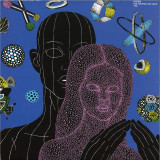
LP on white vinyl! What if a song was not a culmination but a singe, an imprint, or a crater left in the wake of creative process? On her new record "Jade", Pan Daijing composes at a different scale than that we've come to know. Since the release of her groundbreaking LP "Lack" in 2017, Daijing has expanded her operatic vision into a series of major commissioned exhibition-performances at institutions including the Tate Modern, Martin Gropius Bau, and the Haus der Kulturen der Welt. Developed for full casts of opera singers and dancers, and reaching for an all-encompassing durational experience of intensity for both performer and audience, the development of these works was for Daijing as emotionally disarming as it was thrilling. In order to continue accessing her own limits, Daijing had to develop a place of sanctuary within her own practice. Its nine tracks written and recorded over the last three years, "Jade" is the sound of solitary release and refuge, of creative self-sustenance. Written without the imperatives of direct address to performers or audience, "Jade" speaks inward, while inviting a kind of rhetorical listening. The artist draws on materials familiar from her previous work: namely, ascetic electronic textures that rumble and pierce, and voice bent in irreverent directions. In place of catharsis, however, her arrangements here linger in tension, extending curiosity towards the delicate void that nourishes extremes. They toy with the minor capacities of song: repetition, chant, observations that conclude without resolving. "Jade" comes from a vulnerable place, tender as in an undressed wound caught in the midst of healing over. Vocals, mostly Daijing's own, arrive as wordless sequences of notes soaring alongside a drone, or plain laughter, or in a few places spoken word. What is said or sung provides fragments of experience and reflection. In the process of piecing together these fragments, the listener is confronted with the tender parts of her own. "Solitude is like an immense lake you're swimming through," says Daijing of these songs. "Sometimes you dip your head in and sometimes you lift it above. On album centerpiece "Let," she speaks to us over the sound of rippling water, returning between anxious scenes to a refrain: "I take my bath in the ocean." We are not just consuming Daijing's story; we are being invited to join her in the water. The album is mixed and mastered by Rashad Becker, featuring artwork by Pan Daijing, cinematography by Dzhovani Gospodinov & design by NMR.
Поиск:development
Все
The original Rio beach boy returns in style, with a new record of unabashedly feel-good Brazilian party music. Featuring Azymuth bassist Alex Malheiros (responsible for some of Brazil’s all-time funkiest low-end licks), a horn section including Valle’s go-to high-trumpeter Jesse Sadoc, and percussion master Armando Marcal, Sempre has all the masterful composition, exceptional musicality, and forward-thinking ideas you’d expect from the Brazilian titan, and it’s fresher than a fruity caipirinha in the Copacabana sunshine.
Updating Marcos Valle’s seminal boogie-era sound, Sempre spans ecstatic disco, cosmic samba, and late-night jazz-funk, drawing obvious comparisons to some of Valle’s late-seventies and early-eighties output. ‘Estrelar’ (1983), for example, an ode to the joy of exercise, has become one of the biggest Brazilian disco hits of all time. But lyrically the new album is more closely reminiscent of Valle’s progressive early seventies’ releases. Heralding love, tolerance and living in the present, while satirising political corruption, the new release recalls a time in which Valle, together with his brother Paulo Sergio, was writing subtly subversive lyrics in order to bypass the censorship imposed by the military dictatorship, which ruled over Brazil between 1964 and 1985.
The album marries compositional genius with pure pop perfection. From the blistering brass arrangements on up-tempo disco hit ‘Olha Quem ta Chegando’ and the infinitely classy ‘Vou Amanhã Saber’, to the nine-minute synth heavy instrumental funk stepper ‘Odisséia’, which gradually morphs into an interplanetary samba jam, the songs are tightened and given an extra coat of gloss, by London based producer Daniel Maunick (son of Incognito frontman Bluey). More moments of boogie delight come in the form of ‘Minha Roma’ (a musical nod to the famed ‘Estrelar’), and the sunshine anthem title-track ‘Sempre’.
Translating as ‘Ever’, Sempre is a testament to the continual drive for development and reinvention that has defined Marcos Valle’s astounding six-decade career. Ever changing, ever moving forward, he began as one of the second-wave of early bossa nova composers in the sixties, writing the world famous bossa standard ‘Summer Samba (So Nice)’ for his sophomore album ‘Samba 68’. After a brief stint in the States, Valle returned to Brazil, and the early ’70s saw the release of four ground-breaking Valle albums which incorporated progressive rock, psychedelic influences, pop, jazz, soul and cinematic arrangements. These albums would see Valle work alongside a number of hugely influential Brazilian bands, including Milton Nascimento’s backing band Som Imaginaro, the prog-rock band O Terco and jazz funk legends Azymuth. Returning back to the US in ‘75, Valle resided in LA, writing music for the likes of Eumir Deodato, Airto Moreira, Chicago, Sarah Vaughn and Leon Ware, before returning to Brazil once more, where after releasing a handful of hit pop records, he took a hiatus from recording.
Since the mid-nineties, Marcos Valle has been experiencing a renaissance with London based label Far Out Recordings, where his approach to music has remained, as always; decidedly open to new influences, possibilities and technologies. Sempre is Marcos Valle’s fifth album for the label, following 2010’s critically acclaimed Estatica.
Just in time for summer, Sempre is out on Vinyl LP/ CD on 28th June 2019 on Far Out Recordings, and Marcos Valle and band will be touring Europe in May /June (see below for dates).
Contemporary hard driven Jazz Funk from the north of England. Bee To The Flower, initially released under the influence of Newcastle’s finest Warr
Thompson in a much slower and kind of stepped down version has been rearranged and recorded again by the band expressly for Tesla Groove Internation
at the Loft Studios. We have been on this project for a long while and the biggest thing we blame covid for is the goddamn delay it forced into t
development of artistic projects, of which the physical final release is only the latest of the steps. Driving (and very creative) basslines, a beautiful and almo
psychedelic Fender Rhodes intercalate with a vibrafone played with such a mastery I could only remind of thegreat Pharoah Sanders at the time of h
performances with Lonnie Liston Smith and Nathaniel Betties, one of the greatest afro percussionists of all times. All of this on such a hitting drumming I ju
can’t wait to fire it out of a proper soundsystem. Created in 2011 by north-east based Dave Wilde and Chris Jelly, the original jazz/funk fusion sounds of th
seven piece Newcastle based band have carved a niche as some of the finest exponents of the genre in the UK. The band has given exciting dance induci
live performances up and down the country, at Band on the Wall, Hoochie Coochie and many more, supporting the likes of Craig Charles, Roy Ayers an
Lonnie Liston Smith along the way. New material has been in the making for quite a while, but after the enforced lockdown, King Bee are ready to release th
latest recordings at long last. Worth waiting for.
The System 108 anniversary record sums up the label's five-year work without words. The new collection is an impression of everything that the team has become during its existence. System 108 has matured nominally and stylistically, defining for itself three main directions: post-industrial, techno and break-beat, disco and house. Each of the three parts of the new collection reveals one of the musical trajectories of System 108 development: Part 1 is a dark story that covers the genres of new beat, EBM, acid, new wave, with a light touch in Goa trance by Mashkov.
Where the Streets Lead is the new album from Slowly Rolling Camera, and builds on their acclaimed 2018 release Juniper. Inspired by colliding worlds of jazz, trip-hop, and cinematic soundscapes, SRC’s music blends strong melodies, big grooves, and surprising turns of phrase, and is infused with expansive emotional gravitas. The music on this album, recorded throughout 2020, encompasses greater scale, with an 8-piece string section and a list of world-class guests including Mark Lockheart, Jasper Høiby, Verneri Pohjola, Chris Potter and Sachal Vasandani as well as the band's regular guitarist Stuart McCallum. Where the Streets Lead is emphatic in its purpose: communicating the joy of collaboration and, through an audio-sensory landscape, a vision of the world. There is a boldness and simplicity in the album’s conception, balanced with attention to detail in its production and sound design. Slowly Rolling Camera’s last album Juniper set the band on a new path. Where the Streets Lead is a natural progression and development in the band’s’ continued exploration.
Emotional Rescue and HMV Record Shop (Japan) team up to present six limited edition 7"s of DISCO REGGAE LOVERS music. Featuring Sugar Minnott, Dambala, One Blood, 101 Band, Red Cloud and here to start, for the first time ever as a single, Ernest Ranglin's, cover of The Dramatics R&B classic, In The Rain.
A defining guitarist and composer in the development of Jamaican music, Ranglin's career spanned mento to reggae, playing on the groundbreaking recording of My Boy Lollipop itself, before going on to work with the likes of the Skatalies, Jimmy Cliff and Bob Marley.
Moving to Florida in 1982, he teamed up with Noel Williams to mix the bass heavy sound the producer was famous for with Ranglin's unique playing. Featuring a who's who of the Miami scene including Bobby Caldwell, Timmy Thomas, Betty Wright and Williams himself, In The Rain continued the link between R&B and reggae to sweet perfection.
To accompany, for half this series, a modern producer offers their own remix. Here Nik Weston, DJ, promoter and owner of the respected Mukatsuku label, releasing afro, jazz dance and more and with a long standing association with Japan, presents here an instrumental dub - letting the groove roll and Ranglin's ubiquitous playing to shine."
A deep dive into the one of most collectable jazz catalogues in the world, a selection of some of the rarest and most sought-after recordings from the 60s and 70s, a time when British jazz began to find its own identity. Drawn from the iconic labels of Decca, Deram, Argo, EMI Columbia/Lansdowne Series, Fontana, Mercury, & Philips. A figure in British modern jazz for over half a century, Don Rendell was both active protagonist and key witness to the main developments in the music from its rise out of tiny clubs and back rooms on up to the most prestigious national stages. From his earliest performances in London’s West End and his work of the 50s and 60s — most not ably with the Don Rendell-Ian Carr Quintet — to the lower profile work of the 70s and 80s, his quite assurance and consistent performance marked him out as a highly respected figure among his peers. He is one of a handful of British artists to feature on Blue Note Records and appeared on some of the most distinctive and characterful British jazz albums by the likes of Michael Garrick, Stan Tracey, Amancio D’Silva, and Neil Ardley. Even though Rendell eschewed much of the free and electric fusion styles that came to the fore in the late 60s, in the main sticking to an acoustic sound with melody and rhythm at its heart, he similarly bridled at any notion that he was merely a ‘bopper’, a description he positively hated. In many ways, Space Walk was as much a valedictory as transitionary album for Rendell. It was his last for Denis Preston, the fabled producer behind Lansdowne Studios, described by Neil Ardley as a ‘rare Diaghilev like figure’ who steered many of the key figures of the British jazz scene into the studio when nobody else would record them. It was also Rendell’s final project for EMI Columbia and his last as a leader for a major record label. After Space Walk, Rendell would record for smaller, independent labels like Spotlite. But as much as the album is a farewell to one chapter, it also marked the way forward to the next..
Tonnon produced the album with longtime collaborator, and The Beths’ guitarist and producer, Jonathan Pearce. Tonnon wrote the bulk of the songs during an extensive period of touring after the release of Successor - a period where Tonnon performed with Nadia Reid in Europe, The Veils in the USA, and The Chills, The Phoenix Foundation and Don McGlashan in New Zealand. The pair workshopped songs between tours, often recording new parts as the live versions developed.
Tonnon and Pearce recorded between 2017 and 2020, and in that time, Tonnon’s practise evolved heavily. He incorporated new technology into his set, including the Wellington-designed Synthstrom Deluge, which allowed him to adapt his set for new performance environments;Art Galleries, Museums, even New Zealand Fashion Week. He took that technology further when he collaborated with the Otago Museum on the immersive show for Planetariums, A Synthesized Universe, which travelled to Arts Festivals around New Zealand in 2019.
Creating a music video for ‘Old Images,’ which explored a lost passenger train network, Tonnon came to the idea for a new experience-based show called Rail Land. It took audiences on railways to reach distant community halls around Aotearoa. The show saw Tonnon combine historical research and spoken word narrative, with the immersive lighting and musical technology he developed for A Synthesized Universe. In March, Rail Land finished a three-night run at Auckland Arts Festival, cementing Tonnon’s move to the concept show.
Over time, Tonnon and Pearce’s production moved further from the traditional rhythm sections that powered songs like Successor’s ‘Water Underground.’ In their place came off kilter electronic rhythms, like the beat in ‘Two Free Hands,’ and textures that blur lines between organic and synthesized sound. Guitars are set against synthesizers, and drums against drum machines in ‘Entertainment’ and ‘Peacetime Orders,’ which Tonnon also used in his soundtrack for RNZ’s 80s spy-themed podcast The Service. In ‘Leave Love Out Of This,’ a ballad starts with a piano and a string quartet, but ends in a wall of electronic sound.
The constant has been Tonnon’s lyrics. Whether singing about evolution and the future of work in ‘Two Free Hands,’ the television industry in ‘Entertainment,’ or environmental disaster and regulatory failure in ‘Mataura Paper Mill,’ Tonnon has followed a distinct approach to subject matter, description and phrasing that have seen him longlisted for the APRA Silver Scroll three times.
Tonnon’s explorations of local government and civic infrastructure in his work - an unusual preoccupation for a songwriter, have taken new meaning in his adopted home of Whanganui, where last year, he was elected by councillors as Whanganui District Council’s representative for public transport.
After Tonnon moved to Whanganui, and Pearce toured almost constantly after the success of The Beths’ first album, the pair conducted their collaboration over distance, but with key sessions at Pearce’s Karangahape Road studio, including drums and bass with long time band members Stuart Harwood and David Flyger, a string quartet led by Charmian Keay and arranged by Matthew Bodman, and additional drums with The Beths’ Tristan Deck.
As Leave Love Out Of This is released, Tonnon and Pearce find themselves in very different places to where they started, working on Auckland’s Karangahape Road, close to the venues like Wine Cellar and Whammy Bar where they regularly performed. Back in New Zealand since Covid, Pearce has had to adjust to being in one of Aotearoa’s best-known bands, while Tonnon, when not working on conceptual shows, wrestles with how to restore civic infrastructure to a post industrial city in the regions.
Created over a life-altering period of, Leave Love Out Of This is the culmination of years of experimentation and development - with new technology, new sounds, and new ways of creating, and performing music.
- 1: Trenchtown Rock – Feat Ziggy Marley
- 2: Man Next Door – Feat Santigold
- 3: Rule The Nation – Feat Shaggy
- 4: Tom Drunk – Feat Tarrus Riley
- 5: Wake The Town
- 6: Stop That Train – Feat Rygin King
- 7: Soul Rebel – Feat David Hinds
- 8: Queen Majesty /Chalice In The Palace
- Feat Robbie Shakespeare
- 9: Small Axe – Feat Jesse Royal
- 10: Wear You To The Ball – Feat Richie Spice
- 11: Every Knee Shall Bow – Feat Big Youth & Mick Jones
- 12: Every Knee Shall Bow (Scientist Dub)
TROJAN JAMAICA / BMG is proud to announce the release of U-ROY’s final full-length, SOLID GOLD U-ROY. The album was originally set to come out in 2020 with plans for a worldwide tour in support, but unfortunately, the pandemic delayed the release. Now, with the heartbreaking loss of U-ROY on February 17, the album has become a celebration of one of the most profoundly influential reggae stars of his generation. An originator of the chatty rhythmic vocal style known as toasting — a key foundational element in the development of rap in its nascent stages in the 1970s — U-ROY left behind an unmatched legacy which is clearly on display on SOLID GOLD U-ROY, with its guest appearances including ZIGGY MARLEY, SHAGGY, MICK JONES of THE CLASH, SANTIGOLD, SLY & ROBBIE, DAVID HINDS of STEEL PULSE, and more. The album arrives on
July 16, 2021.
SOLID GOLD U-ROY is being heralded today by the release of “MAN NEXT DOOR” (Feat. SANTIGOLD). One of the great reggae songs of all time, the track features an indelible guest appearance by the incomparable Santigold. “Man Next Door” is a beloved reggae standard written by John Holt and released in 1968 by his group The Paragons. U-ROY sampled the song in 1982 for “Peace and Love in the Ghetto” on his Original DJ album. Pre-orders of SOLID GOLD U-ROY will come with an instant grat download of “MAN NEXT DOOR”
Jackie Mittoo is one of Jamaica’s musical giants, a towering figure in the development of reggae whose skills as a keyboardist and musical arranger led to indelible changes in the evolution of Jamaican popular music, helping it to reach international prominence. An exceptionally-expressive player whose mastery of the organ was truly outstanding, Mittoo was also a gifted arranger with an intrinsic feel for what would work best, his key instruction giving shape to ska at Studio One and roots reggae at Channel One and other Kingston studios, as well as lover’s rock at Wackies in New York and with Sugar Minott and UB40 in Britain, Jackie’s own productions later incorporating far-out synthesizer experiments and vocoder techniques. Reggae as we know it would never have existed without Mittoo’s essential input, making him an under-sung icon of Jamaican song. Jackie Mittoo went on to make all kinds of other incredible music in Jamaica, the UK, USA, and Canada before dying of cancer in 1990 at the tragically young age of 42; the dramatic send-off he received at the National Arena in Kingston gives some indication of the stellar status he achieved in his lifetime and the universal respect with which he was regarded. In an exemplary career full of exceptional music, 'Showcase', originally released on Bunny Lee's own imprint Jackpot in 1977, remains one of his greatest, an enthralling collection of stunners that shows why he will always be regarded as Jamaica’s keyboard king.
Etruria Beat founder Luca Agnelli unveils his long-awaited debut album, ‘Source Drops’ – presenting a ten-track journey through techno and beyond.
A name at the centre of Italy’s rich house and techno scene for over a decade, Etruria Beat head-honcho Luca Agnelli continues to showcase his talent as a leading DJ, producer and label boss on the international stage. With releases via a host of globally renowned labels, plus standout remixes including Moby’s iconic ‘Porcelain’, the Tuscany native’s reputation has seen him become of the genre’s leading artists when combining energetic, entrancing productions throughout his powerful DJ sets. Yet, the core of his work has always found a perfect home on his own Etruria Beat imprint, with July now welcoming the arrival of his highly-anticipated debut album ‘Source Drops’ – an in-depth musical story presenting growth, development, self-reflection and raw emotions via a collection of ten tracks ranging from powerful peak-time anthems through to EBM influenced cuts and slower, hypnotic productions.
“This is the journey that traces my musical evolution of the last 20 years, discovering more conceptual, deeper musical territories; taking inspiration from what influenced me in my career as a DJ and from my continuous research without musical barriers. A journey always in equilibrium, at times dark and sharp, solar and fluid, that develops a different creative vision in each track trying to convey my most intimate and strongest emotions". – Luca Agnelli
Opening via the slow-blooming builds and atmospheric and waves of ‘Black Mirror’, before diving into the heady and menacing tones of ‘Mutant Circle’, the ten-track project quickly showcases a wide-reaching range of influences and nuances central to Agnelli’s development as an artist over his career. Productions such as ‘Balance’ and ‘Oxigen’ contrast with one another whilst bringing space to proceedings, guided by breaks-influenced percussion, minimal arrangements and warping leads, whilst the driving ‘Resistance’ harnesses classic techno tendencies to provide an energetic and lively, snaking journey through rich soundscapes.
Title cut ‘Source Drops’ brings that trademark Luca Agnelli energy to the heart of the project, merging scintillating melodies, acid-tinged stabs and icy hats to unveil a high-octane ride into the peak-time, whilst ‘Raw Surface’ keeps the tempo high with sweeping leads, oscillating basslines and resonant lasers. Next, ‘Omega’ spirals into an off- kilter ride through glitchy echoed vocals, crunchy percussion and rumbling low-ends, with the epic ‘Losing Control’ welcoming an infectious lead melody at its core guided by punchy kicks and slick drum licks. To close, the package veers to an eerie yet ethereal close as hazy, celestial vocal chants meet panning sirens and swooping electronics – punctuating an expansive and diverse offering from the Italian favourite and shaping up an impressive debut LP in the process.
In 2015 we stumbled across an EP by a low-profile Romanian producer, which retrospectively was a pivotal event for the development of the label. This record was Serb's 'Transient Recs 1', released via Listen2me from Bucharest. We were deeply touched by the harsh and progressive sound of the tunes, which at the same time were so musical.
After a remix for Fehlzuendung and his LP 'A12 Proceedings' in 2018, things are coming full circle in 2021 as Șerb returns to NDR with 'Transient Recs 2', a collection of tracks produced between 2015 and 2018.
Lu's Jukebox is a six-volume series of mostly full-band performances recorded live at Ray Kennedy's Room & Board Studio in Nashville, TN. Each volume features a themed set of songs by other artists curated by the multi-Grammy award winner, Lucinda Williams. The series aired as ticketed shows through Mandolin in late 2020 with a portion of ticket sales benefitting independent music venues struggling to get by through the pandemic. Like thousands of artists, Williams cut her teeth and developed her craft by playing in small, medium and large clubs throughout the country, and the world. These venues are vital to the development of artists and their music. Williams has never forgotten her roots, and often performs special shows in some of her favorite halls. This year, the Lu's Jukebox series will be made widely available on vinyl and CD. Volume 1, Running Down A Dream: A Tribute to Tom Petty, features songs from the namesake's celebrated career and is scheduled for an April 16th, 2021 street date.
Antoine Tato Garcia,Juan Luis Curbon « Patela »,Steeve Laffont,Ramon Del Pichon,Nas Heredia,Fra
Mediterranean Gypsies Roads - The sounds of guitars
- A1: Caroline (Antoine Tato Garcia) 2'51
- A2: El Rencuentro (Juan Luis Curbon « Patela ») 4'04
- A3: El Ratinho (Steeve Laffont) 4'35
- A4: Suspiro (Ramon Del Pichon) 4'21
- A5: Cositas Del Maestro (Nas Heredia) 2'56
- B1: Gipsy Melancolie (Steeve Laffont Et William Brunard) 4'36
- B2: Raphael (Antoine Tato Garcia) 4'38
- B3: Miro Djiben (Fraïda) 5'58
- B4: Bossa Gitana (Djelito Soles) 3'26
I attended a trade fair in Rio de Janeiro, Brazil. In this show, we met producers, label and festival managers. It is a privileged moment when it is possible to learn about new trends, new musical forms, emerging groups. The timing of the meal is undoubtedly the most important. We take the time to introduce ourselves and discover each other. When my turn arrived, I took out my little map to locate the town of Sète on the map of France. There, an American promoter exclaimed "Yeah! You live in this beautiful city. Where there is this incredible music. ” I admit that at the time I didn’t quite understand what he meant but flattered by his remark I told him yes. Later, I realized that he was talking about gypsy music that made the whole world dream.
When my friend shared this anecdote to me, it resonated deeply with me. Indeed, for us, people of the south of France, this was nothing exceptional. Indeed, every day you could meet in the street a gypsy musician performing a rumba, another declaiming a fandango or another who liked to paraphrase the maestro Django. It is part of our daily environment, but it is indeed a peculiarity of this region. The territory of the Mediterranean arc, from Arles to Perpignan, is indeed the cradle of gypsy music in France. In addition, we must underline the major influence of the Gypsy artists of Catalonia in the development of these different artistic forms. Through weddings and family reunions, the repertoires have shifted to be reinterpreted according to the identities specific to each and the territories of residence.
With this new collection, we wanted to show, to hear all the musical richness of Gypsy and Manouche artists populating the territory. From appropriation to recreation, they never stop bringing this music to life, re-enchanting it and offering it a resolutely modern reading, open to the world. In this first opus, devoted to the guitar, we will take the routes of latin music, flamenco or jazz alongside renowned artists and young talents. With "The sound of guitars", it is a first door open to the gypsy music of the Mediterranean Arc, that we will discover gradually through the "Mediteranean Gypsies roads" collection.
Good things come to those who wait! A commonplace that is also true in the case of Perel’s Running Back debut. Ever since „Die Dimension“ appeared on DFA, our own CEO couldn’t wait for a call from the lady herself. Star is the consequence of said call and not only that.
Picturing Perel’s development as a recording artist on the one hand and the hardships everyone had to experience since the world has been changed by a pandemic on the other, making it - in her word words - „an EP about crossing the „physical distance between the people I miss and love“. Opening with the riveting vocals of Star („This song is literally a love song for my people“), the three pieces also show Perel's growing versatility as a producer. The tried and tested neon disco lights interchange with darker tones, uplifting and affirmative moments (Tour De Perel) rotate with contemplative and pondering intervals (Internal Monologue). Yet, by no means Perel is whistling a sad tune. Her melodies are as always deep, distinguishable and delightful to dance to. Wherever that may be.
Black Truffle is pleased to announce the first-ever vinyl reissue of Remko Scha’s Guitar Mural 1 featuring The Machines, originally published as a rare cassette edition by Taal Beeld Geluid in 1982. A computational linguist by profession, Scha played an important role in the development of sound, installation, and digital art in the Netherlands from the late 1970s onward, co-founding the performance and exhibition space Het Appolohuis in Eindhoven in 1980. Alongside Paul Panhuysen and Jan Van Riet, Scha was a founding member of the radical improvisation group The Maciunas Ensemble, though he is best known for his work with mechanised electric guitars, documented on the legendary 1982 LP Machine Guitars.
Guitar Mural 1 documents an installation of Scha’s mechanical guitar ensemble The Machines held at a Groningen gallery space in 1982. Five electric guitars hang from the wall, their strings sounded by rotating rubber strings and a sabre saw controlled by a mechanical apparatus, as well as four ropes criss-crossing the five instruments on the wall. Once the mechanism was set up, Scha’s only intervention was to vary the speed at which it operated. Where Machine Guitars presents short excerpts clearly distinguished by rhythmic and timbral variation, here we are confronted with four enormous side-long slabs of percussive string attack and the resulting clouds of harmonics. Variation is minimal across the duration of each side, making for a sculptural listening experience, as if we are patiently examining each facet of a static object. But significant variety exists between the four sides, each of which shows off a different facet of what The Machines were capable of. The first two excerpts feature open strings sounded at rapid tempos, dissolving the percussive attack into a continuous stream of sound reminiscent of Charlemagne Palestine’s ‘strumming’ technique. On the third side, the strings are partly muted and the tempo slightly lowered, resulting in layers of relentlessly chugging rhythm somewhere between an ensemble of hand drums and an early Velvet Underground bootleg. On the fourth side, havoc breaks loose in percussive waves of asynchronous repetition that bring Scha’s sound world close to that of another pioneer experiment in musical mechanisation, the Solar Music of Joe Jones.
Presented as a limited edition 2LP set in a deluxe gatefold sleeve accompanied by stunning visual documentation of the original installation, remastered audio and new liner notes from Alan Licht and Van Lagestein, Guitar Mural 1 is an exhilarating document occupying a unique space between kinetic sculpture, hardcore minimalism and rock & roll.
- A1: Invitation To Jamaica – Lord Tanamo
- A2: Fat Man – Derrick Morgan
- A3: Tell Me Darling – Jackie Edwards
- A4: Running Around – Owen Gray
- A5: Miss Jamaica – Jimmy Cliff
- A6: Housewife’s Choice – Derrick And Patsy
- A7: Give Me All Of Your Love – The Continentals
- A8: Darling Patricia – Owen Gray
- B1: Rough And Tough – Stranger Cole
- B2: Man To Man – Kentrick Patrick
- B3: Uno-Dos-Tres – Stranger & Ken
- B4: Slow Boat – Al T. Joe
- B5: Rude Boy – Duke Reid’s Group
- B6: Gone Is Yesterday – Higgs & Wilson
- B7: I'm In The Mood For Ska – Lord Tanamo
- B8: Virginia Ska – The Baba Brooks Band
- B9: Satan – Justin Hinds & The Dominoes
- C1: One Eyed Giant – Baba Brooks & His Band
- C2: Every Night – Joe White And Chuck
- C3: King Size – Baba Brooks & His Band
- C4: Syncopate – The Astronauts
- C5: Keep The Pressure On – Winston & George
- C6: Oh Babe – The Techniques
- C7: Train To Skaville – The Ethiopians
- C8: Rudy, A Message To You - Dandy Livingstone
- D1: Dreader Than Dread – Honey Boy Martin & The Voices
- D2: It's Raining – The Three Tops
- D3: The Whip – The Ethiopians
- D4: Pretty Africa – Desmond Dekker & The Aces
- D5: Rock Steady – Alton Ellis & The Flames
- D6: Rock Steady Train – Ewan & Jerry
- D7: King Without A Throne – Sugar Simone
- D8: Perfidia – Phyllis Dillon
- E1: Musical Train – Roy Shirley
- E2: Do The Beng Beng – Derrick Morgan
- E3: Way Of Life - Lynn Taitt & The Jets
- E4: Second Fiddle – Tommy Mccook & The Supersonics
- E5: People Funny Boy – Lee ‘Scratch’ Perry
- E6: I've Got To Get You Off My Mind – The Tennors
- E7: Do The Reggay – The Maytals
- E8: Nana – The Slickers
- F1: Tell Me Baby – Delano Stewart
- F2: Mama Look Deh – The Reggae Boys
- F3: Hong Kong Flu – The Ethiopians
- F4: Pressure Drop – The Maytals
- F5: Them A Laugh And A Ki Ki – The Soul Mates
- F6: Walking In The Rain – The Melodiansf
- F7: Satisfaction – Carl Dawkins
- F8: Black And White – The Maytones
- F9: Rasta Never Fails – The Charmers
One of the most significant collections in Trojan’s immense catalogue, the ‘The Trojan Story’ album dramatically changed the perception of Jamaican music among the general British public outside of the country’s Afro-Caribbean population.
Prior to its release in 1971 there had never been an attempt to present a comprehensive anthology of the island’s musical development, with vintage ska, rock steady and reggae widely regarded as obsolete and of precious little merit.
The treble disc set, which became an instant best-seller, had been the brainchild of Trojan’s label manager and Black Music fan, Rob Bell, who, assisted by Trojan stalwarts, Dandy, Webster Shrowder and Joe Sinclair, produced arguably the most significant Jamaican music retrospectives of all time.
Now, 50 years following its original release, this hugely influential album has been revisited by Bell, along with reggae musician, Rusty Zinn, who have succeeded in improving what was already an almost perfect collection.
Presented in the original eye-catching artwork, the set is further enhanced by a highly illustrated 50-page booklet in which Bell relates the stories behind the release and the 50 tracks featured on the compilation.
Suburban Bases favourite duo Krome & Time rare DAT studio masters saved!
Krome & Time provided the very first Suburban Base release that launched the now legendary label, under the alias Kromozone catalogue number SUBBASE 001 set the tone for the label that became and integral part of the development of Rave and Breakbeat Hardcore into Jungle and Drum & Bass!
So who better to kick off the relaunch of such a revered brand than the legendary duo that started it all KROME & TIME! With brand new sleeve design from original SubBase illustrator Dave Nodz!
Having accessed a long forgotten storge facility and discovered a treasure trove of Suburban Base master tapes, we struck gold when we found box after box of unreleased and exclusive master recordings from some of the biggest artists within the SubBase family.
The two exclusive tracks that make up this release were huge dubplate only specials and have never been released as vinyl singles or digitally. Finding the master copy of the once thought lost 'Original Juggling' was incredible, the song is much asked after and as an album exclusive on the 1995 Telepathy Dub Plate Special was never given a full release only appearing on that project.
‘Non-Stop Rocking’ was a 1995 dubplate recorded specifically as an album exclusive for the legendary Drum & Bass selection album project and stayed exclusively on dubplate receiving extensive club and radio play whilst remaining only available within D&B selection.
These sought-after tracks remained stuff of legend never having had a digital release or full vinyl release… until now! From the original master tapes of Suburban Base we present this slamming 12inch from Krome & Time
This journey, this slowly drifting sonic meditation, is an 'inner soundscape', a dialogue between the senses, the conscience and the world, inside / outside, interconnected. Like waking up from a long dream, and being stuck into its echo. The April Sessions immerges the listener into a drone-ish universe, full of random acousmatic events, inner monologues and a vast and unwritten subjective map to be drawn.
The April Sessions has been living in a seedy hotel in Brussels for a few months. She listens to the sparse traffic outside her window, locked in and locked down. 'Everything is constructed', she says to herself, 'even the sound of a solitary aircraft at 25,000 feet traverses the sky no further out than the inside of my skull'. Other weird sonic phenomena criss-cross the inner cosmos of her brain and streak across her private sky like comets. And then there is the unshakeable presence of that inner monologue, known to her variously as the Tacit Dictator, the Subvocaliser and, nightmarishly enough, the voice of the Merlucid Hake. (Anthony Moore, St Leonards, 10th of March 2021)
Anthony Moore, Dirk Specht and Tobias Grewenig have known each other and worked together since the early 2000s. They have collectively participated in a number of projects including live performances and recordings. In 2016, as part of The Missing Present Band, they released the live LP 'The Present Is Missing' on A-Musik. The following year they released 'Ore Talks', a double LP, realised in collaboration with Therapeutische Hörgruppe Köln.
Anthony Moore was born in 1948, founded the band Slapp Happy (circa 1972) with Peter Blegvad and Dagmar Krause, then worked alongside a.o. Fred Frith and Tim Hodgkinson in the unclassifiable band Henry Cow. He released several solo albums, composed soundtracks for experimental movies. His path also crossed Kevin Ayers's, Pink Floyd's, Richard Wright's. He was appointed professor for research into sound and music in the context of new media at the Academy of Media Arts in Cologne, Germany. He still continues to write and perform.
Dirk Specht is a sound artist, musician and curator. He studied architecture and media art and is active in the fields of sound works for choreography, radio drama, sound art, film and video art soundtracks. He published releases with several bands and projects. He has been an assistant for research into sound from 2011 to 2016 at the Academy of Media Arts in Cologne, and is a founding member of Therapeutische Hörgruppe Köln.
Tobias Grewenig studied at the Academy of Media Arts in Cologne. He primarily deals with non-linearity in his audiovisual installative works and performances, including projects with the artist group 'Therapeutische Hörgruppe Köln', the ensemble 'The Knob, The Finger & The It' and the improvisation collective "Frequenzwechsel". The conception and development of electronic instruments and code is a key component of his artistic work. He lives and works in Cologne.
180g audiophile vinyl pressing. Tip-On Gatefold packaging.
A fascinating solo album from the Swiss pianist, composer and
conceptualist best known as leader of the bands Ronin and Mobile,
‘Entendre’ offers deeper insight into Nik B rtch’s musical thinking.
As the album title implies ‘Entendre’ is about hearing as a creative process,
referencing the patient unfolding of B rtch’s modular polymetric pieces, with
alertness to the dynamics of touch, finding freedom in aesthetic restriction,
serving the flow of each piece’s development while also taking the music to
new places.
Recorded at Auditorio Stelio Molo RSI, Lugano, in September 2020, and produced by Manfred Eicher.
Nik Bartsch: piano
Press:
“Entendre - his first album entirely played on solo acoustic piano, with no
overdubs - might be his finest yet.” - **** The Guardian
“Nik Bärtsch feels a long way from jazz, but a lot closer to a freewheeling
rhythmic spontaneity on this unexpectedly action-packed set.” - **** (Editor’s
Choice) Jazzwise
“There is nothing lost when Nik Bärtsch, bandleader, becomes Nik Bärtsch,
solo pianist. It’s the same, captivating music, only played through the single
vessel of a piano. Through this prism, more is revealed about the genius of
Bärtsch’s ‘ritual groove music,’ not less.” - Somethin’ Else
“Entendre is a fascinating solo album from Swiss pianist, composer and conceptualist Nik Bärtsch... In these six solo realisations, Bärtsch’s creative music
unfolds with heightened alertness and dexterity as the pieces develop and unfurl with texture and subtlety of touch. The pianist finds freedom in aesthetic
restriction, while also seizing opportunities to guide the music to new places
of discovery.” - UK Vibe
“Manfred Eicher’s production captures the sound of the piano and the room
with forensic clarity. Entendre is, literally, classic Bärtsch. It is also classic
ECM.” - All About Jazz