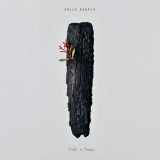
The opening line of Emily Dickinson’s short poem ‘‘Hope’ is the thing with feathers’ inspired the central image of Emily Barker’s new single ‘Feathered Thing’, written while she navigated cumulative grief.
When Barker was first introduced to producer Luke Potashnick (Gabrielle Aplin, Jack Savoretti, Katie Melua) in May 2022, she brought with her a full album’s worth of songs. But after visiting Potashnick’s storied studio, The Wool Hall and hearing his ambitious production ideas, she was inspired to write one more song.
“I also needed to process some heavy news” she comments. Barker and her husband Lukas Drinkwater had been trying to start a family. Following a couple of failed IVF cycles (and other “starts that we’d lost”), they investigated adoption and had decided to relocate to Australia to be closer to Barker’s family.
“It felt like we couldn’t work out what we wanted, but we finally reached a point where we both felt at peace with not having kids,” Barker recalls. “It had been an incredibly intense time, coinciding with a house move and the pandemic.”
And then Barker found she was pregnant. “We’d done all these things to try to make it happen, and then it happened naturally (and against all biological odds). Having previously navigated losses throughout our pregnancy journey, we now had to get our heads around what having this new person in our lives might look like - emotionally and practically.”
Soon after work began on the album, Barker had a miscarriage.
“Songwriting has always been a way of processing throughout my life.” Barker reveals how the new song came quickly as she sat at her piano at home. She shared an early version with Potashnick and remembers him politely asking, “Do you mind telling me what this is about?”
“I think I’d left it too abstract, initially,” she reflects. “It was difficult to open up about the miscarriage, but Luke was very supportive and encouraged me to dig a little deeper without necessarily being specific. I revisited the lyrics, and the result is much stronger.”
“I went to the burnt-out woods/ A tourist with some damaged goods/ Remembered how the trees withstood fires before…”
“The opening line is a metaphor for knowing that I’ll get through this,” Barker clarifies. “It’s about recovery and hope, allowing yourself both the space to grieve and permission to move on”. But Barker’s optimism is never misplaced – she knows the imprint of imagined futures and lost children are carried in hearts and minds forever:
“It’s so hard to let go, wanted to know wanted to know you …”
“I think that it's important to share and normalise these stories, which are all too common, yet not openly spoken about. People hide their pain and don’t want to burden friends and family. I think behind all this anguish, there’s a deep, often untold story.”
Now that Barker is settled back in Western Australia, she’s embracing being an auntie. “I’ve got three younger siblings over here who I’m close to, and they all have kids,” she enthuses. “I look after my brother's kids, aged two and five, one morning a week.”
Recorded - along with the entirety of the new album - at The Wool Hall, ‘Feathered Thing’ begins gently, with oscillating piano and distant drums, until the arrangement gradually transforms into an instrumental dervish of vibrant strings, bass drones and cymbal crashes. Throughout, Barker’s vocals float tantalisingly like a slipstreaming feather.
Watch the video, filmed at The Wool Hall here. The Wool Hall is a studio in Beckington, Somerset, set up by Tears for Fears in the 1980s and used by artists including The Smiths, Pretenders, Joni Mitchell and many more.
Emily Barker is an award-winning singer-songwriter, best known as the writer and performer of the theme to the hugely successful BBC crime drama ‘Wallander’ starring Kenneth Branagh.
Her last album, 2020's ‘A Dark Murmuration of Words’, was produced by Greg Freeman and recorded at StudiOwz, a converted chapel in the Welsh countryside. Lyrically probing, by turns both dark and optimistic, Barker searches for meaning through the deafening clamour of fake news and algorithmically filtered conversation, delivering a timely exploration of the grand themes of our age. It garnered widespread acclaim, with Uncut calling it “…a kind of Australian equivalent of PJ Harvey’s Let England Shake”.
Barker has released music and toured as a solo artist as well as with various bands and collaborations, most notably her long association with Frank Turner, and has written for TV and film, including composing the soundtrack for Jake Gavin’s lauded debut feature ‘Hector’ starring Peter Mullan and Keith Allen.
‘Fragile as Humans’ is scheduled for release on May 3rd 2024 through Everyone Sang/Kartel Music Group. The album will also feature earlier singles: the vast, cinematic ‘Wild to be Sharing This Moment’ and the meditative, crestfallen ‘Loneliness’.
Поиск:dif
Все
In the dynamic landscape of contemporary jazz, Scottish pianist and composer Fergus McCreadie has carved a remarkable niche. Since 2021, his career has skyrocketed, marked by two acclaimed album releases that propelled him into the limelight – shortlisted for the Mercury Prize and clinching the Scottish Album of the Year (SAY) for "Forest Floor." His debut with Edition Records, "Cairn" (2021), set the stage for a journey deeply rooted in natural themes. McCreadie's latest venture, "Stream," continues this intriguing exploration, this time delving into the essence of water. Accompanied by his long-standing comrades, David Bowden and Stephen Henderson, the album flows with the fluidity of its namesake. It's a musical stream that flows through the rich landscapes of Scottish folklore and the sophisticated avenues of contemporary jazz, blending them seamlessly. The album's narrative is a testament to the trio's evolving musical identity, meticulously crafted to mirror a journey from darkness to light. McCreadie shares, "What I like most about this album is that it evolves from dark to light as the album goes on. It's a sort of cloudy skies to sunnier skies journey, quite different from previous albums where the track sequence was more arbitrary." Their sound, a nuanced tapestry woven with delicate touches and bold strokes, speaks of their confidence and exuberance in forging a distinct path. "Stream" is an exploration of shared passions and expressions, pushing the boundaries of their musical language and vocabulary to new depths. With "Stream," Fergus McCreadie, Bowden, and Henderson offer a refreshing antidote to the predictable. Their music is a celebration of individuality, a journey that resonates with the trio's unique voice. It's an invitation to listeners to immerse themselves in a soundscape that's both familiar in its Scottish roots and revolutionary in its jazz execution – a goal every artist aspires to achieve. "Stream" is a musical narrative that flows like water – sometimes calm, sometimes tempestuous, but always moving forward. For those seeking a fresh, engaging, and authentic musical journey, Fergus McCreadie's "Stream" is a listening adventure not to be missed.
Stream by Fergus Mccreadie, released 3 May 2024, includes the following tracks: "Driftwood", "Sun Pillars", "Stony Gate", "Coastline" and more.
Chris Whitley was an artist with his feet planted in two very different worlds. On one side was a guitarist/ songwriter who grew up with the Delta and Chicago blues of Robert Johnson, Muddy Waters and Howlin’ Wolf, with some Bob Dylan thrown in. But at the same time, he was hanging out with NYC Lower East Side avant-gardeists like Arto Lindsey and Michael Beinhorn during his early ‘80s formative years. And it is precisely that tension between tradition and experimentation that makes his music so interesting and unique among “roots rock” artists. That tension is palpable on 1995’s Din of Ecstasy, his second record; Whitley abandons the acoustic blues-rock of his Living with the Law debut in favor of an album, that at first listen, owes a lot to the early-‘90s grunge movement. But Din of Ecstasy is hardly a johnny-come-lately to that sound; those are some truly weird tunings and chords being played by Whitley. It’s almost like he’s reinventing grunge in his own fashion, soaking it in blues and seasoning it with dissonance and feedback. Add some dark, druggy lyrics to the mix and Din of Ecstasy takes its place as one of the decade’s most adventurous albums, a cult classic way overdue for a vinyl release. Limited edition “clear smoke” vinyl, nestled inside a printed inner sleeve. Don’t sleep on this one
I Know I'm Funny haha is Webster's most realized manifestation yet of this emotional and musical alchemy. Continuing to bloom from her 2019 breakthrough and Secretly Canadian debut Atlanta Millionaires Club, Webster's sound draws as much from the lap-steel singer-songwriter pop of the 1970s and teardrop country tunes as it does from the audacious personalities of her city's rap and R&B community. The album began for Webster with the stirring ballad "In a Good Way," as in "You make me want to cry in a good way"_an instantclassic Faye Webster one-liner. It's beguilingly simple, the kind of melody and arrangement that seem to have existed forever. A sense of relief charges the neo-psychedelic pop of "Cheers," where Webster experiments with an overdriven guitar tone. She also collaborated, on "Overslept," with the Japanese artist Mei Ehara, who she calls the biggest influence on her new music. Webster's music is full of personality. Many of her songs contain bits of girl-group-esque talk-singing, which color her atypical storysongs. Webster says she's in a growth mindset, pushing herself to learn more, to be more vulnerable. "Growth is really important to me," she says. "I hope people will relate to my songs, and not just be like `this is a good record' but `this makes me feel something. This is making me think differently, this is making me question things.' I told myself a few years ago that I was going to be more honest in my songwriting, that honesty is the best route to take with music. If I have a voice and people are listening to me, I'm not going to waste it."
Nach zwei von der Kritik hochgelobten Alben, zahlreichen Mini-LPs, EPs und Singles kehrt das Londoner Trio Girls In Synthesis mit seinem neuen Statement, dem dritten Album "Sublimation", zurück. Wenn du dachtest, du kennst GIS bereits, dann irrst Du Dich diesmal vielleicht.GIS gehen weiter und haben eine düstere und intensive, aber dennoch melodische Sammlung von Tracks erschaffen, ihre Interpretation einer kantigen Pop-Platte. Der Opener 'Lights Out' besteht aus zwei Teilen; der erste ist ein Barrett-eskes Gesangs- und Gitarren-Lamento über Schlafmangel, das über eine von 'Faust Tapes' beeinflusste Freeform-Noise-Sektion in einen stampfenden, hochintensiven Showdown übergeht. In Songs wie "Deceit", "We Are Here" und "Picking Things Out Of The Air" zeigt sich die Gruppe von ihrer melodischsten Seite, indem sie einige der chaotischen Noise-Elemente ihres charakteristischen Sounds auf ein Minimum reduziert und leidenschaftliche, schwebende Vocals und Keyboard-Melodien in den Vordergrund stellt. Ihr Markenzeichen, das treibende Schlagzeug und der Bass, ist besonders bei den Stücken "I Judge Myself" und "Corrupting Memories" zu hören, wird aber durch intensive, vom frühen Gothic beeinflusste Keyboardlinien ergänzt, die Einflüsse aus den späten 1970ern/frühen 1980ern mit der zeitgenössischen GIS-Intensität in Einklang bringen. Die langsam sich steigernden Tracks 'I Was Never There' und 'The Prefix' bauen mit spärlichen Arrangements und kreisenden, spiralförmigen Outros Spannung und Atmosphäre auf, während die Band im abschließenden 'A Damning Lesson' zu ihrer intensiven, knüppelnden Soundwand zurückkehrt, nur um sie in eine verschwommene, hallende Drum-Machine zu schicken, die an die frühen Arbeiten von Cabaret Voltaire erinnert. Nächstes Kapitel, nächstes Level für GIS!
The Bolshoi released three albums during their existence, but they also recorded a fourth album that was never officially released during their tenure. Provisionally titled Country Life, it was released in 2015 as part of a limited 5-CD box set. We are excited to now release it on vinyl for the first time. The album is double colored orange and green vinyl. Country Life consists of demos recorded for the album, and many of these only survived on reference cassettes but were digitally restored. We are especially thrilled that Trevor Tanner has recorded a brand new acoustic reimagining of the song "Dolores Jones" made specifically for this release. The Bolshoi were different. Their songs were dark and subversive, sufficient evidence for many critics to corral them under the "Gothic" banner at the time of their debut - but they really only "flirted" with Goth. They oozed dark, pensive lyrics supported with inventive pop-goth guitar making them nearly impossible to categorize.
- 1: Lesanu
- 2: Asha The First Feat. Thundercat, Taj Austin & Ras Austin
- 3: Computer Love Feat. Patrice Quinn, Dj Battlecat & Brandon Colema
- 4: The Visionary With Terrace Martin
- 5: Get Lit With George Clinton & D Smoke
- 6: Dream State With Andre 3000
- 7: Together With Bj The Chicago Ki
- 8: The Garden Path
- 9: Road To Self (Ko)
- 10: Interstellar Peace (The Last Stance)
- 11: Lines In The Sand
- 12: Prologue
Turning his attention to dance for his latest album, Fearless Movement out this May on Young, Kamasi Washington resumes his ongoing study of music as a means of connection. His 2015 album The Epic, as well as 2018’s Heaven and Earth were received by critics and audiences as a reimagination of modern jazz showcasing Washington’s larger-than-lift compositions full of celestial grandeur and his distinct blend of jazz, Latin, funk, classical, hip-hop and soul. Fearless Movement, however, offers something different: terrestrial rhythms and collaborations from rappers, musical icons and even Washington’s own daughter. Features include: Thundercat, Taj Austin, Ras Austin, Patrice Quinn, DJ Battlecat, Brandon Coleman, D-Smoke, George Clinton, Bj the Chicago Kid, and Andre 3000.
Culled from three 1985 gigs in the UK during a transitional and transcendent time in the band's story, Sonic Youth's `Walls Have Ears' appeared as a 2LP set in 1986, not just a live album but an artful tapestry full of live experimentation with songs, between-song tape segues, darkness, humor and audio verité on par with elements of side B of `Master Dik' to come later. With a bit of complexity to the situation of the release itself. But that's a different story. Deleted as quickly as it appeared then, it's now issued for the first time officially under the band's auspices. In this 2LP set brimming with primitive classics like "The Burning Spear", "I Love Her All The Time", "Death Valley 69" and "I'm Insane" (uncredited on sleeve), segues and live guitar changes ooze together threaded by Madonna tapes and vocal loops off the board. The first two sides of `Walls' are massive, cavernous, with newly-drafted drummer Steve Shelley in tow taking on past tunes and unveiling "Expressway To Yr Skull" in glorious form. They tear it up especially on one trash-fi excerpt of "Blood On Brighton Beach" (actually "Making the Nature Scene") from a legendary outdoor gig November 8th where Moore, Gordon and Ranaldo's guitars treble-blast dissonant shockwaves over the black-stoned beach of Quadrophenia fame. The record's second slab spotlights an April 1985 pre-Shelley gig supporting Nick Cave at London's Hammersmith Palais and was one of the final appearances live of Bob Bert, again featuring some molten takes on "Brother James", "Kill Yr Idols", "Flower" (Iisted as "The Word (E.V.O.L.)"), "Ghost Bitch" and others. The emergence of the Jesus and Mary Chain in the world gave Brit scribes a lazy and easy parallel, addressed here with a wink with the inclusion of "Speed JAMC", another offstage tape interlude playfully scrolling through one of that band's songs at fast-forward. This document remains an essential representation of some lean and mean years of the quartet's throttling march out into the world in the mid eighties. Coloured vinyl, one red, one yellow LP.
- 1: No Rest No End (Feat. Spiro Dussias)
- 2: Hex Unending (Feat Dan Sugarman And Ice Nine Kills)
- 3: Ascension (Feat. Dean Lamb And Archspire)
- 4: With Ill Desire
- 5: The Silent Foray (Feat. Per Nilsson & Scar Symmetry)
- 6: Unwelcome Return (Feat. Spiro Dussias)
- 7: Purified By Vengeance (Feat. Mark Holcomb And Mick Gordon)
- 8: Deserving Of The Grave (Feat. Jeff Loomis)
- 9: Into Forgotten Dirt
Lauded experimental death metal band Dååth has emerged from its 13-year hiatus with a new album, The Deceivers, at once a devastating reminder and giant leap forward that showcases the technical wizardry and brutal intensity that the Atlanta, Georgia-bred band is capable of. After 12 years on hiatus, Dååth found their ideal new home at Metal Blade, signing to the label and wasting no time creating new music, cover songs (Death’s “The Philosopher” and Morbid Angel’s “Where the Slime Live”) and reissuing previous albums. The first new song from the revitalized Dååth, “No Rest No End” (released ahead of the album in February, 2023), features guest solos by Spiro Dussias and now-Daath member Trujillo, who impressed Levi so much while guesting on the track that he was invited to join the band. Metal Injection called the song “massive,” with Sean Z. saying, “The first time I heard 'No Rest No End' in demo form, I was blown away! I immediately knew exactly what I wanted to do vocally. The words practically flew off the page. During every step of the creation process, the song was an obvious masterpiece.” The band began their journey in 1999 and stayed busy for just over a decade before its 2011 hiatus. In that time, Dååth released four studio albums—2004’s Futility, The Hinderers in 2007, The Concealers in 2009, and their self-titled LP in 2010. Tours with Cattle Decapitation, Dark Funeral, Cynic, Nile, Slayer, Dragonforce, Goatwhore, Chimaira, Dying Fetus, and Devildriver followed. Dååth also landed a coveted spot on Ozzfest playing before tens of thousands of fans in outdoor amphitheaters across the US, in addition to the infamous and long-running metal tour Summer Slaughter. Levi believes this is the most focused and deadly version of Dååth to date, and is excited about what’s in store. “The chemistry is great, because we can talk about stuff that would normally be uncomfortable for a lot of musicians to do without causing problems,” he says. He’s lived a lot of life since the band went away over a decade ago and admits that his mindset is very different now than it was during the original run. “We're taking this to its full potential, letting nothing and nobody stand in our way,” Levi concludes. “If you're not going all out, what's the point?"
Cate Brooks is back with her seventh release for Clay Pipe Music. Never one to stand still, ‘Easel Studies’ finds her pushing the boundaries of sound synthesis and experimentation on the Buchla Music Easel while still sounding beautifully beguiling and hypnotically melodic.
"On this day in 2015, at exactly Midday, I took delivery of a wildly exotic musical instrument. To call it a synthesizer would be a misrepresentation; it’s really more of a tactile, living, breathing entity than anything else. It had originally supposed to have been delivered on the day before, but had somehow been mislaid in the labyrinths of the Royal Mail sorting office at Elephant and Castle.
I sat patiently and quietly all morning, waiting for its imminent arrival. I had already read through the ‘manual’, which is more of a concept / design for living, written by synthesis legend Allen Strange.
With Noon approaching, I became a little anxious- my local postie, Barrie, was usually here by about 10:30am and there was no sign of him.
At 11:58, Barrie walked past, completely ignoring my house. Obviously concerned, I stood at the door and waited for him to walk back toward his van. As he came back, he smiled and I called out, quizzically “Barrie?”. His reply was “Yes I have!” and walked back to his van, collecting a large box and bringing it to my door. I remember the weather was muggy and my neighbour was attending to her rose bushes, as the cheery and helpful postie deftly navigated around her busy secateurs.
I took the box inside, opened the top and just looked at the inner box for a while. I took a photo of it, which I still have. It felt like quite a momentous occasion, because I felt that this instrument would take me to different sonic spaces than I was used to. It wasn’t my first experience with Don Buchla’s instruments by any means, as I’d learned to use his 200e system. But this was quite a different beast.
My cat Brillo came to inspect the box and I set the Music Easel up on the floor and plugged it in. The result of that very first experiment became “Pendula”.
In the following days and weeks of that summer, I created many more experiments on the Easel, quite often with Brillo either sat on me as I played, or trying to climb up on the instrument itself, attempting to move the faders and switches himself.
By the end of August, I had amassed some thirty-something pieces, which I put aside for future reference. I had learned a lot about this instrument, its idiosyncrasies, subtleties and ways of working.
Sadly, Brillo died in September of 2015. I like to think that his last summer with me was a comforting experience, curling up and listening to the sonic experiments taking place, as he regularly did for the sixteen years he was with me. The first track on the album, “Con Brillo” is my little tribute to him.
Fast forward to 2021 and I rediscovered all of these experiments. Some were almost unlistenable, but some had a beguiling charm about them- perhaps the sound of someone not really knowing what they’re getting into. They needed mixing and balancing, so I set to work. I also wrote a new piece, with exactly the same recording chain, in the same way, in the same room. This became the suitably titled final track “Hindsight”.
The Music Easel has remained a constant source of sonic worlds for me to explore. It because the main instrument on the album Agri Montana, for example and has cropped up on many other records I’ve made since.
I would especially like to thank David at Postmodular for selling the Music Easel to me, after phoning him and disturbing his Sunday afternoon outing to Hyde Park (sorry about that David). I always promised I would send him a copy of something I had produced on it, so hopefully he will enjoy Easel Studies."
As I finish writing this, I notice that it is, once more, exactly Midday.
I hope you enjoy Easel Studies too.
Cate Brooks (21st of May, 2023).
Heavyweight vinyl LP version comes with full colour inner sleeve and free download card
Designed by Julian House
"The Carrier is a succinct distillation of folk-rock magnificence." SHINDIG
"The Carrier an impressive package all round, and one that could easily end up on a few Album of the Year lists." - WE ARE CULT
Large Plants started as a solo project for Jack Sharp, the singer and guitarist for Wolf People. It was spurred on by a writing frenzy during the lockdown of 2020 when Sharp played and recorded all the parts for what would become the debut single, La Isla Bonita and the first album The Carrier. In summer of 2021 the tracks were mixed by songwriter Chris Cohen (formerly of Deerhoof & Ariel Pink’s Haunted Graffiti).
Large Plants’ songs are immediate, heavy psychedelic rock belters filtered through a haze of analogue tape flutter. Sharp’s voice has an eerily distant and delicate tone that lends a strong folk sensibility to the album; like the scent of winter mornings and fresh soil mixed with the whiff of petrol. Though the songs are generally three-minute gems, they are lyrically more like ancient ballads; peopled with tragic youths, witches, lovelorn troubadours and femmes fatales.
Sharp is now touring Large Plants as a four piece along with Ed Taylor on drums, Ollie Taylor on bass and Joe Wooley on guitar with dates booked so far at OSLO, Hackney -17th April and The Betsy Trotwood, Clerkenwell 5th May
Pull the Rope, the new record by Ibibio Sound Machine, casts the Eno Williams and Max Grunhard-led outfit in a new light. The hope, joy, and sexiness of their music remain, but, further honing the edge of their acclaimed 2022 album Electricity, the connection they aim to foster has shifted venues from the sunny buoyancy of a sunlit festival to a sweat-soaked, all-night dance club. Williams and Grunhard attribute this shift to a matter of collaborators, recording Pull the Rope with Sheffield-based producer Ross Orton (Arctic Monkeys, M.I.A.) over the course of two weeks. The way the pair wrote songs changed significantly_rather than Eno penning lyrics to music generated by Max and company's jamming, Orton started with Eno and Max writing together before adding the band. With less time in the studio and a new way of considering how they built songs, the duo found making decisions about Pull the Rope's sound quicker and more instinctual than before. "Ross is from Sheffield, which has an edgier, more industrial vibe than London," Grunhard explains. "He hears things differently than us, is more grounded in rave and grungier sounds, and knew when to add drums or push the instrumentation more. It was very different for us, but it lends itself to where Ibibio Sound Machine is going." In melding their songwriting process, Grunhard and Williams have, impossibly, pulled the trick of making Ibibio Sound Machine a tighter band than ever before, building out from their core in a way that highlights the electrifying group of musicians they play with. Rather than recording with the full band in the room, Pull the Rope was sculpted, elements added and shaped by Grunhard, Williams, and Orton along the way. As a result, Pull the Rope is a nimble, sleek machine that's thrilling from the first note of the opening title track, Eno's otherworldly voice and PK Ambrose's throbbing bass driving through a kaleidoscopic array of house, post-punk, funk, Afrobeat and disco, bangers and ballads, making an argument for unity that begins on the dancefloor. "We are the places we grew up, the places we've been, and the people we've met along the way," Williams says. "Hopping around the globe, we've found that people are fundamentally the same_they're people. Opposing sides push and pull, but there is an alternative to war, violence, and suffering." Lead single "Got to Be Who U Are" literally globetrots, name checking locales across the world that would feel disparate were it not for how well-traveled they are. Eno growing up in the musical melting pot of the Ibibio region of Nigeria and Max being a conservatory-trained musician from Australia, one could call their meeting in London and formation of Ibibio Sound Machine predestined. "Mama Say" and "Let My Yes Be Yes" touch themes of female empowerment. They're indicative of the band's depth as they push further into the electronic; "Mama Say" hits notes of electropop while "Let My Yes Be Yes" fuses electro to Afrobeat. Ibibio Sound Machine have always imbued their music with political consciousness, and the light that shines through in Williams' vocals and voice has never felt more necessary. The sound of Pull the Rope, then, is hope in darkness, bliss in spite of bleakness. Once again, Ibibio Sound Machine are here to provide the soundtrack to the best night of your life, and the better world to come.
Experimental Japanese operator Lemna returns to Mantis with another five intricately sculpted cuts that toy with tension, release and the mysterious atmosphere of the forest at dawn. Lemna adopts a considered, patient approach to her music practice, creating interlocking rhythms which take cues from Autonomic fragmentation as much as techno hypnosis, but it's the spatial pressure and textural sound design which makes her music truly fly. Taking predawn walks in woods at the foot of the mountain she calls home, she drew inspiration from five different organisms within the vibrant ecosystem around her to create a collection of tracks she aptly refers to as 'Nocturnal Assembly'.
- 1: Hörprobe Track : More Rain
- More Rain
- 2: Hörprobe Track : Pirate Dial
- Pirate Dial
- 3: Hörprobe Track : Time Won't Wait
- Time Won't Wait
- 4: Hörprobe Track : Confession
- Confession
- 5:
- I'm Listening (Child's Theme)
- 6: Hörprobe Track : Girl From Conejo Valley
- Girl From Conejo Valley
- 7: Hörprobe Track : Slow Driving Man
- Slow Driving Man
- 8: Hörprobe Track : You're So Good To Me
- You're So Good To Me
- 9: Hörprobe Track : Temptation
- Temptation
- 10: Hörprobe Track : Phenomenon
- Phenomenon
- 11: Hörprobe Track : Little Baby
- Little Baby
- 12: Hörprobe Track : I'm Going Higher
- I'm Going Higher
Available for the first time from Cargo. This album, Ward’s eighth solo affair, finds the artist picking up the tempo and volume a bit from his previous release, 2012’s A Wasteland Companion. Where that record introspectively looked in from the outside, More Rain finds Ward on the inside, gazing out. Imagined initially as a DIY doo-wop album that would feature Ward experimenting with layering his own voice, it soon branched out in different directions, a move that he credits largely to his collaborators here who include R.E.M.’s Peter Buck, Neko Case, k.d. lang, The Secret Sisters, and Joey Spampinato of NRBQ. The result is a collection of upbeat, sonically ambitious yet canonically familiar songs that both propel Ward’s reach and satisfy longtime fans.
"A spiraling and winding descent into arcane black metal pandemonium! Sounding both modern and timeless at the same time, they unleash some serious throwback Celtic Frost/Darkthrone/early Mayhem vibes while projecting its hideous aura straight into the future with a shape-shifting approach to songwriting that can’t be called anything different but “prog”, while also throwing in the mix some unexpected ambient passages and improvisational liturgic abstractions ( that yield a result of constant motion and disorienting unpredictability, as if we were facing a European version of Negative Plane or a more experimental reinterpretation of the arcane mysticism of Mortuary Drape.
All in all if you are looking for black metal with a touch of timelessness and with classic heavy metal influences mixed with a keen sense of experimentalism then KVELGEYST definitely represents one of the strongest expressions of this school of thought in black metal that’s been seen in a long time." ~ CVLT NATION
Keep It Simple!
That's what Tony Allen told me, whether on stage, in the recording studio or when we were working together on the album "The Source"(Blue Note 2017) in my studio. Obviously, if he repeated it at will, it's because it's so difficult, to express the essential, not to scatter, over-play, over-arrange. So natural for him, so constraining for others! For years he pushed us, the members of his group to develop our projects. I had something in mind, necessarily with him, unfortunately his unexpected demise decided otherwise.
It took a moment to accept his departure, to accept being a voice, to find a new path. The desire to continue the work started together, that of mixing styles, sounds to appropriate them and create new, authentic. The desire also to meet new people, another energy.
After composing music for this project, I asked my friend Ben Rubin, musician and producer to help me record it. I found in NYC what I was looking for, a sense of urgency, that of doing, generous and committed musicians. I knew Jason Lindner, a musician that I have been following for a long time and he was the first person I thought of for pianos and synthesizers. He has this ability to find new and powerful sounds, with a direct and unadorned playing. For the drums, I didn't especially thought about a musician whose playing could come close or far to Tony's. Ben suggested Josh Dion to me, I've been following him since his "Paris Monster" project, I love his ability to make his drums sound like a new instrument by playing the bass synth with his right hand, that forces him to keep it simple! He also plays 2 tracks in drum/synth mode on the album.
I'm also happy that he agreed to sing a song on this album.
So we recorded at the Figure8 recording studio in Brooklyn, Eli Crews providing the sound recording, we decided with Ben to create a powerful and assumed sound from the take. Many biases on the tones, whether on the drums and the keyboards. Back in my studio in Paris, I continued to search, to dig while recording additional saxophones, percussions and keyboards.
I met Tchad Blake during a week-long mixing seminar. His work on the album on is radical.
Keep it simple?
Difficult but I try to remain so on all the phases of evolution of this project, from writing to production, in the improvisation parts. Where I feel it the most is in the immediate joy of playing with Jason and Josh, of tweaking a few sounds in my studio to create the unexpected, surprise in the structures, authenticity. Simple as the desire to go towards something essential, to seek oneself, to find oneself, to doubt but also to invent oneself.
After 20 years of living on the road in different places, Six Organs of Admittance had returned home to Humboldt County - a far country, to some, but still part of the world through which creatures of all kinds are moving through and contributing to. And some of them are human. Alone together - forming connection and exchange out of thought and expression - no different from the people on the other side of the Redwood Curtain. It was there, where Six Organs had long ago emerged, in the name of everything cycling, of circles that spiral concentrically and remain unbroken, the new music was conceived. In moments, it was as if the future had somehow wrapped around 360 degrees; elsewhere, the systems and patterns inside the writing and recording only became evident later - like a recognition that cumulus and nimbus clouds which passed through the sky the day before contained familiar shapes. Informing the songs accordingly as he went, Ben picked up on modes both musical and lyrical, threading backward through the time of Six Organs of Admittance. Almost marinating in it as a way of life. Working on the music and the vocals, then spending some time with them while stepping away from them. Walking the dog and coming back to them Time is Glass is made of that kind of time. Alone time. Recorded in the visceral environs of home, Time is Glass is sharply focused, even as misty impressionist mountains float through the background. Sweet and spiny, "The Mission" sings its purpose, before turning abruptly to the orchestral rumble of "Hephaestus": rural industrial psychedelia, ecosystem goth, synths arcing to lift a helplessly earthbound community into the firmament above. Winding almost imperceptibly back into song with "Slip Away", the time of the record becomes clear, moves fluidly, relaxed but aware, from event to event. People and things coming around again. The intuit, passing through wormholes and time, sounding deep then dissolving into the universal. The acoustic sounds ringing, layered suddenly, then clear again. Explosions of a new kind of distortion. Ecstatic melodies. Communing. The space of a day. The space of a season. Time is Glass, and Six Organs of Admittance is here and will be here, again.
Apparel Wax's 7inches vinyl series continues with a release focused on new, exciting sounds. APLMINI003, which drops in late January 2024 is composed, as usual, of two tracks, one per side. Side A kicks off with a nu-disco track, in which the solos of a wild sax and a loopy guitar riff takes the listener by the hand until the very last second. Side B, however, shows the more experimental part of APLWAX's soul, with a beat that seems nostalgic of the 90s/00s UK sounds, a broken beat and a decidedly more pressing rhythm, which recalls D&B influences, British-style Electronica. The possibility of combining tracks with different styles on the same record represents a sonic challenge, but APLWAX has always been accustomed to combining different musical currents, keeping the fresh and happy soul of its brand clear. Everything is represented by the new, elegant graphic design of APLWAXMINI, in which even the smallest details and small changes fill the record's release with anticipation. APLWAXMINI003 is coming.
Hal Singer – Tenor Sax
Alain Jean-Marie – Piano
August “Gus” Nemeth – Bass
Oliver Johnson – Drums
When the U.S. State Department announced in the mid-1970s that they were sponsoring a South African tour for the Oklahoma-born, Paris-based saxophonist Hal Singer, producer Rashid Vally took note. Even though his nascent record label As-Shams/The Sun (established in 1974) was making waves on the local scene, the idea of commissioning a recording from an international artist was a ballsy idea. With a discography that stretched back to the 1950s, Hal Singer was already somewhat of a legacy artist by 1976. Vally was well-versed on Singer’s accomplishments and specifically enamoured by his composition “Blue Stompin’,” which appeared on a Prestige album from 1959 that had struck a chord in South Africa.
With his irresistible charm, Vally managed to coax Singer into a studio in Johannesburg, South Africa, to record a new version of “Blue Stompin’” with South African sax star Kippie Moeketsi, which became the title track of a 1977 album by Moeketsi. The recording session also yielded an album’s worth of new material by Hal Singer and his quartet that took its name from a track inspired by Singer’s trip to South Africa entitled “Soweto to Harlem.” Released in 1976 and only available in South Africa, Soweto to Harlem captures a laid-back, cheeky and nostalgic rhythm and blues set from the Hal Singer Quartet that is unlikely to have emerged for a different target market.
With her irresistible charm, Vally was able to convince Singer to enter a Johannesburg studio. The recording session produced this album of new material by Hal Singer and his quartet named after a song inspired by Singer’s trip to South Africa, entitled “Soweto to Harlem.” Released in 1976 and available only in South Africa, “Soweto to Harlem” captures a laid-back, unabashed and nostalgic rhythm and blues of Hal Singer’s quartet that would hardly have been born for a different market.
Cinedelic’s 2024 edition of this rare album is sourced from the original tape masters and presents it on vinyl internationally for the very first time. The reissue follows Singer’s passing at the 100 in August 2020 as we contemplate and celebrate his extraordinary contribution to jazz in the United States and beyond.