Neil Young + Promise Of The Real release a new live album, ‘Noise & Flowers’, that captures the group in all their glory on their 2019 European tour. The release will be accompanied by a concert film that shares the same title and is included in the album’s 2xLP+CD+Blu-ray Deluxe Edition.
‘Noise & Flowers’ documents a 9-date tour that began just two weeks after Young’s lifetime friend and manager of more than 50 years, Elliot Roberts, passed away at the age of 76. Performing alongside a photograph of Roberts taped to his road case, Young approached each show as a celebratory memorial service to honour his late friend. It’s a trek the legendary singer/songwriter describes as “wondrous.”
In the album’s liner notes, Young says, “Playing in his memory made it one of the most special tours ever. We hit the road and took his great spirit with us into every song. This music belongs to no one. It’s in the air. Every note was played for music’s great friend, Elliot.”
In paying tribute to the manager who guided Young’s career for over a half-century, ‘Noise & Flowers’ explores all corners of his vast discography. It balances all-timer anthems (‘Mr. Soul’, ‘Helpless’, ‘Rockin’ in the Free World’) with rarely aired ‘70s deep cuts (‘Field of Opportunity’, ‘On the Beach’) and ’90s gems (‘From Hank to Hendrix’, ‘Throw Your Hatred Down’). His frequent backing band since 2015, Promise of the Real effectively bridges the extremes in Young’s sound, infusing his raging rockers and country serenades with their casual brilliance and telepathic intuition.
The companion film (directed by Bernard Shakey and dhlovelife) emphasizes both the intimacy and ecstasy of these performances.
‘Noise & Flowers’ is entry No. PS 21 in the Neil Young Archives Performance Series of live releases – a special addition to a robust, and still-growing catalogue.
Поиск:document one
Все
Acid Jazz Group Label Countdown Records is proud to present 'Shake A Tail Feather' - a Vinyl/CD collection from Fast Eddie, one of the early '80s most exhilarating live groups, and a favourite of the Rhythm and Soul powered Mod scene of 1980s. Initially called 'The Investigators', Fast Eddie emerged from Billericay in the wake of Thames Delta Blues pioneers, Dr. Feelgood. Having gained a following playing the raw R&B of the Pub Rock circuit, the band diversified their sound to incorporate classic soul repertoire, alongside their own material, which is documented throughout this collection.
Significantly, the group was also managed and produced by a certain young Eddie Piller - our founder - in his first foray as a music Mogul. Consequently, this collection marks an important document in the formation of Well Suspect Records, Countdown Records and the wider Acid Jazz Story. The LP contains a sharp selection of 16 tracks from their recordings, while the CD and digital version extends this with 4 extra tracks. Their storming versions of 'Shake A Tail Feather' and 'Out Of Sight', show their love of classic club soul, while 'Help Me' and 'My Babe' prove that they could play the blues with plenty of rhythm and feeling.
Hailing from Ancaster, Ontario, Carl Didur has been an enigmatic fixture of Toronto’s underground music community for close to two decades. Originally traversing the Golden Horseshoe with The Battleship, Ethel, a band which sprung from his first outfit CEDRUMATIC, Didur soon moved to Toronto. Throughout the mid-2000’s he could be spotted playing his trademark ace-tone organ as a member of No Dynamics and Rozasia in the city’s crammed rogue venues, such as The Bagel and the infamous and transient Extermination Music Night. During these years The Battleship, Ethel continued to tour, often performing as backup band for Damo Suzuki, while at other shows inviting Dave Byers (Simply Saucer) and Bob Bryden (Spirit Of Christmas) to perform alongside the band. Perhaps the most enduring legacy of "The Battleship, Ethel", which dissolved in 2009, is that it laid the creative foundation for Carl and bandmate Michael McLean's next project, the prolific, studio focused, Zacht Automaat. As Zacht Automaat released music at a frantic pace, Carl continued to collaborate with members of a tight-knit group of Toronto’s downtown scene including touring with U.S. Girls and Slim Twig, performing and recording with Colin Fisher as Fake Humans, guesting on Absolutely Free’s Currency EP and producing New Fries’ most recent album The Idea of Us. Throughout the last decade Didur’s purely solo output has served to document his unimpeachably singular approach to music making. I Cannot See You Too Well (2011), Nothing is the Secret to Anything (2014) and Is It Yesterday? (2020) all released on cassette were followed by a digital album of gentle minimalism called Natural Feelings Vol I (2020). His solo shows consist of multiple tape machines running loops through various analog devices (a Certified Electronics Technician Didur now spends his non-piano playing hours of the day repairing all manner of tape echoes and synthesizers) or solo Wurlitzer electric piano improvisations, his performances gracing both stage and gallery. With his latest release Maybe Next Time, Didur further establishes himself as a singular artist with a unique methodology honed from years of music-making and listening. The album’s compositions swing from lush Axelrod-ish affairs filled with Mellotron strings to the album’s spiritual jazz influenced centerpiece The River Meets The Sea. “I was inspired by Eno's Here Come the Warm Jets, Crazy Horse but only when they are sad, Alice Coltrane, Jessica Pratt, McDonald and Giles, and so many others…” states Didur. Infused with a melancholic tone throughout, tracks such as Close My Eyes and Autumn’s Here invoke cinematic memories with tape echo and reverb applying a softened focus to the proceedings. Carl explains the context for the tone and the setting for the record’s gestation: “Maybe Next Time is a record I made after the world lost a sweet person that many in our community loved. Unlike most of my albums this one never seeks to shock or surprise you. It is about sadness, confusion, dissolution, transformation and ultimately a deeply forgiving sense of love. It is a concept record about being a human being!”
It’s been an exhilarating 40-year ride for Voivod, the Jonquière, Quebec quartet that has, over the years, defied the odds, faced tragedy head on and also seen the band rise above many of the contemporaries to a point where the band’s intricate progressively fuelled heavy metal sound also brings with it honours and awards. The 2018 Voivod album, ‘The Wake’, won the band a Juno Award for Heavy Metal Album of The Year, while the previous year Away had picked up the Visionary Award at that year’s Progressive Music Awards in London.
The music contained in this set proves that Voivod were very much pioneers of the sound, as their own music became more refined and experimental. You can hear the development of the band’s sound over the three albums contained here (Rrröööaarrr, Killing Technology & Dimension Hatröss). In the five year span from 1984’s ‘War And Pain’ debut to 1989’s ‘Nothingface’, Voivod forged a defiant progressive metal sound that they would expand upon with later albums and ensure that they are one of the most exhilarating metal bands in existence today. ‘Forgotten In Space’ is a deluxe celebration of Voivod’s, Noise Records discography and is the definitive collection of their recorded work plus rare and previously unreleased material.
Includes :
- Includes following 5 Albums:
Rrrröööaaarrr
Killing Technology
Dimension Hatröss
Dimension Hatröss – The Demos
No Speed Limit Weekend ‘86
- Chaosmongers - DVD (Containing a mini documentary plus a previously unseen concert from 1987 and an audio recording of the legendary WWIII show from 1985.)
- 12” x 12”, 40 page book of photography, and brand new interviews with founding member Michel ‘Away’ Langevin. Contains a vast array of previously unseen photos from the era.
- ‘Körgull’ f¬igurine USB drive containing MP3
Following on from acclaimed recent releases on Hallow Ground and Boomkat’s Documenting Sound series, NOISEEM is a major new work from Japanese sound artist/instrument inventor Yosuke Fujita, who performs under the name FUJIIIIIIIIIIIITA. Where Fujita’s recent recorded output has focussed primarily on documentation of his remarkable self-built pipe organ, NOISEEM is the culmination of half a decade of work with highly amplified water. The evocative and timbrally rich sound of water has inspired concrete and experimental music practices since ground-breaking works such as Hugh Le Cain’s ‘Dripsody’ and Knud Viktor’s obsessively aquatic ‘Images’. However, other than his compatriot Tomoko Sauvage, few have explored the possibilities of water in live performance to the extent that Fujita has, constructing a series of water tanks that, with their pumps and amplification controlled by the performer, become a new musical instrument. The recordings contained here are drawn from live performances in Tokyo and London, edited and mixed by Fujita into two side-length pieces dominated by water, pipe organ, voice and subtle electronics. On ‘AWA’, which occupies the LP’s first side, the listener is immediately immersed in an aqueous world of recognisable drips and splashes, as well as more mysterious squeaks and squawks. While the liberal use of delay at times conjures up the sound world of early electronic music, the sparklingly clear amplification is unmistakably contemporary, lending the music a stunning weight and tactility. Building over several minutes, the piece eventually comes to a rapid boil, criss-crossed by washes of white noise splashes of electronics, before the untempered long tones of the pipe organ enter. The slowly shifting harmonies lend the remainder of the side a meditative, almost oneiric quality, inviting listeners to lose themselves in the aquatic layers that ripple across the harmonic foundation. On the second side, ‘UZU’ begins more starkly, with a single rapid bubble, quickly joined by full-spectrum wooshes and silvery, ringing tones. After a few minutes, the music undergoes a radical, entirely unexpected shift with the entry of a distorted, auto-tuned voice that repeatedly cycles through ascending and descending melodies. Left alone at times to be heard acapella, this mysterious element at times takes an odd resemblance to dhrupad singing. Eventually joined by rich, sonorous chords from the organ, the high tones of Fujita’s voice, and water, the piece takes on an ecstatic quality, channelling the sublime expansiveness of the natural element on which it is built. Disappearing as abruptly as they entered, the voices then make way for a haunted coda of isolated drips and distant whistles. Far from the intellectualised abstraction of much sound art, NOISEEM is strikingly immediate, both rigorously experimental in its explorations and unashamedly direct in its musicality. Tracklist 1. Awa 2. Uzu
- A1: Resemblage (Parasamblaz)
- A2: Cobra Wages Shuffle (Off! Schable W Gure!)
- A3: Few, Far Chaos Bugles (Uff Bosch Gra Walese)
- A4: Flashcube Fog Wares (Glucha Affera Slow)
- A5: Flight To Sodom (Lot Do Salo)
- B1: Tonight There Is Something Special About The Moon (Jaki Ksiezyc Dzis Wieczor)
- B2: If All Things Were Turned To Smoke (Gdyby Wszystko Stalo Sie Dymem)
- B3: Anti-Antiphon (Absolute Decomposition) - Anty-Antyfona (Dekonstrukcja Na Calego) (Absolute Decomposition)
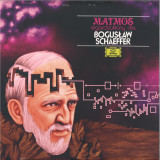
Matmos are one of the most prominent experimental electronic artists working today, crafting work by creating new conceptual frameworks and immediately testing those frameworks’ absolute limits. For ‘Regards/Ukłony dla Bogusław Schaeffer’ they’ve focused on another artist known, in large part, for doing the same.
Bogusław Schaeffer was one of the first Polish artists creating electronic music. In step with American contemporaries like John Cage and Morton Feldman, he worked across the boundaries of classical composition, electronic experimentation and radical theatre, in playfully form-breaking ways.
Matmos are not the first ones to recognize the power of his catalogue, from ‘Solo’ (a 2008 documentary that garnered numerous international awards), to the annual Shaeffer’s Era Festival (most recently celebrated simultaneously in Warsaw and Los Angeles), Bogusław Schaeffer’s work continues to inspire.
‘Regards/Ukłony dla Bogusław Schaeffer’, however, was not just inspired by his work. Matmos were given access to the entirety of Schaeffer’s recorded works to use as they saw fit, commissioned by the prestigious Instytutu Adama Mickiewicza. They re-assembled and re-combined these recorded works with modern instrumentations in a way that only Matmos could, and what emerged is a composite portrait of the utopian 1960s Polish avant-garde and the contemporary dystopian cultural moment regarding each other across a distance.
Vinyl packaged with digital download card.
- 1: Connais Tu L'animal Qui Inventa Le Calcul Integral?
- 2: Evariste Aux Fans
- 3: Les Pommes De Lune
- 4: La Chasse Au Boson Intermédiaire
- 5: Dans La Lune
- 6: La Faute À Nanterre
- 7: Ma Mie
- 8: Wo I Nee
- 9: Si J'ai Les Cheveux Longs C'est Pour Pas M'enrhumer, Atchoum!
- 10: La Révolution
- 11: Je Ne Pense Qu'a Ça
- 12: Je Chante Pour Vous Faire Marcher
- 13: Je Ne Suis Pas Simple
- 14: Si Les Étoiles Pouvaient Parler
Évariste is one of the rare specimens of artist-cum-scientists. Among his kind stand others like Pierre Schaeffer, a Polytechnique graduate (an engineer but also the father of musique concrète) and the eccentric Boby Lapointe (graduate of the École centrale and inventor of the Bibi-binaire system, patented in 1968). Évariste's songwriting, joyful and full of energy (albeit extremely critical), shrouds an original tragedy: born in 1943 among résistants, Joël Sternheimer (aka Évariste) grew up without a father, lost to Auschwitz. Although he makes little reference to Jewish culture in his music, his origins leave their mark: in 1974, he sings a Hebrew song on television. In 1966, the young Joël sports Princeton's colourful paraphernalia - that's because he's freshly returning from the US, where he was sent to pursue his research on "particle mass and the interpretation of observed regularities, such as the effects of a wave" (will understand who may). When he gets there the country's in the midst of the Vietnam War. With McNamara keen to find an alternative to the nuclear weapon and calling upon the country's biggest brains to undertake the task, there's a "fund shift" within the university - a diplomatic way to give notice to whoever may not be disposed to follow the government's scheme. Joël, who's under the supervision of a rebellious physician, is dismissed. He regardless keeps following the prestigious seminaries of the Institute for Advanced Study, chaired by Oppenheimer, inventor of the atomic bomb. Likely inspired by the hippie movement and music, Joël buys a guitar and starts playing in Washington Square - after all, Bob Dylan himself started there. He blithely skips Oppenheimer and receives a warm (though surprised) welcome from a crowd thoroughly unfamiliar with French. When the ageing physicist questions him about his decreasing attendance, Joël explains how drawn he is to music, and how he thinks it could help him in self-financing his research. Évariste recalls seeing the sickened man, his face torn by remorse, lighten up to his words and say: "What's keeping you - go for it! If I was still young that's exactly what I'd do." The student takes these words as a testimony from his professor - and it's enough to convince him . And so he takes the leap during the Christmas vacations he spends in Paris. A journalist friend he often sees around the Sorbonne introduces him to the artistic director of Disques AZ. The latter passes the tapes on to the label's boss, Lucien Morisse, also program manager on Europe N°1. Morisse is blown away - and signs him onto the label right away. Michel Colombier, arranger for Serge Gainsbourg and co-author of "Psyché Rock", with Pierre Henry, contributes some of his original ideas to the 7 inch "E=mc2": Évariste's preoccupation with the percussion sound on the track "Le calcul intégral" is that it goes "poom poom" and not "tock tock" - Colombier is aware of the issue and records Évariste's guitar like a percussion in an isolated booth. The organist Eddy Louis, who is to participate, in 1969, to the success of Claude Nougaro's "Paris mai", also appears on the record. It's 1966 and the Antoine phenomenon (signed on Vogue) storms through France. The two singers share similarities: Antoine is an engineer of the École centrale, gifted with a great originality in his song-writing. A godsend for the two labels who turn this resemblance into a commercial strategy, setting them out as rivals. To this day though, Évariste still denies what was little more than slushy tabloïd gossip. Success comes around swiftly and in 1967 Évariste launches into a second 7 inch, "Wo I nee", again arranged by Michel Colombier. Quantum mechanics fans finally get their anthem with "La Chasse Au Boson Intermédiaire" (or the "Intermediary Boson Pursuit"). To sum up what's a boson, say he's a close pal of the meson, photon and other gluons. A few months later, it's May 68 and everything's turned upside down. Évariste writes a series of songs inspired by the events, which he immediately submits to Lucien Morisse. When the man behind "Salut les copains", once married to Dalida, hears the song "La révolution" - a father and son dialogue - he can't take any more: AZ simply cannot release this. But there and then Lucien Morisse makes a gesture which will remain engraved in French music's history: sorry to be unable to officially stand by the singer, he encourages him to self-produce the record, but with his tacit support. He calls the pressing factory and asks they apply the same rate for Évariste as they would for AZ. The singer and his musicians use the same studio as for the previous record, all of them playing for free awaiting a return on investment. Évariste keeps singing at the Sorbonne with "Jussieu's gang" and "the young Renaud" he nicknames "le p'tit gavroche" (or "street urchin"). Renaud volunteers to type the lyrics of the song "La révolution" so that the chorus can be sung and recorded. A boy in the group is related to Wolinski and introduces them. The two get along so well that Wolinski ends up drawing the cover for the record "La révolution", for free. The self-released 7 inch "La révolution / La faute à Nanterre" is sold under the table and door-to-door for half the price of a standard record, on and around the boulevard Saint-Michel; and it runs out fast. In the end, there will be 6 releases of the record, and 25000 copies sold. When the theatre director Claude Confortès decides to adapt Wolinski's drawing series titled "Je ne veux pas mourir idiot" ("I don't want to die a fool"), he asks Évariste to write the original soundtrack. His friend, now cartoonist for Hara-Kiri Hebdo, often promotes him in accordance with a principle dear to him by virtue of which he gives a special place to his friends. Dominique Grange (writer of the song "Nous sommes les nouveaux partisans") soon joins the team. After 150 performances, Évariste leaves his place to Dominique Maurin (brother of Patrick Dewaere). Évariste composes the songs for Claude Confortès' next play, "Je ne pense qu'à ça" ("That's all I think about"), co-wrote with Wolinski in 1969. The comedians of the play record the songs on a 7 inch, with a cover signed, again, by Wolinski. In 1971, French television produces the documentary "Évariste et les 7 dimensions", but doesn't air it. Indeed, the scientific sub-comity of the programming comity (sic) censors the show. The given justification is that "Évariste dangerously mixed science with science-fiction, numerology and other non-scientific disciplines". The underlying motive might have been a will to censor the singer-mathematician's political discourse. In the documentary and among other things, Évariste discusses hierarchy, alienation and revolution. Half a century later the documentary remains invisible, though some excerpts resurfaced in 1992 in the cult show "L'oeil du cyclone", on Canal +. Though flourishing, Évariste's career is nearing its end. 1970 is the beginning of a decade in the course of which he is to make a decisive discovery in the musical and scientific domains. Following this breakthrough, he moves away from self-produced music and gaucho magazines to focus on science. He keeps Oppenheimer's encouraging words in mind, now freely pursuing his research thanks to the sales of his records. Joël realises that when decoding protein sequences, one finds musical sequences recognisable to humans. He names them "proteodies". If, when listening to a proteody, one responds by being so sensitive as to finding it beautiful, then it reveals a deficiency of the related protein - and this peculiar music may be the cure. We could trace back the music history in light of proteins lacking in a given artist, or within a public's majority. You always thought these hysterical groupies who'd throw their underwear with passion and faint in the pit had miraculously appeared because they had never heard anything as wonderful as the Beatles? Make no mistake! For Évariste, it all boils down to an intro's protein content. Indeed, the beginning of their first hit "Love Me Do" corresponds to dopamine, the neurotransmitter linked to compulsive buying. An intro like this could only unleash the fervour of groupies, victims of fashion and biology. Évariste's success is such that the income from his sales gives him the autonomy to which he had aspired when confiding to Oppenheimer. It made it possible for him to pursue his research without any institutional constraints. He now devotes himself to his proteodies, sat in the offices of the European University for Research, just around the corner from the Sorbonne he knew so well. Évariste is no more. Joël regained control of this strange and comical beast.
Imperfect Stranger is the pseudonym of Glasgow based soundtrack composer and producer Kenny Inglis. “Everything Wrong is Right” is his debut solo album for Castles in Space.
Born in 1975, Kenny didn't listen to much music, unless it was the opening credits to a TV show or a film score that had caught his ear. "I loved the pre-title music on a lot of those 80's U.S. TV shows. From the family orientated stuff like The A-Team, to darker dramas such as The Equalizer. My mother would let me stay up to watch the opening sequence of the latter then send me to bed because the story would be too heavy for a kid. That left me with this hanging sense of ambiguity as to what would happen in that hour after the titles came up.”
Exposure to a work colleague’s tiny project studio in a kitchen cupboard was a lightbulb moment for him and the experience of utilising music technology as a way of writing and producing entire tracks stirred a wave of determination to chase a career in music using the opportunities that technology could offer. Kenny figured the best way to move forward was to start a small project studio and learn his craft as a recording engineer. "It was a bit of a shock to the system. I literally had no idea how to work any of the equipment. Kenny focused on learning as much about the craft as he could whilst winging his way through recording and mixing everyone from the likes of singer/songwriters to bands, to voiceovers artists and anything in between. "Eventually, I stopped writing the music I thought people would want to hear, and started writing the music I wanted to make. I didn't come from a music loving background, but I was always obsessed by the way music and film would interact - how music brings this atmosphere and tone to even the most mundane visual stuff. I wanted to capture that. I wanted to grab some of that ambiguity I felt from the TV shows of my childhood and make it into a project of some sort". That project was Spylab. A dark, downtempo project with a cinematic edge. The initial demo consisted of three tracks, with the melancholic 'This Utopia' leading the playlist.
"At the time you did demos on normal cassette tapes. I remember having this endless battle with the bias control to try and get the best sound I could on these little tapes. Ten went in the post one Monday morning, and the following Monday there were three offers from three different labels. Studio K7 were interested in a singles deal, as was Flying Rhino in London. But then there was an offer from a Chicago based label by the name of Guidance Recordings. They wanted an album, and were offering a $15,000 advance. It wasn't a difficult decision to make"
Writing and recording Spylab 'This Utopia' began in 1999. The album took a whole year to produce. The album was to catch the attention of Mary Anne Hobbs at Radio One. At the time Mary Anne was presenting The Breezeblock - a late Sunday night show with an eclectic playlist of alternative electronic music. Picking out the album's title track 'This Utopia', Mary Anne would go on to play it no less than 8 weeks in a row. A request for Spylab to DJ on the show was to follow. "I had never DJ'd before. I think I had a week to figure out how to do that and put a playlist together. I'm not entirely sure how I pulled that off.” In March 2001 the Spylab album was finally released to a hoard of excellent reviews. A North American live tour would follow. From the launch party in Los Angeles, to a sell out show at SXSW in Austin. "I then started a new project under the name Cinephile. It had some of the core elements of the Spylab sound but it was deeper, more cinematic.” Kenny received news that a track from the previous project Spylab had been requested by HBO for the first episode of a new TV drama called Six Feet Under. This was to become a major turning point in Kenny's career. The Spylab track 'Celluloid Hypnotic' dropped during a poignant party scene of the first Six Feet Under episode. Within a couple of days Kenny was getting requests for music from other music supervisors. "It was a chain reaction. The Six Feet Under sync was like the tip of an iceberg. One day I called CBS in America and they put me on to the CSI music supervisor and I managed to get on a call with him. I sent the Cinephile stuff out and within a few months I got this fax through from CBS - a quote request for one of the tracks for a potential use on CSI. It changed my life."
The tone and style of Kenny's music sat perfectly with the CSI score requirements. So much so he found himself part of a pool of incidental writers who worked on all three aspects of the franchise - CSI, CSI: NY, and CSI: Miami. This would continue until 2013, when the last of the series would come to an end.
"I was juggling a bunch of stuff for those ten years. Writing material for CSI, whilst releasing new Cinephile stuff and playing live. As Cinephile continued to gather pace, one of the tracks from Kenny's efforts on CSI was chosen for the Hollywood trailer for the Samuel L. Jackson film 'Lakeview Terrace'. Further trailers would follow, from Gangster Squad to Dead Man Down, Spike Lee's Undisputed Truth, to Fifty Shades Freed.
At the same time, Kenny picked up his first factual commissions in the UK, and this too would be the beginning of a regular run of fully scoring factuals and documentaries. By 2021, six of these had won BAFTAs. He also would find himself soundtracking adverts for the likes of Nike, Audi, and American AirlinesIn early 2020, Kenny made a return to focusing on his own music under the pseudonym Imperfect Stranger. A tweet from Colin Morrison from Castles In Space regarding a charity compilation album 'The Isolation Tapes' caught his eye. Kenny had made a start on his debut album as Imperfect Stranger and submitted the track 'Hymn To The Sun' (which would become the lead track on the album). Further discussions ensued, and the album found a home on CiS. "I had been doing TV and film stuff for almost ten years. It paid the bills and was as close to a 'real job' as I'd had, but I yearned to get back to writing for myself, so doing an album for Castles in Space was a joy.
“The music I write is like a diary. There's an authentic narrative to everything i do. I don't write tracks for the sake of writing. I write tracks to diarise and process the stuff that I've lived through, and the experiences that have come along with the passing years. That's what makes me tick. It's a very public and vulnerable way of expressing myself. If people want to know the real me, all they have to do is listen."
‘Jim, I’m Still Here’ is the second album from James Righton under his own name; produced by David & Stephen Dewaele of Soulwax and released on their label DEEWEE, the album follows The Performer released in 2020. James’ musical past is well documented; as the frontman of the genre inventing Klaxons, he helped create a revolution in British music and spawned a youth subculture. ‘Jim, I’m Still Here’ is a captivating meditation on the artists experience of the pandemic as James looks to conceptualize the myriad of emotions and events into a fascinating third person narrative. One of the album tracks features Benny Andersson from Swedish pop legendary band ABBA, with whom James has been working on putting together their new live band.
"I wrote this record during the first few months of the pandemic. At the time I wasn’t intending to make any music. I’d just released ‘The Performer’ on what turned out to be the first week of lockdown. The outside world shut down and I was busy being Dad. Then. I started making notes on my phone. Just words. In moments stolen from family life I’d head downstairs to my garage studio and put the words to music. When I was happy with a song I’d send it to Dave and Stef. Demos and Pro Tools sessions were passed back and forth between my home studio and the Deewee studio in Ghent. I was nervous about their response to the music I was making. It was personal, raw: unlike anything I’d ever written before. A conversation with the outside world during these times of isolation. For the most part my life was centred on the domestic. Getting to spend so much time with my family was a blessing. Making music was my play time. Isolation opened me to memories and allowed me to dream of the future. As the outside world tried to adapt to the pandemic I was asked more and more to promote ‘The Performer’ in live stream concerts on various platforms. As the pandemic went on, demands on production increased (more camera angles, better lighting, higher quality audio recordings). It became a one man show. I’d head downstairs to my garage, put on my Gucci suit, comb my hair and become someone else. Jim. Jim the deluded rock star, living out his fantasies from the confines of his garage. A lonely stardom. And yet, Jim was part me. He made me feel like I still existed. Jim became the centre of the new album. Dave, Stef and I worked into the sessions over the following months. It was always exciting to see where they would take my initial demos. The working method and the restrictions of making music together but in separate spaces, separate countries shaped the sound and feel of the record.
I won’t make another record like this again”.James/Jim
- 1: Shimmy She Wobble
- 2: Bounceball
- 3: Short?Nin? / Henduck 4. Too Slow
- 5: Shimmy She Wobble
- 6: Station Blues 7. Shake ?Em
- 8: My Babe 9. Boogie
- 10: How Many Mo? Years
- 11: Roll & Tumble
- 12: 2-Stepping Place
- 13: Granny, Do Your Dog Bite?
- 14: Shimmy She Wobble
- 15: Glory, Glory, Hallelujah!
- 16: Memory Of A Goat Picnic
The trance blues stylings of Otha Turner and his Rising
Star Fife And Drum Band should be a music classification
unto itself, a whole new primitive take on drum and
bass. This music is the oldest still-practiced post-colonial
American music, and Turner was one of its greatest artists
of the 20th century. Blowing the cane fife with a band
of drummers as back up, The Rising Star Fife And Drum
band was legendary in the hills of Tate County, Mississippi,
where they would perform during the yearly goat picnics
on Turner’s farm. These tracks were recorded by Luther
Dickinson during such picnics and released when Turner
was ninety years old. Everybody Hollerin’ Goat shows
first hand the hypnotic and rhythmic style of fife and drum
music at its best—raw and beautiful.
It is every bit as essential a document of America’s folkmusic
heritage as anything Harry Smith or Alan Lomax ever
offered up for posterity. Turner’s band included some of his
children and grandchildren that have gone on to continue
the fife and drum tradition since his death in 2003.
This first ever vinyl release of Everybody Hollerin’ Goat
contains a whole side of unreleased recordings from one
night of the picnic and is intended to bring the experience
of hollerin’ for goat in Senatobia, Mississippi to the living
room. Dancing around the plants is recommended (but
don’t eat the pickled eggs). The entire album is remastered
by legend Gary Hobish.
Following the precursor singles of 2021, Formality Jerne-Site’s unveiling is finally cast upon her already-growing fanbase. Trained classically as a composer and completing a masters at the Royal Danish Academy of Fine Arts, Jura introduces a highly-anticipated playground of carefully sculpted characters, plots and lessons - sometimes charming, sometimes nefarious, always absolute and sincere. A fictional land opens its doors and roof to us. A trio of trans kids run amok in rural suburbia. Various sorcerers of the wild future enter the scene on some songs; on others, the mind is cast to sun-drenched drives and journeys of yesteryear. At the heart is a pop sensibility: yearning, reflections, vanity, guesswork, hope. Jura is adamant about practice and precision. Dead seriously she offers, about making music: ‘Nothing should be half-hearted or an accident.’ There’s a maturity and elegance to her compositions, arrangements that - although at first sound seem abstract - lean away from experimental, somehow. She sing-speaks in English, and somehow not typically theatrically for such a play of a record. The theatrics are all real. It’s a fantasy land for sure, but it's based on hard facts. Like academia subdivided into poetry. It’s that weird-ass specificity she mentioned. Opener ‘Someone’s Lifework’ introduces less a choir of voices, than a choir of personalities. The art of storytelling is at the center of the musical expression. A protagonist relinquishes control of chaos that’s bigger than them on a perilous journey on some vessel: they comfort their co-passengers. There’s a sense that the hero - or anti-hero - might be more canny and cunning than the sweetness they first sell to fellow players. 'Is this our getaway chance?’ sings fellow Copenhagener Ydegirl amongst swelling synths and reverb that become so definitely Jerne-Site as the quest continues. The search? For intimacy, perhaps. ‘Same late Age (dIcK bIfFeReNcE)’ imbibes at once, some further disorientation, perhaps a little hallucinatory feeling which may come over the listener. Through a synthesizing of political themes that work across time ‘Same Late Age (dIcK bIfFeReNcE)’ bears reminiscences of the musical expressions of anti-capitalism in the 1980es, although in a new body and context. “I have a feeling that music reconjures societal morals and ideas from the time in which it was written when we press play or hear a live performance. From the moment at a concert when the symphonic orchestra starts tuning in, the time traveling begins. So I imagined how it would be to be trans sitting there playing the first violin, having the job of producing that first tone that all the other musicians around me tune in ona, ” Jura explains. The listener yearns for more; and subsequent tracks deliver. On ‘How Intimate It Gets,’ Jura meditates on the futility of closeness, begging the audience to enter the blood and guts of their own entanglements, the blueprints of focusing entering. Jura sings richly about fingers being lines, pointing or bending, and we’re reminded of their own wicked ways we can’t control. A history of singing in choirs informs the harmony of myriad inner voices heard across the album. At once prophetic and enigmatic, some of the songs rearrange historical events out of pop musical language. The enormously entertaining ‘Pinot-Botticelli Toast to European Users’ conjures scenes of Cold-War world leaders stuck on a cruise in the Transatlantic vacuum, and the protagonist watches a devastating heartbreaker careen on into the picture, led by his own hips on ‘The Lasceaux Associate’. Finally, on title track ‘Formality Jerne-Site’, American English rises to the occasion like a verdict around the narrative of three trans teenagers in rural Colorado: language turns into something sensual and haptic, playing with the snare and sizzle of syllables. The words twist and bend, while the music follows its own synaesthetic logic: “around us pop culture made a vow to a normative desire, drawing in like water color percussion”. Anyines is a site of play and documentation, with a canon so far quite nice. Their future is one that envisions supporting the galaxies their dear friends embody, be it music, performance, video games or beyond. Highlights from their discerning back catalogue include myriad formats: live and digital, plus releases binded to physical artefacts that enhance the live experience such as sculptures and scents. Their history also includes disappearing time-sensitive shadow-tracked material and cross-disciplinary opportunities that reflect deep professionalism and a totally non-schooled semblance of sound and drama. Recent releases include a dance-theatre soundtrack, a traditional shiny pop record, and the acclaimed ML Buch sophomore, Skinned.
It's hard to believe it's taken this long for a proper retrospective of legendary Los Angeles collective CVE. "We Represent Billions" is a crucial portrait of one of the West Coast's most low-key influential crews - a hydra-like collective of rappers, producers, designers and engineers who were key members of the Good Life Cafe's open mic scene, going on to inspire artists like Jurassic 5, Kendrick Lamar amongst many other. Initially called Chillin Villain Posse before morphing into Chillin Villain Empire in the late 1980s, they eventually centered around the core trio of Riddlore, NgaFsh and Tray-Loc. The crew were years ahead of their time, self-producing music without samples and pioneering a stream of consciousness lyrics that still sound fresh and innovative. CVE were self-sufficient and motivated from the beginning, named "Chillin Villains" because that's how they were perceived by white America. This social motivation was channeled into their groundbreaking performances at Good Life Cafe, the South Central session that evolved into Project Blowed and later on came to influence LA club night 'Low End Theory'. It was chronicled by Ava Duvernay, herself an MC in short-lived duo Figures of Speech, in her "This is the Life" documentary, where she interviewed CVE alongside Jurassic 5, Freestyle Fellowship, Abstract Rude and Busdriver. On "We Represent Billions", we're treated to a snapshot of the CVE sound from 1993-2003, their most prolific era. The retrospective collects music from the handful of albums the crew released on their own Afterlife Recordz label (mostly as limited edition CD-R's) plus many previously unreleased tracks and highlights their untethered eccentric creativity and sheer breadth of influence. Whether twisting twitchy West Coast electro on 'All Over Da Globe' or free associating over horror synths and foley sounds on 'Made in Chillz Ville' there's a sense that their music was just too future for its time. Assembled from heaving industrial samples and graced by back-and-forth tongue twisting flows, 'Thugs and Clips' is as eerie and hard-hitting as anything 2Pac's "The Don Killuminati: The 7 Day Theory" full-length. Fuzzed-out and unsettling, 'Calistylics' welds an ambient synth loop and bone-rattling percussion to Tricky-esque percussion, while the flickering closer 'Unicycle' is a cross between Dr. Dre's icy G-gunk pressure and Three 6 Mafia's pitch black lo-fi funk. In many ways, 2022 is the perfect time to rediscover this music: an urgent, creative fusion of spine-tingling pre-grime electronic minimalism and mind bending wordplay that still sounds completely idiosyncratic and utterly alien. Tracks: 1 All Over Da Globe 2 Thugs and Clips 3 C.V. Vault 4 Made in Chillz Ville 5 Bring It On 6 Calistylics 7 No Feelins 8 Let's Get It On 9 Today Was A Fucked Up Day 10 Untitled (Freestyle) 11 Unicycle
- A1: Resemblage (Parasamblaz) (Parasamblaz)
- A2: Cobra Wages Shuffle (Off! Schable W Gure!) (Off! Schable W Gure!)
- A3: Few, Far Chaos Bugles (Uff Bosch Gra Walese) (Uff Bosch Gra Walese)
- A4: Flashcube Fog Wares (Glucha Affera Slow) (Glucha Affera Slow)
- A5: Flight To Sodom (Lot Do Salo) (Lot Do Salo)
- B1: Tonight There Is Something Special About The Moon (Jaki Ksiezyc Dzis Wieczor) (Jaki Ksiezyc Dzis Wieczor)
- B2: If All Things Were Turned To Smoke (Gdyby Wszystko Stalo Sie Dymem) (Gdyby Wszystko Stalo Sie Dymem)
- B3: Anti-Antiphon (Absolute Decomposition) - Anty-Antyfona (Dekonstrukcja Na Calego) (Absolute Decomposition)
Coloured VInyl[31,05 €]
Matmos are one of the most prominent experimental electronic artists working today, crafting work by creating new conceptual frameworks & immediately testing those frameworks absolute limits. For Regards / Uklony dla Boguslaw Schaeffer they've focused on another artist known, in large part, for doing the same. Boguslaw Schaeffer was one of the first Polish artists creating electronic music. In step with American contemporaries like John Cage and Morton Feldman, he worked across the boundaries of classical composition, electronic experimentation, and radical theater in playfully form-breaking ways. Matmos are not the first ones to recognize the power of his catalog, from Solo (a 2008 documentary that garnered numerous international awards), to the annual Shaeffer's Era Festival (most recently celebrated simultaneously in Warsaw and Los Angeles) his work continues to inspire. Regards.. however, was not just inspired by his work, Matmos were given access to the entirity of Schaeffer's recorded works to use as they saw fit, commissioned by the prestigious Instytutu Adama Mickiewicza. They re-assembled & re-combined these recorded works with modern instrumentations in a way that only Matmos could, and what emerges is a composite portrait of the utopian 1960s Polish avant-garde and the contemporary dystopian cultural moment regarding each other across a distance. To facilitate the transcultural exchange that is the album's essential premise, all song titles and liner-notes are provided in both English and Polish. The album was mastered by Rashad Becker and features illustration and design by acclaimed artist Robert Beatty (Tame Impala, Osees, Mdou Moctar). Like the anagrams of the letters of Boguslaw Schaeffer's name that were re-assembled to create some of the song titles, the album itself is a musical re-assemblage of component parts into possible but unforeseen new shapes. Adding harp from Irish harpist Una Monaghan, erhu, viola and violin from Turkish multi-instrumentalist Ulas Kurugullu, and electronic processes from Baltimore instrument builder Will Schorre, and Horse Lords wunderkind Max Eilbacher, the resulting arrangements constantly toy with scale as they move from the close-mic-ing of ASMR and the intimacy of chamber music to the immensity of processed drones and oceanic field-recordings that close the album. Offering a "life review" of production styles, Regards / Uklony dla Boguslaw Schaeffer builds temporary shelters out of the panoramic wreckage of modernist composition, sixties tape music, seventies dub, eighties industrial music, nineties postrock and dark ambient, 2000s era glitch fetishism, and contemporary post-everything collage sensibilities.
- A1: Maria Maria
- A2: Cozinha
- A3: Pilar (Do Pila) (Do Pila)
- A4: Trabalhos (Essa Voz) (Essa Voz)
- B1: Lilia
- B2: A Chamada
- B3: Era Rei E Sou Escravo
- B4: Os Escravos De Jo
- B5: Tema Dos Deuses
- C1: Santos Catholicos X Candomble
- C2: Pai Grande
- C3: Seducao
- D1: Francisco
- D2: Maria Solidaria
- D3: De Repente Maria Sumiu
- D4: Eu Sou Uma Preta Velha Aqui Sentada No Sol
- D5: Boca A Boca
- D6: Maria Maria
Repress incoming...
Far Out Recordings proudly presents Milton Nascimento's Maria Maria. Recorded in 1974 and unreleased until almost thirty years later, the album was written as the soundtrack to a ballet which dealt with the legacy of slavery in Brazil. Raw, atmospheric and emotionally charged, Maria Maria reveals one of Brazil's greatest ever songwriters at his creative peak. Featuring an all-star cast of fellow Brazilian legends including Nana Vasconcelos, Joao Donato, Paulinho Jobim, and members of Som Imaginario, Maria Maria holds what Milton considers to be the definitive versions of some of his classic songs, including 'Os Escravos De Jó' and 'Maria Maria'.
Originally released in 2003 as a double CD package, with Milton Nascimento's 1984 follow up ballet soundtrack Ultimo Trem, Maria Maria will be available on vinyl for the very first time from December 2019, with Ultimo Trem set for vinyl release early 2020.
Milton Nascimento possesses one of the most immediately recognizable voices in Brazilian music: high and sweet and as breathtakingly sublime as that of any soul singer. It was this voice that the legendary Brazilian singer Elis Regina fell in love with back in 1964, having heard Milton perform his song 'Canção do Sal (Sultry Song)' at a private party in Sao Paulo. Ellis went on to record the song in 1967 -giving Milton his first hit in Brazil and beginning a career that has spanned over 50 years.
Born in Rio on the 26th October 1942, Milton moved with his adoptive parents at the age of 18 months to Tres Pontas, a rural town in the state of Minas Gerais, 500 miles north of Rio. He began his musical career as a young teenager, singing in a crooner style he learnt from listening to Brazilian singers and US groups such as The Platters on the radio. Hungry for more opportunities to perform, Milton moved to Belo Horizonte, the capital of Minas Gerais, at the age of twenty. By the beginning of the 60s Milton had made a name for himself both as an accomplished singer and guitarist.
Milton became part of a local network of musicians, film makers, dancers, theatre directors and writers that included the journalist and song writer Fernando Brant as well as lyricist Marcio Borges and his younger brother Lo Borges. Together these four wrote and produced what would become Milton's milestone album, 'Clube da Esquina (Club on the Corner)'. The originality of 'Club da Esquina' shaped the local scene, and it reflects the essence of 'the Nascimento Sound'. Milton's religious upbringing as an Afro-Brazilian Catholic saw him exposed to church choral music from an early age. His love of this genre of music is apparent in both his celestial falsetto and vocal choral arrangements. This collection also displays his early fascination with evocative, non-verbal, scat-style singing, spare, harmonic guitar work and local folk music, jazz and rock.
In 1976, Milton and Fernando Brant teamed up with a new contemporary dance company called Grupo Corpo, whose Argentinian choreographer Oscar Araiz, would become a collaborator with the two musicians. Together, they conceived a show based on the composite life story of the daughter of a black slave called Maria. Nascimento wrote music to Brant's lyrics and "Maria Maria" was premiered in the main theatre of the Belo Horizonte Palacio das Artes that year. "Fernando wrote the lyrics for the ballet, but there were originally no lyrics for the theme song, "Maria Maria'". Milton and Fernando worked on the lyrics together, basing them on folk stories about black women of the countryside. Adds Milton "These memories are mostly things that we witnessed – Fernando and I – rather than what we experienced ourselves.
Milton's music is impressionistic, emotional and romantic. Relying on songs without lyrics as well as evocative vocalizing and choruses, Milton experimented heavily with Afro-Brazilian percussion and taped jungle sounds. His composing method for these recordings was highly unconventional: "I wrote the music for 'Maria Maria' in a tiny Rio apartment with friends and their kids running around and having fun! I love to be in noisy places, surrounded by people", he says.
The music on 'Maria Maria' was performed by an impressive group of young musicians who are today household names in Brazilian music, including Naná Vasconcelos (percussion and effects), Toninho Horta (guitars) and Paulo Moura (sax). Several vocalist including Naná Caymmi, Fafá de Belém, Beto Guedes, and Milton himself, had hits in years to come with reworkings of these songs.
Milton says his compositions follow his visions "like a movie", and he believes that reflects his long love affair with cinema. "I only began composing because of enjoying the movies so much," he says. "I wrote my first song "Peace for the Coming Love" after seeing 'Jules et Jim' (the cult 60s French film directed by François Truffaut), with my friend Marcio Borges. We went early in the morning and watched it four or five times in a row, then went to Márcio's home and wrote the song."
The songs also include solo spoken passages set to music, clearly influenced by this style of French art cinema. On the title track, Maria's story is narrated and translated to music through the use of African Percussion, drums and metal signifying the field slave tools of the day. 'Trabalhos (Works)' runs to work rhythms and whipcracks: no words, just pain. 'Lília' documents the beating of the slave woman. After 'A Chamada (The call)' and the triumphant 'Era Rei e Sou Escravo (I was a king now I am a slave' things begin to turn and Milton employs tropical jungle cries to symbolize freedom. 'Santos Catholicos x Candomble (Catholic Saints vs Candomble)' represents the battle between African and European religions through the music of both sides. Milton's heavenly falsetto pours into 'Francisco' and 'Pai Grande (Great Father)' and the outstanding 'Eu Sou Uma Preta Velha Aqui Sentada no Sol (I'm an old black lady, sitting under the sun)' conjures images of an old woman sitting deep in the forest, her memories painted in drums, piano and voices.
While awaiting the release of Dignity Of Labour, The Ex headed back into the studio in early 1983; this time with a new friend – The Mekons' Jon Langford – helping produce.
Originally released in April 1983 (only a month after Dignity Of Labour), Tumult marks a major evolution in Ex-sound. Opener "Bouquet Of Barbed Wire" emerges snarling out of post-punk atmospherics with Terrie Ex's glacial guitar, Bas Masbeck's loping bass and cascading tom-toms from new recruit Sabien Witteman, while "Fear" and "Survival Of The Fattest" bring to bear the rhythmic core of the band, their signature angular style.
Lyrically, the songs on Tumult cycle through a series of familiar concerns: animal rights, squatters, the working class, punk's penchant for radical chic and the creeping fascism of nationalist sentiments. G.W. Sok's voice is squalling and perfectly wry throughout.
Tumult remains a high-water point of early Ex, serving as both developmental guide and way-station. The next 18 months would see the departure of Bas and Witteman and the arrival of long-serving bassist Luc Klaasen and drummer Kat Bornefeld (whose supple rhythms propel the group to this day). The album stands as one of the most compelling and unique documents of early '80s DIY exploration. If Mark E. Smith had only one favorite Dutch punk band, then it would undoubtedly be The Ex.
This first-time vinyl reissue comes with 28" x 39" full-color poster
Joona Toivanen Trio makes their We Jazz Records debut with their new album "Both Only", out 25 Feb 2022. A landmark work for the long standing group, the album showcases a new sound for the band, trekking deep into new ideas for an acoustic jazz piano trio. Since their formation as teenagers in mid-1990's, the trio of pianist Joona Toivanen, bassist Tapani Toivanen and drummer Olavi Louhivuori (of Superposition, Ilmiliekki Quartet and Linda Fredriksson "Juniper") has developed their remarkably coherent band sound step by step, touring the world over. Nowadays, the trio is geographically split between Gothenburg, Sweden (Joona), Copenhagen, Denmark (Tapani), and Helsinki, Finland (Olavi), but the unit has never sounded so together as one, and as adventurous as on "Both Only".
"Both Only" by Joona Toivanen Trio is a cocoon, a welcoming shelter of sound that opens up naturally for the listener to inhabit. The album is moody and introspective, even dark at times, but by the time you get to the closing track, "This and This", you'll likely notice something hopeful brewing up. This is not music dealing with nostalgia or a world lost. Instead, it's a body of work with delicate dynamics, taking a minute just to listen and to look inwards to learn something, to move forward.
The first single "Enlightened" is perhaps the most traditional piece on the album, yet it flows like a vessel beyond genre, conveying a mood, a feeling and an idea. Listen to how the piano, bass and drums discuss, how the groove moves with the instruments having their clear roles but also supporting each other and documenting a musical aging process exactly as that of a quality bottle of red wine. As a song like "Direction" proves, the melody is there all the way, yet there is nothing obvious about how it's carried by the trio. Things remain surprising, fresh and moving at all times. "Except For" keeps its intensity, while nearly erupting into a full on 4-to-the-floor banger. Nearly! The key here is how the energy sustains itself, building the intensity within the music.
"Both Only" is a powerful statement from a band ready to renew itself time and again, and one willing to do it slowly, outside of the hype. This process makes the impact enduring, nuanced and lovely.
WJLP37 Joona Toivanen Trio "Both Only" is available on vinyl as a black vinyl edition and as a LP+7" bundle also including WJ0716 "Except For (7" Edit)" / "Keyboard Study No. 2".
“More excellent poetic soundscapes from We Jazz! Love the flow through the tracks here – textural pieces moving into more rhythmic jazz abstractions. Beautifully recorded too.”
Quinton Scott — Worldwide FM
“Following on from the excellent Linda Fredriksson album We Jazz extend the journey with this innovative Joona Toivanen Trio set.”
Paul Bradshaw — Straight No Chaser
“You’ll look in vain here for extravagant splashes of color or bright swathes of sound, but what you will discover are a finely-chiselled set of compositions that make the most of the trio’s limited palette: flint-sharp melodies hewn from the ice, crisp and crackling rhythms.”
Cal Gibson — Ban Ban Ton Ton
“Incredible album from Joona Toivanen Trio and a strong start to the new year from We Jazz.”
Kerem Gokmen — Dubmission
“Encapsulating a new movement in jazz.”
Jay Scarlett — Sounds Supreme
“Interesting listen on the shortest day of the year. They have a very definite and saturated style.”
John Chacona — All About Jazz
“Airplayed the track”
Tom Ravenscroft — BBC6 Music
“Jazz album of the year released already in February?”
Ralf Sandell — Hufvudstadsbladet
“★★★★★”
Iida Simes — Voima Magazine
He may not have known it before, but Toronto-born, New York-based
guitarist Matthew Stevens, prized for his forceful, distinctive electric
sound was an ideal candidate to make an album fully devoted to solo
acoustic guitar: the intimate, unadorned, straightforwardly titled
'Pittsburgh'
September 2020, Stevens was hunkering down in his wife's family's hometown of
Pittsburgh, while navigating his way through the crisis. He had with him a vintage
Martin 00-17, a small- body mahogany guitar. Practicing daily on the Martin, he
began generating a series of short song "starts" - ideas and sketches he thought
might lead somewhere. Then one rainy Pittsburgh day, Stevens' bike slid out from
under him and he broke his right elbow. Rather than getting derailed musically, he
became immersed in a creative process that led straight to 'Pittsburgh': a
document of those short song "starts" from the notebook, now hatched as
completed compositions. "Playing this music became a big part of my rehab,"
Stevens recalls.
As the album took shape, it became clear to Stevens that he was headed in the
direction of a wholly unaccompanied recital, with no overdubs or sound layering
of any kind. Just him and this special Martin, two Neumann U89 mics and enough
peace of mind across two separate sessions to make 'Pittsburgh' the triumph that
it is.
In addition to his extensive high-profile work with Esperanza Spalding (serving as
co- producer on 'Exposure' and '12 Little Spells'), Stevens is also a member,
songwriter and co-producer of Terri Lyne Carrington's GRAMMY-nominated Social
Science band. He has made vital contributions to groups led by Dave Douglas,
Linda May Han Oh, Christian Scott aTunde Adjuah, Ben Williams and more. With
tenor saxophonist Walter Smith III he co-leads the In Common collective. Stevens
has also amassed many credits beyond the jazz world, collaborating on
forthcoming releases by Anna B Savage, Jamila Woods, Tyler Armes
(Murdagang) and Berlin-based electronic artist Robag Wruhme.
- A1: Number One In Hell
- A2: Clocklords
- A3: But I Don't Believe You
- A4: Labor Board
- A5: Radical Document
- B1: Babbling Brook
- B2: Log Me Out
- B3: Old Skin
- B4: Fall On The Floor
- B5: Ice Cream Sandwich
Baby? are Erin Allen (Violence Creeps, High
Castle) and Max Nordile (Preening, Violence
Creeps, Uzi Rash).
This collaboration sprang from a singular epic
recording session. “Even though we hang 11 times
weekly, shouldn’t we remotely pile on overdubs ad
infinitum for havoc injection?” Did they really say
that? Did they really do all this on purpose?
For fans of Wild Man Fischer, Minutemen, Electric
Miles, Contortions, The Fugs, Preening.
Punked-up no-wave improv skronk to get you
going all night.
Includes poster insert.
- A1: Grand Master Caz & Chris Stein - Wild Style Theme
- A2: The Chief Rocker Busy Bee Vs Lil Rodney Cee & Dj Grand Wizard Theodore - Mc Battle
- A3: The Cold Crush Bros Vs The Fantastic Freaks - Basketball Throwdown
- A4: Kevie Kev, Master Rob, Prince Whipper Whip, Mc, Rubie Dee, Dota Rock & Dj Grand Wizard Theodore - Fantastic Freaks At The Dixie
- A5: Grand Wizard Theodore & Dj Kevie Kev Rockwell - Military Cut (Scratch Mix)
- A6: Grand Master Caz, Jdl, Easy Ad, Kg, Dj Charlie Chase & Dj Toney Tone - Cold Crush Bros At The Dixie
- B1: Double Trouble, Rodney Cee & K K Rockwell - Stoop Rap
- B2: Rodney Cee, K K Rockwell & Dj Stevie Steve - Double Trouble At The Amphitheatre
- B3: Grand Master Caz & Chris Stein - Wild Style Subway Rap
- B4: The Chief Rocker Busy Bee & Dj Aj - The Chief Rocker Busy Bee, Dj Aj At The Amphitheatre
- B5: Dj Grand Wizard Theodore & Kevie Kev Rockwell - Gangbusters (Scratch Mix)
- B6: Rammellzee & Shock Dell & The Grand Mixer Dst - Rammellzee & Shock Dell At The Amphitheatre
Animal Records – founded by Chris Stein of Blondie fame – only ever released one album in its brief early-80s history, but what an album that was. Wild Style remains the most seminal soundtrack in hip-hop history, a snapshot of the scene as it evolved from the streets to the recording studio. But it’s not just a vital document, it’s also a damn good listen.
The line-up is a who’s who of those who stood out from hip-hop’s nascent block party days. The Double Trouble pairing of Rodney Cee and KK Rockwell, The Chief Rocker himself, Busy Bee, the mighty line-ups of both The Cold Crush Brothers and The Fantastic Freaks. The music captures the free-form, roaming nature of the film – it’s rough at the edges, it’s occasionally amateurish, but it’s completely, utterly glorious.
The original Animal tracklisting, of which this is a reissue, is full of recurring sounds and motifs, all of them co-produced by Chris Stein and Fab Five Freddy, stepping away from breakbeats to produce a sound that reminds you of them, while being totally unique. The epic drums are courtesy of Lenny ‘Ferrari’ Ferraro, a Vietnam vet and punk drummer whose career spanned stints backing Aretha Franklin and Lou Reed.
Over time, those sounds – the Charlie Chase and Grand Wizard Theodore scratches, the indelible lyrics - have become hip-hop touchstones, endlessly sampled and referenced, the bedrock of so much music to follow. That’s because the soundtrack perfectly encapsulated the essence of the film, the scene and hip-hop’s emergence from The Bronx to the attention of the wider world. Presented in this reissue with the original artwork, it remains the blueprint.