Where's Joao Donato? It's a frequently asked question, referring simultaneously to the physical location and the musical moment he inhabits. A sampling of some of his more descriptive song titles suggests Donato's comfort with musical hybrids: "Bluchanga," "Sambolero," and "Sambongo," to name just a few. Lacking a formal genre for his style of music, Donato's is a distinct sound, immediately recognizable from the first few bars of any of his compositions. He was funky back when "funk" was a bad word (listen to either of his 1960s Brazilian LPs, Sambou, Sambou and The New Sound if Brasil, for proof). His compositions are deceptively simple, while his arrangements are harmonically complex, revealing their intricate details upon repeat listening. Today, Donato brings this flavor, now near synonymous with his name, to a new album in the Jazz Is Dead series with Adrian Younge and Ali Shaheed Muhammad: Joao Donato JID007. "Donato is one of the greatest Brazilian composers from that golden era. His signature style, simple melodies combined with colorful chordal progressions, establishes a new lane for Jazz Is Dead," explains Younge. "Joao is one of the most innovative Brazilian jazz composers of the last century. Creating with and learning from this maestro was one of the greatest experiences of my career."
quête:don t ask
- H3: @Rt$ W3Re M3@Nt T0 F7¥
- Lithonia
- Survive Feat. Chlöe
- Steps Beach
- Talk My Shit Feat. Amaarae & Flo Milli
- Got To Be
- Real Love
- In The Night Feat. Jorja Smith & Amaarae
- Yoshinoya
- Can You Feel Me Feat. Legend
- No Excuses
- Cruisin' Feat. Yeat
- We Are God
- Running Around Feat. Fousheé
- Dadvocate
- Happy Survival Feat. Khruangbin
- A Place Where Love Goes
It is with a certain sadness for his fans across mediums that Donald Glover has declared Bando Stone and the New World the last Childish Gambino album. The ostensible soundtrack to a feature-length movie of the same name, the hour-long project includes snippets of dialogue that hint at the film’s apocalyptic subject matter. The fact that the soundtrack is preceding the actual film is part of Glover’s strategy: He wants listeners to work to figure out what they’re listening to. “The soundtrack forces the audience to participate in a way that I don't feel like most things force you to participate,” he says. “It forces you to have an imagination. I already see people being like, 'This is very cinematic, this must be the part that... This feels like a credit sequence.' A lot of stuff feels flat because it's not asking you to participate. Art used to be you had to participate on some level and have some sort of thought process on it. You can't just be like, 'Oh, this is mid.'” Even without the benefit of the full visuals, these 17 tracks make for a satisfying swan song that synthesizes what came before with fresher ideas gleaned from the threshold of finality.
Mr. Luck & Ms. Doom is the Delines most realized and strongest album to date, a record of romantic misfits and grifters who live out of suitcases and cars, who can"t seem to settle down, who hope that in the next town or city will be the score that saves them. Mr. Luck & Ms. Doom features the stalwart Delines line up: Amy Boone on vocals, Cory Gray on horns and keyboards, Sean Oldham on drums, Freddy Trujillo on bass, and Willy Vlautin on guitar. The record features Amy Boone"s lush, world worn voice, the cinematic production skills of Askew, and the horn and string arrangement of Delines keyboardist and trumpeter, Cory Gray. This is wide screen, CinemaScope, Delines at their best.
- 1: Burn From Inside
- 2: A Cage Full Of Sins
- 3: Can't Be Done
- 4: Before You Leave
- 5: A Symmetry Of Faith
- 6: Son Of Myself
- 7: Carry On
How does one approach the morning after a party for the end of the world? This is a question which Mamuthones had to ask themselves, in the wake of their last album for Rocket, 2018's Fear On The Corner. Nonetheless, from the aftermath of this uncertain period has risen the still more flourishing realm of From Word To Flesh - a colourful and multi-faceted creation very much befitting the outsider spirit of Rocket's new Black Hole imprint. “I believe that with this album a circle has been closed” reflects Mamuthones mainman Alessio Gastaldello. “We returned to the atmosphere of the first Mamuthones albums with the skills acquired throughout the journey, with new sounds and with new creative processes. I would say that what remains constant – and at the core of our music – is the obsessive rhythms and the search for a sonic rituality: this is for certain our trademark”. This is clear right from the curtain raiser 'Burn From Inside', which beams the emotive approach of the band through the shamanic prism of Coil's Ape Of Naples. From there, hypnotic repetition marries to abstract abrasion and mournful laments with equal finesse, as redolent of the spiritual zest of Popol Vuh and Ash Ra Tempel as the gnostic folk of Six Organs Of Admittance. Elsewhere, 'A Symmetry Of Faith' summons a union of post-punk and psychically charged folk aligned with the recent work of Bristol's Beak. The Sardinian ritual of the Mamuthones – in which sinister masked figures weighed down with cattle bells conduct a ceremonial procession to ward off evil forces - has gone on for some two thousand years, and it may be that these ghoulish avatars are engaged in a celebration of the endless cycles of death and rebirth, fortifying spirits for a new epoch. Amidst the chaos and tumult of the 2020s, the band of this name has undergone just such a change themselves, and ‘From Word To Flesh’ is the fruit of their struggle. As Alessio says “With this album I think the Mamuthones have never been so unmediated, so naked: all masks gone”
- A1: Do U Fm
- A2: Novelist Sad Face
- A3: Green Box
- A4: Dusty
- A5: The Linda Song
- A6: Dm Bf
- B1: I Tried
- B2: Melodies Like Mark
- B3: Wildcat
- B4: How U Remind Me
- B5: Pocky
- B6: Bon Tempiii
- B7: Pt Basement
- B8: Alberqurque Ii
- B9: Mary's
Yellow Coloured Vinyl[29,37 €]
Kneading dough is tricky – you should know how it’s supposed to feel. If you try too hard you could make it worse. It’s a beautiful practice – creation with a gentle touch, to work at something so it can be left alone. “If it’s too drawn out it’s awful. It’s easy to give too much.” Dance in the mirror. Contemplate your veiny hands. Who do they remind you of?
You begin by mixing flour and water. “What happens when your people die? Why’d they move the rock to the other side of Ulster Park?” Eliza Niemi asks two seemingly unrelated questions in a rising melody with guitar accompaniment, like fingers playing spider up to the nape of your neck. Gentle pressure. Strands of gluten form to bind the mix. A new question lingers in the binding. When she admits “but I don’t know how to tell if I’m feeling it or not,” that question surfaces through the text. It is reiterated throughout the album. When I’m working with dough I think the same thing to myself.
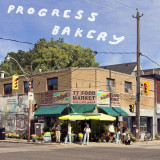
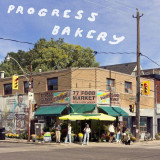
On Progress Bakery, her second album as a solo artist, Eliza knows to leave some questions alone – to let juxtaposition and tension be the proof. It doesn’t have to be hard. The feelings and revelations they provoke rise in the heat. The smell is sweet. Crispy on the outside and soft all the way through. She playfully slip-slides through words and sounds and images, delighting in surprise, skimming ideas like stones cast across clear water, touching down briefly with uncommon grace.
The question provoked between those opening lines resurfaces in the strands between songs – “Do U FM” is fully formed and beautifully layered, while “Novelist Sad Face” is a short, acapella rendering of gentle curiosity. What is holding these ideas together? Some songs demand more, seem to carry a whole load – eventually the skipping stone will halt to sink and resume its idle duty – while others drift in and out of focus, the way thoughts and dreams become interwoven before the mind is sunk into true sleep.
Music and words don’t always have to interact. Where she decides to keep them apart gives a new contour to where and how she puts them together. The kind of thing you’re supposed to take for granted with songs and their singers comes alive in Eliza’s hands – the little miracle of mixing, kneading, stretching, and stopping.
So often on Progress Bakery, Eliza teases out truth and meaning by asking questions. “Do I wanna be crying?” “Do you want me good or do you want me bad?” “Do I need an eye test?” “I’m writing songs in my head while you’re going over stuff with me — is that cruel??” In “Pocky” Eliza ends with a question that feels to me like the actual biography, succinct and revealing:
I don’t wanna be made to see
I just wanna ask “what’s that?”
Grace that ought to be rare, but in its care and precision is offered humbly, with great generosity, and without announcing itself. Eliza’s simple, miraculous music is given further form and shape by a group of collaborators – invaluable guest musicians Jeremy Ray, Evan Cartwright, Steven McPhail, Kenny Boothby, Ed Squires, Carolina Chauffe, Dorothea Paas, Louie Short, and Avalon Tassonyi. Together with Louie Short, who recorded, mixed, and produced the album along with Jeremy Ray and Lukas Cheung, Eliza has cultivated a richness in sound and texture that prods and provokes the ticklish ear. Barely audible guitar tinkering, a brief lo-fi field recording of trumpets, the harmonic clicking of a looped synthesizer, a flourish of reeds, a child’s conversation, each uncanny sound perfectly placed, rippling out under a soft breeze.
Lay in bed alone at night and ask aloud to the stillness,
“What were you doing at the Albuquerque Airport?
What were you doing there??”
And hear your question answered by a dream of swelling, undulating cellos. Try to grasp at the melody and structure. It’s not an answer (if there could be one), but it moves deeper, closer to the weird layer of fleeting moments and disconnected images, barely perceptible at its core. Wait for the dream reel to click into place.
Eliza took me for a ride in Nicole (her beloved Dodge Grand Caravan) and told me she’d been thinking of the album as an embodiment of transition – and I think every transition, known or unknown, carries the weight of new meaning, skittering off the surface tension of life as you know it, creating ripples, sometimes bouncing off and sometimes breaking through. There is a trick you can use to tell if a dough is glutinous enough. You’re supposed to stretch it out as thin as you can without breaking it and hold it up to the light. If you can see through, even if it renders the world murky and uncertain, you should leave it alone. I love this trick. It’s one that Eliza seems to know intuitively: work gently and ask questions and don’t always expect answers, and when you can, take a glimpse at something new, and then leave.
Kneading dough is tricky – you should know how it’s supposed to feel. If you try too hard you could make it worse. It’s a beautiful practice – creation with a gentle touch, to work at something so it can be left alone. “If it’s too drawn out it’s awful. It’s easy to give too much.” Dance in the mirror. Contemplate your veiny hands. Who do they remind you of?
You begin by mixing flour and water. “What happens when your people die? Why’d they move the rock to the other side of Ulster Park?” Eliza Niemi asks two seemingly unrelated questions in a rising melody with guitar accompaniment, like fingers playing spider up to the nape of your neck. Gentle pressure. Strands of gluten form to bind the mix. A new question lingers in the binding. When she admits “but I don’t know how to tell if I’m feeling it or not,” that question surfaces through the text. It is reiterated throughout the album. When I’m working with dough I think the same thing to myself.
On Progress Bakery, her second album as a solo artist, Eliza knows to leave some questions alone – to let juxtaposition and tension be the proof. It doesn’t have to be hard. The feelings and revelations they provoke rise in the heat. The smell is sweet. Crispy on the outside and soft all the way through. She playfully slip-slides through words and sounds and images, delighting in surprise, skimming ideas like stones cast across clear water, touching down briefly with uncommon grace.
The question provoked between those opening lines resurfaces in the strands between songs – “Do U FM” is fully formed and beautifully layered, while “Novelist Sad Face” is a short, acapella rendering of gentle curiosity. What is holding these ideas together? Some songs demand more, seem to carry a whole load – eventually the skipping stone will halt to sink and resume its idle duty – while others drift in and out of focus, the way thoughts and dreams become interwoven before the mind is sunk into true sleep.
Music and words don’t always have to interact. Where she decides to keep them apart gives a new contour to where and how she puts them together. The kind of thing you’re supposed to take for granted with songs and their singers comes alive in Eliza’s hands – the little miracle of mixing, kneading, stretching, and stopping.
So often on Progress Bakery, Eliza teases out truth and meaning by asking questions. “Do I wanna be crying?” “Do you want me good or do you want me bad?” “Do I need an eye test?” “I’m writing songs in my head while you’re going over stuff with me — is that cruel??” In “Pocky” Eliza ends with a question that feels to me like the actual biography, succinct and revealing:
I don’t wanna be made to see
I just wanna ask “what’s that?”
Grace that ought to be rare, but in its care and precision is offered humbly, with great generosity, and without announcing itself. Eliza’s simple, miraculous music is given further form and shape by a group of collaborators – invaluable guest musicians Jeremy Ray, Evan Cartwright, Steven McPhail, Kenny Boothby, Ed Squires, Carolina Chauffe, Dorothea Paas, Louie Short, and Avalon Tassonyi. Together with Louie Short, who recorded, mixed, and produced the album along with Jeremy Ray and Lukas Cheung, Eliza has cultivated a richness in sound and texture that prods and provokes the ticklish ear. Barely audible guitar tinkering, a brief lo-fi field recording of trumpets, the harmonic clicking of a looped synthesizer, a flourish of reeds, a child’s conversation, each uncanny sound perfectly placed, rippling out under a soft breeze.
Lay in bed alone at night and ask aloud to the stillness,
“What were you doing at the Albuquerque Airport?
What were you doing there??”
And hear your question answered by a dream of swelling, undulating cellos. Try to grasp at the melody and structure. It’s not an answer (if there could be one), but it moves deeper, closer to the weird layer of fleeting moments and disconnected images, barely perceptible at its core. Wait for the dream reel to click into place.
Eliza took me for a ride in Nicole (her beloved Dodge Grand Caravan) and told me she’d been thinking of the album as an embodiment of transition – and I think every transition, known or unknown, carries the weight of new meaning, skittering off the surface tension of life as you know it, creating ripples, sometimes bouncing off and sometimes breaking through. There is a trick you can use to tell if a dough is glutinous enough. You’re supposed to stretch it out as thin as you can without breaking it and hold it up to the light. If you can see through, even if it renders the world murky and uncertain, you should leave it alone. I love this trick. It’s one that Eliza seems to know intuitively: work gently and ask questions and don’t always expect answers, and when you can, take a glimpse at something new, and then leave.
Every so often an album of such deceptive genius, of such aesthetic clarity, comes across our desk and transfixes us. Thought Leadership's III Of Pentacles is one such work of art. It's an instant classic and glides into the pantheon of timeless guitar-soul totems. Originally out on cassette only, we present the first ever vinyl issue. It's a hideously limited pressing of 300 for the world, so don't sleep on this.
Thought Leadership has already garnered big support from such tastemakers as Ruf Dug, Jason Boardman, Nathan Gregory Wilkins, J Walk, Evan Woodward, Justin Robertson and Heavenly's Jeff Barrett. The first time we heard III Of Pentacles, we nearly wept at the thought that something so beautiful, so bursting with real hope, could even exist in this brutal world. To quote the Quietus, "imagine if Stockport was situated somewhere along the Pacific Coast Highway rather than the M60, and you’ll have some idea of the coordinates to the post-industrial, sunburnt dream space opened up here."
So, who is Thought Leadership? What do we know about them? They reside in Stockport and are obsessed with ethereal guitar records. That’s about it. That and these X ideas shared with you, the listener.
Captured on a multitrack recorder in a terraced house in Stockport, this is as DIY as it gets. Glaringly obvious is a love for classic Factory and early 4AD. Perhaps it is the proximity to the River Mersey where the ideas arrived, and there being but three miles between where this and the Durutti Column’s classic “LC” was recorded, as the two operate across a familiar aural plain. Be it geographic or otherwise, limited by a true economy of means, namely guitar, pedals and drum machine, the fruit borne from these humble tools has been indelibly shaped by the perma-gloom that hangs low over the Manchester and Stockport environs.
Ushered in on 808 kicks, “I” opens the record as a beautiful Sketch for Stockport; a chiming maj7 chord dripping in chorus and delay sets us on our way. The Vini Reilly comparisons are unavoidable. “II” is all John McGeoch, with its trippy goth-psyche arpeggiated pattern cascading across the stereo image. Do those drums swing? But goths don’t swing?! They do here. We’re treated to a bit of crunch on the lead guitar part and some really lush reverb. We even step forth into shoegaze territory, albeit briefly, for the middle eight. “III”, a firm Be With favourite, continues the dreamy psyche leanings of the previous track, with an even bigger melody this time. We’re hearing The Teardrop Explodes on quaaludes here. A proto-dream pop cut soaked in melancholy. But watch out! The coda finds Johnny Marr has gotten into the ‘ludes and gatecrashed the final bars with some incredibly ignorant B minor pentatonic noodling.
“IV” ditches the drum machine for the first in a suite of three beatless electric guitar duets. The first of these semi-improvised rubato ideas is a striking departure from the earlier playful pieces, coming over emo and moody. Greyscale sulking for Stratocaster. Sign us up. “V” contains some really lyrical phrasing; a gorgeous conversation between two guitars. Real Stopfordian Primitive; meditative, crude, rain-soaked. We cycle through the same feels, then end on an alluring chord that breaks the pattern. Sometimes thoughts are like this. “VI” creeps in all plaintive, then a huge reverberating descending guitar line comes tumbling in like something off those classic Dif Juz 12”s. There’s some Maurice Deebank in there too, for sure, and the coda nods to early Meat Puppets.
“VII” rounds out the A Side, and succinctly presents a summary of all ideas explored thus far on our journey. The drum machine is back, this time with some wispy delay, before both guitars enter together playing interlocking lines. As we start, we end, with the delayed 808 guiding us out.
Opening Side B, “VIII” sees us embark on the other side of our journey as we slow down and space out. The drum machine is here, but the guitars are different now. Think Sensations Fix or Göttsching at his most peeled out. Drones, ambient drifts of broken chords and distorted lead lines all swirl round the mix. Side B is one for headphones for sure. “IX” is almost too exquisite for words. A New Age Mixolydian voyage through the cosmos. If you’re unmoved by the end you’ve probably got no pulse. We were left blunted ineffable by this one, such is the smudged elegance radiating from this idea. All hail the Thought Leader.
“X” is a full circle moment, and a fitting end. If you’ve not already elsewhere across the platter, you will be getting heavy Robin Guthrie vibes from this piece. Like the rest of Side B, this improvised jam sticks within a framework of related chords but the celestial energies channelled might invite us to wander “outside”, especially when the Tubescreamer is engaged.
RIYL Durutti Coulmn, Cocteau Twins, Dif Juz, Sensations Fix, Spike and adjacent guitar musicks – but, ultimately, this is just its own thing; such is the strength of ideas presented. "It’s good music to chill out to." (??)
Be With is honoured to present the first ever vinyl release of III Of Pentacles, carefully remastered by Be With's engineer Simon Francisco to ensure it sounds better than ever after its initial tape release. Cicely Balston's expert skills have made sure nothing is lost in the cut whilst the records have been pressed to the highest possible standard at Record Industry, in Holland. The original tape cover artwork, so crucial to Thought Leadership's striking visual aesthetic, has been rejigged for vinyl issue here at Be With. Its stark presentation befits the music contained within. They inform us that they shuffled their tarot deck to ask what the album should be called and the card you see on the cover popped out. The III Of Pentacles tarot card represents teamwork, shared vision and the ability to achieve goals through collaboration. We like to think Thought Leadership and Be With have nailed this one.
- A1: Special
- A2: B.a.b.e
- A3: Fantasy
- A4: Not Hell, Not Heaven
- A5: Tonight (I’m Afraid)
- B1: Fleshed Out
- B2: Let You Down
- B3: Cellophane
- B4: Suffer The Fool (How High Are You?)
- B5: Haunted
- B6: Are We All Angel
Olive Green Vinyl[28,15 €]
Scowl is a band that sounds exactly like their name implies. Venomous, fierce, antagonistic. A sneer not to be crossed. Over the last five years, the Santa Cruz, California, band has firmly planted their flag in the hardcore scene with their vicious sound and ripping live show, sharing stages around the world with Circle Jerks, Touché Amoré, and Limp Bizkit, and filling slots at prominent festivals like Coachella, Sick New World, and Reading and Leeds. But with their new album, Are We All Angels (Dead Oceans), Scowl is aiming to funnel all that aggression through a more expansive version of themselves. Much of Are We All Angels grapples with Scowl’s newfound place in the hardcore scene, a community which has both embraced the band and made them something of a lightning rod over the past few years. Standout single “Not Hell, Not Heaven” outright rejects the narratives cast onto them by outsiders. “It’s about feeling victimized and being a victim, but not wanting to identify with being a victim,” explains vocalist Kat Moss. “It’s trying to find grace in the fact that I have my power. I live in my reality. You have to deal with whatever you're dealing with, and it ain’t working for me.” The band breaks from a sense of disassociation to seek deeper connections on “Fantasy.” “It’s incredibly challenging to try to balance my love for the scene while also feeling, in some spaces, extremely alienated and hated,” Moss says. “‘Fantasy’ is about feeling like I don't know how to connect with these people anymore, because I have shelled myself away so hard.” The album ends in a philosophical place on the closing, titular track, “Are We All Angels,” asking questions like, “Is this all there is?” and ultimately putting it on the listener to decide. “It’s about the personal struggle between good and evil. It doesn’t matter how ‘good’ or ‘bad’ you are, there are systems that will try to rewrite your narrative no matter what you actually do,” explains Moss, noting that punctuation on “Are We All Angels” has been deliberately omitted in an attempt to leave the statement open-ended. Are We All Angels is the highly anticipated follow-up to Scowl’s debut, 2021’s How Flowers Grow, a 16-minute primal scream over punishing riffs. But amidst the pounding chaos, it was the record’s sonic outlier, a cleaner interlude called “Seeds to Sow,” that, true to its name, planted the seed for what was to come for the band. “It kind of laid out this destiny for us, and I feel like now we’re fulfilling that,” says drummer Cole Gilbert. The band continued to expand their sound on 2023’s widely acclaimed Psychic Dance Routine EP, incorporating more pop hooks and favoring gentler singing over heavy screaming, paving the way for what would come next. Scowl’s growth got a huge boost from producer Will Yip (Turnstile, Title Fight, Code Orange, Balance and Composure), who broadened the band’s scope. “Will would say, ‘Everything you have here is correct, but it’s in the wrong place,’” says Gilbert. Moss adds: “Will really helped restructure a lot of the material. Some songs he tore apart to make more space for the really good hooks and choruses.” But even through this more eclectic approach, Scowl loses none of their edge, and still manages to convey the anger and frustration that lies underneath. They are deeply committed to carrying the ethos of punk and its sense of community. “Hardcore and punk have sculpted how we operate, what we want to do as a band, and how we participate,” says guitarist Malachi Greene. “At our core, we are a punk and a hardcore band, regardless of how the song shifts and changes.
- A1: Do U Fm
- A2: Novelist Sad Face
- A3: Green Box
- A4: Dusty
- A5: The Linda Song
- A6: Dm Bf
- B1: I Tried
- B2: Melodies Like Mark
- B3: Wildcat
- B4: How U Remind Me
- B5: Pocky
- B6: Bon Tempiii
- B7: Pt Basement
- B8: Alberqurque Ii
- B9: Mary's
Kneading dough is tricky – you should know how it’s supposed to feel. If you try too hard you could make it worse. It’s a beautiful practice – creation with a gentle touch, to work at something so it can be left alone. “If it’s too drawn out it’s awful. It’s easy to give too much.” Dance in the mirror. Contemplate your veiny hands. Who do they remind you of?
You begin by mixing flour and water. “What happens when your people die? Why’d they move the rock to the other side of Ulster Park?” Eliza Niemi asks two seemingly unrelated questions in a rising melody with guitar accompaniment, like fingers playing spider up to the nape of your neck. Gentle pressure. Strands of gluten form to bind the mix. A new question lingers in the binding. When she admits “but I don’t know how to tell if I’m feeling it or not,” that question surfaces through the text. It is reiterated throughout the album. When I’m working with dough I think the same thing to myself.
On Progress Bakery, her second album as a solo artist, Eliza knows to leave some questions alone – to let juxtaposition and tension be the proof. It doesn’t have to be hard. The feelings and revelations they provoke rise in the heat. The smell is sweet. Crispy on the outside and soft all the way through. She playfully slip-slides through words and sounds and images, delighting in surprise, skimming ideas like stones cast across clear water, touching down briefly with uncommon grace.
The question provoked between those opening lines resurfaces in the strands between songs – “Do U FM” is fully formed and beautifully layered, while “Novelist Sad Face” is a short, acapella rendering of gentle curiosity. What is holding these ideas together? Some songs demand more, seem to carry a whole load – eventually the skipping stone will halt to sink and resume its idle duty – while others drift in and out of focus, the way thoughts and dreams become interwoven before the mind is sunk into true sleep.
Music and words don’t always have to interact. Where she decides to keep them apart gives a new contour to where and how she puts them together. The kind of thing you’re supposed to take for granted with songs and their singers comes alive in Eliza’s hands – the little miracle of mixing, kneading, stretching, and stopping.
So often on Progress Bakery, Eliza teases out truth and meaning by asking questions. “Do I wanna be crying?” “Do you want me good or do you want me bad?” “Do I need an eye test?” “I’m writing songs in my head while you’re going over stuff with me — is that cruel??” In “Pocky” Eliza ends with a question that feels to me like the actual biography, succinct and revealing:
I don’t wanna be made to see
I just wanna ask “what’s that?”
Grace that ought to be rare, but in its care and precision is offered humbly, with great generosity, and without announcing itself. Eliza’s simple, miraculous music is given further form and shape by a group of collaborators – invaluable guest musicians Jeremy Ray, Evan Cartwright, Steven McPhail, Kenny Boothby, Ed Squires, Carolina Chauffe, Dorothea Paas, Louie Short, and Avalon Tassonyi. Together with Louie Short, who recorded, mixed, and produced the album along with Jeremy Ray and Lukas Cheung, Eliza has cultivated a richness in sound and texture that prods and provokes the ticklish ear. Barely audible guitar tinkering, a brief lo-fi field recording of trumpets, the harmonic clicking of a looped synthesizer, a flourish of reeds, a child’s conversation, each uncanny sound perfectly placed, rippling out under a soft breeze.
Lay in bed alone at night and ask aloud to the stillness,
“What were you doing at the Albuquerque Airport?
What were you doing there??”
And hear your question answered by a dream of swelling, undulating cellos. Try to grasp at the melody and structure. It’s not an answer (if there could be one), but it moves deeper, closer to the weird layer of fleeting moments and disconnected images, barely perceptible at its core. Wait for the dream reel to click into place.
Eliza took me for a ride in Nicole (her beloved Dodge Grand Caravan) and told me she’d been thinking of the album as an embodiment of transition – and I think every transition, known or unknown, carries the weight of new meaning, skittering off the surface tension of life as you know it, creating ripples, sometimes bouncing off and sometimes breaking through. There is a trick you can use to tell if a dough is glutinous enough. You’re supposed to stretch it out as thin as you can without breaking it and hold it up to the light. If you can see through, even if it renders the world murky and uncertain, you should leave it alone. I love this trick. It’s one that Eliza seems to know intuitively: work gently and ask questions and don’t always expect answers, and when you can, take a glimpse at something new, and then leave.
- A1: Don't Pick Her Up
- A2: Wax & Dust
- A3: Grand Telescopio Canarias
- A4: Frying Brains
- A5: A Bmx On Broadway
- A6: The Champion's Sister
- A7: The Game
- B1: Pretty Empty
- B2: Motivation
- B3: I Wonder
- B4: Pure Honey
- B5: Without The Sky
- B6: Little Magic
You may not require any introduction to the members of ROACH SQUAD, or at least one or two of the band. Needless to say, Hugo Mudie (The Sainte Catherines), Frankie Stubbs (Leatherface), Graeme Philliskirk (Leatherface) have all graced the Paradise Gutters around the Punk Rock world for some time. Joining them is Alex Keane (The Murderburgers), along with another local Sunderland Lad, Sim Robson. As with many of the members previous works, a DIY approach to writing and recording the album was taken. The bulk of the recording took place at their own Rocket Studios in Sunderland, UK with the exception of Hugo laying down the vocals from his home in Montreal (Quebec, Canada). Some of you will have noticed the line-up contains two vocalists, and indeed this is the case. For this new Band, Frankie wanted to take some time out from vocal duties and concentrate on playing his guitar. This sees Hugo taking front stage... Not for every song, though! Who knows what you expect, but what we do ask of you before listening is that you find your comfortable spot, abandon any preconceptions, and as always play it loud.
When I started the second Hylozoists record in 2004 my goal was to make it an album we could perform live and put together a real band. The first record I was so proud of but not a practical affair! It was great because I didn't think of it that way but after playing in the Sadies for years my focus was performing this music live and bringing it to people in person. It also helped forge some of my most meaningful relationships that I would have musically, Jason Tait, a drummer looking to vibraphone more, was such a great motivator and made this music come to life in a way it hadn't before. Patrick Conan also had bought a vibraphone and having a three man mallet show it was coming to life but also meant there were extra drummers around and how we would find ourselves settling into the two drummer formula. While a real headache for trying to open for people and tour ourselves it was another magical part of this set up.
With that core in place the next huge relationship took place which was with Cuff the Duke as Paul Lowman, Wayne Petti and Matt Ferris. Paul was the greatest bass player I could have ever asked for and loved playing the music and was so gracious of playing the parts I had written and then brought his own great playing to the band. Cuff and the Hylos would tour together allowing me to tour the band in a way I could have never done without them. Without them I am not sure how much the Hylozoists could have done, forever grateful.
2026 Repress
MOLA's music is the unadorned antithesis to a rosy world. She celebrates herself to death, pulls you into her inner chaos and does without the usual romanticising transfiguration of the merciless disorientation that catches up with you on the way home after the last cigarette.
MOLA knows better than anyone that she is a border commuter - and she has never made a secret of it. Perhaps it was fate that the course of events abandoned her shortly after her birth in Erba, Italy, in Germany's most austere metropolis. In Munich, where flying free and falling free are a little more complicated than in the cesspit of Berlin, where one would naturally place Isabella Streifeneder and her music if one didn't know better.
Temporarily reduced to intimacy, then escalating into iconic 80s "Purpel Rain" pathos, MOLA illustrates the emotional chaos that the inner dialogue of left and right brain triggers in her. Unconventional pop music that bundles the nonchalance of great soul anthems, the grace of the Italo-disco of the eighties and the ingenuousness of lascivious hip-hop bangers instead of trying to sound modern by force.
MOLA celebrates defeat, exposes life lies, criticises adulthood, documents radical mood swings. She balances along the abyss in her ball gown, jokes about things you don't joke about, praises and curses intoxication and love - "Vino Bianco no longer tastes like dolce vita, it only tastes like losing".
You can now see MOLA supporting Fatoni, Roy Bianco & the Abbrunzati Boys, Mayberg and Kaffkiez in a flurry of strobe lights after sold-out "nothing breaks me" shows in Munich, Cologne, Berlin & Hamburg. In addition to a festival season that couldn't have been more beautiful, they finally have a big tour of their own coming up for their next album, which will see the light of day in September.
After more than 40 festivals "Snow in Summer" on well-known stages like Lollapalooza Berlin, Rocken am Brocken, Puls Open Air, but also as support for Udo Lindenberg at the Hermann-Hesse-Festival, "Life is Beautiful", the darned second record, sounds almost cynical, ironic or simply naive? In the end, it doesn't matter, because when you are overcome by this spontaneous feeling that is far removed from any rationality, you don't ask any questions. It tastes like the melancholy of a summer in its last breaths, like the last drink of an uncompromisingly insane night.
There is sweating, pogoing and feeling together. Even where it hurts.
You are not just an onlooker or a silent spectator, but part of this empowering feeling of "we".
- A1: On Being Ft. Felix Gerbelot
- A2: Peace Exists Here
- A3: I Am In A Church In Gravesend Listening To Old Vinyl And Drinking Coffee
- B1: A Sense Of Getting Closer
- B2: Exist Inside This Machine Ft. Aneek Thapar
- C1: My Choices Are Not My Own Ft. Tawiah And May Kaspar
- C2: The Sun In A Box
- D1: True Under Certain Conditions
- D2: When I Am Alone With My Thoughts. I Am Crushed Ft. Aho Ssan
- E1: You Couldn't Love Me Enough And I've Spent My Whole Life Making Up For It Ft. Niels Orens
- E2: My Mind Is Slipping
- F1: Mother Nature Must Have A Different Plan For Me Ft. Tom Vr
- F2: The Missing Piece
- F3: It's Up To You, What You Do In The Void
Powerful works of art have traditionally sprung from some source deep within an artist and, if they strike the right tone, resonate with an audience to leave a lasting mark. But what if that equation were reversed: what if an artist were to draw their inspiration from deep within their audience, and use that to reflect those ideas, emotions, hopes, fears, pains and aspirations back to us?
Over a two year journey, audio-visual artist and electronic innovator Max Cooper has inverted the creative process by collecting hundreds of anonymous quotes, posing deep but open questions such as "What would you like to express which you cannot in everyday life?" and "What is it like to exist inside your head?"
The goal: to understand what it is truly like to be human right now. The result: his new album On Being, to be released in February 2025 with the first single "Sun In A Box" coming this September 4th.
With On Being, Cooper aimed to probe under the synthetic surface of social media to "create a snapshot of our minds these days," as he puts it by asking people to share anonymously what they dare not ever say publicly. The result is an emotionally raw and shockingly honest kaleidoscope of confessions, ranging from suicide contemplations to miserable marriages to simple pure loneliness, contrasting with hundreds of anonymous confessions of love and longing.
"I was interested in the way I interact with people for my writing process, which usually involves a one-way communication of feelings and ideas that I later find out whether they resonate with others or not," says Cooper.
"With this I could start instead with people's thoughts and feelings, what resonates for them, and make my own interpretations of those musically and visually, and then send those back out to everyone. It's more of a collaborative approach to making an album, and more intense."
Grief, hope, regret, joy, hurt and love form the basis for each track, taking Cooper's ever-evolving creative process in a completely new direction - with profoundly intense results.
"Rendering the experience of being is at the core of what I do musically - but I hadn't realised the impact that other people's words on being would have on me until I started reading the database of thoughts," he says.
"It was like finding a secret window into everyone's minds, and discovering amongst the chaos, pleasure and pain, the experiences that we all share at different times of our lives, and overwhelming emotions and connections that call out to be explored."
Despite what we see in the maelstrom of rage in the echo chambers of society ‘On Being’ reveals that humans still have an innate need to trust one another and express communal generosity - more easily done from the safety of an anonymous portal.
"The quotes carried so much weight for me - I interpreted them with my usual musical tools, but as you can hear in the music, everything got more extreme as I dove into the depths of what everyone had to say later in the record," says Cooper.
The result is a unique work of art that demonstrates unequivocally not only the power of using music without words to express emotions, but the power of words to express what seemed to be inexpressible.
On Being will continue to evolve as Cooper gathers more confessions to feed into this ecosystem of emotions and to create a new range of art projects and other accompanying works which hopefully will speak truthfully to humanity today - and of who we are and who we can become.
- A1: Dear John
- A2: Angel Artist Feat Tom Misch
- A3: Ice Water
- A4: Ottolenghi Feat Jordan Rakei
- A5: You Don't Know Feat Rebel Kleff & Kiko Bun
- A6: Still
- A7: It's Coming Home
- A8: Desoleil (Brilliant Corners) Feat Sampha)
- B1: Loose Ends Feat Jorja Smith
- B2: Not Waving, But Drowning
- B3: Krispy
- B4: Sail Away Freestyle
- B5: Looking Back
- B6: Carluccio
- B7: Dear Ben Feat Jean Coyle-Larner
Loyle Carner will release his highly anticipated sophomore record, 'Not Waving, But Drowning' on 19 April via AMF Records.
'Not Waving, But Drowning' follows Loyle's BRIT (Best Male, Best Newcomer) and Mercury Prize nominated, top 20 debut 'Yesterday's Gone'. The bedrock of honest and raw sentimentality that you heard on 'Yesterday's Gone' left an inextinguishable mark on music in general and UK Hip Hop in particular, standing out as an ageless, bulletproof debut.
'Not Waving, But Drowning', Loyle's new album, gives yet more evidence - as if it were needed - of his razor-sharp flow and his unique storytelling ability. Yes, he can rap, but he allies that with the sensitivity of a poet, the observational skills of a novelist, and warmth of your best friend. The album opens with 'Dear Jean', a letter to his mother in which he's telling her that he has found the love of his life, 'a woman from the skies', and he's moving out.
It goes without saying that Loyle's music is hard to categorise, but what is even more impressive is that for someone who grew up listening to Mos Def, Biggie Smalls, Roots Manuva, and Wu Tang Clan, he doesn't sound like any of them. Although he might from time to time give lyrical nods to them, he's no imitator.
Loyle loves cooking. There are two tracks on this album named after chefs. The British-Israeli chef Yotam Ottolenghi, and the now deceased Italian chef Antonio Carluccio. 'Ottolenghi' the first single from the album was featured on the BBC Radio 1 B-list, BBC 6 Music A-list and has already been streamed over 5 million times.
Loyle refers to real life for everything, the title of 'Yesterday's Gone' came from a song of his step father, the title of his new album 'Not Waving, But Drowning' comes from a poem by his grandfather, which in turn came from a Stevie Smith poem. What you hear on the track 'Krispy' is real. He is pouring his heart out to his best friend Rebel Kleff after their relationship went downhill, he invites him on the track to say his piece but he doesn't turn up, so we get a flugel solo instead.
Loyle also has his own personal black consciousness movement. When he refers to his 'fathers' in the track 'Looking Back' he really is referring to two fathers. His biological father, a black man who he knows, but knows very little of, and his step father, a poet and musician who happens to be a white man but died a sudden unexpected death from epilepsy (SUDEP). With no real emotional ties to his biological father, but a deep connection with a deceased step-father, where does a young child turn He succinctly captures many of the great, unspoken, cultural and historical paradoxes of multicultural Britain on 'Looking Back'.
An album like this is hard to find. It is for those who like their Hip Hop to have soul, and their soul to have spirit. This is because it works on so many levels, but it is reflecting the personality of its creator. There are a host of collaborators here, Jorja Smith, Rebel Kleff, Kiko Bun, Kwes, Jordan Rakei, Sampha, Tom Misch and more, but none are overpowering. They blend righteously into place.
Loyle is not bitter with people who have let him down, or a society that lets so many down, but the combination of anger and love he has gives his voice the perfect blend of strength and vulnerability. This might be a coming of age album, but it's also a coming of ageless album. Loyle's 2019 Spring tour - which includes London's Roundhouse - sold out within 20 minutes of being on sale.
Not Waving, But Drowning
A rapper that raps about family is hard to find. The boys in the 'hood' tend not to be that interested in how much a 'brother' loves his mother, or how much he misses his dad, or even how much he misses his best friend. The boys in the 'hood' tend to be obsessed with the size of their cars, girls, bank accounts, and other personal 'possessions'. Loyle Carner's Mercury and BRIT Prize nominated debut 'Yesterday's Gone' (Released 2017), made it clear that he wasn't that kind of rapper. In fact, every time I talk to him about his work we talk about the world, and we tended to confuse ourselves by calling his work rap, poems, or songs, sometimes in the same sentence. They are in truth all of these things.
Here's some poetry.
Honestly I need them.
I hate them but I grieve them
I think I've finally found the reason
Trust
Like the fire needs the air.
I won't burn unless you're there.
'Not Waving, But Drowning', Loyle's forthcoming new album, gives us yet more evidence, (if it were needed), that he still has what rappers call, flow, but he hasn't lost any of his story telling qualities. Yes, the boy can rap, but a rapper with the sensitivity of a true poet, the observational skills of a novelist, and warmth of your best friend. The album opens with 'Dear Jean', a letter to his mother in which he's telling her that he has found the love of his life, (a woman from the skies), and he's moving out. He really loves the woman from the skies, but he still loves his mum, and so he reassures her that there is no competition, and tells her that 'She's not behind me or behind you, but beside we and beside two', his words. Or to put it another way, moving out without moving out. My words.
It goes without saying that Loyle's music is hard to categorise, but what is even more impressive is that for someone who grew up listening to Mos Def, Biggie Smalls, Roots Manuva, and Wu Tang Clan, he doesn't sound like any of them. Although he might from time to time give lyrical nods to them, he's no imitator. He says finding his own voice was something he always found easy. Although young, (in terms of a musical career), he has confidence in his own words and his own voice, and has never been tempted to sound like he's been hanging out in the USA, or rolling in 'Grime' on the mean streets of East London. And so when it comes to the creative process he doesn't simply find a beat to jump on and ride. Beats are important, but they are tenderly layered with samples, keyboards, or live drums, all imaginatively assembled for the laying on of words. Some tracks start with the idea, some with poetry, and some with a verse from a singer or some other melodic inspiration, but there is no formula.
Here's some poetry.
Don't hold any memories of us
Rather hold you everyday until the memories are dust
Yo we only caught the train
Cos you know I hate the bus
A prolific reader, who has dyslexia is hard to find. Add ADHD (Attention deficit hyperactivity disorder) to that and life should become even more difficult. To deal with your difficulties you devise coping strategies, which can differ from person to person. Loyle loves cooking. There are two tracks on this album named after chefs. The British-Israeli chef Ottolenghi, and the now deceased Italian chef Antonio Carluccio. Loyle describes himself as 'weird' because he is happy to read a cookbook as if he was reading a novel or a book of poetry. He has opened a cookery school for young adults not just because he loves food and wants to make more of it, but because it is one of the few things that can focus the ADHD mind. And when it comes to his other love, football, his approach is the same. Focus. He wanted to be a striker he says, up front scoring goals, but found his best position was in midfield because he was able to focus, check options, and see passes ahead of time, providing passes for other players just when they needed them. He says, 'You don't grow out of ADHD, you grow into it.' Loyle is also working with Levi's® on their music project where he is mentoring young musicians over a six month period, culminating at Liverpool Sound City festival.
More poetry.
When the going is tough
I wait till it falls on deaf ears
Hearsay
Without the boundaries of love
He also said, 'Ask most people and they will say that they love their mothers, but most are not going to rap about her'. On his first album Loyle's mum Jean wrote about the 'scribble of a boy' that growing up would take things apart to see how they worked. On this album she speaks with pride about a man who has found his place in the world.
Yes, poetry.
I'm still looking for the answers
Trying to find the right questions
Still waiting for my fathers
But can't break them in to sections
This poetry is serious. Loyle has his own personal black consciousness movement. He told me that he always felt safe at home, and being the darkest one in the family never meant a thing, but then when he had to face the outside world he felt hostility. It shook him up. Now he had to start asking questions, but what were the questions. This is serious. When he refers to his 'fathers' in the verse above taken from the track 'Looking Back' he really is referring to two fathers. His biological father, a black man who he knows, but knows very little of, and his step father, a poet and musician who happens to be a white man but died a sudden unexpected death from epilepsy (SUDEP). So to whom would a young black (or mixed race) kid turn He succinctly captures many of the great, unspoken, cultural and historical paradoxes of multicultural Britain when he says, 'My great grandfather could of owned my other one.' We are a people descended from enslaved people on one hand, and enslavers on the other, something we are still struggling to come to terms with, and this can be apparent in one family. A big book could have told you that, but here we get it in one line on the track, Looking Back.
Loyle refers to real life for everything. The album is peppered with captured moments that he records on his phone. These moments can range from conversations with taxi drivers, to capturing the moment when England scores a goal in the world cup. The title of 'Yesterday's Gone' came from a song of his step father, the title of his new album 'Not Waving but Drowning' comes from a poem by his grandfather, which in turn came from a Stevie Smith poem. What you hear on the track 'Krispy' is real. He is pouring his heart out to his best friend after their relationship went downhill, he invites him on the track to say his piece but he doesn't turn up, so we get a flugel solo instead. Yes people, this is real.
An album like this is hard to find. It is for those who like their Hip Hop to have soul, and their soul to have spirit, this is an album for those who have, (I'm sorry, I'm going to say it), emotional intelligence. This is because it works on so many levels, but it is reflecting the personality of its creator. There are a host of collaborators here, Jorja Smith, Rebel Kleff, Kiko Bun, Jordan Rakei, Sampha, Tom Misch and more, but none are overpowering. They blend righteously into place. Loyle is not bitter with people who have let him down, or the society that has let him down, but the combination of anger and love he has gives his voice the perfect blend of strength and vulnerability. This might be a coming of age album, but it's also a coming of ageless album. His first album worked, and this second album is a continuation of that work. Not creating a form, but being formless, as someone like Bruce Lee once said.
And here's some poetry from mum.
We talked long in to the darkest hours
Until we saw the burnished sky
And our eyes stung
As our words blurred and became thoughts
As we were silenced by the dawn
We clung to each other like sailors in a storm
- 01: King Of Rock And Roll
- 02: Hey, Hey, Hey, Hey
- 03: Spreadin' Natta What's The Matter
- 04: Shake A Hand
- 05: Dew Drop Inn
- 06: True Fine Mama
- 07: Great Gosh A'mighty
- 08: Poor Dog
- 09: Send Me Some Lovin
- 10: Slippin' And Slidin
- 11: Bama Lama Bama Loo
Black Vinyl[22,65 €]
Diamond Dogs may be a bunch of renaissance rockers deeply rooted in the early 70s British rock and roll, but just like our forerunners, we owe
almost everything to Little Richard, the architect of it all! It's impossible to even imagine rock and roll without him.
Little Richard is the soul, spirit and passion of the Diamond Dogs lifestyle, and I was six years old when I first heard 'Rip It Up' with love at first feel.
The raw energy and the blood screaming lyrics over that manic hammering piano embodied everything I craved in music, straight from the speakers to my young heart. Even if I discovered a lot of other influences later on in life, I always kept Little Richard close to where he once hit me. One of Diamond Dogs' early tunes is called 'Lunatic Eye-Rolling Delivery' which is a line nicked from a concert review of Little Richard, and we believe it sums up the essence of his greatness pretty well. He was much more than a rock pioneer, the way he dressed up and spoke was something the world had never experienced before.
Little Richard got Paul McCartney to write 'I Saw Her Standing There', got James Brown a new haircut, and put a silly little mustache on Prince!
So, the idea of recording a homage to the true king of rock and roll had been with all of us for many years when Chris Spedding one day called me
and asked if we should record something together. Of course, I immediately said yes, and then asked him to join Diamond Dogs in the upcoming
studio session to record some well selected Little Richard gems for an LP. All said and done, and Chris was extra thrilled that his favorite 'Send Me
Some Lovin'' was among the songs we picked.
And on a cold and windy January day we gathered the Dogs and the new old puppy in the sweet premises of Dog Pound Studios, along with our
beloved friend and engineer Jonas Åhlén.
So, when the room is geared up, we do our melodies as we normally do it, no rehearsals, all live, straight to tape. One hour per track is usually a
good thing! An amazing energy and swagger filled the atmosphere as Diamond Dogs and Chris fulfilled my dream.
Now that I'm listening through the vinyl, I must say that I've never been prouder of anything we've achieved with this shady bunch so far. It's like
walk the full circle, like I've been graduating from the 12-bar rock and roll academy.
Sulo, Stockholm/Sweden, 2024
Sound Like: The Faces, Rod Stewart, Frankie Miller, Elton John, Mott
The Hoople, J Geils Band, The Rolling Stones, Steppenwolf, Little
Richard
Diamond Dogs may be a bunch of renaissance rockers deeply rooted in the early 70s British rock and roll, but just like our forerunners, we owe
almost everything to Little Richard, the architect of it all! It's impossible to even imagine rock and roll without him.
Little Richard is the soul, spirit and passion of the Diamond Dogs lifestyle, and I was six years old when I first heard 'Rip It Up' with love at first feel.
The raw energy and the blood screaming lyrics over that manic hammering piano embodied everything I craved in music, straight from the speakers to my young heart. Even if I discovered a lot of other influences later on in life, I always kept Little Richard close to where he once hit me. One of Diamond Dogs' early tunes is called 'Lunatic Eye-Rolling Delivery' which is a line nicked from a concert review of Little Richard, and we believe it sums up the essence of his greatness pretty well. He was much more than a rock pioneer, the way he dressed up and spoke was something the world had never experienced before.
Little Richard got Paul McCartney to write 'I Saw Her Standing There', got James Brown a new haircut, and put a silly little mustache on Prince!
So, the idea of recording a homage to the true king of rock and roll had been with all of us for many years when Chris Spedding one day called me
and asked if we should record something together. Of course, I immediately said yes, and then asked him to join Diamond Dogs in the upcoming
studio session to record some well selected Little Richard gems for an LP. All said and done, and Chris was extra thrilled that his favorite 'Send Me
Some Lovin'' was among the songs we picked.
And on a cold and windy January day we gathered the Dogs and the new old puppy in the sweet premises of Dog Pound Studios, along with our
beloved friend and engineer Jonas Åhlén.
So, when the room is geared up, we do our melodies as we normally do it, no rehearsals, all live, straight to tape. One hour per track is usually a
good thing! An amazing energy and swagger filled the atmosphere as Diamond Dogs and Chris fulfilled my dream.
Now that I'm listening through the vinyl, I must say that I've never been prouder of anything we've achieved with this shady bunch so far. It's like
walk the full circle, like I've been graduating from the 12-bar rock and roll academy.
Sulo, Stockholm/Sweden, 2024
Sound Like: The Faces, Rod Stewart, Frankie Miller, Elton John, Mott
The Hoople, J Geils Band, The Rolling Stones, Steppenwolf, Little
Richard
- 1: Mr. Luck & Ms. Doom
- 2: Her Ponyboy
- 3: Left Hook Like Frazier
- 4: Sitting On The Curb
- 5: There's Nothing Down The Highway
- 6: Don't Miss Your Bus Lorraine
- 7: The Haunting Thoughts
- 8: Nancy & The Pensacola Pimp
- 9: Maureen's Gone Missing
- 10: Jp & Me
- 11: Don't Go Into That House Lorraine
Oxblood Red Vinyl[24,79 €]
Mr. Luck & Ms. Doom is the Delines most realized and strongest album to date, a record of romantic misfits and grifters who live out of suitcases and cars, who can"t seem to settle down, who hope that in the next town or city will be the score that saves them. Mr. Luck & Ms. Doom features the stalwart Delines line up: Amy Boone on vocals, Cory Gray on horns and keyboards, Sean Oldham on drums, Freddy Trujillo on bass, and Willy Vlautin on guitar. The record features Amy Boone"s lush, world worn voice, the cinematic production skills of Askew, and the horn and string arrangement of Delines keyboardist and trumpeter, Cory Gray. This is wide screen, CinemaScope, Delines at their best.
- 1: Automatic
- 2: Happyman
- 3: 9Th At Pine
- 4: Sugar In Your Gas Tank
- 5: Shindo
- 6: 107
- 7: Johnny Quest Thinks We're Sellouts
- 8: Krazy Glue
- 9: Never Going Back To Jersey
- 10: How's My Driving, Doug Hastings?
- 11: Just Like Frank
- 12: Ask The Magic 8 Ball
- 13: Dopeman
- 14: Jen Doesn't Like Me Anymore
- 15: Rock-N-Roll Pizzeria
- 16: Lockdown
The Official “Forever” Versions of Less Than Jake’s first full lenght album, Pezcore and Losing Streak are here! "Losing Streak" comes with reimagined artwork done by the legendary punk artist Chris Shary (Descendents, ALL, Black Flag), this special version celebrates the history of this seminal album, with a fresh new look!
- A1: Slaw 03 52
- A2: Dirtmouth (Feat. James Brandon Lewis) 04 42
- A3: Solanin (Feat. Brandee Younger) 03 54
- A4: Never In My Short Sweet Life (Feat. Mononeon) 03 50
- A5: Robert Pollard 01 54
- B1: Unified Dakotas (Feat. Jeff Parker) 05 04
- B2: Fast Asleep 04 34
- B3: (If You Don't Leave) The City Will Kill You (Feat. Daedelus) 05 11
- B4: Fatigue (Feat. Kurt Rosenwinkel & Telemakus) 03 20
- B5: Bad Infinity 04 44
Los Angeles-based experimental jazz collective High Pulp will release
their new album Days in the Desert in peak sweltering summer heat on
July 28
The titular desert is both literal and metaphorical: it's the Mojave Desert that the
band powers through on their many DIY tours around the country, and the band's
founder / drummer Bobby Granfelt perceives the desert as "a spiritual quest" as
well. Amid the trials of our present moment, you must look within, relying solely
on your own instincts to keep moving forward. "You're in the desert and it's a long,
lonesome process and a lot of times you have to check yourself to ask 'Is this
right? Is this good? Is it too out?'" he says.
High Pulp's Days in the Desert makes this vision come true, finding the West
Coast band fully emerging into their own sound. Rooted in the jazz tradition while
also smitten by indie- rock and electronic music, High Pulp was willing to grab
from all these sounds at once to pursue something truly their own. Their third fulllength album (following 2022's promising Anti- debut Pursuit of Ends), Days in the
Desert reveals the band realizing their strengths, deepening their own bonds, and
pushing all these skills into a thrilling new sonic vista all but unimaginable just a
few years before