Nineties-inspired alternative indie noise rock / post
punk.
For fans of IDLES, The Jesus Lizard, (‘Worst Case
Scenario’-era) dEUS, Black Midi.
If The Waltz were a drink, it’d be a slamming
cocktail of Panoramix’s magic potion, mixed with
Red Bull, some coffee and a strong Belgian Tripel
beer. A firm headbutt with a kiss on the cheek
afterwards. You won’t know what to remember first:
the bang or the catharsis.
CD in digipack. LP pressed on 180gm yellow
coloured vinyl.
First singles received airplay on Belgian national
radio (Studio Brussels / Radio Willy).
Everything is Noise (US) premiered the single
‘Red-Orange Moon’ and will do an extended
feature on the album.
Поиск:dr dick
Все
Reissue of George Duke's classic 1973 jazz-funk-fusion album 'The Inner
Source'
In 1971 George Duke, having just recently done his time with the Mothers of
Invention, was engaged by the Cannonball Adderley Quintet. Beginning in April of
that year, Duke made two recordings over a short timespan that on their release
in 1973 as a double LP (against the desire of the artists, by the way), would be a
major statement.
On Chapter One of his fusion autobiography, "Solus", Duke, along with the
skeleton crew of bassist John Heard and drummer Dick Berk, tries out the new
compositional philosophy he had absorbed from his work with Adderley. On
Chapter two, "The Inner Source" " Duke lives it up as he shows off his exuberant
experimental synth side and also begins to vary the line-up here as some tracjs
are reinforced with Latin percussion, incisive horn and reed instruments or with
Duke on his first instrument, the trombone. As a curiosity, two basses compete
with each other on "Twenty Five".
Silver Vinyl[27,27 €]
Mit nur zwei Demos seit Gründung im Jahr 2018 scheint es, dass MALIGNANT ALTAR nach modernen Maßstäben etwas zu ruhig gestartet waren. Doch dieses Monster hat nicht geschlafen oder sich auf seinen Lorbeeren ausgeruht, sondern das ranzigste, obszönste Album geschaffen, das man sich vorstellen kann. Aus dem tiefsten Schlund 80er-Horror-Einflüssen ergießt sich eine Flut von Innereien in Form von eitrig faulen Riffs und zermürbenden Drums in einem dicken teerigen Matsch instrumentalen Verfalls über den Hörer. Gesanglich wird purer Ekel ausgekotzt, der sich glorreich klebrig über die letzte Ritze bösartig hypnotisierender Rifflandschaft einfügt und wie verfaulte Leichenreste aus euren Lautsprechern tropfen. Wenn das alles nach einer Demo-Band mit begrenzten technischen Spielfähigkeiten klingt - Nichts wäre weiter von der Wahrheit entfernt, da MALIGNANT ALTAR mit gnadenlosem Drumming und technisch ausgefeilten Riffs aufwarten können.
Über fünf typische Tracks und einem spektralen Zwischeninstrumental ist die Platte zwar gnadenlos brutal, verzichtet aber dennoch nicht auf Dynamik. Diese Texaner haben Würze in ihrem Death Metal und wissen genau, wann unausweichliche Attacke oder zermürbender Groove bis hin zum Pulverisieren der Nackenwirbel gefragt ist!
- A1: Dick Khoza And The Afro Pedlars - Chapita
- A2: Ensemble Of Rhythm And Art - Pelican Fantasy
- A3: Spirits Rejoice - Sugar Pie
- B1: Makhona Zonke Band- The Webb
- B2: Abacothozi - Night In Pelican
- C1: The Black Pages - There Goes
- C2: The Headquarters - Moshate
- C3: The Shyannes - Asso-Kam
- D1: Almon Memela’s Soweto - Pelican City
- D2: The Drive - I Have A Dream
‘The Afro Modern Seventies Sounds of Soweto’s First Nightclub
• Over ten years in the making, this is the first compilation from South African vinyl re-issue specialists Matsuli Music
• Ten track double gatefold album journey through jazz, funk, fusion and disco, detailing the incredible story and sounds behind the Soweto nightclub during the height of apartheid
• Uniquely South African take on the trans-Atlantic sounds of Philadelphia, Detroit and New York City
• Cover artwork by Zulu Bidi (of Batsumi fame) with unseen photographs, and liner notes by Kwanele Sosibo featuring interviews with key musicians, players and a former president of South Africa
• Audio mastered and cut for vinyl by Frank Merritt at The Carvery with heavyweight 180g vinyl pressed at Pallas in Germany
A night-time haunt in the backstreets of Soweto run by a well-known bootlegger should have been a prime zone for nefarious underworld activities. Instead, it nurtured an underground of a different kind. Soon after its opening in 1973, Club Pelican became a spot where musicians steeped in the tradition of South African jazz began to cook up experimental sounds inspired by communion, competition and the movements in funk and soul blowing in from the West. Located in an industrial park on the western edge of Orlando East, Soweto, Club Pelican was off the beaten track, among a matrix of railway and industrial infrastructure. In a different time and place, this would have been a prototypical nightclub location, except there was no local precedent to follow. This was Soweto’s first night club.
In the intervening years, this location has served to heighten the now-defunct spot’s legendary status as a singular venue, one that ruled the night in the Seventies. Initially called Lucky’s and established in 1973, the Pelican’s impact on the Soweto cultural landscape was immediate. Lorded over by a charismatic figure known as Lucky Michaels, the club became the jewel in a nondescript collection of family businesses. It boasted a diverse pool of talent in its succession of house bands and an A-list of ghetto-fabulous singers as
its cabaret stars. Its VIP section was a veritable who’s who of Soweto society and its stage, hosting a mix of the day’s pop culture infused with the creativity and individual histories of the musicians, the Pelican filled a live music vacuum.
One Night in Pelican captures the halcyon seventies period with a single nightclub embodying an indomitable spirit of its troubadour players. While schooled and rooted in “standards” and local forms, the music could take any direction, at a moment’s notice. This compilation features all the key groups and players of the time: Abacothozi, Almon Memela’s Soweto, The Black Pages, Dick Khoza and the Afro Pedlars, The Drive, Ensemble of Rhythm and Art , The Headquarters, Makhona Zonke Band, the Shyannes and Spirits Rejoice.’
- A1: Opening Credits
- A2: The Chase
- A3: Saved/Captured
- A4: The Bracelet
- A5: Council Of Draags (Part 1)
- A6: Terr & Tiwa
- A7: The Knowledge (Part 1)
- B1: The Fight
- B2: The Knowledge (Part 2)
- B3: The Initiation
- B4: Escape
- B5: The Big Tree
- B6: The Ritual
- B7: The Duel
- C1: Theft/Zarek
- C2: The Bird
- C3: The Free Oms
- C4: The Purge
- C5: The Journey To Ygam
- C6: Council Of Draags (Part 2)
- D1: The City Of Free Oms
- D2: Robot Attack
- D3: The Fantastic Planet
- D4: The Final Battle
- D5: Terr
- D6: End Credits
White / Pink LPs[30,21 €]
Double BLACK Vinyl, Gatefold sleeve, DL card. René Laloux’s celebrated 1973 sci-fi animation ‘La Planète Sauvage (Fantastic Planet)’, is overhauled with a re-imagined soundtrack by electronic modernists Stealing Sheep and legendary sound innovators The Radiophonic Workshop. This exclusive release is part of Fire Records’ re-imagined score series. “No institution has had a greater impact on the development of electronic music than the BBC Radiophonic Workshop.” The Vinyl Factory. It’s a real pre-Avatar conundrum that Stealing Sheep, with the help of Bob Earland, Dick Mills and Roger Limb from the Radiophonic Workshop, unravel. Creating an ethereal excursion that’s narrated by Roger Limb; like a futuristic Martin Denny, or Dr Who gone ambient techno, with a hint of Forbidden Planet 50 years on. It’s an analogue swirl set in an off-world paradise; a field recording from the future. This is a creative, generation-spanning, union brought together to score this unique cult film. A must for fans of psyche electronica and Stealing Sheep’s formidable ‘Big Wows’ album. “Stealing Sheep devour a broad range of styles, incorporating everything from the dark dance-pop of Grace Jones to the experimentations of Radiophonic Workshop pioneer Delia Derbyshire and John Carpenter soundtracks.” The Guardian // ‘La Planète Sauvage’ is a thing of ambient beauty punctuated with electronic earworms that switches from intensely ominous to otherworldly dream like moments.
10” black vinyl with download code. File under: Indie, UK. It’s been four years since we last heard from Tigercats, with the 2018 album Pig City marking the expansion of their sonic palette from indie-pop and alt-rock, to include highlife, afrobeat, and scuzzy West African psych. The New Works EP is another step into the new for Tigercats, the sound of an increasingly political band, unbound by the records they’ve made previously, and enjoying the freedom of exploring and experimenting for these 5 new tracks. “We’ve been a band over 10 years and it felt like all of our previous recordings have been leading up to this one. After Duncan switched from guitar to kalimba a few years back, and we welcomed a horn section into the line-up, the sound has been getting denser and grittier, particularly live. With this recording we’ve finally managed to capture some of that energy on record.” The opening track New Work, a song about the relentless tyranny of labour in the 21st century, grows from the synth bass riffs and riotous brass lines with production inspired by industrial techno like JK Flesh, to display lyrical ferocity not often heard. The Space came together completely improvised in the studio, and reflects on the fight for space to create art - in a world fighting for your attention 24-7, and the depletion of available arts spaces. The intensity subsides for The Picture, a track whose origins date back to the writing of the band’s second record. More reminiscent of Tigercats’ indie credentials, drawing on the textures of Low or Yo Lo Tengo, it is developed here by a band confidently hitting their stride. New Works was written in 2019 and recorded at Lightship 95 on the Thames, and at Big Jelly in Ramsgate. Originally scheduled for a spring 2020 release, we’re excited to finally bring you these 5 tracks and the promise of a return to blistering live shows from Tigercats. Tigercats are a kalimba-led psychedelic pop band from East London. Having honed his songwriting craft in the short-lived but much much-missed Esiotrot, in 2010, Duncan Barrett went about forming a new band and recruited sibling/long-time producer Giles Barrett (bass), talented songstress Laura Kovic (keys), as well as Paul Rains (guitar, of Allo Darlin’). The band have performed throughout the UK and Europe and have supported The Wave Pictures, Allo Darlin and Darren Hayman among others. They have also performed at the End of the Road and Primavera Festivals and have appeared on Spanish TV (RTVE Radio3) and Indietracks. A tour of the USA and Canada included a headline appearance at NYC Popfest. New Works harks a return to Fika Recordings, having released the debut Tigercats album Isle of Dogs back in 2012, bookending albums with Fortuna Pop! (2014’s Mysteries) and El Segell Del Primavera (2018’s Pig City). Tigercats are: Duncan Barrett - Vocals, Kalimba. Giles Barrett - Bass, Production. Laura Kovic - Keys, Vocals. Paul Rains - Guitar, Vocals. Will Connor - Drums, percussion. Seb Silas - Baritone saxophone. Meridyth Dickson - Alto saxophone. Thom Punton – Trumpet.
Mike Pride was not a fan of legendary punk band MDC – a straight-edge hardcore devotee, you could even say he had a chip on his shoulder about this more mainstream, less disciplined form of punk – when he suddenly found himself on a tour of Europe as their drummer sometime in the early ‘00s. Twenty years later, now a longtime fan and friend of the band, Pride unexpectedly turns to the band’s raucous catalogue as a source for jazz standards on his warped new album, I Hate Work. I Hate Work draws its material exclusively from MDC’s iconic 1982 debut album, Millions of Dead Cops. Despite his long established passion for bringing the extremes of hardcore and heavy rock into the jazz and improvised music realm (and vice versa), Pride instead does the unexpected, transforming MDC’s pummeling punk into swinging acoustic jazz. For the occasion he enlisted pianist Jamie Saft and bassist Bradley Christopher Jones, both master re-interpreters of a wide swath of pop and rock music, as well as special guests Mick Barr (Ocrilim, Krallice), JG Thirlwell (Foetus), Sam Mickens (The Dead Science) and MDC frontman Dave Dictor.
After a trilogy of spectacular explorations of relentlessly driving rhythms – Sagittarian Domain (2012), Quixotism (2014) and Hubris (2016) – Simian Angel finds Oren Ambarchi renewing his focus on his singular approach to the electric guitar, returning in part to the spacious canvases of classic releases like Grapes from the Estate while also following his muse down previously unexplored byways. Reflecting Ambarchi's profound love of Brazilian music – an aspect of his omnivorous musical appetite not immediately apparent in his own work until now – Simian Angel features the remarkable percussive talents of the legendary Cyro Baptista, a key part of the Downtown scene who has collaborated with everyone from John Zorn and Derek Bailey to Robert Palmer and Herbie Hancock. Like the music of Nana Vasconcelos and Airto Moreira, Simian Angel places Baptista's dexterous and rhythmically nuanced handling of traditional Brazilian percussion instruments into an unexpected musical context. On the first side, 'Palm Sugar Candy', Baptista's spare and halting rhythms wind their way through a landscape of gliding electronic tones, gently rising up and momentarily subsiding until the piece's final minutes leave Ambarchi's guitar unaccompanied. While the rich, swirling harmonics of Ambarchi's guitar performance are familiar to listeners from his previous recordings, the subtly wavering, synthetic guitar tone we hear is quite new, coming across at times like an abstracted, splayed-out take on the 80s guitar-synth work of Pat Metheny or Bill Frisell. Equally new is the harmonic complexity of Ambarchi's playing, which leaves behind the minimalist simplicity of much of his previous work for a constantly-shifting play between lush consonance and uneasy dissonance. Beginning with a beautiful passage of unaccompanied percussion dominated by the berimbau, the side-long title piece carries on the first side's exploration of subtle, non-linear dynamic arcs, taking the form of a gently episodic suite, in which distinctive moments, like a lyrical passage of guitar-triggered piano, unexpectedly arise from intervals of drifting tones like dream images suddenly cohering. In the piece's second half, the piano tones becomes increasingly more clipped and synthetic, scattering themselves into aleatoric melodies that call to mind an imaginary collaboration between Albert Marcoeur and David Behrman, grounded all the while by the pulse of Baptista's percussion. Subtle yet complex, fleeting yet emotionally affecting, Simian Angel is an essential chapter in Ambarchi's restlessly exploratory oeuvre. --- Oren Ambarchi - guitars & whatnot Cyro Baptista - percussion & voice Recorded by Randall Dunn, Joerg Hiller, Iuri Oriente and Oren Ambarchi. Edited by Joerg Hiller and Oren Ambarchi at Choose Studios, Berlin. Mixed by Joe Talia and Oren Ambarchi at Good Mixture, Tokyo. Cut by Rashad Becker at D&M, Berlin. Executive Producers: Konrad Sprenger & Dick Wolf. Photography by Traianos Pakioufakis. Design by Lasse Marhaug.
Forty years ago, on July 8th and 9th in 1981, a group formed by the splintering of some of Bristol’s essential post punk bands, entered the hallowed studio at Berry Street in London to record their debut single. What would emerge was not only an exuberant post funk classic on the A-side, but also a wildly influential dub workout on the flipside, whose reverberations can still be heard today. Both songs have proven essential in very different ways.
A focal point for the unique punk-funk that was coming together in Bristol as the bridge from the 70s to the 80s arrived, Maximum Joy was formed by Glaxo Babies multi-instrumentalist Tony Wrafter and 18 year old vocalist and multi-instrumentalist Janine Rainforth. Soon they drafted in additional Glaxo Babies in the form of drummer Charlie Llewellin and bassist Dan Catsis, along with guitarist John Waddington, fresh from The Pop Group. The group set about making a one-of-a-kind mix of funk, punk, pop, jazz, dub, soul, afrobeat and reggae; creating a brilliant charge of danceable tunes wrapped around elastic basslines and complex percussion, punctuated by melodic horns and stabs of guitar, all of it highlighting Rainforth’s naturally enthusiastic vocal style.
Bursting at the seams, “Stretch” feels like it can barely be contained within the studio walls. Rainforth delivers a vocal performance that can only be found within the freedom of someone recording their first ever single. I’m not lying when I say there isn’t another song that sounds quite like it. The group’s love of funk is evident on “Stretch”, but the heavy influence of dub and reggae from their surroundings shapes the moody skitter of “Silent Street”. Here, the sing song vocals seem to drift across the heavy late night air. The two songs are wildly different, yet both could only have come from this key collection of players. Paired with the likes of The Pop Group, The Slits, The Raincoats and the On-U-Sound collective, Maximum Joy still stands out as a unique voice in the movement.
Y Records head Dick O’Dell would join the sessions and give the release a warm home in the UK while legendary 99 Records in New York took on the US release since Maximum Joy made perfect sense being equal parts ESG and Liquid Liquid. This 12” has been a staple for DJ’s in the know since day one.
A deep dive into the one of most collectable jazz catalogues in the world, a selection of some of the rarest and most sought-after recordings from the 60s and 70s, a time when British jazz began to find its own identity. Drawn from the iconic labels of Decca, Deram, Argo, EMI Columbia/Lansdowne Series, Fontana, Mercury, & Philips. If one were asked to pick an album that represented the best of British jazz in the 1960s, Le Déjeuner Sur l’Herbe by the New Jazz Orchestra would be a serious contender. Recorded in September 1968, it draws together many of the key streams that had developed in British jazz in the preceding years, and also presages much of what was to come. Notwithstanding the line-up, which includes some of the very best British jazz musicians directed by an inventive and ingenious leader in Neil Ardley, the session features pieces written by the most distinctive jazz composers active in Britain at that time alongside idiosyncratic interpretations of works by John Coltrane and Miles Davis. And it’s all captured beautifully by engineer Howard Barrow and producer Tony Reeves and it features a stella cast of some of the greatest musicians, not just from that era or genre but beyond; Jack Bruce, who would become one of the founding members of Cream, Barbara Thompson, Ian Carr, Michael Gibbs, Dave Gelly, Dick Heckstall-Smith and Jon Hiseman, who went on to form one of the greatest jazz/progressive/rock bands – Colosseum.
Alice Cooper perfected shock rock with his 1975 concept album WELCOME TO MY NIGHTMARE. The stage show is justifiably legendary, replete with boa constrictors, guillotines and other Grand Guignol theatrics, and this 1975 Atlantic collection is its aural equivalent - a loosely conceptual set exploring a child's dark dreams. With guitarists Dick Wagner and Steve Hunter supplying the firepower, this NIGHTMARE features plenty of hard rock (“Cold Ethyl,” “The Black Widow”), but there are also quieter moments like the hit ballad “Only Women Bleed,” and thanks to Bob Ezrin's elaborate production it all flows together perfectly. WELCOME TO MY NIGHTMARE will be pressed on clear vinyl.
Things become intangible. On his 3d album "Take Care Of Me", Murena Murena does an about-turn: his new songs are silhouette vehicles in the reverse of all traffic formulas that strive for speed and progress. You can also do it with your back on the floor, you can also go backwards! In Murena Murena's Augmented Reality Roll, language, rhythm and harmony always turn and expand in the opposite direction. The direction we / they came from. If the idea of a monoposto was to replace the front passenger with a rear-view mirror, and from then on to let the driver run the distance forwards and backwards in the driver's eye, then you can also carry out a U-turn while sitting on a chair with eyes painted on the lids. A mandrill will quickly become the Sphinx. And a hawk moth sees just as much as a fire bug. Dry sump lubrication in the box: camshafts driven by a spur gear cascade ensure additional turbulence of the helium mist in the crankcase through their rotary motion. Of course, that's hard to believe. Gone, the wet sump lubrication of ,Shame Over,! You, listener, now have to grab the ropes yourself and perform wave-like movements, pull the ropes and let them pop. If your eyes go black, you have both hands free again.
Southern Avenue Announces New Album, ‘Be The Love You Want’. Out August 27 via Renew Records/BMG, produced by Multi-Grammy Winner Steve Berlin
(Memphis, TN) – Memphis soul powerhouse Southern Avenue has announced the release of their third full-length album. BE THE LOVE YOU WANT was produced by multi-GRAMMY® winner, Steve Berlin (Los Lobos, Deer Tick, Susan Tedeschi, Jackie Greene), and co-produced by Ori Naftaly. The album, arriving via Renew Records/BMG on August 27, 2021, is preceded by today’s release of the sultry first single, “Push Now,” available at all DSPs and streaming services.
BE THE LOVE YOU WANT is Southern Avenue’s most ingenious and personal effort thus far. Since their inception, the band has produced a wide-ranging collection of original music – predominantly co-written by Israeli-born guitarist Ori Naftaly and powerhouse lead vocalist Tierinii Jackson – that links them to their home city’s glorious past while at the same time, demonstrates their ambitious intent to evolve Memphis music to contemporary effect.
BE THE LOVE YOU WANT sees Southern Avenue teaming up with artists like multi-GRAMMY® award-winning pop superstar Jason Mraz and certified Platinum producer Michael Goldwasser from Easy Star All-Stars on “Move Into The Light” for a churning, funk-blasted burner. Besides writing with him on the first single, the band also collaborated with Cody Dickinson from North Mississippi Allstars for the song “Heathen Hearts.” The songwriting core grew within the band as well, as drummer Tikyra Jackson and bassist Evan Sarver collaborated to co-write “Let’s Get It Together” and “Pressure.”
The band brilliantly bridges the power of Memphis soul with jamband liberation, gospel blues, and R&B to craft their own timeless brand of American music. The ambitious sonic approach expertly complements BE THE LOVE YOU WANT’s rich themes of self-love, self-empowerment, personal accountability and the desire to push through towards something greater in life.
This is the first official re-release on vinyl under licensed courtesy of BMG Rights Management,UK, remastered from an original master copy out of the vaults of BMG, originally released in 1972 on Bronze Records.
Co-founder of Colosseum in 1968 with Jon Hiseman, he knew from his Jazz Club years as drummer for Georgie Fame, Dick ran through this group's hectic recording and touring schedule for over 3 years until November 1971, when it disbanded.
In his late 30s at that time, on top of his musical shape, he moved on to start recording on his first solo project, with material left over from Colosseum days (written by D. H.-S., Clem Clempson and Jon Hisemann) and new material jointly composed with well-known lyricist Pete Brown. He recruited the help of Colosseum mates, Hiseman, keyboardist Dave Greenslade and vocalist/bass player Mark Clarke, plus the brilliant ex-Elton John group Caleb Quaye (Hookfoot) on guitars and Rob Tait (ARC, Battered Ornaments) on drums; old pal G. Bond is featured providing remarkable moog work on 'Pirate's Dream', funky organ on 'Moses In The Bullrushourses' and sharing piano duties with Gordon Beck (G.B. Trio, Nucleus) on 'What The Morning Was After'; Paul Williams (Juicy Lucy) gets the lion share of vocal duties, and Chris Farlowe and Chris Spedding (Nucleus, Battered Ornaments) have respectively a sole vocal and a guitar spot on 'Pirate's Dream'.
The album track by track:
Side one starts with 'Future Song', the track that really rises above the other tracks here. The guitar, vocals (by Mark Carke) and sax are great on this one. Killer sax 2 minutes during an excellent instrumental interlude. H.-S. sounds slightly eastern-influenced on his outstanding sax lines. Such an uplifting track with it's repetitive riff and hard, driving sound! Next is 'Crabs', starting off in a mellow way with Greenslade's piano and reserved vocals as the sax joins in followed by guitar and drums as it builds. Irresistable! Great vocals by Paul Williams. One could easily imagine both tracks on a Colosseum album. 'Moses In The Bullrushourses' is uptempo, owing just as much to jazz, blues and hard rock. Great groove! Lots of organ here to send shivers down your spine and perfect guitar playing. 'What The Morning Was After' opens with some sax excursions as the drums help out. Acoustic guitar by Quaye and powerful vocals by Paul Williams take over as the piano joins in. Our second favourite tune on here after the opener. A folky song really until it picks up half-way through.
Side 2 opens with the 11 minutes 'Pirate's Dream', with Farlowe on vocals and Spedding's initial rock blues riff, but soon evolving to a complex multi parted composition in the best spirit of Valentyne Suite, driven by Hiseman multi faceted drumming. D. H.-S. twin saxes soar on a calmer mid section with Spedding doubling the licks and the bass grumbling relentlessly behind; it slowly gains speed with moog, sax and vocalizations duelling and answering each others with dazzling, demanding and inspired phrasings on top a thundering rhythm section; after the lyrics resume it evolves into a majestic, grandiose finale. A bluesy clean guitar lick opens 'Same Old Thing', a swinging, calm heavily modulated twisted blues, with a punchy rhythm section, a soulful Williams on vocal, Quaye delivering an inspired sparkling solo and D. H.-S.'s sensitive fat sax enhanced with some double tracking on the solo part. A great ending to a great album.
Album comes with the reproduction of original gatefold cover sleeve, additional cover-sized insert with band story, lyrics and photos. A highlight! Highly recommended!
Having already unearthed three collections of archival ‘70s recordings by Catherine Christer Hennix, Blank Forms continues their annual illumination of the visionary Swedish composer’s music by turning to more recent work with this first-time vinyl edition of Hennix’s “Blues Alif Lam Mim in the Mode of Rag Infinity/Rag Cosmosis,” a 2014 piece first released as a CD in 2016 (Important Records).
The double album captures the April 22, 2014 premiere of Hennix’s composition by by the Chora(s)san Time-Court Mirage, her expanded just intonation ensemble, featuring a brass section of Amir ElSaffar, Paul Schwingenschlögl, Hilary Jeffery, Elena Kakaliagou, and Robin Hayward; live electronics by Stefan Tiedje and Marcus Pal; and voice by Amirtha Kidambi, Imam Ahmet Muhsin Tüzer, and Hennix herself. Intended to reveal the blues’ origins in the eastern musical traditions of raga and makam, “Blues Alif Lam Mim in the Mode of Rag Infinity/Rag Cosmosis” has its roots in Hennix’s 2013 realization of an “Illuminatory Sound Environment,” a concept developed in 1978 by anti-artist Henry Flynt on the basis of Hennix’s own “The Electric Harpsichord.”
As Hennix explains in Other Matters, Blank Forms’ 2019 collection of her writings:
“Rag Infinity/Rag Cosmosis presents fragments of ‘raga-like’ frequency constellations following distinct cycles and permuting their order, creating a simultaneity of ‘multi-universes.’ When two such ‘universes’ come in proximity of each other and begin unfolding simultaneously along distinct cycles, there is a kaleidoscopic exfoliation of frequencies as one universe is becoming two, but not separated—the effect of cosmosis is entrained, binding two or more frequency universes into proximity where their modal properties interact and blend, creating in the process entirely new microtonal constellations in an omnidirectional simultaneous cosmic order with phenomenologically ‘transfinite’ Poincaré cycles (cyclic returns to initial conditions).”
As with Hennix’s best work, the organic unfolding of this quivering drone belies a precision that opens onto the infinitesimal. Upon its mesmerizing ebb and flow, the vocalists incant a devotional poem written in Arabic by Hennix and featuring quotations from the Quran. Also reproduced on the album’s gatefold jacket, Hennix’s reduction of the sacred text to its most elegant formulation invites the contemplator to bring their inner knowledge to the composition for use as a prompt for meditation. Yet the piece offers depth to even the most secular listener willing to immerse themselves in music brimming with such serene intensity.
Catherine Christer Hennix (b. 1948) started her creative life playing drums with her older brother Peter, growing up in Sweden where she heard jazz luminaries, such as John Coltrane, Eric Dolphy, Dexter Gordon, Archie Shepp, and Cecil Taylor perform from 1960 to 1967. Directly after high school, Hennix went to work at Stockholm’s pioneering Elektronmusikstudion (EMS), where she developed early tape music, incorporating computer generated speech done at the Royal Technological University (KTH), where she was an undergraduate student. After traveling to New York In 1968, she met artists Dick Higgins and Alison Knowles who invited her to stay at the Something Else Press Town House where she had the opportunity to meet, among others, composers John Cage, James Tenney, and Phil Corner. During the following years she developed fruitful collaborative relationships with many composers in the burgeoning American avant-garde, including, most significantly, Henry Flynt and La Monte Young. Young introduced Hennix to Hindustani raga master Pandit Pran Nath and she would later study intensively under him as his first European disciple. While Hennix continued to make music performing alongside Arthur Russell, Marc Johnson, Henry Flynt, and Arthur Rhames, she also served as a professor of Mathematics and Computer Science at SUNY New Paltz and as a visiting Professor of Logic (at Marvin Minsky’s invitation) at MIT’s Artificial Intelligence Laboratory. In recent years Hennix has led the just-intonation ensemble the Chora(s)san Time-Court Mirage, which has featured musicians Amelia Cuni, Amirtha Kidambi, Chiyoku Szlavnics, Hilary Jeffrey, Amir El-Saffar, Benjamin Duboc and Rozemarie Heggen. She currently resides in Istanbul, Turkey pursuing studies in classical Arabic and Turkish makam.
- A1: Ken Wheeler And The John Dankworth Orchestra | Don The Dreamer
- A2: Don Rendell Quintet | A Matter Of Time
- A3: Collin Bates Trio | Brew
- A4: John Surman, John Warren | With Terry’s Help
- B1: Michael Garrick Sextet | Second Coming
- B2: Mike Westbrook Concert Band | Waltz (For Joanna)
- B3: Stan Tracey And His Big Band | Matinee Days
- B4: Harry Beckett | Third Road
- C1: Neil Ardley, Ian Carr, Don Rendell | Greek Variations: Vi Kriti
- C2: The New Jazz Orchestra | Angle
- C3: Alan Skidmore Quintet | Old San Juan
- D1: Dick Morrissey Quartet | Storm Warning
- D2: Mike Taylor Quartet | To Segovia
- D3: Michael Gibbs | Some Echoes, Some Shadows
A deep dive into the one of most collectable jazz catalogues in the world, a selection of some of the rarest and most sought-after recordings from the 60s and 70s, a time when British jazz began to find its own identity. Drawn from the iconic labels of Decca, Deram, Argo, EMI Columbia/Lansdowne Series, Fontana, Mercury, & Philips.
2LPs (+ audio download code voucher)
Vinyl audio remastered & cut by Gearbox Records
180grm Optimal Pressing
16-page 12x12 insert with 20,000 word essay detailing this crucial era of British jazz with track commentaries and artist biographies
2CD Set, hard cover book includes a 20,000 word essay detailing this crucial era of British jazz with track commentaries and artist biographies
Track list below (2CD set is same tracks split LP1 & LP2)
i c1. Neil Ardley, Ian Carr, Don Rendell | Greek Variations: VI Kriti edit
This album is a sequel to trumpeter/bandleader Red Rodney’s ‘One For Bird’ recorded live at the Tivoli Gardens 1988. The band he brought from USA includes then up-and-coming young players: Dick Oats (alto saxophone), Garry Dial (piano), Jay Anderson (bass) and John Riley (drums), musicians that have become regular SteepleChase recording artists. Red Rodney (1927-1994) succeeded Miles Davis’ post in the Charlie Parker Quintet from 1949 to 51. This indelible experience enabled him to be an adviser on Clint Eastwood’s 1988 Golden Glove awarded film “Bird”, which featured Red’s character extensively. The publicity that came with the film seemed to have given a boost to his career. Red started to play professional at the age 15 but slowed down during early and mid- 70s due to his addiction. He made a successful come back later and toured the world with his band. “Rodney rockets through most of his solos here, ascending into high-register terrain with the audacity if youth. At 62, he plays with the ebullient spirit more typical of men half his age.” - Mark Stryker, Cadence
2021 Repress
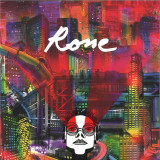
Rone is a stalwart of the French electronic scene and returns with his fourth album, 'Mirapolis', a synesthetic journey with features from Bryce Dessner (The National), Baxter Dury, John Stanier (Battles) and Saul Williams. The artwork was created by the critically acclaimed director Michel Gondry.
Stepping into Rone's music is like sleepwalking through a vividly colourful dream, eventually stumbling across a strange, scintillating Megapolis of saturated light and colours: 'Mirapolis'. Its twelve tracks / districts, each with their own specific planning, pulsate as though animated by their musical mastermind.
The project was an opportunity to get reacquainted with long- time stage and studio partners John Stanier, Gaspar Claus and the Vacarme band and Bryce Dessner (guitarist for The National,) while bringing in new collaborators (and thus, new interpretation of Rone's dreams). We find American slam-poet Saul Williams, who happened to be in Paris for a moment and contributes a searing anti-Trump screed, Baxter Dury, who brings an irresistible East London touch to 'Switches', a kind of fan fic that reimagines the Beatles' Sergeant Pepper lounging pensive in a club chair, Israeli electronic music muse Noga Erez, who inspired 'Waves' which, despite being recorded remotely, betrays a euphoric partnership, and finally, Kazu Makino, Blonde Redhead's bewitching singer and multi- instrumentalist, who contributes to the album's closer, the gauzy 'Down For The Cause'.
Rone remains a producer of grand instrumental pieces, which cannot be easily categorized in the architectural canon of our electronic music galaxy. Hypnotic, cinematic opening track 'I Philip' is an offshoot from the score for the first French virtual reality fiction, built around Philip K Dick - the perfect gate into a city that then opens up myriad temporal perspectives.
Rico started his career in the late 1950’s playing with the likes of Prince Buster, Laurel Aitken and Max Romeo as a session musician in addition to creating his own recordings. He moved to the UK in the early 60’s and continued performing live and playing as a session musician. He signed to Island Records in the 70’s, releasing his first solo albums.
In 1979 Rico met Jerry Dammers and began playing with The Specials. He became an honorary member of the band and featured prominently on some of their most famous tracks, along with Dick Cuthell, which produced a distinctive sound. In 1980 he released his first album for the 2 Tone label, That Man is Forward.
Jama Rico was the second album released on 2 Tone Records in 1982. This album felt like a celebration of Jamaican musicians - Jama Rico was an altogether different beast. This was a more resolute statement, more African in its rhythms and a hidden treasure within the 2 Tone label.
This time the recording sessions were split between Joe Gibbs studio in Jamaica and sessions at London’s Town House Studios. The Jamaican sessions again were produced by Dick Cuthell and comprised of musician friends Sly Dunbar, Robbie Shakespeare, Headley Bennett, and Ansel Collins. The London sessions, produced by Dick and Jerry Dammers, featured Specials John Bradbury and Horace Panter, along with Tony Utah and Satch Dixon.
This new remaster, originally released in May 1982, is a part of the ongoing 2 Tone ‘40th Anniversary’ releases.
The package is a 3mm Spined Sleeve, 180gm Heavyweight Black Vinyl, printed inner and bellyband.
I Be Trying might be the title of the new record from two-time GRAMMY nominee Cedric Burnside, but it's also a mission statement in an era when plenty of us have discovered what "the blues" really means. Recorded over three days at Royal Studios in Memphis (the home studio of Al Green and Hi Records in the 60s and 70s), this album is the ultimate statement of purpose for a critically acclaimed artist who has proudly carried the mantle of Mississippi Hill Country blues around the world. Over thirteen tracks, Burnside delivers his bruised but unfettered truth over blistering guitar and deep pocket drums-a sound birthed in his soul but developed and perfected on the road. But no matter how far he travels, the righteous sound he makes could only come from one place. I Be Trying is the sound of modern Mississippi. Produced by second-generation Memphis soul trailblazer Boo Mitchell ("Uptown Funk") and featuring guest appearances from Luther Dickinson (North Mississippi Allstars) and Zac Cockrell (Brittany Howard), I Be Trying takes the sound that Burnside learned from his grandfather, blues legend R.L. Burnside, and reinterprets it into a modern, bold Black American sound that expands the sonic landscape while respecting and honoring its roots.


![Rico - Jama Rico [40th Anniversary]](https://www.deejay.de/images/l/4/0/977140.jpg)