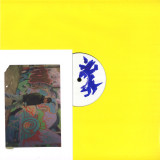
"Following this year’s VA ‘Marmo’, a collaborative offering co-released with XCPT, Baroque Sunburst releases its first Various Artists EP. Tracks from Taro, Pugilist, Slacker and Flørist, create a statement record championing subtle yet hybrid club-oriented sounds.
Buffalo, NY's Taro ignites the white label 12" with ‘Gas Burn’, a dreamy, rarified IDM zipper. An off-kilter UK funky remix from Flørist follows (his second appearance on the imprint after 2020's Intermedia 1 EP). The B side drags us into a half-time, downtempo sideroom, with tracks from Slacker (Aqueduct) and Pugilist (Symbiosis) slowing pace but maintaining intensity."
Limited to 300 copies.
Suche:dream cop
- 1: Cavity - First Communion
- 1: 2 Figurative Theatre
- 1: 3 Burnt Offerings
- 1: 4 Mysterium Iniquitatis
- 1: 5 Dream For Mother
- 1: 6 Stairs - Uncertain Journey
- 1: 7 Spiritual Cramp
- 1: 8 Romeo's Distress
- 1: 9 Resurrection - Sixth Communion
- 1: 0 Prayer
- 2: 1 Dogs
- 2: Romeo's Distress (Demo)
- 2: 3 Deathwish (Demo)
- 2: 4 Desperate Hell (Demo)
- 2: 5 Spiritual Cramp (Demo)
- 2: 6 Cavity - First Communion (Demo)
- 2: 7 Sleepwalk (198 Frontier Demo)
- 2: 8 Invocation (198 Frontier Demo)
- 2: 9 Cavity - First Communion (Alternate Version)
- 2: 10 Lord's Prayer (Alternate Version)
CHRISTIAN DEATH was formed by Rozz Williams in Los Angeles, California in 1979. Williams was eventually joined by guitarist/songwriter Rikk Agnew of ADOLESCENTS, James McGearty on bass and George Belanger on drums. This CHRISTIAN DEATH line-up was responsible for recording the band's iconic 1982 debut, ONLY THEATRE OF PAIN, widely regarded as the #1 American goth album of all-time. This exclusive double-LP version of OTOP commemorates its 40th anniversary- the first disc is the digitally remastered, original version of the album while the second disc is comprised of "Dogs" from HELL COMES TO YOUR HOUSE, four pre-Frontier demos, two studio demos made for a second Frontier Records' LP that never happened and two alternate studio mixes from OTOP. The gatefold LP jacket is printed in its original its black and metallic gold, includes a Colver collage poster and a hardcover copy of the photo book, ONLY THEATRE OF PAIN and all come in a hard slipcase. The oversized 12" x 12" book features rare and never-before-seen photos of CHRISTIAN DEATH as well as new interviews with photographer Edward C. Colver, the surviving band members, Frontier's Lisa Fancher and others. Colver befriended the band and followed them around in late 1981 and early 1982 at more than a dozen concerts as well as photo shoots in Rozz Williams' family home (used on the back cover and insert of ONLY THEATRE OF PAIN) and a session of now famous images at a Pomona CA cemetery. Info: Just as the theatrically-minded LA punk scene was beginning to give rise to such morbidly themed outfits as 45 Grave and the Flesh Eaters, an androgynous teenaged street performer named Rozz Williams (né Roger Painter) founded CHRISTIAN DEATH, one of the most prolific, enduring, and beloved gothic acts of all time. Williams' otherworldly groan can make "Only Theatre of Pain" difficult going for those that aren't the gothic faithful, but the loud/not-too-fast music (courtesy of ex-ADOLESCENTS guitarist Rikk Agnew and the walking-dead rhythm section of bassist James McGearty and drummer George Belanger) is appropriately doom 'n' gloomy, with inventive arrangements and clear sound - thanks to Frontier Records' go-to punk production legend, Thom Wilson- capturing the mood in full B-movie fidelity. The lyrics sacriligiously address horror topics and religion: they're overwrought (the backwards masking of 'Mysterium Iniquitatis' being one clever exception) but easy to overlook in the wash of inspired rock noise. The original lineup's recorded debut is a gem. Artists inspired by CHRISTIAN DEATH include Danzig, Craddle of Filth, Paradise Lost, Korn, Type O Negative, Nine Inch Nails, Marilyn Manson and Jane's Addiction. Press: "A depraved masterpiece, this was punk rock made poetic, subversive, and gracefully savage."- AV Club "The Gothic album to out-gothic all others" - Melody Maker "Only Theatre of Pain's influence should not be underestimated" - Record Collector Limited availability!
Some dreams take longer to come true. For many years we trusted in Orka's musical talent and were hoping that one day we will spin the turntable and listen with our eyes closed. That moment is now at your fingertips.
Strictly limited 100 copies made for absolute musical joy. Seven tracks including three awesome remixes which warp classical music to electronic universe. Superb cover by Silvie and Marika. Shines in your collection like a pearl.
- 180 GRAM AUDIOPHILE VINYL
- RANKED FIRST IN ALL-TIME TOP TEN LIST OF SHRED ALBUMS BY GUITAR WORLD MAGAZINE
- LIMITED EDITION OF 1.000 NUMBERED COPIES ON GOLD VINYL
Rising Force is the first studio album by guitarist Yngwie Malmsteen, released on 5 March 1984 through Polydor Records. The album reached No. 14 on the Swedish albums chart, No.
60 on the US Billboard 200, and received a nomination for Best Rock Instrumental Performance at the 1986 Grammy Awards. It is regarded as a seminal release in the shred and neoclassical metal genres.
Steve Huey at AllMusic gave Rising Force four stars out of five, calling it 'a revelation upon its release' and 'The true inauguration of the age of the guitar shredder'. He praised Malmsteen's technique and 'blinding virtuosity', as well as highlighting 'his obsessions with Bach, Beethoven, and Paganini'.
In a 2009 article by Guitar World magazine, Rising Force was ranked first in the all-time top ten list of shred albums. The staff wrote: 'Yngwie J. Malmsteen was, is, and always will be the greatest shredder of all time. Hell, he invented the genre with his debut.'
Black Star' and Far Beyond the Sun' have endured as two of Malmsteen's most popular songs, as well as being staples of his live setlist. In a 2008 Guitar World interview, Malmsteen said of the two songs: 'I'll probably play Far Beyond the Sun' and Black Star' until the day I die.'
-4 Songs from Upcoming Albums. -Pressed at 45 RPM for High Fidelity. -Strictly limited to 150 copies. Top 4 features four songs from four forthcoming LP's on the Cold Busted label. To start the series off we have beats from label favorites Sim Nagai, Mister T., and Emapea plus two artists who were recently signed to the label: Goodge and MichRyc. Sim's latest album, Equator Hotline, features exotica-fueled beatscapes and transportive vibes. The equator itself is breached on "Deep in the Rainforest" as busy percussion playfully accompanies the downtempo drum beat. Goodge's jazz-funk dreamscape is sonically interpreted through the grooves in tracks like "Heart of the City" from the forthcoming album Echoes of Yesteryear. Here, cool electric piano keys, a snazzy saxophone, and scratchy guitar are buoyed by an uptempo drum track that transmits a cool inner city feel. MichRyc's friend Emapea helps out with "Monkeys in the Jungle," from Under the Surface, a deep instrumental hip hop cut that almost sounds influenced by Saharan guitar bands like Mdou Moctar. Mister T. returns to Cold Busted with Synchronized Roots, another fantastic album encompassing the many styles of the prolific producer. "Looking Above" continues on a dubby tip, delivering a more heady and smoked-out feel. Each record is limited and pressed at 45 RPM with two tracks on each side for maximum fidelity.
- A1: Release Date
- A2: Symphony In X Major (Feat. Dr Dre)
- A3: Multiply (Feat. Nate Dogg)
- A4: Break Yourself
- B1: Heart Of Man
- B2: Harder (Feat. The Golden State Project)
- B3: Paul
- B4: Choke Me, Spank Me (Pull My Hair)
- B5: Losin' Your Mind (Feat. Snoop Dogg)
- C1: Bk To La (Feat. M.o.p.)
- C2: My Name (Feat. Eminem & Nate Dogg)
- C3: The Gambler (Feat. Anthony Hamilton)
- C4: Missin' U
- C5: Right On
- D1: Bitch Ass Niggaz (Feat. Eddie Griffin)
- D2: Enemies
- D3: My Life, My World
- D4: What A Mess
- D5: (Hit U) Where It Hurts
"I was 27 when this album came out, LA was a whole different animal. I was going back and forth from NY to LA, touring a lot and trying to make progress for me and my close friends and family.
Oct 1 2002 seems like it was yesterday... The day we released the album, I got a call from Nas, completely caught me off guard. He complemented me on the writing of “Release Date” the first track on the album. Those are some of the moments I think of when I reminisce about dropping this project. It was such a turning point in my life, I was coming off of a huge push with “Restless” and the follow up had to be a smash, at the same time I was still finding my standing as a man, a young father, and an artist. It was always my dream to work with the people I’ve now been able to work with and I can listen to this album and remember exactly where I was and who I was with, it’s like time travel.
Fast forward 20 years later and I am thrilled to be able to share this body of work with you and more generations to come.
Thank you for rockin' with me for all this time.
Enjoy the 20th Anniversary Edition of MAN VS MACHINE,
From its dramatic intro, "Release Date," to the thundering West Coast march "Enemies," Xzibit's fourth and mythical album, Man vs. Machine produced by no less than Dr Dre, spent a total of 19 weeks on the "Billboard" 200 chart and was certified gold only a month after its release with over 500,000 copies sold.
The legendary album that features a heavyweight cast of featurings with the likes of Snoop Dogg, Eminem, M.O.P, Nate Dogg, DJ Premier and Dr Dre himself is now available for the first time since its original release, to celebrate its 20th anniversary!
[q] D3. My Life, My World [Bonus Track]
[r] D4. What a Mess [Bonus Track]
[s] D5. (Hit U) Where It Hurts [Bonus Track]
Rounding off the year on Redstone Press, Debba comes correct with a varied 4 tracker laden with hefty subs and lock tight percussion.
The A-side starts out with fast-paced staccato kicks and the oscillating, warped bassline of ‘Called Up’. These elements soon develop into a twisted, energetic romp, showing Debba’s innate knack for upfront, low-end percussive work. Continuing with this theme ‘Direction’ adds reverb drenched vocals to the mix and ups the bass weight, with gritty, looping subs throughout. These two will put that soundsystem you’re dreaming of playing on to the test!
The B-side is more restrained and meditative but retains the heavy subs, opening with the downtempo and introspective chords of ‘I Said’. The drop in pace gives Debba’s signature beatwork and melodic flourishes space to breathe with the dreamy synths of ‘Subtle’ building up, then breaking down into a low-slung UK Techno roller.
Limited to 100 copies. DON’T SLEEP!
Boxset[69,71 €]
Great songs are not set in stone - since he burst from the blues clubs of Louisiana onto the global music scene with 1995's breakthrough first album, Ledbetter Heights, followed by his career defining second album, Trouble Is..
in 1997, Kenny Wayne Shepherd has twisted those classic cuts into bold new
shapes each night on the stage. Led by the pulse of the crowd, every last note
alive in his hands, the Trouble Is... tracks have always been on the move, never
settling into museum pieces.
But to give a quarter-century-old album a second birth is another matter. And in
more recent times, as the five- time- Grammy- nominated, multi- platinum- selling
artist looked up the road and saw the 25th anniversary of Trouble Is... on the
horizon, he hatched an audacious plan."One of the coolest things about rerecording Trouble Is... has been finding out or verifying how timeless this album
really is," says Shepherd, who also is leading a triumphant anniversary tour across
the United States in 2022 and 2023, performing the album in full. "I'm so proud of
what we accomplished, and also the fact I was just 18 years old when I did it. I
mean, I had an experience with this album that most musicians can only dream
about. Trouble Is... sold millions of copies. There's validation in all of that for me."
The Artbook package contains: 2LP on Gold Vinyl, CD, DVD and Blu- ray of the
Trouble Is... 25th Anniversary Show in the Strand Theatre in Shreveport, Louisiana
and a documentary about the making of the album, plus a Dolby Atmos audio Bluray that is exclusive to this release.
Great songs are not set in stone - since he burst from the blues clubs of Louisiana onto the global music scene with 1995's breakthrough first album, Ledbetter Heights, followed by his career defining second album, Trouble Is..
in 1997, Kenny Wayne Shepherd has twisted those classic cuts into bold new
shapes each night on the stage. Led by the pulse of the crowd, every last note
alive in his hands, the Trouble Is... tracks have always been on the move, never
settling into museum pieces.
But to give a quarter-century-old album a second birth is another matter. And in
more recent times, as the five- time- Grammy- nominated, multi- platinum- selling
artist looked up the road and saw the 25th anniversary of Trouble Is... on the
horizon, he hatched an audacious plan."One of the coolest things about rerecording Trouble Is... has been finding out or verifying how timeless this album
really is," says Shepherd, who also is leading a triumphant anniversary tour across
the United States in 2022 and 2023, performing the album in full. "I'm so proud of
what we accomplished, and also the fact I was just 18 years old when I did it. I
mean, I had an experience with this album that most musicians can only dream
about. Trouble Is... sold millions of copies. There's validation in all of that for me."
The Artbook package contains: 2LP on Gold Vinyl, CD, DVD and Blu- ray of the
Trouble Is... 25th Anniversary Show in the Strand Theatre in Shreveport, Louisiana
and a documentary about the making of the album, plus a Dolby Atmos audio Bluray that is exclusive to this release.
Blue Vinyl
The Outer Edge is proud to present the first ever vinyl release of "No Message" by Art P, a still lesser known and lost masterpiece from the P.A.P. archives. Art P (initially Art Programming) was an electronic music duo consisting of Jens-Markus Wegener and Frank Grotelüschen. On "No Message", originally released in 1985, we hear the band's most profound work, a detailed and unique mixture in between of Electro and the synth-laden edge of New Wave.
We initially discovered Art P on the tape compilation "berlincassette 2-85" a couple of years ago. Their contribution, the title track from their second and last album "No Message", blew us right away: punchy drum machines, heavy synths and cool female vocals delivering a serious, yet slightly ironic view on the meaninglessness in pop music having "no message". A couple of months later, when we finally were lucky to get hold of an original full length tape, we couldn't ask for more: powerful apocalyptic Synth Wave on "A Place To Fear", thrilling vocoder Electro Funk on "Polaroid", uptempo New Wave Synth Pop on "Sounds of the City", dreamy and melodic Electro on "Without Jackets", and other well produced tracks. It was an absolute necessity for us to get in touch with Art P and ask for permission to re-release their music on vinyl.
"No Message" was remastered from the absolute best original tape source and sounds incredibly well. The release is limited to 300 copies and will be pressed on blue vinyl. It contains an insert with lyrics and additional art. We think it is save to say, that this should not be missed!
As a side note it should be mentioned that Wegener later became a key figure in the German music market. He was the founder of companies such as Public Propaganda, Europe's largest and most successful promotion agency in the mid '90s, the publishing company AMV, the distributor PP Sales Forces, among others. As a freelance promoter for SPV and the PIAS label he was also responsible for establishing the term Electronic Body Music as a musical genre. Grotelüschen was active as a music journalist (e.g. for Spex magazine) and later became an important and well known journalist for science.
- 1: Today - The Moons
- 2: You Ain't Got It Bad - Teenage Waitress
- 3: A Simple Song - Sunzoom
- 4: Tearaway - Bliss Williams
- 5: Still - Tiny Dyno
- 6: Dreaming - Duvet Daze
- 7: Left For Dead - Pale Sabres
- 8: Neverready - Wilderman
- 9: Secret Garden - Chris Watson
- 10: Nothing New Under The Sun - Robi Mitch
- 11: Haunted - Eloise (Feat. Andy Crofts)
- 12: Wire - The Lunar Towers
- 13: True Heart - Reid Anderson
- 14: Forevermore - Andy Crofts & Le Superhomard
500 Copies only on 180gm Heavyweight Classic black vinyl. Colour sleeve with printed disco bag/inner sleeve. Andy Crofts rounds up his Colorama artists on Volume 1 of this uber cool and eclectic compilation. The brainchild of Andy Crofts from the Paul Weller band the Colorama record label was set up initially as a vehicle to release records from Andy's own band The Moons but always with the ambition to champion the art of the songwriter and build an eclectic roster of like minded bands and musicians. Building on the critically acclaimed 'Pocket Melodies' from The Moons came the album 'Love & Chemicals' from Teenage Waitress and a new addition to Colorama Bristol DJ & Promoter John Britton joining Andy in the search for artists to join this burgeoning boutique label. The search culminated in the album you are now reading about 'THIS IS COLORAMA! VOL. 1' a collection of tracks from The Moons, Teenage Waitress, Sunzoom, Bliss Williams, Tiny Dyno, Duvet Daze, Pale Sabres, Wilderman, Chris Watson, Robi Mitch, Eloise, The Lunar Towers, Reid Anderson, Andy Crofts & Le SuperHomard which offers a diverse melting pot of genres with a common theme, to deliver memorable verses, hooks and choruses.
- 1: An Mp Speaks
- 2: Monetaries
- 3: The International Narcotics Traffic
- 4: The Way Of The World
- 5: Antinature
- 6: Charles Windsor
- 7: The Vision Of Peregrine Worsthorne
- 8: The Well Of Loneliness
- 9: The Wicked Palace Revolution
- 10: God Made The Virus
- 11: The Funeral
- 12: A Child Soon In Chains
- 13: In The Dark Times
- 14: The Procession Of Popular
- 15: Capitalism
- C16: In Purgatory(Re-Recorded Version)
- 17: Comrade Era(Re-Recorded )
- 18: Something Wrong Somewhere
- 19: Red Sleeping Beauty
- 20: From The Damned
- 21: For The Fat Lady
- 22: Frans Hals
- 23: Kill Kill Kill Kill
- 24: You’re Alive
- 25: Bad Dreams
- 26: Someone Worse Off Antiamericancretin
- 27: Unfortunately
- 7: 1 In Purgatory
- 7: 2 Comrade Era
- 7: 3 Something Wrong Somewhere
Pressed on Red vinyl and presented in gloss laminated gatefold sleeve.
Double album set contains the original LP plus 13 bonus tracks taken from their first four singles and the re-recorded version of In Purgatory which originally appeared on the PINK compilation E.P “It sells or it smells” plus bonus 7” a reproduction colour vinyl copy of McCarthy’s first 7” “In Purgatory”
All three tracks have been remastered from the original master tape and presented in a wraparound sleeve, just like the incredibly rare “Wall Of Salmon” original.
Also Includes
20 page 12x12” full colour booklet containing all the lyrics and packed full with photos, many previously unpublished. Press clippings and other memorabilia. Introduction by Nicky Wire of the Manic Street Preachers and track by track commentary by Malcolm Eden.
8 x 10 Black & White press photo
Reproduction European Tour poster “The Well Of Loneliness” Promo poster McCarthy sticker
By the time McCarthy appeared on the NME’s C86 cassette they had already been playing together for a couple of years and released two excellent singles. Their debut “In Purgatory” and the indie masterpiece “Red Sleeping Beauty” (both included on this release). The following year McCarthy released the brilliant “Frans Hals” before unleashing their debut album “I Am A Wallet”
Now recognised as an indie pop masterpiece it has gone on to achieve cult status, receiving praise from the likes of Nicky Wire (Manic Street Preachers) as one of the most important albums of the 80s. Known by today's indie acolytes as the band that spawned Tim Gane and Leititia Sadier (who of course went on to form Stereolab).
It’s a seamless album reminiscent of the Byrds. Wonderful, if slightly twee, jangly guitars with complex and rarely rhyming lyrics, Malcolm Eden’s strident left wing political views are manifest on I Am A Wallet. Cloaked in pretty guitar and propulsive drums, Eden sets about attacking the pillars of the day, MPs, Prince Charles, Fleet Street, religion, the response to AIDS and on almost every song, capitalism. The horrors and inequalities of the capitalist system are laid bare for all the see. The system which enables some to get rich at the expense of others is reviled and attacked.
Moody Blue Vinyl. RIYL: Codeine, Mazzy Star, Bedhead, Red House Painters, Low & American Music Club. Previously unreleased 16-track recordings that predates Spain’s 1995's landmark “The Blue Moods Of Spain". Includes original studio version of "World Of Blue" featuring Petra Haden on violin. Re-mixed and re-imagined by Kramer for Shimmy-Disc. The LP “World of Blue” features Merlo Podlewski on guitar. I first met Merlo in 1994. My sister Rachel Haden, who had been working with him at the Rhino Records store in Westwood, knew I was looking for a new guitarist for my band, and introduced us. Merlo is one of those guitarists whose playing is so smooth and effortless he makes anyone feel like they can play. He had an instinctual grasp of harmony and theory, which brought a great counterpoint to the technical knowledge and finesse of lead guitarist Ken. Spain played their first official L.A. gig with Merlo at a club called Pan, which shortly thereafter changed its name to Spaceland. We opened for Beck and That Dog. We played at Spaceland a lot and at other small clubs and coffee joints like the Troy Cafe (owned by Beck’s mom), Congo Square Coffee House in Santa Monica, Alligator Lounge, and others. At a certain point that year we were ready to record our first 7” single, and I reserved some time at Poop Alley. Poop Alley didn’t seem like the ideal recording setting. The walls and floors were made of concrete, and there was no soundproofing. The mixing board was in a loft up this steep staircase with no guard rails. But it worked somehow. On the particular day we recorded basics there was a rain storm which you can clearly hear in the background. The ceiling was so high there almost wasn’t a ceiling. A steep curving staircase with no guardrail led up to a loft area where the console was located, and next to it, on a custom-built, guardrail-less ledge, a queen-sized bed where Tom slept. I paid for the session with weed I grew in my closet. We set up and it started raining. Tom put a microphone outside. After tracking was finished, Petra came over and overdubbed violin. There was a cushioned area where I remember sitting during mixdown. We stayed good friends with Tom. We recorded a couple more songs with him the following year. Tom recorded lots of bands at Poop Alley. My sisters’ band That Dog, Beck, the Rentals, Rod Poole, Tom’s band Waldo the Dog Faced Boy, and many others. There were parties in the alley. There would be a keg of beer. Everyone was well-behaved. The most dangerous it got was when Kenny asked Beck if he was a Scientologist. I remember laughter and happiness the most from those parties. Not long afterwards Tom shut down the studio. Luckily for us, the tapes still exist. On those tapes are five songs, all of which are represented here. “I Lied” and “Her Used-To-Been” were released on the 7”, the remaining three have never been released before now. I can’t remember who I sent copies of the 7” to but shortly after it came out I got a call from an A&R executive at Geffen inviting me to their offices to talk. “I love your songs,” I remember him saying to me, “but my boss David Geffen won’t let me sign you because he doesn’t know how to market you.” Eventually a label that did want to sign us got in touch with me. Restless Records, they had decent distribution, so I said to myself, “Why not?”. This eventually led to the recording that produced our debut LP “Blue Moods of Spain”. Track listing: A1. Her Used-To-Been A2. Phone Machine A3. I Lied B1. Dreaming of Love B2. World of Blue
Berlin based cellist, composer and improviser An?l Eraslan brings together 11 musicians from Istanbul. The dreams of these musicians are composed and improvised for this album. Dream Works offer an extended musical experience that is surrounded by traditional and experimental approaches.
Limited 250 Copy
- A1: Here If You Want Me 03 01 Min
- A2: Overtime 02 44 Min
- A3: Up To You 03 13 Min
- A4: Second Thought 03 30 Min
- A5: Anytime You Want 04 16 Min
- A6: Heavy Like Air 02 53 Min
- A7: For A Minute 02 49 Min
- A8: Mercury’s Ladder 01 34 Min
- B1: Empty Eyes 02 56 Min
- B2: Bottleneck Boys 03 30 Min
- B3: Balloon 01 43 Min
- B4: Riversong 03 45 Min
- B5: The World Can Wait 03 05 Min
- B6: Not A Blue Sky 02 50 Min
- B7: Coffee Girl 03 11 Min
- B8: ) | Death 01 36 Min
Public Possession proudly presents Aiden Ayers debut album „Venus Copper Rose“. A few words by the artist himself: „ Venus Copper Rose came to me in a dream. The three words are all the same thing, symbols of beauty and material formations of love. Together they are a VCR (videocassette recorder) - a memory machine, a portal into fantasy and myth + a transcriber of dreams. The songs on the album represent the past five years of my life. The oldest of them were written and first recorded in 2017 and the youngest barely made it to the mastering session on time. I am always writing and recording, travelling to and fro, on little islands off the coast of BC, down to the California desert, or in makeshift basement studios throughout Vancouver. Every song has grown up and been captured in a different way - the album is a wild garden of misfits, flowers and weeds. I hope that people feel nourished by this album - I believe that is the ultimate role of music, like another kind of food, light, or love. I hope these songs and this album can help people see the beauty and poetry that flows through their own lives.“
Night of Rain is the second art book by musician and artist Loren Connors, following last year’s Wildweeds (Recital, 2021).
The book is composed of two parts: ‘Night of Rain,’ which Loren describes as “seascapes, or expressions of the sea and shore. They are about the power of rain and the sea, lagoons, bays, tides." Taken from small pencil and black ink drawings enlarged again and again at a copy store. The pieces would often be drawn over and modified throughout this process – ultimately reaching sizes of 8 x 6 feet or larger. In this series, Loren considers the digital images as the "originals” – so this section of the book acts as a sort of swatch, a gallery exhibiting the final stage of this process.
The second section of the book is “A Coming to Shore.” Nineteen acrylic paintings on stretched canvas, which are often cast in hazy and dreamlike blues, greys, and yellows. They span across the page in stark simplicity. “They all have the feeling of horizon, but not all of them depict horizons,” Loren remarks. Supplemented with a foreword written by artist and friend Aki Onda, Night of Rain is part of a continuing series of limited books published by Recital that explore Loren’s visual art.
- A1: Bardo State "Sospiro
- A2: Nikolaj Grandjean "Heroes & Saints
- A3: Riccardo Eberspacher "Setira
- A4: Shiftz Feat Hiba El Mansouri "Ahwak
- B1: Ravin, Carlos Campos & David Visan "Homage To Mr V
- B2: Amanaska "Cetacea
- B3: Hess Is More "Yes Boss
- B4: Alihan Samedov "Sen Gelmez Oldun
- C1: Alfida "Allaya Lee (Original Mix)
- C1: Waldeck Get Up .. Carmen
- C2: Arno Elias "El Corazon
- C3: Amanaska "Fracture
- D1: Ravin & Carlos Campos "Romance In Klotild Palace
- D2: Aria "Un Bel Di
- D3: Ganga "Chair
- D4: Laidback "Happy Dreamer
- E1: Consoul Trainin & Pink Noisy Feat Anastasia Zannis "Ta
- E2: Kirpi "The Song
- E3: Riham "Erja Ya Habebi (Dj Srulik Einhorn Remix)
- F1: Amanaska "Wonder Of The Storm
- F2: Panjabi Hit Squad Feat Manpreet Kaur "Hasdi Hasdi (Hit
- F3: Sean Bay Vs Mehdi Mouelhi Feat. Arabella "Maktoub
- F4: Parov Stelar "Chambermaid Swinge
Blue Vinyl
Since 1996, Buddha-Bar has created and developed a new vision of Life. With its enchanting venues and intoxicating music, Buddha-Bar has created Lounge Music. Widely copied but never equaled, our musical signature has delighted millions of people around the world and through the years. Selected by Ravin, this triple Best Of Vinyl gathers the greatest titles that made the Buddha-Bar history from 1996 to 2013.
More solid UK boogie & brit-funk courtesy of Freestyle Records - this time giving the 12" reissue treatment to short-lived group Cool Runners' 1982 single Checking Out, backed up with sought-after High on a Feeling.
-------
As Cool Runners' Paul Tattersall recalls, "this single was a follow-up to the "Play The Game (So You Think It Funny) / Hawaiian Dream" 12" which we believe got to around number 60 in the national charts, and was at the time heavily played on the radio by DJ Greg Edwards who sadly passed away earlier this year..." Recorded mixed and mastered then licensed for release to MCA, this initial single also relased in 1982 was voiced by Tony Jackson, then part of Paul Young's backing band as his career took off in the charts. Tony formed part of a string of funk groups throughout the 70s and early 80s - Sweet Dreams, Midnight, Ritz & Indigo - and later went on to be successful as lead singer in Rage.
These tracks "Checking Out" and "High on a Feeling" on the other hand features the vocal talents of Rush Winters, who would go on to record with the likes of Carmel, Yello, D.C.Lee and others. "It received little in the way of promotion by the record company at the time", Tattersall continues "so it has produced a cult following and has become rather sought-after, as few copies were actually released at that time."
After release, Cool Runners' Paul Tattersall and Chris Rodel then played with several different bands, with Chris moving onto double bass. He still plays professionally today as an accomplished jazz bass player. Paul has run a successful musical hire company in North London, with a specialism on synths and keyboards, since the eighties - and continues to this day.
- A1: Rock This Mother
- A2: Talk To Me Girl
- A3: You Can Find Me
- A4: Check This Out
- A5: Jesus Going To Clean House
- A6: Hope You Understood
- A7: Is It What You Want
- A8: Love Is Everlasting
- A9: This Is Hip-Hop Art
- A10: Opposite Of Love
- A11: Do You Know What I Mean
- B1: Saving All My Love For You
- B2: Look Out Here I Come
- B3: Girl You Always Talking
- B4: Have A Great Day
- B5: Take My Hand
- B6: I Need Your Love
- B7: Your Town
- B8: Talk Around Town
- B9: Booty Head/Take A Little Walk
- B10: I Love My Mama
- B11: I Never Found Anyone Like You
Vinyl LP[23,49 €]
As the sun sets on a quaint East Nashville house, a young man bares a piece of his soul. Facing the camera, sporting a silky suit jacket/shirt/slacks/fingerless gloves ensemble that announces "singer" before he's even opened his mouth, Lee Tracy Johnson settles onto his stage, the front yard. He sways to the dirge-like drum machine pulse of a synth-soaked slow jam, extends his arms as if gaining his balance, and croons in affecting, fragile earnest, "I need your love… oh baby…"
Dogs in the yard next door begin barking. A mysterious cardboard robot figure, beamed in from galaxies unknown and affixed to a tree, is less vocal. Lee doesn't acknowledge either's presence. He's busy feeling it, arms and hands gesticulating. His voice rises in falsetto over the now-quiet dogs, over the ambient noise from the street that seeps into the handheld camcorder's microphone, over the recording of his own voice played back from a boombox off-camera. After six minutes the single, continuous shot ends. In this intimate creative universe there are no re-takes. There are many more music videos to shoot, and as Lee later puts it, "The first time you do it is actually the best. Because you can never get that again. You expressing yourself from within."
"I Need Your Love" dates from a lost heyday. From some time in the '80s or early '90s, when Lee Tracy (as he was known in performance) and his music partner/producer/manager Isaac Manning committed hours upon hours of their sonic and visual ideas to tape. Embracing drum machines and synthesizers – electronics that made their personal futurism palpable – they recorded exclusively at home, live in a room into a simple cassette deck. Soul, funk, electro and new wave informed their songs, yet Lee and Isaac eschewed the confinement of conventional categories and genres, preferring to let experimentation guide them.
"Anytime somebody put out a new record they had the same instruments or the same sound," explains Isaac. "So I basically wanted to find something that's really gonna stand out away from all of the rest of 'em." Their ethos meant that every idea they came up with was at least worth trying: echoed out half-rapped exhortations over frantic techno-style beats, gospel synth soul, modal electro-funk, oddball pop reinterpretations, emo AOR balladry, nods to Prince and the Fat Boys, or arrangements that might collapse mid-song into a mess of arcade game-ish blips before rallying to reach the finish line. All of it conjoined by consistent tape hiss, and most vitally, Lee's chameleonic voice, which managed to wildly shape shift and still evoke something sincere – whether toggling between falsetto and tenor exalting Jesus's return, or punctuating a melismatic romantic adlib with a succinct, "We all know how it feels to be alone."
"People think we went to a studio," says Isaac derisively. "We never went to no studio. We didn't have the money to go to no studio! We did this stuff at home. I shot videos in my front yard with whatever we could to get things together." Sometimes Isaac would just put on an instrumental record, be it "Planet Rock" or "Don't Cry For Me Argentina" (from Evita), press "record," and let Lee improvise over it, yielding peculiar love songs, would-be patriotic anthems, or Elvis Presley or Marilyn Monroe tributes. Technical limitations and a lack of professional polish never dissuaded them. They believed they were onto something.
"That struggle," Isaac says, "made that sound sound good to me."
In the parlance of modern music criticism Lee and Isaac's dizzying DIY efforts would inevitably be described as "outsider." But "outsider" carries the burden of untold additional layers of meaning if you're Black and from the South, creating on a budget, and trying to get someone, anyone within the country music capital of the world to take your vision seriously. "What category should we put it in?" Isaac asks rhetorically. "I don't know. All I know is feeling. I ain't gonna name it nothing. It's music. If it grabs your soul and touch your heart that's what it basically is supposed to do."
=
Born in 1963, the baby boy of nine siblings, Lee Tracy spent his earliest years living amidst the shotgun houses on Nashville's south side. "We was poor, man!" he says, recalling the outhouse his family used for a bathroom and the blocks of ice they kept in the kitchen to chill perishables. "But I actually don't think I really realized I was in poverty until I got grown and started thinking about it." Lee's mom worked at the Holiday Inn; his dad did whatever he had to do, from selling fruit from a horse drawn cart to bootlegging. "We didn't have much," Lee continues, "but my mother and my father got us the things we needed, the clothes on our back." By the end of the decade with the city's urban renewal programs razing entire neighborhoods to accommodate construction of the Interstate, the family moved to Edgehill Projects. Lee remembers music and art as a constant source of inspiration for he and his brothers and sisters – especially after seeing the Jackson 5 perform on Ed Sullivan. "As a small child I just knew that was what I wanted to do."
His older brother Don began musically mentoring him, introducing Lee to a variety of instruments and sounds. "He would never play one particular type of music, like R&B," says Lee. "I was surrounded by jazz, hard rock and roll, easy listening, gospel, reggae, country music; I mean I was a sponge absorbing all of that." Lee taught himself to play drums by beating on cardboard boxes, gaining a rep around the way for his timekeeping, and his singing voice. Emulating his favorites, Earth Wind & Fire and Cameo, he formed groups with other kids with era-evocative band names like Concept and TNT Connection, and emerged as the leader of disciplined rehearsals. "I made them practice," says Lee. "We practiced and practiced and practiced. Because I wanted that perfection." By high school the most accomplished of these bands would take top prize in a prominent local talent show. It was a big moment for Lee, and he felt ready to take things to the next level. But his band-mates had other ideas.
"I don't know what happened," he says, still miffed at the memory. "It must have blew they mind after we won and people started showing notice, because it's like everybody quit! I was like, where the hell did everybody go?" Lee had always made a point of interrogating prospective musicians about their intentions before joining his groups: were they really serious or just looking for a way to pick up girls? Now he understood even more the importance of finding a collaborator just as committed to the music as he was.
=
Isaac Manning had spent much of his life immersed in music and the arts – singing in the church choir with his family on Nashville's north side, writing, painting, dancing, and working various gigs within the entertainment industry. After serving in the armed forces, in the early '70s he ran The Teenage Place, a music and performance venue that catered to the local youth. But he was forced out of town when word of one of his recreational routines created a stir beyond the safe haven of his bohemian circles.
"I was growing marijuana," Isaac explains. "It wasn't no business, I was smoking it myself… I would put marijuana in scrambled eggs, cornbread and stuff." His weed use originated as a form of self-medication to combat severe tooth pain. But when he began sharing it with some of the other young people he hung out with, some of who just so happened to be the kids of Nashville politicians, the cops came calling. "When I got busted," he remembers, "they were talking about how they were gonna get rid of me because they didn't want me saying nothing about they children because of the politics and stuff. So I got my family, took two raggedy cars, and left Nashville and went to Vegas."
Out in the desert, Isaac happened to meet Chubby Checker of "The Twist" fame while the singer was gigging at The Flamingo. Impressed by Isaac's zeal, Checker invited him to go on the road with him as his tour manager/roadie/valet. The experience gave Isaac a window into a part of the entertainment world he'd never encountered – a glimpse of what a true pop act's audience looked like. "Chubby Checker, none of his shows were played for Black folks," he remembers. "All his gigs were done at high-class white people areas." Returning home after a few years with Chubby, Isaac was properly motivated to make it in Music City. He began writing songs and scouting around Nashville for local talent anywhere he could find it with an expressed goal: "Find someone who can deliver your songs the way you want 'em delivered and make people feel what you want them to feel."
One day while walking through Edgehill Projects Isaac heard someone playing the drums in a way that made him stop and take notice. "The music was so tight, just the drums made me feel like, oh I'm-a find this person," he recalls. "So I circled through the projects until I found who it was.
"That's how I met him – Lee Tracy. When I found him and he started singing and stuff, I said, ohhh, this is somebody different."
=
Theirs was a true complementary partnership: young Lee possessed the raw talent, the older Isaac the belief. "He's really the only one besides my brother and my family that really seen the potential in me," says Lee. "He made me see that I could do it."
Isaac long being a night owl, his house also made for a fertile collaborative environment – a space where there always seemed to be a new piece of his visual art on display: paintings, illustrations, and dolls and figures (including an enigmatic cardboard robot). Lee and Issac would hang out together and talk, listen to music, conjure ideas, and smoke the herb Isaac had resumed growing in his yard. "It got to where I could trust him, he could trust me," Isaac says of their bond. They also worked together for hours on drawings, spreading larges rolls of paper on the walls and sketching faces with abstract patterns and imagery: alien-like beings, tri-horned horse heads, inverted Janus-like characters where one visage blurred into the other.
Soon it became apparent that they didn't need other collaborators; self-sufficiency was the natural way forward. At Isaac's behest Lee, already fed up with dealing with band musicians, began playing around with a poly-sonic Yamaha keyboard at the local music store. "It had everything on it – trumpet, bass, drums, organ," remembers Lee. "And that's when I started recording my own stuff."
The technology afforded Lee the flexibility and independence he craved, setting him on a path other bedroom musicians and producers around the world were simultaneously following through the '80s into the early '90s. Saving up money from day jobs, he eventually supplemented the Yamaha Isaac had gotten him with Roland and Casio drum machines and a Moog. Lee was living in an apartment in Hillside at that point caring for his dad, who'd been partially paralyzed since early in life. In the evenings up in his second floor room, the music put him in a zone where he could tune out everything and lose himself in his ideas.
"Oh I loved it," he recalls. "I would really experiment with the instruments and use a lot of different sound effects. I was looking for something nobody else had. I wanted something totally different. And once I found the sound I was looking for, I would just smoke me a good joint and just let it go, hit the record button." More potent a creative stimulant than even Isaac's weed was the holistic flow and spontaneity of recording. Between sessions at Isaac's place and Lee's apartment, their volume of output quickly ballooned.
"We was always recording," says Lee. "That's why we have so much music. Even when I went to Isaac's and we start creating, I get home, my mind is racing, I gotta start creating, creating, creating. I remember there were times when I took a 90-minute tape from front to back and just filled it up."
"We never practiced," says Isaac. "See, that was just so odd about the whole thing. I could relate to him, and tell him about the songs I had ideas for and everything and stuff. And then he would bring it back or whatever, and we'd get together and put it down." Once the taskmaster hell bent on rehearsing, Lee had flipped a full 180. Perfection was no longer an aspiration, but the enemy of inspiration.
"I seen where practicing and practicing got me," says Lee. "A lot of musicians you get to playing and they gotta stop, they have to analyze the music. But while you analyzing you losing a lot of the greatness of what you creating. Stop analyzing what you play, just play! And it'll all take shape."
=
"I hope you understood the beginning of the record because this was invented from a dream I had today… (You tell me, I'll tell you, we'll figure it out together)" – Lee Tracy and Isaac Manning, "Hope You Understand"
Lee lets loose a maniacal cackle when he acknowledges that the material that he and Isaac recorded was by anyone's estimation pretty out there. It's the same laugh that commences "Hope You Understand" – a chaotic transmission that encapsulates the duality at the heart of their music: a stated desire to reach people and a compulsion to go as leftfield as they saw fit.
"We just did it," says Lee. "We cut the music on and cut loose. I don't sit around and write. I do it by listening, get a feeling, play the music, and the lyrics and stuff just come out of me."
The approach proved adaptable to interpreting other artists' material. While recording a cover of Whitney Houston's pop ballad "Saving All My Love For You," Lee played Whitney's version in his headphones as he laid down his own vocals – partially following the lyrics, partially using them as a departure point. The end result is barely recognizable compared with the original, Lee and Isaac having switched up the time signature and reinvented the melody along the way towards morphing a slick mainstream radio standard into something that sounds solely their own.
"I really used that song to get me started," says Lee. "Then I said, well I need something else, something is missing. Something just came over me. That's when I came up with 'Is It What You Want.'"
The song would become the centerpiece of Lee and Isaac's repertoire. Pushed along by a percolating metronomic Rhythm King style beat somewhere between a military march and a samba, "Is It What You Want" finds Lee pleading the sincerity of his commitment to a potential love interest embellished by vocal tics and hiccups subtlely reminiscent of his childhood hero MJ. Absent chord changes, only synth riffs gliding in and out like apparitions, the song achieves a lingering lo-fi power that leaves you feeling like it's still playing, somewhere, even after the fade out.
"I don't know, it's like a real spiritual song," Lee reflects. "But it's not just spiritual. To me the more I listen to it it's like about everything that you do in your everyday life, period. Is it what you want? Do you want a car or you don't want a car? Do you want Jesus or do you want the Devil? It's basically asking you the question. Can't nobody answer the question but you yourself."
In 1989 Lee won a lawsuit stemming from injuries sustained from a fight he'd gotten into. He took part of the settlement money and with Isaac pressed up "Saving All My Love For You" b/w "Is It What You Want" as a 45 single. Isaac christened the label One Chance Records. "Because that's all we wanted," he says with a laugh, "one chance."
Isaac sent the record out to radio stations and major labels, hoping for it to make enough noise to get picked up nationally. But the response he and Lee were hoping for never materialized. According to Isaac the closest the single got to getting played on the radio is when a disk jock from a local station made a highly unusual announcement on air: "The dude said on the radio, 107.5 – 'We are not gonna play 'Is It What You Want.' We cracked up! Wow, that's deep.
"It was a whole racist thing that was going on," he reflects. "So we just looked over and kept on going. That was it. That was about the way it goes… If you were Black and you were living in Nashville and stuff, that's the way you got treated." Isaac already knew as much from all the times he'd brought he and Lee's tapes (even their cache of country music tunes) over to Music Row to try to drum up interest to no avail.
"Isaac, he really worked his ass off," says Lee. "He probably been to every record place down on Music Row." Nashville's famed recording and music business corridor wasn't but a few blocks from where Lee grew up. Close enough, he remembers, for him to ride his bike along its back alleys and stumble upon the occasional random treasure, like a discarded box of harmonicas. Getting in through the front door, however, still felt a world away.
"I just don't think at the time our music fell into a category for them," he concedes. "It was before its time."
=
Lee stopped making music some time in the latter part of the '90s, around the time his mom passed away and life became increasingly tough to manage. "When my mother died I had a nervous breakdown," he says, "So I shut down for a long time. I was in such a sadness frame of mind. That's why nobody seen me. I had just disappeared off the map." He fell out of touch with Isaac, and in an indication of just how bad things had gotten for him, lost track of all the recordings they'd made together. Music became a distant memory.
Fortunately, Isaac kept the faith. In a self-published collection of his poetry – paeans to some of his favorite entertainment and public figures entitled Friends and Dick Clark – he'd written that he believed "music has a life of its own." But his prescience and presence of mind were truly manifested in the fact that he kept an archive of he and Lee's work. As perfectly imperfect as "Is It What You Want" now sounds in a post-Personal Space world, Lee and Isaac's lone official release was in fact just a taste. The bulk of the Is It What You Want album is culled from the pair's essentially unheard home recordings – complete songs, half-realized experiments, Isaac's blue monologues and pronouncements et al – compiled, mixed and programmed in the loose and impulsive creative spirit of their regular get-togethers from decades ago. The rest of us, it seems, may have finally caught up to them.
On the prospect of at long last reaching a wider audience, Isaac says simply, "I been trying for a long time, it feels good." Ever the survivor, he adds, "The only way I know how to make it to the top is to keep climbing. If one leg break on the ladder, hey, you gotta fix it and keep on going… That's where I be at. I'll kill death to make it out there."
For Lee it all feels akin to a personal resurrection: "It's like I was in a tomb and the tomb was opened and I'm back… Man, it feels so great. I feel like I'm gonna jump out of my skin." Success at this stage of his life, he realizes, probably means something different than what it did back when he was singing and dancing in Isaac's front yard. "What I really mean by 'making it,'" he explains isn't just the music being heard but, "the story being told."
Occasionally Lee will pull up "Is It What You Want" on YouTube on his phone, put on his headphones, and listen. He remembers the first time he heard his recorded voice. How surreal it was, how he thought to himself, "Is that really me?" What would he say to that younger version of himself now?
"I would probably tell myself, hang in there, don't give up. Keep striving for the goal. And everything will work out."
Despite what's printed on the record label, sometimes you do get more than one chance.