Art Blakey’s 1960 hard bop classic The Big Beat introduced one of the greatest line-ups of The Jazz Messengers with the legendary drummer joined by trumpeter Lee Morgan, tenor saxophonist Wayne Shorter, pianist Bobby Timmons, and bassist Jymie Merritt. Three of the six tunes here were composed by Shorter including “Lester Left Town,” but the album is best-known for an unforgettable version of Timmons’ enduring hit “Dat Dere”. This Blue Note Classic Vinyl Edition is all-analog, mastered by Kevin Gray from the original master tapes, and pressed on 180g vinyl at Optimal.
Поиск:drummer
Все
Stargazing from the sands of the Niterói beach, Tempos Futuros is low-end-led Brazilian futurism from one of Brazil’s most prolific and influential bassmen. As one third of legendary trio Azymuth, Alex Malheiros has pioneered a unique fusion of space-funk, samba and jazz since the early seventies. His playing can be heard on the records of Jorge Ben, Milton Nascimento, Roberto Carlos, Marcos Valle, and Mark Murphy (to name a few), and he’s performed and toured with everyone from Stevie Wonder to Chick Corea.
Written and recorded in Niterói, Brazil, overlooking Guanabara and the beaches, mountains and forests of Rio de Janeiro, Tempos Futuros has deep roots in Brazilian soil. The rhythms of Malheiros’ homeland have always permeated his music. But just like the Oscar Niemeyer designed Niterói Contemporary Art Museum which stands spaceship-like over the water, Tempos Futuros - while inspired by terrestrial forms, reaches out, deep into the great unknown.
Produced by acclaimed London-based producer Daniel Maunick, who has worked with Marcos Valle, Azymuth, Terry Callier, and Ivan Conti, the funk comes full circle. Daniel’s father Jean-Paul “Bluey” Maunick and Alex Malheiros shared a reciprocal stream of influence throughout the 80s, between London and Rio; Azymuth and Incognito; brit-funk and samba-funk. But just as with Azymuth’s music, you can also hear the influence of stateside jazz-funk masters like Roy Ayers, Weather Report, Lonnie Liston Smith, Mtume and Pleasure.
Tempos Futuros features Alex’s daughter, a Brazilian star in her own right, vocalist Sabrina Malheiros, Brazilian percussion master Sidinho Moreira, London based saxophonist Sean Khan, Marcos Valle’s go-to drummer Massa, and Brazilian keyboard player Dudu Viana. Featuring the late Azymuth keyboard maestro Jose Roberto Bertami on Fender Rhodes, the title track “Tempos Futuros” was originally recorded as a demo in 1995. On this finished version, Alex Malheiros used Bertami’s original keyboard take, explaining the posthumous release.
The Scottish wunderkind pianist’s second album, Cairn, looks set to establish his global presence as a formidable composer, pianist and bandleader with its freshness of sound and originality. - Rooted in the Scottish tradition and inspired by Scottish landscapes, Cairn combines contemporary, jazz and classical influences in a profound, mesmerising and compelling way. - Fergus works with established trio of bassist David Bowden and drummer Stephen Henderson; Cairn is a testament to their instrumental command, originality and communication. - In October 2020 Fergus was awarded Best Instrumentalist at the Scottish Jazz Awards.
- A1: Black Caesar / Red Sonja
- A2: Recycler 1A
- A3: Vacation, Asphyxia, Vacation
- A4: Empathy On A Stick
- A5: Recycler 1B
- A6: Non-Threatening
- A7: Black Metal In The Hour Of Starbucks
- A8: Nice Chaps, Buddy
- A9: So Much For The Fourth Wall
- A10: Recycler 2
- B1: And Them
- B2: Mandatory Psycho-Freakout
- B3: Trapped In The Hobbit
After delaying the inevitable for over half a decade, the west coast's most versatile indie rock everyman (Rob Crow, co-creator of Touch and Go sentimental pop superstars Pinback) and the world's most left-of-everything drummer (Zach Hill, one-half of the outlandish noise duo Hella and drummer for Deftones side-project Team Sleep) have joined forces to unite the disparate worlds of noise and pop as The Ladies on the stunningly addictive and efficient They Mean Us. More adventurous than Pinback, and more accessible than Hella, The Ladies prove to be the best of both worlds. It's even better than the ideal album you've been making up in your head for the last half decade or so.
Repress - Yellow Vinyl
Harlem River marks the solo debut of songwriter Kevin Morby. Known for his work as the singer/guitarist for the Brooklyn band The Babies and bassist for Woods, the Kansas City native and new Los Angeles resident, calls the record “an homage to New York City”, his adopted home for the past five years. Harlem River features eight interweaving tales of tragedy and misfortune; a series of desperate characters playing out their dramas with the city as backdrop. A departure from some of the signature sounds of his better known projects, Morby’s songs glisten with a haunting intimacy and while he maintains that the songs are stories about other people, it’s hard not to feel a piece of him in each one; a half-imagined, half-painfully personal world of lost love, addiction, violence and prayers for the departed. The album was recorded in Los Angeles in February and March of ‘13 with producer Rob Barbato who recorded the Babies second album “Our House on the Hill” and whose guitar and bass work figure prominently on Harlem River. The album also features drummer Justin Sullivan (the Babies) as well as contributions from Will Canzoneri, Tim Presley (White Fence), Dan Iead and Cate Le Bon.
Reunited after some fourteen years, following the historic success of their first collaboration Raising Sand (2007), which reached #2 on the UK album chart, generated multi-platinum sales, and earned six Grammy Awards including Album and Record of the Year.
Like its predecessor, Raise The Roof was produced by T Bone Burnett, who worked with Plant and Krauss to expand their collaboration in thrilling new directions, accompanied by drummer Jay Bellerose, guitarists Marc Ribot, David Hidalgo, Bill Frisell, and Buddy Miller, bassists Dennis Crouch and Viktor Krauss, along with pedal steel guitarist Russ Pahl among others.
The album features twelve new recordings of songs by legends and unsung heroes including Merle Haggard, Allen Toussaint, The Everly Brothers, Anne Briggs, Geeshie Wiley, Bert Jansch and more. Other highlights include a Plant-Burnett original, “High and Lonesome,” and the Lucinda Williams classic “Can’t Let Go”.
This is a special one. Very much indeed. I was on a train on my way to Galicia earlier this year when my phone started off. It was Mike. Me and him exchange a call every now and then, so I thought it was the classic how-you-doing thing, which of course was. Only that this time the call ended with him saying “I’ve emailed you something, a couple of vocal takes plus the only music line that survived that session which is some great drumming by Gad”. Nothing more. Gad (scratches head)? Who the hell is Gad? When I arrived at destination and found some steady wifi connection I downloaded the stuff and found out “who the hell” Gad was. Nothing less than the “most recorded drummer in the history of soul music” aka James “Big Foot” Gadson who, beside the Kirklands, in his career has been drumming for the likes of Marvin Gaye, Charles Wright, Bill Withers, The Temptations, Martha Reeves, Quincy Jones, you name a Soul Star or a famous album, or a legendary recording session, he was there beating snares and kicks. Having been much satisfied by our work on the “Love Scenario” release Mike wanted us, and I quote him literally, “to do our magic”. We did our best of course, but you just can imagine the pressure. This time we went the extra mile though because at some point, listening again and again to the verses and choruses I figured out it would have been a great experiment to give an ultra retro feel to an original recording of 1980. So, while we were doing our thing I’ve asked my mate Paul from Blue Lotus Recordings in Saint Louis, if they could “do their magic” themselves. They gladly accepted the challenge, I handed them over the vocal takes and Gad’s drumming and the result is this 4 tracks 7”/33 rpm biscuit which we hope you will enjoy as much as we all have enjoyed producing it.
Castles in Space is thrilled to present Luke Requena’s debut solo album, “Mirror Stage”. As the Lacanian title suggests, it is a collection of meditations and self-reflection translated into sonic explorations of the space that connects the macrocosm and the microcosm. Inspired largely by Tarkovsky’s film Solaris, the making of Mirror Stage was a musical journey of internal struggle across subconscious landscapes.
Requena is a composer and multi-instrumentalist based in Vancouver, BC. Although his main source of sound is analog synthesizers, he also integrates santur, guitar and organs into his pieces. Drawing influences from artists such as Günter Schickert, early Pink Floyd, and classical Persian music, “Mirror Stage” emits waves of sonic and lush textures while exploring the dark cosmos. It’s a genuinely enthralling work.
Luke has already released a double album, “Nocturnal/Seasonal” with John Jeffrey, drummer of Moon Duo, for the Castles in Space Subscription Library as part of the new age electronic jazz project, Oscilloclast.
Over the course of the decade, Meatbodies’ Chad Ubovich has been
a perennial candidate for MVP of West Coast’s fertile rock scene. The
LA native could be seen peeling off guitar solos in Mikal Cronin’s
backing band, supplying the Sabbath-sized low end for Ty Segall and
Charlie Moothart as the bassist for Fuzz, and, of course, fronting his
own Meatbodies. Today the recently dormant experimental noise /
freak-rock outfit has announced their return with 333—a corrosive
stew of guitar scuzz, raw acoustic rave-ups, and primitive
electronics that charts Ubovich’s journey from drug-induced darkness
to clear-eyed sobriety. 333 simultaneously reflects on how the world
he re-entered was still pretty messed up—if not more so. “These lyrics
are dark, but I think these are things that a lot of people are feeling
and going through” he says. “Here in America, we’re watching the
fall of U.S. capitalism, and 333 is a cartoonish representation of that
decline.”
In mid to late 2019, the band—Ubovich and drummer Dylan
Fujioka—had a new album in the can, ready to be mixed. But
when COVID hit, like so many other artists, they put their release
on hold as they rode out the pandemic’s first wave. During that idle
time, Ubovich discovered a cache of demos that he and Fujioka had
recorded in a bedroom back in the summer of 2018, and he really liked
what he heard. In contrast to Meatbodies’ typical full-band attack, it
was deliriously disordered. “It sounded gross, like a scary Magical
Mystery Tour,” he recalls proudly. After subjecting them to some
mixing-board freakery, Ubovich fast-tracked the songs into becoming
this third release of theirs, 333. It proves Meatbodies have greatly
expanded their palette, opening new portals to explore. And for an
album that wasn’t supposed to exist, 333 is the ultimate testament to
Meatbodies’ renewed vitality.
Restlessly awakening from the depths of a feverish slumber, doomed heavy metal masters KHEMMIS return to reveal their fourth full length studio album, DECEIVER, arriving via Nuclear Blast Records in November 2021. Six tracks of desolate, soul-awakening heaviness encapsulate a project that has been nearly three years in the making. With a title that reflects the internal struggles that many of us battle in our daily lives, DECEIVER is a ferociously honest and appetizingly raw piece of musical artistry.
The first single LIVING PYRE signifies far more than just the beginning of another musical endeavour for the band; it is a substantial benchmark for emotional struggle and growth. “When it comes to my own mental health, when I’m in a bad place, I can’t access the part of me that creates art. After reaching that understanding of myself, the bulk of this song came out in one sitting. I was feeling stable. I was feeling hopeful–even though so much outside in the world was not exactly inspiring. All of us needed a reason to feel a glimmer of hope,” recounts Hutcherson. With a big, quintessentially KHEMMIS chorus embellished by a swampy sorrow, this song incorporates familiar elements of the band’s sound with a touch of Swedish death metal in its latter half. “The reason that this was the song that came first lyrically was because I was juggling all the things that were happening with the inside and outside world intersecting. All the lyrics for me feel very ‘of the time.’ So much was happening in this world, and they were just my efforts to contend with it,” explains Pendergast. “Like Ben, this was a breakthrough moment for me. Once I got the song out, it allowed me to write other songs for the album. It’s less about the fire metaphor implied by the title than about the fact that in order to escape fire you have to find water. You find the deepest, darkest cavern…you just want to stay there forever. It slowly fills up and you eventually drown.”
HOUSE OF CADMUS was another deeply collaborative writing effort between all three members of KHEMMIS. “I thought the opening riff had this cool almost-swing to it...but evil,” recalls drummer Zach Coleman. “I was drawn to the atmosphere of that first riff, and it felt like it needed to be a song that was dark the whole way through. Ben and I discussed getting some New Orleans-style sounds somewhere on the album, and I think this is where we were able to sneak some in to tie together other aspects of the song.”
“I knew that I wanted the lead guitar line in the second half of the song to tie two very different parts together,” explains Hutcherson, “but the idea was all really abstract until we were in a room together. It wasn't until we jammed out that big funeral/death doom bridge and the slow, sad coda that we found out what we wanted that lead line to be: memorable and emotive. It was a very honest musical moment together.” The writing and recording processes of HOUSE OF CADMUS were so emotionally driven that even producer Dave Otero of Flatline Audio (Cephalic Carnage, Cattle Decapitation, Act Of Defiance) encountered his own deeply personal and intense connection with the song. “With the lyric turn at the end, I was inspired by Dave’s imagery,” says Pendergast. “This idea of a person leaving some important part of themselves behind as they float away and leave the thing they love on the shore. The sound of this song is like a lighthouse beam cutting through the fog in a dark night on the ocean.”
While the lyrical themes of DECEIVER;sorrow, pain, longing for hope, will no doubt be familiar to longtime fans, these six songs display a broader collection of musical influences than on any other KHEMMIS record to date. “It being our 4th album, especially after the transition between the last two albums, it felt really freeing. We felt that we could really do anything on this record,” explains Coleman. “There’s a lot here that we’ve never done before,” adds Pendergast. “In some areas it gets darkly psychedelic. I think we found a cool way to mutate things using transitions that feel really natural. There is a subtle symmetry between the first and last songs which is one of the things that makes listening to the full album a satisfying holistic experience. It builds from almost nothing, becomes very dark, and then you slowly crawl out of that lowest circle of hell.” KHEMMIS’s DECEIVER is a beautiful, musically ambitious journey from beginning to end drenched in impassioned melody and complex, unrestrained variations of sonic savagery adorned with chilling, intensely tragic cover art by frequent collaborator Sam Turner.
Restlessly awakening from the depths of a feverish slumber, doomed heavy metal masters KHEMMIS return to reveal their fourth full length studio album, DECEIVER, arriving via Nuclear Blast Records in November 2021. Six tracks of desolate, soul-awakening heaviness encapsulate a project that has been nearly three years in the making. With a title that reflects the internal struggles that many of us battle in our daily lives, DECEIVER is a ferociously honest and appetizingly raw piece of musical artistry.
The first single LIVING PYRE signifies far more than just the beginning of another musical endeavour for the band; it is a substantial benchmark for emotional struggle and growth. “When it comes to my own mental health, when I’m in a bad place, I can’t access the part of me that creates art. After reaching that understanding of myself, the bulk of this song came out in one sitting. I was feeling stable. I was feeling hopeful–even though so much outside in the world was not exactly inspiring. All of us needed a reason to feel a glimmer of hope,” recounts Hutcherson. With a big, quintessentially KHEMMIS chorus embellished by a swampy sorrow, this song incorporates familiar elements of the band’s sound with a touch of Swedish death metal in its latter half. “The reason that this was the song that came first lyrically was because I was juggling all the things that were happening with the inside and outside world intersecting. All the lyrics for me feel very ‘of the time.’ So much was happening in this world, and they were just my efforts to contend with it,” explains Pendergast. “Like Ben, this was a breakthrough moment for me. Once I got the song out, it allowed me to write other songs for the album. It’s less about the fire metaphor implied by the title than about the fact that in order to escape fire you have to find water. You find the deepest, darkest cavern…you just want to stay there forever. It slowly fills up and you eventually drown.”
HOUSE OF CADMUS was another deeply collaborative writing effort between all three members of KHEMMIS. “I thought the opening riff had this cool almost-swing to it...but evil,” recalls drummer Zach Coleman. “I was drawn to the atmosphere of that first riff, and it felt like it needed to be a song that was dark the whole way through. Ben and I discussed getting some New Orleans-style sounds somewhere on the album, and I think this is where we were able to sneak some in to tie together other aspects of the song.”
“I knew that I wanted the lead guitar line in the second half of the song to tie two very different parts together,” explains Hutcherson, “but the idea was all really abstract until we were in a room together. It wasn't until we jammed out that big funeral/death doom bridge and the slow, sad coda that we found out what we wanted that lead line to be: memorable and emotive. It was a very honest musical moment together.” The writing and recording processes of HOUSE OF CADMUS were so emotionally driven that even producer Dave Otero of Flatline Audio (Cephalic Carnage, Cattle Decapitation, Act Of Defiance) encountered his own deeply personal and intense connection with the song. “With the lyric turn at the end, I was inspired by Dave’s imagery,” says Pendergast. “This idea of a person leaving some important part of themselves behind as they float away and leave the thing they love on the shore. The sound of this song is like a lighthouse beam cutting through the fog in a dark night on the ocean.”
While the lyrical themes of DECEIVER;sorrow, pain, longing for hope, will no doubt be familiar to longtime fans, these six songs display a broader collection of musical influences than on any other KHEMMIS record to date. “It being our 4th album, especially after the transition between the last two albums, it felt really freeing. We felt that we could really do anything on this record,” explains Coleman. “There’s a lot here that we’ve never done before,” adds Pendergast. “In some areas it gets darkly psychedelic. I think we found a cool way to mutate things using transitions that feel really natural. There is a subtle symmetry between the first and last songs which is one of the things that makes listening to the full album a satisfying holistic experience. It builds from almost nothing, becomes very dark, and then you slowly crawl out of that lowest circle of hell.” KHEMMIS’s DECEIVER is a beautiful, musically ambitious journey from beginning to end drenched in impassioned melody and complex, unrestrained variations of sonic savagery adorned with chilling, intensely tragic cover art by frequent collaborator Sam Turner.
Reunited after some fourteen years, following the historic success of their first collaboration Raising Sand (2007), which reached #2 on the UK album chart, generated multi-platinum sales, and earned six Grammy Awards including Album and Record of the Year.
Like its predecessor, Raise The Roof was produced by T Bone Burnett, who worked with Plant and Krauss to expand their collaboration in thrilling new directions, accompanied by drummer Jay Bellerose, guitarists Marc Ribot, David Hidalgo, Bill Frisell, and Buddy Miller, bassists Dennis Crouch and Viktor Krauss, along with pedal steel guitarist Russ Pahl among others.
The album features twelve new recordings of songs by legends and unsung heroes including Merle Haggard, Allen Toussaint, The Everly Brothers, Anne Briggs, Geeshie Wiley, Bert Jansch and more. Other highlights include a Plant-Burnett original, “High and Lonesome,” and the Lucinda Williams classic “Can’t Let Go,”.
Reunited after some fourteen years, following the historic success of their first collaboration Raising Sand (2007), which reached #2 on the UK album chart, generated multi-platinum sales, and earned six Grammy Awards including Album and Record of the Year.
Like its predecessor, Raise The Roof was produced by T Bone Burnett, who worked with Plant and Krauss to expand their collaboration in thrilling new directions, accompanied by drummer Jay Bellerose, guitarists Marc Ribot, David Hidalgo, Bill Frisell, and Buddy Miller, bassists Dennis Crouch and Viktor Krauss, along with pedal steel guitarist Russ Pahl among others.
The album features twelve new recordings of songs by legends and unsung heroes including Merle Haggard, Allen Toussaint, The Everly Brothers, Anne Briggs, Geeshie Wiley, Bert Jansch and more. Other highlights include a Plant-Burnett original, “High and Lonesome,” and the Lucinda Williams classic “Can’t Let Go,”.
- 1: Too Many Creeps
- 2: Snakes Crawl
- 3: You Taste Like The Tropics
- 4: Punch Drunk
- 5: Cold Turkey
- 6: Things That Go Boom In The Night
- 7: Das Ah Riot
- 8: Cowboys In Africa
- 9: Rituals
- 10: You Can’t Be Funky
- 11: Moonlite
- 12: Dum Dum
- 13: Stand Up And Fight
- 14: Page 18
- 15: Color Green
- 16: Mr. Lovesong
- 17: World
- 18: Motörhead
- 19: Pretty Thing
- 20: You Don’t Know Me
- 21: Heart Attack
- 22: Ocean
- 23: Nails
- 24: True Blue
- 25: Red Heavy
- 26: Out Again
- 27: There Is A Hum
- 28: Seven Years
- 29: Sucker Is Born
- 30: Run Run Run
- 31: Cutting Floo
Flashes of light rarely burn for long. Bush Tetras exploded into
New York in 1979 and flamed out just a few years later. Yet
somehow this lightning-quick band have risen from their own
ashes again and again for four decades. The spark that ignited
Bush Tetras tapped into a deep grid of power, fuelled by
guitarist Pat Place, singer Cynthia Sley and drummer Dee Pop.
That chemistry is palpable on ‘Rhythm and Paranoia: The Best
of Bush Tetras’, which features 30 tracks across 2CDs in a 4-
panel digipack / 29 songs across 3LPs pressed onto 180gram
vinyl in a rigid lift-off box with lift ribbon, remastered by Carl
Saff, plus a 40-page (2CD) / 46-page (3LP) book with neverbefore-seen photos, an original essay on the band by Marc
Masters and micro essays by Sonic Youth’s Thurston Moore,
R&B legend Nona Hendryx, The Clash’s Topper Headon and
more.
From the band’s earliest recordings to their current, vital-asever incarnation, ‘Rhythm and Paranoia’ - for the first time ever
- showcases their unique, influential and body-shaking meld of
rock, punk, funk, reggae and more in one cohesive, immersive
and meticulously constructed box set.
“Coupled with ‘Too Many Creeps’’ dancey arrangement, Sley’s
monotonous tone signaled that within the Tetras’ newly staked
safe space, misogyny wasn’t a threat: it was just a boring,
predictable damper on the party. Like the rest of their peers, this
band was over it.” - Pitchfork (The History of Feminist Punk in
33 Songs)
“The Bush Tetras are a national treasure” - VICE
“Renowned at the dawn of the eighties for pairing the disjoined
guitar skronk of the inaccessible No Wave scene with
irrepressible, funk-infused rhythms, the Bush Tetras were
remarkably influential without ever really receiving their due” -
The New Yorker
“Bush Tetras bridge the gap between the Ramones and Sonic
Youth.” - NY Post
[e] 5 Cold Turkey [Live in London]
[p] 16 Mr. Lovesong [Alternate Version]
[xd] 30 Run Run Run [Live in San Francisco]
Black vinyl[16,60 €]
Born in 1999, Charlie Hickey grew up in South Pasadena,
just minutes from Downtown Los Angeles. Raised by two
singer-songwriter parents, Charlie’s second language was
music since day one. As early as grade school, he was
making sense of the world through songwriting, and by
middle school he was writing, recording and performing
songs that attracted a community of collaborators and could
silence a room.
A turning point for Charlie came at around the age of
thirteen, when he covered a song by then up-and-coming
artist Phoebe Bridgers, who was still in high school herself.
The two quickly became friends and collaborators, setting
Charlie on an exciting new musical path. Years later,
Bridgers introduced Charlie to songwriter, drummer, producer
and her bandmate Marshall Vore, who noticed something
special about Charlie. The two began writing and recording
songs together, and soon Charlie dropped out of school to
work on his music full-time.
Charlie Hickey’s first proper single was ‘No Good at Lying’
and it’s the first track on ‘Count The Stairs’. The Marshall
Vore-produced track introduces us to Charlie’s evocative
storytelling and features Phoebe Bridgers on backing vocals.
“I’m no good at lying / on my back or through my teeth / but
I’m good at dreaming / I can do it in my sleep,” he sings over
hushed guitars and a whimsical banjo, searching for truth as
his unconscious mind runs wild and bleeds into reality. It’s a
slow, quiet, and understated peek to the world of Charlie
Hickey, who is barely of legal drinking age, but taps into such
universal themes that showcase a wisdom beyond his years
and exudes promise for what’s to come.
Silver vinyl[16,60 €]
Born in 1999, Charlie Hickey grew up in South Pasadena,
just minutes from Downtown Los Angeles. Raised by two
singer-songwriter parents, Charlie’s second language was
music since day one. As early as grade school, he was
making sense of the world through songwriting, and by
middle school he was writing, recording and performing
songs that attracted a community of collaborators and could
silence a room.
A turning point for Charlie came at around the age of
thirteen, when he covered a song by then up-and-coming
artist Phoebe Bridgers, who was still in high school herself.
The two quickly became friends and collaborators, setting
Charlie on an exciting new musical path. Years later,
Bridgers introduced Charlie to songwriter, drummer, producer
and her bandmate Marshall Vore, who noticed something
special about Charlie. The two began writing and recording
songs together, and soon Charlie dropped out of school to
work on his music full-time.
Charlie Hickey’s first proper single was ‘No Good at Lying’
and it’s the first track on ‘Count The Stairs’. The Marshall
Vore-produced track introduces us to Charlie’s evocative
storytelling and features Phoebe Bridgers on backing vocals.
“I’m no good at lying / on my back or through my teeth / but
I’m good at dreaming / I can do it in my sleep,” he sings over
hushed guitars and a whimsical banjo, searching for truth as
his unconscious mind runs wild and bleeds into reality. It’s a
slow, quiet, and understated peek to the world of Charlie
Hickey, who is barely of legal drinking age, but taps into such
universal themes that showcase a wisdom beyond his years
and exudes promise for what’s to come.
Emerging from the ashes of the band Church Of
Void, there is a new force rising up to pursue a
path in the name of doom. Fimir are set to release
their blistering debut album, ‘Tomb Of God’.
Fimir were founded in 2019 by former Church Of
Void members G. Funeral, Magus Corvus, H.
Warlock, A.D. and Septic Apes’ drummer H.
Wizzard. From a mere spark in the dark and a
distant echo of forgotten riffs haunting in emptiness
from a collapsed doomstar of their former band,
Fimir got rid of their ghosts and started to work on
their first album right away, until the world went into
lockdown.
The five-piece collective, hailing from the frozen
wastelands of Finland, used their time and
creativity wisely, and managed to put the final
touches on their upcoming debut, featuring six
heavy cosmic tracks unleashing an enthralling
blend of razor sharp riffage, haunting occult vibes,
ambient atmospheres and classic doom metal.
For fans of Black Sabbath, Tiamat, Type O
Negative, Pentagram, Church Of Void, Reverend
Bizarre, Candlemass.
LP on cyan coloured vinyl.
Mega rare 1974 jazz funk rock album recorded by Argentina's top jazzmen Pocho Lapouble, Ricardo Lew and Adalberto Cevasco (also members of Quinteplus, Jorge Lopez Ruiz's band and Gato Barbieri's group among many others). Includes the irresistible fast-paced funk rock track 'Se Acabó el Recreo' and the ethereal 'Todo en Su Medida y Armoniosamente' and 'Haceme Shaft', featuring Patricia Clark on vocals and unexpected moog arrangements. First time reissue, with remastered sound and original artwork.
Those into world jazz will be aware of the amazing modal, big band and post-bop jazz recordings released in Argentina in the '60s. The body of work produced by the likes of Chivo Borraro, Jorge López Ruiz or Enrique Villegas would be able to rival the recordings of their American counterparts.
The following decade would see a great openness to the exploration, with a jazz language, of other musical genres, with a certain preponderance of rhythm. The members of El Trio are part of a jazz generation with a greater propensity to experiment with electricity and with what could be considered an avant la page exercise of what soon afterwards would be called jazz rock -it is music composed and played, in the faraway Buenos Aires, at the same time Miles Davis adventured into new fields, with such records as "In a Silent Way" or "Bitches´ Brew".
"Todo en su medida y armoniosamente" reflects that same spirit of experimentation and fusion of diverse influences with an eye on both rock and local folklore. It's not surprising that the protagonists of this recording -Pocho Lapouble (drums), Ricardo Lew (guitar) and Adalberto Cevasco (bass) - had accompanied Gato Barbieri himself in his project "Latinoamérica" shortly before the release of this album where the presence of rhythms from the southern hemisphere infused the avant-garde jazz of the Argentine saxophonist. Drummer Pocho Lapouble had also created Quinteplus, which in 1972 released a single studio LP inspired by those same premises of fusion jazz.
This album was originally released on the eclectic local label Music Hall in 1974 and probably distributed in tiny quantities, hence the rarity of this record and the current crazy prices in the collectors' market.
LP Black Vinyl, DL card. ‘Until We Fossilize’ is the debut album from Marta Del Grandi, an eclectic singer songwriter from Italy. This is an award-winning jazz vocalist set in new territory, crossing borders of genre and style from West Coast ‘60s to ambient exotica, from plaintive Lynchian etherealism to dramatic Morricone scores. Marta gathers influences from near and far to create a unique genre-splicing style who’s now travelling her own unique and unchartered path. Newly signed to Fire Records, this debut is an unravelling of time and distance; a breathtaking journey from mainland Europe to the Far East and back again, delivered as an eerie, soundtrack by a captivating vocalist. A self-produced gem; filled with lush strings and electronic ambience and an eclectic vocal that transcends boundaries. Lead single ‘Amethyst’ takes inspiration by the myth of Amethyst, filled with Greek mythology, touching the wildest manifestation of imagination, it’s the story of a woman who frees herself from the expectations imposed on her by patriarchy. Composed with Indian drummer Tarun Balani, Marta sounds like Sandy Denny backed by Eno on Gamelan with a nod to Sun Ra. ‘Until We Fossilize’ is a lyrically aware set of dramas littered with life-affirming couplets over gorgeous, dramatic turns. “It’s modern and ancestral at the same time.”
- A1: Thembelihle Dunjana – Pressin’ On
- A2: The Sn Project - Afrikanization
- A3: Sisonke Xonti - Sinivile
- A4: Muhammad Dawjee Ft Siphephelo Ndlovu - Otherness
- B1: Tefo Mahola - First Offering
- B2: Ayanda Sikade - Zimkhitha
- B3: Linda Sikhakhane - Inner Freedom
- C1: Sibusiso Mash Mashiloane - Ke Mashiloane
- C2: Marcus Wyatt & The Zar Jazz Orchestra - Race For Timbuktu
- C3: Spha Mdlalose - Indlela
- D1: Blake Hellaby - Hodge
- D2: Leagan Starchild Ft Justhlo – Fiend
- D3: Ndabo Zulu & Umgidi Ensemble - Nandi’s Suite (Interlude Ii)
- D4: Afrika Mkhize - Be Still
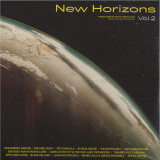
Following a definitive first volume jam-packed with forward-thinking musical talent working in the South African creative improvised music idiom, New Horizons returns with a fresh iteration of young artists who continue in the same tradition and tone.
The compilation showcases recent recordings from 14 more leading lights in South Africa’s contemporary jazz scene: pianists Thembelihle Dunjana, Afrika Mkhize, Sibusiso ‘Mash’ Mashiloane, Blake Hellaby and Siphephelo Ndlovu’s The SN Project; saxophonists Sisonke Xonti, Muhammad Dawjee and Linda Sikhakhane; singer Spha Mdlalose; drummers Ayanda Sikade, Leagan Starchild and Tefo Mahola; and trumpeters Ndabo Zulu and Marcus Wyatt accompanied respectively by Umgidi Ensemble and The ZAR Jazz Orchestra.
Together they form part of a vibrant, connected community charting new sonic territory that speaks to today’s troubled times while building on the country’s unique and proud jazz history.