For Fans Of Temples, Allah-Las, Unknown Mortal Orchestra, Khruangbin, David Axelrod. Each song on Ghost Funk Orchestra's 3rd album, A New Kind of Love, due to be released on Colemine Records … 2022, resonates like the soundtrack to a scene from an imaginary movie. The music could score a romantic drama, an action thriller, or a modern twist on a classic film noir. The spare, cascading vocals accentuate the lush instrumental orchestrations composed, performed, arranged and produced by multi-instrumentalist Seth Applebaum, whose latest brainchild was conceived and conceptualized during The Great Pause of 2020, a time of tension, bewilderment and isolation. Evoking the grooviness of an era which preceded his arrival on earth, Applebaum draws upon sonic devices of mid-century exotica and the succinct but dense arranging style of the leaders of the pop orchestras which dominated the hit parades of the 60s and early 70s. He blends impressions of this bygone era with an expression of his actual experiences as a young filmmaker coming of age in the 21st century, citing influences such as Sharon Jones & The Dap Kings and Antibalas. A New Kind of Love encompasses a reverence for the past without attempting to recreate it. In the tradition of the "production forward" discographies of such record makers as David Axelrod and the Mizell Brothers, it's easy to visualize Applebaum as a "mad doctor" figure, hunkered down in a studio channeling this musical representation of his inner world into the 12 compositions which make up A New Kind of Love. His writing stretches his psyche to explore a terrain in which to capture emotional notes of love going well, love gone sour, manifesting love songs based in ghostly affairs. While the studio is obviously a wondrous happy place of experimentation and creativity for Applebaum, he's a band guy too (having actually fronted punk outfit The Mad Doctors). Applebaum has the wherewithal to bring his dreamy material to the 10 piece all star Ghost Funk Orchestra, leading them to breathe life into this sophisticated body of work which heralds the celebration of a new era for the group. Ghost Funk Orchestra will be touring in concert this summer and fall to celebrate the release of A New Kind of Love, an album which is sure to stand the test of time. Also Available From Ghost Funk Orch: Night Walker/Death Waltz LP/CD, Opaque Red LP, An Ode To Escapism LP/CD, A Song For Paul LP / CD 1. Introduction 2. Your Man's No Good 3. Scatter 4. Prism 5. Quiet Places 6. A New Kind Of Love (pt. 1) 7. Why? 8. Blockhead 9. A Song For Pearl 10. Bluebell 11. Rooted 12. A New Kind Of Love (pt. 2)
Suche:ear dis
As three souls plunge down from the heavens, death and destruction can be felt hanging in the air like a foul stench. Red clouds swirl around a black sun that never sets and an erratic clock ticks off-tempo, moving faster and slower before rewinding and starting anew.
“Let me paint you a picture…” vocalist Mikey Arthur sings, welcoming listeners with a dramatic opening scene. It takes a skillful guide to navigate the darkest depths of hell. And, as The Gloom In The Corner depict in their second full-length album Trinity, death is merely the beginning of the series of chilling adventures
Purposefully aligning their song count with unlucky number thirteen – a reoccurring symbol in the ever-unfolding Gloom Cinematic Universe or GCU – it comes as little surprise to longtime fans that each of the Australian quartet’s enticing tracks intertwine to form an interlocking tale; this time centered around the appropriately labeled unholy trinity.
Comprised of previously deceased characters Rachel Barker, Ethan Hardy, and Clara Carne, the group’s bloody battle is woven throughout the album as the anti-heroes determinedly claw their way back to Earth from the Rabbit Hole dimension, slashing, shooting, and extinguishing anyone who dares to oppose their quest. Yet, for the Girl of Glass, Ronin, and Queen of Misanthropy, there is clearly more to the story than what can be contained within a single package.
Projecting a wide and complex web of lore, plot twists, and tongue and cheek humor, frontman Mikey Arthur, guitarist Matt Stevens, bassist Paul Musolino, and drummer Nic Haberle, have been producing highly detailed concept releases since their formation. And, consistently filling in more missing pieces of the puzzle with every body of work, the band equate each new record to a fresh season of The Umbrella Academy dropping on the streaming service of your choice. Because, just as a great TV series captivates viewers with its music and storytelling, the quartet’s work provides a complete experience designed to allow fans to check in with their favorite characters, all the while enjoying a cinematic new soundtrack.
For those just joining the GCU, as well as those looking for a quick refresh, 2016 debut album Fear Me introduced listeners to main protagonists Julian “Jay” Hardy, a Section 13 agent consumed by anger over his girlfriend Rachel’s death, and Jay’s gloom (later known as Sherlock Adaliah Bones), a demonic entity who at times takes over Jay’s body as a host vessel. 2017 EP Homecoming tells the tale of Jay’s brother Ethan, a war veteran suffering from PTSD, who upon discovering his brother’s struggle, kills himself as part of a Dante-style rescue mission to bring Rachel back to life. In 2019 EP Flesh and Bones, we’re introduced to Clara Carne, a past witness to one of Jay and Sherlock’s crimes, who instead of taking revenge, began a twisted love story with Sherlock, only to be murdered by his forced hand. And 2020’s Ultima Pluvia EP where we finally learn of Sherlock’s past as an ancient warlord under the tyrannical King Baphicho, and see Sherlock and Jay’s deaths ushered in by Section 13 opponent and New Order leader Elias DeGraver and his gloom Atticus Encey.
After 2016’s Fear Me, the band admit that their original intention was to jump straight into the events of Trinity before pivoting to create Homecoming, Flesh and Bones, and Ultima Pluvia. However, upon reflection, primary storywriter Mikey Arthur believes that pushing the timeline back actually provided greater opportunity for the group to properly flesh out the songs and plotlines for their sophomore studio record.
Indeed, while Trinity re-introduces the three central “heroes” of this new arc, it’s important to understand that while familiar, the characters are not carbon copies of who they were earlier in the story. And neither is the band who brought them to life.
Fully embracing the weird and whacky has never been a struggle for The Gloom In The Corner. Rather, it’s together with this attitude that the group come away with special moments such as the fascinating old and new dynamic between neighboring tracks “Red Clouds” – a song whose initial version predates the formation of The Gloom In The Corner as an official band – and “Gravity” in which a demo intended for future material was adjusted to fit the sonic drop.
Mirroring this evolution in the band’s musical approach, a sense of growth can also be seen projected in the characters and story that the quartet chronicle across the thirteen tracks.
Classifying their individual sound as an intricate form of “cinema or theater-core” due to the depth and breadth of their musical approach, features, samples, symphonic elements, and conceptual nature, The Gloom In The Corner continue to prove that they’re more than just a simple concept band.
In fact, similar to character theme music in movies and video games, the group seamlessly play off their diverse sonic story in a variety of ways. Continuing to breathe new life into older staples from their catalog, the quartet reworked their infamous “Oxymøron” breakdown from Fear Me into an impactful moment in Trinity’s “Nor Hell A Fury” and sprinkled audio easter eggs of this sort all throughout their new music for fans to discover.
Listeners are also brought further into the world of the GCU with the help of what The Gloom In The Corner call their “casting process.” Like picking actors for a musical, the band meticulously selected eleven different vocal features and several additional voice actors to bring the album and characters to life. Described as a 50/50 split between notable talents such as Ryo Kinoshita (Crystal Lake), Joe Badolato (Fit For An Autopsy), and Lauren Babic (Red Handed Denial), as well as talented friends and family like Elijah Witt (Cane Hill) and Mikey’s sister Amelia Duffield, each featured artist brought their own touch and realistic spark to the characters they portrayed.
For in the end, as much as Trinity and it’s cast live within the confines of their own supernatural worlds, themes such as falling out of love (Gatekeeper), battling depression (Obliteration Imminent), and standing behind women’s empowerment (Nor Hell A Fury), are ones that many can relate to or understand. And, while most individuals may avoid drowning their woes by way of transforming into full-on egotistical murderers like the Queen and King of Misanthropy and the gang, The Gloom In The Corner have illustrated that time and time again, life’s a little more fun when you can crack a smile. Taking a page from the trinity’s playbook: try to avoid the end of the world. But if you can’t…at least spend it with a killer soundtrack.

Lee Fields is arguably the greatest soul singer alive today. In an age when the shelf life of an artist largely depends on posturing and trends, he has proven to be an unassailable force of nature. His prolific, decade-spanning career continues to reign supreme on the modern soul scene.
In early 2022, Lee reunited with Daptone Records and producer Gabriel Roth to record Sentimental Fool, a deep, blues-tinged, whollyconceived soul album. From his first line to his final plaintive lyric, the beauty, power, and raw humanity of Lee' s voice is on full display here; the culmination of an astounding career that has seemed to defy gravity, rising to only greater and greater heights.
After the legendary French Ethno-industrial band Vox Populi! vanished into obscurity in the early 1990ees, some, like bass player, Francis Manne aka Francis Laffont aka Kosa Nostra aka Kosa aka Fr6, expanded in their their new artistic adventures. Alone or with others, he followed his multi-disciplinary sonic visions that he already displayed on the label Vox Man records, that he founded with Vox Populi! member Axel Kyrou in 1982. Together they released the famed "Audiologie" compilations, an audio fanzine featuring a contemporary outlook on the experimental electronic, and improvisational avant-garde music scene of the time. Particularly the two "Alterntative Funk: la Folie Distinguée" compilations turned into today’s collectors’ items for fans of bizarre electronic music.
Now Notte Brigante brings “Kosa and Friends 1987/97“, twelve unreleased recordings that display Francis Manne’s ongoing musical creation after the break-up of Vox Populi!. Minimal Synth, post punk, field recordings, psychedelic, cold wave, and weird proto funk are welcome thoughtful listeners into an eccentric world of pop and poetry, of experiment and groove. As the visual part was always equally important as the music for him, the cover links to Manne’s graphic work, which has also often been featured on many Vox Populi!, Bain Total, or Vox Man Records. A venturesome collection that documents an unexplored universe of a visionary French avant-garde musician and his vivid peer group.
NNAMDÏ has never been able to stay in one place. The Chicago
multi-instrumentalist and songwriter set a blistering pace in 2020
with his critically acclaimed genre-fusing LP, ‘Brat’, a punk EP,
‘Black Plight’, and ‘Krazy Karl’, a full-length tribute to Looney
Tunes composer Carl Stalling. Add in his role as co-owner of label
Sooper Records, as well as recent tours with Wilco, SleaterKinney and black midi, and it’s an overwhelming schedule.
However, his latest album, ‘Please Have A Seat’, is the result of a
much needed pause. “I realized I never take time to just sit and
take in where I’m at,” says NNAMDÏ. “It’s just nice to not be on
‘Go, Go, Go!’ mode, and re-evaluate where I wanted to go
musically.” This period of reflection allowed him to take stock of his
life and his relationships. “I wanted to be present,” he says. “Each
song came from a moment of clarity.” ‘Please Have A Seat’ serves
as an invitation to listen. It’s a request to sit down, be present, and
take in a moment. With this quiet introspection, NNAMDÏ found
inspiration in silence and nuance.
While making the record, he decided to stretch the limits of his pop
songwriting: every track had to be hummable. Though he’s written
earworms throughout his career from playing in bands in
Chicago’s DIY community or releasing goofy raps as Nnamdi’s
Sooper Dooper Secret Side Project, here, his shapeshifting hooks
are undeniable. Each of the album’s fourteen songs, which
NNAMDÏ wrote, produced, and performed entirely himself, are
relentlessly re-playable, careening into unexpected and
disorienting places. With NNAMDÏ’s singular vision, ‘Please Have
A Seat’ is yet another leap from Chicago’s hardest working
musician. By taking a minute to sit down and catch his breath, he
re-emerged with the most ambitious, accessible, and nuanced
work of his career.
Coloured vinyl LP format pressed on Walnut Brown vinyl.
Low Company presents Yuta Matsumura’s Red Ribbon, a sequence of introspective, lavishly melodic dream-songs and amphibian atmospheres recorded in scattered periods over 2018-21. Having played in bands like Low Life, M.O.B. and Orion, and the duo Jay & Yuta (with Jay Cruikshank), Red Ribbon is Matsumura’s first solo outing, and represents a conscious effort to move away from guitar-based songwriting. He composed its nine tracks mostly on piano - layering vocals, bass, keyboards, flute (courtesy of Maeve Parker), violin/cello (Laurence Quinn) and clacking drumbox rhythms into dynamic, dubwise avant-pop structures which are supple and spacious but fizzing with detail and vivid inner life. The laconic 4/4 pulse, heat-warped synth-tones and haunting vaporous melodica of opener ‘Box Garden’ set the tone: its surreal psychedelic patternings barely concealing a deep sting of longing and regret. The cryptic lyrics suggest chance encounters, hidden logic, missed opportunities, fatalism, serendipity. A city submerged: everyone else paused mid-movement, while you’re allowed to swim free and fish-like through the streets, over the rooftops...‘Tangled Orchid’ is a tense night-drive through dry desert heat and into the unknown, running away from your old life, chased down by dust-devils of half-baked schemes and abandoned plans, while ‘Myth Machine’ drops the tempo and something mind-altering, guiding us on a tripped-out dub-disco scuba among alien flora and fauna, a world of impossible shapes and sensations. At which point, the mood of the album decisively shifts, firstly with ‘Sake No Otoh’, sung in Japanese by Haruka Sato: an instant-classic, breathtakingly intimate lover's lament that sounds like it got lost on its way to heaven and is now doomed to orbit the earth forever. The songs that follow continue in this more confessional, imploring mode. As if the travelling's done, the baggage has been cast off, and we’ve arrived at our destination, where the real process of rebirth and repair can begin. The music’s textures become less overtly dubby and electronic, with more of an organic, earthy, chamber-pop/avant-folk feel, at once sad and hopeful-sounding. Three songs in particular bear the influence of Eno’s 70s work (and its mutant bedsit offspring Lifetones, Flaming Tunes, etc): ‘‘E. Potential’, where baroquely chorused vocals - half-agonised, half-beatific - teeter on top of simple oscillating piano loops, and the stately, dawntreading ballads ‘Tabula Rasa’ and ‘No Sleep For Birds’. The bulk of the album was made prior to lockdowns and all of that; its themes of reset, self-examination, the need to f**k it all off and take spiritual stock, are timeless. Though they perhaps have a more bittersweet resonance now the world has returned pretty much to how it was, only worse. Track list: 1. Box Garden 2. Tangled Orchid 3. Myth Machine 4. Red Ribbon 5. Soko No Ato 6. Tabula Rasa 7. E. Potential 8. No Sleep For Birds 9. Zookeeper's Trial
- A1: Enslaved - Eon
- A2: Mono - Er Eb Os
- A3: Ihsahn - Dark Awakening
- B1: Jo Quail - Prime
- B2: Bohren & Der Club Of Gore - Plateau
- C1: Hackedepicciotto - Trinity Past
- C2: Ulver - Godeater
- D1: Jonas Renkse - Er Eb Os
- D2: Zola Jesus - Prime
- D3: Spotlights - Of Eons
- E1: The Ocean - Primal (State Of Being) (State Of Being)
- E2: Crown - Element
- E3: Jaye Jayle - Er Eb Es
- F1: Godflesh - Ashen
- F2: Steve Von Till Aka Harvestman - Testament
- F3: Arabrot - The Last Days (See The Light) (See The Light)
The Others (Lustmord Deconstructed) is a celebration of the fearless attitude of being different and the expression of unique ideas which have never existed before. Over 13 years after the release of O T H E R , Pelagic Records has gathered 16 bands and solo artists to record their own unique takes on tracks from the Other-sessions. The result is an album that is more than a compilation, and more than the sum of its parts; covering a wide range of musical niches and directions, but sharing the same underlying mood and vibe defined by Lustmord's timeless soundscapes: from the ambient solo performances provided by IHSAHN, ENSLAVED or JONAS RENKSE to the subdued voice of ZOLA JESUS woven into Lustmord's sombre fabric to the industrial carnage that is GODFLESH's version of `Ashen'. LUSTMORD is the artistic moniker of Brian Williams. Born in North Wales, he started his musical career in 1980 and soon became a pioneer in the early industrial music scene in the UK. He was a former member of SPK during arguably their most crucial era, and went on to work with THROBBING GRISTLE members Chris & Cosey as well as appearing on early albums by CURRENT 93, NURSE WITH WOUND and others. After relocating to Los Angeles in 1993, Williams worked on dozens of motion picture soundtracks including The Crow, Underworld and Paul Schrader's First Reformed. Additionally he created several video game soundtracks, television scores and solo albums, as well as collaborating with artists as varied as THE MELVINS, CLOCK DVA, JARBOE, John Balance of COIL, Paul Haslinger (TANGERINE DREAM), PUSCIFER, Wes Borland and more, including Grammy Award-winners TOOL on their much acclaimed effort Fear Inoculum. To this day, Lustmord is actively recording and releasing music, his latest release being the collaborative album Alter with Karin Park of A°RABROT, and he is considered to be the founding father of the dark ambient music genre. The original O T H E R was released by independent record label Hydra Head Records, founded by ISIS frontman Aaron Turner and former home of bands such as CONVERGE, PELICAN, JESU, SUN O))) or BORIS. As one journalist put it at the time, O T H E R is a "grim example of a consummate artist who is working frmly within the parameters that he has laid out for himself over the years." This album shows Lustmord at his most characteristic, and the icy, ominous guitar playing of Jones, Turner and Ozborne resonates perfectly within the deep soundscapes that make up this frightening yet inspiring journey. What demonstrates the profound influence of Lustmord on this contemporary music underground showcased here is that artists from disparate ends of the sonic spectrum all feel inspired to explore the essence of his idiosyncratic sounds within their own realm: experimental electronica icons ULVER excel on a stunning, hazy rendition of `Godeater', while Japanese post-rock act MONO deliver a crushing version of `Er Eb Os', and THE OCEAN take us on a cathartically heavy mindtrip back to our `Primal State of Being'. In the end, each of these 16 artists delivers an interpretation that pays the deepest respect to this pivotal artist, while also standing out as a new track of its own.
The phrase ‘Holy Grail’ is much overused when it comes to record collecting, so we tend to use it sparingly. When we do though, you know it’s serious!
Well, here is a genuine holy grail which lives up to its title. Originally released on the tiny Wizard label in Australia in 1976, Marcia Hine’s effervescent 'You Gotta Let Go' achieved a few local plays in Sydney at the time before disappearing for almost three decades before it was re-discovered by Modern Soul cratediggers in the early '00s.
Since then, the record has exploded in popularity across a number of scenes and the price for an original 45 has now reached a staggering £700 and that’s if you can even locate a copy! The song was available on Marcia’s ‘Marcia Shines’ album which helped its spread in popularity, but most collectors really needed the 7”. Well, wait no longer.
Selector Series is proud to finally re-release the original 7'' version of 'You Gotta Let Go' with the original ‘B’ side 'Don’t Let The Grass Grow'.
This release will appeal to buyers all across the board – Soul, Modern Soul, Northern Soul, Disco and Rare Disco audiences so expect heavy demand the minute this hits the shelves. This is a multi-crossover record which will be played everywhere upon release and will be equally as popular internationally. Don’t say we didn’t warn ya.
Like a rediscovered Viking burial ship, Electro Nova compiles near-mythical drone recordings produced in 1998 and described by Helge Sten aka Deathprod as some of the most important music to ever come out of Norway. It's the work of Kåre Dehlie Thorstad and compiles two of the earliest releases on Smalltown Supersound, back when it was basically no more than a bedroom operation. It’s taken over two decades, but finally the label have given the material a first ever proper release on vinyl, complete with mixing and mastering by Deathprod. If you’re into the ice cold swells of anyone from Thomas Köner to Harley Gaber, Biosphere, Kali Malone or, of course, Deathprod - this one's as essential as they come.
Kaare Dehlie Thorstad's Elektro Nova produced just two releases during the late ‘90s that have since slipped into drone lore - Trans-Inter-Ference and Elektro Nova/Electro Nova. Admired not only by Deathprod and Joakim Haugland of Smalltown, but also by his contemporaries Lasse Marhaug and Biosphere, his work has evaded pretty much any attention outside of Norway these last two decades. Following a chance meeting with Thorstad at Oslo airport a few years back, Smalltown were prompted to give the recordings a second wind, presenting what is essentially a captivating new release, and crucial addition to the Norsk drone canon.
As the story goes, Thorstad was studying photography in the late 90’s in Scotland, but instead of delivering a photo for his final exam he made a record - a double album (2CDs) and a 10” to be precise. That should provide some idea of the textural synaesthetic and landscaping qualities evoked by his music, which he ended up sending to a then-young Smalltown label, who were mostly issuing tapes at the time. With no proper distribution the records largely bypassed wider attention, and become a personal favourite of Smalltown’s Joakim Haugland, as well as avowed fan Helge Sten (Deathprod), who helped render its diaphanous scale in mix down, and Lasse Marhaug who describes them as "two perfect records that deserved much bigger attention”.
Between its jaw-dropping opener; the post-apocalyptic vision of its untitled part; and the cinematic white-out of the 10” tracks; Thorstad comes as close as we’ve ever heard to evoking the inhospitable nature and stark beauty of the wild far north. We can hear those landscapes palpably internalised and alchemically transmuted into its coarse grained textural swells and a reverberating multi-dimensionality, variously sustained to extents that evoke an abandonment of the senses, or likewise squashed and isolated to imply the relative anxiety relief of atmospheric flux, where a few degrees temperature rise or a drop in the wind speed can make the difference between life and death.
Impressively, Thorstad realised after the release of Elektro Nova and just two live shows that he couldn’t really follow up the work and instead pursued a career as professional cyclist, eventually combining his visual skills to become a pro cycling photographer. In that sense, he’s a bit like composer-turned-tennis coach Harley Gaber, whose almighty ‘The Winds Rise In The North’ (1976) is in some ways richly prescient of this work. Like Gaber, Thorstad can remain safe in the knowledge that his contribution to the drone sphere will endure for the ages, especially with this important, impressive new edition.
Max Loderbauer’s career in music spans the last 3 decades, yet he’s still managed to keep his listeners hungry by releasing only 3 solo albums to date. Two of those releases (Transparenz, 2013 and Donnerwetter, 2020) were on Tobias Freund’s label Non Standard Productions - his long time collaborator and Templehof studio mate. In between those releases, Loderbauer graced Marionette with Greyland in 2016, revealing a previously unheard youthful and sentimental side. Now in 2022, the seasoned mind voyager is back with Petrichor, making yet another rare and treasurable solo appearance.
Petrichor distills the elements of Loderbauer’s work that are fundamental to the initiation of the label. With his Buchla, modular synth, and Haken fingerboard, Loderbauer’s improvised studio maneuvers dilate into imagined journeys from glacial peaks into the exosphere. This is Maxi at his most exhilarating state, morphing through bittersweet and optimistic soundscapes to bleak moments of throbbing unease - all while maintaining a sense of grace and elegance. Petrichor is a reflection of Loderbauer’s impactful trips to the mountains, and returning from these summits with an electrifying urge to paint this mighty perspective. The harmonies and melodies on the tracks simulate emotional peaks and valleys, with vibration and rhythm rooted in the foundation of the sound, as though it's woven into the fabric of the fauna and flora.
Legendary collaborations like Vilod (with Ricardo Villalobos), the Moritz Von Oswald Trio, Non Standard Institute, Sun Electric in the early nineties, and the newly formed Ambiq ensemble have gained this unique artist the respect of the underground and avant garde scenes alike.
- A1: Fragments Of Yesterday
- A2: Wendys Hollow Path
- A3: Less Real Than You
- A4: In Sosteso
- B1: L'ennui Hâté
- B2: Moving Tiles
- B3: Melee
- C1: The Place Is What Emerges
- C2: Setting Things Apart
- C3: Perhaps Significant
- D1: Non C'é
- D2: Indefinable Basement
- D3: Dance Of The Forgotten
- D4: Shaping The Experience
- D5: L'anticipazione Del Futuro
"While focusing on the current conditions we find ourselves in and bracing for what seems like the collapse of humanity, I made this collection of music in an attempt to ignite the essential remnants of my inner euphoria, and perhaps yours too" - Feldermelder
Euphoric Attempts is a finespun, voluminous manifestation of euphoria, a testimony to creativity, produced at a time when the outside world seems to be slowly disintegrating. The musical language is pure, vast, resilient, and vulnerable. The compositions of Feldermelder have a tonality both strange and familiar, intensified and influenced by classical music, yet distinguished by the coalescence of contrasting styles.
Euphoric Attempts relates to the state of our external surroundings but also refers to our inner life: it passes through our memories — through our organism — through our stories, and intends to elude the cold grip of analytical listening, instead retrieving intrinsic truths. The track titles signify a form of homage to our inner individuality, existing in parallel with the severities of the tangible, the external.
For this album, Feldermelder draws together compositions from his extensive archives, focussing on material that reflects the simple joy of making music. As a counterpoint to the abstract complexities and intricate rhythms of his live performances, here Feldermelder creates candid compositions of purity and minimalism, finding a sense of elegance in the details. Euphoric Attempts discovers the prospect of liberation and vitality in concealed intimacies, capturing their resemblance in gentle, elaborate, and prodigious movements of sound.
Feldermelder is a Swiss musician, sound designer, producer, and installation artist. He is co-founder of -OUS and part of the audio-visual collective Encor.studio. He has previously released several releases on -OUS, both as a solo artist, and in collaboration with Sara Oswald and Julian Sartorius. Feldermelder's influences range from pioneering early electronic music to contemporary analogue electronics to classic jazz and beyond. The diversity of the music that inspires him is mirrored in his own work, which illustrates an ever-evolving sound, and indicates that influence is seen as both map and compass, guiding divergent inclinations.
The end of the Doc Pavlonium's trilogy has come. Third and final chapter of the series.
"Is 2333 dc and humanity decided to leave planet earth as they don't need it anymore. The Earth is only but a limit to the inescapable human evolution: from simple terrestrial to new outer space inhabitants who are able to live without a planet, nature, art or music. In this robotic, hi-tech, and perfectly controlled future, somebody will be wondering if they can discover another moon, another sun, another galaxy..."
We Jazz Records presents the second volume of their reworks albums dealing with source material from the Helsinki-based label's catalog. This time around, it's Carl Stone's turn to tackle the source albums at hand and filter the label's output through his musical lens.
We Jazz Reworks is an idea that repurposes some of the label's output 10 albums at a time. That is, the label invites producers whose music they love on board, and one by one, they tackle 10 albums worth of source material, of which they are free to use as much or as little as they choose. The series evolves chronologically, so this volume being number two, the source material is pulled from We Jazz LPs numbers 11 through 20. The artist has complete freedom.
Volume 2 in the series happens with Carl Stone, a legendary figure in creative music. His career spans decades of unlimited musical innovation. Stone's recent output on Unseen Worlds, the label who has also been instrumental in issuing some of his remarkable earlier work, ranks among the most original art of our time and renders notions such as "genre" virtually meaningless.
Here, We Jazz originals by Terkel Nørgaard, OK:KO, Jonah Parzen-Johnson and more are met here with a fresh sense of discovery, spun around and delivered ready for the turntable once again.
Carl Stone says:
"It was wonderful that We Jazz gave me carte blanche to work with any materials from the set of ten releases in its catalog. This freedom to work with everything could have been a mixed blessing though, as it could be a challenge to try to deal with so much musical information. In the end I did what I almost always do: Let my intuition be my guide and to seize upon any musical items that seemed to fit into an overall approach."
"To make a new piece I usually start with an extended period of what really is just playing, the way a child plays with toys. Experimentation without necessary expectation, leading to (hopefully) discovery of things of musical interest, then figuring out a way to craft and shape these into a structured piece of music. Each track uses a different approach, which I found along the way during this play period."
This conceptual approach becomes complete with the design, in which album graphics are treated in a similar fashion, reworking what's there. This time around, the artwork is reinvented by Tuomo Parikka, a regular cover collage contributor for the We Jazz Magazine.
CURACAO BLUE TRANSPARENT VINYL, INSIDE OUT SLEEVE, OBI W/ LINER NOTES, PRINTED INNER SLEEVE WITH SOURCE ALBUM DESIGN REFLECTIONS.
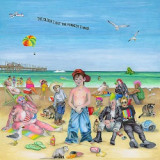
The Older I Get, the Funnier I Was, which follows Thomas’ brilliant 2020 HBO special The Golden One and his Can't Believe You're Happy Here EP released earlier this year, surveys a range of emotion and offers a broad sonic palette, moving between pop punk, electro, and the obvious influence of the singer-songwriters he grew up listening to in early childhood. It conjures the ennui of Bright Eyes alongside the barefaced storytelling of John Prine, the overstuffed lists of Fred Thomas with the lackadaisical humor of Colleen Green, among many others.
Thomas attributes the dexterity of the record to Duterte, who recorded and engineered most of it in addition to serving up plenty of encouragement when Thomas got down on the process. “As a comic, I used to test out new songs during sets to see if the funny bits were hitting, but since I wrote this in isolation I ended up writing lyrics and worrying less about making jokes,” Thomas says. That said, the album’s plenty funny. Stand-out and lead single “Rigamarole” opens with a Thomas-voiced infomercial that recalls his oft-cited lookalike Jim Carrey as the Grinch, before launching into a buoyant pop song about being depressed.
Whitmer Thomas will admit that when he traveled home to small town Gulf Shores, Alabama to record his HBO stand-up special, The Golden One, he expected to be greeted as a returning hero, a conquering king, or at minimum, a guy with a moderately successful career as an entertainer in Los Angeles. “I expected a big welcome home, open arms, but when I went back I realized: nobody fucking knows me. Nobody remembers me,” Thomas says. “In the years I’d been performing that show, I’d been romanticizing my childhood in this mythologized place, but the visit made me see that I’m not really from there anymore.”
The sense of alienation compounded when Thomas recognized how few people in town remembered his mom, to whom The Golden One is dedicated and largely about. Thomas grew up watching her perform with her twin sister at the legendary Flora-Bama Lounge, where he set the special, and still counts her as one of his musical influences. His new album, The Older I Get, the Funnier I Was, isn’t overtly about his mom, her presence is deeply felt throughout. While in Gulf Shores, Thomas discovered dozens of her old recordings, all of which had been wrecked by Katrina, but upon returning to LA, Thomas paid “a fancy place in Hollywood” to fix the tapes and hired Melina Duterte (Jay Som, Bachelor, Routine) to mix them. The two struck up a collaborative friendship, and Thomas had the sound of his mom’s voice back. “I was listening to songs she recorded when she was about my age, just these heartfelt, sweet Americana songs,” he says. “I decided then that I wanted to lose the Ian Curtis voice I always sing with; I wanted to do what came naturally, because my mom always sounded like herself, even when she was singing some cheesy reggae song about, like, Jamaica.”
Thus he went into The Older I Get, the Funnier I Was knowing it was time to retire his darkwave persona, and leaning into his natural, chirpier voice, which he says sounds “like a 12-year-old’s.” It makes sense: much of the album chronicles what Thomas calls “being a kid and feeling like you have no control and overcompensating by being annoying.” “So much of the album is about witnessing drug and alcohol addiction as a kid and seeing what it does to people, but also realizing that there's nothing you can do about it,” Thomas says. It’s familiar territory (see: “Partied to Death”) but the methodology is different this time around; true to its title, The Older I Get, the Funnier I Was isn’t always looking for laughs. Thomas might’ve left his hometown behind, but his kid self is still tagging along, a Peter Pan shadow he can’t untether himself from. The first line he sings on The Older I Get, the Funnier I Was is: “There should be a room at every party where you can just sit and watch a movie.” Find a 12-year-old who wouldn’t say the same.
Several things happened before a warm day when I met the four members of Frankie Cosmos in a Brooklyn studio to begin making their album. Greta Kline spent a few years living with her family and writing a mere 100 songs, turning her empathy anywhere from the navel to the moon, rendering it all warm, close and reflexively humorous. In music, everyone loves a teen sensation, but Kline has never been more fascinating than now, a decade into being one of the most prolific songwriters of her generation. She's lodged in my mind amongst authors, other observational alchemists like Rachel Cusk or Sheila Heti, but she's funnier, which is a charm endemic to musicians. Meanwhile Frankie Cosmos, a rare, dwindling democratic entity called a band, had been on pandemic hiatus with no idea if they'd continue. In the openness of that uncertainty they met up, planning to hang out and play music together for the first time in nearly 500 days. There, whittling down the multitude of music to work with, they created Inner World Peace, a collection of Greta's songs changed and sculpted by their time together. While Kline's musical taste at the time was leaning toward aughts indie rock she'd loved as a teenager, keyboardist Lauren Martin and drummer Luke Pyenson cite "droning, meditation, repetition, clarity and intentionality," as well as "'70s folk and pop" as a reference for how they approached their parts. Bassist/guitarist Alex Bailey says that at the time he referred to it as their "ambient" or "psych" album. Somewhere between those textural elements and Kline's penchant for concise pop, Inner World Peace finds its balance. The first order of business upon setting up camp in Brooklyn's Figure 8 studios was to project giant colorful slides the band had made for each track. Co-producing with Nate Mendelsohn, my Shitty Hits Recording partner, we aimed for FC's aesthetic idiosyncrasies to shine. The mood board for "Magnetic Personality" has a neon green and black checkerboard, a screen capture of the game Street Fighter with "K.O." in fat red letters, and a cover of Mad Magazine that says "Spy Vs. Spy! The Top Secret Files." On tracks like "F.O.O.F." (Freak Out On Friday), "Fragments" and "Aftershook," the group are at their most psychedelic and playful, interjecting fuzz solos, bits of percussion, and other sonically adventurous ear candy. An internal logic strengthens everything, and in their proggiest moments, Frankie Cosmos are simply a one-take band who don't miss. When on Inner World Peace they sound wildly, freshly different, it may just be that they're coming deeper into their own. Inner World Peace excels in passing on the emotions it holds. When in the towering "Empty Head" Kline sings of wanting to let thoughts slide away, her voice is buoyed on a bed of synths and harmonium as tranquility abounds. When her thoughts become hurried and full of desire, so does the band, and she leaps from word to word as if unable to contain them all. As a group, they carry it all deftly, and with constant regard for Kline's point of view. Says Greta, "To me, the album is about perception. It's about the question of "who am I?" and whether or not the answer matters. It's about quantum time, the possibilities of invisible worlds. The album is about finding myself floating in a new context. A teenager again, living with my parents. An adult, choosing to live with my family in an act of love. Time propelled us forward, aged us, and also froze. If you don't leave the house, who are you to the world? Can you take the person you discover there out with you?" - Katie Von Schleicher
- 1: Lettuce And Cabbage
- 2: Pay Me
- 3: Flamboyant (Feat. Frankie Storm)
- 4: Beastie Boyz (Feat. Ron Browz & Method Man)
- 5: Billy Joel
- 6: Feast (Bo Blakk & Milly D.o.d.)
- 7: Got It Movin (Feat. Ron Browz)
- 8: Faith (Feat. Ron Browz & American Bboy)
- 9: Shark Tank (Feat. Steel & Ruste Juxx)
- 10: Hood Up (Feat. Frankie Storm)
- 11: Squad (Feat. Ron Browz & Last American Bboy)
- 12: The Answer
Since making his mark in the ‘90s through the early aughts as a part of the legendary Boot Camp Clik and one half of “Da Incredible Rap Team” and duo Heltah Skeltah, Rock (also known as the Rockness Monsta) has been conservative with solo efforts. With one of the most distinct voices in hip-hop, the Brooklyn emcee released his full-length debut solo albumRockness AP in 2017, and now looks to step back into the spotlight with his sophomore album, Ether Rocks.
Produced entirely by Harlem, New York’s Ron Browz (Nas’s “Ether”, Jim Jones’s “Pop Champagne”, etc.), the project sees Rock’s ominous tone and sharp flow transposed from the traditional Boom-Bap beats of Da Beatminerz and others, into a sonic backdrop that retains grit yet bolsters an updated and more sophisticated style from the legendary emcee.
The 12 track LP boasts guest appearances from Method Man, Steele (Smif-N-Wessun), Ruste Juxx and more, and is available via DSPs, CD and vinyl through American B Boy Records in partnership with Fat Beats.
“Dope is dope. I'm trying to break out of the underground rap box and ease into ‘grown man rap’. This album is basically my way of showing y’all more sides to myself musically and conceptually. A lot of our culture wants you to do the same thing over and over. That’s understandable but not realistic as we are forever evolving as human beings. So, while I continue to serve jedi level barbarian bars, I’m adding some things to the menu.” – Rockness Monsta
Yazzus follows up her appearance on the Tresor 30 compilation with a new EP named BLACK METROPOLIS.
Within its, at times, rough-hewn textures lies a core
that explores joy and energy within the roots of black techno. In her words: “I want this release to be black and beautiful, to be queer, and playful, a nostalgic nod to the 90s but also reimagining it in the current times.”
The Ghana-born, London-bred, now Berlin-based producer’s research into afro-futurism, envisaging a path forward for science, technology and culture through the black experience, has impressed a deep
vision on this EP. Yazzus sets like a cartographer, using her tracks to explore a technologically advanced world, each representing dierent regions and environments.
Human Error Processor introduces an ear-worming percussion pattern nearly swamped by distorted bass drums and a vocal sample screwed just beyond recognition. Perforated leads with a 150bpm four to the floor stomp, infectious and supercharged. Gluey synth
motions soak in an otherworldliness, where industrious,
mechanical rhythms map out futurist structures in all directions.
Metro City Bay Area exhibits a ghettotech soul, lean and bouncy - this part of the galaxy is an infinite source of fun, with the heart of groove at it’s core. Three Deities brings adventurers of its region towards higher powers, its ravey synths and an engulfing bass provoke a complete NRG release, ascending into a spiritual trance where dense melodies bubble and fizz.
Digital-only track United By Fate meddles busy vocal samples with searching melodies, a fitting end to the kaleidoscopic that is BLACK METROPOLIS.
TOHO, the creators of GODZILLA, unleash SPACE AMOEBA aka Gezora-Ganime-Kameba: Kessen! Nankai No Daikaijû! A space probe is lost while on its way to the planet Jupiter but returns to Earth after being overtaken by a deadly and dastardly single-celled organism.
The organism then mutates into giant kaiju that mimic a cuttlefish, a stone crab, and a matamata turtle, and uses these destructive forms in their plan to take over the planet. The only thing that stands between humanity and the insidious invertebrates is a group of photographers doing recon for a tourism company!
Directing, of course, is the legendary Ishirō Honda (MOTHRA, RODAN) alongside producer Tomoyuki Tanaka, with the dreamy Akira Kubo (DESTROY ALL MONSTERS) as photographer Kudo. As with GODZILLA, Honda recruited the great Akira Ifukube to compose the thrilling score, and Ifukube brought his trademark innovation and dramatic grandeur.
The title theme is beautifully distinctive, mixing thick brass and low piano to match the destruction of the kaiju with higher horns and trumpet, providing a lighter contrast. Ifukube scores action and horror with his iconic lumbering colours but provides suspense with piano and otherworldly strings, with a unique slithering theme for the evil amoeba. Another Ifukube triumph! (Charlie Brigden)
Composed by Akira Ifukube
Artwork by Matt Taylor
Manufactured in Czech Republic
By early 2020, Kayleigh Goldsworthy had finally figured out who she was. The long-time hired-gun musician from Syr- acuse and based in south Philadelphia, who had spent a decade backing up the likes of Dave Hause, Bayside, Frank Iero, and others, was ready to commit fully to a solo career of her own work. The day after New Year’s Day 2020, Gold- sworthy started recording her second solo LP, seven years after her debut Burrower, with Will Yip at Studio 4 outside Philly.
Then everything changed. The job and life Goldsworthy had pursued since her teen years was ripped away: tours, shows, studio time, even band practices and writing sessions, all gone. Along with those went away a hard-won sense of self.All those things that had given Goldsworthy the confidence and push to believe in herself and her work disappeared.
“I had figured out who I was,” says Goldsworthy, “then this whole thing happened, and I had to figure out who I was again.”