Tough Love have partnered with West Coast imprint Mt St Mtn for the release of Free Advice, the instant slowcore/dreampop classic by San Fran four piece, Cindy. The full album is available to stream/download now, while a highly limited transparent vinyl pressing will be released on 20th November. Limited to just 250 copies, this pressing follows the long sold-out edition of 100 released earlier in the year and which was previously only available in the US. Free Advice offers a somber-yet-uplifting take on sobered dream pop. Imagine if Galaxie 500’s On Fire didn’t have a guitar solo or if The Trinity Session was stripped of its folk & blues roots; it’s just pure mood. Like sitting in a half-empty movie theater that’s playing Alphaville or Wild Strawberries and watching patron’s heads briefly illuminated from the screen; Free Advice (and all of the Cindy output) transfers you to these momentary worlds. Cindy is Karina Gill on guitar/vocals, Aaron Diko on synth/keys, Simon Phillips on Drums/Percussion, and Jesse Jackson on Bass/Keys + Simon and Jesse on backing vocals. The songs on Free Advice are these moments in mood: Phillips & Jackson’s rhythms create the foundation, while Diko’s keys rise and fall. Gill’s guitar rattles, vocals brood, and lyrics create these narratives that depict observers, not necessarily wronged rather, cautious and investigative of the world around them
quête:ear dis
Utrecht label U-Trax welcomes 90s legend P.A. Presents for an enhanced re-release of his first two releases on this label, namely "Salicylic Acid" and "Flight Simulator".
Ironically P.A. Presents aka Peter Aarsman is the only artist on U-TRAX that actually is born and bred in the city of Utrecht. Even more irony lies in the fact that he hasn't lived in the city for 25 years and has only recently returned home. He was an early player in the hip hop and boogie scenes and long before house landed in Europe he was playing disco and Italo which helped establish him as a truly vital DJ talent. The two reissue EPs presented here marked his production debut back in 1993, both of which are hugely sought after and pricey techno records on second hand markets. In 2019 he returned to the music scene with two new EPs on U-Trax in the the form of Swirling Gas and Sax Madness and new releases are planned for 2020.
The release kicks off with 'Mesopmorph', an effervescent, nostalgic cut with a deeply buried techno rhythm that eventually takes over in tribal style. 'Pop' is a brilliantly tense and dense track wired up with fizzing synths, chattering claps and haunting effects as well as pending drums, then 'Theme' is cosmic industrial, with powerful hits and metallic sounds married to searching laser synths.
'Vera S' is classic 90s techno with mad vocal sounds and frantic synth lines darting about the mix, then things grow deeper and more heady on the stripped back intergalactic journey that is 'Flight Simulator.' The timelessness continues on the dancing analogue drums and hi hats of the classic Detroit styled 'Experiental' and 'A Gasp' before 'Vexillum' brings more warm solar winds and molten techno grooves whist 'Long Metal' closes out with pounding kicks, skewed synths and real sense of space travel.
These are essential early techno tracks that sound as fresh and relevant now as ever and come with remastering and restoration from Thee J Johanz.
Pressed on 2x12" 180 grams grey marbled vinyl.
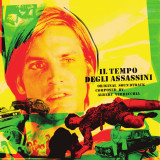
Between the 60s and 80s, Albert Verrecchia played a major role in Italian pop music and on the European disco and Afro-cosmic scene, both under his own name and under the monikers Albert Weyman and Albert Prince. He was the keyboardist of legendary Italian-French r'n'b band I Pyranas, served as a session Hammondist for singer and TV star Raffaella Carrà, and produced the disco trio Belle Epoque as well as the debut album of singer-songwriter Alan Sorrenti. Among his many incarnations, in the early and mid-70s he also composed a few soundtracks for Italian genre cinema, including for movies such as the poliziottesco Roma drogata, la polizia non può intervenire (Hallucinating Trip, 1975, Lucio Marcaccini) and the erotic drama Tecnica di un amore (1972, Brunello Rondi).
The score he wrote in 1975 for Il tempo degli assassini (Season of Assassins, a film about a gang of criminal youths who terrorize the city of Rome in the already violent 70s) is certainly his most accomplished work in the genre. Conceived for a small ensemble, it was written almost entirely on the spot in the recording studio. Verrecchia himself played the Moog, and his dynamic and percussive approach to the instrument resulted in a style midway between funk and proto-disco. A modern rhythmic style - or Ritmico Moderno, which is the title chosen by CAM for the LP containing the soundtrack and released two years later as part of a promotional library music series only distributed to film professionals and radio and TV programmers (CML series, cat. no. 131). One is led to wonder whether it was thanks to that LP that, in 1977, three pieces from the soundtrack found their way into another film about youth gangs, the Spanish Perros callejeros (Street Warriors), written and directed by Jose Antonio de la Loma. On a side but important note, there's the added bonus of popular 70s and 80s entertainer Sammy Barbot singing on Gang Leader alongside female vocal group Baba Yaga. What a pity that Verrecchia's career as a film composer ended here!
"Released in October 1971, Frank Zappa’s “200 Motels” was a miraculous feat, a cinematic collision of the venerated musician and composer’s kaleidoscopic musical and visual worlds that brought together Zappa and his band, The Mothers, Ringo Starr as Zappa – as “a large dwarf” – Keith Moon as a perverted nun, Pamela Des Barres in her acting debut, noted thespian Theodore Bikel, the Royal Philharmonic Orchestra, and an incredible assortment of characters (both on screen and off) for a “surrealistic documentary” about the bizarre life of a touring musician. The 2LP set : We are pleased to present the original soundtrack, a double-album set featuring all original packaging including the booklet & poster and a brand new remaster by legend Bernie Grundman at Bernie Grundman Mastering. Pressed on 180g black vinyl by Optimal Media in Germany.
In celebration of “200 Motels” golden anniversary, Zappa Records, UMC and MGM have assembled a definitive Super Deluxe six-disc box set of the beloved, yet hard to find, soundtrack. Fully authorized by the Zappa Trust and produced by Ahmet Zappa and Zappa Vaultmeister Joe Travers, the monstrous 200 Motels 50th Anniversary Edition brings together the original soundtrack, newly remastered by Bernie Grundman at Bernie Grundman Mastering, along with a staggering amount of unreleased and rare material unearthed from FZ’s Vault, including original demos, studio outtakes, work mixes, interviews and movie ads, along with newly discovered dialog reels, revealing an early audio edit of the film. Also included is a wealth of never-before-heard audio documentary material surrounding the project.
The six-disc set will be housed in a 64-page hardcover book in a handsome 12” x 12” slipcase. The packaging replicates the original booklet updated with revealing new liner notes from Pamela Des Barres, Ruth Underwood and Joe Travers, as well as Patrick Pending’s essay from the 1997 reissue, and is chock full of motion picture artwork, stills and images, from the film and its making, many which have never been seen before. This must-have collector’s release will also include a custom “200 Motels” keychain and Do-No-Disturb motel door hanger and a full-size replica of the original movie poster. Years in the making, all the audio was meticulously identified and transferred over several years as Travers dug through the Vault to create a new high resolution 96K/24B digital patchwork stereo master from the original analog tapes. The Vault material was mastered by John Polito in 2021. We are pleased to present the original soundtrack on 2 compact discs featuring all original packaging including the booklet & poster and a brand-new remaster by legend Bernie Grundman at Bernie Grundman Mastering. *Existing orders still stand."
Strictly Limited to 450 copies each of the Picture sleeve and Picture Disc • All of these versions recorded over 4 days in March 1972 at Strawberry Studios, Chateau d’Hérouville, France and are different recordings to those released at the time .• Images on the picture disc taken from ‘top of the pops’ performance of Metal Guru • Image on the picture sleeve is backstage at ‘top of the pops’ for the recording of Metal Guru • These are the very last in the highly successful series of ‘alternative singles’ • Taken from returned tapes to the Bolan family with all royalties going to The Light of Love Foundation for the Marc Bolan School of Music & Film
So you thought U-TRAX was all about fancy, state-of-the-art, absolutely undanceable, hard-to-understand, semi-intelligent techno Well, you're absolutely right, but this U-TRAX-release is just not!
Produced by German Heinrich Tillack, these TICK TRAX VOLUME 1 are just the good old way of making techno. Raw & uncomplicated, in the tradition of the Chicago underground.
Heinrich is a bit of an enigma. Having released some 12"s on Detroit's Plus 8 Records (as Sysex), Force Inc. Music Works (as Absolute) and Disko B (as Festival) and his own label Jakpot (both as Festival, as well as Co-Jack, together with Olivier Bondzio aka Hardfloor), he more or less disappeared from the face of the earth. It is said that he is a developer of children's apps for mobile phones nowadays.
The 5 tracks on this 12" are centered mostly around the 909 drum machine and the 303 bassline synthesizer. While two bulky techno tracks feature on side A, the flipside is completely dominated by acid tracks, most of them receiving high praise when they hit the dance floors in the mid 90s.
More recent techno heroes also know how to appreciate these vintage tracks, like Dutchman Danny Wolfers, aka Legowelt, who had this to say about 'Pump Track' on his Facebook page: "Such a fun track, how it stops and starts, almost falls apart. It's mentally challenged simplicity with a giant hall rave vibe... total dance floor control track. On the super cult U-TRAX, one of the coolest Dutch labels from the 90s!"
Original release date: Fall 1994.
The second and, as later would turn out, also the last release in Heinrich Tillack's critically acclaimed Tick Trax-series. The first Tick Trax-release by this talented producer from Braunschweig (Germany) was released as Volume 1 on U-TRAX in 1994 (cat. no.: 13 UTR SYS 1). It was a very successful record, however a bit too 'rough' for U-TRAX. Therefore, Volume II is launched on the U-TRAX sublabel Phoq U Phonogrammen, that has a more raw approach to techno, acid and electro.
Heinrich is a bit of an enigma. Having released some 12"s on Detroit's Plus 8 Records (as Sysex), Force Inc. Music Works (as Absolute) and Disko B (as Festival) and his own label Jakpot (both as Festival, as well as Co-Jack, together with Olivier Bondzio aka Hardfloor), he more or less disappeared from the face of the earth. It is said that he is a developer of children's apps for mobile phones nowadays.
This second Tick Trax release has 6 tracks, all in the distinctive raw Chicago-style that Heinrich uses only in his Tick Trax-identity. For minimalists, the CR-78 orientated beats on 'Samba Track' (from '93!) will be the track to go for. For heavy pounding floor fillers you can rely on 'Heavy Weight Track' and 'Super Heavy Weight Track'. Our personal favorite is 'Rush Track', another minimal track, but heavy and dark at the same time. The power is the drive in this one!
Original release date: October 1995.
The third release on U-TRAX in 1993 was also a third debut, this time by Natasja Hagemeier and Jeroen Brandjes. Early in their career, they used several artist names, but became most commonly known as The Connection Machine. With their debut mini-album The Dream Tec Album they more or less described their style: dreamy techno. It became an instant Dutch techno classic and U-TRAX is proud and delighted to offer a fully remastered re-release, including three never before released bonus tracks (one of which is digital-only).
Natasja and Jeroen resided in Utrecht back in the 90s. In 1991 they assembled all their ideas and recorded the track "24 Hours" with DJ Paradize. Soon after this experience, they started to buy their own gear, all strictly MIDI (which wasn't too obvious in those days). In their early recording years, they had three producer-names (Syndrome, The Connection Machine and Bitch&Bites), that were all collected under the The Utroid Machine Missions umbrella, which was used for their debut on U-TRAX.
All tracks on The Dream Tec Album are The Connection Machine's earliest works, from the 1991/1992 years.
"An Overflow of the Mind" is a beautiful, dreamy track with almost divine sounds and strange voice-samples that serves perfectly as an introduction to their entire repertoire.
Their first production was "24 Hours", and what a brilliant one it is! A well-known jazz-musician talks about a "24 hour party going on", on top of a sinister and trancey rug, woven of sampled sounds from pioneers in electronic music and nailed down to the floor with a deep pounding bassdrum. At the time they made this track, 141 bpm was unbelievably fast...
"Evilish Cosmos" is all about a very sad and personal emotion, so everything we say about it will be absolutely wrong. Just listen to the meandering piano line, distorted voice samples - and feel it.
The first bonus track on this release is "Recognized Pain", which was intended to be part of the original The Dream Tec Album. It had appeared on the Phuture Classical Section C cassette in 1993, on the famous Drome Tapes label that formed the roots of U-TRAX. It truly is an amazing track: pure sonic terror with haunting rhythms, psychedelic synth lines and shards of voice samples that make the listener feel slightly uncomfortable.
"X_Manray" is many electronic music lover's favorite track. It is sooo deep that it is hard not to get hypnotized by it. Warm strings are coupled with deep beats that show up and disappear every now and then. Could serve perfectly to start off any DJ's set, as long as she or he has the guts.
Though "Braindrain" is probably the most danceable track on this album, it is carefully designed to tease the listener. Everything in this track drops in too late and every tone, melody or loop last exactly a few bars too long. Designed as a DJ-teaser and so it is.
The second bonus track, "Cafe d'Anvers", is another previously unreleased work, of which unfortunately no master recording was saved. All that is left, as far as we know, was an old VHS Hifi tape from the U-TRAX Archives. And that is where this bonus track was taken from. Mastering engineer Thee J Johanz managed to restore the quality of the recording somewhat, while at the same time maintaining its dark, clubby sound, a tribute to the famous club of the track's name in Antwerp, Belgium.
"Dream Affected Dream" is one of the most recent productions on this album. It was recorded with CNN playing live on top of it. At this exact moment, CNN was having an interview with David Koresh, the leader of the infamous Branch Davidians sect from Waco, Texas, while they were under siege by an armed police force. Natasja and Jeroen were just ready to record Dream Affected Dream, and spontaneously decided to mix in the audio from CNN. Not very long after that, the cult members set fire to themselves. A very strange and oddly funky track, that also serves as a time-document.
The final track is another bonus track. Like Cafe d'Anvers, "Voight-Kampff" is taken from on old U-TRAX VHS Hifi tape and masterfully mastered into a lovely relaxed dreamtech piece. Very suitable to start the Sunday after a long night of clubbing. This track is available for free to buyers of the complete digital album only.
Original release date: July 1993.
- A1: Earthquake
- A2: King Of Nothing
- A3: Armadillos
- A4: Pterodactyl
- A5: Wine & Milk
- A6: Cooking
- A7: Cantharellus Cibarius
- A8: Sparassis Radica
- A9: Five Golden Keys
- A10: Qiyamat
- A11: Coprinus Comatus
- A12: Last Winter
- B1: Theogeny
- B10: Venerate Decay
- B2: Happyland
- B3: Black Cat
- B4: Muff Eating Dinosaur Crocodile
- B5: The Assasins
- B6: Little Red Riding Hood
- B7: The Deep Lake
- B8: Pirate Radio
- B9: Amanita Muscaria
Originally released on cassette in 1994 and now for the first time on vinyl, this is an incredible document from a teenage Arrington de Dionyso. All the seeds of his 30+ career are engrained on these fully formed Tascam recordings. From Arrington: "Orga Ar is how Old Time Relijun came into being. It was the first time I ever had a "real" drummer (Bryce Panic) come in to give me some tracks to build songs with, and then I had Aaron come in and play upright bass on one tune (Qiyamat). When they heard the tape they both asked me if I had ever thought about starting a band and getting some shows organized. It's so weird to imagine now, because I really didn't have my shit together to do the kind of live performance I wanted to do all by myself. So the idea was that we would start with the songs on the tape but allow them to "breathe" in the live setting. I think at first I really wanted the band to be mostly improvisational, and just using the lyrics as a way to have continuity. But after a lot of trial and error in setting up our own shows we decided that having a more structured setlist had better results in getting people to dance. The Olympia scene at that time was kind of "anti-dance party"- most of the punk shows downtown were heavily politicized and were more about the connected activism than about the music per se. For me at the time, I felt like the REAL "political statement" that needed to be made was for the music to be an affirmation of one's physicality, that movement and enthusiasm were both OK and sometimes necessary for self-and-social liberation. We weren't popular at all in the "scene" until years later, in fact all of our US tours were disastrous until we were invited to tour in Europe by an Italian fan who organized everything in 12 different countries. In pre-internet era Olympia, our only aims were playing fun shows for our friends, with little regard for reaching the outside world."
BOSS BY NAME, BOSS BY NATURE. The five heroes finally follow up the Steel Box 45 (Goner) with Cash 'Em In. A disgustingly catchy yet charming ode to the lost art of picking up one lucky person and, well, chucking them over a bar. Might as well, right? Sonically, this is still hitting that sweet spot between early UK punk and glam rock n roll, and once you've flipped both sides you'll be getting ready to cash someone in yourself (and don't worry, Cal from The Chisel pops up to provide full instructions). Featuring members of Fucked Up, Rixe, Chubby and The Gang and The Chisel. The 7" is limited to 450 copies on white vinyl and comes in a fold out poster sleeve with artwork from Tin Savage.
Originally released in 2005 on Cooper's Hipshot Cd-r label, and reissued here for the first time on vinyl, Spirit Songs deserves to be regarded as a true rediscovered gem, remixed and remastered by Mike Copper himself!
Spirit Songs comes as a highly organic form of Ambient-Folk-Blues with Cooper reordering material to create an immersive listening experience. A stream of cut-up lyrics inspired by Thomas Pynchon's writing slide across multiple electronic layers and masterfully fingerpicked acoustic guitars combining into a moving tide. This is deeply inspired music from a unique artist: Mike Cooper the so called "icon of post-everything music” a true sound explorer constantly pushing the boundaries of genres and styles, Folk, Blues, Free Improv, Exotica, Ambient, Electronica...
"Spirit Songs.. a glorious marriage of all three of Cooper's previous musical strategies; creating a stunning hybrid. The album contains 10 songs performed on finger-picked acoustic and electric lap steel guitar,
often looped and treated in real time, with Cooper singing lyrics in a quietly meandering, semi-improvisatory manner that recalls a more polished Jandek. The style of songwriting is immediately recognizable as blues, but an intuitive, idiosyncratic form of folk-blues, with Cooper narrating laments over matters personal and global, gentle universalisms that double as political messages. All of this occurs over a loose rhythmic framework provided by various noisy loops, with cracks, scratches and pops, echoes and distortions skipping out from every refrain. It's a gentle cacophony with subtle undercurrents of beauty and sadness, effortlessly nostalgic but still very rooted in the now. I think that Mike Cooper can genuinely call this style his own; I've never heard anything remotely like it, and it works beautifully, highlighting both song and singer, as well as the happy accidents resulting from the intersection of structure and chaos."- Pitchfork Review.
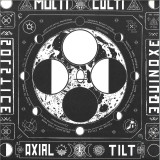
Multi Culti launch a new quarterly 12" series in step with the seasons beginning with SOLSTICE I:
Post-pandemic lockdown inspiration can be found in the great planetary balancing act that has taken place since a cataclysmic impact with an asteroid caused mass extinction and set our earth’s orbit off axis. This AXIAL TILT, or obliquity, is responsible for the seasons, and life as we know it has evolved around these unleashed forces. As our lives and for many, careers, have spun dramatically off axis as of late, we look ahead to the coming seasons, with the hope that we can weather the changes, and maintain inner stability. To aid in this quest, Multi Culti promises to deliver sonic support with utmost regularity at the peak moments of cosmic significance, with each Solstice and Equinox.
Beginning this journey are some of the label’s most beloved artists. Israeli duo RED AXES provide a chakra-elevating soundtrack with their inimitable blend of psych-garage-tronica, a sun-kissed banger that signals a long-awaited return to the togetherness of the dancefloor.
ZILLAS ON ACID turn in a robustly wiggly jam that electrifies, frazzling zaps and frenetic percussion recall the fritzy tension of the past year, a cathartic shock-treatment for traumatized dancers looking to get back to prime spine-shaking shape.
Mexico managed to stay open for the most part, and TYU seems to have not skipped a beat here, still in perfect form after breaking out as one of the hottest young producers to emerge in recent years. Dark disco, Mexi-chug, call it what you want, but the emergent genre is never better represented than here… spooky, phosphorescent tribal dance, Tulumminati-tested and approved.
Finally, the big guy - MANFREDAS - whose remixes and edits have been highlight-reel material the past couple of years, delivers a long awaited original track with his requisite heavy-weight swag. Wonky tunings and a chunky downtempo beat underpin Manny’s trademark masterful arrangement style, building patiently, with breakdowns that managed to wring every last drop of impact out of an odd, other-worldy assortment of sounds.
Seminal early 80's HI-NRG / Synth disco emanating from the gay clubs, bath houses and discotheques of San Francisco. A truly original and groundbreaking sound and style helmed by studio genius Patrick Cowley. Heavily informed by sonically charged science fiction fantasy and the darkest corners of nightlife, 'Mind Warp' is a cornerstone of electronic music that still astonishes today. Originally released on Cowley's own Megatone imprint in 1982 the album marks a definitive change in direction of post-disco dance music, undoubtedly inspired by European artists such as Kraftwerk, Moroder, Yello and more. A huge influence on what was to come through in later years via house and techno music, 'Mind Warp' is a bonafide classic and every single self respecting music lover or DJs home should have a copy!
Celebrate 40 years of the label with this unmissable reissue package beautifully presented on wondrous coloured vinyl by your friends over at Unidisc.
Freestyle Records in association with Rare Sounds USA present a stellar repress of Speedometer's 2003 debut LP This Is Speedometer.
Originally released on Clive Johnson's Blow It Hard (started after the demise of the well-loved weekly Soho club night of the same name, and home to the New Mastersounds first releases alongside choice cuts from JTQ and others) This Is Speedometer showcased the sounds of one of the UK's premier acts in the deep funk scene of the early noughties for the first time on the long player format.
Starting out back in 1999, Speedometer started out as an instrumental quartet gigging in small clubs in the Southeast of England, paying homage to classic funk tunes by artists such as The Meters and The JB's. The band soon expanded and began writing original material, adding the highly regarded horn section and vocalists in 2001, which enabled them to deliver the powerhouse deep funk sound on display here. In addition to their own albums, singles and live shows, Speedometer have backed many US funk & soul legends including Sir Joe Quarterman, Eddie Bo, Marva Whitney, Sharon Jones & Lee Fields and more.
Now coming up on 20 years since it's original release, you can now marvel at Speedometer's classic, original soul-funk sound thanks to a sparkling new cut. Dig in!
d 04: Just Keep On (Doin the Do) feat. The Speedettes
- A1: 20/20 Vsn 00 03:11
- A2: Karþýlýklý (Talk To Me) 00 02:19
- A3: Holy Waters Feat Mulay 00 04:06
- A4: Being Alive Feat Sedric Perry 00 03:17
- A5: Dayrunner Feat Ndo 00 02:14
- A6: Power Feat Young Naughty Soul 00 03:00
- A7: Dream On 00 04:02
- B1: Interlude 00 01:12
- B2: On Me Feat Mike Nasa 00 03:18
- B3: Sex'n'ghetto 00 02:37
- B4: Wholesome Feat Barne 00 03:04
- B5: Resilience 00 04:01
When Berus debuted in January 2021 on Kommerz Records with his “Voyage EP”, he had no idea how precise the title would be for the coming months. A little over a year before the release of “Voyage” the Berlin based multi-instrumentalist and producer had taken his focus away from his, more than a decade lasting, house and techno career towards a new sound, inspired from neo soul and hip-hop. Whilst his electronic projects found home on Kerri Chandler's Madhouse Recordings and DVS1’s infamous Mistress and gained his moniker Frag Maddin worldwide attention, it was part of his progress to focus on himself and Berus, his real name. He took this step not knowing it would lead him into a dark journey of self revelation, identity finding and for the foremost new hope: blue hope.
Berus was born to a Zaza family in Kurdistan, which eventually migrated to Germany escaping prosecution and discrimination of the nationalist regime in Turkey. The family settled in Hamburg and Berus grew up to be a New Release Information
musician. He played the drums, formed teen punk bands and started producing at an early age experimenting and shaping his future as an artist.
Since the beginning of his career Berus releases can be seen like a diary, always expressing his very personal state at the time. For the work on “Blue Hope” two main topics fall into the production of the album: love relationships and seeking identity.
There is a blue melancholy and reflection leading through the album. On “Talk to Me (Karþýlýklý)” Berus opens up about his feelings of true love and the need to set free when they are not answered. Whilst the incredible Mulay who is featured on “Holy Waters” answers with her female perspective. And there is hope. The hope (“Dream On”) and fears (“Being Alive” feat. Sedric Perry) of a young migrant generation. “Blue Hope'' is a coming of age story that’s relatable and yet unique, honest but vulnerable and for the foremost: 100% Berus.
The album is a neatly curated mixtape and delivers a wide range of styles like the jiggy sounding Mike Nasa on “On Me” all the way to “Wholesome” on which Barne delivers a John Mayer-esque performance.
On “Blue Hope” Berus gathered a mixture of old friends and new talent around him to produce the record. The outcome is an LP referencing different influences without the use of any samples.
Black vinyl pressing of the now sold out RSD 2020 reissue.
Cascade was originally released oct 1993 the first single from the now highly regarded LIFEFORMS album. Cascade went on to chart in the UK top 40 at No.27 and has continued to be regarded as an early piece of classic Electronica. Twenty-seven years later FSOL rebuild and create ten new compositions inspired by the original. The familiar electronic swamp of FSOL and engineer Yage can be heard as the tracks journey through fragmented melodies of the original composition.
Nostalgia is a hell of a drug. No one in particular is renowned for that cliched statement, but when something is so universal, who cares who said it? And is there anything more nostalgia inciting than a blurry film, bursting with colours but aged just perfectly so that you know, it's from a past which will never return. Het Jaarronde, a 1977 short film by Dutch amateur filmmaker Jan van Keulen is a picture perfect study of Dutch rural life. Filmed at an observer's distance it, as the title states, follows the Netherland's throughout the year. It's not bombastic and grand like 1967's John Fernhout film, Sky Over Holland. Instead it's modest, even shy, as if afraid to document too much because to document means to acknowledge change and loss.
For the second time, Nous'klaer and The Netherlands Institute for Sound and Vision's RE:VIVE initiative have teamed up for a split 12" featuring two new film scores of Nous'klaer staple, Mattheis and newcomer Ranie Ribeiro. Each artist was given half the film to compose for, resulting in two sonically disparate pieces that are emotionally twinned. Mattheis offers a lush, heart melting wave of pianos and synths and field recordings to appease his own inner-nostalgia, as the images struck an immediate chord with his childhood and youth in Goeree Overflakkee, South-Holland.
Ranie Ribeiro, known under his solo moniker for his slamming chopped beats and earlier club oriented releases as D-Ribeiro unveils his talents as a harpist for the first time. His work, is an encapsulation of a calm autumn day. A work in the present rather than a reflection on the past. But as the day fades into night, one can't wish for it to stay, just a little bit longer, because who knows what tomorrow is going to bring?
- A1: ) Fiend Discovered And Titles
- A2: ) Peter And Rosalind In Attic
- A3: ) Rosalind's Madness
- A4: ) Angel's Claw
- A5: ) Claw In Classroom
- A6: ) Judge By Fireside
- A7: ) Peter Fights Devil, Severs Hand
- A8: ) Judge Drives Off
- A9: ) Mark Alone
- A10: ) Death Of Marc
- A11: ) Angel Naked
- A12: ) Angel's First Curse
- A13: ) Angel's Second Curse
- B1: Return From The Graveyard
- B2: Return From The Graveyard
- B3: Kathy Crowned
- B4: Children Into Church
- B5: Kathy's Ceremony
- B6: Kathy's Rape And Death
- B7: Peter's Ride
- B8: Ralph Chops Tree
- B9: Ralph Saves Margaret
- B10: Margaret Escapes
- B11: Ralph's Wound
- B12: Ralph Bewitched
- B13: Finale And Credits - Total Running Time: 48:B8
Blood On Satan’s Claw – AKA Satan’s Skin in the USA, is a cult British horror movie from 1971. It’s a film from the golden age of British horror, and one that ticks most of the horror connoisseur’s boxes - it stars the Devil, Olde England, it has nudity, strange ritualism, a fair smattering of blood and of course, sublime music. Produced by cult masters Tigon, this film was the perfect companion piece to their earlier Witchfinder General (1968). Set in rural 17th century England, it tells the fine story of a small village that quickly falls under the devil’s spell. It’s brilliantly told and quite beautifully shot with a very fine cast of superb character actors.
Over many years the film has slowly gained a cultish reputation, and there are rumours that good old Tim Burton is a very big fan and used the movie as an influence for his “Sleepy Hollow” production.
The score was never released. Written by Marc Wilkinson, former director of music for the National Theatre, this cult soundtrack takes its lead from “The Devil’s Interval”, but more about that in the next paragraph. Musical appearances from the Ondes Martenot (the earliest electronic instrument) and Cimbalom add to the overall spookiness of this recording. And in 38 years the music has lost none of its depth or addictive, evil hooks. The first pressing sold out many years ago and commands high prices. A repress has been requested for many years.
Here’s Marc Wilkinson’s thoughts…
“The descending chromatic scale which features throughout the music omits the perfect fifth (the only true consonant in the chromatic scale) and therefore highlights the diminished fifth, which ever since the middle ages in Europe has been known as the Devil's Interval!!”
BRIEF ARTIST INFO: Marc Wilkinson was musical director of the National Theatre throughout the 1960s. He scored a number of films in the late 1960s and 1970s including “If” for Lindsay Anderson. Wilkinson currently lives in France.