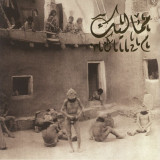
Pachakuti is a musician and producer with family roots in Colombia. He plays keys, tenor saxophone and clarinet. While living and working in Berlin, he draws inspiration from the natural world, investigative travels, and ancestral traditions of Latin America and beyond. His expressive and rhythmical playing and his instantaneous compositions are directed at the human core, arousing subtle experiences. While not being conformed to one style, it always invokes a sense of liveliness and depth to be delved in. young.vishnu is a producer and DJ. He has studied philosophy and music in Hildesheim, Germany, which heavily influenced his views on meaning and mythology in music. In his DJ sets he selects and plays classic and contemporary Funk, Soul and Afrobeat. His practice as a DJ informs his work behind the boards directly, adding also more organic grooves and broader spectrum of musical styles to his in Hip-Hop based production. If you had to put one single tag on their forthcoming album Dédalo, the best choice would be Jazz. That being said, Pachakuti and young.vishnu's sound worlds might be better described in their own words: "We just make music and try to incorporate what we love about it". They are musical freethinkers with shared interests in eastern philosophy and botany who interweave Hip-Hop, Latin and Funk with musical storytelling and world mythology. Undoubtedly, their most ambitious work to date, Dédalo (Spanish synonym for labyrinth), recorded and produced over the course of a year, shows Pachakuti & young.vishnu's ambitions and growth. Where their debut work Semilla (2020) centered around the image of the seed, Dédalo takes on the entire garden. Besides playing multiple instruments by themselves, Pachakuti & young.vishnu invited a growing group of befriended musicians into the studio, including percussionist maestro Eric Owusu (Pat Thomas, Ebo Taylor, Jembaa Groove) and drummer Leon Raum (Bokoya, Wyl), as well as Brazilian newcomer vocalist Laíz, and members of their former band project Soularkestra. The 16 recorded songs, ranging from 1:19 to 14:58 minutes, take you on an emotionally honest, metaphoric journey through the maze of human existence, of modern society and mythic poetry. The mostly instrumental tracks build on expressive melodies, layered rhythms, and a wide range of musical instruments, merging the sounds of Jazz with the classical word of orchestras and choirs, and urban soundscapes with traditional instruments such as the Andean Kena and Charango, the Colombian Gaita and Marimba de Chonta, and an Indian harmonium. The Album thus weaves together past and future, and diverse cultural threads, sounds and ideas in an act of cultural appreciation and global conscience. Mixed and mastered by Roe Beardie at The Brewery Studios, Berlin. The album artwork itself merges the visionary art of Mexican painter Sergio Chávez Hollar with an original artwork-inlay of Brazilian artist Laíz and the work of Carsten Pölking of the Nima Compositions Archive.
Dédalo will be available digitally and on double-vinyl with inside-out print cover and colored inlay with credits and painting by Laís De Mello Barbero.
Cerca:east 4
Black vinyl edition. Available for the first time ever on vinyl, cassette tape and digital, the reissue features fully remastered tracks and new artwork along with a 12“ size insert, 2x12“ size poster, sticker and DL-Card. Vocalist Chaka Malik and guitarist Chris Traynor met in the New York hardcore band Burn and began playing together as early as 1992. With an early version of Orange 9mm, the duo released a live EP in 1993. The recording earned the band a contract with East West, and after picking up bassist David Gentile and drummer Matthew Cross, Orange 9mm began recording. Driver Not Included was released in 1994, and the band spent time touring with Helmet before signing with Atlantic the following year. Gentile left later in 1995 and was replaced by Taylor McLam just after recording ended for Tragic, with production by Barkmarket's David Sardy. Tragic was released in 1996; it would be three years before Orange 9mm issued a follow-up, which bore the title of Pretend I'm Human.
Idrissa Soumaoro, L’Eclipse De L’I.J.A.’s sought-after album ‘Le Tioko-Tioko’ was originally released in the German Democratic Republic (GDR) in 1978 and has been a long-time favourite at Mr Bongo. Two tracks from the album were featured on our 2017 compilation ‘The Original Sound Of Mali’ (MRBLP135), and we subsequently released the track ‘Nissodia’ on its own 12” (MRB12053) in 2020, complete with a blistering dancefloor re-edit by Mike D of The Beastie Boys.
‘Le Tioko-Tioko' is one of the rarest vinyl albums from the already scarce Malian vinyl discography, partly as the album was never released commercially, only independently distributed via the Malian Association for the Blind in Bamako. Though recorded at Radio Mali under the aegis of master engineer Boubacar Traoré; the album was originally released in East Germany. The tapes had been taken by some Malian students to East Berlin as part of a student exchange program. It was then manufactured and released on the East German state-owned label Eterna with only a few boxes of records being shipped back to Bamako.
A true masterpiece, this legendary LP offers some devastating songs such as ‘Djama’ (society), ‘Nissodia’ (joy of optimism), and ‘Fama Allah’ (an ode to god). Hypnotic organ riffs and breakbeats convey an unknown funk quality in Malian music, it now stands as a loving tribute to an unsung Malian golden age. Sadly, like many of the other now desired and prized vinyl rarities, at the time of release, it almost immediately disappeared without a trace due to a lack of promotion, and distribution. So, it feels fitting to share this gem of a record again, and hopefully it will reach the wider audience it deserved over 45 years ago.
Many thanks to Florent Mazzoleni for contributing sections of these notes.
- 1: March Of The S.o.d
- 2: Sargent "D" & The S.o.d
- 3: Kill Yourself
- 4: Milano Mosh
- 5: Speak English Or Die
- 6: United Forces
- 7: Chromatic Death
- 8: Pi Alpha Nu
- 9: Anti- Procrastination Song
- 10: What's That Noise
- 11: Freddy Krueger
- 12: Milk
- 13: Premenstrual Princess Blues
- 14: Pussy Whipped
- 15: Fist Banging Mania
- 16: No Turning Back
- 17: Douche Crew
- 18: Fuck The Middle East
- 19: Hey Gordy!
- 20: The Ballad Of Jimi Hendrix
- 21: Diamonds And Rust (Extended Version)
- 22: Identity
- 23: Go
- 24: March Of The Sod (Live)
- 27: Speak English Or Die
- 28: Fuck The Middle East
- 29: Douche Crew
- 30: Not
- 31: Momo
- 32: Taint
- 33: The Camel Boy/ Diamonds & Rust
- 34: Anti-Procrastination Song (Live)
- 35: Milk (Live)
- 36: United Forces (Live)
- 37: United Forces Ii (Live)
- 38: Ram It Up (Live)
- 39: Ram It Up" ((Bonus Studio Track)
- 25: Kill Yourself (Live)
- 26: Milano Mosh (Live)
Long overdue pressing of cult band’s most sought after release. Engineered and remastered by Jack Shirly (Deafheaven, Bosse-de-Nage, Oathbreaker). For fans of Have a Nice Life, Xasthur, and Planning For Burial. Entirely remastered and includes a never before heard bonus track!! Mamaleek’s Kurdaitcha is finally back in print! The San Francisco-based duo released their third album of weirdo black metal, Kurdaitcha, on the legendary cult label Enemies List Home Recordings (Have a Nice Life, Giles Corey), and it quickly sold out. For years the LP has been a hard to find collector’s item. Kurdaitcha finds the project in its initial period of creating music influenced by black metal, hip hop, jazz, and spirituals. Founded in 2008 in the Bay Area by two anonymous brothers, Mamaleek has explored a vast sonic territory on the edge of a genre renown for its aversion to change. Their expert utilization of left-field samples and unconventional instrumentation, and their insistent drive to experiment continues to set the band apart from their peers. This pressing of Kurdaitcha has been remastered and features a previously unreleased bonus track with a gold foil stamped jacket. “Mamaleek are the great destroyers.” — Invisible Oranges // “An incredibly rich and rewarding experience.” —Heavy Blog Is Heavy // “Is it good, though? It’s fucking mental. It’s amazing. It’s absolutely horrible. It’s barely listenable at times and yet you can’t turn it off. The music is perfect. Like broken glass is perfect.” —Echoes And Dust // “The group cloaks its music in the kind of warm, hypnotic distortion that defines shoegaze, and underneath that haze is a style that’s conceptually abrasive yet altogether beautiful.” — FORBES
- 1: Glasgow Moths
- 2: Everyone Hates The Balloon Guy
- 3: Mortality Maths
- 4: I Didn't Choose The Thug Life Yet I'm Continually Subjected To Its Whims
- 5: I Can't Smell Flowers And Just Assumed Everybody Was Lying About It
- 6: Normalise This Very Niche Confession
- 7: I Fell In Love With An Abandoned Crisp Packet
- 8: When The Bomb Drops I Will F**King Run Into It
- 9: I Don't Want To Hold Your Hand
- 10: Do People In America Wear Easterhouse T- Shirts?
- 11: Puddles
- 12: Why Don't You Deepfake Your Apology?
- 13: Polite Nu Metal
- 14: The Phil Collins Cinematic Universe
- 15: It Doesn't Matter What You Say To Me (Because I Don't Exist At All)
Ex-We Are The Physics and current Slime City vocalist Michael M returns with a brand new album of irreverent lo-fi garage punk bangers
Short, fast, pointed anecdotes crammed into just over 30 minutes (so it's eligible for a Scottish Album of the Year Award) for fans of Weezer, Art Brut, Mike Krol, Half Man Half Biscuit, Mclusky, Jay Reatard. Includes download code and videos for each song.A scathing but reflective attack on the internet's Balloon Guy? 10003;The existential crisis of finding out how old the boy from the Sixth Sense is? A Shangri-Las inspired tragedy-pop song about an old crisp packet?Nu Metal, but polite?
Pressed on a totally randomly assigned Eco Colour Vinyl!
- A1: Weakness Within
- A2: Desolation Of My Mind
- A3: Mentally Numb
- A4: Death Throes
- A5: Sigh
- A6: Mentally Numb
- A7: Desolation Of My Mind
- B1: The Knell
- B2: Desolation
- B3: Taste Defeat
- B4: The Zombie Terror
- C1: Suicidogenic
- C2: Schizo
- C3: Carnage
- C4: The Seven Gates Of Hell
- C5: Black Metal
- C6: The Shadowking
- D1: Black Metal
- D2: The Seven Gates Of Hell
- D3: Schizo
- D4: Welcome To Hell
- D5: Poison
- D6: Witching Hour
EXTENSIVE COLLECTION OF SIGH'S EARLY DEMOS, EP's & RARITIES,
PRESENTED ON DOUBLE CD FORMAT - INCLUDES INTERVIEW & LINER
NOTES COURTESY OF MAINMAN MIRAI KAWASHIMA ON THE
FORMATIVE YEARS OF THE JAPANESE LEGENDS.Cult Japanese black
metal legends Sigh formed in 1989/90, featuring mainman Mirai
Kawashima, Satoshi Fujinami & Kazuki Ozeki
Following initial demos, Shinichi Ishikawa was brought into the band, & Kazuki
removed from the line- up. It was following this shift that the band set about
recording the masterpiece debut 'Scorn Defeat' for Euronymous' Deathlike Silence
Productions, going on to become one of the country's greatest & most revered
metal exports. With a journey through the strange & the psychedelic,
incorporating a whole eclectic mix of genre styles & experimentation throughout
their career, Sigh has remained a vital creative force in the avantgarde field.
However, at its core, Sigh has always remained true to its roots of old school
metal. 'Eastern Darkness' contains a comprehensive collection of Sigh's early rare
works showing their swift musical evolution as well as the strong utilisation of
keyboards in their compositional process throughout. The collection includes the
band's legendary demo tapes, 'Desolation', & 'Tragedies', plus their EP's & rarities,
as well as contributions to various compilation releases in the mid 1990's.
Considering Sigh's well- known regard for UK legends Venom throughout their
career, 'Eastern Darkness' also contains the band's own tribute to the 1980's black
metal pioneers, in the form of tribute 'To Hell & Back', originally released on tape
in 1995.
This edition of 'Eastern Darkness' is presented on double disc CD format &
includes a 12- page booklet featuring an interview with Mirai Kawashima about
the early years of the band, along with his recollections of the origins of each title
contained within the release, three decades on from Sigh's formation.
'Dirty Camaro' was written and recorded in collaboration with several of
Williams' musical compatriots, in cluding John Paul White, Ashley
Monroe, Robert Ellis, Anderson East, Thad Cockrell, and more
Williams' voice is one to be reckoned with, and the album spins powerful stories
of heartbreak and longing, tenderness and love for family, and overcoming
obstacles when everything seems like it's going wrong
First solo project of front man from the folk-rock group "The Lone Bellow"
Until recently, it was thought that we had heard all there was to hear from Saâda Bonaire. The German studio project's 1980s recordings had been compiled on the now cult-classic double LP Saâda Bonaire, released by Captured Tracks in 2013. Though the group had continued working until 1994, founder Ralph "von" Richtoven had firmly stated that all of their post-1986 work was lost. Released now for the first time ever, 1992 compiles the band's long-lost early nineties material. Produced between Bremen and New York City, the 12 songs presented here capture the group's attempts at steering their trademark fusion sound (reggae, afro-funk, Eastern music, and sultry German female vocals) into uncharted nu jazz, trip-hop, and house territories. It's no surprise, given both the time lapse and the fluid nature of the project, that these recordings differ sonically from the 1980s material. 1992 finds Saâda Bonaire folding new influences from the time (house, hip-hop, rap) into their eclectic sonic universe. Vocalist Andrea Ebert's soulful voice -the result of a church choir background and an early love of American soul and jazz music- offset Stephanie Lange's laid-back, more German-sounding vocals. This unique interplay bolstered the band's new direction - evident in their inspired takes on James Brown's "Woman" and Syreeta Wright and Stevie Wonder's "To Know You Is To Love You". The American influence was also made literal via contributions by renowned DJ Matthias Heillbronn and rapper Jimmy Lee Patterson, both of whom lent some stardust to the tracks at François Kevorkian's Axis Studios in NYC. Unfortunately, the demo recordings were considered too bizarre for 1990s record label standards, and as a result were never published. As with all things Saâda Bonaire, the discovery of these discarded recordings feels like a sort of magical impossibility. It's been nearly ten years since the release of the last compilation, and thirty since the recordings were originally captured. That they still manage to sound fresh and avant garde is a testament to Saâda Bonaire's flair for creating pop music for past, present, and future outsiders.
- A1: Innersoul •
- A2: Interlude 1 •
- A3: Psyche Move
- A4: I Come Real With This (Feat. Kankick)
- A5: Interlude 2 •
- A6: Situation
- B1: Get Whack (Feat. Declaime)
- B2: Antidote To Da Antidope (Feat. God's Gift) •
- B3: Interlude 3
- B4: Attack Of The Tupperware Puppets (Feat. Declaime, God's Gift, & Oh No)
- B5: Interlude 4 •
- B6: Forever Beef (Feat. Medaphoar & Oh No)
- C1: What 'Cha Gotta Say? (Feat. Oh No) •
- C2: Interlude 5
- C3: Miss Deja Vu •
- C4: I Declare War (Feat. Medaphoar & Oh No)
- C5: Why Do We Go Out Like That? (Feat. Declaime)
- D1: Make Your Ears Want To Bleed (F. Kazi)
- D2: Interlude 6 • D3. Female Request Line
- D4: Undisciplined (Feat. God's Gift) •
- D5: Hip Hop
Before Madvillain, before Yesterday’s New Quintet and before Quasimoto or any other of his several alter egos, Madlib perfected his craft as an MC/producer in the Lootpack. Along with DJ Romes, and fellow rhymer Wildchild, they released the dusty full-length, Soundpieces: Da Antidote back in 1999, that laid down the foundation for the unique and dusty sound now associated with Madlib. The loose, freeform recordings on this collection are circa 1996 when the group was managed by Madlib’s father, and they show the now-renowned maverick producer in comparatively restrained form. Madlib’s scope and imagination was clearly fixated on East coast jazzy hip-hop production from the early ’90s, laying down soundscapes for his hungry crew including the likes of Kazi, Declaime and Medaphoar, who have all become well known underground rap vets. Madlib’s own strong mic presence is noticeable given his now only-on-rare-occasion rhyming, but it’s his production that is the most fascinating element here. While a resolutely hip-hop project, the burgeoning jazzy flourishes and Madlib’s heavily accomplished ear for sound makes the record an important starting point for adherents of his more recent exploratory work.
- 01: Tony Hall&Apos;S &Quot;Hallstars&Quot; - Hi-Ya Mr. Jackson
- 02: Wilton Gaynair - Wilton&Apos;S Mood
- 03: Ronnie Scott &Amp; Dizzy Reece Quartet - Out Of Nowhere (You Came Along From)
- 04: Don Rendell - You Stepped Out Of A Dream
- 05: Tony Kinsey Trio &Amp; Joe Harriott - It Don&Apos;T Mean A Thing If It Ain&Apos;T Got That Swing
- 06: Eddie Thompson - Nelson&Apos;S Column
- 07: Ginger Mofolunsho Johnson &Amp; His Afro-Cuban Band - Egyptian Bint Al Cha Cha
- 08: Johnny Dankworth - Treasure Drive
- 09: The Joe Harriott Quintet - Spiritual Blues
- 10: The Jazz Five, Vic Ash &Amp; Harry Klein - Hootin&Apos;
- 11: Shake Keane Quintet - Morning Blue
- 12: Dizzy Reece - I Had The Craziest Dream
A survey of the modern jazz & hard-bop scenes that emerged in the new cultural melting pot of post war London, with recordings from the end of the 1940s through to the early 1960s.
Featuring representations from players whose roots lay in the East-End's jewish community, such as Ronnie Scott, Vic Ash & Harry Klein, alongside a wealth of talent of Caribbean and African descent playing and recording in post war London during this period, incl. Dizzy Reece, Wilton Gaynair, Joe Harriott, Shake Keane & Ginger Johnson.
Made in partnership with the Barbican to coincide with the exhibition Postwar Modern: New Art in Britain 1945-1965.
, Ivor Novello award-winning band The Feeling have announced a new chapter in their career with their sixth studio album, Loss. Hope. Love - out May 6th on Island Records - back where it all started in 2006 for their Top 3 debut album Twelve Stops and Home. Self-produced, predominantly at their East London studio during lockdown, Loss. Hope. Love is the sound of a band who have reconsidered their identity, taken control of their sound and embraced the Queen-esque theatrical elements of their DNA, recently realised by the success of Everybody’s Talking About Jamie. The Feeling return a whole new perspective. 15 years since their multi-million selling debut record Twelve Stops and Home - the new album is bursting with joy, but with the thread of melancholy that’s always been synonymous with their flawless songwriting.
Two hip-hop legends that are both part of historic groups themselves, are
forming a new group - Havoc, from the Queensbridge bred Mobb Deep
(rest in power Prodigy) and Styles P of The Lox, straight out of Yonkers,
are forming Wreckage Manner
Both Havoc and Styles P have collaborated with a number of artists in recent
years. Havoc released joint albums with Alchemist, Flee Lord and Dark Lo. His
last solo album was in 2014, the same year as the last Mobb Deep album. Styles
has teamed up to release projects with Talib Kweli, Berner and Dave East in
recent years. In addition to new music from The Lox, Styles P has released at
least one new album every year since 2018.
On the album, Styles P raps over Havoc's gritty, piano- laced production. Havoc
also gets busy on the mic and lets his opponents know that for all his success,
he's still the same kid from 41st Side.
Ferocious JP / US free jazz bomb. A rare meeting between the NYC free jazz scene and the Japanese free music scene. Old-style Gatefold LP, with rare photographs & liner notes by Alan Cummings.
Following hot on the heels of the first, mid-sixties generation of Japanese free jazz players like Kaoru Abe, Masayuki Takayanagi, Yōsuke Yamashita, Motoharu Yoshizawa, etc., an exciting second wave of younger players began to emerge in the seventies. Two of its leading members were the saxophonist Kazutoki Umezu and multi-instrumentalist Yoriyuki Harada. Both were post-war babies and immigrants to the city, Umezu from Sendai in the north and Harada from Shimane in the west. They first met as students in the clarinet department at the Kunitachi College of Music, a well-known conservatory in western Tokyo. Harada was already securing sideman gigs on bass with professional jazz groups and was active in student politics, making good use of his connections to set up jazz concerts on campus. It was around this time that the two began to play together in an improvised duo, with Umezu on clarinet and bass clarinet and Harada on piano. They also experimented with graphic scores and prepared piano.
These experiments eventually led to the creation of a trio, with a high-school student called Tetsuya Morimura on drums, that they decided to name Seikatsu Kōjyō Iinkai (Lifestyle Improvement Committee) in joking reference to the Marxist discourse of the student radicals of the time. Around 1973, Umezu and Harada decided to call it a day and go their separate ways. Umezu began playing with the Toshinori Kondo Unit and Harada with the Tadashi Yoshida Quintet. In 1974 Harada formed his own trio and began to play at jazz coffeehouses across Japan.
Then, in September 1974 Umezu travelled alone to New York, where he set about building connections with the loft jazz scene in the city. It was a fortuitous moment to arrive in New York. Rents were cheap in the Lower East Side, possibilities for squatting existed, so many musicians and artists had moved to the area. Umezu soon became known on the scene as Kappo and he started to make connections with some of the young musicians like David Murray, Arthur Blythe, and Oliver Lake. He recalls making the rounds of the lofts every evening, checking out the performances, and getting the chance to sit in with many groups including Juma Sultan’s Aboriginal Music Society and trumpeter Ted Daniel’s orchestra.
Things were going so well that Umezu wrote to Harada and invited him to come to New York. He accepted and arrived in the city in July 1975. Harada and Umezu took the opportunity to resume their artistic collaboration. Their first concert together in over two years took place on July 20th at another loft, Sunrise Studios at 122 2nd Avenue. Umezu remembers Sunrise as an unusually sunny loft with the rarest of things, a grand piano. He invited along Ahmed Abdullah, a trumpeter he had got to know while playing with Ted Daniel. Abdullah led his own group and was a long-term Sun Ra sideman. William Parker, one of the key figures in the loft jazz scene of the period, was on bass. Abdullah also brought along Rashid Sinan on drums. Sinan drummed in Abdullah’s units throughout the seventies, but he had also played on Frank Lowe’s immortal Black Beings album and collaborated with Arthur Doyle, playing on Doyle’s Alabama Feeling album. By all accounts the evening was a huge success, with speed and dynamism of Harada’s piano playing gaining him lots of support.
Since they had managed to save some money from their day jobs, Umezu and Harada decided to set up a recording session with the same line-up on August 11 at Studio We, where there was a well-equipped studio on the third floor. Umezu recalls the session as follows, Of course, we recorded our performances in one take, with zero retakes as far as I remember. On all the tracks we recorded, we moved as one unit, sharp and fast. That was the nature of Lifestyle Improvement Committee, New York Branch.
Umezu and Harada would later become known for the elements of parody and entertainment that they brought to their music, a freewheeling blend of pastiche, humour and on-stage performativity that paralleled the approaches of the Art Ensemble, Sun Ra, and Holland’s ICP. But here, on their first recordings, the humour element is not yet present. Instead, there is a febrile sense of joy in creation and connection. On the Umezu-penned “Kim”, for example, Harada opens the piece with a speedy exploration of the full-range of the keyboard, hitting hard on the bass keys to create a rhythmic bed out of which patterns begin to emerge. Umezu enters at a much slower pace, longer held notes that at first float weightlessly over the urgency of the piano before they begin in splinter and accelerate. When Parker and Sinan kick in, it’s a rollicking tempo with Parker plucking deep and hard and the left-handed Sinan skittering hard across the topside of his kit. Abdullah kicks in a glorious solo twelve minutes in, bright and breathy at once. The piece slows and grows more spacious towards the end, giving Parker a chance to showcase some arco work that shades beautifully into the air against Abdullah’s trumpet.
Wu-Tang Clan founder and producer RZA releases a 12" vinyl single
featuring a collaboration with Flatbush Zombies.Robert Fitzgerald Diggs,
better known by his stage name RZA, is an American rapper, actor,
filmmaker and record producer
He is the de facto leader of the hip- hop group Wu- Tang Clan, having produced
most albums for the group and its respective members. He is a cousin of two
other original Wu- Tang Clan members: GZA and Ol' Dirty Bastard. He has also
released solo albums under the alter ego Bobby Digital, along with executive
producing credits for side projects. After forming the Wu-Tang Clan, RZA was a
founding member of the horrorcore group Gravediggaz, where he went by the
name The RZArector.
Flatbush Zombies are an American hip- hop group from the Flatbush section of
Brooklyn, New York City, formed in 2010. The group is composed of rappers
Meechy Darko, Zombie Juice and Erick Arc Elliott, with Elliott also serving as their
regular record producer. The trio are part of the East Coast hip hop supergroup
Beast Coast, with fellow Brooklyn-based rap groups the Underachievers and Pro
Era.
Spun Out Agency is honoured to present ‘More of that Frightful Oompty Boompty Music’, a compilation dedicated to the Guv’nor himself Mr Andrew Weatherall who should need no introduction on these pages. Released on vinyl in two beautiful parts, the first drops on April 15th with the second following two weeks after.
‘More of that Frightful Oompty Boompty Music’ (yes we are going to write that out every time we talk about it in this communique) showcases a selection of the shining greatness from the agency’s roster. Paranoid London, Fantastic Twins, Mehmet Aslan, Autarkic, Ruf Dug, Sean Johnston, and Manfredas gift exclusive tracks which highlight the sublime acid, techno and house sound that Weatherall would have described as “oopmty-boompty” music.
Spun Out is a London-based artist booking agency which has been run by Caroline Hayes for over 20 splendid years, that looked after the life and times of Andrew Weatherall alongside his partnership with Sean Johnston under their A Love From Outer Space moniker, and the likes of Optimo (Espacio), Ivan Smagghe, Josh Caffe, Man Power, Body Hammer, Kiara Scuro and many more artists, doing it differently.
Kicking off the A-side of the first record is Hardway Bros’ (aka Sean Johnston) previously unreleased remix of We Are The Axis by The Asphodells, the duo consisting of the Andrew Weatherall and former Battant member and Spun Out talent Timothy J. Fairplay. An energetic techno stomper with percussive rhythms, this exclusive remix offers the ideal tantalising dose to tease any dancefloor. The vocals and synth layers give it a punk rock approach, referencing the multi-genre essence of Weatherall’s taste in music.
Tel-Aviv-based Autarkic’s Sleepover closes the A-side with a chuggy lullaby, one that is certainly unsuitable for putting a baby to bed, given its intricate acid lines of total hypnosis. Following on the B-side is Manctalo Banger, a house bop by the Manchester-via-Ibiza computer game nerd and vinyl digger Ruf Dug, and Shizowaves, Turkish-born Basel-based Mehmet Aslan’s soulful touch to the compilation, bringing Middle-Eastern percussive melodies and catchy basslines.
The second record is introduced by Paranoid London, with a Spun Out dedicated acid techno banger appropriately titled Spinning Out and Fantastic Twins’ EBM track Kali’s Tongue Was A Weapon. On the B-side is Lithuanian chug legend Manfredas’ Hfuhruhurr, and Naum Gabo, who closes the compilation with the chaotic analogue-synth frenzy, Cold Sold. The name Naum Gabo may evoke the pioneer of Russian constructivism, who rose to fame thanks to his crazy kinetic sculptures. However, here it manifests as one half of Spun Out’s Optimo duo Jonnie Wilkes (JG Wikes) and James Savage. The duo’s impeccable manipulation of electronic hardware couldn’t give a better homage to him.
Some highlights for Spun Out artists this summer include 9 acts from the roster playing at Houghton Festival, Paranoid London’s show at Sonar Festival, Love International Festival and Ransom Note’s festival with Optimo Watching Trees.
- A1: 72 Bar Assassin (Feat The Game - Intro)
- A2: Extravagant Lifestyle (Feat Raekwon, Sheek Louch, Ghostface Killah & Tragedy Khadafi)
- A3: Harlem Block Money (Feat Dave East, Vado, Jim Jones, Shoota 93 & Talkit Trigga)
- A4: Wtf You Thought (Feat Az, Saigon, Papoose, Dj Paul, Merkules, Jon Connor & Tony Yayo)
- B1: The Struggle (Feat Sheek Louch, Styles P, 88 Lo & Meet Sims)
- B2: Don't Judge Me (Feat Emc Scotty, Inkedup Baddie & Sabrina Foxx)
- B3: Wild Child (Feat Styles P, Mc Gruff, Jadakiss, Sheek Louch, Black Rob & Razah - Bonus Track)
- C1: Rolling 110 Deep (Part 1)
- D1: Rolling 110 Deep (Part 2)
Building on his already impressive resume, DJ Kay Slay returns to set the streets ablaze with his latest offering, Accolades. Featuring the next installment in the highly-acclaimed posse cut series, Rolling Deep, DJ Kay Slay blesses listeners with the ultimate version, Rolling 110 Deep, containing over 40 minutes of pure bars from some of hip-hop royalty, including Sheek Louch, Styles P, Dave East, Crooked I, Black Thought, Raekwon, Ghostface Killah and many more. Other standouts include 72 Bar Assasin (feat. The Game), Extravagant Lifestyle (feat. Raekwon, Sheek Louch, Ghostface Killag & Tragedy Khadafi), & Harlem Block Money (feat. Dave East, Vado, Jim Jones, Shoota 93 & Talkit Trigga)
"Off-kilter melodies, dense instrumentation and lyrical explorations of the darkest side of the human condition" -- The Guardian
With B FLAT A this much acclaimed quartet from Gdansk, Poland have
produced their most epic and visceral statement to date.
A universe where echoes of Can, Syd Barrett and Fugazi lovingly collide. Cryptic and possessing of a great moral force, Trupa Trupa is a band for these times, whether we are ready for them or not.
The frst single "Twitch" is already out and is receiving strong airplay from BBC6 Music. Clash magazine wrote "Polish art-rock group Trupa Trupa return with the storming 'Twitch.' The band's imposing physicality is matched to some truly ground-breaking artistry - imagine a kind of Eastern European answer to Swans and you'd be close. With their intense live shows and crunching studio output,
Trupa Trupa have built an imposing catalogue, one with an international reach."
UK GIGS
19.02.2022 – UK – London – Lexington
21.02.2022 – UK – Brighton – Green Door Store
- A1: Three King Fishers
- A2: Love Is Blue
- A3: Theme From Valley Of The Dolls
- A4: Bacchanal
- A5: Sunshine Superman
- B1: Some Velvet Morning
- B2: The Look Of Love
- B3: Divided City
- B4: Theme From Valley Of The Dolls (Single Version)
- B5: Sunshine Superman (Single Version)
- B6: The Look Of Love (Single Version)
- B7: Bacchanal (Single Version)
The long-awaited reissue of this rare Eastern and psychedelic Jazz LP by the famous Hungarian guitarist, originally
released in 1968. For the first time and as extended Edition with four bonus tracks: radio version from 1968/69 7”
singles 7”. Deluxe 6-sided Digipak CD with 20 page booklet and Gatefold Vinyl comes with long, exclusively written
inner notes by the famous researcher and biographer Douglas Payne.
“The performances on this LP have a restrained, introspective quality. Szabo’s work is lyrical, rather economical, and
somewhat angular, and his tone is warm and glowing.” – Harvey Pekar, DownBeat
“Gabor Szabo is at the musical zenith of his career. This album could rank as his best to date.” - Billboard
“But for sheer lyrical beauty, few players are in Szabo’s class. His startling use of dissonance is a delight, too, and
time and again he will alter a final phrase just slightly, totally reorienting a familiar tune.” – Alan Heineman, DownBeat
“This is definitely one of my ‘go to’ Gabor albums.” Mike Stax, Ugly Things
"Gabor Szabo’s Bacchanal documents one of the earliest and finest examples of what was then known as “jazz rock.”
Years before this new jazz style evolved – or devolved, according to some – into “fusion,” jazz rock was mostly
fashioned by younger jazz players whose ears were open to the emerging sounds coming out of rock and roll,
especially those of the Beatles and, later, Jimi Hendrix. " - Douglas Payne
After recording four albums for Impulse in 1967, the distinctive guitarist Gabor Szabo cut three strongest records for
the Skye label in 1968-1969: "1969", "Dreams" and "Bacchanal" all of them became a legendary classic. This time
EBALUNGA!!! are rediscovers "Bacchanal". Szabo's regular group of the era is heard on record for the last time:
guitarist Jimmy Stewart, bassist Louis Kabok, drummer Jim Keltner and percussionist Hal Gordon. With the exception
of two Szabo originals, the material is comprised of current pop tunes including two songs by Donovan, "Love Is Blue,"
"The Look of Love" and "Theme from the Valley of the Dolls."
Gabor Szabo was one of the most original guitarists to emerge in the 1960s, mixing his Hungarian folk music heritage
with a deep love of jazz and creating a distinctive, largely self-taught sound.
Born in Budapest, on March 8, 1936, Szabo was inspired by a Roy Rogers cowboy movie to begin playing guitar when
he was 14 and often played in dinner clubs and covert jam sessions while still living in his hometown. He escaped
from his country at age 20 on the eve of the Communist uprising and eventually made his way to America, settling
with his family in California.
He attended Berklee College (1958-1960) and in 1961 joined Chico Hamilton's innovative quintet featuring Charles
Lloyd. Urged by Hamilton, Szabo crafted a most distinctive sound; as agile on intricate, nearly-free runs as he was
able to sound inspired during melodic passages. Szabo left the Hamilton group in 1965 to leave his mark on the popjazz of the Gary McFarland quintet and the energy music of Charles Lloyd's fiery and underrated quartet featuring Ron
Carter and Tony Williams.Szabo initiated a solo career in 1966, recording the exceptional album, Spellbinder, which yielded many inspired
moments and "Gypsy Queen," the song Santana turned into a huge hit in 1970. Szabo formed an innovative quintet
(1967-1969) featuring the brilliant, classically trained guitarist Jimmy Stewart and recorded many notable albums
during the late '60s. The emergence of rock music (especially George Harrison, Eric Clapton, and Jimi Hendrix) found
Szabo experimenting with feedback and more commercially oriented forms of jazz.
During the '70s, Szabo regularly performed along the West Coast, hypnotizing audiences with his enchanting,
spellbinding style. From 1970, he locked into a commercial groove, even though records like Mizrab occasionally
revealed his seamless jazz, pop, Gypsy, Indian, and Asian fusions. Szabo had revisited his homeland several times
during the '70s, finding opportunities to perform brilliantly with native talents. He was hospitalized during his final visit
and died in 1982, just short of his 46th birthday.