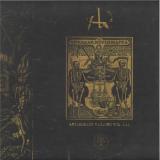
For this Voices edition we unite producers across the techno panorama with different backgrounds in producing and playing music.
The theme of this series is to find your voice, to express your voice as well as listening to others.
Menous opening track "Meguri" carries an atmospheric, floating feeling, followed by an joyful and playful approach by Mary Yuzovskaya with "Late AM". Then there is the spoken words (vinyl only), in the mothertongue of each Artist, on the A and B side to be explored.
The B side opens with "Oya", a track by Sarah Wreath exploring soundscapes and hypnotizing elements. The final track "Ash" by Laima Adelaide unfolds a colder atmosphere and groove.
The artwork by Yeliz Kilicaslan encapsulates this vinyl in a textured envelope.
Suche:el fin
- A1: Jon Hopkins - Embodiment Breathing (With Fearne Cotton)
- B1: Cherub Sanson, Tim Wheater And Rommek - Bliss Code 000
- B2: Hannah Holland - Ambient Chronolight 1
- B3: Djrum - Come Find Me
- C1: Alessandro Cortini - Iv
- C2: Wata Igarashi - Mineral
- C3: Silent Shadow - Red World
- D1: Cherub Sanson & Tim Wheater - Stillpoint
- D2: Manami - Sown
- D3: Jennifer Loveless - If You Let It
- D4: Ruthlss - Dark Angel
- D5: Hannah Holland - A Door To Who Knows
Mastery, London’s pioneering sound studio, has spent its first two years creating live experiences and installations exploring sound as a gateway to altered states. Now, with co-founders LWE, Mastery enters recorded music with Quantum Sound, a first-of-its-kind project combining sound meditation, breathwork, neuroscience and ambient electronic composition. Announced in December in collaboration with Houndstooth, the album builds on Mastery’s ongoing exploration of sound as both meditation and live electronic music, first introduced through immersive performances by Cherub Sanson, Tim Wheater and Daniel Avery.
Released on 12th February, Quantum Sound positions sound as a psychedelic catalyst, designed for eyes-closed listening. The multi-artist album spans ambient and transcendental spaces, featuring Jon Hopkins, Hannah Holland, Wata Igarashi, Manami, Jennifer Loveless, Silent Shadow and Alessandro Cortini. It also includes a continuous 60-minute mix by Hannah Holland, alongside a 15-minute sound meditation by Cherub Sanson and Tim Wheater with electronic composer Rommek. Following Djrum’s Come Find Me, Ruthlss'’ Dark Angel is out today. Ruthlss is a live electronic artist, composer and producer building a singular musical universe where club culture, classical virtuosity and emotional
storytelling collide. At the centre of the project is a fully authored live show - written, produced and performed entirely by Ruth - that treats electronic music with the emotional and structural depth of film scores and symphonic works, while retaining the physical impact and communal release of the dancefloor.
Two ultra-rare Peruvian gems that reimagine the international hits 'Do You Think I'm Sexy?' and 'Saturday Night Fever' through the lens of hypnotic Andean rhythms, full of vibrant winds and pounding percussion. Disco music, reworked with huayno and Andean cumbia flair! Once again, Peru manages to surprise us. From the heights of the Andes come two incredible recordings that show how local folklore has embraced international hits-resulting in fun, unexpected fusions with a distinct Andean twist. 'Do You Think I'm Sexy?', Rod Stewart's 1978 classic, is transformed into a powerful huayno anthem-complete with driving percussion and bold brass that almost echo the sound of a New Orleans street parade. Raw, energetic, and unmistakably Andean. On the flip side, we find a playful nod to 'Saturday Night Fever'-retitled 'El Travoltoso'-infused with infectious rhythms of huayno and cumbia. Once again, wind instruments take center stage in this track, just like in the flip-side cut. Both songs come from some of the rarest and most sought-after records among collectors of Peruvian music. Reissued for the first time ever.
With Motions, Black Flower presents a unique EP, a compact collection of musical organisms that simply insisted on coming into the world. During the creation of their latest LP Kinetic, an abundance of ideas emerged, far more than could fit on the album. Among these half-formed sketches were a few striking pieces with such a strong character that they refused to be left behind, and some even grew into band favourites.
Diagonal Walk, for instance, has long opened the Kinetic live set while on tour in Europe, despite not appearing on the record itself. The band loved playing it so much that they decided to bring it to its full potential: mixing it, mastering it, and ultimately giving it a physical release. The result is a track where energy swells and breaks in waves, offering groove, colour and deft counterpoint.
That momentum also elevated Out of One, Many, a meditation on polyrhythm and shimmering harmony, as well as Trip to the Store. Both pieces were further developed and now complete this new collection of tracks. The time between full studio albums has proved creatively rich for Black Flower. Motions stands as a vibrant statement of kinetic energy, and the band is thrilled to finally share it with the world.
A1 GIRL IN A BAND (ORIGINAL BY HALF GIRL)
A2 INCOMPREHENSIBLE WORLD (ORIGINAL BY LAUNDROMAT CHICKS)
A3 NACHT (ORIGINAL BY CULK)
A4 PAST LIFE (ORIGINAL BY EUROTEURO)
A5 INVISIBLE (ORIGINAL BY LUISE POP)
A6 CAN'T YOU SEE (ORIGINAL BY SALAMIRECORDER & THE HI-FI PHONOS)|TOPSY TURVY
B1 THE BULLSHIT (ORIGINAL BY TELEBRAINS)
B2 TOMORROW (ORIGINAL BY DIVES)
B3 SCHÖNE GRÜßE (ORIGINAL BY TCHI)
B4 WHO'S GONNA LOVE ME (ORIGINAL BY BAD WEED)
B5 TROUBLES CAUGHT (ORIGINAL BY MILE ME DEAF)
B6 PLEASE WASTE YOUR TIME (ORIGINAL BY POTATO BEACH)
B7 MARCELINO (ORIGINAL BY TOPSY TURVY)
Das Wiener Label SILUH RECORDS feiert 20-jähriges Jubiläum u.a. mit dieser limitierten wirklichen Vinyl Only-VÖ (no CD, no DL, no Stream)! Das Album kommt mit 13 Songs, aktuelle Label-Artists covern jeweils einen liebgewonnene Song von Labelkolleg*innen. Ein wilder Ritt zwischen den Genres ist vorprogrammiert, was auch den breiten Backkatalog der Wiener Indie-Institution Siluh Records gut widerspiegelt. Das 2005 gegründete Label mit mittlerweile über 100 Releases ist ein wahrliches Szene-Juwel, wo Bands wie DIVES, GARDENS, CULK, MILE ME DEAF, LAUNDROMAT CHICKS, SEX JAMS oder EUROTEURO ihr zuhause haben und zum kleinen Undeground-Hype der Musikstadt Wien maßgeblich beigetragen. Doch im Label-Backkatalog finden sich auch ein paar internationale illustre Gäste. So zum Beispiel gab es Releases mit JAD FAIR von Half Japanese bzw. dem französischen Elektro-Akustiker PHILIP PETIT, den 90er US-Indie-Rockern SWEARING AT MOTORISTS, eine Techno-Remix Platte mit ALEC EMPIRE, ERIC D. CLARKE, JASON FORREST und BERNHARD FLEISCHMANN, ein Single mit CASSIE RAMONE von The Babies, oder Alben vom Chokebore-Frontman TROY VON BALTHAZAR. Für die Jubiläumsplatte wurde jetzt der Auftrag an derzeitige Siluh Acts erteilt, je einen Song aus dem Katalog neu zu interpretieren. ISCHIA zaubern aus einem LAUNDROMAT CHICKS Song eine wahre Dream Pop Hymne mit Shoegaze Finale. LAUNDROMAT CHICKS wiederum basteln aus dem Garagenrock von TELEBRAINS eine Neil Young'esque Version. TELEBRAINS nehmen sich DIVES' "Tomorrow" vor, diese wiederum graben einen alten LUISE POP Song, der nie auf einem Album erschienen ist, aus und erwecken ihn zu neuem Leben. Die Indie-Folk-Gruppe GARDENS bearbeiten eine Dada-Pop-Nummer von EUROTEURO, die wiederum einen TOPSY TURVY Song eingedeutscht haben. Und so geht's munter weiter... Der Titel "POCKET SONGS" bezieht sich auf ein Zitat des befreundeten Betreibers von Bachelor Records, der mal meinte "Pocket Band, eine Band für die Hosentasche. Eine Band, die man liebt und von der man Freunden erzählen möchte, aber nicht zu vielen, denn die Band sollte klein und in der Hosentasche bleiben und nicht in den Playlists von jedem Tom, Dick und Harry vorkommen". Dem Vinylalbum beigelegt ist ein Siluh-Poster, alle Tracks nur auf LP hier exklusiv/original! Herzlichen Glückwunsch!
SML is the quintet of bassist Anna Butterss, synthesist Jeremiah Chiu, saxophonist Josh Johnson, percussionist Booker Stardrum, and guitarist Gregory Uhlmann. Their second album, How You Been, finds the supergroup of prolific composer/producers pushing ever further into the hyperrealist, collectivist approach to music creation nascently explored on their debut Small Medium Large, which was lauded as "awe-inspiring" by Glide, "exuberant" by the Los Angeles Times, and "an exciting milestone" by Pitchfork. As SML has evolved and spread out in space-time, their fluencies, both as an improvising unit in performance and as a production team in the studio, have sharpened. At inception the band inspired disparate but distinctive artist comparisons like Essential Logic, Oval, Herbie Hancock"s Sextant, and electric Miles Davis, as well as assorted genre touchpoints like Afrobeat, kosmiche, proto-techno and new-jazz. With How You Been their work manages to both collapse and explode such derivatives, displaying a new, high resolution version of SML, fully-flowered into a new strain of sound, bound to incite its own copycats in due time.
Trippy Journey presents Night Club EP the next chapter in the cosmic saga of Dollar the cat. Continuing his interstellar quest for sound, Dollar now finds himself drifting into the neon haze of a galactic nightclub, where the spirit of the 2000s meets futuristic frequencies.
A Side 'Night Club' fuses trippy tech energy with a garage-style bassline, acid-infused details, and a hypnotic cut built for deep late-night floors. The release also includes a huge remix from Liquid Earth, an artist who needs little introduction. His interpretation elevates the original with driving momentum, injects high-octane energy and experimental textures, pushing the original into new cosmic trip.
B Side 'Grand Hotel' delivers a darker minimal house mood a tight and built around classic synth tones that echo the essence of Trippy Cat’s sound. The EP is completed by a remix from Lisbon-based Nebulaee, who transforms it into a raw, atmospheric trip filled with experimental elements and deep textures.
Trippy Cat Wax continues to expand the sonic journey of Dollar the cat exploring the hidden corners of the universe where past, present, and future meet with new galactic sounds.
Mastered At Time Item Studio
If you like cold-wave music and you’re nostalgic of the 80s, “Lines & Parallels” by French Swiss trio Factice Factory clearly reveals multiple parallels with this golden decade of dark music. A delicious propulsive bass, cold synths and lots of atmosphere. A dark and at times even claustrophobic atmosphere.
On the release, two musical sides can be identified: two lines or parallels. An electronic and more hypnotic side with the Neue Deutsche Welle-like “Leuchtturm”, the minimal film noir tribute “Audran”, the eighties sounding “Sway” or the harsh industrial tainted “Extinguisher”. The other line is to be heard in tracks such as the desperate and goosebumping “Defeat”, the oriental sounding “Hatch End” or the melancholic end ballad “The Weeping Willow” These two parallel lines finally merge into one single and united sound pattern, a delight that will surely find its place in the ears of many dark music addicts.
- 1: Snowdrop
- 2: Winter Daphne
- 3: Gerbera
- 4: Statice
- 5: Hedera
- 6: Shion
- 7: Bells Of Ireland
- 8: Farewell To Spring
BOYSENBERRY VINYL[33,57 €]
Als MONO ihr vorheriges Album OATH 2023 gemeinsam mit ihrem langjährigen Produktionspartner und Freund Steve Albini aufgenommen hatten, konnten sie sich nicht vorstellen, dass es das letzte Studioalbum sein würde, das sie zusammen machten. Albini starb im darauffolgenden Jahr tragisch, und dieser Verlust hinterließ eine unermessliche Leerstelle - nicht nur im Leben all jener, die Steve persönlich kannten, sondern bei jedem, der eine emotionale Verbindung zu einem der Tausenden von Alben hat, an deren Entstehung er in den vergangenen vier Jahrzehnten beteiligt war. Er brachte Klarheit in das Chaos und eine selbstlose Hingabe an die Kunst und die Künstler, die ihresgleichen suchte. Auf persönlicher wie auf praktischer Ebene stellte sein Tod MONO vor tiefe Trauer und große Unsicherheit. Albini war zu einem grundlegenden Bestandteil des unverwechselbaren MONO-Sounds geworden, und allein der Gedanke daran, ihn ersetzen zu müssen, war mehr als entmutigend.Und dann kam: Brad Wood (Touché Amoré, The Smashing Pumpkins).Ausgewählt aufgrund seiner Vertrautheit mit MONOs kreativen und technischen Arbeitsprozessen - ebenso wie seiner jahrzehntelangen Freundschaft mit Steve Albini - betrat Brad Wood im September 2025 das legendäre Electrical Audio Studio, um aufzunehmen, was schließlich zu Snowdrop werden sollte. Gemeinsam mit dem in Chicago ansässigen Dirigenten und Orchesterleiter Chad McCullough verpflichteten MONO ein zehnköpfiges Orchester und einen achtköpfigen Chor für die acht monumentalen Stücke, aus denen Snowdrop besteht. Die Band spielte, und Wood nahm in demselben heiligen Raum auf, in dem die meisten MONO-Alben ihrer 25-jährigen Geschichte entstanden waren - die Songs auf Snowdrop tragen daher ein besonderes Gewicht. Abgemischt wurde das Album von Wood in seinem Seagrass-Home-Studio in Los Angeles; es klingt zugleich intim und umhüllend.Wo leicht ein Schatten über Snowdrop hätte liegen können, findet sich stattdessen eine außergewöhnliche Atmosphäre der Dankbarkeit. Statt in Herzschmerz zu verweilen, entsteht eine eindringliche Wertschätzung für das gut gelebte Leben mit einem geliebten Freund - und eine Sehnsucht danach, was noch kommen mag. Snowdrop ist der Klang einer Band, die Schock und Trauer in Hoffnung und Staunen verwandelt - und neue Klarheit im befreienden Gefühl des Nichtwissens findet.
Do You Feel Me sees New York house staple NY’s Finest (Victor Simonelli) return with one of his most iconic productions, bringing the unmistakable garage house sound back to vinyl.
Built around uplifting piano lines, soulful vocal elements and groove-led rhythms, the track captures the feel-good energy of classic New York dancefloors and remains a timeless cut for DJs.
A recognised name within the New York house scene, Victor Simonelli’s productions sit comfortably alongside legendary artists such as Masters At Work, Todd Terry and Tommy Musto.
Back on fresh 12" red vinyl and featuring full suite of mixes including Club Mix, Instrumental, Dub, Bonus Beat and Piano Pella, this release brings an essential garage house record to a new generation while maintaining strong appeal for long-time collectors.
As the so-called “Latin boom” becomes a new anchor for hard-swung club sounds, it is crucial to recognize that the region’s musical culture extends far beyond dembow edits and the pop-trap hybrids that have edged into the mainstream. Monterrey-born, New York City-based producer and DJ Delia Beatriz, aka Debit, returns to NAAFI with Potpourri, a generous and kinetic collection of dancefloor-oriented tracks filled with percussive flourishes, squelching 303 basslines, and rhythmic mutations that actively challenge the status quo. Rather than rebuilding “Latin sounds” as a fixed category, the album rethinks their internal logic, tracing the evolution of techno and house in cities like Detroit, Chicago, and New York alongside parallel innovations emerging in Mexico, Colombia, and across the wider Latin world. Positioned on the bridge between Mexico and the US, Potpourri does not seek synthesis as a gesture of smooth fusion, but as a site of disruption.
The album can be heard as a loose follow-up to System (2018), Debit’s NAAFI-released EP that expanded the sonic potential of tribal guarachero through triplet-driven rhythms, industrial pressure, and noisy reconstruction. Potpourri retains guaracha as a structural backbone while drawing further influence from veteran DJ and producer Javier Estrada—who also appeared on System—and particularly from his fast-paced, nonlinear style of mixing. That approach becomes a formal principle here: canonical structures are dismantled, repetition is avoided, and tracks evolve without sacrificing propulsion. Coming after the introspective temporal inquiry of Desaceleradas and the speculative historical acoustics of The Long Count, Potpourri arrives as a deliberate surge of energy. As Beatriz explains: “It’s a manifesto for rethinking form and sound in dance music. By stepping outside traditional structures and embracing the potpourri approach, I’m creating new meaning with familiar rhythms. I’ve also been applying this to my DJ sets, using it as a tool to break free from established norms and explore new narrative possibilities.”
Years in the making, Potpourri imagines an alternate timeline in which the psychedelic squelch of acid—echoing pioneers such as DJ Pierre and Mr. Fingers—and the dub-inflected atmospheres of Basic Channel entered into direct and sustained contact with Latin American club mutations. Those references are legible, but never merely quoted. Instead, they are folded into syncopated hi-hats, overdriven kicks, and unstable arrangements that absorb both the intensity of the parties Beatriz remembers from Monterrey and the abrasive edge she sharpened at DIY noise shows in New England. The result is unmistakably a dancefloor record—heard in tracks as forceful as “Pero like” and the peak-time pressure of “tuvesuerte”—but one saturated with grotesque, psychedelic atmospheres, where sounds dissolve into hoarse croaks, acidic smears, and anxiety-inducing growls. Here, the rave becomes not simply a site of release, but a platform for navigating identity, hybridity, and artistic formation across borders. Moving through peaks and ruptures, Potpourri reveals a party narrative that is not linear but multidimensional.
By folding together the fluidity of DJ culture, the experimental charge of acid, and the rhythmic vitality of guaracha, Potpourri proposes a space of formal and political innovation within Latin America’s rapidly expanding electronic music landscape. It is a record that refuses containment, pushing against the templates through which Latin electronic music is often consumed, and insisting instead on friction, instability, and transformation as generative conditions for the dancefloor.
Welcome to the second instalment of the collaboration between THE REFLEX’ DISCOLIDAYS label and BECAUSE MUSIC in Paris, remixing gems from the ZAGORA catalogue.
Created in 1975 by producer Daniel Vangarde (father of Daft Punk’s Thomas Bangalter), the Zagora label created some of the most exciting disco music in France, ranging from cult underground artists Who’s Who and Starbow, to massive international hits by the Gibson Brothers, la Compagnie Créole and Black Blood.
On this 12’’, we’ve got two first time ever remixes from LA COMPAGNIE CREOLE, one of the most successful acts in France during the 80’s who expertly mixed tropical sounds from the West Indies with pop and disco to staggering record sales.
With tapes thought to be long lost, a chance find of stems from two of their songs not only makes this release possible, but also perfectly showcases two sides of the band with ‘Le Bal Masqué’ which was a huge hit commercially in 1984 and ‘La Nuit Des Requins’ which is probably their least known and most underground track, both masterminded by songwriters DANIEL VANGARDE and JEAN KLUGER.
‘LE BAL MASQUE’, now devoid of its cheesiest sections, puts the focus on that infectious groove adorned with percussions and electronics but with its singalong chorus intact and stronger than ever. A guaranteed tropical disco floor filler at 122bpm, regardless of your knowledge of the French language!
‘LA NUIT DES REQUINS’, an ode to session musicians found regularly in Paris studios back in the day, gets a complete overhaul by putting the exhilarating drums and killer bass line of the original to the fore into a brand new 124bpm version that is destined to rock the most discerning dance floors the world over.
Released on 180g vinyl with custom artwork on card sleeve designed by AL KENT / MILLION DOLLAR DISCO.
- A1: C’est Loin
- A2: Là Où Tu Veux (Deixa A Gira Girá)
- A3: Pas Tant De D'chichi Ponpon
- A4: Assez
- A5: Le Soleil En Haut
- A6: Tout L’or
- B1: Désillusion
- B2: Attends-Moi
- B3: O Sapo
- B4: Horssaison
- B5: Presque Rien
- B6: Vou Festejar
For his sixth solo album, Ezéchiel Pailhès returns with a new collection of songs infused by a sunny wandering spirit.
Within each of the twelve songs on SOL is a thread of melancholic happiness that has permeated much of Pailhès’ music and songwriting. He addresses love, the passing of time, hope, lost illusions, fleeting moments of grace, the temptation of forgetting, a need to escape, and desire. All this is
insulated by understated orchestrations that blend acoustic and electronic instrumentation with deft confidence.
The Portuguese and Brazilian concept of saudade—a form of melancholic longing and nostalgia— pervades, thanks in part to Pailhès decision to record the album in Rio de Janiero and to reinterpret some of the finest works of Música Popular Brasileira (MPB). In particular, he revisits a handful of
lesser known classics from the mid-century samba and bossa nova era—originally written or performed by talents including Vinícius de Moraes, João Gilberto, Tom Zé, Dorival Caymmi, João Donato, Os Tincoãs, and Ataulfo Alves.
The shift from Brazilian Portuguese to French and the decision to adapt rather than perform a straightforward cover versions, allows Pailhès to invent a form of prosody and euphony (the musicality and harmonious combination of words) that feels vibrant and unlike anything else in today’s French
chanson landscape.
“Some lyrics are simple translations from Portuguese, in what I’d call an expanded version. For others, I started from a single word or a single phrase and embroidered an entirely new text that carried me elsewhere,” explains Pailhès. “I allowed myself great interpretive freedom, while preserving the humanist dimension of the original songs. I’ve always been deeply moved by the way Brazilians transfigure reality through heightened emotion. I love this visceral and spontaneous country, which always seems to live through emotion. And above all, I love its music both popular and unifying,
bringing together all social classes. In that sense, it’s very political music, but even more so utopian, made by the people and for the people.”
On this new album, however, the French artist was keen to avoid cliché. Each song is therefore built around a carefully balanced interplay between Pailhès’ piano and synthesizers, alongside restrained arrangements of percussion, brass, bass, and cavaquinho (a small four-string plucked guitar). These parts were recorded in Rio de Janeiro with two musicians who regularly perform alongside the legendary Caetano Veloso—Kainã Do Jêje and Alberto Continentino—joined by Thomas Harres, Antônio Neves, Eduardo Neves, and Gabriel Loddo.
Since the 1960s, France and Brazil have shared a long-standing cultural and musical relationship. Some Brazilian artists, most famously Gilberto Gil, took refuge in France during the dictatorship years (1964–1985). But above all, French chanson quickly fell in love with the richness and ingenuity of
bossa nova and samba, translating and reinventing them in the language of Molière. Throughout the 1960s and 1970s, albums and hits by Henri Salvador, Georges Moustaki, Pierre Barouh, Pierre Vassiliu, and Claude Nougaro all drew from the MPB repertoire.
Fifty years later, with SOL, Ezéchiel Pailhès reinvents this rich Franco-Brazilian musical legacy, bringing to it a personality and modernity that stand confidently alongside those of his forbears.
Pon is Tujiko Noriko’s sixth album for Editions Mego and a further extension of her already significant body of work as both a solo and collaborative artist. Dedicated to her cat who she adopted as an infant and passed away due an accident having been born deaf, Pon is imbued with abstraction, tenderness and a deep emotional resonance.
Noriko’s palette of electronics, romantic melodies and surprising sonic details are all fully present here, and like her last full length, 2023’s Crépuscule this is an epic work, released as a 2LP by Editions Mego alongside a Japanese CD release.
The unmistakable hue of Japan hovers throughout this emotional rich landscape. Subtle field recordings and fragile, abstract motifs drift through the album, all cloaked in a warmth and humanity that only Noriko seems able to conjure.
Pon moves effortlessly between the childlike and the obscure. There are moments of deceptive simplicity where unexpected elements suddenly surface — strange voices emerge on Boku Wa Obaka, Knife of Yonder is a standout: a startling ten-minute unfolding that begins with a warm, almost Eno-esque drift before launching into a soaring mid-section and finally landing somewhere unexpectedly blues-adjacent.
Kikoeru Pon is brimming with childlike wonder — a heartfelt ballad that dissolves into domestic field recordings, including sounds of the feline for whom both the album and track are named. A quietly devastating ending that brings the personal nature of the record into sharp focus.
There is a deep sense of the human in the way Noriko embraces technology. This is far from cold abstraction; rather, Ponfeels like a colourful photo album, documenting Noriko’s inner world and instincts with remarkable intimacy. Hovering in liminal states between pop, ambient and abstraction, this is a deeply affective and moving release that reveals new surprises with each listen.
The emotional range of Noriko’s latest offering inspires hope in a world in disarray. It is both gentle and epic and one which we feel embodies the work of an artist fully at the height of her powers.
- 1: When Hamlet Left Town 0:32
- 2: Radio Four 05:45
- 3 34: E 03:34
- 4: Solid Ground 0:25
- 5: Arc 04:37
- 6: Aelita 03:12
- 7: All Tomorrows Past Part Ii 04:26
- 8: Interlude 03:26
- 9: Henry & The Ghosts 03:22
- 1: Space Minor 03:22
- 2: Loop D 03:36
- 3: Tomorrows Past Part I 0:11
- 4: Modest Farewell 03:5
- 5: Nordlead 03:3
- 6: Momo 03:12
On his new album, Micha Acher rearranged compositions for bands such as Tied & Tickled Trio and Ms. John Soda from previous years.
Why are we interested in ghosts? What fascinates us about the eerie? According to cultural theorist Mark Fisher, the allure that the eerie possesses is not captured by the idea that we „enjoy what scares us“. It has, rather, to do with a fascination for the outside. For that which lies beyond standard perception, cognition or experience, as he writes in his book „The Weird and the Eerie“.
In fact, also none of the 15 pieces from Henry and the Ghost is really scary. On the contrary, they all feel strangely familiar. Like revenants or doppelgängers, which in fact they are. They have all been released before. But in a different form. In different line-ups. With different band projects such as Tied & Tickled Trio, The Notwist or the Alien Ensemble.
With the „Songbook“, Micha Acher's aim was, as he says, to find out how the familiar pieces sound in a chamber music instrumentation. Therefore he met with Theresa Loibl (bass clarinet, piano), Timm Kornelius (bassoon), Markus Rom (guitar, banjo, electronics) and Simon Popp (drums, percussion) in his living room for a musical séance in the summer of 2022. The séance lasted two days. Afterwards, Markus Rom (Oh No Noh), added some haunting electronical ideas.
The mood of most of the pieces is melancholic. There are surprising twists and siren-like melodies. Just as ghost stories should be. However, most of the songs sound very light-footed. With their feet in pop, folk, jazz and classical music. Pieces such as „Johanna“ with its wheezing harmonium and spooky piano, or the dreamy „Modest Farewell“ on the other hand have a cinematic flair. Immediately faces and scenes arise in the mind. But at the beginning, there is „Hamlet“. It starts with ghostly electronics and merges into a calm, almost classical guitar piece. Could it be that the ghost of Hamlet's father is hiding between the strings?
„34E“ begins with a banjo. Then the deep humming of Micha Achers sousaphone and the other brass instruments kick in. In the slow, solemn „Aelita“, the sousaphone starts a dialogue with a children's piano. With the banjo and the other wind instruments acting as mediators. The title of „All Tomorrow's Past“ brings Velvet Undergrounds „All Tomorrow's Parties“ to mind. Another ghost from the past. What connects the two pieces is free-floating percussion, which accompanies the sumptuous melodies.
„Arc“ takes us on an exhilarating voyage at sea, with the sousaphone providing powerful propulsion. Towards the end, things get quite turbulent. With the clarinet stirring up the water, before the sea calms down again. „Henry and the Ghost“ is characterised by a ghostly mood change between major and minor. In „Radio Four“ the banjo with its stoic chords keeps the lively brass section in check. „Solid Ground“ is imbued with melancholy. „Space Minor“ takes us into outer space, with the power of sousaphone and percussion.
„Tomorrows“ is filled with cautious optimism. And the concluding „Nordlead“ turns out to be a revenant of the instrumental „N.L.“ from The Notwist's legendary album „Shrink“ from 1998. In the new version, the piece sounds like a distant echo. One that also brings to mind how Micha Acher's music has evolved. Which new worlds he explored and opened up since the nineties. And yet Acher's signature is recognisable in every single note of this fascinating „Songbook“.
- A1: From Loch Raven To Fells Point
- A2: Calliope Wailer
- A3: Tightroping
- B1: Critical Masses
- B2: Reservoir Drop > The Summer Song
Jeffrey Alexander and the Heavy Lidders return with their best album yet, and a UK tour this August. Press by Silver PR
‘’On the alternate timeline where the Meat Puppets inherited the bulk of the Grateful Dead’s tourheads when Jerry Garcia died in 1995, none of this would be necessary, because Jeffrey Alexander and the Heavy Lidders are a household name for evolving their own musical space that overlays dusty folk, cosmic jazz, deep psych, free improv, and even (gasp!) indie rock, building an audience that ranges from open-eared curiosity seekers to deep committed music weirdos that’s also yielded the Heavy Lidders, an infamous sub-cult of concert tapers that you’re already sick of hearing about. A lot of other things are better over on that timeline, too.
But in this consensus reality (and probably the other one, too), Liquid Donnon catches the Lidders at their heaviest, “heavy” in the Lidderverse being far from a monolithic musical idea. There’s heavy like the album-opening “From Loch Raven to Fells Point,” one of several tracks with elegant and gnarled conversational jams featuring the core Lidders lineup of Alexander alongside guitarist Drew Gardner and bassist Jesse Sheppard (both of Elkhorn) and drummer Scott Verrastro. But there’s heavy, too, like “Calliope Walker” and “Tightroping,” featuring Gardner shifted to dream-space vibraphone, the former with saxophonist Tacuma Bradley, the latter with Christina Carter of Texas noise-psych legends Charalambides on veil-crossing wordless vocals, her first collaboration with Alexander in some 20 years.
But then there’s also heavy like the cover photo of Alexander’s late friend and album namesake Donnon, taken at a Dead show at Rich Stadium in Buffalo in 1989, a spirit threading through the songs and weaving unexpectedly into Alexander’s life decades later, emerging especially when Alexander passed through a near-death experience of his own. But, taken together, the different heavies of Liquid Donnon add up into a state of musical grace, where all the Heavy Lidders from all the universes come together as one. Just, like, imagine.
Convened in 2019 on Alexander’s relocation back to his native east coast, the Heavy Lidders are the latest hard-touring expression for the guitarist’s music, joining a vast and tangled discography (and tape list) that includes the beloved long-running west coast Dire Wolves Just Exactly Perfect Sisters Band and, before them, the Iditarod and Black Forest/Black Sea, as well as a bushel of solo play-all-the-instruments projects, a stint with Jackie-O Motherfucker, sessions with Kemialliset Ystävät and Avarus and others, and you’ll have to keep digging for the rest.
And while it’s not hard to find tapers at Lidders gigs (and they encourage you to be one), or to track themes and songs over Alexander’s many live releases, Liquid Donnon makes a new primary text, the original versions of six new pieces for the repertoire. The album closes with a devastating pairing of “Reservoir Drop” into “The Summer Song,” floating into a duo between Alexander’s guitar and Carter’s voice. Catch a half-dozen Lidders shows this summer, and you might not ever catch them playing it like that again, but you just might open the doorway back to that better place." - Jesse Jarnow (writer, WFMU DJ, producer and host of The Good Ol’ Grateful Deadcast)
- 1: Testcard
- 2: Horizontal Hold
- 3: Not Waving
- 4: Water
- 5: Twilight Furniture
- 6: 24 Track Loop
- 7: Diet Of Worms
- 8: Music Like Escaping Gas
- 9: Rainforest
- 10: The Fall Of Saigon
- 11: Testcard (Locked Groove)
‘They went beyond punk before punk had properly started…the entire album is a controlled explosion of ideas. Nearly fifty years on, This Heat’s debut is something the world has still not completely caught up with.’ - Simon Reynolds
‘Over the years, there have been bands to play as aggressively, or even as strangely, but very few have been able to rise from their collective influences and histories to create music so singularly distinctive and inspiring.’ – Pitchfork 9/10
‘This Heat sounded like the future then ... and still do now.’ - Dan Snaith (Caribou)
Although widely considered to be Post-Punk’s finest, This Heat actually began performing and recording their music in 1976, the early days of London’s punk era. Within their two albums and an EP they perfected a strange and volatile new strain of avant-garde rock that time has proved to be massively influential, a blueprint for much that would follow: post-rock, math rock, homemade musique concrète, experimental electronica.
Numerous critics have recognised the band's influence on the music of Sonic Youth, Glenn Branca, Steven Wilson, Public Image Ltd., Radiohead, Swans, Shellac, Young Knives, Black Dice, Lightning Bolt and numerous other experimental and post-rock bands. Disbanding in 1982 they have left an undeniable legacy that has only continued to grow in stature and relevance.
The album This Heat, also known to fans and critics as the ‘Blue and Yellow’, was their eponymous debut release, recorded in sessions between February 1976 and September 1978 in a variety of studios including their own Cold Storage, a converted cold storage room in the Acme Studios complex. Innovating throughout, they combined loops and tape manipulation (producing for example the proto-drum and bass ‘24 Track Loop’) with live performance and haunting vocals to a complex, dissonant whole. The band recorded everything they ever did – including gigs – and tracks such as “Water” were entirely improvised in the studio.
Having recently passed the 50 year anniversary of their first gig, and the recording of material that appears on their debut album, the group’s surviving members Charles Bullen and Charles Hayward, true to their DIY roots, have set up an imprint to release their recordings for their growing fan base that is increasingly recognising their influential place in music history.
2026 Repress
Tresor Records is fortunate enough to be sitting on a catalogue of past releases that no other label in electronic music would turn down. Three of the finest in this collection were contributed by Surgeon;
“Basictonalvocabulary”, “Balance” and “Force + Form”, which all came out between 1997 and 1999.
Surgeon’s inimitable combination of Detroit techno and post-industrial sounds emanating from his British homeland found its fullest expression in these masterful trio of releases.
Following the release of Surgeon's first album in 5 years "Crash Recoil" earlier in 2023, Tresor Records have decided that its high time to give these seminal albums another airing.
Third sureshot from Christian Linder as he once again delves back into the vaults and brings to light some of his cherished works. His latest revisit is the Polaris EP, originally released in 2000 on German label Phono Elements. Comprising two fantastic, heady, dubby techno excursions which live long in the memory after the party has finished.