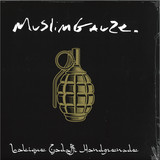
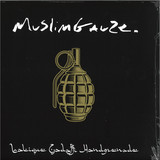
Given Jones' rather slack approach to track titles (both being consistent with and sometimes even just supplying them), it's a bit of a relief to realize that two tracks with the same name are indeed related. In the case of "Arab Jerusalem", which makes up nearly half of the newly-released Lalique Gadaffi Handgrenade, that kinship is immediately apparent even though both tracks are clearly their own experiences. Released as the first track on the Minaret-Spearker picture disc 7" in 1996, "Arab Jeruzalem" (spelling also sometimes being fairly slack) is 5:42 of effectively shifting dark ambience, wordless female vocals drifting over the hand percussion, chimes, and static of the track, with eventual conversational loops discussing ... something underneath.
The end of that version is especially striking for the way the woman's wordless singing starts being sampled in such a way that it overlays the whole track (and, slightly, itself). The almost 24-minute "Arab Jerusalem" here might be called the Deer Hunter version of the same story, building with great patience and many more abstract detours towards what now seems like simultaneously an excerpt and, now, a climax.
As with many of Jones' more ambient tracks, the great length just lets it cast its spell more thoroughly and entrancingly. The other three tracks, meanwhile, suggest some of Jones' other work but never evoke them as directly as "Arab Jerusalem". "Jordan River" is nearly as long (a second shy of 20 minutes) but strips out the vocal elements in its predecessor, focusing instead on a more active percussive workout (analogue and digital both) and a river of hiss running down the center of the track. The title track of Lalique Gadaffi Handgrenade might bring to mind the title of "Lalique Gadaffi Jar" from Libya Tour Guide (last reissued by Staalplaat in 2015), but if they're sonically related Jones must have practically melted the other track to get this one.
And the closing "Desert Gulag" (like the title track, a much more manageable length than the first two epic tracks here) bears a slight resemblance to "Negev Gulag" from 1996's Fatah Guerrilla, here what was a piercing, repetitive drone is softened and looped over more of Jones' percussion. The result is a well-rounded release that shows off many aspects of Jones' sound as Muslimgauze, while existing (like many of these DAT tapes do) in conversation with much of his previously released work.
Search:elements archive
When Elena Colombi launched the Osàre! Editions label in the autumn of 2019, she explained that the label would become home to bold, daring, future-facing music rooted in experimentation and free-spirited musical abandon. These are all descriptions that could apply to the label’s latest release, a retrospective album of little-known works by Greek musician and producer Thanasis Zlatanos.
Many will not have heard of Zlatanos, or Nekropolis, the band he fronted alongside dear friend and regular collaborator Trygve Mathiesen, yet the music he made during the 1980s was otherworldly, intergalactic and undoubtedly alluring. These songs and instrumentals made extensive use of analogue synthesizers and lo-fi drum machines, as well as Zlatanos’s trusted Gibson Les Paul guitar and his own distinctive voice.
Stylistically, the musician and producer refused to settle on a specific sound, preferring instead to create inspired, often mind-altering pieces that join the dots between wave music, skewed leftfield pop, ambient, prototype electronic and Madedonian folk music. Operating for much of the period from a crumbling house earmarked for demolition, Zlatanos kept up a daily music-making vigil that resulted in a vast vault of music, most of which has remained unissued since the 1980s.
The breadth of and width of Zlatanos’s distinctive approach is laid bare on Retrospective, a compilation album prepared by Colombi and the artist himself that draws on tracks from his numerous albums, those by Nekropolis – whose sophomore set “The New Europeans” was banned in Norway – and his epic archive of previously unheard material.
The artist’s singular but wide-ranging musical vision is free for all to see across the 13 tracks stretched across the vinyl version of the album (digital buyers also get a further four superb cuts). It veers attractively from the ghostly, traditional-meets-futuristic new age electronica of “The Crystal Sight (Excerpt)” and the doom-laden coldwave throb of “Master Chameleon”, to the undulating, soft-touch creepiness of “Surreal Moment”, the Vocoder-laden operatic poignancy of “The New Barbarians” and the squally guitar solos and effects-laden electronics of “The Light”.
Words from the artist___:
"I live in the Internet. Visits from outer space make me compose. I breathe here. I am the master chameleon, the psychedelic clown. I am not here anymore, neither in the picture, nor the reflection. Our bed is a boat that takes us tomorrow without us.
Here is an album of dreams and digital emotions. Analogue recordings made with a Prophet, a Moog Rogue, a tape recorder and a Gibson Les Paul guitar.
As far as I can remember I have always been in a recording studio. I listen to, understand and live my life through songs and music. I have worked alone and with friends such as Trygve Mathiesen. Although I am a guitarist, I continue to work with synthesizers on music that blends elements of Macedonian folk music, recordings from the streets and embryonic electronic sounds.
Some of my albums have been critically acclaimed, others banned by radio stations. For years I worked on endless recording sessions in a crumbling house that should have been torn down. The music on this retrospective compilation was recorded at various points between 1982 and the present day. Some of the compositions first appeared on previous albums, while others have never been released before. They were sat on tapes waiting for a saviour. Now that saviour has arrived and they can be free.
For further proof of Zlatanos’s unique sonic approach, check the startling contrast between the bass-laden slacker pop headiness of “No Expectations” and the spacey ambience of “The Dead Don’t Remember”. Considered together, the selected pieces and those elsewhere on Retrospective forms a snapshot of a genuinely unique and visionary musician, composer and producer. It’s a celebration of someone whose work has previously been overlooked."
First run on marbled vinyl!
During a career spanning decades, under a spread of monikers, Lee Norris has weaved musical gold. Shipwrec know this. Once again the dutch imprint delves into the Metamatics' archives to come up with audio treasures. Instamatic, released in 2014, is the source material for the "Instamatic EP" with four tracks being revisited from the album. As with all of Norris' work, a depth of expression can be enjoyed from the outset. Mixing elements of electro, electronica and IDM, "Neon Future Blue" is a warm textured and simply addictive opener. Subtlety and form are tinkered and toyed with in the ruffled edges and stark lines of "Cosmic Emotion" before the grandeur and isolation that is "Metamatix." Fragility and the ephemeral combine in the closer. "Haethear" casts whimsical notes to the wind, gentle currents shift as basslines bubble against crushed beats. Simply sublime from a true master.
iven Jones’ rather slack approach to track titles (both being consistent with and sometimes even just supplying them), it’s a bit of a relief to realize that two tracks with the same name are indeed related. In the case of “Arab Jerusalem”, which makes up nearly half of the newly-released Lalique Gadaffi Handgrenade, that kinship is immediately apparent even though both tracks are clearly their own experiences.
Released as the first track on the Minaret-Spearker picture disc 7” in 1996, “Arab Jeruzalem” (spelling also sometimes being fairly slack) is 5:42 of effectively shifting dark ambience, wordless female vocals drifting over the hand percussion, chimes, and static of the track, with eventual conversational loops discussing... something underneath. The end of that version is especially striking for the way the woman’s wordless singing starts being sampled in such a way that it overlays the whole track (and, slightly, itself). The almost 24-minute “Arab Jerusalem” here might be called the Deer Hunter version of the same story, building with great patience and many more abstract detours towards what now seems like simultaneously an excerpt and, now, a climax. As with many of Jones’ more ambient tracks, the great length just lets it cast its spell more thoroughly and entrancingly.
The other three tracks, meanwhile, suggest some of Jones’ other work but never evoke them as directly as “Arab Jerusalem”. “Jordan River” is nearly as long (a second shy of 20 minutes) but strips out the vocal elements in its predecessor, focusing instead on a more active percussive workout (analogue and digital both) and a river of hiss running down the center of the track. The title track of Lalique Gadaffi Handgrenade might bring to mind the title of “Lalique Gadaffi Jar” from Libya Tour Guide (last reissued by Staalplaat in 2015), but if they’re sonically related Jones must have practically melted the other track to get this one. And the closing “Desert Gulag” (like the title track, a much more manageable length than the first two epic tracks here) bears a slight resemblance to “Negev Gulag” from 1996’s Fatah Guerrilla, here what was a piercing, repetitive drone is softened and looped over more of Jones’ percussion. The result is a well-rounded release that shows off many aspects of Jones’ sound as Muslimgauze, while existing (like many of these DAT tapes do) in conversation with much of his previously released work.
Planning the imminent arrival of the 50th release on Touchin’ Bass, label boss Andrea Parker was digging through the warehouse during a stock take and it became apparent that there was something missing. There was a gap in the catalogue numbers. Where was TB036? Searching the archives it transpired that, for one reason or another (not least Parker’s inability to count), there actually wasn’t one.
So what better way to backfill this now documented gap than to welcome the multitalented guitarist and drummer, mathematician and multidisciplinary improviser Maria Gamboa Perez into the Touchin’ Bass fold with an updated focus for 2019.
Perez combines elements of rage, chaos, tension and anguish to form a visceral style. Her musical terrain and talent is shaped by dissonance and NO art. Under the moniker NonZero!, Perez brings Matrix Equation to the fore; a heavy 8 track EP with electro aesthetics from none other than Carl Finlow Scarletron/Silicon Scally/Voice Stealer.
Beginning her artistic career as a teenager playing as a bassist and guitarist in groups with influences from Noise, Avant Garde and the No-Wave, Perez was introduced into several areas of electronic music during the club culture years in Madrid and opted for styles such as Electro or Industrial, at which point she began to be interested in the introduction of rhythm boxes together with traditional drums.
Her passion for sound synthesis and musical exploration led Perez to introduce electronics into a solo project under the pseudonym NonZero!. Under this name she aims to make electronic music her field of sound research and for years has been continuously searching for existing relationships between sound and mathematics, focusing on the perceptual limit between music and noise.
Matrix Equation indulges in an evidential brooding angst, shifting between abstraction and the kind of elevated introspection carefully harvested over the years. With dramatic frontage in parts, blasts of boisterous energy and machine mayhem, its deployment of surprise, shifting focus and spontaneity operate in an assured statement.
Splintered beats and a foreboding sense of tension give way to a more DJ friendly logic of instinctive introductions and codas of gradual builds and breakdowns as Finlow further reworks the results to great effect.
This 4 track EP comes out of Ibiza Records archive vault's called Archives Vol 5 produced by Low Block Noise in 1991 & EOAD in 1993. Each of these tracks represents hardcore and merging of jungle breaks starting to come through in the early 90s.
A. Rave in the Bedroom - This track produced by L.N.B made in 1991 has some great piano stabs and had a sample taken from 'The Young Ones' bbc2 sitcom as back then it was all about the big samples being used.
AA. Its Not Big & Its Not Clever - This track from L.B.N made in 1992 and has a classic sample taken from Robin Williams 'Good Morning Vietnam' film. The track has strong jungle breaks that were now a dominating presence at that time in the scene.
AAA. Love The Feeling - This track produced by E.O.A.D made in 1993 is more hardcore with the piano stabs offering a ravey anthem feel representing the warehouse scene. Which was dying out and Jungle was becoming the more dominant force.
AAAA. This track produced by E.O.A.D also made in 1993 and is a remix of the original with the hardcore elements offering a more raving anthem feel representing the warehouse scene back then.
In early 2018, Jas Shaw, one half of Simian Mobile Disco was diagnosed with a rare health condition – AL amyloidosis – a disorder of bone marrow cells. Having just completed SMD’s 7th studio album Murmurations and with a special show at the Barbican scheduled for April, things were thrown into confusion. At the time, no one, including Shaw, knew how the prognosis would pan out. Jas had to start chemotherapy almost immediately, which meant cancelling the tour. The duo decided to go ahead with the Barbican show in spite of Shaw’s illness, which was especially poignant as all involved knew it could potentially be SMD’s last ever live performance – in the end it turned out to be a tour-de-force. If this was SMD’s swansong, so be it.
In the year that followed, Jas spent months receiving weekly chemotherapy, learning to live with his condition, and when he felt well enough, spending hours in his studio making music.
The result of this was twofold, firstly a collaborative album with Derwin Dicker (Gold Panda), released as Selling – On Reflection, on City Slang Records Secondly, a growing archive of solo work, which is now ready for release. Entitled “The Exquisite Cops”, this 20+ track growing body of work will see the light of day via SMD’s Delicacies label – with a 2-track single released every fortnight /month and a limited
edition double LP scheduled for 27th September.
At the end of 2018 a difficult year was capped with hopeful news. With his condition in remission, able to stop chemotherapy Jas is able to start DJing and playing live again.
Jas: “The Exquisite Cops tracks seem to have made their own system for creation. Normally I record electronic music like a band would, as a take. So, it’s kind of surprising to me that that this batch of tracks wasn’t made this way. Instead of a single take that gets edited and developed these tracks were all made in bits, usually months apart. Some days I’d make a drum track, often editing it down so that it’s some sort of semblance of a structure; on other days I’d end up just making a synth sound or texture. This wasn’t something that I gave into reluctantly, it’s nice to be able to give a feedback based pad your whole attention rather than just set it up and only attend to it if it gets really out of hand.
The process of matching these misfits together was originally born out of laziness, rather than break open the synths to make something to develop an idea, what if I could just use something that I already had; slack. The interesting thing was that in pulling two takes together that were done months apart, they cast each other in a different light and though sometimes making them fit together was a hatchet job, sometimes they locked up together in an improbable way, making the rough structures that I’d improvised make a different sort of sense; often a more interesting sort of sense.
The more I did this the more it felt like this was not just a slacker’s way to use up offcuts, this resulted in combinations that I’d probably not have chosen if I’d done the tracks in one go. Also, and I know this isn’t something that’s important to everyone, there was a level of fastidious detail that I’d never have got if I’d had the textural and rhythmic elements playing together. It’s a longwinded process but it’s changed how I record and how I think about recordings I’ve made; plus I enjoy all parts of it so why cut it short?”
Ibiza Records label was established back in 1989 and was one of the main contributors to the UK underground music scene. Those behind the label were the innovators of Hardcore Jungle, Jungle Techno and Jungle genres in the 90s stemming from Warehouses to clubs and now festivals. Ibiza Records Label returns today with some new releases and a back catalogue of gems for the real Junglists out there.
Another 3 track EP comes out of Ibiza Records archive vault's called Archives Vol 4 produced by Noise Factory. Each of these tracks represents 'The Original Jungle Sound' from back in the 90s.
This 3 track EP called Archives Vol 4 comes from out of Ibiza Records archive vault and produced by Noise Factory. Each of these tracks represents 'The Original London Jungle Sound' from back in the 90s.
A.JUNGLE MYSTIC - This track made back in 1999 produced by one of the member's of Noise Factory aka Drumpella Black. Keeping with the original sounds of Noise Factory and the elements of techno and hardcore the early developments of Jungle.
AA.CAN YOU FEEL IT - This track made back in 1999 produced by one of the member's of Noise Factory aka Drumpella Black feat. Tremma T on the vocals. Keeping with the original essense of jungle, piano stabs and hardcore flavours.
AAA.ROLL WITH ME - This track made back in 2000 produced by one of the member's of Noise Factory aka Drumpella Black feat. Jnr Dangerous on the vocals. Once again showcasing the true elements of jungle.
TUTTI is comprised of eight soundscapes: an audio self portrait comprising of manipulated sound recordings from Cosey's life, music and art:
'It's the only album I've made that is an all encompassing statement expressing the totality of my being. A sense of the past in relation to the present and everything in between.'
These eight pieces were originally conceived as the soundtrack to the autobiographical film 'Harmonic Coumaction', and performed live in February 2017, part of a series of events that accompanied the COUM Transmissions retrospective which opened Hull UK City of Culture 2017. Later that year, 'Harmonic Coumaction' was presented as an audio-visual installation for Cosey Fanni Tutti's solo exhibition at Cabinet Gallery, London.
Cosey Fanni Tutti explains: 'Working on the COUM Transmissions exhibition also coincided with writing my autobiography - collating archive material and re engaging with my past. My work is a continuum, the past feeding the present and vice versa. The album is an interpretation of my past and present, of my understanding the shifting perceptions of how they inform one another. One form creating another through a metamorphic process.'
On TUTTI, the music has been updated and enhanced with elements of the original tracks re-recorded and further processed specifically to create a unique stand-alone document, separate to the live performance and installation. Recorded at Cosey Fanni Tutti's studio in Norfolk, the album, as on her debut release, Time To Tell, merges Cosey's art activities with her exploration of sound: The album's autobiographical theme is not locked into any specific time or place, the 'voices', instruments and sounds together span decades of my life, music and art. In this context my name 'TUTTI' shifts from its role as a noun to perfectly represent the concept of the album, also acting as sign for me the artist.
TUTTI is Cosey Fanni Tutti's only solo album release since 1982's Time To Tell. Time To Tell was recently given its first release on vinyl, on a long awaited official deluxe edition. The interim years between solo releases has seen a blisteringly prolific output as an artist and musician. Renowned for her art, her work in the sex industry, as co-founder of Industrial music and Throbbing Gristle, and her pioneering electronic music solo and as Chris & Cosey, Carter Tutti and Carter Tutti Void, she has created throughout with the motto 'my life is my art, my art is my life'.
Cosey's autobiography ART SEX MUSIC was published to worldwide acclaim by Faber & Faber in 2017, a Japanese edition has just been published with further translations and an audio book to follow. TUTTI
Jabal is the title of the forthcoming release by Kendojubaki and Dj Ali through Berlin based Label 'Live From Earth'. The release is the second instalment of the labels Live From Earth Klub series.
'Jabal' translates to mountain in Arabic. It is also where the two artists roots trace back to in their home country of Lebanon. The listeners receive a glimpse of the socio-political issues surrounding the jabal areas across Lebanon through unique sampling
KendojubakiKendojubaki is the pseudonym of Adam Rajab, an Australian-Lebanese Sound Designer and producer currently based in Melbourne. As the son of Lebanese refugees he spent parts of his childhood working in his parents Middle Eastern supermarket. In times of recreation he and his relative Ali would pretend to be an Arabic wedding band playing the tabla and the mijwiz to imaginary dabke dancers.Hatched from these activities and through years of back-and-forth between e Middle East and Australia, Adam has captured a unique sound-language which amalgamates traditional sounds of the Levant with modular synthesis, drum machines and industrial elements of unrelenting vim. His thematic music dwells on commonly unfair socio-political issues surrounding the east and the west, displacement and identity.
As a Dj Kendojubaki's sets are filled with long Arabic intros, old school hardcore rave tracks and tempos above 140. In his own productions and live sets, kendo recombines his sound design influence into powerful and cathartic riddims, along with thick echoes un-natural like drums.
Dj Ali Dj Ali is the stage name for Ali Chahine, an Australian-Lebanese live hardware act currently based in Melbourne, Australia. In his productions, Ali fuses sounds from his archive of field and foley recordings along with 90's hardcore rave melodies to create an emotive flow of fast techno music.As the son of Lebanese refugees, Ali also shares stories of conflict and socio-political issues through his music and art. In 2018 Ali joined the collaborative label 'Al Gharib' with relative Adam Rajab who is most commonly known as 'Kendojubaki's'. The two are collaborating on a 12' release named 'Jabal' in December, released through Berlin label Live From Earth.
Shunter, the new album by the Berlin-based duo Driftmachine, is their most ambitious work to date. Although instantly recognizable, featuring their trademark Kosmische and Avant-garde sounds, it also presents a new journey into abstract and hallucinatory worlds. Filled with eerie textures, their electronic visions are darker and more vaporous than ever.
Driftmachine's fourth album (also the fourth one for Umor Rex) offers a new perspective on their ample sound spectrum and systemic narratives. Shunter overlaps and mutates their post-industrial-dub motives. It was conceived and produced in search of a very different kind of imagery, with sections of noise and field recordings intersecting with analogue sounds, a mixture of contrasted fragments, where the usual creative process of modular-synthesis leads Gerth and Zimmer to the discovery of a dark, hazy and diffused experience. There is a protean quality to the rhythmic elements, with tempos constantly contracting and expanding, a departure from the mono-beat-rhythms of "Nocturnes" and "Colliding Contours". The first half of Shunter is made of four pieces named "Shift", although individually separated, they are conceptually linked and can be understood as a sort of score. Imagine a late stage of the industrial revolution, with the interaction between heavy machinery and human beings. The second half of the album is not completely separated, but it has three other substantial melodic moments. Somewhere between the hauntological and the realms of archive-music, a huge range of subterranean beats and distinct patterns dotting the landscape of early electronic and post dub music.
All songs written & produced by Driftmachine (Andreas Gerth & Florian Zimmer), Berlin.
Mastered by Rafael Anton Irisarri. Design by Daniel Castrejón.
Bursting through the vapour trails of previous Solar Phenomena pilot Antonio Ruscito, London's Roberto is invited to the take the controls of the forward-thrusting new label's third adventure.
With turbine pads raising hairs at 20 paces, opening track 'Into The Blue' is an alluring statement. Adorned with breathing atmospherics and stately kicks, it builds perfectly on Roberto's previous work both on his own highly respected label Fossil Archives and other eminent imprints such as Emmanuel's Arts and Dehnert's Fachwerk as a fusion of contrasts and shades.
'DX Waves' takes us up a gear as it heads nose-first into a techno vortex. Relentless, driving and hypnotic, there's a pneumatic funk to the drums while the riff ripples and stimulates with a warmth and fluidity that instantly recalls the legacy of Motor City while remaining plotted to a path of its own.
This sense of unbridled drive and energy continues on Roberto's final original of the EP: 'Chord Recall'. Here the drums take more of a central position on the stage as the warped, melting tones and textures wrap themselves around the punctuated kicks and occasional deep-splash cymbals. Laced with a deep sense of space and a bewildering sensation of an unknown destination, it s another innovative voyage for Solar Phenomena that's brought home with an exciting revision conclusion from the one and only Peverelist.
A Bristol beat explorer who needs no introduction, Peverelist's take on 'Chord Recall' takes off where his recent album 'Tessellations' left us at the start of the summer. With his loose broken drum signature, Peverelist provides space for Roberto's original textured elements to take place at the centre of the stage and roam and evolve freely and hypnotically. A fitting end to another exceptional and innovative exploration, both Roberto's originals and Peverelist's remix set us up eagerly for the next Solar Phenomena chapter
For the second installment in their 12' series Music From Memory present two deeply forward thinking electronic tracks from British musician Michal Turtle made between 1983-4.
The first track 'Are you Psychic' is taken from Turtle's obscure 'Music From The Living Room' album which Michal recorded literally in the living room of his family's South London house at the young age of 22.
Over-running his parents' front room with various synthesizers, amps and instruments, and setting up a portable four track studio the 'Music From The Living Room' tracks were built around live jams that took place alone or sometimes with musicians he would invite to play alongside him. Whilst seemingly sample based the instruments were played live and any voices or sound effects were actually recorded directly to tape, or put onto tiny 2.5 second cassette loops.
'Astral Decoy' was made in the year following the release of his only solo LP and forms part of a series of unreleased tracks that reflect a growing interest in combining electronics with more analogue elements such as Xylophone and live percussion. At the same timce this track draws inspiration from the sound of electro and boogie which Michal had become greatly interested in at the time, and in particular the work of musicians such as Grandmaster Flash.
With access to the archives of the many recordings made at his family home, this 12' serves as an introduction to a wider compilation of Michal Turtles works which is to follow on Music From Memory.