Delights imprint continues its venture in way-out cinematic grooves with a debut 45 from Oregano - a new collaboration between Shawn Lee, Paul Elliott (JetTricks, Eleven76, Hot Border Special), Shay Landa (RPS Surfers) and Markey Funk.
Initially recorded just a few hours ahead of the Tel Aviv premiere of The Library Music Film in early 2019, the first pair of cuts from this session has been taking shape throughout the global pandemic. The result is two pieces of otherworldly sci-fi psych-funk, featuring mesmerising flute by Roey Bar Yehuda (RPS Surfers): the meditative organ and synth-drenched slow-burner, Melting Sand on the A-side, and the quirky uplifting Transmitter on the flip.
Limited to 300 copies worldwide.
Buscar:eleven
Livity Sound is proud to present a 12” of lean, refined club tracks from UK stalwart Beneath. The Mistry and No Symbols boss has spent the past 10 years exploring a sound which nods to the legacy of bleep techno, dubstep and UK funky while leaning forwards into its own distinctive space.
His stripped-back blend of crisp drums, sprightly hooks and sub bass are instantly identifiable, but across four new tracks Beneath displays the versatility within his reach. Stomping four to-the-floor rollers on the A side face-off with minimalist dub and weighty, synth-rich expressions on the flip that move beyond the demands of the dancefloor.
Livity Sound is a label set up by Peverelist in 2011 as a vehicle for a raw and exploratory strain of UK techno, rooted in the heritage of UK dance music and sound system culture. It has since become one of the UK's foremost protagonists for cutting edge underground electronic music.
"Free Jazz " - Ornette Coleman (as); Eric Dolphy (b-cl); Don Cherry, Freddie Hubbard (tp); Charlie Haden, Scott LaFaro (b); Billy Higgins, Ed Blackwell (dr)
The term 'free jazz' was already inexistence – but it had a quite different meaning, namely jazz without paying for an entrance ticket. The album "Free Jazz", however, was intended to lend its name to a quite different style of jazz. 'Free' playing – now this meant that no one was bound to conventions, you could let your imagination run loose. Free jazz gave one the chance to find new rules for every new composition. And it was to be the greatest boost to innovation in the world of jazz. Ornette Coleman’s album from December 1960 stands at the beginning of the free jazz era like a massive portal. Coleman thought big: he brought two quartets into the studio at the same time, both with two wind instruments and no piano, and let them play together for 36 minutes without a break – a collective improvisation. There aren’t any precise themes, although short, fanfare-like motifs do exist in which the winds come together. A continuousdense rhythmic beat underlies the music almost throughout – and the pulse is felt rather than heard. One musician after the other comes into the foreground to improvise, almost like at a jam session. First Coleman, then Dolphy, then the two trumpeters. The other winds, however, never remain silent, then make comments and support one another continually – the energy level is immense the whole time (it was cold in the studio ...). Only when it is the turn of the bass and drum players do the winds remain silent for about eleven minutes. This album is not only a historic caesura, but a truly great experience over andover again.
This Speakers Corner LP was remastered using pure analogue components only, from the master tapes through to the cutting head. More information under pure-analogue
All royalties and mechanical rights have been paid.
Recording: December 1961 in A&RStudios, New York City, by Tom Dowd
Production: Nesuhi Ertegun
At this stage in the game, the name Whitechapel commands respect. Already sitting on one of the most enviable catalogs in contemporary metal, in 2019 they dropped The Valley, showcasing a confident evolution in their sound and standing as a true landmark release that sets a new standard for the genre. In 2021, they return with that album's successor, the mighty Kin , which is an even more dynamic and diverse collection, further advancing the band's sound into new territory without losing sight of what brought them to this point. The commencement of writing for the album was a direct result of the Covid pandemic, the band having several tours lined up to finish out the cycle for The Valley, but when these got cancelled, they decided to refocus their energies and begin working on a new record. The result is a collection that explores a lot of sonic and emotional territory, and for the first time, it could be said that a Whitechapel record is as much a rock album as it is a metal one, an assertion guitarist Alex Wade agrees with. "It's still very much a metal album, I don't think you would hear any of the songs on mainstream radio, but there are elements of the record that have more of a rock and open vibe. We really wanted these songs to breathe and have life and to sound bigger than anything we've made so far. We have explored more singing on 'Kin' too. It wouldn't make sense to have the majority of the fanbase enjoy that sound and then shy away from it." This is not to say that the band have lost their hardest edges, with the full-on death metal assault that kicks off both "Lost Boy" and "To The Wolves" as brutal and serrated as extreme metal gets, and while vocalist Phil Bozeman explores his wide-ranging singing voice more, he also cuts loose with his trademark roar across the album's eleven tracks.
- 1: Chances Are #
- 2: Generation 13 (Theme #1)
- 3: All Wil Change (Goodbye And Good Luck)
- 4: The Cross (Home #3)
- 5: Danger Whistle
- 6: Leave Her Alone
- 7: I'll Never Be Like You
- 8: My Name Is Sam (Finding A Friend)
- 9: The 13Th Generation
- 10: The Cross
- 11: The Learning Tree
- 12: I'll Never Be Like You (Once Again)
- 13: Snake Oil
- 14: We Hope Youre Feeling Better (The Test)
- 1: My Name Is Sam (Your Time Is Up)
- 2: Generation 13 (Theme #)
- 3: Where Are You Now?
- 4: Screw' Em
- 5: No Strings Attached
- 6: All Will Change (It's Happening To Me)
- 7: The Victim
- 8: One Small Step
- 9: Sams New Friend
- 10: We Hope Youre Feeling Better
- 11: Chances Are #2
- 12: Gotta Love It (1991 Single)
Their eleventh studio recording “Generation 13“ saw SAGA release a concept album for the first time in their career. Inspired by the book ‘13 Gen Abort Retry Ignore Fail’ by Neill Howe and Bill Strauss, keyboardist Jim Crichton developed the (fictitious) story of young Jeremy, a member of what is known as the 13th Gen – the generation born between 1961 and 1981, identified as the 13th generation in the US since the founding fathers – whose future prospects, according to Strauss/Howe, were full of uncertainties despite the nation’s huge wealth, and whose daily life would be marked by violence and chaos. The result was a versatile album featuring haunting rock songs and an ambitioned story full of social criticism. Reissued as a Double Heavyweight Black Vinyl Gatefold Edition, “Generation 13” will be available for the first time ever on vinyl and features the acclaimed 1991 single „Gotta Love It“ as an exclusive bonus track as well as personal liner notes by Jim Crichton.
- A1: Dark Waters
- A2: Aurora (With Nandini Srikar)
- A3: Take Me There (With Gvn)
- A4: 1995
- B1: She Was Looking Into The Sun (With Khomha)
- B2: Repondez-Moi (With Gjon's Tears)
- B3: Off The Grid
- B4: Revival (With Gabriel & Dresden, Andy Moor & Proff - Feat Mokka)
- C1: Alma
- C2: Koski (With Sonin & West Of The Sun)
- C3: By Your Side
- C4: Sisu
- D1: 5Am
- D2: Dusted
- D3: The Best Part
- D4: Surreal
There shouldn't have been a debut album on Anjunabeats, gardenstate shouldn't have existed, and we should have stuck to our normal day job. This album is to everyone out there who has been told that 'you can't do it'." Be it through passion, determination, or just sheer stubbornness, gardenstate continues to bloom. A transatlantic labour of love from superproducer Marcus Schössow and club promoter Matt Felner, their debut album 'Inspirations' is out this year on Above &Beyond's Anjunabeats imprint. At the heart of Sweden's decade-long domination of club music in the 2010s, Marcus' fifteen-year-long career boasts a smörgårdsbord of styles. You've got electro with 'Swedish Beatballs', the mainstage energy of 'Reverie' and 'Ulysses', and the driving progressive of 'London / 1985'. Few artists have record sleeves from Axtone, Armada, Size, Spinnin' and Anjunadeep in their catalogue. Heavily invested in the early 2010's big room sound, he was a permanent feature in the sets of Swedish House Mafia and Knife Party. New Jersey native Matt Felner gave up his blue-collar job to follow his passion for electronic music. A respected promoter and performer, he's brought emerging artists to the clubs of New York and the East Coast. In 2008, he toured Marcus Schössow and they became close friends. Eleven years later, and here we are - a hotly-tipped duo with a debut artist album on Anjunabeats. Making music on their own terms, the gardenstate sound is a melting pot of '90s trance nostalgia, brooding melodic techno, peak-time breaks and poignant song writing. Few acts can worm their way into the DJ sets of Kölsch, Cristoph, Tiestö and Above & Beyond at the same time.
On Now Where Were We, The Exbats hit the ground running like
a dystopian garage rock version of the Shangri-Las, or like
a message to the future from the pre-Velvet Underground doowop
wannabe Lou Reed. The album rings bright, like a beacon
in the wilderness: eminently, effortlessly catchy, and loaded
with buoyant choruses that rank alongside the best chart-toppers
launched by the Brill Building or Phil Spector’s Wall of Sound.
Kenny McClain and his daughter, vocalist and drummer
Inez McClain, formed the nucleus of the Exbats over a decade
ago, when Inez was just 10 years old; today, Bobby Carlson
rounds out the group on bass. Despite their remote location in
Bisbee, Arizona, just eleven miles north of the U.S.-Mexican
border, the group quickly racked up accolades citing a wealth of
influences that run from cartoon quintet the Archies to punk rock
originators the Avengers, and from the so-sweet-it-hurts 1910
Fruitgum Company to Los Angeles antiheroes the Weirdos.
Truthfully, The Exbats embrace a wider swath of musical styles,
incorporating blue-eyed soul, tongue-in-cheek country, Brit
pop, psych, and R&B into their sound.
The McClains describe this album as “more ambitious” than
its predecessors. They tooled ninety minutes northeast to Tucson
to record, per usual, with Matt Rendon at Midtown Island Studios.
Months later, the Exbats emerged with an album imbued
with harmoniously cautious optimism—the musical equivalent
but psychological antithesis to the Brian Wilson-Tony Asher
masterpiece “I Just Wasn’t Made For These Times.” While Wilson
was looking for “a place to fit in,” The Exbats have found
sanctuary via the brilliant “Ghost In The Record Store,” which
is “for all of us who need the joy of a little bit of plastic making
lots of noise.” Like the best records to croon along with, Now
Where Were We is captivatingly simple, yet hardly simplistic.
The Exbats are singing from their hearts—and they aren’t afraid
to bare their souls.
Radio Slave returns to his Rekids imprint this October with the perfectly balanced ‘Acid Dip’ single.
The titular track on ‘Acid Dip’ sees Matt ‘Radio Slave’ Edwards in particularly strident form. Riding a broken, stuttered-kick rhythm, ‘Acid Dip’ is a jabbing, insistent slice of UK techno shot through with hardcore and, whilst not skimping on raw power, still maintains the hypnotic nature that inhabits much of Edwards’ work.
On the flip, ‘Armani’ takes off down a dubbed-out, futuristic Italo-infused house workout that, throughout its eleven minutes 28-second span, shows a more dense, layered side to Radio Slave production.
Another triumph of a single from one of modern electronic music’s most consistent talents, Radio Slave’s ‘Acid Dip’, is released 15th October via Rekids.
Work on 'Fragile' began last August at the height of lockdown. Grill locked himself in the recording studio where he found himself experimenting with new sounds and technologies and was able to learn more about the techniques involved in mixing, production and arrangement. "The aim was to write a physical album maintaining an energy throughout and utilising sounds and structures I'm interested in. Using limitation was a big part of the process to push what I used as far as possible. Reading about Robin Guthrie's breakdown of Cocteau Twins minimal setups across different albums and how Prince distorted the Linn Drum Machine were also inspirations."
Musically, 'Fragile' is a more dance-centric record than 2020's 'Ride', with eleven blistering tracks aimed straight for the dancefloor. From the lush, pulsing synths and blistering beats of 'Another Time', to the hazy, sun-soaked 'Wildflower', Grill seeks to create dance music that is endlessly catchy and hugely uplifting. He draws heavily on a Euro-dance influence in his search for pop perfection with melody instrinsic to each track. The Italo disco sound of Giorgio Moroder is never too far away, climaxing with the pumping 'Crash' while the emotive dance of New Order is echoed in 'Wandering Sky' and 'Romance'.
From a visual perspective, 'Fragile' is inspired by gothic, renaissance art and architecture. The album artwork is a photograph Grill took on Château d'If, a fortress and former prison located on the Île d'If, the smallest island in the Frioul archipelago, a short distance from Marseille in southeastern France.
- 1: Can't Turn Me Around
- 2: It's A Shame
- 3: Tell It All To Jesus
- 4: Somewhere To Lay My Head
- 5: Glory Glory
- 6: Tell It
- 7: Use Me Lord
- 8: Ask God In Faith
- 9: Victory
- 10: We Will Work
- 11: He's Coming Again
- 12: Trying To Make It
- 13: Shake Me
- 14: Stand Up
- 15: I Want To Be Ready
- 16: Have You Tried Jesus
- 17: No Ways Tired
- 18: Amazing Grace
Eleven groups in eight days. A marathon recording session in a makeshift storefront studio in a 100-year-old building in the tiny Eastern North Carolina town of Fountain. Once the idea for the project was in place, Alice Vines of the Glorifying Vines Sisters started calling local musicians. It didn’t take her long to line up almost a dozen groups to come lift their voices and represent the region’s unique Sacred Soul traditions. When the groups on this record gathered to record in February of 2020, they couldn’t have known that the world was on the heels of a global pandemic, or that the year would bring great turmoil and social upheavals. But in the reality created by gospel songs even the greatest of trials are not surprising, nor can they be ultimately devastating. Every time singers stepped up to the mic during these sessions, they created a sonic world where no amount of bad news can undermine the truth of The Good News. Even when “you can’t really see a solution to what you’re dealing with at the moment,” says Kiamber Daniels of Faith and Harmony, singing gospel music will remind you, “hey, I’m still here; I got what it takes to make it through this. It will give you a sense of peace.” Produced by Bruce Watson (Fat Possum/Big Legal Mess/Bible & Tire), this collection of sacred soul recordings of Eastern North Carolinian gospel groups is a one of a kind exploration. With a rich heritage of family gospel music, the artists in this area have been honing their craft over generations and have their own way of making the material original and unique. This is Sacred Soul of North Carolina.
In creating Our Beautiful Baby World (May 2021), the pacing of Izzy True’s
songwriting process has slowed down since their prior Don Giovanni
releases -- Sadbad (2018) and Nope (2016).
Arranging with Curtis and Sam, Reidy says they’ve grown as musicians together, and their songs were given space to grow, too. OBBW exhibits eleven rock
songs of melded collaboration, expressing the deepness of acceptance. These
are the band’s most dynamic compositions to date. The result is, Reidy hopes,
to ‘sound like a bad drawing of a rock record.’
The inspiration for the soft-hard dynamics of OBBW may have come from Reidy
listening to Thin Lizzy, along with the bleeding of the band members’ strengths
and histories: Curtis as a courageous experimental musician in the DIY circuit,
Sam’s expertise as a hardcore drummer, one Halloween cover-set of System
of A Down in a Chicago basement from another world, and Reidy’s childhood
growing up listening to old love songs and country music.
OBBW was recorded in Rock Island, IL at Rozz-Tox, a well-loved bar and music
venue in the humble Midwest. Recorded and mixed by Ian Harris on reel-toreel, Izzy True’s tunes returned to tape after Sadbad, which was digitally produced.
The record utilizes the talents of Chicago music friends Jess Shoman (Tenci)
on backup vocals and Andrew Clinkman (Spirits Having Fun) on lead guitar on
‘Four Good Ponies’. OBBW was recorded in the months before the pandemic,
January and February 2020, which can feel obvious (‘I don’t wanna hang out
for a thousand years’) and subtle. The authentic limitations of reel-to-reel tape
recordings give this project the aura of a time when live music was possible.
On the fringe of the indie Rust Belt scene since the 1990s,
Moviola has quietly forged a low-key career of high-quality
recorded output over twenty-five years, issuing ten (!) records
and countless 7-inch singles (including splits with Cobra Verde,
Hiss Golden Messenger, Handsome Family and many others).
In this artistic continuum, the band has evolved from everything
from 4-track fuzz to hi-fi country soul. Today, the band steps
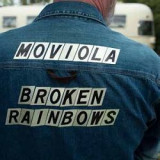
forward with Broken Rainbows, its strongest collection of songs
to date, written, recorded, and mixed inside the group’s HQ in
Columbus.
Jake Housh started Moviola in 1993 as a student at “The”
Ohio State University as a noisy, fuzzed out lo-fi noisemakers.
Over the years, the band has morphed into a unique DIY
music and art-making collective with five distinct singers and
songwriters, recalling the creatively democratic lineage of The
Mekons, The Band, Pink Floyd, many others. Moviola is Jake
Housh, Ted Hattemer (Thomas Jefferson Slave Apartments),
Scotty Tabachnick, Greg Bonnell, and Jerry Dannemiller.
Broken Rainbows is a milestone release, showcasing a band
newly energized and assured in its artistry, and supportive of its
members’ songcraft. The eleven-song album hovers over a plot
of ground that’s optimistic in its despair. Album topics range
from the personal to the political, showcasing each member’s
unique songwriting within an overall cohesive band aesthetic.
“Moviola was one of those groups I met early on back in the day
that showed me how to do it. Broken Rainbows is a highlight—
pastoral thumpers, fuzzy indie radness, hooks to spare, pretty
much all the good stuff. Feels like a glorious drive from one
disparate end of Ohio to another. I love this band.”
—Eric Johnson (Fruit Bats)
- A1: Big Enough
- A2: Take It So Hard
- A3: Struggle
- A4: I Could Have Stood You Up
- A5: Make No Mistake
- A6: You Don't Move Me
- B1: How I Wish
- B2: Rockawhile
- B3: Whip It Up
- B4: Locked Away
- B5: It Means A Lot
In 1988, on a break from his band the Rolling Stones, Keith Richards released his first ever solo album, Talk Is Cheap. This universally respected debut is an eleven track masterclass in everything that's good about rock 'n roll and features guest appearances from an all-star cast including Sarah Dash, Bootsy Collins, Maceo Parker, the Memphis Horns, Patti Sciafia and Mick Taylor.
Remastered from the original tapes by Richards' collaborator, Steve Jordan, the album's joyous swagger is re-energised and permeates through each and every song.
Talk Is Cheap sounds as good today as it did thirty years ago; in Keith's words: 'As fresh as the day it was made.
Kansas City trio BUMMER mirror the absurdity of
modern life with a balance of dark humour, dejected
nihilism and righteous fury. Their music spills out in
torrents of skull-crushing riffs, gargantuan bass and
caustic howls delivered at breakneck speed with
gleeful abandon.
Following their split 7” with long-time friends The Body,
which teased a more focused, lean sound for the
group, ‘Dead Horse’ hones BUMMER’s auditory
desolation and scathing gaze to laser-point precision.
In eleven short vignettes the quartet lay waste to
everything in their path, penning a vitriolic overview of
life in the American Midwest, a surprising blend of onestar Trip Advisor review and insightful cultural critique.
“BUMMER puts the ‘power’ in power trio as they play
a raw and primal form of aggressive music that splits
the difference between ‘Bleach’-era Nirvana and the
early, primitive thrash of Slayer. It’s aggressive and inyour-face, but doesn’t skimp on melody, making their
songs memorable. So, there is power and a bit of
precision to what they do. A whole lot of volume, too.” -
New Noise Magazine
CD in gatefold packaging with lyrics.
LP packaged with download code.
Available to independent retailers on grey / blue vinyl.
Artwork by painter Joan Lalucat Vehil.
Who could forget the BAMs, the BLAMs, and the BAOMMs?!
Ubisoft, Microids and Laced Records have conspired to bring the fabulously percussion-heavy music of XIII to vinyl.
Based on the graphic novel by Jean Van Hamme and William Vance, the 2003 cult first-person shooter adopted a cel-shaded look and visual onomatopoeia to set it apart. Mixing action, stealth, and exploration, XIII is chock full of conspiracy, assassination, and plot twists.
French composer Lionel Gaget created a superb spy-jazz soundtrack that fuses John Barry’s ‘60s James Bond musical blueprint with David Holmes’ Ocean’s Eleven instrumental funk. The 11 specially remastered tracks on the LP — featured in both the 2003 and 2020 versions of the game — are stuffed full of first-class percussion, deep bass and subtle jazz stings.
The audiophile-quality, heavyweight 180g black and white LP will be housed in a deluxe card sleeve.
Light Blue Vinyl
**Tracks 'Sixth Sequence' and 'Tenth Sequence' are bonus tracks & exclusive to the vinyl release only.** limited transparent green vinyl LP
Past Inside The Present is pleased to announce 'Wave Variations' which is a new mini-album by veteran ambient producer Dennis Huddleston AKA 36.
36 has often enjoyed exploring self-imposed restrictions, as it forces him to be creative, while allowing an inherently coherent sound between the different compositions. All the arrangements on Wave Variations use a limited pallete of mostly synth-based sounds, with particular focus on keys and melodies. Each track directly influenced the next one.
Dennis has kept almost every track around three minutes in length. He states, 'I feel like a lot of ambient music (including my own) is often unnecessarily long and these small vignettes work as a nice counter to that. Don't expect long build-ups or over-extended crescendos; These are short tracks that take you straight to Elysium and then dissolve into the ether.'
He further explains the output of Wave Variations, 'Ocean tides inspired the album. I think we've all felt that sense of longing and wonder while standing at the beach, staring at the waves and gazing into the endless horizon. I think it's something that transcends all generations of people. Like the waves, these tracks leave as quickly as they arrive. I feel it's one of the most minimal records I have made, with far fewer individual sound sources at my disposal. It keeps me on my toes and forces me to deeply explore the instruments I have available to me.'
This stripped-back sound gives the album a hypnotic quality to it. Like much of Dennis' work, there is a delicate balance between melancholic melodies and rich textures, resulting in an understated yet deeply exhilarating sound. Fans of emotional, melodic ambient music should find plenty to enjoy.
Originally from Philadelphia, invited to New York by Miles Davis, playing at Antibes in 1960 with Charles Mingus and Eric Dolphy, here is trumpeter Ted Curson in 1971... in Paris. With him, a legendary trio: Georges Arvanitas (piano), Jacky Samson (double bass) and Charles Saudrais (drums). A new transatlantic alliance in the service of jazz of all kinds: classic, modal, fusion and even free... Pop Wine is – between Coltrane and Miles with a nod to roots in the club the Caveau de la Huchette – an explosive cocktail but which leaves no stains!
In 1960, trumpeter Ted Curson played with Charles Mingus and Eric Dolphy on stage at the Antibes jazz festival. Eleven years later he was in Paris to record one of the gems of his discography, with a hard-hitting French trio: Georges Arvanitas (piano), Jacky Samson (double bass) and Charles Saudrais (drums).
Arvanitas was also someone who had travelled widely. Originally from Marseille, he had accompanied visiting American musicians in Paris before moving to the States. It was when he came back that the charismatic trio was created with Samson and Saudrais and who recorded, in 1970 on Futura, the unforgettable In Concert and then, the following year, Pop Wine with Ted Curson.
Pop Wine: don’t be fooled into thinking you are going to hear jazz musicians trying to play pop after uncorking too many bottles. For, although the album occasionally tends toward fusion, it is first and foremost a wonderful jazz recording; and a recording with enough fizz to make your head spin!
There are five tracks in total: Quartier Latin reminds us a little of Olé Coltrane (Curson, like the saxophonist, is originally from Philadelphia), Flip Top where the trumpet and piano play out a chase scene through the streets of Paris, Pop Wine where funk and cool jazz meet on the barricades of black and white, L.S.D. Takes A Holiday which breaks out in a style close to free jazz, and finally Lonely One, with the impression that ends this unclassifiable album. Unclassifiable, unless we decide to elevate Pop Wine to the rank of a great vintage.
3 + 3 is the eleventh studio album by American musical group The Isley Brothers, released under T-Neck/Epic Records. It marked the first time the group officially included six members instead of three: older brothers Ronald, Rudolph and O’Kelly Isley were joined by younger brothers Ernie and Marvin as well as their brother-in-law Chris Jasper. The album was very successful, which can be attributed to the successful singles “That Lady”, “What It Comes Down To” and “Summer Breeze”. 3 + 3 ultimately became the band’s first platinum album. The album was included in the book 1001 Albums You Must Hear Before You Die and was also ranked #464 in Rolling Stone’s 500 Greatest Albums of All Time list in 2020
In 1970, Kevin and David met whilst they were working in the Labour Exchange Office on Aytoun St, Manchester. Both played guitar and had been searching for other musicians who played atmospheric music. Kevin had been playing in small clubs in Manchester and David performed in a few local bands. One evening, they jammed together at Kevin’s family home, and quickly realized that their playing blended together to form the basis of the sound they had been looking for. In the late ‘70s, the music scene in Manchester was bursting with new bands and music.
However, Kevin and David had little in common with the local acts, being disciples of a more meditative approach. They followed a path of their own, reaching for an otherworldly sound that they heard from artists like John Martyn, David Crosby, Erik Satie, Terry Riley, Eberhard Weber, Alice Coltrane, and Ralph Towner. They experimented combining their acoustic guitars and David’s bass with various effects pedals and techniques to try and achieve a warm and expansive sound that rides the line between ambient, jazz, and psychedelic folk Music.
Towards 1981, they had written eleven songs and accompanied a few with Moog synthesizer laid down by Rob Baxter. All were recorded on cassette decks in their simple home studios. They named this collection of music “Light Patterns”, after a poem Kevin had written. With Light Patterns complete, they set out to find a label to represent their music. They started playing a few gigs in Manchester; Band On The Wall, the Gallery, and other venues, such as Rotters which local promoter Alan Wise had organized. They set up with small amps along with their effects and played as though they were back at home. As Kevin remarks, “It was unusual, to say the least, to play such venues in a low volume chilled out way. However, people listened, often in shocked curiosity, and some even asked for tapes.”
Peter Jenner, of Blackhill Enterprises, eventually picked up the album for his new label, “Sheet”. Peter had managed lots of experimental bands and solo artists, including Pink Floyd in their early Syd Barrett days. He always favored outsiders! The tapes were taken to Strawberry Recording Studios in Manchester, who were surprised when Kevin and David walked in with just a couple of home-produced cassette tapes. Fortunately, they liked them and agreed to master the album. It was then sent to Portland Recording Studios in London for final mastering to vinyl. George Peckham, aka “Porky”, did the pressing with a personal message in the deadwax; “Kaftans, Candles and be Cool Man”. The artwork for the album cover was done by the late Barney Bubbles, a truly visionary artist.
After the album’s release, the pair continued to play together regularly until David moved away from the city. Kevin still resides near Manchester in the rolling hills outside of the city. He continues to experiment with dreamy music in his loft, and we are set to share a selection of his ethereal archival and current compositions in the coming months. David lives a quiet life in a small coastal town in the South, he likes to sail and is an avid cricket fan. We’re excited to make Light Patterns accessible again for the first time in nearly 40 years, remastered from the original tapes. As the original press release said, “Put the album on, lie back and enter the land of no floors”.