
pre-ordina ora25.09.2026
dovrebbe essere pubblicato su 25.09.2026
25,17 €
dovrebbe essere pubblicato su 25.09.2026

dovrebbe essere pubblicato su 17.07.2026

When accidents happen, they are normally over in seconds, sometimes minutes; this one has been going on for 20 years. It is two decades since the members of Emile Parisien’s quartet played a jam session together. At the end, they looked at each other in disbelief. They had not just been hit by a collective musical thunderbolt, they also knew they had just brought...well...something...into being. The common ground between them was jazz, but each had all kinds of seeds to sow in it, from classical music and contemporary sounds to rock, electronica and chanson. Saxofonist Emile Parisien, Pianist Julien Touéry, Bassist Ivan Gélugne and drummer Julien Loutelier rip up labels, break down barriers, upset codes, and yet they know exactly where they are headed. There is a shared obsession with narrative. “The central axis of the quartet has always been storytelling,” Parisien emphasizes.
“Let Them Cook” is like a breath of fresh air, and with a band sound now firmly and unmistakably of 2024 rather than 2004. There was a particular turning point: at a concert in Sweden near the end of their “Double Screening” album tour, they had taken a chance and tried out a move from an entirely acoustic sound to incorporate some electronics.It worked, so they stayed with it: they found that these electronic punctuations never polluted the band’s DNA, but rather stimulated it. The electronic apparatus was clearly additive to the stories of these compositions, the way it all fitted together was astounding.
Which brings us back to the ever-present question: how do you get away from the classic jazz quartet of sax, piano, bass and drums? “We’re always trying to find the answer! There’s no point in redoing what the John Coltrane and Wayne Shorter groups did, because in many ways you’ll never reach their level.” “There’s a certain road in life most people walk on,” Wayne Shorter once said, “because it’s familiar, and they can jostle to get in front. I prefer to take a different road that’s less crowded, with many forks, where you get a wider view of life. I call it ‘the road less travelled’. That’s where I want to be.” In the year which marks its 20th anniversary, Emile Parisien’s quartet has never been more in tune with the thinking of one of its main influences.
slide 7 to 10 of 8
Les Égarés
Les Égarés
dovrebbe essere pubblicato su 08.03.2024

dovrebbe essere pubblicato su 01.03.2024

100 Jahre Ligeti: Duo-Improvisationen inspiriert von György Ligetis Streichquartett Nr. 1 „Métamorphoses nocturnes“Am 28. Mai 2023 wäre der Komponist György Ligeti 100 Jahre alt geworden. Auch wenn ihn Filmregisseur Stanley Kubrick durch die Verwendung seiner Musik in dem Soundtrack für „2001: Odyssee im Weltraum“ bekannt gemacht hat, ist der Kosmopolit der Neuen Musik kein Publikumsfavorit geworden. Umso mehr Eindruck hat Ligeti bei den Musikern selbst hinterlassen. Mit seiner lebenslangen Suche nach neuen Wegen, von der Klangflächen-Musik über Mikropolyphonie bis zur Mikrotonalität hat er auch Jazzmusiker beeinflusst. Wenn sich ihm nun der herausragende französische Sopransaxofonist Emile Parisien und der Italiener Roberto Negro, den viele wegen seiner eigenen Projekte wie der Zusammenarbeit mit den Ceccaldi-Brüdern für einen der akt...
dovrebbe essere pubblicato su 30.06.2023

Ligeti schätzte die Improvisation beim Jazz, lehnte sie aber
innerhalb seiner Kompositionen ab. Entsprechend respektvoll gingen Parisien und Negro vor: „Die originalen Motive, Stimmungen und Farben blitzen immer wieder hervor.
Harmonisch haben wir sie mit unseren Ideen erweitert,“ erklärt Negro. Bei ihrer Ligeti-Hommage halten sie sich nicht mit historisierenden Konventionen einer alten abstrakten Avantgarde auf, sondern lassen betörend aktuelle, mitreißend konkrete Musik erklingen.
dovrebbe essere pubblicato su 02.06.2023

A musical journey with Emile Parisien is an adventure, something way out of the
ordinary. The soprano saxophonist’s sound is instantly recognisable - as is the way
with the greats - and you know that you are in the best possible company to set off
for a destination shrouded in uncertainty.
For the past twenty years, the one-time child prodigy of Marciac has found ways to
astonish, to shake up and to enchant listeners with colourful and productive
experiments. His driving force is a passion which seems physically to take hold of
him as he plays.
Anyone who has seen his development as a performer knows what he’s about; there
is an element of the dance but also the tension of a coiled spring. And among the
musicians who seek him out are not only the very best of his own generation but also
the jazz masters, such is his reputation both as a leader and as an inspirational
partner.
As a musician he is one of a kind, with a power to be evocative and to bring
convincing shape to the unpredictable. His musical language can express sudden
frenzy, keeping the listener completely on tenterhooks, but there are also outbursts of
tenderness and a palpable emotional honesty.
‘Louise’ takes its title from Louise Bourgeois and more specifically her sculpture of a
spider, ‘Maman’. Her monumental work has motherhood as its theme, also conveyed
through the metaphor of weaving, an underlying thread that runs through Emile
Parisien’s creation.
He has assembled a group of musicians who bridge the two sides of the Atlantic. The
saxophonist has set out to combine the essence of jazz with his own purposes; so,
what shines through here are both his kaleidoscopic imagination and his appetite for
breaking down barriers. Three American musicians are in the group, all of them
friends whom he has got to know over time.
Their eagerness to engage in fruitful conversations with a trio consisting of Parisien
himself and two of his closest colleagues from France is miraculous. All kinds of
nuances and a confluence of influences are to be heard here. We find variations of
pace from skittering syncopations to the softly majestic.
Textures are meticulously calibrated, with a broad palette of instrumental colours
both in the original compositions and in a burning cover of Joe Zawinul’s
‘Madagascar’. This collective endeavour leaves plenty of room for individual
inventiveness, yet there is a happy balance between the different personalities as
well. Emile Parisien, always hyperalert, knows when to step back and to leave the
initiative to his partners, but will then re-enter authoritatively and be the catalyst who
completely re-energise them.
‘Louise’ is just magnificent in its twists and turns, and in the way it celebrates the
sheer joy of the groove. ACT have taken a path towards intoxicating freedom with a
team of artists in complete balance both individually and collectively. Through its
subtle amalgamation of diffidence and affirmation, this pellucid music tells us the
truth about life.
dovrebbe essere pubblicato su 28.01.2022

Das Zusammentreffen eines uralten Instruments wie der Kora in den Händen eines Virtuosen wie Ballaké Sissoko mit Elektronik, die die Möglichkeiten des Instruments selbst erweitert, wie es Lorenzo Bianchi Hoesch vorschlägt, ist das Herzstück von Radicants: eine Suche nach neuen Wegen, die mit Eintauchen, Verlassen und neuen Wurzeln zu tun haben. Wurzeln, die dynamisch sind, die sich weiterentwickeln und die in der Lage sind, den anderen zu unterstützen. Die Idee der Verwurzelung zu respektieren und sie in eine kaleidoskopische, vielfältige Welt zu projizieren. Es gibt also keinen Gegensatz zwischen zwei Welten - akustisch und elektronisch, traditionell und zeitgenössisch, afrikanisch und westlich -, sondern vielmehr Akzeptanz, Zusammenarbeit und Risikobereitschaft. Das Ziel ist es, einen echten Dialog zwischen den beiden Musikern zu schaffen, bei dem die Kora die Quelle von allem ist, die Elektronik aber die Entwicklung, die Resonanz und die Form darstellt. Ballaké Sissoko ist malischer Koraspieler, der sowohl in der Weltmusik als auch im Jazz hervorgetreten ist.Sissoko ist der Sohn von Jeli Madi Sissoko, der mit der LP Ancient Strings einen Welterfolg hatte. Das Album New Ancient Strings des Sohnes konnte diesen Erfolg wiederholen. Er gilt zusammen mit Toumani Diabaté als einer der derzeit herausragenden Koraspieler Afrikas. Lorenzo Bianchi Hoesch ist ein Komponist und Klangkünstler. Seine Interessen reichen von reiner Elektronik bis zu Kompositionen für Theater und Tanz, von Soundtracks für Bilder bis zu interaktiven Installationen und drüber hinaus. LP und CD mit zwei Bonustracks
dovrebbe essere pubblicato su 11.10.2024

Gemeinsam macht zwei plus zwei nicht vier, sondern eins.
Dieses ungewöhnliche Quartett bildet eine Einheit des Geistes, aus der ein einziger, fließender Klang entspringt.
Weder Jazz noch traditionelle Volksmusik, weder Kammermusik noch Avantgarde für sich ist das, vielmehr von allem etwas und alles auf einmal. Ein Album, in dem sich Virtuosität in einer besonderen Kunst der Komplizenschaft ausdrückt und wo aus der Idee des gegenseitigen Zuhörens ein hinreißendes vierstimmiges Lied entspringt.
— Als Digipak CD oder 180g schwarzes Vinyl erhältlich
— Ballaké Sissoko (Kora), Vincent Segal (Cello), Vincent
Peirani (Akkordeon) und Emile Parisien (Sopransaxofon)
— Eine außergewöhnliche Paarung, die für Genre-Experimente und deren Überschreitungen steht
dovrebbe essere pubblicato su 31.03.2023
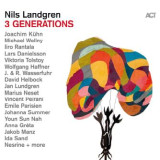
Nils Landgren war und ist das Rückgrat der ACT-Familie. 40
Alben als Leader und weitere 20 als Produzent und Solist
sind bisher auf dem Label erschienen. All diese Rollen und
damit verbundenen Qualitäten kommen auf ‘3 Generations‘
parallel zum Tragen: Zusammen mit ACT-Gründer und
Produzent Siƽi Loch bringt Landgren, anlässlich des
30-jährigen Label-Jubiläums, drei Generationen von ACTKünstler*innen in verschiedenen Besetzungen zusammen.
Im Jahre 1994, nur zwei Jahre nach Label-Gründung, begegneten sich Siƽi Loch und Nils Landgren erstmals. Kurz
darauf wurde Landgren exklusiver ACT-Künstler. Über sein
Netzwerk kamen in der Folge Künstler*innen wie Esbjörn
Svensson, Viktoria Tolstoy, Rigmor Gustafsson, Ida Sand
oder Wolfgang Haffner zum Label. Auf '3 Generations' sind
Joachim Kühn, Michael Wollny, Iiro Rantala, Lars Danielsson, Viktoria Tolstoy, Wolfgang Haffner, Julian & Roman
Wasserfuhr, David Helbock, Jan Lundgren, Marius Neset,
Vincent Peirani, Emile Parisien u.v.m. zu hören.
dovrebbe essere pubblicato su 11.11.2022

A fascinating thing about jazz is what can arise through force of
circumstance rather than the result of planning. The drummer
scheduled to appear in a trio with Jan Lundgren at the Ystad
Sweden Jazz Festival had to cancel because of the pandemic,
which forced Lundgren to rethink the gig. The pianist - who is
also artistic director of the festival - quickly realised that things
could also work without a drummer. Serendipitously, the name
of Emile Parisien came to his mind... and a new trio was born.
The three musicians had never played together in this
configuration before; so, after a single day of rehearsals, the
band took to the festival’s main stage on 1 August 2020.
Jan Lundgren is one of those pioneers who gave European jazz
its distinct identity and freed it from American jazz. The Ystadbased pianist combines virtuosity, an acute sense of tonal
colour, awareness of form from European classical music and
his own folk music tradition. For him, to make music where
many different genres coalesce is both inevitable and natural.
Lars Danielsson’s bass playing is unmistakably melodic and
lyrical. He is one of just a handful of bassists who stand out
both as creative composers and as distinguished band leaders.
Technical brilliance, outstanding musical imagination and an
almost telepathic understanding of his fellow musicians - his
presence is ideal in this trio.
Soprano saxophonist Emile Parisien found his way into this
band practically out of nowhere. The vivacious Frenchman lives
jazz with body and soul and his honesty and authenticity ring
true in every note he plays. Parisien is a visionary of jazz,
aware of its legacy but always looking forward in an innovative
way.
This unique performance leaves the listener begging for more.
Having started this new venture so auspiciously, Jan, Lars and
Emile are surely going to want to aim even higher.
Recorded live in concert by Mattias Dalin (Eurosound AB) at
Ystad Sweden Jazz Festival, August 1, 2020. Mixed by Bo
Savik, Jan Lundgren and Lars Danielsson at Tia Dia Studios,
Mölnlycke, Sweden. Mastered by Bo Savik.
dovrebbe essere pubblicato su 03.12.2021

All music improvised by Michael Wollny, Emile Parisien, Tim Lefebvre
and Christian Lillinger (except ‘Nostalgia for the Light’, written and
arranged by Michael Wollny).
The music we hear doesn’t fit into any category. We’re in uncharted
territory, so a good way to capture its essence might be to break it
down into its four component parts. First there’s Michael Wollny, here
for the very first time playing only on electronic keyboard instruments.
He creates a characterful world of retro-futuristic sounds that is very
much his own. We find the occasional nod to early Jean-Michel Jarre,
references to science fiction and horror movies and also vivid
memories of the sounds of avant-garde Krautrock: Can and Irmin
Schmidt and Klaus Schulze.
As for Tim Lefebvre, here is a musician who has plied his very great
craft with stars such as David Bowie, the Tedeschi Trucks Band, John
Mayer, Knower, Steely Dan, Elvis Costello and Wayne Krantz. Here
he is like a rock in a tempestuous sea. He propels the music forward
with a combination of bass and effects. He builds structures and
tames unruly elements. The way he lays down a groove is
overwhelming.
As a counterbalance we find the explosive yet highly sensitive playing
of drummer Christian Lillin-ger. He stacks layer upon layer of rhythms
and textures.
And the melodic lines of Emile Parisien on soprano saxophone
always have an astonishing springy inventiveness. Such is Parisien’s
latent energy, it seems as if at any moment he could suddenly
become airborne.
The players’ eager curiosity as to what the next turn, the next
impulse, the next push will be is palpable to the listener. One can
sense the tension between the urge to construct forms, lines,
grooves, harmonies, textures, versus the illicit joy of tearing such
fragile structures apart before they have even been heard. There are
beats and patterns from the 90s, 80s and 70s, all coalescing into
cinematic bacchanalia of sound. These four master improvisers and
composers all have the urge to rewrite the rules of their musical world
- and to do so in real time.
LP pressed on 180g vinyl with digital download code.
dovrebbe essere pubblicato su 30.04.2021

‘Hörtest-Edition IV - Visions of Jazz’ is a listening experience to be cherished. It offers a specially curated programme which can be compared across different media and in various formats. Enjoy an audiophile adventure in perfect sound quality: the 180gram LP, cut at half speed, has been subject to the most exacting demands during the pressing process, rendering the quality of a turntable audible. Compare the special features of vinyl with the strengths of a conventional audio CD, or alternatively feast your ears on the sound quality attainable in the hi-res world of 24-bit. For this listening experience, ACT has curated a selection from its current releases by renowned artists, all recorded and produced to the highest standards and with an uncompromising focus on sound quality. Test… compare… but above all, enjoy the music. Under the motto ‘Visions of Jazz’, ‘Hörtest-Edition IV’ presents a multi-faceted kaleidoscope of current jazz. This ‘Hörtest-Edition’ includes gatefold 180g LP, CD and 24Bit high resolution digital download files. Curated and compiled by Marco Ostrowski.
Ordina ora e ordineremo l'articolo per te presso il nostro fornitore.
