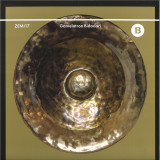
The Gamelatron is many things; one could call it a sculpture, a multimodal installation, an instrument, a robot, a feat of engineering, a vision—and it is all of these things. More importantly, though, it is a concept sustained by Aaron Taylor Kuffner, aka Zemi17, whose Gamelatrons are “sound producing kinetic sculptures” designed to create an immersive, visceral experience for the listener. Not a small feat, and yet the ambitions of Zemi17 are absolutely realized in this long-standing project, culminating now in his third release for The Bunker NY: Gamelatron Bidadari.
The Gamelatron Bidadari is not just a name—it is one of seventy-plus musical sculptures that Zemi17 has conceptualized, designed, and fabricated. Therefore, it would be inaccurate to think of this release as simply a series of arrangements composed in a finite period of time. Rather, it’s a window into a project and a process that is much larger than any single album can encapsulate. Gamelatron Bidardi is the culmination of more than a decade of work, and is central to Zemi17’s evolution, not only as a musician but as an artist.
Having studied gamelan for many years in Indonesian villages and at the Institut Seni Indonesia in Yogyakarta, Kuffner is a musician, an artist, technologist, and craftsman. The gongs in his sculptures are co-created with master Indonesian artisans. Each Gamelatron composition is site-responsive, meaning its sounds are composed for the acoustics and intentions of the space it inhabits, whether it’s an art gallery, a wooded landscape, or the inner temple of Burning Man. The Gamelatron does not stand alone: it is in constant co-creation with its physical environment, and in dialogue with gamelan’s long-standing history.
Originally exhibited at the Smithsonian Renwick as part of a show entitled, No Spectators: The Art of Burning Man, the Gamelatron Bidadari produces sounds that are delicate yet strong, and deeply hypnotic. Textured chiming creates intricate polyrhythmic patterns that are both complex and simple, or in a word, elegant. On Gamelan Bidadari, Zemi17 refrains from adhering to the strict musical structures; his approach to composition is free flowing.
He says, “I want to evoke what the music tells me it has to offer. It is like following water to its conclusion (or non-conclusion).” The arrangements on this album, written by Zemi17 and performed by the robotic arms of the Gamelatron, leaves the listener feeling enchanted, nourished and enriched.
A sense of the mystical comes through in the tonal quality of the instrument, and is conceptually felt in the sculpture’s name: the Bidadari, which loosely translates to “forest nymph.” The music conjures up natural wonder, and the four sculptures that make up the Gamelatron Bidadari, in fact, resemble trees. They are four independent yet connected entities, each with a large gong situated at their structural base—the sonic “roots” of the sculpture—while smaller gongs branch off of a golden, trunk-like spine. The Gamelatron Bidadari is as physically stunning as it is mesmerizing to the ear. A kind of divinity is invoked through its sound, or a sacred cohesion between past and present, tradition and new form. Meant to be viscerally experienced, the sounds of the Gamelatron call for sublime togetherness. Gamelatron Bidadari is not just an album but the crystallization of Kuffner’s work; it is a condensed yet spacious glimpse into the sonic power of Zemi17’s Gamelatrons, which have already been heard and experienced live by over a million people.
Buscar:engine one
Formed in 1996, Goatsnake was an ultra-heavy, blues-doom powerhouse consisting of guitarist Greg Anderson (Engine Kid), vocalist Pete Stahl (Scream, Wool) and the mega rhythm section of Greg Rogers (drums), Guy Pinhas (bass) from underground heavy legends The Obsessed. The band’s tenure has ebbed and flowed for over two decades, leaving behind a legacy of legendary live shows and classic albums and EP’s.
VERY LIMITED QUANTITY OF BLACK VINYL FOR UK.
Goatsnake’s classic debut album— appropriately entitled 1 (one)— was originally released by Man's Ruin Records in 1999 on CD and LP formats. The album featured 8 songs that gracefully combined monolithic, Sabbath-y riffs with soulful vocals to create a monumental introduction to the band, and a style that would be influential for years to come.
- A1: Hortense & The Sound Dimension - People Make The World Go Round (Version)
- A2: Leroy Wallace & The New Establishment - Far Beyond (Version)
- A3: Sound Dimension - Face Man (Version)
- A4: Fabian & The Vibes - Mother & Child (Part 2)
- A5: Lennie Hibbert - Go For Yourself
- B1: Dub Specialist - Chainey Roots
- B2: Brentford All Stars - The World Is A Ghetto
- B3: The Jay Tees & Brentford Rockers - Forward To Jah (Part 2)
- B4: Roy Richards - Summertime
- C1: Lennie Hibbert - Snow Bird
- C2: Pablov Black - Dread Head
- C3: Cedric Im Brooks - Glory To Sound
- C4: Jackie Mittoo - Lazy Bones
- D1: Dub Specialist - Message From Dub
- D2: Jackie Mittoo - Sunshine Of Your Love
- D3: Roland Alphonso - Tenor Man Trip
- D4: Ernest & The Sound Dimension - Surfin' (Part 2)
This new Studio collection on Soul Jazz Records delves deep into a melting pot world of reggae and funk and dub created at the music laboratory of 13 Brentford Road, Kingston in the 1970s - an intense collaboration of crack musicians, singers, DJs and engineers under the guidance of producer Clement 'Coxsone' Dodd. Here you will find some of the deepest and rawest cuts to emanate out the Studio One factory - truly hypnotic rhythms, powerful funk guitar and bass, soaring horns and more interspersed with occasional vocals and toasting as musicians reach for the highest heights and deepest roots of reggae music.
180 gram Vinyl reissue originally released in 1983
Produced & Arranged by: Earl Morgan
Vocals: Earl Cunningham
Backing Band: The Roots Radics
Drums: Lincoln Valentine 'Style' Scott
Bass: Errol 'Flabba' Holt
Lead Guitar: Eric 'Bingy Bunny' Lamont
Rhythm Guitar: Eric 'Bingy Bunny' Lamont
Organ: Wycliffe 'Steely' Johnson
Piano: Wycliffe 'Steely' Johnson
Recorded at: Channel One Recording Studio, Kingston, Jamaica
Engineer: Anthony 'Crucial Bunny'/'Bunny Tom Tom' Graham
Voiced & Mixed at: Tubby Recording Studio, Kingston, Jamaica
Engineer: Winston 'Professor' Brown
Advertising in Black Echoes and Record Collector Magazine
A return to form after the departure that was 1980's muddled Panorama, the Cars' Shake It Up bursts forth with a rich assembly of synthesizers, drum machines, electronic blips, and catchy melodies that make it an early 80s pop staple. Known the world over, the famous title track proves the band's arrangement skills were in perfect shape and set the stage for a record overflowing with memorable hooks and complementary rock riffs.
Shake It Up also plays witness to primary songwriter/vocalist Ric Ocasek's increased cynicism and biting wit. While the Cars never took a rosy-eyed view of romance, the songs here impart a newfound sense of sympathy, regret, limbo, and reservation. The beauty of the Cars – and all ten tunes here – is that the music suggests something else entirely. Such subliminal emotions and dynamic contrasts act as a magnet, and the band plays as if it's in on the secret.
Apart from the party vibe of the title cut, the Cars aim for deeper targets and smarter undertones. Shake It Up is defined by an urban edginess and modern feel that comes alive on tunes such as "Cruiser" and circular "I'm Not the One," a pop gem laded with stacked vocals and keyboard lines that double as a horn section. The band's arrangements have never been better – or more involved. Absent the cheesiness that would mar the group's late-period work, the songs ride on the strength of keyboard-heavy lines and layered harmonies. You will not be disappointed.
Recorded at the band's Synchro Sound studios by famed Queen producer Roy Thomas Baker, the album takes advantage of electronic textures and varying timbres in immersing the listener in accessible albeit abstract washes of sound. MoFi's engineers made sure to capture every note and nuance; this marks the first time that Shake It Up has been remastered in any way, let alone from the original tapes.
Very limited vinyl pressing, 500 copies in a full colour single outer sleeve and full colour printed lyric inner sleeve, housing black and white smoke effect vinyl. Two albums in and London’s Grave Lines, purveyors of ‘heavy gloom’ have already carved a unique niche in the myriad spheres of heavy music. Their first album ‘Welcome To Nothing’ set the tone for their distinct take on doom metal, which was broadened even further with album two ‘Fed Into The Nihilist Engine’. An epic feast of hard ‘n’ heavy riffs coupled with brooding sadness interspersed with thoughtful transcendent moments of introspection. Never a band to rely solely on trotting out those ‘doom metal’ tropes, the band began to weave in gothic and experimental elements into their music, to delve deeper into the dark shadows of the psyche. Now with their third album ‘Communion’ Grave Lines continue their exploration into the ugliness of the human condition, at the same time becoming a band that truly defies any pigeonhole. Continuing to hone and evolve their collective vision and aided by the masterful production of Andy Hawkins at The Nave Studios, 'Communion' sees Grave Lines creep further into the various corners of their sound. In a nutshell ‘Communion’ is a violent descent of bile-soaked intensity spiralling between filth laden swagger, and fragile mournful lament. The album delves into the internal aloneness of existence and the failings of the human connection. Owing as much to Bauhaus and Killing Joke as it does to Black Sabbath or Neurosis, there are moments of gut wrenching doomed up heaviness and bellowing noise rock, contrasting with ambient gothic passages and a thoughtful melancholy, to a create a powerful new chapter in their ceaseless journey through the gloom. The seven tracks act as distinctly separate representations of the album, each individually mirroring the remoteness of human consciousness. Opening track 'Gordian' doesn't waste any time, a burst of feedback kicks you straight into a filthy low slung punked up stomp before the band switch mood to drop off into a doom abyss, singer Jake raging at the void. 'Argyraphaga' continues the pummelling groove, gradually descending into nihilistic sludge. In direct contrast the sprawling atmosphere of 'Lyceanid' travels through the darkness. Jake’s vocals harnessing the spirits of Scott Walker and Mark Lanegan in equal measure. The rest of the band (on top form throughout) focus the dynamics over eleven enthralling minutes, as the song builds and builds to a towering crescendo before finishing with a plaintive acoustic coda. This is pure Grave Lines’. An immersive blend of darkness and light. 'Tachinid' is a violent palette cleanser, harsh industrial synths astride a hateful droning spoken word sermon. 'Carcini' is soaring melancholic doom, with the band at their most melodic whilst still able to crush the listener. Broodsac, with its circular riffs, is all gothic post punk noise rock meets fuzz fat riffs, and album closer ‘Sinensis’ offers a final delicate, melancholy moment of calm before launching into an industrial charged grind into oblivion. Grave Lines’ fusion of elements makes them one of the most powerful and mesmerising bands inhabiting the heavy music world at the moment, and with ‘Communion’ they have crafted an album that encapsulates their distinctive dynamic perfectly. ‘COMMUNION’ will be released in deluxe black and white smoke effect vinyl, housed in a full colour single sleeve with download included, CD and all digital platforms
King Tubby and Producer Bunny ‘Striker’ Lee are intertwined in the birth of Dub Music. After discovering a mistake that made a ‘serious joke’ (more of which later...) they went on to release the first pressings of this new musical genre namely ‘Dub Music’. Tubby’s vast knowledge of electronics and Bunny’s vast catalogue of rhythms would lay the foundations of what today is taken as a standard... the Remix / Version cuts to an existing vocal tune.
Osbourne ‘King Tubby’ Ruddock was born in Kingston, Jamaica on 28th January 1941 and grew up in the High Holborn Street area of downtown Kingston. He studied electronics at Kingston’s National Technical College and also on two correspondence courses from the U.S.A... When he had qualified Tubby began repairing radios and other electrical appliances in a shack in the back yard of his mother’s home. His work in the early days included winding transformers and building amplifiers for Kingston’s Sound Systems. Tubby built his first Sound System in 1957 playing jazz and Rhythm & Blues at local weddings and birthday parties. His reputation as a man who knew and understood both electronics and music grew steadily and as the sixties drew to a close. Tubby purchased his own basic two track equipment. He installed this alongside his dub cutting machine, a homemade mixing console and his impressive collection of Jazz albums in the back bedroom of his home at 18 Dromilly Avenue which he christened his music room.
Tubby and Striker were at Treasure Isle Studio’s one day while Ruddy from Spanish Town was working with the engineer Byron Smith....
“Tubby and myself was talking when Ruddy was cutting some dub but Smithy (engineer) made a mistake through we were talking and forgot to put in the voice. It was two track recording in those days. Ruddy said ‘No Man! Make it stay! and so they cut the rhythm. When I went over to Ruddy’s that Saturday night a dance was in progress and when they played the vocal to the tune... then he said we’re going to play ‘Part Two’. They never called it ‘Version’..and then he played the rhythm track. The song was a catchy song and everybody started to sing along and the deejay started to toast so everything went down well. On Monday morning I went up and I said ‘Tubbs the mistake we made was a serious joke. It mash up Spanish Town! The people went wild. So you have to start to do that now ‘cause when the man put on the ‘Part Two’ everyone start singing this song. It played about twenty times. I said you try Tubbs!’...Well the next Saturday night now when Tubby strung up down the farm U Roy said he’s going to play ‘Part Two’ but Tubby did it different now. He started with the voice then dropped it out and let the rhythm run and then he brought in the voice in the middle and from there Tubby started to get really popular.’’
Bunny ‘Striker’ Lee
Dynamic Sounds upgraded to sixteen track recording in 1972 and Tubby purchased, again with the help of a deal brokered by Bunny Lee. The old four track equipment and the MCI console from their Studio B. The four tracks now gave him far wider scope to work with and he began to create a new musical form where the bass and drum parts were brought up while the faders allowed Tubby to ease the vocal and rhythm in and out of the mix. It was only a matter of time before Tubby’s dub plate experiments began to make it on to vinyl and the first ever long-playing King Tubby releases would feature a collection of his mixes to a selection of Strikers rhythms. So please sit back and enjoy this historic set of sounds, mixed by King Tubby and Mr Prince Phillip Smart and another set of scorcher Bunny Lee rhythms.
Lasse Marhaug is one of those characters that operates at the nexus of so much stuff that’s important to us here - working as a producer (over the last couple of years alone he’s helped shape albums by Jenny Hval, Kelly Lee Owens, Okkyung Lee, Hillary Woods etc etc), a mastering engineer (far too many releases to mention), a prolific sleeve designer (likewise), publisher (his occasional Personal Best magazine is still going strong) and, perhaps most importantly - a recording artist in his own right. ‘Context’ is his most substantial release in years - a crushing assembly of bone-dry/darkside drone/machine malfunctions that’s bursting with a visceral, throbbing, mass of feeling. If yr into anything on the spectrum from Mika Vainio to Grouper to Kevin Drumm or Deathprod - this one’s as good as it gets
Over almost three decades of activity, Marhaug has carved out notoriety as a solo performer, a prolific collaborator (working with everyone from Sunn O))) to Jim O'Rourke) and as a busy producer, who's notched up credits on some of the most striking-sounding albums of the last few years. This new album was created as a swan song for the infamous Oslo studio that he's inhabited for 17 years, prior to his move back to the Arctic Circle where he originally came from. Recorded over a 14-month period and painstakingly edited from hours upon hours of material, it might just be the most impressive, moving record we’ve heard from him so far.
The interplay between piercing softness and deafening noise is the key to "Context", displaying a philosophy Marhaug has been exploring for years. Few other artists are able to balance chaos and harmony with such ease; Marhaug does it without grandstanding, it's music that sounds as simultaneously beautiful and as daunting as the Arctic landscape he's returning to. At any moment a sound can be alluring or treacherous, like the frozen sun reflecting on a snowy mountaintop. Marhaug's deftness with rhythm and bass emerges on 'Context 3', as he pairs Vainio-esque low-end pulses with crumpled noise and widescreen tones; as disquieting music-box chimes absorbed into the blasted soundscape on 'Context 5', while we're thrust into the freezing cold on 'Context 6', subjected to punctuating gusts of white noise and trapped string loops.
Trust it’s a rare and near-mythical beast, conjuring vast, treacherous soundscapes illuminated with pangs of sentiment that naturally weave strands of his non-musical practice in their psychosensual lustre and gritty attrition. As he steps into a new phase of his career, we're left with a concluding chapter that stands as a summation and open-ended post-credits reveal.
Phillip Smart was one of the great engineers to learn his trade as understudy to the legendary dub master himself Osbourne'King Tubby'Ruddock.
Alongside other luminaires such as Prince Jammy and Scientist,Phillip Smart would step in at the controls when demand for King Tubby studio dubs grew to such an extent that each single release was expected to carry a version/dub flipside.
Phillip Smart moved to the United States in the late 70's and in 1981 opened his successful studio HC&F,Long Island,New York.It produced some sizeable Jamaican Dancehall hits for his two record labels TanYah and Eclipse.
Tracks like Dirtsman's 'Hot This Year' and 'Rikers Island' and most notably artist Shaggy used the studio to work up his massive hits 'Oh Carolina','Big Up' and 'Angel'.
But it's in the heady days of the early 1970's and up to 1976 that we concentrate on for this release.When Version was King and Prince Phillip Smart was at the controls mixing up some fine dubs with Jamaica's finest musicians The Aggrovators.
Working some of producer Bunny'Striker'Lee's rhythms in fine style....hope ypu enjoy the set......
Following the release and subsequent year of our first album, "The Hearth," we began nurturing some new compositions for a second release. This process began similar to the first album, each of working us separately on songs, then bringing the bones, veins, and skin of a track to the rest of The Creux to fully animate. We were all taking off in a lot of directions, which tends to lend greatly to our dynamic sound once harnessed, and it was a good departure after playing "The Hearth" tracks live for two years straight during tours and festivals. We ended up with around 25 or so song frames and delighted that list down to about 12 to lay into. Then, the pandemic hit. We were all separated into our own bubbles, trying to make responsible choices on how to continue writing and recording this record promptly as we had just penned a deal with our new label Freakwave; with a target of releasing sometime in 2020. It was a pretty challenging endeavor for a band that typically relies on each member to bring greatness to the sound. We began experimenting with using virtual jam sessions and shipping files to each other. Luckily, we are all decent home sonic production creators so creating and flying around edits and changes over the months leading up to our time in the studio wasn't tricky. Around the end of Summer 2020, we finally had the demo tracks prepped enough to start working with our engineer and producer, Patrick Hills of Earthtone Studios. He worked with us on our last album and is sort of a special weapon of creativity for what we can pull off. We would send in one member at a time to lay down studio versions of the finals in a separate room from Mr. Hills; mask on, the whole nine. We would fly out the takes each day and make edits, rinse, and repeat. It was tedious and was pretty trippy to make a record in that manner. "Goodbye Divine" took almost a year to finish recording and mixing. So, here we are, in the Summer of 2021, and it is complete and ready for release this October. Expect both departures and arrivals of what you might have predicted following "The Hearth." Yet, this album does, in true Creux Lies fashion, offer a complete range of emotions throughout the album; prepare to find yourself ass shaken, and watery-eyed before you raise the needle on "Goodbye Divine."
With their emotive melodies, propulsive rhythms, angular guitars and dark cinematic electronics, TRAITRS have quickly become one of modern post-punk’s fastest rising independent bands. Consisting of Sean-Patrick Nolan and Shawn Tucker, TRAITRS formed during the summer of 2015 in Toronto, Ontario Canada. The duo recorded demos with producer/engineer Josh Korody (Nailbiter, F*cked Up, Japandroids, Dilly Dally), garnered the attention of Pleasence Records label head James Lindsay and released their debut cassette Rites And Ritual in April 2016. After gaining buzz in the European and North American dark music scenes, TRAITRS released their critically acclaimed LP Butcher’s Coin (Pleasence Records, Manic Depression Records, Alchera Visions) in May 2018. Backed by the strength of lead single ‘Thin Flesh’, the duo embarked on a series of lengthy tours overseas, performed in over a dozen countries including showcases at Wave Gothik Treffen, Castle Party, Extramuralhas, Nocturnal Culture Night, Wavefest, Canadian Music Week and Pop! Montreal. Their relentless touring schedule and work ethic caught the attention of Schubert Music Publishing’s Thomas Thyssen and Eric Burton, and in October 2020 they announced TRAITRS as the first signing to their brand-new record label Freakwave Records. This year, TRAITRS will release ‘The Sick, Tired And Ill’ EP on July 30 and the full-length LP ‘Horses In The Abattoir’ on November 19.
The Grateful Dead’s first tour outside of North America was immortalized on Europe ’72, a triple live album that distilled peak moments from the 22 shows the band played in six countries for thousands of Europeans. A triumph critically and commercially when it was released in November 1972, today the double-platinum album is an integral part of the Dead’s live legacy and beloved by generations of fans. Appreciation for the extraordinary tour grew in 2011 when every show was released in the unprecedented, 73-CD boxed set, Europe ’72: The Complete Recordings.
Today is the 50th anniversary of the first show from the Dead’s European adventure. It took place on April 7, 1972, at Wembley Empire Pool in London. To mark the milestone, Rhino and Dead are announcing a series of upcoming releases and events connected to the celebrated tour.
A newly remastered version of the original Europe ’72 album will be available on July 29. EUROPE ’72 (50th ANNIVERSARY EDITION) arrives in 3-LP. All of the new 50th anniversary editions were mastered by Grammy® Award winning engineer David Glasser with newly restored audio by Plangent Processes.
Very few copies in on this. Limited to 350 2LP’s pressed at 45RPM Black vinyl, pressed at Kindercore in Athens, GA, housed in “bootleg-style” hand-stamped and numbered LP jacket. Lacquers cut by Bob Weston at Chicago Mastering Service. Mixed by John Congleton w/ Jeremy Lemos and Steve Shelley." In the summer of 2009, Sonic Youth drummer Steve Shelley and the band’s long time sound engineer, Jeremy Lemos, invited Lemos’ White/Light bandmate Matt Clark and Chicago spacepunx Disappears to come over to Lemos’ Semaphore Recording studio and jam. Their one-afternoon, two-drummers, three-guitarists, no-rules jam evolved into a productive and glorious multi-day freakout, which resulted in the recording of these eight songs. Producer John Congleton (St. Vincent, Angel Olsen) later mixed the marathon session with Steve and Jeremy at Echo Canyon West in Hoboken, NJ.
More than 20 years after its release, Arab Strap’s second album is reissued on vinyl.
Philophobia was recorded on the outskirts of Glasgow in the early incarnation of CHEM19 Studios with engineer/producer Paul Savage & at Cava Studios in Glasgow with engineer Geoff Allan.
Initially released in 1998, it was the follow up to the band’s 1996 debut The Week Never Starts Round Here. Instrumentally ambitious, Philophobia is adorned with sepulchral guitar, trumpet, cello & Scottish rainfall, providing a most beautiful backdrop to Aidan Moffat’s bold lyrical presentation as he articulates experiences most of us are too embarrassed to even think about; confessional, intimate, insightful and hilarious, ‘Philophobia’ remains a literate & musical revelation. ‘Philophobia’ - (from Greek "φιλέω-φιλώ" (love) and "φοβία" (phobia)), is the fear of falling in love / emotional attachment.
- A1: Season For Love (3:06)
- A2: The Twelfth Of Never (2:25)
- A3: Trying To Understand A Woman (2:27)
- A4: When A Boy Falls In Love (2:38)
- A5: The Shortest Distance (0:36)
- B1: Hurt So Bad (3:16)
- B2: Walking On My Love (3:02)
- B3: Wichita Lineman (3:21)
- B4: Let's Try It Over Again (2:09)
- B5: The Magic Of Love (2:47)
2022 re-press, 180g vinyl
A monumental force firmly rooted in the soul canon, Willie Hutch is most notable for recording two of the best Blaxploitation soundtracks, The Mack and Foxy Brown. Yet his legacy is much greater. Outside of Marvin Gaye, Stevie Wonder and Smokey Robinson, Hutch was arguably Motown's top male solo artist of the 70s. Prior to his association with Gordy et al, Hutch crafted his opening statements for RCA, two vital LPs that Be With Records is honoured to present today.
Often-overlooked, his second album Season For Love (1970) is a must for all deep soul fans and has been sought-after by collectors of different stripes for decades. Whereas his debut featured thundering, gritty numbers, Hutch treats us to a mellower soul here - sumptuous, warm and string-led. He compared his approach to that of Otis Redding and there are definite parallels, from the raspy, rough-hewn vocals that tend to roam between sweet and deeply impassioned to the horn-heavy, emphatic sonic backdrops.
With flawless originals presented alongside a few well-chosen classics (his stunning cover of "Wichita Lineman" arguably bests the original's splendour), it's easy to see why sample-based musicians have been falling over themselves to plunder from this album. Witness the sweeping strings that grace "The Magic Of Love" and the heartbreaking "Walking On My Love", the mellifluous guitar work on the contemplative instrumental "The Shortest Distance" and gorgeous single "When A Boy Falls In Love".
Whilst the arrangements and playing are subtly jaw-dropping throughout, Hutch's uncontrived voice has a certain warmth to match a Nat "King" Cole and a purity of tone that even recalls the great Sam Cooke. Indeed, a few numbers are almost in a jazz vocal territory reminiscent of artists Lou Rawls. That's not to say that others lack the righteous energy and undeniable groove of Willie's later sound.
Remarkably consistent throughout - a rare commodity for many 70s soul albums - the lack of one signature song likely hindered its progress. Regardless, it deserved to make more of an impact and now, paired with the majestic debut, Soul Portrait, these recordings shine a new light on the early work of a soul legend.
Original vinyl copies of this album are extremely rare - and correspondingly expensive - so we're thrilled to present the first ever vinyl reissue of a true lost classic. This release is officially licensed and has been remastered for vinyl by our esteemed engineer Simon Francis. It has been pressed on audiophile 180g vinyl for the first time and features the original, rarely seen artwork.
Pye Corner Audio releases a new album, Let’s Emerge!, for Sonic Cathedral. It’s his first studio outing for the label following the acclaimed live recording Social Dissonance, which came out earlier this year, and it features Ride guitarist Andy Bell playing on five of its ten tracks. From the first glimpse of the artwork to the first note of the music it’s a marked deviation from Pye Corner Audio’s more traditional shadowy sounds. Whereas his last outing for Ghost Box (2021’s Entangled Routes) was inspired by the underground fungal pathways through which plants communicate, this one is very much above ground, bathed in sunlight and acid-bright psychedelia.
“This is a departure to sunnier climes, but a departure nonetheless,” says Pye Corner Audio, aka Martin Jenkins. “It’s something that I’d been thinking about for a while. I try to tailor my work slightly differently for the various labels that I work with, and this seems to fit nicely with Sonic Cathedral’s ethos.” Designer Marc Jones’ bold and ultra vivid artwork consciously references the likes of LFO, Spacemen 3 and the early output of Stereolab. “I think it mixes together many of my earliest influences,” explains Martin. “I’ve been a long-time fan of Spacemen 3 and Stereolab.
Their moments of repetition and drone have always seeped into what I’ve tried to create.
“I was living in a small apartment and I’d stripped down my studio set-up when I was recording this album. This enabled me to focus on a few key pieces of equipment and explore them fully.” The recordings were fleshed out by Andy Bell, who Martin first met at the Sonic Cathedral 15th birthday party at The Social in London back in 2019 – the same show that became the live album Social Dissonance.
“New alliances were formed and friendships made in that basement in Little Portland Street,” recalls Martin. “When I met Andy, we agreed that we needed to work together in some way. After I’d remixed a few tracks from his album The View From Halfway Down, he kindly repaid the favour.” The end results – mastered in New York by acclaimed engineer Heba Kadry – are incredible, from the first stirrings of opener ‘De-Hibernate’, via the glorious ‘Haze Loops’ and ‘Saturation Point’, the album slowly but surely awakens, blinking and feeling its way into the light. It all culminates in the epic closing track ‘Warmth Of The Sun’ which, with its vocal harmonies and acid breakdown, is seven and a half minutes of pure release.
“That one’s about life’s simple pleasures,” concludes Martin. “The Beach Boys, tremolo guitars, infinite drones, Spacemen 3. Let’s emerge from this darkened era and feel the ‘Warmth Of The Sun’. “The last few years have seen huge changes, both personally and in a wider perspective. The album title is a reaction to this, a collective (tentative) sigh of relief. Here’s to new beginnings and a sense of hope.”
- 1: Connais Tu L'animal Qui Inventa Le Calcul Integral?
- 2: Evariste Aux Fans
- 3: Les Pommes De Lune
- 4: La Chasse Au Boson Intermédiaire
- 5: Dans La Lune
- 6: La Faute À Nanterre
- 7: Ma Mie
- 8: Wo I Nee
- 9: Si J'ai Les Cheveux Longs C'est Pour Pas M'enrhumer, Atchoum!
- 10: La Révolution
- 11: Je Ne Pense Qu'a Ça
- 12: Je Chante Pour Vous Faire Marcher
- 13: Je Ne Suis Pas Simple
- 14: Si Les Étoiles Pouvaient Parler
Évariste is one of the rare specimens of artist-cum-scientists. Among his kind stand others like Pierre Schaeffer, a Polytechnique graduate (an engineer but also the father of musique concrète) and the eccentric Boby Lapointe (graduate of the École centrale and inventor of the Bibi-binaire system, patented in 1968). Évariste's songwriting, joyful and full of energy (albeit extremely critical), shrouds an original tragedy: born in 1943 among résistants, Joël Sternheimer (aka Évariste) grew up without a father, lost to Auschwitz. Although he makes little reference to Jewish culture in his music, his origins leave their mark: in 1974, he sings a Hebrew song on television. In 1966, the young Joël sports Princeton's colourful paraphernalia - that's because he's freshly returning from the US, where he was sent to pursue his research on "particle mass and the interpretation of observed regularities, such as the effects of a wave" (will understand who may). When he gets there the country's in the midst of the Vietnam War. With McNamara keen to find an alternative to the nuclear weapon and calling upon the country's biggest brains to undertake the task, there's a "fund shift" within the university - a diplomatic way to give notice to whoever may not be disposed to follow the government's scheme. Joël, who's under the supervision of a rebellious physician, is dismissed. He regardless keeps following the prestigious seminaries of the Institute for Advanced Study, chaired by Oppenheimer, inventor of the atomic bomb. Likely inspired by the hippie movement and music, Joël buys a guitar and starts playing in Washington Square - after all, Bob Dylan himself started there. He blithely skips Oppenheimer and receives a warm (though surprised) welcome from a crowd thoroughly unfamiliar with French. When the ageing physicist questions him about his decreasing attendance, Joël explains how drawn he is to music, and how he thinks it could help him in self-financing his research. Évariste recalls seeing the sickened man, his face torn by remorse, lighten up to his words and say: "What's keeping you - go for it! If I was still young that's exactly what I'd do." The student takes these words as a testimony from his professor - and it's enough to convince him . And so he takes the leap during the Christmas vacations he spends in Paris. A journalist friend he often sees around the Sorbonne introduces him to the artistic director of Disques AZ. The latter passes the tapes on to the label's boss, Lucien Morisse, also program manager on Europe N°1. Morisse is blown away - and signs him onto the label right away. Michel Colombier, arranger for Serge Gainsbourg and co-author of "Psyché Rock", with Pierre Henry, contributes some of his original ideas to the 7 inch "E=mc2": Évariste's preoccupation with the percussion sound on the track "Le calcul intégral" is that it goes "poom poom" and not "tock tock" - Colombier is aware of the issue and records Évariste's guitar like a percussion in an isolated booth. The organist Eddy Louis, who is to participate, in 1969, to the success of Claude Nougaro's "Paris mai", also appears on the record. It's 1966 and the Antoine phenomenon (signed on Vogue) storms through France. The two singers share similarities: Antoine is an engineer of the École centrale, gifted with a great originality in his song-writing. A godsend for the two labels who turn this resemblance into a commercial strategy, setting them out as rivals. To this day though, Évariste still denies what was little more than slushy tabloïd gossip. Success comes around swiftly and in 1967 Évariste launches into a second 7 inch, "Wo I nee", again arranged by Michel Colombier. Quantum mechanics fans finally get their anthem with "La Chasse Au Boson Intermédiaire" (or the "Intermediary Boson Pursuit"). To sum up what's a boson, say he's a close pal of the meson, photon and other gluons. A few months later, it's May 68 and everything's turned upside down. Évariste writes a series of songs inspired by the events, which he immediately submits to Lucien Morisse. When the man behind "Salut les copains", once married to Dalida, hears the song "La révolution" - a father and son dialogue - he can't take any more: AZ simply cannot release this. But there and then Lucien Morisse makes a gesture which will remain engraved in French music's history: sorry to be unable to officially stand by the singer, he encourages him to self-produce the record, but with his tacit support. He calls the pressing factory and asks they apply the same rate for Évariste as they would for AZ. The singer and his musicians use the same studio as for the previous record, all of them playing for free awaiting a return on investment. Évariste keeps singing at the Sorbonne with "Jussieu's gang" and "the young Renaud" he nicknames "le p'tit gavroche" (or "street urchin"). Renaud volunteers to type the lyrics of the song "La révolution" so that the chorus can be sung and recorded. A boy in the group is related to Wolinski and introduces them. The two get along so well that Wolinski ends up drawing the cover for the record "La révolution", for free. The self-released 7 inch "La révolution / La faute à Nanterre" is sold under the table and door-to-door for half the price of a standard record, on and around the boulevard Saint-Michel; and it runs out fast. In the end, there will be 6 releases of the record, and 25000 copies sold. When the theatre director Claude Confortès decides to adapt Wolinski's drawing series titled "Je ne veux pas mourir idiot" ("I don't want to die a fool"), he asks Évariste to write the original soundtrack. His friend, now cartoonist for Hara-Kiri Hebdo, often promotes him in accordance with a principle dear to him by virtue of which he gives a special place to his friends. Dominique Grange (writer of the song "Nous sommes les nouveaux partisans") soon joins the team. After 150 performances, Évariste leaves his place to Dominique Maurin (brother of Patrick Dewaere). Évariste composes the songs for Claude Confortès' next play, "Je ne pense qu'à ça" ("That's all I think about"), co-wrote with Wolinski in 1969. The comedians of the play record the songs on a 7 inch, with a cover signed, again, by Wolinski. In 1971, French television produces the documentary "Évariste et les 7 dimensions", but doesn't air it. Indeed, the scientific sub-comity of the programming comity (sic) censors the show. The given justification is that "Évariste dangerously mixed science with science-fiction, numerology and other non-scientific disciplines". The underlying motive might have been a will to censor the singer-mathematician's political discourse. In the documentary and among other things, Évariste discusses hierarchy, alienation and revolution. Half a century later the documentary remains invisible, though some excerpts resurfaced in 1992 in the cult show "L'oeil du cyclone", on Canal +. Though flourishing, Évariste's career is nearing its end. 1970 is the beginning of a decade in the course of which he is to make a decisive discovery in the musical and scientific domains. Following this breakthrough, he moves away from self-produced music and gaucho magazines to focus on science. He keeps Oppenheimer's encouraging words in mind, now freely pursuing his research thanks to the sales of his records. Joël realises that when decoding protein sequences, one finds musical sequences recognisable to humans. He names them "proteodies". If, when listening to a proteody, one responds by being so sensitive as to finding it beautiful, then it reveals a deficiency of the related protein - and this peculiar music may be the cure. We could trace back the music history in light of proteins lacking in a given artist, or within a public's majority. You always thought these hysterical groupies who'd throw their underwear with passion and faint in the pit had miraculously appeared because they had never heard anything as wonderful as the Beatles? Make no mistake! For Évariste, it all boils down to an intro's protein content. Indeed, the beginning of their first hit "Love Me Do" corresponds to dopamine, the neurotransmitter linked to compulsive buying. An intro like this could only unleash the fervour of groupies, victims of fashion and biology. Évariste's success is such that the income from his sales gives him the autonomy to which he had aspired when confiding to Oppenheimer. It made it possible for him to pursue his research without any institutional constraints. He now devotes himself to his proteodies, sat in the offices of the European University for Research, just around the corner from the Sorbonne he knew so well. Évariste is no more. Joël regained control of this strange and comical beast.
Jazz writer Walter Kolovsky has said that Friday Night In San Francisco "may be the most influential of all acoustic guitar albums." LPs of it have been a demonstration staple on turntables around the world for over 40 years. To celebrate the lasting impact of this singular album and the legendary concert that it represents, Impex Records is proud to announce the long-awaited follow up: Saturday Night In San Francisco.
Working with hours of original 16-track live session tapes, Al Di Meola and his team have brilliantly curated this musical tour-de-force, bringing to life for the first time on LP, SACD-Hybrid and CD the explosively virtuosic final performance of Di Meola, John McLaughlin, and Paco De Lucia at the Warfield Theater in San Francisco, December 6, 1980. In the exclusive essay by music historian Charles L. Granata, Di Meola says of that final night: "It's exciting because the audience was right there with us, savoring every single note of music. And, we were ripping. It was crazy good!"
Impex worked carefully with Di Meola, mixing engineer Roy Hendrickson (SPIN Studio), and mastering engineer Bernie Grundman to recreate the magic of Friday Night In San Francisco so these never-before-released solos and trios burst out of your system with striking clarity, dynamics and technical brilliance. "Crazy good," indeed.
Tim Pinch
Musicians
Al Di Meola guitar
John McLaughlin guitar
Paco De Lucia guitar
Selections
Jazz writer Walter Kolovsky has said that Friday Night In San Francisco "may be the most influential of all acoustic guitar albums." LPs of it have been a demonstration staple on turntables around the world for over 40 years. To celebrate the lasting impact of this singular album and the legendary concert that it represents, Impex Records is proud to announce the long-awaited follow up: Saturday Night In San Francisco.
Working with hours of original 16-track live session tapes, Al Di Meola and his team have brilliantly curated this musical tour-de-force, bringing to life for the first time on LP, SACD-Hybrid and CD the explosively virtuosic final performance of Di Meola, John McLaughlin, and Paco De Lucia at the Warfield Theater in San Francisco, December 6, 1980. In the exclusive essay by music historian Charles L. Granata, Di Meola says of that final night: "It's exciting because the audience was right there with us, savoring every single note of music. And, we were ripping. It was crazy good!"
Impex worked carefully with Di Meola, mixing engineer Roy Hendrickson (SPIN Studio), and mastering engineer Bernie Grundman to recreate the magic of Friday Night In San Francisco so these never-before-released solos and trios burst out of your system with striking clarity, dynamics and technical brilliance. "Crazy good," indeed.
Tim Pinch
Musicians
Al Di Meola guitar
John McLaughlin guitar
Paco De Lucia guitar
Selections
Imperfect Stranger is the pseudonym of Glasgow based soundtrack composer and producer Kenny Inglis. “Everything Wrong is Right” is his debut solo album for Castles in Space.
Born in 1975, Kenny didn't listen to much music, unless it was the opening credits to a TV show or a film score that had caught his ear. "I loved the pre-title music on a lot of those 80's U.S. TV shows. From the family orientated stuff like The A-Team, to darker dramas such as The Equalizer. My mother would let me stay up to watch the opening sequence of the latter then send me to bed because the story would be too heavy for a kid. That left me with this hanging sense of ambiguity as to what would happen in that hour after the titles came up.”
Exposure to a work colleague’s tiny project studio in a kitchen cupboard was a lightbulb moment for him and the experience of utilising music technology as a way of writing and producing entire tracks stirred a wave of determination to chase a career in music using the opportunities that technology could offer. Kenny figured the best way to move forward was to start a small project studio and learn his craft as a recording engineer. "It was a bit of a shock to the system. I literally had no idea how to work any of the equipment. Kenny focused on learning as much about the craft as he could whilst winging his way through recording and mixing everyone from the likes of singer/songwriters to bands, to voiceovers artists and anything in between. "Eventually, I stopped writing the music I thought people would want to hear, and started writing the music I wanted to make. I didn't come from a music loving background, but I was always obsessed by the way music and film would interact - how music brings this atmosphere and tone to even the most mundane visual stuff. I wanted to capture that. I wanted to grab some of that ambiguity I felt from the TV shows of my childhood and make it into a project of some sort". That project was Spylab. A dark, downtempo project with a cinematic edge. The initial demo consisted of three tracks, with the melancholic 'This Utopia' leading the playlist.
"At the time you did demos on normal cassette tapes. I remember having this endless battle with the bias control to try and get the best sound I could on these little tapes. Ten went in the post one Monday morning, and the following Monday there were three offers from three different labels. Studio K7 were interested in a singles deal, as was Flying Rhino in London. But then there was an offer from a Chicago based label by the name of Guidance Recordings. They wanted an album, and were offering a $15,000 advance. It wasn't a difficult decision to make"
Writing and recording Spylab 'This Utopia' began in 1999. The album took a whole year to produce. The album was to catch the attention of Mary Anne Hobbs at Radio One. At the time Mary Anne was presenting The Breezeblock - a late Sunday night show with an eclectic playlist of alternative electronic music. Picking out the album's title track 'This Utopia', Mary Anne would go on to play it no less than 8 weeks in a row. A request for Spylab to DJ on the show was to follow. "I had never DJ'd before. I think I had a week to figure out how to do that and put a playlist together. I'm not entirely sure how I pulled that off.” In March 2001 the Spylab album was finally released to a hoard of excellent reviews. A North American live tour would follow. From the launch party in Los Angeles, to a sell out show at SXSW in Austin. "I then started a new project under the name Cinephile. It had some of the core elements of the Spylab sound but it was deeper, more cinematic.” Kenny received news that a track from the previous project Spylab had been requested by HBO for the first episode of a new TV drama called Six Feet Under. This was to become a major turning point in Kenny's career. The Spylab track 'Celluloid Hypnotic' dropped during a poignant party scene of the first Six Feet Under episode. Within a couple of days Kenny was getting requests for music from other music supervisors. "It was a chain reaction. The Six Feet Under sync was like the tip of an iceberg. One day I called CBS in America and they put me on to the CSI music supervisor and I managed to get on a call with him. I sent the Cinephile stuff out and within a few months I got this fax through from CBS - a quote request for one of the tracks for a potential use on CSI. It changed my life."
The tone and style of Kenny's music sat perfectly with the CSI score requirements. So much so he found himself part of a pool of incidental writers who worked on all three aspects of the franchise - CSI, CSI: NY, and CSI: Miami. This would continue until 2013, when the last of the series would come to an end.
"I was juggling a bunch of stuff for those ten years. Writing material for CSI, whilst releasing new Cinephile stuff and playing live. As Cinephile continued to gather pace, one of the tracks from Kenny's efforts on CSI was chosen for the Hollywood trailer for the Samuel L. Jackson film 'Lakeview Terrace'. Further trailers would follow, from Gangster Squad to Dead Man Down, Spike Lee's Undisputed Truth, to Fifty Shades Freed.
At the same time, Kenny picked up his first factual commissions in the UK, and this too would be the beginning of a regular run of fully scoring factuals and documentaries. By 2021, six of these had won BAFTAs. He also would find himself soundtracking adverts for the likes of Nike, Audi, and American AirlinesIn early 2020, Kenny made a return to focusing on his own music under the pseudonym Imperfect Stranger. A tweet from Colin Morrison from Castles In Space regarding a charity compilation album 'The Isolation Tapes' caught his eye. Kenny had made a start on his debut album as Imperfect Stranger and submitted the track 'Hymn To The Sun' (which would become the lead track on the album). Further discussions ensued, and the album found a home on CiS. "I had been doing TV and film stuff for almost ten years. It paid the bills and was as close to a 'real job' as I'd had, but I yearned to get back to writing for myself, so doing an album for Castles in Space was a joy.
“The music I write is like a diary. There's an authentic narrative to everything i do. I don't write tracks for the sake of writing. I write tracks to diarise and process the stuff that I've lived through, and the experiences that have come along with the passing years. That's what makes me tick. It's a very public and vulnerable way of expressing myself. If people want to know the real me, all they have to do is listen."