Early summer 2019, João Lobo started recording his compositions at les Ateliers Claus in Brussels, with guitarist Norberto Lobo, bassist Soet Kempeneer and recording engineer Christophe Albertijn. The recording sessions were planned over the course of one week, however the job was mostly done in just a few takes. With the addition of some overdubs, the whole process was finalised in a spontaneous wave. It is too simplistic to define Joao Lobo’s compositions with one term, and the association of the album “Simorgh” with this ingenious partnership’s new creations, is inevitable.
While the mix of genres and styles may be easy to distinguish, the focus centres on the result of the mixing: a highly grooving and an occasionally paused and introspective music that seems out of time and out of space. It is difficult to grasp or define a specific period in time or a geographic origin in this fusion of references, as what you listen to is a bold creation of original and surprising elements. Drummers – such as João Lobo – employ a multi-layered concept in their music, weaving the different tracks into a linear wash of sound. He plays the song with the drum set while the other members fly in and out of the compositions, always gathering around their phoenix in order to attain enlightenment.
What João Lobo and many of his contemporaries are up to, can be explained through simple terms as a future exploration of the emotionally expressive possibilities of sound. It breaks away from the conventional order providing space for the discovery of a new order. Simultaneously it allows a more profound and broader expression of what the current reality of music is and represents. It was instantly clear for me that we had to share his music with our audience and create this medium for happiness.
This release is the trio’s debut record, which is the impetus for their personal development in the realisation that features João as a mentor in the creation process. The featured compositions highlight the musicians’ unique physical aspect to control their instruments and their hidden techniques that underlying these tracks. The result is an ongoing aural interplay. It was love at first sound.
This album is a co-release between Les Albums Claus and Shhpuma.
Cerca:engine one
- A1: Samba Negra - Eberebijara
- A2: King Somalie - Monkey 'S Dance
- A3: El Grupo Folclórico - Tamba
- A4: Los Viajeros Siderales - El Campanero
- A5: Rio Latino - Ayu
- B1: Aníbal Velásquez - La Mazamorra Del Diablo
- B2: La Francachela - Mosquita Muerta
- B3: El Grupo Folclórico - Juipiti
- B4: King Somalie - Le Mongui
- C1: El Grupo Folclórico - El Tornillito
- C2: Samba Negra - Long Life Africa
- C3: La Banda Africana - Te Clavo La... Mano
- C4: Myrian Makenwa - El Platano
- D1: El Grupo Folclórico - Tucutru
- D2: Grupo Bola Roja - Caracol
- D3: El Grupo D'abelard - Otro Perro Con Ese Hueso
- D4: Conjunto Barbacoa - Wabali
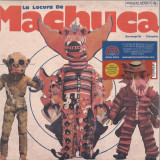
La Locura de Machuca is the story of one man’s bizarre odyssey into Colombia’s coastal music underground, and the wild, hypnotic sounds he helped bring up to the surface.
One night in 1975, a successful tax lawyer named Rafael Machuca had his mind blown in Barranquilla’s ‘Plaza de los Musicos’. Overnight he went from a high ranking position in the Columbian revenue authority to visionary production guru of the newly formed record label that bore his name, Discos Machuca, and for the next six years he devoted his life to releasing some of the strangest, most experimental Afro Psychedelia Cumbias ever produced. La Locura de Machuca is the story of one man’s bizarre odyssey into Colombia’s coastal music underground, and the wild, hypnotic sounds he helped bring up to the surface.
The Colombian music industry was thriving in the mid-seventies, but while homegrown bolero and vallenato tunes were doing well on the charts, it was imported African records that were setting crowds on fire at the picos – the sound-systems that fuelled neighbourhood parties – and wherever those records were played there were always a handful of groups who were inspired to plug traditional Cumbia directly into the electric currents coming from across the Atlantic.
It was these obscure bands, who fused Colombian and African rhythms with the swirling organs and psychedelic guitars of underground rock, that fired Machuca’s imagination. While the label made its money releasing popular hits by legends such as Alejandro Durán and Aníbal Velásquez, that money was poured back into a unique run of experimental releases by fringe artists such as La Banda Africana, King Somalie, Conjunto Barbacoa, and Abelardo Carbono, one of the godfathers of Champeta Criolla.
When Machuca couldn’t find groups to realise his particular vision, he simply created them himself. Drawing on a fearsome roster of musicians associated with the label, he assembled bands that lasted only as long as it took to record an album ,and unleashed the results – complete with arrestingly unusual album covers – under a series of different names such as Samba Negra or El Grupo Folclórico. This unorthodox approach led his longtime recording engineer, Eduardo Dávila, to describes Machuca’s productions as the “B-Movies of Colombian music.”
The story of Doctor Machuca and his eccentric exploits tells of one of Colombia’s most atypical and peculiar record companies; a defining pillar of Afro-Caribbean psychedelia. His productions have come to represent the roots of Champeta and set the pedigree standards for Afro and Costeño avant-garde. The seventeen tracks on La Locura de Machuca, harvested from the darkest, strangest corners of the Discos Machuca catalogue, sound like little else recorded before or since.
On her third album Welsh Music Prize winner Georgia Ruth returns to her roots. Having moved back to her native Aberystwyth ‘Mai’ was recorded in the town’s Grade-II listed Joseph Parry Hall over the course of one week in Spring 2019. Named after the renowned composer and professor, the room was used as a venue for chamber concerts throughout the twentieth century and offered musicians a view of the sun setting over the castle as they worked.
But despite this setting Mai (meaning May) is an intimate collection of songs written from within the depths of a house during stolen moments. At its heart sits a beautiful and simple setting of Eifion Wyn’s poem – ‘Gwn ei ddyfod, fis y Mel’ (I know it’s coming, month-of-honey).
Mai is a meditation on finding hope and renewal in the seasons, in a world where the certainty of Spring feels increasingly fragile.
The album was produced with Iwan Morgan (Meilyr Jones, Cate Le Bon, Richard James) who also engineered mixed and mastered. Additional parts were recorded at his studio in Liverpool. With improvised strings, pedal steel and saxophone sitting alongside harp, the album presents a sound which is both lush and sparse in turn.
Without warning, a group of young girls from a remote region of Benin is shaking up the world of garage rock with breathtaking freshness, ingenuity and energy, playing spot-on, loud and clear.
A musician named André Baleguemon decided to form an exclusively female band rooted in the concerns of its time. He puts the spotlight on the guitar, drums and keyboard, instruments he has admired since his childhood, symbols of modernity in this remote region. His observation is simple: “In the North, girls have no room to advance and women are put aside. I simply wanted to show the importance of women in the societies of North Benin by forming a female orchestra “.
On July 25th, 2016, with the support of the city of Natitingou, André launched a press release on Nanto FM offering to help train girls in music for free. A few days later, dozens of aspiring musicians showed up at the Youth Center. “The girls who came didn’t know anything about music. We selected seven girls of the Waama and Nabo ethnic groups from the surrounding villages, some had never even seen these types of instruments before. “
The girls quickly became passionate about their new musical activities, learning how to play drums, guitar, piano and sing vocal harmonies. Their progress was astounding. An intense work of musical training took place, starting with drum workshops, their favorite instrument. Angelique and Urrice on drums and vocals, assisted by Marguerite, the third drummer. Sandrine is on keyboards, as is Grace, who also sings vocals. Julienne is on bass and Anne on guitar.
André’s determination is one of the key elements of this human and artistic success. The girls have already performed dozens of concerts in the region, forging and expanding an already solid repertoire, while attracting an ever-increasing local audience. In addition to musical progress, he has been personally involved with each family, showing them the importance of his project, both musically and humanly and in particular the fact that each girl must remain in school and not be forced into marriage.
At the end of 2018, their encounter with the young French sound engineer Jérémie Verdier accelerated the course of things. On a mission in the region, he called on his Spanish friends Juan Toran and Juan Serra who showed up with their recording equipment in order to record the band’s first songs in the annex of the local museum. Random encounters and fate led Jean-Baptiste Guillot to hear the tapes. He decided to go meet them at the end of 2019. This short but memorable journey sealed the fate of the record you are now holding in your hands.
First Word Records are extremely proud to welcome aboard Allysha Joy and her first EP
for the label, 'Light It Again'.
Well versed in poetry and performance, Allysha Joy's potent lyricism, unique musicianship and killer vocals have garnered legions of attentive fans the world over. She's an integral member of the Melbourne soul jazz scene, known as part of the acclaimed 30/70 Collective and for her own equally revered solo work.
'Light It Again' is a 4-part expedition across a variety of grooves and deep lyricism that marks a defiant statement of intimacy and hope. Produced and engineered by twice Grammy nominated artist Clever Austin, the EP features accompaniment from an all-star set of Melbourne artists; Horatio Luna, Ziggy Zeitgeist, Danika Smith and Josh Kelly. This EP marks a new sound for the young artist, transmitting her honest and raw expression through the signature crunch and sonic landscape of Clever Austin.
Allysha is already well established across Europe, performing on the live circuit alongside the likes of Sampa the Great, Matthew Halsall, Ezra Collective, Bradley Zero and Children of Zeus, as well as currently hosting two regular radio shows, on Worldwide FM and Reform Radio in Manchester respectively.
Her 2018 debut album 'Acadie : Raw' on Gondwana Records won 'Best Soul Album' at the Music Victoria Awards, was nominated for a Worldwide Award, and featured in many an end-of-year list, including Bandcamp's Top Soul Albums, whilst she's also featured on releases on UK labels such as Rhythm Section, Total Refreshment Centre and now an EP for First Word, 'Light It Again'.
The EP touches on love, shame, mental health, grief & spirituality. 'Watercolours' sets off on a mid-tempo neo-soul jazz tip. Allysha says "I wrote this in the hope that maybe we could all feel the beauty that is present in the every day - in nature, in art, in each one of us mirroring each other so intrinsically. Then maybe we'd all start to live out a message of love."
'Better' follows on an uptempo vibe influenced musically by The Senegambian Jazz Band, who Allysha would watch regularly at Bar Oussou in Melbourne. Lyrically the song explores the external and internal struggles that occur trying to create a more inclusive and compassionate world. "It's about catching myself pointing the finger outwards to challenge social / political systems and certain individuals, then coming to the realisation that I must turn that finger back on myself to ask, "how can I do better, how can I know better?"
Lead track 'Light It Again' begins with Allysha's keys gliding a steppa-like rhythm - head-snap snares and punchy bass accompany ethereal harmonies and delicate vibes on an ever-evolving groove before switching entirely mid-track. This time the subject matter is mental health and "the cycle of addiction and pain, the coping mechanisms that hold us back from reaching our true potential".
The EP closes out with the beautiful 'Mardi'; deep Rhodes, sax and synths build ahead of deliciously slushy percussion and jilted drums. Named for her grandmother, 'Mardi' is a tribute to the spiritual connection they shared before her passing. Allysha writes, "it's about the connective forces of the matriarchal lineage and the drive to step into my own sense of self, in all the beauty and pain which that entails".
Allysha's lyrics weave together a heartfelt mix of love, power, desire, wonder, anger, faith and hope for change. An artist that presents a palette of intricate grace and optimism, whilst unafraid of adding uncomfortable truths. Allysha is an incredibly powerful live performer; her husky vocals sonically synced with her formidable Fender Rhodes playing, whilst her influences are a solid base of jazz, hip hop and R&B; all glazed with the unique special sauce the Melbourne soul scene has become known for globally. A gloriously meditative, raw soul, we are delighted to be able to share her music with you.
'Light It Again' is released on vinyl & digital worldwide, November 20th 2020.
Misha Sultan is a professional musician multi-instumentalist and sound engineer with a wide background. He started making music over 20 years ago with his brother and neighbors in the heart of Siberia. Misha’s hometown Novosibirsk is located between Europe and Asia where lots of his inspiration came from.
«The Red Fern Road» is a trip for years and for less than an hour at the same time. While listening to the album you’re going into the void of time and place. But the world that opens up to you when you listen to the music is such a beautiful universe that you want to stay there forever.
- A Intro (My Single Isn't Finished Yet)
- Deep Blue Monday
- In The Game
- Chance Encounter (Jungle Theme)
- Call Of Beauty
- Welcome To Soma
- Unreal
- Superstar
- One Nation
- Beware Your Fans, Diva
- Call Of Beauty (Esports Reprise)
- Followers (Diva's Theme )
- Farsight's Greatest Star
- In My Prime (Bonus Track)
- Apocalypse (End Credits)
500 COPY LIMITED EDITION ~ INCLUDES 4 INDIVIDUAL FULL SIZE ARTWORK INSERTS. Hyperdub are excited to present our first soundtrack release, Lawrence Lek's score for his debut feature film `AIDOL', which premiered at Sadie Coles HQ in 2019 and has been shown at numerous virtual and physical festivals and exhibitions worldwide. Lawrence Lek is a simulation artist who uses computer-generated animation and video game engines to create films and virtual worlds that play with the language of science fiction, music videos and corporate world building. He has released soundtracks to five of his previous projects, most recently `Temple' OST (Vinyl Factory, 2020). `AIDOL' continues his on-going 'Sinofuturist' cinematic universe, which posits the creative theory that China's technological rise is an emergent form of Artificial Intelligence. `AIDOL' is a CGI fantasy that tells the story of a fading superstar, Diva, who enlists an aspiring AI songwriter to mount a comeback performance at the 2065 eSports Olympic finale. Set in a realm of spectacular architecture, sentient drones and snow-deluged jungles, `AIDOL' revolves around the long and evolving struggle between humanity and Artificial Intelligence; a shifting and seductive virtual reality, punctuated by Diva's songs and the voice of Kode9 as the unforgiving label boss. The soundtrack is a delicate lattice - complex, opaque and entirely synthetic. Diva's yearning vocals - created with a Vocaloid voice synthesiser, sung in English and Mandarin - cast classical melodies over billowing, intricate arrangements. The instrumental tracks, produced with composer Seth Scott, are elegiac and beautiful, hybridising the film score archetype, folding in patterns from game soundtracks, vaporwave, and ambient fourth world music.
Favorite Recordings presents an exclusive reissue of the first private press eponymous LP by Sacbé, a Mexican Jazz Fusion masterpiece from 1977. Unique and beautifully recorded, with a breezy feel brought by the synthesizers, Sacbé could be likened to what Azymuth was doing at the same time in Brazil. Available as a vinyl-only limited pressing Deluxe Tip-On LP, coming with its original printed innersleeve, remastered by The Carvery.
Sacbé was composed of Eugenio (keyboards), Enrique (electric bass) & Fernando Toussaint (drums), three brothers hailing from the huge Mexico city, and their friend and sax player Alejandro Campos. Growing up in a family of musicians, they quickly became familiar with jazz music. However they were mostly self-taught, most of them choosing at first to work and study outside the music industry, but somehow, Eugenio had the opportunity to start studies at the Berklee Music University. Before leaving, he deeply wanted to play jazz with his brothers. That’s how Sacbé was created on a hot day of October 1976.
The band then built step by step a challenging repertoire including Chick Corea, Herbie Hancock, Weather Report, Milton Nascimento, Focus, Passport, and many more… Gradually, Eugenio started to compose more tracks, and through a cooperative work of arrangement, Sacbé ended up playing only their own compositions. That was not an easy choice for the band, resulting in a lot fewer opportunities to play in bars and clubs at night, while they were cumulating small jobs during the daytime. But their dedication, tightness, and integrity started to attract a wider audience thanks to their sessions at the Musicafé and helped Sacbé to assert its imprint within Mexico’s creative artistic circles. A group of artists with similar attitudes was created and they began working almost as a team, holding live shows, exhibitions, and dance performances, all with a very unique and creative proposal. It’s at this period that the band met Luis Gil, a young designer and recording engineer, who had access to one of the best studios of the city called LAGAB. Recording at nights and weekends for free, the Toussaint brothers had, therefore, the chance to really put their band quite literally under the microscope.
With tenacity, they explored all the possibilities of interpretations, structures and improvisations, collaborating with great musicians and finding themselves in the position of being their own producers, despite being only around 20 years old! This album is the result of this perfectionism ethics, shared by everyone involved. “Sacbé” means white road in the Mayan culture, it was the name for the roads connecting the main ceremonial centres with the jungle, made of roughly three feet of coral limestone. They were sacred roads used by high priests and warriors, which echoed the musical path of the three brothers. Putting the pieces together, they managed to create their own label and pressed 1000 copies of their reunited recordings in 1977. The artwork was painted by Enrique, inspired by the work of Le Douanier Rousseau and the Mayan jungle. Hopefully, the LP met some success in Mexico and California, opening many radio and TV doors for them. It was the starting point for a whole career of recordings, with a total of seven albums including various guests.
We are back on wax again with a very special release. It means a great pleasure for us to have one of the pivotal figures of the Madrid underground techno scene on board, Herr Unkle Fon.
Some years ago, Madrid clubscene was formed by conventional clubs in conventional locations with conventional opening and closing times and usually, conventional programming. Manuel Cano then founded Utopía Secret Society and things changed forever for the city’s underground nightlife.
Now as you may have noticed there is no club scene at all, neither conventional nor illegal, sign of the times.
Musically speaking, Manuel started as a guitarist and soon evolved into studio engineer, label owner, club promoter, record shop owner (Ater Cosmo), social agitator… and adventurous character that reflects in his productions all his knowledge of the dancefloor.
Jisatsu is a slow paced broken beat surrounded with smooth textures, soon joined by a repetitive synth line that adds the hypnotic component.
Genroku Ako follows with a cosmic approach, continuous percussive and synthetic lines run together on a fast BPM exercise obsessive, linear and mental.
On the flip side, 47 Ronin uses dreamy stabs over a relentless groove mixing liquidity with tension.
Closing the release Shuppatsu is an almost beatless exercise, just with 909 rimshots, toms and snares spiced with ethereal components
A timeless futuristic release that can wait on your record bag until things go in better directions.
"This second series of Konduko reissues continues with the rare and in demand Street Talk. Noel Williams (aka King Sporty) again shows the breadth of his talent, recording reggae, funk, soul and disco in the space of a few years with groundbreaking results.
Back recording at Miami's legendary Quadradial Studios, alongside master engineer Paul Speck, Williams created a synth-assisted, beat-programmed bomb, adding Jeanette Williams and Betty Wright's vocals and Bert Bailey's (The Ex-tras) blazing guitar, Street Talk heralds the dawn of the computer funk called electro boogie.
The inclusion of Benji "The Mad Bomber" for some South Beach rapping showed Williams' encompassing new music styles that led to his music being heavily sampled and revered at the birth of Miami Bass.
This all comes together and out the other side in the panoramic Discomix by Rune Lindbaek. A legend of the Norwegian sound that has conquered far and wide, Rune is one of the elder statesmen, from setting up his own long standing Drum Island label, to releasing with Noid, Repap and recent edit excursions on Norsk Tripping. His psychedelic dub wonderland is an all-together outer-body experience where vocal and rap soundclash deep, deep in the echo chamber.
- A1: Untethered Angel
- A2: A Nightmare To Remember
- B1: Fall Into The Light
- B2: Barstool Warrior
- C1: In The Presence Of Enemies - Part 1
- C2: Pale Blue Dot
- D1: Scenes Live Intro
- D2: Scene One: Regression
- D3: Scene Two: I. Overture 1928
- D4: Scene Two: Ii. Strange Déjà Vu
- D5: Scene Three: I. Through My Words
- D6: Scene Three: Ii. Fatal Tragedy
- E1: Scene Four: Beyond This Life
- E2: Scene Five: Through Her Eyes
- F1: Scene Six: Home
- F2: Scene Seven: I. The Dance Of Eternity
- F3: Scene Seven: Ii. One Last Time
- G1: Scene Eight: The Spirit Carries On
- G2: Scene Nine: Finally Free
- H1: At Wit's End
- H2: Paralyzed
´Distant Memories - Live in London´ vereint ausgewählte Songs von DREAM THEATERs aktuellem Album ´Distance Over Time´ (2019) zusammen mit der vollständigen Aufführung von ´Metropolis Pt. 2: Scenes from a Memory´ (1999). An einem lang herbeigesehnten und fast schon als historisch zu bezeichnenden Abend in der Geschichte der Band entstand dieses bemerkenswerte Live-Album. Die Tour ´The Distance Over Time Tour: Celebrating 20 Years of Scenes From a Memory´ war ein Dankeschön an die Fans für ihre jahrzehntelange Wertschätzung und Liebe. Für die Band war ´die Tour in vielerlei Hinsicht wirklich unglaublich. Wir durften unsere neuesten Werke präsentieren, die von DT-Fans auf der ganzen Welt auf eine Weise aufgenommen wurde, für die wir unglaublich dankbar sind. Und die zwei Abende, die wir in London aufgenommen und gefilmt haben, gehörten definitiv zu den besten Shows der Tour.´ Petrucci fährt fort: ´Egal ob man die Gelegenheit hatte, diese Tour persönlich zu sehen und das hoffentlich großartige Konzerterlebnis noch einmal erleben möchte, oder ob man das Konzert zum ersten Mal auf Video genießt: ´Distant Memories´ fängt die Live-Energie sehr genau und sehr schön ein - ebenso wie die positive Aufregung, die wir alle im vergangenen Februar gemeinsam im Apollo verspürt haben.´ Er hebt das ´unglaubliche Touring- und Produktionsteam sowie unser großartiges Filmteam hervor, die allesamt perfekt abgeliefert haben und es uns ermöglichten, in bestem Licht präsentiert zu werden. Wir sind überaus stolz darauf, diese Veröffentlichung dank unseres talentierten Mix Engineers, unseres Regisseurs und Art Directors mit brillantem Sound sowie in visueller und künstlerischer Perfektion anbieten zu können.´ Die bedeutsame Performance ´Distant Memories - Live In London´ ist als Limited Deluxe 3CD / 2Blu-Ray / 2DVD 44-seitiges Artbook, Limited Edition 4LP + 3CD Boxset, Special Edition 3CD + 2Blu-ray Digipak, 3CD + 2DVD Mulitbox & als Digitales Audioalbum erhältlich.
Caught somewhere between environmental sound studies and surrealist sonic architecture, SUGAI KEN helps mark the 30th release of Field Records with an ambitious new album. Commissioned by the Dutch Embassy in Tokyo, Tone River is the product of a year’s intensive work between artist and label, created in part to examine the relationship between Japan and the Netherlands with regard to water management.
While its doors to the Western world were closed during the 17th and 18th centuries, Japan kept abreast of Western science via a Dutch trade post in the bay of Nagasaki. When the country changed from a feudal society to a modern democracy through the turn of the 19th century, Dutch engineers lent their expertise to large-scale water management projects. One of the most prestigious projects of the time was the Tone River, which stretches 322 kilometers across Honshu, Japan’s largest island.
For this project, SUGAI KEN travelled to three points across the Tone River and used regular, binaural and underwater microphones to record environmental sounds, seeking to express the change in landscape of the river in its flow into the Pacific Ocean. On Tone River, these varied recordings are interspersed and juxtaposed with Ken’s distinctive take on synthesis, where raw and precisely sculpted textures and tones interact in stark, neutral space.
On this conceptually rigorous, yet beguiling and free-flowing record, SUGAI KEN glides between the elemental and hyper-synthetic in a flexible exploration of sound and story
- A1: Didn't You Hear?
- A2: No Smoking
- A3: Dream Sequence 1
- A4: Dream Sequence 2
- A5: Kevin's Theme
- A6: Sail! Sail!
- A7: Kevin And Paige
- B1: Bamboo City
- B2: Walk To Grange Hall
- B3: Virgil's Theme
- B4: Walk To The Other Side Of The Island
- B5: Death Talk And Jeep Approach
- B6: Jeep Ride
- B7: Dead Tree
- B8: Didn't You Hear? (End Title)
Reissue of Mort Garson’s long-out-of-print soundtrack for the 1970 experimental film Didn’t You Hear?
•One of the first-ever all-electronic film scores
•Remastered from the original master tapes
Six years before the release of his landmark Mother Earth’s Plantasia LP, composer and arranger Mort Garson met experimental film director Skip Sherwood, who was interested in an electronic score for his new movie, Didn’t You Hear? While not much is known now about the exact nature of their collaboration, we have Garson’s magnificent score as a record of those heady, early days after his lifechanging discovery of the Moog synthesizer. Notable for being one of the earliest screen appearances by a young Gary Busey, Didn’t You Hear? also boasts one of the first-ever all-electronic movie scores. Though the score was first released in 1970, it sounds as adventurous and futuristic today as it must have then. Originally available only in the lobby of the theater at screenings of the movie in Seattle, the soundtrack LP went out of print shortly after the film’s release. It has been a sought-after record for collectors of Mort Garson and early electronic music ever since. Sacred Bones is honored to reissue Didn’t You Hear? as it was meant to be heard, taken from the original master tapes and given a pristine remaster by engineer Josh Bonati.
ABOUT MORT GARSON: Morton S. “Mort” Garson was a Canadian-born composer, arranger, songwriter, and pioneer of electronic music. He is best known for his albums in the 1960s and 1970s that were among the first to feature Moog synthesizers. His best known album is Mother Earth’s Plantasia, a 1976 Moog album designed to be played “for plants and the people who love them.” Sacred Bones Records has undertaken the project of giving official, licensed reissues to key releases from Mort Garson’s catalog, with the intention of bringing these bold masterpieces to a 21st century audience.
Reissue of this mesmerizing record including an unreleased alternate mix of "Subterranean Zappa Blues". Hypnotic rhythms made of slow minimal beats, industrial textures, intoxicating drones and repetitive voices that seem to merge from dreams. Everything built by two of the most brilliant industrial music minds: Steven Stapleton and Colin Potter.
"This album arrived somewhere after a dream meeting of several individuals, Graham Bond, Joe Meek, Jacques Berrocal and myself. After a few beers and a heated disscussion of puncture repair we all lay down in a circle and point our penises at Venus, telepathic messages are sent out to Colin saying he can use the two golden microphones. He did, and here we are." Steven Stapleton, 17.1.94.
Rock 'n Roll Station began life with Steven Stapleton asking engineer Colin Potter to remix some of the more rhythmic elements of 'Colder Still' from 1992's Thunder Perfect Mind. As Potter gradually warped these sections into weirder and weirder pieces, a new album began to emerge. Potter himself explained it to David Keenan in England’s Hidden Reverse: “What I sometimes did in the studio was to ‘over-use’ effects and processors to totally mutate a piece into something completely different” while Stapleton observed how “it was almost as though telepathic messages were sent over to Colin. We’d started an album together at IC Studio that was never finished. He then sent me some vague mixes, which were just what I had in mind. So, from that basis, I started putting the album together.”
Potter would quickly become a key player in Nurse With Wound’s productions, a position he continues to fulfil to this day. He was first credited as a member on 1992’s Thunder Perfect Mind, a tour-de-force of cold, at times hostile, machined atmospheres, but considers Rock ‘N Roll Station from the following year to still be his favourite.
Building on percussion and drone elements, Stapleton and Potter throw in a huge range of bizarre and atmospheric elements: didgeridoos, chanting voices, and their usual selection of unidentifiable sounds.
Its strong focus on rhythm was erroneously surmised by some as an attempt to join the then rising electronic dance music scene. But it was Stapleton’s recent obsession with the music of ‘King of the Mambo’ Pérez Prado that was beating at the heart of Rock N’ Roll Station’s heady rhythms.
The album’s title alluded to two specifically rock-related stations of influence: the song of the same name by Jac Berrocal, of which a surprisingly straight cover opens the album in homage; and the tragic life of the Sixties British R&B organist Graham Bond who influenced bands such as Deep Purple and Cream. Beset by mental health problems (at one point believing he was the son of Aleister Crowley), Bond died under a train at a Tube station in 1989 and it is this tragic scene that Rock ‘n Roll Station’s closing track, ‘Finsbury Park, May 8th, 1:35 PM (I'll See You In Another World)’, sets in sound.
On December 26th, 2018, Emily Cross received an excited email from a friend: Brian Eno was talking about her band on BBC radio. “At first I didn’t think it was real,” she admits. But then she heard a recording: Eno was praising ‘Black Willow’ from Loma’s self-titled debut. He said he’d had it on repeat.
At the time, a second Loma album seemed unlikely. The band began as a serendipitous collaboration between Cross, the multi-talented musician and recording engineer Dan Duszynski and Shearwater frontman Jonathan Meiburg, who wanted to play a supporting role after years at the microphone. They’d capped a gruelling tour
with a standout performance on a packed beach at Sub Pop’s SPF 30 festival, in which Cross leapt into the crowd and then into the sea, while the band carried on from the stage - an emotional peak that also felt like a natural ending. “It was the biggest audience we’d ever had,” she says. “We thought, why not stop here?” Following the tour, Cross went to rural Mexico to work on visual art and a solo record, while Meiburg began a new Shearwater effort. But after a few months apart
(and Eno’s encouraging words), the trio changed their minds and reconvened at Duszynski’s home in rural Texas, where they began to develop songs that would become ‘Don’t Shy Away’. Loma writes by consensus and, though Cross is always the singer, she, Duszynski and Meiburg often trade instruments. Meiburg compares their process to using an Ouija Board and says the songs revealed themselves slowly, over many months. “Each of us is a very strong flavor,” he says, “but in Loma, nobody wears the crown, so we have to trust each other - and we end up in places none of us would have gone on our own. I think we all wanted to experience that again.” The album that emerged is gently spectacular - a vivid work whose light touch belies
its timely themes of solitude, impermanence and finding light in deep darkness. “Stuck / beneath / a rock,” Cross begins, as if noticing her predicament for the first time. Then she adds: “I begin to see / the beauty in it.” A series of guests contributed to the absorbing soundscapes of ‘Don’t Shy Away’, including touring members Emily Lee (piano, violin) and Matt Schuessler (bass), Flock of Dimes/Wye Oak’s Jenn Wasner and a surprisingly bass-heavy horn section.
And then there’s Brian Eno. Loma invited him to participate in the mantra-like ‘Homing’, which concludes the album and sent him stems to interact with in any way he liked. He never spoke directly with the band but his completed mix arrived via email late one night, without warning and they gathered to listen in the converted bedroom Duszynski uses as a control room. “I was a little worried,” says Cross.
“What if we didn’t like it?” But it was all they’d hoped for: minimal but enveloping, friendly but enigmatic, as much Loma as Eno - a perfect ending to an album about finding a new home inside an old one. “I am somewhere that you know,” Cross sings, above a chorus of her bandmates’ blended voices. “I am right behind your eyes.”
First LP pressing on dark green vinyl.
In 1990 Neil Hannon started recording and releasing under the name
The Divine Comedy. Thirty years and twelve great albums later,
Hannon is rightly adjudged one of the finest singer songwriters of his
generation. To celebrate, Divine Comedy Records are remastering
and reissuing nine of the band's classic albums.
The nine reissued albums have been remastered from the original
tapes at the legendary Abbey Road Studios by mastering engineer
Frank Arkwright (Blur, The Smiths). Overseeing the audio throughout
the campaign is engineer / mixer / producer Guy Massey, whose
work on the Beatles Stereo Remasters won him a Grammy Award.
‘Casanova’ was the band’s third album and the first to bring real
success. First released in 1996 it explored and dissected a world of
casual affairs, loose morals and a thousand anxieties in between.
From the NME: “‘Casanova’ fairly teems with sex, with suppressed
desires... with ample evidence of what dicks men can be.” Mojo
described it as a “glorious... sumptuous paean to life, love and
longing.” Select said “Only a barren heart could resist it... Sensible
people simply swooned.” Singles ‘Something For The Weekend’,
‘Becoming More Like Alfie’ and ‘The Frog Princess’ became chart hits
and airplay staples while an alternate version of ‘Songs Of Love’
became the theme music for legendary Channel 4 sitcom Father Ted
In ancient Rome, Consuls held two strategic roles: exercising authority over all the public affairs of the city and accompanying the legions in their military campaigns.
Lykos Records gave this role to Artist Laertes, born Gianluca Meloni. Ambassador of the sound of Rome, Laertes has been one of the pioneers of the deep-techno genre. After establishing in Italy as producer, live performer and mastering engineer, he exported his aesthetics all around the world.
"Titanomachia" is the title of Laertes' new work inspired by Hesiod's Theogony. The artist tells through aggressive and groovy sounds one of the bloodiest wars in Greek mythology, Zeus leading the Olympian gods versus Chronos and the Titans.
"Chaos" throws us into the swirl of battle. The repetitive sound of the synth bass sequence alludes to the sound of spears broken on shields, while pads and strings charge the entire track with tension. The narration continues in a daring succession of loops and hypnotic rhythms, with the second track "The Immortal". Strident bleeps and incessant percussions and rhythmic patterns characterize the progressive crescendo.
The description of the battle changes with Worg, who proposes his version of "Chaos". The story of the battle is entrusted to the evolution of lashing metallic effects that recall the lightning of the father of all Gods.
Psyk closes the chronicle of the epic battle with an adaptation of "The Immortal". The kick recalls war drums that galvanize the troops on battlefields. The artist evokes the heroic spirit with powerful and thunderous sounds.
Following up on their debut LP Kick Drunk Love for Marcel Vogel’s Intimate Friends imprint a few years back, we are proud to present the next installment in the sporadic KAMM legacy: Cookie Policies.
Far more sonically rich and musically adventurous than its predecessor, Cookie Policies sees the band make bold strides into new territories where classically hardwired categories such as jazz, indie rock, and electronica melt into one another with immaculate, timeless ease.
The band members’ positions are more clear cut as well this round, with Marc David Barrite (aka Dave Aju, who also did one of his coveted mix engineering jobs on the LP) on prominent lead vocals in many of the pieces, Alland Byallo on trumpet, Kenneth Scott on synth bass, and Marc Smith adding guitar sections while the others shared the arranging and programming duties. This makes for a deeper continuation of the otherworldly combination of their known individual production styles, as well as a musical whole truly greater than the sum of its parts.
The set starts off with “Bird Call”, whose opening ode to Morricone ok corral-meets-samurai showdown riffs flow into a loose and drifting psychedelic boom bap blip, building until a glorious change-up of key and energy brings the track to its peak and deconstructed back down. “Rachel, the Largest Bullfrog” then takes things in a sweeter, slightly more traditionally-structured direction where dusty indie-folk ballad vibes intersect with an array of twisted cosmic tones, bits of computer keyboard percussion, and deep rolling sub bass. “Buckle Down” then moves things back away from acoustic restraints into a beautiful synth-laden musing on potential regret, with an ultra-potent horn section from Byallo vs a nasty stacked Roland SH-101 finish.
“CCBPGC” cools things off for a few minutes with an ambient field recording slice-and-dice motif, which slowly but surely evolves into a slinking jazz noir groove from another dimension. The more traditional song structures return on the lovely “La Luna”, where Barrite’s pen and soulful voice take to nautical longing themes over apropos waves of sonic textures. The ebb and flow of the verse/chorus sections eventually rise and give way to an absolutely gorgeous denouement. “Shleem” then takes us into pure unadulterated soaring sci-fi soundtrack ambient blast-off bliss, while the epic closing track “The Soft Glow of Electric Sex” gives a hearty nod to early masters of sprawling psychedelic jam sessions, from Pink Floyd and Can to In A Silent Way-era Miles and Liquid Liquid, while bringing it clearly into futurist millennia. The gradual evolution of the piece into its grand finale is the stuff we true music-lovers live and die for. We hope you enjoy the ride as much as we do.
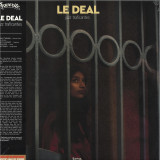
Favorite Recordings presents Jazz Traficantes by LE DEAL, a new musical adventure from the finest French jazzmen with Florian Pellissier (Piano & Fender Rhodes - Camaraõ Orkestra, Cotonete,
Aldorande, Setenta), Yoann Loustalot (Flugelhorn – Bruit Chic, Old & New Songs, Aerophone, Lucky Dog), Théo Girard (Upright Bass – Pensée Rotatives, Discobole) and Malick Koly (Drums - The Wallace
Roney Quintet). Needless to say, they’re used to play all over the globe and quite often to New York. During one of these
trips to the Big Apple, they discovered that the legendary Van Gelder studio (where most of Blue Note, Verve and CTI albums were recorded) was still active and opened so they decided to book a few days session.
Here is the story told by Florian Pellissier: “The tracks had been written the night before. We were going to run through them and then record. A simple plan. Van Gelder had passed a while back, but he left the keys and secret codes with his faithful assistant Maureen before heading off to create the right sound up in heaven. Nothing had changed in the atmosphere or configuration, not even the way the mics were placed. The studio and its wooden beams still exuded New York’s sixties jazz, dimly lit streets and clubs where anything might happen past midnight. Maureen knew just how to capture the ambiance of the sessions and bottle the energy without spilling a drop, taking infinite care to collect each cymbal tone, drum roll and trumpet phrase, without losing a single vibrating bass string or the slightest keyboard pause.”
Indeed, the four contrabandists succeeded to deliver an outstanding album, filled with themes that’ll get stuck in your head, just like in the 19 minutes long performance “Mexican Junkanoo Suite” and its three
parts. But more than just beautiful melodies, LE DEAL truly managed to bring a sense of drama to their compositions, going into the deepest emotions through gutted arrangements, improvising with great attention to the articulation of their ideas. From the beginning to the end, musicians and engineers did their best to emulate the proper vintage sound. Jazz Traficantes could prove once and for all that
French Jazz can indeed cross the borders. The album will be available as Tip-On Deluxe Vinyl LP but also on CD & Digital with a bonus track, “Noche en la Carcel”
A 38 minutes exorcism, dionysac sexyness fueled with romanticism, made of mechanical incantations mixed with spectral vocals of forgotten imaginary tribes, words from a physicist (Incomprehensible Image), and mystical breathings… To remind you that music is demanding your soul and body, fully.
A master irritator, disclosing this talent all the way, down to every chosen title, for the album itself and all of its components (would you put Milk in Water ?). As repetitive or minimalist music may already make some of you feel nervous, it seems more accurate to talk here about primitive music – notwithstanding a non violent anarchism. But those are only words and vain attempts to attach TLT to a region or a family. Neither the burden of classical European music legacy, which eventually lead to pop music, seemed to interfere with his wild mind, and if it is no surprising to hear Bach in German electronic music, there is here a clear statement that you are out of this sirupy prison…
For D.W. is a sorcerer. He’s been empirically learning the speaking of trance with years of touring and experimenting with all kinds of audience and venues, from clubs to museums, from Mongolia to Brazil, from his performances with his bands Kreidler or Toresch to solo ones, sustained by a steady limited set up, as the one used when he’s recording : one MPC, rudimentary synths, few effects and a mixer. No sound engineer on stage as only he knows his secret language… Raw dubmaking, leaning towards hip hop, indubitably underlining here a significant distanciation from his previous industrial inspirations. The bewitchment of this record is operating with no warning from the very first seconds until the last epiphany of Sales Pitch.
He is using his knowledge of techno, psychedelism (Inverted Sea), UK bass (Jumping Dead Leafs), only to bring you out of it. We all tend to be slaves, without even being conscious about it, and a balance must be existing between being a slave and showing off. Mr. Weinrich’s answer is unsettling because it is an utter call to this balance, in our world of black and white and political correctness. There is no morality in music… Don’t expect anything else than an unaccountable liberating immediate experience. Don’t expect any kind of music because you are already in the past or the future… From his recording technique mainly relying on one takes, his adoration of mistakes and jeopardy, to the core essence of repetitive music, it is all here about being in the present. No ears no glasses.