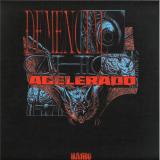
Following the success of his recent releases, Mendekua and Electro Bloody Music, Barro’s honcho Nöle demonstrates that he is at one of his creative peaks with this new four-track EP.
The fortunate owners of reference number thirteen will not only take home a substantial slice of vinyl but also a powerful teleportation device that will instantly send them to the dance floor. Demencial chico acelerado features four tracks of techno infused with elements of industrial and EBM, as dark as it gets.
The EP kicks off with the enigmatic “IDDDQD,” a complex industrial techno track packed with sharp synths, devastating basslines, and an incredible punch.
“Lemmy Dust” comes next showing no mercy from the moment that the powerful kick hits, captivating you with its hypnotic sound and not letting go until you’re exhausted.
Cinematic as its name suggests, “Xenomorph” is a claustrophobic industrial techno powerhouse, brimming with intense EBM nuances that are both unsettling and frenetic—perfect for dancing with your hair standing on end.
Last but not least, “Ghost Dancer,” is one of the most purely techno tracks, showcasing haunting synths mid-way through. It’s heavy material fit for the dance floor.
Without a doubt, this demencial accelerated kid knows exactly what he’s doing.
The above references have already been supported by artists such as Dave Clarke, Phase Fatale, The Hacker, Lokier, NX1, Unhuman, Alienata, Reka, and many more.
Text by : El Garaje de Frank
Поиск:enigma device
Все
- 1
- Blest
- We Belong
- Massive
- Unfair
- Perfect Pear
- Fall Apart
- Worst Of Times
- True
- Gimme Ocean
- Blitz!
Yuno's full-length debut, Blest, out May 16 on Sub Pop, finds the enigmatic indie-pop visionary transforming the emo-tinged suburban malaise of his 2018 Moodie EP into more expansive, widescreen pop drama - suited for big moves and bigger stages. The kaleidoscopic sound he devised as a millennial hermit in his childhood bedroom in Florida has since broadened his horizons, taking him on tour with Unknown Mortal Orchestra and Superorganism, and soundtracking various series for Netflix and HBO. Imbued with elements of dream-pop, rock, trap, and psychedelia, his eclectic songs serve as bids for love and connection, which especially in the fractured era of social media, have resonated with many listeners who find solace in his vulnerability. Yuno's superpower lies in the way he mines a multitude of genres for their pop potential and surfaces with a tapestry that feels novel and fresh. Take, for instance, "Blest," the immediate, blissful, and bright title track, which is inspired by Rich Harrison-breakbeats and Neptunes-esque jangle. Or the breezy single, "True," in which Yuno moderates a lover's quarrel with slick, trap percussion. Amid the breakbeated dream-rock of "Gimme Ocean," he introduces his guitar solo with a searing emo scream, run through an EarthQuaker Devices pedal. Don't let his sanguine aura or his sherbet pink wardrobe fool you; he can shred as hard as he wants to when he wants to. All songs on Blest were written and performed by Yuno, co-produced by Yuno and Frank Corr (Morning Silk), who also contributed keyboards, drums, and guitar throughout the record, with additional production and instrumentation by Patrick Wimberly (Chairlift) at The CRC in Brooklyn, and Nick Sanborn (Sylvan Esso) at Betty's in Durham, NC. Blest was mixed by Steve Vealey and mastered by Joe La Porta.
- Dark Magus - Moja
- Dark Magus - Wili
- Dark Magus - Tatu
- Dark Magus - Nne
It’s safe to assume no one in the audience at Carnegie Hall on March 30, 1974 anticipated what Miles Davis would play at the concert documented on Dark Magus: Live at Carnegie Hall. Recorded near the tail end of his electric period, the double album remains the darkest, most ferocious statement of Davis’ career — a visionary effort that foresaw developments in jungle, noise-rock, funk, and drum ‘n’ bass.
Initially issued in Japan in 1977, Dark Magus waited two decades for U.S. release. Now, more than 50 years after Davis and his ensemble blew minds at the famous New York venue, it gets its first-ever domestic issue on vinyl — and on a definitive-sounding pressing at that.
Mastered at Mobile Fidelity's California studio, housed in a Stoughton gatefold jacket, and pressed at Fidelity Record Pressing, this numbered-edition 180g 33RPM 2LP set of Dark Magus invites you to pull up a seat and wrap your head around an exhilarating performance that simultaneously functions as an audition, experiment, release, and magnificent explosion of jazz-rock fusion. We hope your turntable and speakers are up to the challenge.
This collectible reissue presents the improvisational magic that unfolded onstage — the skronking tonalities, wah-wah-pedal bluster, acid-washed effects, furious drumming, run-the-voodoo-down grooves, menacing riffs, crashing cymbals —with incredible detail, color, and pace. It also captures the band’s unbelievable energy, rendering both instruments and on-the-fly changes with revealing depth, definition, and dynamics. At its core, MoFi’s audiophile set takes you deep into the boundless mystery, promise, and uncertainty of Davis and company’s efforts like never before.
The story behind Dark Magus is nearly as unbelievable as the spur-of-the-moment compositions that resulted when Davis brought drummer Al Foster, bassist Michael Henderson, percussionist James Mtume, horn virtuoso Dave Liebman, and guitarists Pete Cosey and Reggie Lucas together, and, in a new twist for the concert’s second half, added guitarist Dominique Gaumont and tenor saxophonist Azar Lawrence to mix. That the latter two instrumentalists had never seen each other until that night adds to Davis’ legend — and penchant for bold, unorthodox moves.
Ditto Davis’ own actions that spring evening, which reportedly included showing up to the show an hour late and taking the stage with his back facing the crowd. The strategy worked. Davis inspired the group to play in a bold manner that few, if any, had heard before. Dark Magus is a rhythmic bonanza. Rooted in Afro-centrist techniques, avante-garde sensibilities, and exploratory moods, the songs eschew set arrangements and solos, and, for the most part, melodic devices.
For Davis, Dark Magus represented a personal triumph amid a period marked by health issues, addictions, and critical decline. The latter slight would be corrected, but not until decades later when Dark Magus saw Stateside release in 1997 via a CD reissue. Of course, the free-form patterns, unpredictable passages, dense structures, and distorted blues that course through the songs — titled after Swahili numerals — are not for everyone. And certainly not for the fainthearted. Though Dark Magus contains majestic moments marked by quiet restraint and something on the level of balladry, its rich and radical concoction of tormented thwacks, thumps, cracks, clatters, wails, bleeps, burbles, stomps, and enigmatic beats remains its adventurous heart and soul.
Primal and enigmatic, fierce and jagged, forceful and revolutionary, jolting and terrifying, Dark Magus seemingly attacks from any and all directions. Turn it up loud and let the prophetic brilliance of this inimitable and relentlessly funky album wash over you.
The debut recording from the duo of multi-award-winning Scottish author David Keenan and Bruce Russell, the guitarist from the greatest underground rock band of the late 20th century, New Zealand’s The Dead C, was recorded live in Christchurch, NZ, as part of the WORD festival in August 2023. A series of live improvised settings that pair readings from Keenan’s monolithic and critically-acclaimed modernist masterpiece, Monument Maker (White Rabbit 2021), with guitar and electronics from Russell, the music takes off on the kind of post-VU fantasy of punk-primitive free music posited by Russell in projects like A Handful of Dust while expanding on Russell’s no-technique blues w/scalpel sharp riffs and aformal blats of pure electricity that match the religious eroto-mania of the text. Keenan reads w/shamanistic intensity and with a sonorous, incantatory rhythm, while Russell conjures the very ghost of the book straight out of the air. Think the early Patti Smith/Lenny Kaye spoken word/guitar jams informed by religious painting, Bach cantatas, Pierre Reverdy, Goya, Charles Olson, Arthur Doyle and Rudolph Grey. Features full colour photography by musician and artist Heather Leigh taken in-situ during the writing of Monument Maker in France in 2018. Bruce Russell is a practitioner in sound, who for forty years has been a member of The Dead C and A Handful of Dust. He mixes rock, electro-acoustics, noise and improvisation in equal measures. Also directed two of New Zealand’s vanguard independent labels, Xpressway and Corpus Hermeticum. His solo guitar practice reconfigures the blues as a form of improvisational auto-destruction. He is also a writer and his next book is titled ‘Rock’n’roll: my part in its downfall’. David Keenan is the author of six novels; This is Memorial Device (Faber & Faber) which won the London Magazine Prize for Debut Fiction and was shortlisted for the Gordon Burn Prize; For the Good Times (Faber & Faber), which won the Gordon Burn Prize and was shortlisted for the Encore Award for Second Novels; Xstabeth (White Rabbit), which was shortlisted for the Dublin Literary Prize; The Towers The Fields The Transmitters (White Rabbit); Monument Maker (White Rabbit), which was a Rough Trade Book of the Year; and Industry of Magic & Light (White Rabbit). Edna O’Brien has said of him “I sometimes think David Keenan dreams aloud. His prose has the effortless, enigmatic, unsettling quality of dreams… reading him feels like being cut open to the accompanying sound of ecstatic music.”
Gladio Operations label presents its ninth release, with volume 2 of the Split Machine series, which this time features two new and recognised faces on the European and American electro scene.
One of these new faces is producer Noamm. This Greek artist, who has releases on such respected labels as Bass Agenda and Fundamental Records, opens the EP with “Clone Machine” and “Scientific Technological Device”, two excellent rough and pragmatic tracks which link perfectly with “Verruckter Wissenschaftler”. The latter track, a fast-paced cut impregnated with tasty dark textures, perfectly defines the talent of the Hellenic producer.
The B-side bears the signature of Brice Kelly, who also debuts on Gladio Operations and gifts us three fantastic, enveloping, and melodic tracks. The American producer kicks off with “Beings of Alpha”, a deep and very well-constructed journey that gives way to “If You Don’t Think Like Us”.
We really like it, even more so if it is accompanied by an elegant vocoder and enigmatic strings. Lastly, we arrive at “Powers That Be”, the closing track of the album, where we can perceive a cut of aggressive bass lines and gloomy textures, well aligned with well-chosen robotic vocals.
The Sex featuring members of Mercenary God and No Suicide. A mixture of different elements with a rock substrate for an uncategorized result. Another Post-Punk gem from the 80's Italian North-Eastern scene.
My adventure buddies? The silent, enigmatic Patti, former singer of the mysterious No Suicide, and the young, faithful Chris, a passionate Police fan, we met on the battlefield and he immediately became my brother. For him, learning to play the bass was a way to get close to Sting, in other words, just one step below Paradise. Patti instead played keyboards as an extension of her mysterious and glacial presence, so still and distant that the audience sometimes wondered if she was real. And then there was my fixation for the drum machine, a futuristic device which could transform the drumming sweat into an invisible, yet physical, dreamlike pulsation. A particular combination of characters and a special astral conjunction, that’s what you need to get a nucleus source of sonic emotions, and in some ways this is what we were. You could clearly feel it during the concerts. When at the end of ‘81 My Mercenary God lost their drummer and had to disband, I felt clearly that the music had already changed.
Our old 70’s rock ‘n’ roll sound was no longer representative of the day. We were like some sort of yesterday’s newspaper. Thus I Sex was born (later The Sex). According to Freudian thought that sees sexual instinct as the driving force behind every (creative or destructive) human act. And in fact we immediately started creating, destroying, assembling and deconstructing our sound. Suddenly “tomorrow became now”. It was an outburst of creative independence in the form of homemade cassettes put together with makeshift tools, at least until the arrival of the legendary 4 track recorder. I was 19 years old, Chris was only 17. Nothing more than kids after all. Yet we were already veterans, veterans of a lost war. Wise, naive, disillusioned dreamers, everything and the opposite of everything. But, above all, we were totally devoted to our creative delirium up to the point of losing touch with reality, crossing limits, breaking down barriers and almost bordering on madness. Perhaps we were just too involved, especially if in relationship with what we could receive in return. We always spread our energies as if there was no future. We unconsciously felt that we had to live in the moment, now or never, and in retrospect it really was like that, and this is why these songs exist now. Songs created with the intent to tell an inner universe that is, now as then, far from any convention.
Hailing from Ancaster, Ontario, Carl Didur has been an enigmatic fixture of Toronto’s underground music community for close to two decades. Originally traversing the Golden Horseshoe with The Battleship, Ethel, a band which sprung from his first outfit CEDRUMATIC, Didur soon moved to Toronto. Throughout the mid-2000’s he could be spotted playing his trademark ace-tone organ as a member of No Dynamics and Rozasia in the city’s crammed rogue venues, such as The Bagel and the infamous and transient Extermination Music Night. During these years The Battleship, Ethel continued to tour, often performing as backup band for Damo Suzuki, while at other shows inviting Dave Byers (Simply Saucer) and Bob Bryden (Spirit Of Christmas) to perform alongside the band. Perhaps the most enduring legacy of "The Battleship, Ethel", which dissolved in 2009, is that it laid the creative foundation for Carl and bandmate Michael McLean's next project, the prolific, studio focused, Zacht Automaat. As Zacht Automaat released music at a frantic pace, Carl continued to collaborate with members of a tight-knit group of Toronto’s downtown scene including touring with U.S. Girls and Slim Twig, performing and recording with Colin Fisher as Fake Humans, guesting on Absolutely Free’s Currency EP and producing New Fries’ most recent album The Idea of Us. Throughout the last decade Didur’s purely solo output has served to document his unimpeachably singular approach to music making. I Cannot See You Too Well (2011), Nothing is the Secret to Anything (2014) and Is It Yesterday? (2020) all released on cassette were followed by a digital album of gentle minimalism called Natural Feelings Vol I (2020). His solo shows consist of multiple tape machines running loops through various analog devices (a Certified Electronics Technician Didur now spends his non-piano playing hours of the day repairing all manner of tape echoes and synthesizers) or solo Wurlitzer electric piano improvisations, his performances gracing both stage and gallery. With his latest release Maybe Next Time, Didur further establishes himself as a singular artist with a unique methodology honed from years of music-making and listening. The album’s compositions swing from lush Axelrod-ish affairs filled with Mellotron strings to the album’s spiritual jazz influenced centerpiece The River Meets The Sea. “I was inspired by Eno's Here Come the Warm Jets, Crazy Horse but only when they are sad, Alice Coltrane, Jessica Pratt, McDonald and Giles, and so many others…” states Didur. Infused with a melancholic tone throughout, tracks such as Close My Eyes and Autumn’s Here invoke cinematic memories with tape echo and reverb applying a softened focus to the proceedings. Carl explains the context for the tone and the setting for the record’s gestation: “Maybe Next Time is a record I made after the world lost a sweet person that many in our community loved. Unlike most of my albums this one never seeks to shock or surprise you. It is about sadness, confusion, dissolution, transformation and ultimately a deeply forgiving sense of love. It is a concept record about being a human being!”
With their debut, MME dUO send us across an impulsive sound collage omniverse of enigmatic Dada - long live imperfection! Formerly working together as Sculptress of Sound, Cologne based Patricia Koellges and Tamara Lorenz make use of a variety of instruments and devices: DIY electroacoustics, small synths, loopers, tuning forks, electric bass, percussion and voice are thrown into the game and shape a sound that’s as diverse as it is striking. The four sides of the record are the four seasons of the year. The cover artwork depicts an oddly shaped honey locust situated just outside MME dUO’s rehearsal room; homebase for a year of recordings for awholerunboom. From spring to winter the album opens up a wayward palette of experimental music. Sweet Cold Night could be a soundtrack for a movie scene of ourselves trudging through a swamp. CutCut somehow sounds as if caught in a loop early in the morning after an extensive club night. RZCK, a deliberately stumbling forward percussion piece is the longest of the 21 tracks. Several video clips go along with awholerunboom, one of which features the artists going through some kind of a ritual exercise inside of a two person costume, trying to put things straight it seems. The track itself Isn’t It Isn’t functions by way of permutations of spoken phrases and it might actually make you wonder if Gertrude Stein had gone electric. Mixed and mastered by Volker Hennes. Cover artwork by MME dUO. Edition of 300.
- 1



