Dummy is a rock band from Los Angeles comprised of Alex Ewell, Emma Maatman, Nathan O'Dell, and Joe Trainor. Their debut full-length "Mandatory Enjoyment" (Trouble in Mind) arrived in late 2021, becoming one of the year 's sleeper hits and garnering praise from Pitchfork, Stereogum, and more. Coming out of lockdown, the band spent two years touring in support of the record, and it is this transformational experience that pulses through "Free Energy ", the exhilarating follow-up to "Mandatory Enjoyment". A creatively restless band, Dummy (Ewell: drums, synths, bass; Maatman: vocals, synths, organ; O'Dell: vocals, guitar, organ; Trainor: guitar, bass, synths) wanted to get harder, dancier, more psychedelic for their next record. This meant applying explorative potentials of electronic textures to the elemental qualities of rock i.e. more vocal loops, sampling, more crazy rhythms, and playful synths - but make those samples of Trainor 's guitar, let Maatman sing bolder, experiment with using cold mechanical elements in warm and sparkly ways, and lean harder into traditional-yet-still-awesome forms of rock guitar experimentation like feedbackThe result is a record that celebrates music's ability to move the body, whether that be through a teeth-rattling wall of MBV-esque noise, a sticky pop chorus, or a joyous drum machine_or, if you're Dummy, maybe all of them in the same song. Pop music has always been a big part of Dummy's sound and it manifests in different ways all over Free Energy: the bubbly synth sequence made with a Korg EM1 popping all over "Nullspace," the revved-up drone-pop inspired by second and third wave Dunedin Sound bands like Look Blue Go Purple and Dadamah, and the motorik beat powering "Nine Clean Nails," perhaps the most confidently pop song Dummy has ever recorded and one that exemplifies "Free Energy "'s balancing of live performance intensity with electronic augmentations, the dancier rhythmic elements created out of a drum loop recorded by Ewell while the bridge recalls the Feelies with call-and-response guitars from O'Dell and expressive vocals from Maatman. "Free Energy " also features guest appearances from Oakland-based saxophonist and electroacoustic artist Cole Pulice (Moon Glyph) contributes saxophone and wind synths and Jen Powers of Powers / Rolin Duo (Astral Editions, Feeding Tube Records).
Buscar:f free
- Three For The Festival
- Moon Song
- A Sack Full Of Soul
- The Haunted Melody
- Blues For Alice
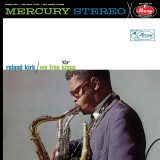
- We Free Kings
- You Did It, You Did It
- Some Kind Of Love
- My Delight
VERVE ACOUSTIC SOUNDS SERIE: komplett analog von Ryan K. Smith bei Sterling Sound von den Originalbändern gemastert, QPR-Pressung (180 g), stabiles Tip-On-Gatefold (Stoughton Printing), wattierte Innenhülle, Gatefold Sleeve.
”We Free Kings” gilt als eines der musikalisch kohärenteren Frühwerke von Roland Kirk. Obwohl der Saxofonist und Flötist es im Januar 1961 mit zwei unterschiedlich besetzten Quartetten aufnahm, gelang ihm eine wunderbare Balance zwischen Bebop-Nummern und souligeren Stücken. Das Repertoire unterstreicht Kirks Fähigkeiten als Komponist (sieben der neun Stücke stammen von ihm). Brillant ist aber auch seine Interpretation von Charlie Parkers ”Blues For Alice”.
- A1: Rhytmicon Example
- A2: What When Ear
- A3: Out Of Town Buying
- A4: Low Tide
- A5: Flight (Instrumental)
- A6: Not To Work
- A7: Papillion
- A8: Steine Nachts
- A9: Untitled 1(Svdh,Ms,Dn)
- B1: Ez Iz
- B2: Neujahrs Wandelen
- B3: Tubing Alone
- B4:
- B5: Item Number
- B6: Xil Sec
- B7: Pala Ping Pong
- C1: Drum Midi Drum
- C2: Rahmentrommel
- C3: Resonance Circul 2
- C4: Aquinas Symposium Remix
- C5: Test (Basel)
- C6: Slow Stroll Words Come
- C7: Shipped Twice
- C8: Untitled 2 (Svdh,Ms)
- D1: Ghost Pipe
- D2: Paper Pen
- D3: Gila Circuit (Short)
- D4: Gila Circuit (Extension)
- D5: Stacking Days Thru U
- D6: Brühl
- D7: Fm Bop
- D8: Fm Test
- D9: Lacandon Vox
This material was released digitally via Belgian label, Stroom as single tracks, as well as located on the Internet Archive as a free download in the form of 4 bulky sides (A,B,C,D) as it was originally conceived. Now available for the first time as physical, compact double MC-set via Tax Free Records.
Alepher “Dodges Aim” was made by iRiAi Verlag and TRii Compiler ca. between 2020-24.
Die Neuaufl age von "Free Jazz Goes Underground" bringt das erste Studioalbum Udo Lindenbergs und seiner damaligen Band Free Orbit zurück. 1970 aufgenommen, fängt dieses Kult-Album die freigeistigen, politischen und visionären Botschaften der damaligen Generation ein. Es verbindet die musikalischen Strömungen der 60er – von Jazz, Rock und Soul bis hin zu sozialkritischen Texten – und spiegelt die rebellische Atmosphäre der Hippie-Zeit wider.
„Was wir ganz dringend brauchen, ist, dass diese gewaltige Revolutionsenergie, diese alle mitreißende Aufbruchsstimmung in ein neues Morgen,
genauso stark ins Massenbewusstsein kommt wie damals!“ (Udo Lindenberg)
Die Neuaufl age enthält neue Linernotes sowie eine freie Übersetzung der originalen Songtexte von Udo Lindenberg und Beatrice Reszat. Die limitierte Sonderedition erscheint als 2 LP (12“ und 10“ Vinyl) und als CD mit dem Originalalbum. In einer handnummerierten Aufl age von nur 1.999 Exemplaren enthält die Vinyledition zusätzlich drei Bonustracks von Udo Lindenbergs späterem Album Lindenberg.
Ein einzigartiges Zeitdokument, das die revolutionäre Energie der 60er Jahre in Texten und Musik von Udo Lindenberg und Frank St. Peter aufgreift – jetzt in hochwertiger, überarbeiteter Form endlich wieder erhältlich.
A prominent Ukrainian experimental music artist Kateryna Zavoloka creates a follow-up to her previous album “Amulet” – the new album "Istyna" features more melodic structures and complex polyphonic layers that deepen the emotional light.
“Istyna,” which translates to “truth” or “verity” in Ukrainian, explores further the concepts of inner liberation and freedom. The album is Zavoloka’s most personal statement – combining her deep-rooted connection to her homeland with experimental sound steppes, polyrhythms, and polyphonic melodies, this album translates resistance of light.
“Istyna” expresses the quiet truth that lies in the heart. It takes an integral approach to Ukrainian folk traditions in a more complex and harmonious sound, where melodies and polyphony are more affluent. Zavoloka recorded traditional Ukrainian instruments, such as the kobza and kolianka, which are embedded in the album's textures. It is raw emotions, from meditative introspection to moments of intense sonic expression.
Zavoloka a.k.a. Kateryna Zavoloka is a Ukrainian experimental musician, composer, and sound and visual artist whose work seamlessly blends traditional Ukrainian influences with contemporary, avant-garde electronic and experimental music, merging lush melodies, and textures with polyrhythms.
The 1968 debut album from Norwegian guitar legend Terje Rypdal stands as a significant entry in the late 1960s jazz landscape, exemplifying the transition from psychedelic rock to a more intricate, freeform blend of jazz elements. Collaborating with legendary musicians like Jan Garbarek, Rypdal's work on this album showcases his innovative talent.
Recorded during three sessions in Oslo in 1968, Bleak House marks Rypdal’s departure from the psychedelic group The Dream as he ventured into new musical territories. He would go on to become one of the most recognizable instrumentalists in European jazz, with releases on the ECM label filled with his searing, evocative guitar sounds that evoke a future tundra.
Though only 21 at the time, Rypdal was already creating music that was incredibly mature, smooth, and sophisticated. While it undeniably captures the essence of the 60s, it remains enjoyable today. The album, originally released on Polydor, features slight Latin and blues influences, along with big-band arrangements that are both well-crafted and enchantingly loose.
The reissue of Bleak House offers much to unpack. Historically, it represents a bridge in the European transition from jazz-rock to a unique avant-garde/free jazz hybrid. Even at this early point in his career, Rypdal's ability to incorporate post-bop, fusion, and avant-garde elements into a cohesive album was an impressive feat of imagination. Rypdal has always been a bold composer, capable of weaving intoxicatingly discordant melodies, as exemplified in tracks like "Winter Serenade", or evoking an unearthly sadness in his more reflective pieces.
Bleak House is a timeless and important recording, and it is a pleasure to hear it in this 180g virgin vinyl format.
A must-listen for anyone interested in the evolution of modern jazz.
- Free The Black Man's Chains
- Slave"" I Wanna Be Free
- It's A Sad Black World
- North To The Promised Land (Big Black Man)
- Black Is Black
- Fair Skin Man
- Gone Is The Laughter With You
- Somebody Bigger Than You And I
- Love (L.o.v.e.)
- Tomorrow The Sun Will Shine
- Soul President
- We Are Here (Finale)
Comes on Black & White Marbled Vinyl, complete with a printed inner sleeve featuring insightful liner notes. CHARLY RECORDS present the first ever reissue of the sought-after cult New York, gospel street opera, Free The Black Man’s Chains. The most intriguing, and certainly the most ambitious project on the city’s GSF label (see more stunning titles on GSF exclusively from Charly). The project had its roots in a trio of singles released by the mysterious Broad Street Gang in 1971. The first, on the Cougar label called “Fair Skin Man” and its two follow-ups “L-o-v-e Love” and the title track from the album “Free The Black Man's Chains”. Celebrated musicians on the sessions were Mitchell Rowe, Bobby Eli, Len Pakula, Daryl Hall, Ron Baker, Norman Harris, The Raelettes and strings arranged by Richie Rome. A project like Free The Black Man's Chains should have been perfect for the multi-media nature of GSF. The album could have led to a film in the way that it had for Jesus Christ Superstar, but instead like so many of the label's releases, the album failed to make its mark due to a lack of promotion. GSF would barely reach its second birthday before it – and its parent company – shut down. A Black Opera…
It says a lot about the interconnectedness of the global dubwise underground that it took downtime with Bristolian Neek in Portland to spur the link between ZamZam and Feel Free Hi Fi out of the Minneapolis Twin Cities. Once he put us on to them we were hooked- not only by their brilliant music but by their rigorously DIY approach and aesthetic. Heavily inspired by the more esoteric angles of early digi-era JA dancehall and UK dub (Shaka, Disciples, Mixman and Gussie P being some touchstones) the duo create a sound both reverential and unique, steeped in the traditions but striking out hard left into idiosyncratic territory all their own. Releasing all of their works up to this point on their own fantastic Digital Sting label, we’re excited to showcase them on ZamZam.
Yessss! Here it is! The comeback we have all been waiting for! Borrowed Identity is back! This classy producer and DJ from the German Black Forest has been making his mark some years ago (well it has been nearly a decade now) with releases on labels like Quintessentials (3 EPs to be precise), Circus Company or Foul & Sunk to name but a few. Now he teams up again with his Sandkastenbuddy Mechanical Soul Brother to present some super groovy, deep yet powerful and uplifting House tunes! Grab your copy and enjoy a hot summer!
- A1: Obituaries (Instrumental)
- A2: Beauty & Essex (Instrumental)
- A3: On Sight (Instrumental)
- B1: Shibuya (Instrumental)
- B2: Apartment (Instrumental)
- B3: Gidget (Instrumental)
- C1: Rene (Instrumental)
- C2: Time (Instrumental)
- C3: Cut Me A Break (Instrumental)
- C4: Eternal Light (Instrumental)
- D1: Oslo (Instrumental)
- D2: Lester Diamond (Instrumental)
- D3: The Rivington (Instrumental)
First-ever vinyl release of the instrumentals! RSD25
Groove to the sounds of the Free Nationals like never before! Their self-titled album, Free Nationals, is finally getting an exclusive instrumental vinyl release. Fans can experience the full sonic landscape of their signature funk, soul, and R&B fusion with no distractions—just pure, smooth vibes and great music.
Pressed on 180g heavyweight black vinyl, this limited edition release offers pristine audio quality that showcases the musicianship and craftsmanship behind the album’s beloved soundscapes. Whether you’re a fan of their work with Anderson .Paak or just a lover of rhythm and soul, this release is a collector’s dream—an essential for DJs, audiophiles, and anyone who craves the instrumental heartbeat of this incredible record.
Rerelease of the fourth album of the Intercommunal Free Dance Music Orchestra recorded with the Guinean saxophonist Jo Maka. The title says it all: Vol.4 – Jo Maka.
The Intercommunal Free Dance Music Orchestra was created in 1971 by an “old hand” of French free jazz, François Tusques. Free Jazz, was also the name of the recording made by the pianist and other like-minded Frenchmen (Michel Portal, François Jeanneau, Bernard Vitet, Beb Guérin and Charles Saudrais) in 1965. But, six years later Tusques had had his fill of free jazz.
So he then founded the Inter Communal, an association a name under which the different communities could become closer and compose, simply. In 1976, on the first album: L’Inter Communal, we can already hear Tusques playing without borders in the company of Carlos Andreu, Ramadolf, Michel Marre and Jo Maka (as a conclusion to this Vol. 4, we can hear them in 1977 at the Moulin de Prades Le Lez). Over the next decade, the, association kept going with concerts at the Dunois theatre, in 1980 and 1981, it welcomed old hands and new recruits (Bernard Vitet, Jean-Jacques Avenel, Jacques Thollot, Sylvain Kassap…).
If Vol. 4 – Jo Maka is an homage to the Guinean saxophonist, who passed away a few months before the release of this selection of concert recordings, it also displays a proud collective inspiration! One foot in the blues, and ears open to everything else, Tusques begins with a lament that the Company rapidly transforms into a joyful dance (“Vive la Commune”), weaves a full-blown party piece (“Poses ton fardeau et remets la machine en route”, “7 rue des prêcheurs”, “Mazir”) or gets fabulous with Mingus (“Fable Of Faubus”). And there you have it, with so many revolutions François Tusques is almost back to free jazz.
If the jazz of François Tusques is “free”, his spirit is even more so: having recorded Free Jazz with other like-minded Frenchmen (Michel Portal, François Jeanneau, Bernard Vitet, Beb Guérin and Charles Saudrais), the pianist had covered a lot of ground, with Barney Wilen (Le Nouveau Jazz) or even solo (Piano Dazibao and Dazibao N°2), so as not to repeat himself…
In 1971 he founded the Inter Communal Free Dance Music Orchestra which, as the notes the this album stated, “is an interpretation of a music which synthesizes the different communities living and working in France.” In 1976, on the first album (L’Inter Communal) we can already hear Tusques playing without borders in the company of Carlos Andreu (vocals), Michel Marre (trumpet and saxophone), Jo Maka (saxophone) and Ramadolf (trombone). It is a meeting between jazz and music from Catalonia, Occitanie and Africa. So far so good, but what about Brittany, that, Tusques knows “by heart”? Having lived for a long time in Nantes, he would expand his ‘brittanitude’ on the canal linking the city to Brest by playing with, for example the Diaouled-Ar-Menez. With these “devils from the mountain” who, under the baton of Yann Goasdoué, worked throughout the 1970s on the renewal of music from Brittany, Tusques met, notably, Tanguy Ledoré and invited him one day, with trois bombards and some bagpipes (Jean-Louis Le Vallegant, Gaby Kerdoncuff and Philippe Lestrat), to join the ranks of the Intercommunal. And so they set of towards a new music from Brittany, as the title states; Vers une Musique bretonne nouvelle!
With percussion from Samuel Ateba and Kilikus, the association launches the ‘bombardier’: the repetitions and dissonance of the different members all serve a common cause however: the dance, which is always the reason for the party. This sets a whole universe spinning, which can bring to mind Chris McGregor’s Brotherhood of Breath (“La rencontre”) when not taking on board waltz, swing, blues and gavotta or even revealing mysteries like those of Gurdjieff (“Les racines de la montagne” or “Le cheval” sung by Andreu). Only one thing to say to this Brotherhood Of Breizh: Mersi!
Ein fantastischer Live-Mitschnitt vom 8. November 1975 in Bremen von "Reedman" Gary Bartz mit seiner ultra-hippen NTU-Band, die man von ihren 1970er Klassikeralben bei Milestone kennt. Fast zwei Stunden Free & Spiritual Jazz. Limitierte Auflage auf 180g Black Double Vinyl im Gatefold. Erster Release des neuen Cinedelic-Sublabels Free Flow Archive.