In 1963, Miles Davis was at a transitional point in his career, without a regular group and wondering what his future musical direction would be. At the time he recorded the music heard on this disc, he was in the process of forming a new band, as can be seen from the personnel: tenor saxophonist George Coleman, Victor Feldman (who turned down the job) and Herbie Hancock on pianos, bassist Ron Carter, and Frank Butler and Tony Williams on drums. Recorded at two separate sessions, this set is highlighted by the classic "Seven Steps To Heaven," "Joshua" and slow passionate versions of "Basin Street Blues" and "Baby Won't You Please Come Home."
A fantastic-sounding album. Mastered by Ryan K. Smith at Sterling Sound, and pressed on 180-gram vinyl by the best in the business, Quality Record Pressings. An old-style tip-on jacket by Stoughton Printing makes this one a jewel for your LP collection.
Поиск:feldman
Все
Dalibert who hides badly behind the simplicity of facade of these eight pieces all the rare elegance which emerges from this set. The pianist goes well beyond the codes of the genre, certainly one will think sometimes of harold bad of avalon sutra to philipp glass of metamorphosis but Melaine Dalibert, by his singularity and his clairvoyance, reminds us that the music is nothing more than an arithmetic of the sensitivity, an addition of the possible ones. His fifth album "Shimmering" recently enriched the Mind Travels collection of the label Ici d'Ailleurs, but the magnetic mantras, that French pianist Melaine Dalibert forges on his appreciated concerts, already attracted many lovers of contemporary piano minimalism, due to the way by which this composer manages to integrate an algorithmic approach to composition with popular motifs and influence. His alloy of personalistic flow and technical skills is so strong that even what sounded like pure exercises, such as "Six+Six", one of the more interesting compositions (dedicated to David Sylvian), can titillate listener's soul. These eight haunting, wordless pop songs, snapshots of a melancholy mood, owe as much to Morton Feldman or Philip Glass as to Ryuichi Sakamoto or Peter Broderick. They nonetheless reveal a highly singular musical personality. These eight new white pebbles extend the fascinating journey of an artist who, if the title of his very beautiful record is to be believed, loves nothing more than to illuminate the path.
While most ensembles are driven by personalities, the Necks are powered by an idea. A very large and simple idea - which now seems completely obvious…. but only because the Necks thought of it and made it work. Now their pleasure (and ours) is sequentially to re-imagine and explore that idea – the prime directive of which seems to be to be that each unfolding step and every passing detail of any performance be allowed to evolve organically out of the musical conditions established at its moment of departure. In other words, we are in the territory of chaos and catastrophe theory; of hurricanes and butterfly wings… And, since one can never step twice into the same river, each beginning has led to wildly unpredictable and variant outcomes; and imperceptibly: you never hear the changes until somehow they have already happened. “We end up, Lloyd Swanton writes, ‘in a very different place from whatever our initial notion … had been.” In the case of Vertigo, we are dropped straight into an almost Feldmanesque musical universe, in which sounds - seemingly disconnected - are already there; creating space rather than inhabiting it. Then, without trying, they mutate. Not mechanically and not according to any pre-determined process - because it’s always clear that what we hear is being played by human beings; that it’s music. A special kind of music that is not pushy or demanding or demonstrative, but rather co-operative, spatial, ambiguous. A music that leaves room for its listeners.
Erstmals 2010 veröffentlicht, ist 'NonStopErotik' das bisher letzte Soloalbum von Frank Black Francis. Die Aufnahmen wurden in Los Angeles, Brooklyn und den renommierten RAK Studios in London mit dem Produzenten Eric Drew Feldman gemacht. Erstmalig als LP erhältlich, erscheint das Album über Demon Records auf Purpur-farbigen Vinyl!
Duane Pitre returns to Imprec with Omniscient Voices, an articulate, intense and emotionally resonant set of five pieces for justly tuned piano and electronics.
Omniscient Voices is a uniquely distinct work that follows Pitre's trilogy of releases which culminated with 2015’s Bayou Electric and included the critically acclaimed Feel Free (2012) and Bridges (2013) albums. Where those albums were rooted in long form pieces, Omniscient Voices is a collection of shorter pieces, offering more harmonic variety than previous works, with a unique sound and feel that is still unmistakably the work of Duane Pitre.
In 2019, after a five year period where Pitre did not focus on outward facing music, but instead on his own personal practice, a small idea in the form of a question came to him: would the combination of his latest computer- and electronic-based experiments, used in conjunction with justly tuned piano, produce interesting results; simply put, would it “work”? Concurrently, Pitre was studying a handful of Morton Feldman scores for their focus on tonal clusters, reading a book on Arvo Pärt’s life and work, and contemplating the pulse-based rhythms of Steve Reich and Phillip Glass.
In 2020, with no intention of making a new album, the composer tried to answer this question. The results would spawn five pieces that would become Omniscient Voices. On this new work, Pitre finds himself giving equal priority to both piano and electronics, utilizing his Max/MSP-based generative network to real-time convert precomposed piano motifs, into data, which is then used to communicate with two polyphonic, microtonal hardware synthesizers whose patches Pitre authored; this process generates the electronic component of the album. Pitre also utilizes controlled improvisation to interact with the piano-reactive electronics in a spontaneous and inspired manner, going back and forth between these two pianistic approaches. In all, this approach creates a “musical feedback loop” of sorts.
Despite Omniscient Voices being the culmination of 15 years of hard work and inspiration, this beautiful album somehow materialized in a natural, intuitive and effortless way (like any artist's best work.)
Artist's statement: “When making the pieces that would become Omniscient Voices, I often viewed the piano as human action, a single note becoming a single gesture that has the potential to change the electronic environment, the electronics becoming the environment surrounding that human in the natural world, who then has the power to change their actions based on their surroundings. All actions have consequences. The interconnectedness of everything. Single actions making waves of change.”
RIYL: Arvo Pärt, Morton Feldman, Steve Reich, Phillip Glass
Mastered and cut by Golden and pressed at RTI for maximum fidelity.
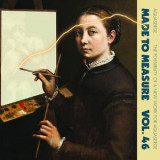
Die französische Avant-Rock-Band Aquaserge ließ schon immer Genregrenzen verschwimmen. Für die Ausgabe 46 der "Made To Measure"-Reihe widmet sie sich auf The Possibility Of A New Work For Aquaserge der zeitgenössischen klassischen Musik ab Mitte des 20. Jahrhunderts: Giacinto Scelsi (1905-1988), György Ligeti (1923-2006), Edgard Varèse (1883-1965) und Morton Feldman (1926-1987). Inspiriert von den unterschiedlichen Ansätzen der vier Komponisten in puncto Dynamik, Klangtextur und Länge der Stücke oder genauer gesagt, Scelsis Forschung über Klangfarbe und Schwingungen, Ligetis Cluster, Varèses melodischer Kubismus und Feldmans graphische Notation, ging die Band das Album intuitiv wie auch methodisch in einem auf neun Musiker*innen erweiterten Line-Up an. Das Album enthält zum einen drei langsame, ausgedehnt-weitläufige Stücke, in denen die Klangfarben der Instrumente miteinander zu einer klanglichen Materie verschmelzen. Diese Materie ist gleichzeitig immobil und mobil, wie in einigen Ligeti- oder Scelsi-Werken. Dagegen enthalten die Hommagen der Band an Varèse und Feldman Momente des Ausbruchs und wilder Improvisation. Diese von Aquaserge geschriebenen Kompositionen, werden mit raren Stücken von Edgard Varèse, eines davon auf Basis eines Gedichts von Verlaine. sowie von Morton Feldman mit einem Rilke-Text komplettiert, und zeigen das Gespür der Band für Melodien.
- C5: I Plead Insanity
- C6: Live Your Life Be Free
- D1: Live Your Life Be Free
- D2: Little Black Book
- D3: Do You Feel Like I Feel
- E1: I Plead Insanity
- E2: Live Your Life Be Free
- F1: Little Black Book
- F2: Live Your Life Be Free
- A1: Live Your Life Be Free
- A2: Do You Feel Like I Feel?
- A3: Half The World
- A4: You Came Out Of Nowhere
- A5: You’re Nothing Without Me
- B1: I Plead Insanity
- B2: Emotional Highway
- B3: Little Black Book
- B4: Love Revolution
- B5: World Of Love
- B6: Loneliness Game
- C1: Only A Dream
- C2: The Air You Breathe
- C3: Live Your Life Be Free
- C4: Do You Feel Like I Feel
- F3: I Plead Insanity
• Released in 1991, and produced by Rick Nowels, Richard Feldman, Eric Pressly, and David Munday,
Belinda’s fourth solo album features four more huge hit singles: “Live Your Life Be Free”, “Do You Feel
Like I Feel?”, “Half The World” and “Little Black Book”.
• The two bonus LPs feature fourteen bonus tracks: two non-album B-sides and the many 12” mixes,
four of them unreleased at the time, and three 7” edits.
• This 30th anniversary box set contains three LPs pressed on 180g vinyl, in individual outer and inner
sleeves plus a 12 x 12 booklet, all in a lift-off lid box.
n c3. Live Your Life Be Free Single Edit
o c4. Do You Feel Like I Feel Single Edit
[p] c5. I Plead Insanity [Single Mix]
[q] c6. Live Your Life Be Free [Radio Edit]
[r] d1. Live Your Life Be Free [Club Mix]
[s] d2. Little Black Book [Little Black Mix]
[t] d3. Do You Feel Like I Feel [Dance Mix]
[u] e1. I Plead Insanity [Extended 12”]
[v] e2. Live Your Life Be Free [Extended]
[w] f1. Little Black Book [Belinda’s In The House Mix]
[x] f2. Live Your Life Be Free [House Mix]
[Remix/Dub Mix]
"A bold chapter in the band's never-ending story of determination, Baptize is a definitive work for a new era. Like 2018's In Our Wake, ATREYU recorded Baptize with producer John Feldmann. Guests include Jacoby Shaddix (Papa Roach), Travis Barker (blink-182), and Matt Heafy (Trivium). Songs like “Warrior,” “Catastrophe,” “Save Us,” and “Underrated” are massive. They stand confidently alongside ATREYU bangers like “The Time is Now,” “Becoming the Bull,” and “Bleeding Mascara.”
Available on softpak CD, on cardinal red 140g LP and on winter wind blue 140g LP."
The second release on Constructive (sister label of SN Variations) is Last Afternoon by Japanese composer Takuma Watanabe. Having studied at Berklee College in America, he is now living in Japan where he composes for film using his own string ensemble. This is Watanabe's first full length artist album.
He also created the animation music videos for the two tracks Tactile and Last Afternoon creating a unique imaginary visual counterpoint to the music.
Last Afternoon features collaborations with American vocalist and composer Joan La Barbara known for her recorded works with John Cage, Morton Feldman, Robert Ashley and composer and software developer Akira Rabelais known for his collaborations with Bjork and David Sylvian. The album is mastered by Jim O'Rourke. Cover photo courtesy of Swedish photographer and cinematographer Anders Edström.
Verisimilitude’ continues drummer/composer Tyshawn Sorey’s effort to shatter the jazz piano trio tradition by extending the form to encompass the influence of the likes of Feldman, Debussy and Xenakis.
Now available on vinyl for the first time.
One of the most in-demand drummers in improvised music - he has collaborated extensively with the likes of John Zorn, Vijay Iyer, Steve Lehman, Claire Chase, George Lewis, and Roscoe Mitchell, among myriad others - Sorey is also in the vanguard of artists working in that liminal space between spontaneous composition and notated music.
The New Yorker calls Sorey “among the most formidable denizens of that inbetween zone,” while The Wall Street Journal has called him “a composer of radical and seemingly boundless ideas.”
Featuring Cory Smythe on piano and Chris Tordini on bass, the trio’s first release, ‘Alloy’ (Pi 2014), was described as “shadowy and elegant” by The New York Times. His 2015 release, ‘The Inner Spectrum of Variables’, which also features the same group joined by a string trio, was called “devastatingly gorgeous” by The Chicago Reader and “a genuine masterwork” by Stereogum.
The new work utilizes a wide array of percussion, along with judicious use of electronics to explore a wider textural soundscape. The result is a far-reaching and intensely beautiful work that daringly blurs the boundaries between composition and improvisation.
Personnel: Tyshawn Sorey (drums, percussion), Corey Smythe (piano, toy piano, electronics), Chris Tordini (bass)
- A1: Motherland
- A2: Roots Mural Theme
- A3: Main Title: Mama Aifambeni (Premiere Episode)
- A4: Behold, The Only Thing Greater Than Yourself (Birth)
- A5: Oluwa (Many Rains Ago) (African Theme)
- A6: Boyhood To Manhood
- A7: The Toubob Is Here! (The Capture)
- A8: Middle Passage (Slaveship Crossing)
- A9: You In Americuh' Now, African
- B1: Roots Mural Theme Intro (Slave Auction)
- B2: Ole Fiddler
- B3: Jumpin' De Broom (Marriage Ceremony)
- B4: What Can I Do (Hush, Hush, Somebody's Calling My Name)
- B5: Roots Mural Theme Bridge (Plantation Life)
- B6: Oh Lord, Come By Here
- B7: Free At Last (The Civil War)
- B8: Many Rains Ago (Oluwa) (African Theme: English Version)
30th anniversary pressing limited to 1000 copies. With the 2016 Roots
mini-series such a success, there is new interest in Quincy Jones’ original
soundtrack to the ground-breaking 1977 mini-series.
Highlights include the “Roots Mural Theme,” composed by Gerald Fried, and
the 28 minute, ‘Roots Suite,’ with Letta Mbulu as the featured vocalist. Plus
the stunning “Main Title: Mama Aifambeni” as sampled by Moodymann and Andrés.
Also included are snippets of dialogue from Roots actor Lou Gossett. Featured
players include: Shelly Manne, Victor Feldman, Ernie Watts and Lee Ritenour.
- A1: Moondog - Fur Fritz (Chaconne In A Minor)
- A2: Emilie Levienaise-Farrouch - Louella
- A3: Bryce Dessner - Ornament 2
- A4: Bryce Dessner - Ornament 3
- A5: Meredith Monk - Railroad (Travel Song)
- A6: Philip Glass - Etude No 9
- B1: William Susman - Quiet Rhythms: Prologue & Action No 9
- B2: Hans Otte - Das Buch Der Klange (Part 2)
- B3: Moondog - Elf Dance
- B4: Michael Nyman - The Heart Asks Pleasure First
- C1: Gavin Bryars - Ramble On Cortona
- C2: Peteris Vasks - Balta Ainava
- D1: Nico Muhly - A Hudson Cycle
- D2: Philip Glass - Etude No 5
- D3: Wim Mertens - Struggle For Pleasure
The title of this new album by Vanessa Wagner refers to John Cage's Imaginary Landscape (1939), one of the first works to use electronic devices. After all, when Cage wrote his manifesto The Future of Music in the late 1930s, he already knew that the merging of written and electronic music would bear exquisite fruits. The album is the lone protuberance from 2016 album Statea, on which Wagner, alongside producer Murcof (she on the piano, him manning the machines), reinterpreted pieces from the fathers of minimalism: Arvo Pärt, Philip Glass, Morton Feldman, Erik Satie, or John Cage. The same secret conversation between the artist, the piano, and contemporary music is now continuing on Inland. Making more with less, the album turns long harmonies into multicolored prisms, miniature detailed embroidery, sighs and breaths, syncopated or restrained chants. In this brave new world, sounds exist for themselves, and silence comes to life. While the repertoire remains in the minimalistic vein, it gives priority to living composers, of which almost all are still active.
Considering He Was A Self Taught Pianist, Brian Auger's Progress Into The Heart Of The British Modern Jazz Scene Of The Late 1950's And Early 60's Was Particularly Impressive. He Gained Invaluable Experience The Hard Way, Paying His Dues At The Cottage Club, And The Original Ronnie Scotts On Gerrard Street, Working With Renowned Saxophonists Tommy Whittle, Dick Morrisey And Jimmy Skidmore - And Sessions In Smoky East End Pubs With His Friend, Arguably Britain's Greatest Jazz Saxophonist Tubby Hayes.
The Inclusion Of Several Of His Rare, Early 60's Piano Trio Tracks On Both Volumes Of 'back To The Beginning - The Brian Auger Anthology' Brought Long Overdue Attention To Brian's Early Jazz Career, Which Many Were Simply Unaware Of Prior To Their Release. The Enthusiastic Reaction To Those Tracks That Stuck In Brian's Mind, And Later, Fate Intervened, As He Himself Explains, "a Couple Of Years Later, Ken Greene, The Music Director Of Bogie's, Called And Told Me That He Was Starting A Project, To Whit, A Week At Bogie's With A Different Jazz Piano Trio Each Night".
The Material Brian Decided To Play Features Tracks From A Selection Of His Musical Influences, Heroes And Friends Including 'chelsea Bridge' By One Of His Favourite Composers, The Great Billy Strayhorn, Freddie Hubbard's Ever Green 'little Sunflower', The Much Loved Standard 'there Is No Greater Love' Which Brian Used To Play In His Original Early 60's Piano Trio, And His Own Composition Victor's Delight He Wrote A Tribute To The Great English Jazz Musician Victor Feldman Who He First Discovered Via His Tenure With The Cannonball Adderley Quintet.
Surprisingly, This Is Brian's Very First Jazz Piano Album Of His Illustrious And Award Winning Career, And Marks A Return To The Instrument And The Music That First Entranced And Enthralled Him As A Young Boy. His Musical Journey, Which Began In Austere Post War London, And On Which He Absorbed So Many Varied Styles Of Music, And Literally Took Him Around The World, Enrapturing Audiences Worldwide, Has Indeed Come Full Circle.
- A1: Interview - Salut Des Salauds
- A2: Philippe Krootchey - Qu'est Ce Qu'il A (D'plus Que Moi Ce Négro-Là)
- A3: Gérard Vincent - Gérard Vincent Pas Gérard Vincent
- A4: Style - Playboy En Détresse
- B1: Pierre-Edouard - A Mon Age Déjà Fatigué
- B2: Casino - Pât Impérial
- B3: Bianca - La Fourmi
- B4: Trigo & Friends - La Dégaine
- B5: Hugues Hamilton - Je M'laisse Aller
- C1: Pascal Davoz - Cinéma
- C2: Anisette - Scratch Au Standard
- C3: Pilou - Ça Va
- C4: Henriette Coulouvrat - Miam Miam Goody
- D1: New Paradise - Easy Life
- D2: Gérard Vincent - Tas Qu'à Fermer Ta Gueule
- D3: Ich - Ma Vie Dans Un Bocal
- D4: Attaché Case - Les Crabes
- D5: Yannick Chevalier - Ecoute Le Son Du Soleilv
This is France in the Mitterrand years: fashions fleet as fast as governments. In the early eighties, the happy-go-lucky gather the nectar of each and every new release.
Believing in a bright future for videotex, and loosened up by the sexy talks broadcasted on the budding pirate radios, the new generation dreams of dance floors and holiday clubs. French Boogie, which preserves the spirit of these years of boodle and bunkum, is the ideal soundtrack to their dreams.
What the web now refers to as French Boogie is some synthetic funk reflecting the spirit of those days when nothing was impossible, or so it seemed. Its syncopated flow heralded the dawning of French rap. Often considered as some kind of post-disco, inspired as much by black music as by new wave, this carefree pop music with bawdy lyrics indulged in simple pleasures: holidays, swank and sun were recurrent themes. Totally in tune with its time, it incidentally glorified luxury, success, and a certain consumerism embodied, for instance, in Bernard Tapie.
In popular clubs such as La Main Bleue in Montreuil, or L'Echappatoire in Clichy-sous-Bois - where Micky Milan could be seen behind the decks - an enthusiastic audience discovered this new sonic wave, influenced as much by French pop as by Sugar Hill Gang or Kurtis Blow. The artists who first launched the movement engaged in it wholeheartedly, but as often the case with new music trends in France, humour and casualness quickly became a decoy to impose a new style. This explosive mixture, in which startling and typically Frenchy French lyrics go along New-York-style tunes, is sometimes reminiscent of the kinky comedies directed by Max Pécas or Claude Zidi. On this prolific scene, partly originating from the Jewish community, everybody was looking for success, trying to hit the jackpot with what was to hand. Famous media personalities, one-hit wonders or John Does in quest of fame, all had a go at French Boogie - more or less successfully. Apart from « Vacances j'oublie tout » by Elégance, « Un fait divers et rien de plus » by Le Club, or « Chacun fait ce qui lui plaît » by Chagrin d'amour (produced by Patrick Bruel), very few songs became hits: the story of funk in France is that of a half-baked robbery.
In this myriad of new musicians, the very young François Feldman and Phil Barney pioneered a fresh and hybrid style. Other well-known artists like Gérard Blanc from Martin Circus (Attaché Case), Richard de Bordeaux (Ich), or Jean-Pierre Massiera (Anisette, Pirate Scratch Band, Mandrake, Scratch Man...) added an eccentric touch to this sound-wave, making it often entertaining, and sometimes showy.
Capture d'écran 2015-10-26 à 12.55.43Singers like Agathe (the author of 'La Fourmi' and of the hit song 'Je ne veux pas rentrer chez moi seule') were far more than just window dressing. They even tried to give an ironic and subversive twist to this rather harmless genre. The very vindictive rebel Gérard Vincent shared in this spirit, but as a whole, French Boogie became associated with nonchalance and sauciness. Thus, Stéphane Collaro, Gérard Jugnot, Alain Gillot Pétré and other TV clowns would clumsily contribute to this French variation on funky sounds. In a few but intense years, French Boogie gave all the tips to party with style.
If some hits made it possible for the happy few to get a real house under truly exotic palm trees, the wave actually ebbed away very quickly, leaving quite a few musicians stranded on the shore. Whether they were sincerely motivated, or simply opportunistic, they had failed. In 1984, French Boogie was already breathless, and got merged with other genres: on the one hand, rap and breakdance adapted its flow to a more urban world, especially with Sydney's show, H.I.P.H.O.P, and Dee Nasty's broadcasts on Radio Nova; on the other, italo, new beat and house began to rule over dance floors, even more strongly asserting the will to develop music for clubs.
Squeezed in between the age of disco and that of modern electronic music, French Boogie was a transitional phase, but it remains an amazingly refreshing testimony to the intermingling of pop and underground cultures. The genre was hastily categorized as anecdotal in spite of its pioneering synthetic groove and matchless bass lines. An attentive ear will discover the poetry of the ephemeral beyond the eccentricities of the genre, as well as a certain unexpected avant-gardism. At the origin of major music trends, always cheerful and catchy, French Boogie is what you need to party.