Running with the ball that 2020’s “Serve To Serve Again” punted forward, this album marks another energetic break towards the goal for Vintage Crop. ‘Kibitzer’ sees the band define their field of play, more melodic at times, still bruising, forever droll. These ten tracks of ‘snappy as elastic’ Australian punk are packed with tensile riffage, hefty beats and witty refrains of everyman curiosity.
‘Kibitzer’ was written in quick response to their critically lauded ‘Serve To Serve Again’ album. Harsh guitars, a brutish rhythm section and a knack for always having the right words at hand are still abundant, but this time Vintage Crop’s songs expand upon their forceful nature with greater harmonic arrangement. It was recorded by Jasper Jolley in one single session on a former apple orchard in Geelong, a backdrop that mirrors the band’s own organic growth whilst highlighting their willingness to approach capturing their own sound their own way. The album was then mixed and mastered by Mikey Young.
‘Kibitzer’ delves into themes of identity, resilience and acceptance; some of the more upbeat notions that the band have dealt with to date. ‘Casting Calls’ opens the record, slamming through the speakers with gusto and setting the tone for the following 30 minutes. “It’s rolling, we’re rolling, we’re winding back the tape, we’re getting better with each take” sings lead songwriter Jack Cherry. Accepting your limitations and taking pride in your work are key themes on ‘Kibitzer’. In fact ideas around learning, growing and being able to take things in your stride are strongly felt through their entire body of work. These themes hit home with the album’s title too, with Cherry feeling that ‘Kibitzer’ is an apt way to describe a lot of the band’s focus. “I feel like a lot of our lyrics over the years have been our unsolicited opinions on other people’s situations, the very definition of the word Kibitzer. So for this record we wanted to lean into that tendency by acknowledging it and even go as far as stamping it on the album cover.”
Musically the band have expanded their palette on this album; exploring a world of rhythmic harmony and a newfound vocal melodicism. There’s also greater lyrical elaboration and considered song structures at play. ‘The Duke’ is a mob of rollicking chants and heavy hitting, catchy to the core. ‘The Bloody War’ is a more sanguine reflection of tumbling drums, struck chords and shrill keyboard warble. “He’s got the keys to the universe and they’re hanging from his belt loop, his wit is as quick as lightning, his disapproving gaze is the thunder that follows” pipes Cherry on ‘Double Slants’, guitars chiming through the hubbub. ‘Hold The Line’ turns the wry amusement of dealing with cold callers into a fidgety anthem of knowing frustration. Whilst ‘Switched Off’ even welcomes the introduction of horns (courtesy of Heidi Peel) to the group’s repertoire, ushering in an unexpected serenity into their tough sound.
Search:force of nature
Running with the ball that 2020’s “Serve To Serve Again” punted forward, this album marks another energetic break towards the goal for Vintage Crop. ‘Kibitzer’ sees the band define their field of play, more melodic at times, still bruising, forever droll. These ten tracks of ‘snappy as elastic’ Australian punk are packed with tensile riffage, hefty beats and witty refrains of everyman curiosity.
‘Kibitzer’ was written in quick response to their critically lauded ‘Serve To Serve Again’ album. Harsh guitars, a brutish rhythm section and a knack for always having the right words at hand are still abundant, but this time Vintage Crop’s songs expand upon their forceful nature with greater harmonic arrangement. It was recorded by Jasper Jolley in one single session on a former apple orchard in Geelong, a backdrop that mirrors the band’s own organic growth whilst highlighting their willingness to approach capturing their own sound their own way. The album was then mixed and mastered by Mikey Young.
‘Kibitzer’ delves into themes of identity, resilience and acceptance; some of the more upbeat notions that the band have dealt with to date. ‘Casting Calls’ opens the record, slamming through the speakers with gusto and setting the tone for the following 30 minutes. “It’s rolling, we’re rolling, we’re winding back the tape, we’re getting better with each take” sings lead songwriter Jack Cherry. Accepting your limitations and taking pride in your work are key themes on ‘Kibitzer’. In fact ideas around learning, growing and being able to take things in your stride are strongly felt through their entire body of work. These themes hit home with the album’s title too, with Cherry feeling that ‘Kibitzer’ is an apt way to describe a lot of the band’s focus. “I feel like a lot of our lyrics over the years have been our unsolicited opinions on other people’s situations, the very definition of the word Kibitzer. So for this record we wanted to lean into that tendency by acknowledging it and even go as far as stamping it on the album cover.”
Musically the band have expanded their palette on this album; exploring a world of rhythmic harmony and a newfound vocal melodicism. There’s also greater lyrical elaboration and considered song structures at play. ‘The Duke’ is a mob of rollicking chants and heavy hitting, catchy to the core. ‘The Bloody War’ is a more sanguine reflection of tumbling drums, struck chords and shrill keyboard warble. “He’s got the keys to the universe and they’re hanging from his belt loop, his wit is as quick as lightning, his disapproving gaze is the thunder that follows” pipes Cherry on ‘Double Slants’, guitars chiming through the hubbub. ‘Hold The Line’ turns the wry amusement of dealing with cold callers into a fidgety anthem of knowing frustration. Whilst ‘Switched Off’ even welcomes the introduction of horns (courtesy of Heidi Peel) to the group’s repertoire, ushering in an unexpected serenity into their tough sound.
- A1: Seventh Mirror
- A2: Ionization
- A3: Cloud Chamber
- A4: Harmonic Oscillator
- A5: Transfiguration
- A6: Urzeit
- A7: Cybernetic Dreams
- B1: Interference
- B2: Computer Garden
- B3: Pyramid
- B4: Halide Crystals
- B5: Integratron
- B6: Imaginary Forces
- B7: Phantom Lfo
- B8: Opticks
- C1: Mannequin
- C2: Mind In Light
- C3: Palantir
- C4: Vertigo Of Flaws
- C5: Exit Syndrome
- C6: Stasi
- D1: Atomic Voyage
- D2: Ultraviolet
- D3: Violence Cascades
- D4: Traumsprache
- D5: Zeitgeber
- D6: Prism
- D7: Threnody
- D8: Mind Oscillation
Trees Speak are back!
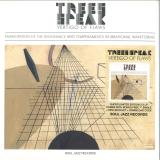
Speak’s new album, “Vertigo of Flaws: Emancipation of the Dissonance and Temperaments in
Irrational Waveforms” comes as a double-vinyl edition, single CD and digital release. The limitededition first pressing only of the vinyl includes a bonus 45 enclosed in an 8-page 7”x7” booklet
insert housed within the gatefold sleeve with cover artwork created by Soviet Union propaganda
artist Lazar Markovich Lissitzky in 1911.
Trees Speak are back!
This new release is a vast leap into an ocean of space and sound, a quantum leap into cybernetics, biology, anti-gravity,
time travel, dream speech and transfiguration. A seriously next step release!
Showing no signs of slowing down their rapid creative pace – incredibly this is their fourth album in the space of just over
one year – ‘Vertigo of Flaws’ is a mighty 29 tracks, one and a half hours of music across one double album that is surely
going to be a defining point in their musical career, a giant leap into the sonic unknown, an epic exploration of intensity
and sound.
Alongside their now trademark German krautrock motoric-beat rhythms, angular New York post-punk attitude, tripped-out
60s spy soundtrack, psyche-rock, and 70s synthesizers and vocoders, here you will also hear a new cosmic spacial
awareness (both personal inner space and galactic outer space) and a truly wilful pushing of sonic boundaries - as police
sirens, static noise, alarms, radio signals, avant-garde voices, and orchestral string quartets, all collide to add beautiful
dissonance to uber-powerful, intense, addictive and propulsive rhythms - in the process creating a truly unique
soundscape that Trees Speak have made wholly their own.
If you ever wanted to hear Can, Hawkwind, Destroy All Monsters, Pere Ubu, electric eels, John Cage, Liquid Liquid,
Tangerine Dream, Suicide, Neu!, Laurie Spiegel, Art Ensemble of Chicago, John Barry, Mother Mallard’s Portable
Masterpiece Company, Sun Ra, Stockhausen, John Carpenter, Electro-Acoustic and Musique Concrete and Mars in one
band - then this is it!
Trees Speak are Daniel Martin Diaz and Damian Diaz from Tucson, Arizona and their music often draws on the cosmic nighttime magic of Arizona’s natural desert landscapes. ‘Trees Speak’ relates to the idea of future technologies storing
information and data in trees and plants - using them as hard drives - and the idea that Trees communicate collectively.
Special guests from the hyper-creative hub of the Tucson music scene on this release are Gabriel Sullivan, Ben Nisbet, Saul
Millan, Stephani Guilmette, and Davis Jones.
The album Vertigo of Flaws was recorded in Brooklyn, New York, and Tucson, Arizona during the plague of 2021.
Extract from Vertigo of Flaws sleevenotes:
‘As we travel through space and time, avoiding the discarded remains of the industrial period, the
deconstruction of social norms through the expression of art, music, and philosophy guide the human
experience towards the unknown.
All that remains are musical echoes scattered throughout the universe, like ancient vibrations that now
populate the cosmos. These waves now show signs of decay. Melody, beauty, tonality have all but fallen
away as dissonance blossoms. As John Cage wrote in 1937,
“Whereas, in the past, the point of disagreement has been between dissonance and consonance, it will be,
in the immediate future, between noise and so-called musical sounds. New methods will be discovered,
bearing a definite relation to Schoenberg’s twelve-tone system and present methods of writing percussion
music and any other methods which are
free from the concept of a fundamental tone”.
Similarly, George Van Tassel claimed the Integratron as capable of
rejuvenation, anti-gravity, and time travel. So, what remains of the
“people”? We have adopted from them our own Zeitgeber: their pulses
now guide our sun, our planets, our earths, and are the new circadian,
diurnal, and ultradian rhythms of the galaxy. Traumsprache, dream
speech, is now the internal language of trees.
Decaying metal and machines liberated the note unto nature’s table,
and we sip the delicious nectar of music once more irrational, elaborate,
violent, vast. The past is the future, musical disintegration its own rebirth.
We are nature, once more the computer of the Universe.’
- A1: Intro To The Underpool: The Path, The Gate, The Field, The Well
- A2: Keening Into Ffynnon Llanllawer
- A3: In The Cave Of The Cailleach's Death-Birth
- A4: Gathering Around Pair Dadeni
- A5: Brigid Wakes To Find Her Voice Anew The Little Flowers & Birds Show Themselves
- B1: Imbolc Dawn Atop Ynys Wydryn Ice Melts As The First Resplendent Rays Of Spring Pour Over The Horizon
- B2: The Tempest On Trefasser
- B3: Don Danann Dana Danu Ana
- B4: Standing Stones Singing/Cellphone Towers Ringing Up To The Darkening Sky
- B5: In Sadness For Our Dying World (Here Come The Christians) (Here Come The Christians)
Consequence and more. Emma Ruth Rundle's second instalment in her Electric Guitar series, EG2: Dowsing Voice, is almost like the soundtrack to a film that hasn't been made. The mostly instrumental record follows her on a trip to the Welsh coast and down a magical well into the waters of nature, myth and the Old Golds - by way of her improvised music. The 40 plus minute album was sewn together from recordings channeled during her month-long solo journey in the early days of 2020 and completed before 2021's critically lauded album Engine of Hell was even written. Unlike Electric Guitar One, EG2: Dowsing Voice features vocal improvisation, unconventional singing and extended vocal techniques free from lyrics - like the throat singing on "In the Cave_" which is meant to be the voices of crones gathering in a rhythmic and physical ritual. Rundle was led to these voices by unseen forces along with the immense impact of the Welsh water: ocean, rivers springs and wells that gave the album its extended title Dowsing Voice. While there is some focus on vocal and story here, her textural and even bombastic guitar improvisations are featured throughout the album. For Rundle, the Electric Guitar series will always be about inspired, unplanned moments like this at its core.
Nothing is explained in the mysteries around us, but some art touches their soul: last year, Justin Tripp, one half of the US-American impro electronic duo Georgia and London-based electronic artist Zaheer Gulamhusein man behind projects like Waswaas and XVARR -joined forces as STRING. Together they went on a virtual vacation and never came back. As the virtual is fully real due to its virtuality, they created a truly authentic aural hardware journey, hauntingly adventurous, calm, and surprising.
Without defining the scope, STRING tumbled through a dark musical zone that stretched to the horizon, letting the sound shape itself while falling discreet into an appealing abstract space. Hovering clockwise shortly above the ground, they formed impossible geometric musical figures - weightless, fluid clouds, made up of relations between asymmetrical elements. Like in nature, their collaborative work avoids identical characteristics. In an expression of respectful admiration, they softly celebrate the irregularities between their specific genetic musical fingerprints, creating eight light binding clouds of dawn. A meditative musical voyage that transports cosmic particles of idealistic Berlin school ambient right into the heart of their electronic machines. All tunes swing calm but constitutive, dancing around synthesized surfaces that form obsessed flaming orbs of fear and hope, of matter and antimatter.
A shared love for hardware and the ethos of improvisation guided STRING into an experimentation, in which each party aligns closely to the core ideas of co-operative, in-the-moment electronic music, tied across the eight tracks in a sequence.
Finding a home with the highly esteemed Hamburg based label V I S, STRING’s debut “Last Index Of...“ will enter the earth in double vinyl and cassette format, plus tripping on at the digital platforms.
With vivid flows that radiate effortless complexity, Detroit rapper Elzhi is among the most masterful lyricists on the planet. The gifted emcee rose to fame as the youngest member of legendary group Slum Village, but has since graduated from prodigy to sensei, with a thriving solo career bolstered by several acclaimed projects, plus memorable collaborations with artists like Westside Gunn, Royce Da 5’9”, Ghostface Killah, Conway, Danny Brown, Little Brother, and many more.
Georgia Anne Muldrow is a supremely talented musician, producer, and vocalist whose eclectic work blends elements of jazz, hip-hop, funk, soul, rock, and beyond. The prolific artist has released more than 20 albums, earned a Grammy nomination without a major label, and worked with the likes of Erykah Badu, Mos Def, Madlib, Bilal, Kool G Rap, Robert Glasper, and more.
Now, Elzhi and Georgia Anne Muldrow are joining forces for the collaborative album "Zhigeist". A carefully crafted mix of psychedelic instrumentation and whirlwind lyricism, the project is entirely produced by Georgia, who also contributes vocals on several tracks. An inspired fusion of styles and textures, Zhigeist is an aesthetic triumph infused with an undeniable message.
Atlanta emcee Tha God Fahim remains a true outlier, releasing new music at a remarkable pace without sacrificing depth or quality. Recently, the talented artist linked with Montreal producer Nicholas Craven for two masterful new EPs within the span of a month, drawing widespread praise in the process. Now, both volumes of "Dump Gawd: Shot Clock King" are available in one physical release. Featuring guest vocals from Your Old Droog, this two-part collection unites powerful creative forces, with Fahim weaving consistently inventive street parables over Craven’s cinematic, soul-drenched production.
On a balmy Brazilian night in February, 1981, a crowd gathered in Rio de Janeiro's Gávea neighbourhood under the iconic dome of the city's Planetário (Planetarium). Alongside musicians like Helio Delmiro and Milton Nascimento (who were in the audience that night), they were there to see the great "Bruxo" (sorcerer) Hermeto Pascoal live in concert, with his new band formation which would become known simply as "O Grupo" (The Group).
Growing up on a farm in Brazil's northeastern state of Alagoas, Hermeto has always been deeply in tune with, and inspired by nature. In his youth he would make his own flutes to play call and response with the birds and frogs. He would build scrap-metal instruments in his blacksmith grandfather's forge, and sit for hours by the lake listening to the sounds of nature. On the Planetário Da Gávea recordings though, Hermeto is cast as the "sorcerer" or the "cosmic emissary" (as the great Brazilian guitarist Guinga once called him), exhibiting an intuitive sense of harmony and melody beyond that of our own world.
"Tudo e Som" (All is Sound). It's a phrase Hermeto regularly returns to, and it points to the fact that not only can music be made from anything, but also alludes to something much more profound. It's an understanding of the universe as being in a state of constant movement, forever vibrating at the quantum level, like the string of a guitar, or a saxophone's reed. "Tudo e Som" is a declaration of the mystical and spiritual power of sound, as a fundamentally vibrational force.
The series of concerts at the Planetário marked the birth of "O Grupo" which would last with the same line-up (apart from Zé Eduardo Nazário) for the next eleven years. Every member of O Grupo was a phenomenal musician in their own right. It was one of saxophonist/flautist Carlos Malta's first gigs with the group, and the concert unusually featured two drummers, Zé Eduardo Nazário and Marcio Bahia. Nazário, from São Paulo, had played with Hermeto during the mid-70s (as well as with Milton Nascimento, Egberto Gismonti and Toninho Horta, to name a few). Bahia though had just joined the group. Acclaimed keyboard player Jovino Santos Neto was on keyboards, piano and organ, and the great Itiberê Zwarg (who remains in Hermeto's band to this day), played bass. Rounding the group off was the percussionist Pernambuco. During this period (up until the early 90s) the group would rehearse for hours on end, virtually seven days a week, with a total dedication to music and Hermeto's musical vision.
Most of the compositions performed that night at the Planetário had never been recorded before, and many are unique to this album, including the wild 'Homônimo Sintróvio', the exaltant 'Samba Do Belaqua', 'Vou Pra Lá e Pra Cá' and 'Bombardino', which features Hermeto's wonderfully absurd call and response mouthpiece soliloquy. Then there's the stunning 7/4 Samba 'Jegue' which builds with inventive dissonance, before releasing yet another celestially colourful, celebratory refrain. The show also features the first recorded performances of 'Era Pra Ser e Não Foi' and 'Ilza na Feijoada' (inspired by Hermetos' wife Ilza's famed black bean and meat stew), which Hermeto later recorded on his 1984 studio album "Lagoa Da Canoa Município De Arapiraca".
Dubbed by Miles Davis as "one of the most important musicians on the planet", a Hermeto Pascoal live show was (and still is) an experience like no other. Across the recording of the Planetário concert, wild improvisation meets groovy, virtuosic vamping on progressive, extended psychedelic jams. The tracks are generally built around a beautiful, transcendent melody; instantly recognisable as being Hermeto's, and for the most part, the musicians then solo over extended two chord vamps. There's a plethora of powerfully delivered rhythms, wild solos and the performances are punctuated by Hermeto's unpredictable, at times comical sonic antics.
Over forty years since this historic happening, Far Out Recordings is overjoyed to release this magical recording of Hermeto Pascoal e Grupo Live at Planetário Da Gávea, on double vinyl LP, CD and digitally for a February 4th 2022 release.
- A1: Projekt Gestalten - The Beast Within
- A2: The Princess Of Death - Trance
- B1: Projekt Gestalten - Trial And Execution Of The Black Wolf
- B2: The Princess Of Death - When The Saints Go Marching
- C1: Projekt Gestalten - Prey To Be Undone
- C2: The Princess Of Death - The Shrine Revelation
- D1: Projekt Gestalten - The Curse Of Engelhart
- D2: The Princess Of Death - Curse, Shattered
- D3: Projekt Gestalten & The Princess Of Death - Requiem For The Swan King
"The Beast Within" is the new album by Brazilian artist, Diego Garcia; exploring gender identities within contemporary electronic music. The artist uses two of their distinguished artistic identities: The Princess of Death, her feminine identity - where there is an exploration of a more introspective and corrosive textures commonly associated with patriarchal values; and Projekt Gestalten, his masculine identity - where melodic and hypnotic sounds, often associated with matriarchy, are emphasized.
In this project, Diego's aim is to dichotomize their gender identities inspired by a point-and-click adventure game from the 90's called "Gabriel Knight 2 - The Beast Within". The story was written by American game designer, Jane Jensen with original music composed by her husband, Robert Holmes. The protagonist is on the trail of a strange wolf, murderer of a little girl. Gabriel was asked to take care of this evil and suspects that this case is paranormal in nature. Together with his assistant, Grace Nakimura, he discovers the dark truth behind the history of Bavaria. The gameplay alternates between Gabriel and Grace and its storyline is only explored indirectly by Diego - as it is deeply connected with their childhood and formative years and still remains as one of their all-time favorite games.
Just like in the gameplay, Diego alternates between both of their feminine and masculine identities in order to create original pieces of music. As Projekt Gestalten, an array of dance tracks are functionally presented; ranging from melodic and trippy to club-ready driving techno; dissecting a more rational aspect of the game's storyline. In contrast, The Princess of Death goes into an ambient and experimental approach; exploring liturgical themes that includes a dark and dystopian cover of the traditional gospel song "When The Saints Go Marching In", a song that is featured throughout the whole franchise of the game in many different versions. In the end, the gender polarizing concept is extrapolated and both aliases are finally merged into one another; leading to the Gestalt principle, alluded to in Diego's main alias, being fully applied as a whole.
The project's ultimate goal is to challenge preconceived notions of how a specific gender should sound/behave and to explore light/dark, sacred/secular, good/evil, male/female using, as the blueprint, a gender-neutral game where the player is forced to assume a feminine and a masculine role in order to navigate through the story. All of these ideas are perfectly aligned with Diego's own trajectory as an artist and their distinct artistic identities featuring distorted gender values - which comes full circle in this project.
It was obvious from the first riff on the first song from their very first album: MASS WORSHIP were born fully-fledged, utterly unique and magnificently destructive. Emerging from Scandinavian shadows like an unstoppable, shape-shifting bulldozer, they have swiftly become one of the most praised and talked-about bands in the metal underground. Despite spending a big part of 2020-2021 locked inside, writing and recording new material, MASS WORSHIP did complete a highly successful tour in support of Polish death metal legends Vader. Meanwhile, MASS WORSHIP are primed and ready to unleash their second full-length assault. Due for release in 2022, “Portal Tombs” is a terrifying but electrifying exploration of the gloomy depths of human nature: a monolithic manifestation of the musical force that is MASS WORSHIP. Drawing inspiration from bands such as At The Gates, Mastodon and Meshuggah, MASS WORSHIP could be likened to many bands, but somehow forge their musical identity into something exceptionally distinctive and transcendent, and with enough confidence and conviction to win over even the most orthodox fans of the genre. “Portal Tombs” will once again proclaim MASS WORSHIP’s one-of-a-kind potency with maximum force. A triumph for both style and substance, “Portal Tombs” is the kind of metal record that shatters epochs, audaciously redefining what it means to be heavy. MASS WORSHIP continue to lead the charge for individuality and verve, while still delivering a never-ending tsunami of life-affirming, spine-shattering riffs. Lyrically, too, “Portal Tombs” takes the path less trodden, exploring the dark recesses of humanity’s past, its present and, darkest of all, its future. As we spiral towards an abyss of our own making, MASS WORSHIP’s soundtrack will resonate loudest of all. “Portal Tombs” is available as: Ltd. CD Digipak, Gatefold LP, Digital Album
Al Doum and the Faryds continue their journey toward a New Direction. Now, they live in a futuristic Garden of Delights, inhabited by strange bright bubbles, golden wheels, water secrets and mysterious plants. From their home of Love & Nature, they set out to travel the Universe to forge a new Being together. Their typical blend of Spiritual-Jazz, Psychedelia and Afro-Latin Rock remains on the same wave, accentuating the collective rite of liberation and expansion of the spirit. There's certainly a greater lightness and airiness, expecially in the most immediate and direct arrangements to convey the message of brotherhood; because the absolute weapon lies in female voices and choirs. These chants are incisive gospel and soul sermons and their narration magically permeates throughout the album. Everything is always supported by the balance between robust and biting guitar riffs, raga-rock incursions, tribal rhythm sections and impregnable and captivating sax drifts; and echoes of the soft lysergic sound of the 60s cannot be missing. This is music of multiple forces, a sacred harmony to overcome barriers, which sees no enemies and breaks down egos. It's the playfulness and the power in making music together, the true magic recipe of these Freaky People: we are what the Universe wants!
Pinegrove’s new album, ‘11:11’, is an unqualified triumph, an
album that seizes listeners with hook-filled songs imbuing
feelings of warmth, urgency and poetic beauty, even as it
asks some of life’s big and difficult questions.
On previous Pinegrove recordings, band member Sam
Skinner usually oversees mixing duties, but this time out,
noted producer and former Death Cab for Cutie member
Chris Walla has assumed the role. Calling previous album
‘Marigold’’s production “crisp and contained,” Hall, who coproduced ‘11:11’ with Sam, sought more of a “messier” feel
for these new songs. Most of the recording took place at two
Hudson Valley facilities (Levon Helm Studios in Woodstock
and The Building in Marlboro) with the final touches done
side by side with Walla in Seattle.
‘11:11’ features lush soundscapes, organs, Megan
Benavente’s melodic and adventurous bass playing, Josh
Marre’s signature guitar work and a special guest - Doug
Hall, Evan’s father- playing piano on many tracks. The record
sounds intimate, yet expansive.
“It spends equal time on optimism, community, reaffirming
what we are and how it’s our duty to look out for one
another,” says singer Evan Stephens Hall. “There’s anger,
love, hope and grief. The record has all of that.”
The opening mini epic track, ‘Habitat’, is a two-part
masterpiece of texturalism, brimming with robust, percussive
guitars and driven by unsettling shifts. Another key track is
‘Alaska’, a happy-go-lucky romp of dense, bracing guitar
rock, lurching out of the gate with tectonic force and boasting
hooks at every turn. Later, the breezy, pastoral folk-tinged
‘Iodine’ glistens with exquisite vocal harmonies, and ‘Flora’ is
a beautifully appointed apology to nature, its luxurious
country rock feels connected to past masters like the Flying
Burrito Brothers or early Wilco.
Following the first ever vinyl reissues of Aurore and Royaume, Aimant + Aimant – Penultimate Press is finally proud to make available the final part of this extraordinary trilogy. Bleu is the final gesture and culmination of this period of creation where poésie and la nature form a magical alliance that resonates as an alchemical wedding. Having the conviction that Bleu was the ultimate arc based on the purity of natural sound and poetry, leaning towards a mystical spiritual search towards their own souls the band moved into commadere and collaboration with friends and ideals such as Lydia Lunch and Alan Vega.
As the world circles the abyss at gathering speed, WIEGEDOOD have returned to provide a perfectly vicious soundtrack. Formed in 2014, the Belgian trio have built an unassailable reputation as purveyors of visceral and bleak black metal in its purest and most destructive form. Since unveiling their debut album “De Doden Hebben Het Goed” in 2015, WIEGEDOOD have blazed an unending trail for musical darkness, bolstering their burgeoning notoriety with some of the most apocalyptic live performances in recent memory, and producing two subsequent albums – “De Doden Hebben Het Goed II” and “III”, released in 2017 and 2018 respectively – which hammered home the band’s unique creative powers. Emerging once more, this time from the involuntary solitude of a plague-bound world, WIEGEDOOD are back with their fourth studio album, “There’s Always Blood At The End Of The Road”. A ferocious tour-de-force, born of frustration and the ever-burning flame of hatred for the modern world, the new record marks a significant departure for this most ruthlessly singular of modern metal bands. “Musically I think we’ve made our most uncomfortable record so far. It’s once again faster than anything we’ve done before, and more unforgiving than the whole trilogy combined”, says vocalist/guitarist Levy Seynaeve. “To me, it feels like a soundtrack, for a movie yet to be made. A movie about the filthiest and most disgusting parts of human nature and society, and about the struggle we lead within, trying to overcome the fact we are all made from that same filth.” “There’s Always Blood At The End Of The Road” is available as: Ltd. CD Edition, 2x 180g LP (with etching on side D) that come in a Wide Spined Sleeve and 2 printed Discobags, Digital Album.
When hearing Anna Gréta at the piano, you become witness to an
astonishingly mature artist, with absolutely profound technique, a
complex understanding of style and harmony and an impressively
wide range of musical expression, who has made an extraordinarily
good name for herself in just a few years on the Scandinavian scene.
Over a period of two years, partly influenced by isolation, the twelve
compositions of ‘Nightjar in the Northern Sky’ emerged, for Anna
Gréta not only as a pianist but also as a singer.
The album title ‘Nightjar in the Northern Sky’ sets the tone for the
world of the album: A metaphor for the Scandinavian expanse,
tranquility and the close connection between people and nature, a
theme that runs through the songs in many pictures. “Nature is just an
enormous force in life. It is so much bigger than most of the other
things that otherwise seem so significant to us. And it is, in its infinite
facets, perhaps the greatest inspiration for my music. A place where
the noise falls silent and you can feel and hear yourself again,” before
adding: “Recently I have been developing a passion for bird-watching
- something that I reflect on in the title track. When you observe
nature carefully you can experience or see something unique. Sort of
like searching for love. The nightjar is a bird that is rarely seen flying
across the sky in Sweden and has been observed in Iceland less than
five times. I feel that everyone is looking for something unique in their
lives. And that nature can offer that to the ones open to see it.”
With each of the tracks on the album she creates little, self-contained
worlds that fit into a bigger picture. Light-footed, relaxed, reduced,
concentrated. An art that required a great deal of work and attention
to detail. Together with pop-experienced producer Albert
Finnbogason, Anna Gréta chose the perfect, hand-picked line-up and
sound for each of her extraordinarily refined - harmoniously and
rhythmically - compositions.
Although always in a coherent framework, Anna took elements from a
very diverse range of musical styles, alternating between jazz
elements and influences from pop music to excerpts from classical
and folk. All these elements create a remarkably multi-layered album,
which at the same time tells a coherent, bigger story.
CD in 4-page digipack with 12-page booklet.
180g vinyl with digital download code
Ever since the release of their acclaimed debut EP P'eau (2018) these Mechelen-based musicians have been honing their craft in songwriting and production, building a new home studio to record future material while also expanding from a three-piece to a five-piece ensemble. By adding singer/percussionist Stefan De Graef (Psychonaut) and guitarist/singer Sander Rom (L'Itch) to their ranks, HIPPOTRAKTOR have become a more versatile outfit able to employ a broader palette of sounds, taking the band's earlier instrumental prog metal sound to new heights. Taking notes from the best moments in contemporary progressive and post metal, HIPPOTRAKTOR capture the awe-inspiring power of nature_from the delicacy of the first falling leaf to the massive cosmic energy of the sun. By combining the big, catchy riffs and the rhythmical prowess of Gojira with the relentless but equally groove-loaded complexity of Meshuggah, Meridian delivers an overwhelming experience of sound, presenting the listener with sentiments that are recognisable, but with an intensity that seems larger-than-life. "Meridian finds its origin in everyday moods, taken out of context and morphed into a stylised version that re- flects the dreamer in me," explains main songwriter and guitarist Chiaran Verheyden. "It tells the story of someone who's lost in a world too massive to comprehend, and seeks answers in places where none can be found. Meridian was written as an attempt to distillate what I felt but couldn't put into words." As the main vocalist in the group, finding these words was the job of Stefan De Graef, who carried over his fascination for philosophy and religion from his other band Psychonaut. "Meridian tells the story of a solitary wanderer on the Earth in the absence of other beings," explains Stefan. "Without anyone to share knowledge and history with, the protagonist is forced to create his own truths and stories about the nature of life, consciousness and the universe. The protagonist begins to personify and deify his surroundings, assigning sentience to the trees, the mountains, the wind, the waters etc. for they are his only companions in this desolate world." Essentially, Meridian is an exploration of the evolutionary theory of naturism, which was put forth by German scholar Max Mu"ller in the 19th century, and which argues that religion finds its origin in the deification of the forces of nature by early human beings. By juxtaposing this sociological theory with seven tracks that unfailingly conjure images of the earth, sea and sky, HIPPOTRAKTOR have created an analogy that enlarges the imaginative quality of their music to (literally) epic proportions. Combining the best of prog, groove and post-metal, Meridian comprises an incredible ride for fans of soaring hooks, technical riffing and earth-shattering breakdowns. Limited bluegreen-grey single colour vinyl edition, gatefold! FOR FANS OF Meshuggah, Periphery, Cloudkicker, Intronaut, Animals As Leaders, Gojira, Skyharbor, Psychonaut
There’s a mystique in things that appear in threes. In Greek mythology it represents harmony, wisdom and understanding: for Pythagoras it’s the smallest number needed to create a pattern, the perfect combination of brevity and rhythm, while in literature there’s no story without a beginning, middle and end or past present and future. Summed up in the Latin phrase omne trim perfectum, for Southampton based songwriter Ian Miles (Guitarist/Songwriter with UK band, Creeper) the perfect trio presents itself as Degradation, Death and Decay. Inspired by performance art of the 70s and Halloween — taking cues from the visual legacies of Robert Rauschenberg and Serbian film maker Marina Abramovic while musically drawing on bands such as Conor Oberst, Leonard Cohen, R.E.M and The Cure — this first full-length is more art horror project than album. “I never really seen this as a solo project because I’ve been writing and recording acoustic music since I was about 15. I low key released some very old songs way before Creeper started and even during,” says Miles about choosing to step out on his own. “I don’t want to be the focus of this record, it’s not about me so I have decided to hide me. I want people to solely focus on the art.” Layered with haunting vocals and a myriad of rhythmic textures, Miles sets out to explore one of natures most habitual cycles: our individual journeys though life, that life eventually coming to an end and acceptance, striving to give the listener full control over the art rather than focus on the inherently human force behind the mask.
- A1: Bukkha - All For Jah
- A2: Bukkha - Dub For Jah
- B1: Bukkha & Fada Jep Feat Mowty Mahlyka - Bun Di
- B2: Bukkha & Fada Jep Feat Jahwind All-Stars - Bun Di Horns
- C1: Bukkha - Conquering Lion
- C2: Bukkha - Conquering Dub
- C3: Bukkha & Bungalo Dub & I-Keys Dub - The Highest Master (Raw Mix)
- D1: Bukkha & Bungalo Dub & I-Keys Dub Feat Don Fe - The Highest Flute
- D2: Bukkha Feat Hazeldub - The System
- D3: Bukkha - Dub System
Ready to chant down Babylon with musical fire and brimstone, none other than Bukkha returns to the revered Moonshine Recordings with a truckload full of sound system music in Roots Dub and Stepper style. Ten organic heavyweight cuts on 2x12" - strictly dubwise, no compromise!
Originally from the US and now residing in Spain, a musical veteran with a career spanning more than a decade, it's safe to say Bukkha runs things when it comes to fuelling sound systems. On top of his long-standing involvement in the thunderous Moonshine Rec. discography, the prolific artist maintains a consistent record of top-shelf releases on numerous famed record labels within the global melting pot of Dub-influenced dance music, including System Music, Dub-Stuy, Lion Charge, and so on. His 'In Roots Vol. 1' debut LP features seven talented guest artists from around the globe, the extended Dub family in full force and effect - connected to Bukkha through previous projects, shared tours and overall engagement in the scene. The symbiotic nature of the collaborations can be heard and felt as big stacks of speakers lend their voice to the musical message. Rebellious sounds for the healing of the nation. In a conscious stepper style, the release marches through original future classics - whether instrumental or led by the Rastafarian teachings of Mowty Mahlyka, anthem brass melodies by JahWind All-Stars, harmonica meditation by Hazeldub or Don Fe's notoriously brilliant flute virtuosity. With true to the roots delay and reverb effects in the original Dub fashion, the album pays tribute to the technique pioneered by the likes of King Tubby, nothing less than a next-generation torchbearer. Sound system music, as timeless as its cultural heritage.
- generic sleeve repress -
It has been a little over a year since the release of 747's debut album, in which the Canadian masterfully drew notes of inspiration from the 90s to create an enchanting hour-long dream. In his first EP since, 747 returns from a temporal leap, bringing with him a blend of sounds and expressions to forge a timeless trip which hinges on the sounds of the 303.
Opening the release, "you,you" unfolds with a gentle and shimmery padded ambiance of anticipation. Gentle and light-footed percussion is soon interrupted by a dramatic siren, a warning beacon. Frenetic energy ensues, a frantic rush to the floor met with a cloudy head. Encompassed in an envelope of disorienting wailing and intermittent buzzing, but finally grounded by the familiarity of a 4/4 bass drum.
"Does Anybody Remember Laughter?" steps in to relinquish the force of gravity. The animated arpeggio and gleaming singing acid line rise up, uncovering the kaleidoscopic nature of the structural surroundings.
"While My 303 Gently Weeps" divulges further, exposing an underlying grid of dark geometry - binary and robotic. The topology of surfaces becomes increasingly fractalized, until the solo overtakes with a somber sadness. The 303 notes guide the mind on a melancholic and meditative walk along the grand staff, met after the break with a sense of hope and serenity.
Motörhead are the true embodiment of rock n’roll excess. A hybrid of punk, rock and heavy metal played with relentless, ear-curdling power. They were a force of nature and nothing short of life-changing for millions, their approach to life and music; there was no “off” switch and they became legends as a result. Fronted for their entirety of their career by Ian ‘Lemmy’ Kilmister, they released twenty two studio albums over their 40 years together. Amassing chart topping records, a Grammy award and racking up 15 million worldwide sales. Their signature song, Ace Of Spades perfectly captured everything great about hard rock, heavy metal, and punk, amped it all up to 11, and came racing out of the gates at what felt like a million miles an hour, pushing at every musical boundary. Nothing was harder. Nothing was faster. And certainly nothing was louder. Anyone disputing this fact need look no further than any heavy metal gig and play ‘spot the Motörhead T-shirt and jacket’, they still outnumber anyone else, hands down. Motörhead has truly become a lifestyle for several generations of rockers, metalheads, punks, bikers, athletes, rebels, outcasts, and freethinkers all around the world. Few bands in modern history can instantly ignite the adrenaline of music fans the way they can, they changed the course of hard rock…forever. This Very Best Of compilation is the very first, spanning their entire career.
Fractal City, the latest Cubenx album is a collection of terrestrial jams and arachnean ambient ballads that are particularly apt for urban listening. If its predecessors cracked the musical codes in force and shone by the versatility of their references, this new opus offers its listener an intense and symbolic sound environment.
The raw material of Fractal City was first conceived as a series of sound patches, designed to run in parallel with Canadian digital artist Maotik's installation. Broadcasted in real-time by generative patches reacting to various external and non-human data, those musical excerpts have been rendered in hundreds of nuances and extended over infinite durations. This unusual approach confers to the recording of the finished album's outstanding immersive strength.
Recorded live on a single track over a short period of a few weeks, the nine compositions of Fractal City capture the obsessions of its author for postmodern urban landscapes, and the revelation of new perspectives on the city of Paris.
The opening piece `Ssarg´ seems to hide the figure of the Mexican ambient producer Jorge Reyes. Cubenx built a cocoon of energetic layers, a new home of the mystical kind harmoniously integrated in a flourishing rainforest ecosystem.
`Transect ´refers to the urban development model of the same name, which is based on a division of the city into autonomous "fractal" zones. It also echoes the concept of "metro polarities" which considers the city as a mosaic of social groups. "By cycling in the evening with a friend, we could get away from the city centre to the suburbs of Paris. The contrasts are striking. You move from chic districts to bedroom communities, from industrial zones to improvised caravan camps. But there is a kind of energy in this heterogeneity that pushes you to always pedal further."
A few miles away, it would look like Art and urbanism have tried to level the cultural and social discrepancies of the outskirts of Paris. "Architectural sites like the Arcades of Bofill are splendid. There are completely extravagant projects, which seem to emerge from nowhere."
These buildings with ambitious aesthetics off the beaten tourist track, deteriorate over time and often remain far from the expectations of the local population. A feeling of nostalgic beauty is particularly perceptible on the slowest and most introspective ballads of the album as 'Urban Decay', 'Hagel' or 'Axe Majeur'. The producer leaves nonetheless no room for melancholic emptiness. "Every time, I have the impression that urban culture is taking its rights back and that young people appropriate the places in one way or another."
Just like `Transect', ` Quantified' and `Fractal City' present themselves as mirrors of a daily urban life in constant motion. All three are empowered by an overheated factory, which dispatches hypnotic beats and burst of analogue compressors with a clinical precision and direct them straight away to the reptilian areas of their listener's brains.
The sequencing leaves however space and time to take breath and makes way for aerial sonic excursions of spiritual and enlightened nature. On `Human Dilemma', Cubenx shows some concerns to opening the Pandora's box of transhumanist theories. While a long cosmic wave gives the listener a feeling of perfect fullness, a dizzying guitar distortion cast doubts on long term outlooks. `Smash Other' on the other way alternates gentle dissonances over an ocean of white noise and concludes the album on ethereal note.
With ´Fractal City", Cubenx eludes his irreconcilable love for shoegaze pop song and techno to concentrate exclusively on the production of mutant experimental materials. The result is an uncanny musical object, rich in image and sensation. Cubenx give us a guiding framework, enthralling enough to engage the listener to a tour of town. But he leaves it to the sole listeners to design their own projection of the city.
Pianist McCoy Tyner was an acknowledged force of nature. On the aptly-named Expansions, Tyner fronts a remarkable band consisting of Woody Shaw on trumpet, Wayne Shorter on tenor saxophone, Gary Bartz on alto saxophone, Ron Carter on cello, Herbie Lewis on bass, and Freddie Waits on drums. Stand-out tracks in a program of four Tyner originals and one standard include the timeless masterpiece “Peresina” and the immersive opening track “Vision.” Blue Note Records’ Tone Poet Audiophile Vinyl Reissue Series is produced by Joe Harley and features all-analog, mastered-from-the-original-master-tapes, 180g audiophile vinyl reissues in deluxe gatefold packaging. Mastering is by Kevin Gray (Cohearent Audio) and vinyl is manufactured at Record Technology Incorporated (RTI).
- A1: Fantas Variation For Voices (Feat Evelyn Saylor, Lyra Pramuk, Annie Garlid &Amp; Stine Janvin)
- A2: Fantas For Saxophone And Voice (Feat Bendik Giske)
- A3: Fantas For Two Organs (Feat Kali Malone)
- A4: Fantas For Electric Guitar (Feat Walter Zanetti)
- B1: Singeli Fantas (Feat Jay Mitta)
- B2: Fantas Hardcore (Feat Baseck)
- B3: Fantas Resynthesized For 808 And 202 (Feat Carlo Maria)
- B4: Fantas Morbida (Feat Kara-Lis Lis Coverdale)
Fantas is the epic opening track on Caterina Barbieri’s acclaimed 2019 release Ecstatic Computation. The original Fantas laid out a magical path of patterns leading the listener on a journey into the sound itself. Fantas Variations maps out eight new potentials sprung from this initial path as constructed by a diverse mix of artists lending to a wide spectrum of new works extrapolated from the original work. For this project Barbieri invited friends and long time collaborators from a variety of musical backgrounds to create a more sustainable and inclusive landscape in terms of stylistic, geographical, gender and generational balance. The results are a diverse array of approaches and instrumentation which blur the boundaries between the acoustic and electronic.
Fantas Variations embraces a platform for mutual exchange and support between like-minded artists, where active and collective re-imagination is prioritised over the traditional model of remixes, which is often strategic, functional and more passive.
Longtime friend and collaborator Kali Malone rearranged Fantas to a slowed-down, austere and eerie version for two Organs. Evelyn Saylor created a piece for a vocal ensemble consisting of her, Lyra Pramuk, Stine Janvin and Annie Garlid, joining forces to express the choral, psychedelic and vitalistic nature of the piece. Barbieri’s former guitar professor at the Conservatory in Bologna, Walter Zanetti, composes Fantas for electric guitar, by translating every single gesture of the original electronic piece into a personal, nuanced and detailed interpretation. Bendik Giske’s reinterpretation for Saxophone and Voice captures the atmospheric essence of Fantas and its psychic meteorology. Longtime collaborator and along with Barbieri the other half of the outfit Punctum, Carlo Maria, resynthesizes Fantas for TR808 and MC202, bringing a more club-oriented dimension of the piece to life whilst unveiling the sonic continuum between rhythm and pitch through a sensitive timbral approach. Jay Mitta’s Singeli reinterpretation of Fantas transpires with pitched-up percussion and turbo-fast polyrhythmic patterns unleashing the frenetic, shifting, transformative matter within the piece to a higher plain of euphoric dance. Baseck’s variation is a rave fantasia, where the prismatic trance of the original is channeled into fierce, uncompromising hardcore, whilst Kara-Lis Coverdale’s take is a phantasmagoria for piano that gently, yet inexorably, captures the relentlessness chimerical qualities of the original, unveiling its spectral backbone.
Evelyn Saylor (feat. Lyra Pramuk, Annie Garlid & Stine Janvin) - Fantas Variation for Voices (7’38’’)
Composed by Evelyn Saylor. Performed by Evelyn Saylor, Lyra Pramuk, Stine Janvin and Annie Garlid. Recording, mix and additional production by Bridget Ferrill at Real Surreal Studio, Berlin 2021.
Bendik Giske - Fantas for Saxophone and Voice (7'31'')
Adapted and performed by Bendik Giske. Recorded, mixed, and produced by Bendik Giske in Funkhaus, Berlin 2020.
Kali Malone - Fantas for two Organs (10'21'')
Arranged for The Utopa Baroque Organ, The Sauer Organ and tuned sine waves. Recorded by Benny Nilsen at Orgelpark, Amsterdam 2020.
Walter Zanetti - Fantas for Electric Guitar (7'27'')
Recorded by Walter Zanetti, Bologna 2020.
Jay Mitta - Singeli Fantas (12'03'')
Recorded by Jay Mitta in Sisso Studios, Dar Es Salaam 2020.
Baseck - Fantas Hardcore (4'44'')
Mixed by Anthony Baldino, Los Angeles 2020.
Carlo Maria - Fantas resynthesized for 808 and 202 (4'29'')
Recorded by Carlo Maria, Milano 2020.
Kara-Lis Coverdale - Fantas Morbida (3'04'')
Performed, recorded and mixed at The Shop in Valens, Ontario by Kara-Lis Coverdale, January 2021. Engineering assistance from Robert Coverdale and Adam Feingold.
Repress
Punctual like a Swiss watch, Driftmachine presents a new album that once again astounds and delights. We know their trademark: solid mechanical percussions, forceful bass and melodies systematically built around circular patterns. "Spume & Recollection" is the sixth Umor Rex album by the Berlin duo, and what better way to celebrate the label's 15th anniversary than with a new record from the masters of labyrinthine cables and patches. Regarding "Nocturnes" (UR 2014), their debut album, we described their sound as precise and symmetrical, identical concrete blocks mounted and articulated in a random order. Their already obsessive style continued to evolve with their third record, "Colliding Contours" (UR 2016), now pushing further into abstract dub, ultra-tense grooves, and even more kinetic loops, moving further away from conventional musical structures. Between these two albums they released the remarkable "Eis Heauton" (UR 2015), a kind of hypnotic experiment informed by shadowy atmospheres, chance, and an intuitive dialogue with their musical machines, a unique situation in which they acted as bemused observers in hunt for epiphanies, resulting in an exquisite amalgamation of lucid dream-logic and mechanical precision. A one-of-a-kind soundtrack for minute and wordless scenes unfolding in pitch-black back alleys and hidden, alchemical basements. A similar map was explored with "Shunter" (UR 2018), a superb secret meeting between avant-garde phantasmagoria and concrete experimentation. "Radiations" (UR 2017) offered B-sides and bonus tracks, in addition to collaborations with Shackleton and The Sight Below, a kind of preamble that united Driftmachine’s different expressions and leanings.
When Andreas Gerth and Florian Zimmer come up with new material, one listens with high expectation. Looking back on their discography, one could safely anticipate a high quality album densely layered with their familiar leitmotifs. And yet, "Spume & Recollection" takes us by surprise and finds a new way to transfix. Fresh methods and ideas are introduced to their dynamics and formula. Yes, of course, you can still expect a healthy dose of kosmische, which is one of the dominant features in Driftmachine’s DNA; but this is now entwined with novel materials, semi-material patterns of alien code stretching over exhilaratingly tense and detailed grooves, clouds of gas shifting on top of deep dub architecture and blocking out the sun for prismatic effect. Even more of a surprise is the immediate, streamlined nature of these tracks, making "Spume & Recollection" their most accessible record and, perhaps, the most addictive (and this without sacrificing the essential mystery and strangeness at the core of Driftmachine’s sound).
We have previously described their work as post-industrial-dub; right now, we might just call it hypno-music for man and machine to dance and dream together. "Spume & Recollection" takes this concept as far as it can go without breaking, and finds some strange new feelings, and weirdly danceable grooves, to shed some light on this dark and dazzling ride.
All songs written & produced by Andreas Gerth & Florian Zimmer in Berlin Mastered by John Tejada Artwork & Photos by Daniel Castrejón
“The Hunt for the Gingerbread Man 2: Get the Dough” embraces the juxtaposition between a fantastical world made of candy and pastries, and the dark and unforgiving lifestyle of the veteran emcee. Sonically immersive, and nostalgic of an era in hip hop that celebrates pain and hardship through whimsical storytelling, this album reaches deep into the life of the protagonist “Mr. Ginjy Breadman” aka “The Gingerbread Man” - and doesn’t let go until you’ve become fully invested in his tumultuous life journey in the “United Cakes of America.”
Thirteen years after the studio release of “The Hunt for the Gingerbread Man,” this sequel album is a testament to MF Grimm’s vivid imagination and innate ability to create stories that transport you beyond our earthly realm. Anthropomorphic cookies, pastries, and gingerbread men are the primary characters in MF Grimm’s tales of violence, crime, drugs, and love, in the ghetto known as “Candyland.”
Perhaps the most compelling aspect of the twenty-one-track album is its unrelenting dedication to both the authenticity of MF Grimm’s infamous life story, and the innocent and irreverent nature of the characters themselves.
The album is produced, mixed, and mastered by Darko the Super.
- A1: It Should've Been Me
- A2: Losing Hand
- A3: Heartbreaker
- A4: Mess Around
- A5: Sinner's Prayer
- A6: The Midnight Hour
- A7: Greenbacks
- B1: Bags Of Blues
- B2: The Man I Love
- B3: Doodlin
- C1: Mary Ann
- C2: I've Got A Woman
- C3: Hallelujah, I Love Her So
- C4: Lonely Avenue
- C5: It’s Alright
- C6: Am I Blue
- D1: What'd I Say (Part 1 & 2)
- D2: Come Rain Or Come Shine
- D3: Hit The Road Jack
- D4: Let The Good Times Roll
- D5: Unchain My Heart
- D6: Georgia On My Mind
Raymond Charles Robinson was not just a legend, “the genius”, a “force of nature” and “a presence”. He was also pure energy, the source of a radiant glow that dazzled everyone who ever came near him. His passion for music, women, and rhythm, coupled with his love of life and laughter, were ingredients that made his work a monument of 20th century culture. He left essential traces – in jazz, blues, soul and R&B – because music is something inseparable and Ray lived its rhythms from the inside.
Born in poverty, raised in America’s racist South, blind at seven and an orphan at 15, Ray had all it took to be a success… Those attributes, plus a few titles in his case that he’d recorded for Swing Time, made such an impression on Ahmet Ertegun that he signed Ray to Atlantic in 1952. The next ten years forged the legend of Ray Charles. And now, six decades later, the tracks on this album are still hits hummed by all generations.
Japanese veteran dj & producer “kza”(half of dj duo “force of nature”) have released his first solo album in 2009 on only cd.
kza is one of best dj in the modern disco/house scene in japan and also well known as vinyl digger.
this album was made with his knowledge from his big collection of vinyl.
we’re listening to this album at studio mule and feeling we should release this album on vinyl.
finally we are going to release this epic modern disco album on 2lp.
In Spring 2021, Seoul-based label Extra Noir will make TENGGER’s first EP, Electric Earth Creation, available on vinyl for the first time. Previously limited to a small run of CDs sold only in Korea, this 5-song 2013 collection reveals the genesis of what would become TENGGER’s signature sound: hypnotic synths, spectral vocals, rhythmic propulsion and nature motifs. Electric Earth Creation, however, presents a harder, less ethereal and more danceable version of the band. The EP was produced on Korea’s Jeju island, after the birth of RAAI, son of Marqido (synthesizers and programming) and Itta (vocals), which followed the dissolution of their previous musical project, 10. Conceived in response to the house-bound isolation of becoming new parents and the wild nature that surrounded them outside, the songs of Electric Earth Creation feel like rituals to summon and celebrate Earth’s primordial forces.
Despite a COVID-19-related separation between Japan and Korea, TENGGER have gained increasing recognition throughout 2020, and are confirmed to play 2021’s SXSW Online, with their most recent LP Nomad appearing in multiple “Best of 2020” lists and Pitchfork describing the album as imbued with “rustic majesty”. Fans of TENGGER’s later work will find Electric Earth Creation an essential part of the band’s catalog.
“This is the time. And this is the record of the time.”
Laurie Anderson’s 1982 debut album, Big Science, will return to vinyl for the first time in 30 years with a new red vinyl edition on Nonesuch Records. The release includes the re-mastered original album first released on CD for the 25thanniversary in 2007.
In the early 1980s, Laurie Anderson was already respected as a conceptual artist and composer, adept at employing gear both high-tech and homemade in her often violin-based pieces, and she was a familiar figure in the cross-pollinating, Lower Manhattan music-visual art-performance circles from which Philip Glass and David Byrne also emerged. While working on her now-legendary seven-hour performance art/theater piece United States, Part I–IV, she cut the spare ‘O Superman (For Massenet)’, an electronic-age update of 19th century French operatic composer Jules Massenet’s aria ‘O Souverain’, for the tiny New York City indie label 110 Records. In the UK, DJ John Peel picked up a copy of this very limited-edition 33⅓ RPM 7” and spun the eight-minute-plus track on BBC Radio 1. The exposure resulted in an unlikely #2 hit, lots of attention in the press, and a worldwide deal with Warner Bros. Records.
’Cause when love is gone, there's always justice.
And when justice is gone, there's always force.
And when force is gone, there's always Mom. Hi Mom!
At the time of its original release, the NME wrote of Big Science, ‘There’s a dream-like, subconscious quality about her songs which helps them work at deeper, secret levels of the psyche.’ With instrumentation ranging from tape loops to found sounds to bag pipes, Big Science anticipated the tech-savvy beats, anything-goes instrumentation and sample-based nature of much contemporary electronic and dance music. On the album’s 25th anniversary, Uncut noted, ‘The broader themes of alienation and disconnection still resonate, while Anderson’s use of loops and traditional/synthesized instrumentation is prescient.’
“In the ’70s I travelled a lot,” Anderson recounts. “I worked on a tobacco farm in Kentucky, hitchhiked to the North Pole, lived in a yurt in Chiapas, and worked on a media commune. I had my own romantic vision of the road. My plan was to make a portrait of the country. Big Science, the first part of the puzzle, eventually became part two of United States I–IV (Transportation, Politics, Money, Love). My goal was to be not just the narrator but also the outsider, the stranger. Although I wasfascinated by the United States, this portrait was also about how the country looked from a distance. I was performing a lot in Europe, where American culture was simultaneously booed and cheered. But the portrait was also a picture of a culture inventing a digital world and learning to live in it. Big Science was about technology, size, industrialization,shifting attitudes toward authority, and individuality. It was sometimes alarmist, picturing the country as a burning building, a plane crash. Alongside the techno was the apocalyptic. The absurd. The everyday. It was also a series of short stories about odd characters – hatcheck clerks and pilots, preachers, drifters and strangers. There was something about Massenet’s aria ‘O Souverain’ – which inspired ‘O Superman’ – that almost stopped my heart. The pauses, the melody. “O souverain, ô juge, ô père” (O Lord, o judge, o father). A prayer about empire, ambition, and loss.”
Laurie Anderson is one of America's most renowned – and daring – creative pioneers. Her work, which encompasses music, visual art, poetry, film, and photography, has challenged and delighted audiences around the world for over 40 years. Anderson released her first album with Nonesuch Records in 2001, the critically lauded Life on a String. Her subsequent releases on the label include Live in New York (2002), Homeland (2010), the soundtrack to Anderson’s acclaimed film Heart of a Dog (2015), and her Grammy-winning collaboration with Kronos Quartet, Landfall (2018). Additionally, Anderson’s virtual-reality film La Camera Insabbiata, with Hsin-Chien Huang, won the 2017 Venice Film Festival Award for Best VR Experience, and, in 2018, Skira Rizzoli published her book All the Things I Lost in the Flood: Essays on Pictures, Language and Code, the most comprehensive collection of her artwork to date.
Tape
After tapes on Steep Gloss and Cruel Nature, we are happy that Stuttgart-based collective Zebularin join the OM family with their new release “Hermetic Topography“.
The album, a product of weekly recording sessions between March and July 2020, just when the pandemic slowed a bit down, might be the closest approach to what communal experiences sounded throughout 2020. It‘s a bold design of how collective improvisation can work in the post-covid era.
The first minute of „Budenzauber“ sets the tone for the whole record. Synth waveforms get joined by a drumset, both settling into a vivid conversation between digital noise and analog free jazz, finding a shared rhythm for this journey.
Daniel Vujanic, known to some from his recordings with Höhlenmusk Ensemble, Ixtar or E Jugend and the driving force behind Zebularin, had this urge to layer electro-acoustic solo material, synths, prerecorded audio meditations, without bending the sounds into detailed harmonic structures, but to build up dense, morphing atmospheres. In came Daniel Kartmann, a combatant in many of Vujanic‘s musical endeavours, his percussions, wind instruments and some deep musical talk - from obscure black metal to brazilian psychedelica, from Scott Walker to Gustav Mahler. The duo laid down basic tracks, kept arrangements vague, creating a perfect environment for a range of other players and instruments to walk in: piano, woodwinds, electronics, ebowed guitars and a vibraphone. The resulting record is a tender, affectionate take on jazz and electroacoustic composition. One can hear the routine of the involved cast as well as the fun, deep listening and correspondence that took place; even though this album was not recorded live in big-band-style, musical ideas interlock on an intuitive level and complement each other.
Take „Peljuga“ as a perfect example, a loosened jazz improv reminding of The Notwist‘s more psychic enhanced moments, which blends into a conversation between a contact mic and heavily manipulated synths and turns into a minimalist piano composition, which melds into a climactic peak and is interrupted only to rise again. And as complex as this description sounds, as uplifting is the actual song. Or the album‘s last track, „Holmen“, which starts out as an underwater ambient piece and evolves pretty organically into cosmic power electronics.
Despite its name and the Heideggerian flair of some song titles, „Hermetic Topography“ is all but hermetic. It‘s rich in musical colours without melting into a quagmire of maximalist noise. It‘s sophisticated but never top-heavy. It might be one of your favourite tapes of 2021.
Los Saicos created a raw, wild and visceral sound, the Southern Hemisphere equivalent of the garage rock that was coming out of the US and their anthem 'Demolición' is one of the most insane '60s punk songs of all time. Unavailable on a 45 for over a decade, here it is again! The archaeology of rock'n'roll is much like any other form of digging. Significant finds demand the re-addressing of previously considered certainty. You can hear direct links to both The Stooges and The Cramps here and several more equally enthralling combos. The latter spawned several generations of individuals who would dig deep to previously (mostly) unheard seams of music and other forms of culture that have since become part of the mainstream fabric. When Los Saicos' front man Erwin Flores was asked how aware he and his friends were of what was happening in Britain and the US at the time, here's what he had to say: "We knew the Beatles, they were our idols. We heard the Rolling Stones after recording 'Demolición' and also Bob Dylan and others. The primitive nature of our songs is something that came spontaneously out of my head. The band had no problem with assimilating and arranging it. We thought of ourselves as bad boys and that must have been a driving force." "Primitive to the point of primordial, Los Saicos are an important benchmark. Not were. Who ever thought there could be a combo out there in Peru that would make The Sonics sound like Simon and bloody Garfunkel? There is quite possibly some other music out there, someplace, that could well make us re-address this consideration, but until then, cherish this short course of Saicotherapy."
- 1: Last One Out Turn Off The Lights
- 2: Destruction
- 3: The Smoking Gun
- 4: Going To Sin City
- 5: Don’t Forget To Live Before You Die
- 6: I’ll Be The One
- 7: Young Man
- 8: You’re Gonna Be My Girl
- 9: St Georges Day
- 10: Force Of Nature
- 11: She’s A Millionairess
- 12: Firebird
- 13: Hero
- 14: The Fires That Roar
- 15: Pariah
- 16: You’re Gonna Be My Girl (Live)
- 17: Destruction (Live)
- 18: Last One Out Turn Off The Lights (Live)
- 19: Don’t Forget To Live Before You Die (Live)
- 20: Going To Sin City (Live)
- 21: I’ll Be The One (Live)
- 22: She’s A Millionairess (Live)
- 23: Young Man (Live)
Overview:
British hard-rock heroes, Thunder, release their 13th studio album ‘All The Right Noises’ on 12th March 2020. The album is a return to the full-throttle sound of Thunder that has seen them create a hugely successful 30+ year career at the forefront of British rock, all built around the lifelong friendship of vocalist extraordinaire Danny Bowes and songwriting genius and guitarist Luke Morley. ‘All The Right Noises’ is an intense confection of illicit charms that reasserts their authority as the number one band in the land. Recorded in the months leading up to the first Covid-19 lockdown, it was originally due for release in September 2020. Strange to reflect then on how much of the new material appears to address the challenging new world we now inhabit. On the album, Luke says “ All the songs were written and recorded pre-Covid. But it is interesting how if you look at some of the tracks through the prism of Covid they still make a
lot of sense.” The volcanic lead single from the album, ‘Last One Out Turn Off The Lights’ could easily be mistaken for world-ending lockdown rage. But, says Luke, “That was directly about Brexit, but you could apply it to everything else.” The track is indicative of both the ferocity and message of the album as a whole, with subjects tackled including depression, mental health, and diversity
‘All The Right Noises’ follows on from 2019’s stripped back and reimagined album, ‘Please Remain Seated’ which continued their consecutive Top 10 UK Album Chart run since their ecstatically received comeback six years ago. It is another chapter in the band’s incredibly successful history that has seen them create a succession of some of the most highly-regarded rock albums of the past 30 years. The key to their renown: brilliantly conceived top-drawer material. Thunder is the last of the true British rock giants.
- 1: Last One Out Turn Off The Lights
- 2: Destruction
- 3: The Smoking Gun
- 4: Going To Sin City
- 5: Don’t Forget To Live Before You Die
- 6: I’ll Be The One
- 7: Young Man
- 8: You’re Gonna Be My Girl
- 9: St Georges Day
- 10: Force Of Nature
- 11: She’s A Millionairess
- 12: Firebird
- 13: Hero
- 14: The Fires That Roar
- 15: Pariah
- 16: You’re Gonna Be My Girl (Live)
- 17: Destruction (Live)
- 18: Last One Out Turn Off The Lights (Live)
- 19: Don’t Forget To Live Before You Die (Live)
- 20: Going To Sin City (Live)
- 21: I’ll Be The One (Live)
- 22: She’s A Millionairess (Live)
- 23: Young Man (Live)
Overview:
British hard-rock heroes, Thunder, release their 13th studio album ‘All The Right Noises’ on 12th March 2020. The album is a return to the full-throttle sound of Thunder that has seen them create a hugely successful 30+ year career at the forefront of British rock, all built around the lifelong friendship of vocalist extraordinaire Danny Bowes and songwriting genius and guitarist Luke Morley. ‘All The Right Noises’ is an intense confection of illicit charms that reasserts their authority as the number one band in the land. Recorded in the months leading up to the first Covid-19 lockdown, it was originally due for release in September 2020. Strange to reflect then on how much of the new material appears to address the challenging new world we now inhabit. On the album, Luke says “ All the songs were written and recorded pre-Covid. But it is interesting how if you look at some of the tracks through the prism of Covid they still make a
lot of sense.” The volcanic lead single from the album, ‘Last One Out Turn Off The Lights’ could easily be mistaken for world-ending lockdown rage. But, says Luke, “That was directly about Brexit, but you could apply it to everything else.” The track is indicative of both the ferocity and message of the album as a whole, with subjects tackled including depression, mental health, and diversity
‘All The Right Noises’ follows on from 2019’s stripped back and reimagined album, ‘Please Remain Seated’ which continued their consecutive Top 10 UK Album Chart run since their ecstatically received comeback six years ago. It is another chapter in the band’s incredibly successful history that has seen them create a succession of some of the most highly-regarded rock albums of the past 30 years. The key to their renown: brilliantly conceived top-drawer material. Thunder is the last of the true British rock giants.
On ‘Human Samling’ Norwegian saxophonist/composer Harald Lassen shows that his growing acclaim and reputation as a unique creative force within Norwegian jazz is not only justified but plain for all to hear.
He once again demonstrates a deft handling of the experimental and adventurous without complete abandonment of melody, harmony or pulse.
Beginning with the mellow opener, “Before You Came”, there is a feeling of both nostalgia and yearning. The single “Berry Joy” sways between languid grooves and playing peek-a-boo with the shadows, a memorably melodic foray with impeccable playing.
“Voyager” swaggers and jitters, its eyes always on the horizon, moving forward. “Thinkwalk” is an atmospheric excursion, complete with the sounds of nature, like church music for the pantheist, other tracks include “Stella”, which begins with a twinkling piano
riff and proceeds to rapidly evolve into a melodic jazz pop classic.
His ultra-reliable and always impressive band maintain a perfect synchronicity, not merely in terms of metrics, but also in terms of the prevailing musical winds, sailing in unison towards the same destination, never becoming lost in their own peregrinations, but remaining distinct individuals rather than mere tools for Lassen’s imagination.
During this difficult situation where we are forced to see beautiful theaters empty and quiet, the eclectic Ital Oscillazioni (Elvio Seta), best known for his bulky live instrumental performances, in the long wait for the release of his 2 first albums offers us a couple of unpublished tracks “obscure-italo” on vinyl, in which he clearly expresses his New Romantic nature.
These two releases blend the raw and pure sound of his vintage synths, with the surprising theatricality of the Opera represented here by Gioacchino Rossini’s “L’Equivoco Stravagante”.
A retrofuturistic Concept-italoDisco that, while we are sweaty and busy dancing it in a dirty nightclub, will transport us for a few moments to an elegant Italian theater of 1982, surrounded by heavy red velvet curtains.
Barbarossa, AKA British singer songwriter and producer
James Mathé, releases his new album ‘Love Here Listen’
via Memphis Industries.
For this latest batch of songs James Mathé collaborated
with producer du jour Ghost Culture (Daniel Avery, Kelly
Lee Owens, Falle Nioke) at his studio in Margate, Kent in
the South East of England. The pair worked with a
limited range of vintage synths - a Mono Poly, Korg MS-
20 a Roland SH-101 and a Juno 108 borrowed from the
local skate store Palm Bay Skates - with the recordings
bounced down to Mathé’s Fostex R8 reel to reel to give
it that undeniable warmth.
Mathé says of the recording process: “It was probably
the most stress-free record to date and so much fun just
messing around with synth arps. It’s easy with James as
we really understand each other and I trust him totally.
He lives five minutes’ walk along the seafront from me.
We even jumped in the sea a couple times after lunch.”
‘Love Here Listen’ is Mathé’s sixth album since his debut,
‘Sea Like Blood’, released on the Fence Collective back in
2006, since which time he’s joined the Jose Gonzales
live show, become a member of Junip, toured with
Poliça and This Is The Kit and morphed from acoustic
troubadoury to electronic song smithery all the while
seemingly searching for an elusive balance between
hopefulness and melancholy. On ‘Love Here Listen’,
thanks to a reconnecting with the visceral forces of nature, it feels like he’s found it.
Yellow vinyl LP.
Angel Tears in Sunlight is Pauline Anna Strom's first album in over thirty years; an assemblage of music that refracts the expansiveness, and minutiae, of imagined realms while embracing the kaleidoscopic echoes of our distant epochs. The capacity to collapse time might elucidate the enigma of Pauline Anna Strom. A mystic force in music, emerging during the dawn of new age as the Trans-Millenia Consort, the pioneering synthesist channelled primordial energies into future-facing sound through a series of full-length releases between 1982 and 1988. Little was known about her, except by a constellation of devoted followers who saw a unique legacy forming amidst the (mostly male) synthesist canon of the time. Following the 2017 release of Trans-Millenia Music, an anthology revitalizing the most evocative parts of Strom's catalog, the Bay Area visionary sensed the universe telling her to return to music. As with her work in the 80s, Angel Tears in Sunlight was composed and recorded in the same San Francisco apartment where Strom has lived for almost four decades in synthesis with her machines and "dinosaurs." Populated by a compact array of modern instruments that streamline the sound of her analog past and her beloved iguanas, Little Soulstice and Ms Huff, the terrarium of her home forms an intimate yet limitless ecosystem that defies the constraints of the outside world. Within this sanctuary, Strom becomes lost in time, drawing on the ancient energies of her inner visions. Her hardware forms the crux of translating these ideas into sound. "It's the only way this stuff can be pulled out of myself, the universe, Little Soulstice, an ammonite_," Strom notes. "It couldn't be done without this machinery, because there's no other way to draw and capture these frequencies into sonic interpretation." Strom's process of recording transient live-takes enriches the mystery of her work. She renders the machinery a composer itself, a cohabitation with a living other. "Many musicians wouldn't go that far because of ego," Strom muses. "The equipment has to become part of you and your creativity. That's how I think it all comes together." Music-making becomes a harmonic language of intuition with an instrument, where Strom cultivates sound for a harvest that defies season. Shaped by circadian contours, Angel Tears in Sunlight is a celestial observatory of earthborn phonic mosaics. Strom uncovers a symbiosis between hardware frequencies and apparitions of nature in the record's arena of organic tones, emulating the melodic pulses of primeval terrain. The album transcends both shadow and light, falling to hushed stretches of sound as if not to awaken antediluvian animals, before soaring through the treetops where ancient skies peer over reptilian traffic and unsparing rains.
Billy Nomates, the fierce, funny, outspoken force of nature who hails from Melton Mowbray and now flits between Bournemouth and Bristol, has arrived to rattle cages.
The songs on her debut album all come from a place of defiance. Rebellion against Brexit. Against soul-sapping, dead-end jobs and zero-hours contracts. Against gender inequality, sexual harassment and festivals with obligatory female acts hidden in the small print. Billy’s songs lampoon the same bleak reality satirised by her beloved Scarfolk website and explored so abrasively in the fringe theatre
she finds solace in.
Musically, there are snatches of Nick Cave’s rumbling sprechgesang; the “off-the-wall-ness of musicians like Captain Beefheart”; Sleaford Mods’ febrile post-punk; the groovesome lofi art-rock of Sonic Youth and the brassy Americana of Emmylou Harris. What dominates, though, is a feeling of release. Of letting it all out.
The track ‘Supermarket Sweep’ features guest vocals by Jason Williamson of Sleaford Mods.
LP is pressed on yellow vinyl, housed in a heavyweight spined sleeve with gold foil text print. Includes printed insert with handwritten lyrics and digital download card.
"Over the years, I have had the absolute pleasure of meeting countless wonderful people in every corner of this beautiful planet, and a lot of times these music enthusiasts have expressed a very similar-sounding story. That our presence – whether it be via a studio recording or our ferocious show – is capable of transporting them to a better place and washing away all earthly worries. Doesn't this sound amazing – especially during these challenging times?"
This gentle voice belongs to the vocalist-guitarist Jonne Järvelä, who happens to be the creative force behind the unique Finnish ensemble KORPIKLAANI. Having experienced multiple triumphant years within the inner circle of folk-influenced heavy metal, Jonne now acknowledges his position as one of the most recognisable artists ever coming from the land of a hundred thousand lakes.
KORPIKLAANI – preceded by Jonne's own project SHAMAANI DUO (1993-1997) and the band SHAMAN (1997-2003) – was founded somewhere deep in the primeval northern forests in 2003. Ten celebrated studio albums, numerous world tours and hundreds of millions of digital streams alongside multiple other releases, have established KORPIKLAANI’s status as one of the leaders of innovative heavy music. For their diehard legion of fans, they are known as Folk Metal Superstars.
"I have always been fascinated by ancient Lappish/Samish culture and the infectious melodies of aged folk songs. However, that's only one side of the coin as I have loved rip-roaring metal since I was a frantic kid looking for some rebellious sounds. My butt was kicked by the likes of MOTÖRHEAD, IRON MAIDEN and JUDAS PRIEST", says Jonne.
"Since the early 2000s, KORPIKLAANI has combined these elements as we have tirelessly attempted to pump new life into the ancient tales of joy and heartbreak, and added the enormous energy of current heavy metal into that folk metal melting pot.We have always been on a mission to create something new and unprecedented."
Here and now, KORPIKLAANI’s fearless journey continues on – and this time, the journey is powered by rather serious subject matter. Their eleventh full-length studio record "Jylhä" (which has no direct translation but can be described as majestic, or wild and rugged in a beautiful way) brings all the well-known and essential ingredients to the table: heavy-duty guitar riffing, rhythmic folk melodies and more.
What about the tales of the wilderness then? The fascinating and miscellaneous tales have always been a crucial part of KORPIKLAANI’s journey within the realms of unspoiled Finnish nature, ancient Scandinavian myths, shamanistic voyages and beyond. "Did I already mention that "Jylhä" offers some new angles?", the singer/guitarist laughs. "Well, lyrically, there are definitely some previously unknown passages – such as fables connected to the infamous Lake Bodom murders in Southern Finland in early 1960s."
KORPIKLAANI’s long-time lyricist Tuomas Keskimäki – the renowned Finnish poet and author, comments: "When I am coming up with narratives, interesting wordplays and other ideas for KORPIKLAANI, I often feel like I am diving into some absorbing fantasy world. I would describe this state of mind as some kind of a deep trance", says Keskimäki.
"As a whole textual piece, "Jylhä" is rather widespread. For example, there are stories about the fragility of life, revealed by using nature metaphors. ‘Miero’ is one of these tales: after all, it's a fact that the lifetime of a human being is just one blink of an eye compared to the eternal aeons of the cosmos."
"On the darker side, there are several murder songs - I wasn't really planning these rather untraditional lyrics, they just happened... One of these is ‘Kiuru’, and that story is inspired by a famous Finnish double homicide case, which took place in the small village of Tulilahti in 1959. In these lyrics, the character called Kiuru – Skylark in English – acts as eyewitness and a prophet, but at the same time, this creature also functions as an allegory of many things... All in all, I am really happy with the lyrics and all these new themes!"
When asked about his current sentiment regarding the new KORPIKLAANI opus "Jylhä", the commander of the forest clan sighs and smiles. "Using "Jylhä" as our solid steppingstone, we are able to reach completely new heights. For me, it's crystal clear that KORPIKLANI has never been better."
It is a fitting album for our dark times, summed up well by the song ‘Huolettomat’ (The Careless). It talks about living in the present moment, alongside a story of joy and celebration. Today is today, tomorrow is uncertain.