Search:forgotten figures

Styles
All
  • 1
DJ Ron - 21st Century

DJ Ron

21st Century

12inchNHS591T
Hospital Records
17.04.2026
  • A1: Original
  • B1: Bladerunner Remix

DJ Ron's forgotten classic 21st Century finally gets the release it deserves, arriving on 12" black vinyl alongside a brand-new Bladerunner remix Originally recorded for DJ Ron's debut album Quintessence back in 1997, Hospital Records proudly welcomes it back into the world in style. The A side carries the original in all its glory. 21st Century is a timeless and futurefacing weapon - analogue at heart, hand-controlled automation and carefully curated sounds take you centre stage, giving it a unique, personal texture and depth that has lost nothing with age. Flip it over and Bladerunner steps in with an equally powerful B side remix, bringing his own vision to a track that was always ahead of its time. Born and bred (and still resident) in Hackney, career-long Rinse/Kool FM DJ, the first jungle/ D&B artist to record an Essential Mix for BBC Radio 1, host of the London Something podcast and more, DJ Ron is a multi-faceted creative and an uncontested foundational figure within jungle and drum & bass. This 12" is long overdue. The first time that DJ Ron's '21st Century,' taken from his unsung debut album, will be available digitally & physically alongside a fresh remix from Bladerunner. One for the heads - this one is all about flying the flag for DJ Ron, one of the foundational figures of jungle and drum & bass.

pre-order now17.04.2026

expected to be published on 17.04.2026

17,23
Jolanda Moletta - Oceanine

Jolanda Moletta

Oceanine

12inchBNSD098
Beacon Sound
01.05.2026

Oceanine, Jolanda Moletta’s third album and her first for Beacon Sound, is a powerful and ethereal statement of artistic community. Expanding on her previous work, each track represents a collaboration with a different female vocalist, with the foundational elements being generated entirely by her own voice. By turns haunting, enchanting, and inspiring, you won’t want to come up for air once you’ve been pulled under. Representing a
musical practice that is distinctly feminist, this is an album with a longer view in mind, to an age when the altars were to goddesses and women were centered as powerful beings representing the earth’s cycles of regeneration and renewal. Oceanine then, in all its beauty, can be viewed as an album of survival. It is deeply transportive, accessing something that lies within all of us. As the late, great Lithuanian folklorist and archaeologist Marija Gimbutas noted, “We must refocus our collective memory. The necessity for this has never been greater as we discover that the path of 'progress' is extinguishing the very conditions for life on earth.”

Jolanda Moletta is a multimedia artist and one-woman electronic choir. She creates wordless compositions through extended vocal techniques, integrating wearable-controlled live processing, alongside symbolic visuals. Moletta considers her performances to be a collective ritual and creates her Sonic & Visual Spells following the cycles of nature and the moon. Jolanda's 2022 critically acclaimed album Nine Spells was released on the Ambientologist label, followed by Night Caves on Whitelabrecs in 2025. Moletta’s artistic practice is a radical and spiritual journey through sound art, ritual, and the symbolic archaeology of the feminine.

Oceanine is inspired by sirens, water nymphs, and the timeless call of the sea. At its core lies Jolanda’s deep, lifelong connection to the Mediterranean Sea and to the ancient and modern myths and folklore that have emerged from its waters. Growing up by the Mar Ligure, Jolanda was surrounded by stories carried by salt, wind, and waves: legends of sirens, echoes of ancient voices, and the sea as both origin and oracle. This intimate relationship with the Mediterranean is not merely a backdrop, but a living source that shapes Oceanine’s emotional, symbolic, and sonic world.

Each track features a different female vocalist, creating a rich tapestry of voices, styles, and perspectives. This artistic choice not only broadens the album’s sonic palette, but also deepens its narrative core: celebrating the power, beauty, and mystique of feminine energy through myth, history, and sound.

The entire album is built exclusively from the human voice, processed and layered, yet always remaining voice, and nothing else. For each piece, Jolanda invited every vocalist involved to contribute a raw stem: a short, unedited melodic fragment of just a few seconds, inspired by the album’s themes. These intimate vocal seeds became the foundation of each track: the guest artists’ voices appear as brief, melodic stems, while the entire surrounding “orchestral” fabric is created solely from Jolanda’s own layered and processed voice. In this way, Jolanda’s voice becomes the Ocean itself, embracing, absorbing, and carrying the sirens’ calls within a vast, immersive soundscape. Every song is a unique expression of the feminine experience, revealing its depth, complexity, and emotional range, echoing the call of the sea and the many faces of the siren archetype.

The figure of the siren has transformed across centuries. In myths of Ancient Greece and Rome, sirens were hybrid beings, part woman, part bird, whose irresistible songs lured sailors to their doom. During the Middle Ages, the image shifted toward the half-woman, half-fish figure, often associated with temptation and danger. Historically, the voice of women has often been feared. Sirens were considered harbingers of misfortune not simply because they seduced or destroyed, but because they were powerful liminal beings.

In Ancient Greek, sirens functioned as psychopomps: figures who existed between worlds and guided souls, especially between life and death. Their songs were believed to carry forbidden knowledge, including prophetic insight and the ability to reveal truths about fate and the future. The danger of the sirens lay in what they revealed: knowledge that humans were not meant, or ready, to hear.

Oceanine confronts this legacy head-on. The voices heard throughout the album are not merely beautiful: they are dark and luminous, wild and enchanting, magical, soothing, dreamy, and at times fractured or distorted. They whisper, lament, beckon, and enchant. Like sirens, they skim the surface of the water and sink into its depths, hovering on the edge between tenderness and danger, vulnerability and power. They rise toward the sky, dissolve into mist, and return as echoes charged with raw, elemental emotion: voices that seduce, warn, mourn, and remember. They refuse to be reduced to decoration.

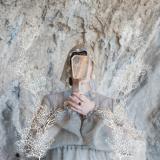
Alongside the album’s release in May, Oceanine will also unfold as a visual and performative work through a short art film. The film includes a live session recorded inside a sea cave facing the Mar Ligure, the very coastline where Jolanda spent her childhood, dreaming of sirens and listening to the sea as if it were speaking directly to her. This site-specific performance reconnects the music to its place of origin, allowing the voice to resonate within stone, water, and air, and transforming the cave into both a sanctuary and a threshold between myth and reality.

What if the sirens’ songs were considered dangerous because they carried another truth, an ancient truth long forgotten?

Oceanine embraces the idea that we are still deeply woven into myth. Though we may see ourselves as rational and modern beings, our world is saturated with ancient symbols and archetypes, often distorted, simplified, or stripped of their original meaning. And if those symbols are allowed to shift, if the mirror once held by the siren becomes an invitation to look beyond appearances and into what has been obscured, then we may finally uncover a deeper truth and reclaim the voice that was always ours.

Oceanine is not just an album. It is a reclamation, a spell, and a call from the depths.

pre-order now01.05.2026

expected to be published on 01.05.2026

23,95
SAMMY ALLEN - SLAVE TO LOVE EP

The 1980s were an iconic era for electronic dance music, with each country delivering a wave of standout artists and producers whose names and music are now etched in music history. One of Germany’s notable figures in this scene was Mike Mareen, both a producer and performer, who also ran his own label, Night’n Day Records. Among the label’s successful releases was the now somewhat forgotten gem, Sammy Allen’s single “Slave To Love.”

Today, this record has become a sought-after item among collectors, leading to its reissue. The re-release not only brings back the original track but also includes a previously unreleased version from the original recording sessions, along with a special DJ Edit designed specifically for seamless mixing. This reissue is a must-have for both fans and DJs looking to revisit or rediscover a classic piece of German italo disco related music history.

In Stock

On Stock and ready to ship

19,12
EABS - Reflections of Purple Sun LP

2023 was a breakthrough year for EABS in many ways. It was all thanks to the well received, fully self-produced album entitled In Search of a Better Tomorrow, recorded in collaboration with the Pakistani band Jaubi. EABS' forthcoming sixth album is a return to their roots – literally and figuratively. It is an in-depth study on rhythm, which materialised in the form of the album titled Reflections of Purple Sun.

The back to the roots part not only manifests itself in the lack of guest instrumentalists, but also in a renewed focus on the history of Polish jazz. The band's debut album Repetitions... was dedicated to Krzysztof Komeda. This time, the band picked up the entire Purple Sun album, which Tomasz Stańko recorded half a century ago. From the POV of Purple Sun fans, a hard-to-find and somewhat forgotten album, it may seem like a doomed undertaking. However, in order to pay tribute to one of the most iconic figures of Polish jazz, it was worth embarking on this mission and attempting to engage in a non-verbal conversation with the Slavic spirit that Master Tomasz Stańko undoubtedly was.

You can learn more about Reflections of Purple Sun through the comprehensive booklet accompanying the record. The cover art was created by the label's regular collaborator, Animisiewasz, whose design pays tribute to Pia Burri's original Purple Sun concept. Release date is 10 May 2024.

In Stock

On Stock and ready to ship

26,01
CHIBUKU - MAXAMBE

CHIBUKU

MAXAMBE

12inchMODLP102
Modulor Records
13.02.2026out soon
  • Maxambe
  • Lekomfere
  • Xikweletib
  • Chibuku
  • Mhamazala
  • Ntwanano

Born at the turning point between apartheid and democratic South Africa, the Xitsonga bubblegum-disco duo Chibuku embodies the energy of a time of change,as Nelson Mandela was released from prison and kwaito began to emerge. Althoughthey did not achieve the fame of figures such as Paul Ndlovu or Penny Penny, their only album Maxambe (1992) is now considered a precious time capsule, a raw disco treasure rediscovered by lovers of forgotten music. Behind the project is Dr Joe Shirimani, a guitarist, singer, composer and producer of genius from Tzaneen and Soshanguve, recognised as one of the major architects of South African disco and bubblegum. Long overlooked, Maxambe nevertheless bears witnessto an era and a social perspective: migration ("Lekomfere"), debt and economics ("Xikweleti"), and family relationships ("Mhamazala"). The music is festive in appearance, but deeply rooted in the reality of its time. Released on Tusk/Diamond Music, an iconic label of the 1980s and 1990s bought out by Gallo Record Company, Chibuku is now emerging as a diamond rediscovered from the archives of South African disco. Its name, borrowed from a millet beer popular in several southern African countries, sums up the spirit of the group: popular, sincere and deeply rooted in local culture.

pre-order now

This item has not yet been released. You can pre-order the product now.

28,53
DRAB MAJESTY - CARELESS

DRAB MAJESTY

CARELESS

12inchDAISC675
Dais Records
05.09.2025

In the smoggy orange light of a new millennium, the young Deb Demure would take the bus, once a week, from his home in crumbling Hollywood to his grandmother's apartment, nestled in the pastel pristineness of Beverly Hills. During these visits, Deb couldn't help but notice the disconnect between the glow of his grandmother's temple, and the downtrodden, alienated figures that populated the seats of the mass transit that took him there. Week after week, he would observe these characters: fading B-movie starlets, leisure-suited alcoholics and forgotten civil servants. But one fateful commute home, as the twilight waned to the purple Los Angeles night, he realized these figures were not as lost as they appeared - there was a nobility in their failure, reflective of the dignity of the city's vanishing golden era. They were survivors, in need of a voice: a spokesperson for every color of hope and hopelessness, transcendent of gender and time; Drab Majesty became Deb's musical podium for this undertaking. Raised in a music-centric household, Deb would find the time to teach himself to play his father's right-handed guitar upside down and left-handed; an unorthodox fashion from where his earliest understanding of chords and harmony were conceived. Exploring the bins of discarded vinyl in his neighborhood thrift stores, his toolkit expanded with the subterranean sonic gems of the recent past. Influences range from the virtuosic arpeggiated guitar work of Felt's Maurice Deebank and the grittier pop progressions of Red Lorry Yellow Lorry's Chris Reed as well as Steve Severin from Siouxsie and The Banshees. He also studied the harmonic oscillations and utilization of the occult power of vibratory frequency present in New Age sounds of Greek artist, IASOS. In terms of orchestration, he consciously culls from the seaside maximalism of Martin Dupont and mechanized grooves of early Depeche Mode. Like a dualistic pendulum, his vocals swing from a preistly baritone to a choir boy's falsetto reflecting the sepulchral ambiance of church visits with his grandmother. Currently the drummer for Los Angeles lo-fi rock ensemble Marriages and having honed an unorthodox home recording style, Deb sources his sounds from a repository of "mid-fi" synthesizers and other lesser-quality instruments. Following the release of his debut cassette EP, "Unarian Dances", he also shared a split 12" with synth pop forefathers, Eleven Pond. During the Spring of 2015, Drab Majesty signed with Dais Records and released his first single, Unknown to the I, as a introduction for his first initial foray into the album format, romantically titled Careless. Written over the course of 2 years, "Careless" is a compendium of songs that have outlasted a malicious burglary of his studio, his struggles with substance addiction, and most recently, the death of his beloved grandmother.

pre-order now05.09.2025

expected to be published on 05.09.2025

22,27
DRAB MAJESTY - CARELESS

DRAB MAJESTY

CARELESS

12inchDAISC575
Dais Records
05.09.2025

In the smoggy orange light of a new millennium, the young Deb Demure would take the bus, once a week, from his home in crumbling Hollywood to his grandmother's apartment, nestled in the pastel pristineness of Beverly Hills. During these visits, Deb couldn't help but notice the disconnect between the glow of his grandmother's temple, and the downtrodden, alienated figures that populated the seats of the mass transit that took him there. Week after week, he would observe these characters: fading B-movie starlets, leisure-suited alcoholics and forgotten civil servants. But one fateful commute home, as the twilight waned to the purple Los Angeles night, he realized these figures were not as lost as they appeared - there was a nobility in their failure, reflective of the dignity of the city's vanishing golden era. They were survivors, in need of a voice: a spokesperson for every color of hope and hopelessness, transcendent of gender and time; Drab Majesty became Deb's musical podium for this undertaking. Raised in a music-centric household, Deb would find the time to teach himself to play his father's right-handed guitar upside down and left-handed; an unorthodox fashion from where his earliest understanding of chords and harmony were conceived. Exploring the bins of discarded vinyl in his neighborhood thrift stores, his toolkit expanded with the subterranean sonic gems of the recent past. Influences range from the virtuosic arpeggiated guitar work of Felt's Maurice Deebank and the grittier pop progressions of Red Lorry Yellow Lorry's Chris Reed as well as Steve Severin from Siouxsie and The Banshees. He also studied the harmonic oscillations and utilization of the occult power of vibratory frequency present in New Age sounds of Greek artist, IASOS. In terms of orchestration, he consciously culls from the seaside maximalism of Martin Dupont and mechanized grooves of early Depeche Mode. Like a dualistic pendulum, his vocals swing from a preistly baritone to a choir boy's falsetto reflecting the sepulchral ambiance of church visits with his grandmother. Currently the drummer for Los Angeles lo-fi rock ensemble Marriages and having honed an unorthodox home recording style, Deb sources his sounds from a repository of "mid-fi" synthesizers and other lesser-quality instruments. Following the release of his debut cassette EP, "Unarian Dances", he also shared a split 12" with synth pop forefathers, Eleven Pond. During the Spring of 2015, Drab Majesty signed with Dais Records and released his first single, Unknown to the I, as a introduction for his first initial foray into the album format, romantically titled Careless. Written over the course of 2 years, "Careless" is a compendium of songs that have outlasted a malicious burglary of his studio, his struggles with substance addiction, and most recently, the death of his beloved grandmother.

pre-order now05.09.2025

expected to be published on 05.09.2025

22,27
DRAB MAJESTY - CARELESS

Drab Majesty

CARELESS

12inchDAISC775
Dais Records
02.09.2025

In the smoggy orange light of a new millennium, the young Deb Demure would take the bus, once a week, from his home in crumbling Hollywood to his grandmother's apartment, nestled in the pastel pristineness of Beverly Hills. During these visits, Deb couldn't help but notice the disconnect between the glow of his grandmother's temple, and the downtrodden, alienated figures that populated the seats of the mass transit that took him there. Week after week, he would observe these characters: fading B-movie starlets, leisure-suited alcoholics and forgotten civil servants. But one fateful commute home, as the twilight waned to the purple Los Angeles night, he realized these figures were not as lost as they appeared - there was a nobility in their failure, reflective of the dignity of the city's vanishing golden era. They were survivors, in need of a voice: a spokesperson for every color of hope and hopelessness, transcendent of gender and time; Drab Majesty became Deb's musical podium for this undertaking. Raised in a music-centric household, Deb would find the time to teach himself to play his father's right-handed guitar upside down and left-handed; an unorthodox fashion from where his earliest understanding of chords and harmony were conceived. Exploring the bins of discarded vinyl in his neighborhood thrift stores, his toolkit expanded with the subterranean sonic gems of the recent past. Influences range from the virtuosic arpeggiated guitar work of Felt's Maurice Deebank and the grittier pop progressions of Red Lorry Yellow Lorry's Chris Reed as well as Steve Severin from Siouxsie and The Banshees. He also studied the harmonic oscillations and utilization of the occult power of vibratory frequency present in New Age sounds of Greek artist, IASOS. In terms of orchestration, he consciously culls from the seaside maximalism of Martin Dupont and mechanized grooves of early Depeche Mode. Like a dualistic pendulum, his vocals swing from a preistly baritone to a choir boy's falsetto reflecting the sepulchral ambiance of church visits with his grandmother. Currently the drummer for Los Angeles lo-fi rock ensemble Marriages and having honed an unorthodox home recording style, Deb sources his sounds from a repository of "mid-fi" synthesizers and other lesser-quality instruments. Following the release of his debut cassette EP, "Unarian Dances", he also shared a split 12" with synth pop forefathers, Eleven Pond. During the Spring of 2015, Drab Majesty signed with Dais Records and released his first single, Unknown to the I, as a introduction for his first initial foray into the album format, romantically titled Careless. Written over the course of 2 years, "Careless" is a compendium of songs that have outlasted a malicious burglary of his studio, his struggles with substance addiction, and most recently, the death of his beloved grandmother.

out of Stock

Order now and we will order the item for you at our supplier.

22,27

Last In: 7 months ago
Doris Dennison - Earth Interval

The discovery of Doris Dennison's score represents a genuine musicological breakthrough—what once would have been "a tree falling in the woods" thirty years ago now holds the potential to render "a thunderous clap in our minds." While researching Anna Halprin's lesser-known collaborators, scholar Tom Welsh uncovered the archives of AA Leath, one of Halprin's principal dancers. Buried within these materials was Dennison's handwritten score for Earth Interval, dated May 1956. Born in Saskatchewan, Canada, in 1908, and raised near Seattle, Dennison (1908-2009) encountered John Cage while teaching Dalcroze eurythmics at the Cornish College of the Arts. She joined Cage's earliest percussion quartet—alongside Margaret Jansen, the composer and his wife Xenia—in the group widely regarded as having performed the first complete concert of percussion music in the United States. This historic December 1938 concert was followed by tours and the landmark May 1941 performance at the California Club, comprising Cage and Lou Harrison's Double Music, the premiere of Cage's Third Construction, and Harrison's 13th Simfony.

As Bradford Bailey observes in his extensive liner notes, Earth Interval demonstrates "an extraordinary balance of elements that imbues the piece with a sense of clarity, directness, and constraint that is both distinct and ahead of its time." The work's most remarkable innovation lies in its approach to extended techniques, particularly Dennison's notation for the central movement: "In 2nd movement, 1st player lowers + raises a gong into a tub of water while beating." This technique, absorbed from Cage's experimental vocabulary, generates what Bailey describes as "fields of acoustic abstraction that bend and warp time through sustained resonances, beat, and space." The temporal sophistication of these manipulations anticipated Karlheinz Stockhausen's Mikrophonie I (1964) and Annea Lockwood's water-based sound investigations by over a decade. After joining Mills College as dance accompanist, Dennison maintained crucial connections to the Bay Area's experimental scene, collaborating with figures like Merce Cunningham and programming Cage's music throughout the 1950s.

Comprising three movements—Land Form, Air Tide, and Earth Play—Earth Interval is scored for recorder, drums, gongs, maracas, muted gongs, and bowl gongs. In total, the piece is just under eight minutes: "a fleeting glimmer of moment in time, a life spent at the cutting edge, and a singular creative vision that packs a powerful punch." When viewed in historical context, placed in contrast to roughly contemporaneous avant-garde percussion works by Cage, Harrison, Louis Thomas Hardin (Moondog), and Harry Partch, or important precursors like Edgard Varèse's Ionisation (1931) and Henry Cowell's Ostinato Pianissimo (1934), it's clear that Dennison was following her own path. Earth Interval is not derivative. It is a precursor to what was yet to come, alluding to developments of avant-garde and experimental music that wouldn't begin to appear on the cultural landscape until the 1970s and '80s, with the emergence of Post-Minimalism and more idiosyncratic artists and ensembles like Midori Takada, Ros Bandt, Peter Giger, Frank Perry, Christopher Tree, Michael Ranta, Gamelan Son of Lion, and Niagara.

This recording by Chicago's Third Coast Percussion, captured in March 2022, represents the first complete documentation of this pioneering work. The ensemble's interpretation reveals the piece's remarkable contemporaneity while maintaining its historical specificity. Where Cage, Harrison, and Partch employed "self-consciously off-kilter polyrhythms," Dennison's rhythmic sensibility anticipates minimalist developments by nearly a decade, yet integrates "forceful rests, as well as sharp shifts in sonic character, tempo, and meter, that break the momentum and breathe a sense of life into the piece's structure." This positions her work closer to Post-Minimalism decades before its emergence. The architectural approach demonstrates Dennison's understanding that "the composer almost entirely disappears" in favor of phenomenological listening experience, creating what might be called an egoless music that places its realities and meaning entirely in the ear of the beholder. The present recording, realized by Chicago's distinguished Third Coast Percussion ensemble, represents a significant achievement in experimental music scholarship and performance practice. As specialists in the Cage tradition and contemporary percussion repertoire, Third Coast Percussion approached Earth Interval with the historical sensitivity and technical precision required to illuminate Dennison's subtle compositional innovations. The March 2022 recording sessions, engineered by Colin Campbell, capture both the work's intimate chamber music qualities and its bold exploration of extended techniques. The ensemble's interpretation reveals the piece's remarkable contemporaneity—its ability to speak directly to current musical concerns while maintaining its historical specificity.

This recording serves multiple scholarly functions: it provides the first complete documentation of Dennison's compositional voice, offers insight into the broader network of experimental music practitioners surrounding Cage and Harrison, and demonstrates the sophisticated level of compositional thinking that was occurring within the Bay Area's dance-music collaborations of the 1950s. The work's emphasis on phenomenological listening—what might be called an "egoless" approach to musical experience—places it within a lineage of American experimental music that prioritizes perceptual process over compositional personality. The work's original obscurity—limited to AA Leath's performances at venues like the 1957 Pacific Coast Arts Festival at Reed College—paradoxically allowed it to remain "entirely on its own terms," free from the constraints of historical categorization. Drawing on Jacques Derrida's Archive Fever, the argument emerges that "the archive can acknowledge, celebrate, and resurrect" overlooked voices, transforming our understanding of experimental music history. The present Blume edition, featuring Third Coast Percussion's authoritative interpretation, includes a lavishly illustrated 16-page booklet designed by Bruno Stucchi / dinamomilano, containing complete scholarly apparatus, historical photographs, and detailed production notes. This recording enables "cross-temporal intersectionality," allowing Dennison to "belong to a newly formed and more dynamic understanding of the present and past," demonstrating how forgotten voices can reshape entire historical narratives when given proper scholarly attention and performance advocacy.

pre-order now01.08.2025

expected to be published on 01.08.2025

25,42
Kitchen Funk - LETUGO

Kitchen Funk

LETUGO

12inchROW001EP
Rebirth On Wax
25.06.2025

KITCHEN FUNK: The Groove Legacy of Funk, Hip-Hop, and House
Founded in 1999 in Lorient by Tabasko and Ramirez, key figures in the Breton underground scene, KITCHEN FUNK fuses hip-hop, soul, funk, acid jazz, and house music into a unique sonic universe. Combining punchy rhythms with captivating grooves, the duo made a name for itself in the 2000s, marked by the excitement of clubs and radio stations.

"LETUGO": A Forgotten Treasure Finally Rediscovered
Among their notable collaborations, "LETUGO," recorded with Karl the Voice, embodies the very essence of KITCHEN FUNK. This powerful track, blending funky vibes and soulful energy, didn't receive the promotion it deserved upon its release.

25 years later, the story takes an unexpected turn. After rediscovering local archives, RAMIREZ and JULIEN LO BONO decided to reissue "LETUGO" on vinyl to mark the project's anniversary. The initiative sparked immediate interest: Breton radio stations picked it up, and the record finally found its audience, proving that KITCHEN FUNK's groove is timeless.

A resounding success with "PUSSY CALL"
Before this resurgence, KITCHEN FUNK had made a lasting impression with "PUSSY CALL", a hit that received critical acclaim on Europe 2, NRJ, and RADIO FG. This success allowed the duo to sign with CHRYSALIS PUBLISHING and then 909 RECORDZ (WARNER FRANCE), confirming their place in the French music scene.

A promising future
And this is just the beginning... Boosted by this renewed interest, KITCHEN FUNK is preparing new projects, supported by Jean Jérôme, a key player in the success of "PUSSY CALL." A return to the stage is in the works, ready to rekindle the flame of funk, hip-hop, and house music for a new generation of enthusiasts.

out of Stock

Order now and we will order the item for you at our supplier.

15,25

Last In: 9 months ago
Ravi Shankar - Shankar Family and Friends LP

Out of print as a stand-alone release for decades since its original 1974 issue. Produced by George Harrison, Shankar Family & Friends is an almost-forgotten masterwork – an emotional and sonic pact between two like-minded souls to both advance their spiritually minded bond and unite musical styles, cultures, and sounds in wondrous fashion Contributions from Ringo Starr, David Bromberg, Billy Preston, Nicky Hopkins, Jim Keltner, Klaus Voorman, and a host of virtuosic Indian musicians add to a diverse album that melds Eastern and Western traditions; encompasses jazz, funk, bhajan, Indian, and pop; and represents the spirit and breadth of Harrison's Dark Horse Records imprint.

Memorable contributions from an A-list of American and English musicians — Ringo Starr (drums), David Bromberg (electric guitar), Billy Preston (organ), Nicky Hopkins (piano), Jim Keltner (drums), Klaus Voorman (bass), Robert Margouleff (Moog), Malcolm Cecil (Moog), Tom Scott (saxophone) included — add to the richness of a set that melds Eastern and Western traditions. These “names” mesh with a host of Indian virtuosos — Alla Rakha, Ashish Khan, Kamala Chakravarty, Hariprasad Chaurasia included — who turn Shankar Family & Friends into a journey laced with percussive, string, and vocal components that aren’t soon forgotten.

Throughout, Shankar Family & Friends remains true to its title — a mesmerizing record named to reflect the group participation approach of its creators. The idea started when Shankar told Harrison about a ballet he wrote. The Beatle, who first met Shankar in June 1966 — roughly a year after Harrison became interested in Indian music after overhearing it in a restaurant while filming Help! — immediately was convinced they needed to record it. Harrison’s staunch admiration of Shankar and serious approach to Eastern styles are reflected throughout the album.

Indeed, for Harrison, Shankar Family & Friends marks the culmination of a years-long effort to master the sitar, study Hinduism, and incorporate elements such as drones, unusual chords, and expressive picking into his own songs. The seeds of this unique collaboration can be heard in Beatles works such as “Norwegian Wood,” “Love to You,” and “Within You Without You.” Both musicians were also fresh from performing at the 1971 Concert for Bangladesh shows. Yet Shankar Family & Friends remains entirely unique in each visionary artist’s history — and ultimately, led to a collaborative tour Harrison and Shankar staged across North America.

Encompassing jazz, funk, bhajan, Indian, and pop, Shankar Family & Friends is thematically split into halves. Side One reveals Shankar’s uncanny ear for melody — even when applied to Western forms. The lead-off “I Am Missing You,” the first single ever released by Dark Horse Records and reportedly the first pop composition Shankar completed, underscores his skills as a composer and global ambassador. Beautifully sung across three octaves by his sister-in-law, Lakshmi Shankar, the devotional song features multiple drummers and production that mirrors Phil Spector’s Wall of Sound approach. Harrison plays autoharp and guitar; Starr sits in on drums; Scott handles flute and soprano saxophone. It’s the inviting start of a musical adventure teeming with color, majesty, and mysticism.

A second version of the track — designated with a “(Reprise)” tag — appears minutes later. Unfolding in different ways, it follows a folk ballad structure stitched together with Indian instrumentation. Here, according to Shankar, the musicians “attempted to convey the sounds and atmosphere of Vrindavan, the ancient holy place where Krishna grew up.” Both renditions speak to the cross-continental fusion that came so naturally to Harrison and Shankar, whose oversight on the side’s other vocal tracks ensures listeners familiar with Western methods gain easy access to the hypnotic allure of his native country’s music.

Nowhere is this more evident than on Dream, Nightmare & Dawn (Music for a Ballet), the side-long piece that served as the genesis for Shankar Family & Friends. Launched with an airy overture and unfolding across three movements, the mostly wordless suite features everything from call-and-response interplay and classical lyricism to uptempo dance figures, stacked rhythms, and intoxicating grooves. Blurring the lines between contemporary and traditional, and Western and Eastern, the inspirational work is the exclamation point on a record that defined “world music” well before the term became co-opted as a catch-all genre.

pre-order now31.03.2024

expected to be published on 31.03.2024

61,77
Various - Playing for the Man at the Door: Field Recordings from the Collection of Mack McCormick, 1958-1971

In the 1950s and 60s, the blues was the dominant form of Black vernacular music throughout Texas and the surrounding areas In segregated neighborhoods, community members gathered in saloons, dancehalls, and each other's homes to hear their neighbors sing their stories of sorrow, heartbreak, jubilation, and triumph. Robert "Mack" McCormick, an academically untrained but fanatical devotee of the blues, stepped into this world and became one of its most devout advocates and documentarians. By photographing Black and Latino Texans and their neighborhoods, as well as recording and interviewing musicians, many of whom never stepped foot into a proper recording studio, McCormick endeared and eventually embedded himself into these communities. By the time he died in 2015, McCormick had amassed a collection of 590 reels of sound recordings and 165 boxes of manuscripts, original interviews and research notes, thousands of photographs and negatives, playbills, and posters. Because McCormick never published or released most of these materials, his collection became a thing of legend and intense speculation among scholars, blues aficionados, and musicians alike. 'Playing for the Man at the Door..' is the first compilation of music drawn from this fabled collection, which indelibly documents a pivotal moment in African American history. It features never- before- heard performances not only from musicians who became icons in their own right, including Lightnin' Hopkins and Mance Lipscomb, but also, crucially, performers whose names may be unfamiliar to even the most devoted blues fans and scholars. Newly mastered recordings and accompanying photographs bring to life many of these forgotten figures: offering insight into their lives and illuminating in new, enlightening ways their joys and anguish, deep social connections, distinctive voices, and cultural networks. The collection spans gospel, ragtime, country blues dirges, the unclassifiable music of George "Bongo Joe" Coleman, and more, showing that no community, no matter how tight knit, is monolithic. Accompanying the music is a 128- page book, which contains breathtaking photographs by McCormick and his associates, as well as contextual essays by producers Jeff Place and John Troutman on McCormick's life, and by musicians Mark Puryear and Dom Flemons on some of the marginalized communities throughout "Greater Texas" to which McCormick devoted his life's work.

pre-order now31.10.2023

expected to be published on 31.10.2023

134,41
The Plastik Beatniks - All Those Streets I Must Find Cities For

Sounds like supergroup. Rarely have outstanding figures of such a variety of musical styles collaborated on one album to pay homage to a nearly forgotten artist, one of the few black Beatnik poets, Bob Kaufman.

"All Those Streets I Must Find Cities For" by The Plastik Beatniks is an attempt to acoustically reanimate Bob Kaufman, to return the Beat to him in a transatlantic collaboration. It is a shimmering psychedelic, at times jazzy concept album, sometimes reminiscent of Krautrock or hip hop, about a Beat-era poet who was as great as he was forgotten. It takes spoken word to a new level, as a transatlantic showcase of musical avant-gardes and a joyful "sound archaeology" of modernity, in which the tracks of the "Plastik Beatniks" meet the best voices of America.

The 12 wildly different songs and audi collages, on the transatlantically-produced album, "All the Streets I Must Find Cities For," is based on lyrics by Beat author Bob Kaufman. They were originally part of the radio play "Thank God for Beatniks," for which author Andreas Ammer ("Ammer & Einheit"), Notwist‘s Markus Acher and Micha Acher and loop maker Leo Hopfinger ("LeRoy") formed "The Plastik Beatniks." On the eastern side of the Atlantic they composed music and crafted soundscapes. On the west side of the ocean, they asked three of the most renowned singers, activists and producers in the U.S. to recite or sing Bob Kaufman's poetry.

Punk-pop icon Patti Smith immediately signed on to read Kaufman's poem "Ginsberg (For Allen)". Free jazz vocalist Moor Mother passionately performed Bob Kaufman's "War Memoir". American jazz clarinetist, composer, singer and “International Anthem” labelmate Angel Bat Dawid, a legitimate successor to Sun Ra, polyphonically read and sang such poems as "The Sun is a Negroe" and "West Coast Sound 1956" and included some clarinet solos on top. Also on the album, Bob Kaufman himself recites his previously unknown poems "Hollywood Beat", "Would You Wear My Eyes", and the "Jail Poem" "All Those Streets I Must Find Cities For". Beat chronicler Raymond Foye, who still lives at the Chelsea Hotel in New York, contributed an interview he conducted with late beatnik Allen Ginsberg about Bob Kaufman. Completing the circle was hip-hop artist Adam "DoseOne" ("13&God"), who once gave Markus Acher a well-thumbed volume of Bob Kaufman, whom he admired. He contributed some raps. Thus 12 tracks emerged, as diverse as the artists, poets and musicians who contributed to it. More than an album. An epitaph. A work for the eternity of Beat.

Regarding Bob Kaufman - of course the FBI kept a file on him – first as a sailor, then a communist, and finally a Beat poet. As one of the mainstays of the movement, he edited the literary magazine "Beatitude" in San Francisco and defined "Beatnik" to Allen Ginsberg: half rhythm, half sputnik. Bob recited his poetry loudly on the streets (when he wasn't sunk into years of silence in protest of the Vietnam War) and in the bars and bagel shops of North Beach. Once, he almost landed a pop hit ("Green Green Rocky Road"), which then made Dylan's companion Dave van Ronk famous. That Kaufman is today less known than his friend Allen Ginsberg may be because he was a black Beat poet, and also a Jew. This was not compatible with fame in the US of the 1950s. Though Kaufman had the same publisher, City Lights, as Ginsberg, he was frequently arrested and jailed, and was treated with electric shocks until he developed serious mental heath issues. There he wrote his "Jail Poems". The seventh of these lent this album its name:

"Someone whom I am is no one / Something I have done is nothing Someplace I have been is nowhere / I am not me What of the answers / I must find questions for? All these strange streets I must find cities for, Thank god for beatniks."

out of Stock

Order now and we will order the item for you at our supplier.

21,64

Last In: 3 years ago
LOS STREAKS - REACCION SICOTICA EP

First time reissue of the holy grail of Colombian garage music, originally released in 1967. Includes two wonderful covers of the Californian band Count Five: 'Psychotic Reaction' and 'They're Gonna Get You', as well as the stellar original 'Cosmos 901'. DESCRIPTION In the mid-sixties, when the temperature of modern youth music was at its highest, Colombian label Codiscos placed its bet on some of the emerging figures of Colombian pop and two exciting wild bands: Los Flippers and Los Streaks. After the fleeting brilliance of the so-called "new wave", the 4-song EPs released by the label -mainly for promotional use- lay forgotten on the shelves of radio stations or stored in the musty trunks of the fans who managed to buy the few copies that were distributed by the record label. Today it's incredibly difficult to find any of these EPs released by Codiscos between 1965 and 1967 in mint condition, with the original sleeve. Los Streaks didn't just come out of nowhere, it was the brainchild of the radio DJ, manager and promoter Édgar Restrepo Caro. Towards the end of 1966, while working as the manager of Los Flippers, Caro became fascinated with the idea of creating a group made up of some of the most talented musicians on the Bogota rock circuit. On January 20, 1967, Los Streaks made their debut at the discotheque El Diábolo as a warm-up act. The following weeks were crazy: they appeared on national television, starred at matinee sessions at two major venues in Bogota, and headlined at the concert organized by the music magazine Juventud a Go 67. During this short period, they established a powerful stage presence, combining exquisite musicianship and a sharp sense of humor. Their repertoire was also bold, encompassing Giuseppe Verdi, The Beatles, Pérez Prado, The Ventures or Mitch Ryder and The Detroit Wheels. The band's solid sound was perfectly aligned to Codiscos' interests. After some enthusiastic promotion by their manager, Humberto Moreno met them, and they signed a contract to release two LPs. In mid-1967 they traveled to Medellín and recorded eleven tracks that would shape the first of these albums. One of these songs was kept back for "El disco de oro a Go-Go" (LDZ-20331), while the rest were included in "OPERAción A Go-Go" (LDZ-20343), released on August 12 of the same year. It included four songs that the label had released on an EP, which decades later has become the holy grail of Colombian garage music. The stunning "Reacción sicótica" EP includes the stellar 'Cosmos 901' composed by Manuel Jiménez, the sparkling 'Escápate mi amor' (a cover of the classic 'Get Away' by Georgie Fame that they most probably heard in the version recorded by the Spanish band Los Angeles) and two wonderful covers of the Californian garage band Count Five: 'Psychotic Reaction' and 'They're Gonna Get You': 'Reacción sicótica' and 'Soy así_ y qué?'. Four hits that shook things up memorably.

out of Stock

Order now and we will order the item for you at our supplier.

12,56

Last In: 3 years ago
R.A. The Rugged Man - All My Heroes Are Dead

Repress!
R.A. The Rugged Man is one of the most fascinating figures in hip-hop history. His career spans decades, and defies simple narratives. The Rugged Man has been an up-and-coming star, an industry outcast banished and forgotten, an underground cult hero, an independent success story, and an influential master of the art form.

Now, R.A. The Rugged Man is back with ""All My Heroes Are Dead"", a brand new album that stands as his best work to date. “So many of the greats are gone, and the legends who made it out alive are cast aside,” R.A. explains. “Society left our heroes and their culture for dead. We have to dig that greatness out of its grave, and bring it back with an angry vengeance.” "All My Heroes Are Dead" features an all-star lineup of hip-hop heavyweights, including Atmosphere, Chuck D, Ghostface Killah, Immortal Technique, Vinnie Paz, Ice T, M.O.P., Kool G Rap, Brand Nubian, DJ Jazzy Jeff, Chris Rivers, Onyx, Inspectah Deck, A-F-R-O, Masta Killa, and more.

pre-order now15.04.2022

expected to be published on 15.04.2022

33,07
Marc Melià - Veus

Born in Majorca, Marc Melià is a composer/producer, who’s been based in Brussels for over 10 years. First spotted alongside Françoiz Breut, Lonely Drifter Karen or Borja Flames, he released Music for Prophet in 2017. It was issued on Gaspar Claus’s label Les Disques du Festival Permanent, as part of Flavien Berger’s curation.

On that first album, Marc Melià had explored the possibilities of a mythic synth; on Veus, as if sloughing, he applied the process of sound modification to his own voice, until becoming an android. But an android who sings of love and dreams, a sensitive automaton who plays with the tropes of pop music. Through this device, Marc Melià knowingly seeks poetry and beauty within transgenics, in the search of a universe where one can surf though waves of profoundly moving chord patterns, hear voices unconstrained by range limitations, or dance freely, as in zero gravity.

Part of the album has been recorded in Une ferme dans les Vosges, courtesy of Rodolphe Burger. It was recorded with Roméo Poirier, one of the most promising figures of ambient, and the elegant multi-talented Lou Rotzinger. As if progressing in parallel with his own linguistic experience, to add another layer to the sloughing, side A is sung in Catalan, Marc Melià’s mother tongue, and side B in French, his adopted language.

Like an echo to his previous album, Veus opens with an instrumental, “Pulse on a E”, which starts with a sequence created with a single note transposed to its octave, just like “Fata Fou”, the last song on Music for Prophet.

Although the title seems to reference an iconic 80s synth, “DX7” is actually about the seven days of the week. It is a love song, about the temperamental oscillations which make every morning the blank canvas of an unpredictable story. Wednesday, I hate you, Sunday, I love you. With few words and a lot of emotion, a synthetic voice is trying to grow more human each day.

“Dent de Serra” deals with the weight of memory on our relationships, but also with the way we revisit them constantly in order to integrate souvenirs within present relationships. Suddenly, the song stops and enters a new dimension, everything is different, as if what had just happened was now forgotten forever.

Oxytocin (“Oxitocines” in Catalan) is said to be the hormone of love. This song deals in a playful way with the duality between science and faith, between rational and magic, when it comes to sentimental relationships. Love is a universal theme, it is everywhere in the world, and love songs have been written for a very long time. But this particular love song is an ode to an aspect of love that has been less sung about: biology, which makes it possible to feel like you’re floating in space when you fall in love.

“Les étoiles” is a trio with Flavien Berger and Pi Ja Ma. The song is about attraction. What attracts humans to each other, but also the inevitable gravitational attraction. The song is also about accidents, magic moments that take us outside of our daily lives and give us the possibility to imagine a sidereal, infinite love.

“A propos d’une chanson” was born after Marc Melià had dreamed he had written the most beautiful song he’d ever created. When he woke up, he realized that song was actually O Superman by Laurie Anderson.

Aside from these songs, Marc Melià offers a few breaks, instrumental but no less narrative.

“Final d’hivern” conjures these quiet moments between two intense events; sleeping at night between two days; the calm that settles in after a hard winter, right before spring properly starts.

Using a musical language that clearly references Ryuichi Sakamoto, “Romain”, with its theme based on a melancholic chord pattern, could be the soundtrack to a 1970s movie lost in time. Little by little, elements that seem to come from a completely different context find their place, while turning the initial mood into something strange and unexpected.

Finally, “Retorn”, which finishes the album, is a reprise of the theme of “DX7”.

From the chords that make up a song, to the days that make up our lives, existence is but a cycle, and Veus is an exploration of them. Marc Melià keeps on drifting on his personal path, between homage to the past and visions of the future.

pre-order now15.10.2021

expected to be published on 15.10.2021

16,77
AMARO FREITAS - SANKOFA

AMARO FREITAS

SANKOFA

12inchFARO225LP
FAR OUT RECORDINGS
28.07.2021

From the slums of Recife in Brazil’s North-East to international jazz icon, Amaro Freitas has worked tirelessly to become the artist he is today. His new album Sankofa - a spiritual quest into the forgotten stories, ancient philosophies and inspirational figures of Black Brazil - is his most stunning and sincere work to date.

out of Stock

Order now and we will order the item for you at our supplier.

26,01

Last In: 4 years ago
Zoë Mc Pherson - States of Fugue

States of Fugue SF02 is the adventurous & uncompromising new record from Zoë Mc Pherson. It follows the success of her critically acclaimed 2018 album String Figures SF01, an audiovisual project that earned her invitations to perform around the world.

States of Fugue SF02 also inaugurates her new hybrid label SFX, a collaborative project with fellow multimedia artist Alessandra Leone. The label presents an opportunity for the pair to fully embody their creative vision whilst building bridges between, and for practitioners working at the intersection of different creative fields.

Zoë Mc Pherson's recent recorded work includes collaborations with Rupert Clervaux and Christina Vantzou, and a remix for Contagious, which was released on Rabih Beaini's Morphine imprint. SoF features collaborations with Elvin Brandi and dutch free improv scene singer Greetje Bijma, a cast which reveals Zoë's punkish & deviant taste and who's vocal work provides moments of both ballistic & mystic power.

Brandi features on Learn Ur Language with a rabid diatribe, somehow flowing through Zoë's staccato barricades. On album closer Bug, Greetje's alien annunciations are neatly vaporised into the year 3000.

The album relentlessly toys with typical dance music meter, creating complex organic structures that activate forgotten muscles in those exposed at sufficient volume, puppeteering the obedient dancer into new patterns of movement. Tenace is the prime example, where wormhole rhythms pull you in with the gravity of an unknown planet.

The album within it's singular feeling for electro-naturalism is rich in humanity and personality, aided throughout by the diverse terrain of Zoë's voice - a tool she uses for full spectrum expression, from whispers to screams. With the launch of SFX and a clutch of multimedia collaborations alongside, we are witnessing her evolve in all directions.

SFX is a new hybrid label from Zoë Mc Pherson and Alessandra Leone. After collaborating for three years on their multimedia String Figures project, the label will build on this foundation, continuing to develop and release objects and experiences across various mediums.

The labels first release will be Zoë Mc Pherson's sophomore LP
States of Fugue, released February 20th 2020.

out of Stock

Order now and we will order the item for you at our supplier.

18,28

Last In: 6 years ago
Dax J UVB - King Of The Sewers EP

Repress

Berlin's Monnom Black is back again with the King of The Sewers EP; four cuts of pulsating techno from two of electronic music's most uncompromising young figures, DAX J & UVB. Already well-known for its more fundamentally rugged take on modern electronics, the label's 19th release is another intense transmission deep from the underworld.

The menacing tone of the EP hides the friendship that's developed between these adopted Berliners, two young men who met in the city and discovered a shared passion for raw analogue audio and electronic sounds that marry starkness with depth. Although they began DJing at the same warehouses since 2014, the duo have waited until the right moment to bring together their mutual love of unique mechanised noisescapes and the high-end production values they ve developed over years of experience and experimentation. The King of The Sewers is that record, a gritty soundtrack inspired by forgotten lives beneath eastern-bloc cities.

For Monnom Black this latest release continues a run of unmistakable techno records that challenge the mainstream with a non-conformist philosophy. The label's ethos is to push boundary-testing music by artists who are unafraid to explore a chaotic, divided world in the belief that distinctive music can still create moments of grace and community. This is music for the deepest, darkest parts of the night, breaking beyond the dancefloor and into the liminal spaces where analogue and digital, body and mind meet. The King of The Sewers EP represents another step forward in the development of a record label pressing at the borders of what contemporary techno can be.

out of Stock

Order now and we will order the item for you at our supplier.

8,87

Last In: 12 months ago
Fith - Swamp

Fith

Swamp

12inchOUT#4
Outer Reaches
22.05.2019

Initially a duo formed in Berlin, FITH have since multiplied and expanded to become a revolving collective of musicians and poets spread out across a Paris/Manchester/Berlin axis. The project, currently comprised of members Dice Miller, Enir Da, Rachel Margetts, ChrIs Lmx, & Arnaud Mathé gesture towards notions of the literary salon, expanded cinema happenings, and the ancient traditions of Greek oratory and religious sermons. Driven by the spell of the spoken word, minimal percussive refrains, oneiric textures & deep melodic synths, FITH channel cinematic imagery, enigmatic narratives & spiritual frenzy.

Their self-titled debut 12' album was released via their collectively run imprint Wanda Portal in November 2016, a 'quietly alluring debut of post punk tempered avant-pop songs' (Boomkat) that laid out the project's foreboding mystique and intoxicating dream sequences with a lurking, devastating sense of purpose and (mis)direction. Other outings have included myriad solo collections of poetry, a two-track release of lurid dissonance and elegiac elevation (Signs / Cornerstone, December 2016) and an extraordinary reinterpretation of the soundtrack for cult film & iconic document of modern alienation Wanda (1971, dir. By Barbara Loden)

With Swamp, their sequel to this activity and their first appearance on Outer Reaches, FITH become a refined force, on a record where all their compelling pluralities and attributes are honed and augmented; everything dilated to delirium. The atmosphere here is one of veiled dread and psychic disturbance, a haunting and macabre psychedelia strewn with echo and dub FX, fragmentary fever dream poetics, elemental drum patterns and volatile synthetic interference. Although the collective conserve the raw crux of their earlier material their execution is, in this special instance, heightened by an intent to broaden and prolong their unique strain of intensity.

Emphatically sinister openers like Forest and Pound present sidereal sequences before building to barrelling, corrosively processed percussion, paroxysmal free jazz and a baleful, concrète-inflected score of electronics, while Swamp introduces phasing currents and a vocal evocative of a chorale from some forgotten giallo film. Elsewhere l'au delà (the beyond) presents a stunning, sombre passage to another state entirely, like some desolate new inflection on Coil's Going Up, before Bialystok shifts into a finale of transportive and meditative evaporation. Together these tracks make for an incredibly immersive and congruous conception; an utterly complete and mesmerising document.

In Swamp's various dimensions perhaps there's comparisons to be drawn with the ritualistic krautrock of Conny Plank and Holger Czukay's Les Vampyrettes, with the hallucinatory, tribal rhythm cycles of Shackleton & Anika's Behind The Glass collaboration, with the primeval drone of Jeremie Sauvage, Mathieu Tilly and Yann Gourdon's France project, with the echoic, disquieting chamber intimacies of Tuxedomoon's Pink Narcissus material and with Lucrecia Dalt's eerie free verse abstractions. But really, we've not heard anything like this before.

Discussing their own inspirations and touchstones the collective cites Franz Kafka, Dario Argento, Lucrecia Martel's La Ciénaga (The Swamp - the film the record is named after) and Yiddish ghost theatre as figures, works and artforms that were prominently drawn upon during the making of Swamp. Yet whilst their imprints could be traced by some, they resemble more of a covert presence within a nuanced whole rather than obvious aspects which moor this record to any familiar setting.

Instead, the acutely unsettling yet poignant spoken word of Miller and the mercurial nocturnes and visitations produced by Margetts, Lmx, Mathé and Da make for a record of strange, novel and striking energies. In revealing the remarkable location and period in which Swamp was recorded Margetts and Miller give a vivid indication as to how these energies are so potently invoked:

'The record was mostly recorded in a caretaker's wing of a 17th century castle in Normandy. It was early March 2018, and our first encounter with the Spring. We had no idea how everything would unfold. There was a lot of tension. Some of us felt compelled to get out the attic room where we had set up our makeshift recording studio and just walk and walk down the vast flat meadows and explore the relics of the wartime barracks, others wanted to keep recording. The outside was serene and inviting, and even though we had been cooped up indoors recording for long stretches of time, we could see from the corner of our eyes, the branches of the trees quivering; an impersonal energy blew through us and then things just happened.'

out of Stock

Order now and we will order the item for you at our supplier.

14,75

Last In: 6 years ago
Various - Switched-On Eugene

Various

Switched-On Eugene

2x12inchNUM198LP
Numero Group
19.10.2018

Switched-on Eugene Documents The Eugene Electronic Music Collective And Some Of The Many Synthed-out Figures In And Around Oregon's Iconic Hippie Stronghold During The 1980s. Whether Connected By Membership, Geography, Or The Tape Trading Scene, The Artists In And Around The Eemc Shared Compelling Visions Of The Future We Now Inhabit, Vividly Captured On Home-recorded Tapes And Distributed Via Zines, Classifieds, And Local Radio. Switched-on Eugene Is A Deep Dive Into A Heretofore Forgotten Sonic Microcosm Unlike Any Other.

out of Stock

Order now and we will order the item for you at our supplier.

31,89

Last In: 6 years ago
Hiroshi & Claudia - Six To Six

REISSUE OF SUPER-RARE ALBUM WHICH SELLS FOR SILLY MONEY ON DISCOGS.
REISSUED FOR RSD AUSTRALIA 2017..NOW WE HAVE A FEW COPIES FOR EUROPE..LIMITED
For decades the mysterious Hiroshi & Claudia LP has been an elusive jewel amongst the curious world of Australian private press LPs. With nothing more than cryptic broken-English album sleeve notes to reference, the mythical Six To Six LP is a bewildering and intriguing jazz oddity. With prices of the rare original record hitting three figures, collectors began demanding to know who was 'Hiroshi', who was 'Claudia' and why did a group of unknown Japanese musicians record an album in Australia in the late 1970s only to issue it in micro-quantities, then seemingly disappear back into obscurity. For years no trace of whom they were nor any clue as to the origins of their peculiar yet entrancing music had surfaced. Until now....

Welcome to the brainchild of Gilles Germain and Carmen Fabro, a French/Italian husband and wife team of restaurateurs and film producers operating in Sydney during the 1970s. Establishing the custom record label 'Atom', the duo released a handful of highly obscure vanity jazz LPs and promotional horse racing 45s. (Yes it's all very strange...) The highlight undoubtedly being the album Six To Six, a session recorded in Sydney in 1979 by a group of touring Japanese jazz musicians led by guitarist Hiroshi Yasukawa, and a forgotten and still undocumented Mauritian cabaret singer performing under the alias 'Claudia'. Sitting somewhere between spacey Balearic disco, haunting soul and hectic funk reminiscent of electric Miles Davis, the Six To Six LP is a curious beast to say the least.

Released specially for Record Store Day 2017 Northside Records and The Roundtable present a limited edition exact reissue of this legendary Australian rare groove LP.  

out of Stock

Order now and we will order the item for you at our supplier.

22,98

Last In: 7 years ago
  • 1
Items per Page:
N/ABPM
Vinyl