
quête:fragile creatures
- 1

14
2025 Repress
It's rare that a certain sound is entirely an artist's own. Although undeniably a stew of impeccable influences - from blues to folk to Latin to dusty funk, soul and hip-hop - one cannot hear a Tommy Guerrero song without immediately recognising it as his - and his only.The cult skater from San Francisco is globally renowned as one of the original members of the legendary "Bones Brigade" team. And as an accomplished multi-instrumentalist, his laid-back soul is beloved by all who've basked in its blissful glow.There's something elemental about this music that really stirs the soul. Strikingly beautiful and instantly addictive, it's a kind of funk-fuelled, melody-driven, groove-based magic. There's a serenity and heart in the playing that radiates warmth and splendour, as if crafted for endless sunsets. His albums that surfaced on Mo Wax at the turn of the century have been treasured since their release and it's two of his most vital LPs that we're honoured to reintroduce.The originals were quietly pressed on to a single piece of vinyl so we've worked closely with Tommy this year to bring you these fresh, limited editions. They have been lovingly remastered, cut nice and loud on to heavyweight double vinyl and presented in deluxe gatefold jackets.A Little Bit Of Somethin' is a quietly majestic gem. Brimming with Guerrero's horizontal "loose grooves", these brief but innovative instrumentals demonstrate a rich variety and, as such, comprise an LP that is aptly titled. An enchanting start-to-finish listen, it was instantly regarded as essential upon release via Mo Wax in 2000. It has aged remarkably well.Throughout this inspired collection, simplicity is key. In deploying it, Guerrero presents a beautifully crafted melodic soundscape. The distinctive, mellifluous approach of his guitar style, blending Brazilian, Cuban, Mexican, soul and jazz motifs, is at once startlingly new and tantalisingly familiar. Set against unrushed percussion, the music releases a crystal clear stream of healing frequencies to create a fragile, hypnotic atmosphere.Each track clocks in at around three minutes and, with a lack of studio polish or commitment to traditional song structure, it's a wonder how this enigmatic record demands your attention. However, through its gentle dynamism and impressive playing, it does just that. Whilst resolutely low-key, this lo-fi aesthetic feels genuinely organic and remarkably personal, its powerful intimacy truly connects. It's what makes this album so beloved of those lucky enough to be already familiar with it. From Margaret Kilgallen's truly iconic cover artwork to the music contained within, it's all brilliantly effortless.Guerrero's musical ideas are consistently compelling throughout, making it impossible to select highlights. The album's laconic drift touches upon jazz-fusion workouts and slow-mo hip-hop drums, Tortoise-style experimental post-rock and cinematic sound textures. It's at once hazy, light and bouncy yet sombre and bluesy. The Latin soul of El Chicano blends with the breezy jazz of Grant Green. By employing guitars and drum machines to create a stripped down rhythmic tapestry of spellbinding, addictive songs, there are even traces of The Durutti Column. A little bit of country, a little bit of rock & roll. A Little Bit Of Somethin', indeed.

- 1: Give Me A Reason
- 2: Billie Was A Vampire
- 3: Black Box
- 4: I'm Addicted
- 5: Ist Die Liebe Tot?
- 6: Un Amor Eterno
- 7: The Language Of Love
- 8: Living Scandal
- 9: Βιτριόλι - Vitrioli
- 10: Φούξια Χαμαιλέων - Fuchsia Chameleon
- 11: Η Μοναξιά Είναι Της Μόδας - Loneliness Is In Fashion
- 12: Υστερία - Hysteria
également disponible
Black / White Splatter Vinyl[25,17 €]
As Selofan's fifth studio album, Vitrioli, from 2018, is a testament to the tragedy of life. The Greek duo, Joanna Pavlidou and Dimitris Pavlidis, who recorded the album in the Fabrika Records home studio, continue on in their poetic, but heartbreaking, music set to a dance beat. Between languages (Greek, English, German, and Spanish), Selofan feels on the brink of mania with Vitroli. However, the madness is controlled, the songs are restrained hysterics that culminate into the alchemic perfection of the band's specific moody sound.
From synthpop to synthpunk elements, the twelve-track LP leads listeners through dark corridors and into haunted, empty beds. There is a resignation to a doomed destiny with Vitroli—a trait that connects all Selofan releases—as a bitter pain and loneliness that cannot, or will not, subside.
The album begins with "Give Me a Reason" whose lyrics feel universal in this day and age: Give me a reason, to get out of bed / I could just watch the ceiling instead. Its heartbreak is profound as bells and voice pads echo under Joanna's voice. The adjacent music video for the song was directed by Dimitris Chaz Lee, and the band describes the video as "depicting the fragile nature, conflicts, emotional demands, and vulnerability of each person in a relationship."
"Billie Was a Vampire" is a story about an undead creature who works at a nightclub followed by the urgency of "Black Box." Brass sounds moan against the fast beat and suggest a frenzied need to escape.
"I'm Addicted" became the second single for the LP. I am addicted, you are mine, Joanna demands of the lover. The music video, also directed by Dimitris Chaz Lee, depicts a clean, white photoshoot primed for the most beautiful creatures of the Athenian wave scene. Alex Macharias, from the legendary Greek band In Trance 95, acts as the photographer for the session, as the models pose and flail under the bright bulbs. The director states: "Addiction is a mental state, something inside all of us. It altered our perception and created a parallel world of avant-garde beings and flashy lights making us part of this everlasting bond."
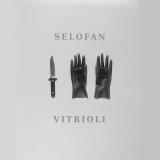
As Selofan's fifth studio album, Vitrioli, from 2018, is a testament to the tragedy of life. The Greek duo, Joanna Pavlidou and Dimitris Pavlidis, who recorded the album in the Fabrika Records home studio, continue on in their poetic, but heartbreaking, music set to a dance beat. Between languages (Greek, English, German, and Spanish), Selofan feels on the brink of mania with Vitroli. However, the madness is controlled, the songs are restrained hysterics that culminate into the alchemic perfection of the band's specific moody sound.
From synthpop to synthpunk elements, the twelve-track LP leads listeners through dark corridors and into haunted, empty beds. There is a resignation to a doomed destiny with Vitroli—a trait that connects all Selofan releases—as a bitter pain and loneliness that cannot, or will not, subside.
The album begins with "Give Me a Reason" whose lyrics feel universal in this day and age: Give me a reason, to get out of bed / I could just watch the ceiling instead. Its heartbreak is profound as bells and voice pads echo under Joanna's voice. The adjacent music video for the song was directed by Dimitris Chaz Lee, and the band describes the video as "depicting the fragile nature, conflicts, emotional demands, and vulnerability of each person in a relationship."
"Billie Was a Vampire" is a story about an undead creature who works at a nightclub followed by the urgency of "Black Box." Brass sounds moan against the fast beat and suggest a frenzied need to escape.
"I'm Addicted" became the second single for the LP. I am addicted, you are mine, Joanna demands of the lover. The music video, also directed by Dimitris Chaz Lee, depicts a clean, white photoshoot primed for the most beautiful creatures of the Athenian wave scene. Alex Macharias, from the legendary Greek band In Trance 95, acts as the photographer for the session, as the models pose and flail under the bright bulbs. The director states: "Addiction is a mental state, something inside all of us. It altered our perception and created a parallel world of avant-garde beings and flashy lights making us part of this everlasting bond."

- A1: Sunlight Zone
- A2: Clarion-Clipperton Zone
- A3: Oreison
- B1: Twilight Zone
- B2: Fracture
- B3: Abyss
- B4: Polymetallic Nodule
- B5: Hadal
- B6: Sunlight Zone (Strings Version) *
Laurel Halo returns with an album of original soundtrack music, composed for the film Midnight Zone by visual artist Julian Charrière. Following the path of a drifting Fresnel lighthouse lens as it descends through the Clarion-Clipperton Fracture Zone — a remote abyssal plain in the Pacific Ocean, rich in rare metals and increasingly targeted for deep-sea mining — the film traces a descent into one of Earth’s last untouched ecosystems.
Charrière’s film reveals the deep not as void, but as a luminous biome teeming with fragile life: bioluminescent creatures, swirling schools of fish, and elusive predators. The suspended lens becomes an abyssal campfire, attracting species caught in the tides of uncertainty, their futures hanging in the balance.
Echoing this tension, Halo’s compositions evoke a sensory freefall, where gravity falters and light and sound flicker in uncertain rhythms. Midnight Zone is a sonic drift through the space between what we seek to extract, fail to understand, and must protect.
Halo’s score evokes the life that exists beyond our physical airbound capacity. The material features long, subtle passages of electro-acoustic ambient, drone and sound design, slowly flowing and unfolding with rich detail. The music, composed largely on a Montage 8 synthesizer and Yamaha TransAcoustic piano at the Yamaha studios in New York City, possesses an uncanny quality: that of synthetic waveforms being amplified and sung through the stringboard of the physical body of the TransAcoustic piano. Combined with stacks of violin and viol da gamba, the music on Midnight Zone possesses trace elements of a human hand in an otherwise sunken landscape. Patient, submerged, and alive. The album will be the third on Halo’s imprint, Awe.
The film is central to Charrière’s current solo exhibition Midnight Zone. The exhibition engages with underwater ecologies, exploring the complexity of water as an elemental medium affected by anthropogenic degradation. Reflecting upon its flow and materiality, profundity and politics, its mundane and sacral dimensions, the solo show acts as a kaleidoscope, inviting us to dive deep.
7
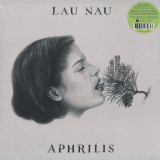
The title of the Lau Nau's 10th album, Aphrilis, derives from the Latin word aperire, meaning "to open." A fitting verb for the month of the year it is closely associated with — April. And while the images of plants and blossoms coming back to colorful life after a long, cold winter feels appropriate when listening to the rich and lustrous bloom of music on Aphrilis, another definition of open feels even more apt. For under the abundance lies the memory of times of austerity, the friction of hard choices, the acceptance that nothing is fixed and the future is unknown. This literal and metaphorical exploration of complexity and contradiction makes Aphrilis a multi-dimensional antidote for our troubled times, one that emphasizes the quiet and communal over noise and spectacle. Laura Naukkarinen, the Finnish artist behind this project, has long kept her mind and spirit open to whatever sounds and creative ideas felt appropriate for the moment. For the past six years that has meant primarily working with modular synthesis — learning how to build modules and releasing acclaimed work centered on its sounds like 5x4 (2023) or Puutarhassa (2022). Running parallel to this work, however, has been a continued exploration of acoustic instruments and group performances with her trio Lau Nau ja Seitsemäs Taivas. Aphrilis arrives then like fresh growth in a creative season cycle. A companion to her brilliant 2017 release Poseidon, the album, says Naukkarinen, "felt like a needed moment to embrace songs with lyrics again." And through the creation of this work, she remained open not only to her own creative muse, but also the input of her chosen collaborators. Each player on Aphrilis — Matti Bye on celesta and synths, Pekko Käppi on jouhikko, Hermanni Yli-Tepsa on violin and contrabass, Topias Tiheäsalo on electric guitar, Samuli Kosminen (Múm) on various instruments — was given free reign to arrange their own parts to accompany Naukkarinen's compositions. Kosminen’s lush fingerprint can also be heard in the mixing and production of the album, as with Poseidon six years ago. The moniker of this project may be taken from Naukkarinen’s own name, but Lau Nau feels more like a band than ever before. The delicacy and softness of the music is reflected in Naukkarinen’s lyrics. Each song is rife with imagery and creatures from the natural world. The spiders in the forest. The animals that keep a young woman company in her refuge in the woods. Wet grass. The feeling of the music is almost tactile, as if listening to the album will leave a bit of dew or sap on your fingers. The theme of this material, says Naukkarinen, runs even deeper. “The songs tell about cracks and changes of direction in different histories: personal, societal, planetary,” she says. “About moments when a yes can become a no and vice versa. The album wants to propose that at the moment of a crisis there is a possibility to influence the histories by our choices.” That may feel like a lot for such a fragile sounding collection of songs to bear. But Aphrilis is an album of surprising strength and resilience

9
The third release from Fred Laird was recorded during the period June 2020 and January 2021 on 24trk home studio recording. It is also the first album recorded purely as a solo artist with the occasional guest and draws more from a roots style music (trad it isn’t) than previous more psychedelic releases.
‘Inspiration for the album came from listening to the self-recorded primal music of Hasil Adkins and the first solo Link Wray album for Polydor. The idea of these guys just doing what they wanted back of beyond seemed more akin to me sat in a box room during lockdown feeding off a diet of Billy Chong Kung Fu horror flicks, David Lynch, Noir crime movies, Jean Cocteau and the works of Yukio Mishima.
Musically the sound draws from early Bad Seeds or Crime and the City Solution, Gallon Drunk, Bohren and Der Club of Gore, The Cramps, Hasil Adkins and various other trash inspired twilight creatures. I also wanted to try and create that spooky organ sound that dominates the midnight movie classic ‘Carnival Of Souls’, so there’s quite a lot of organ and piano going on. I also got my hands on a baritone guitar to give the songs more of a deep growly twang!
Vocals are provided by Daisy Atkinson for the Jean Cocteau dedication ‘Orphee’ which is the nearest thing to a pop song on the album and the echoey almost Sister Lover’s sound of the title track. I got sick of my own shit voice and I just thought a female voice would give it a more fragile ethereal vibe.
Mike Blatchford provides formidable saxophone to the album’s last three tracks which were recorded on his mobile phone 300 miles away and synched into the music. The big blasted swing blues of ‘The Big Duvall’ is a dedication to Andy Duvall of Carlton Melton – a big guy who needed a big song. Who knows how big the song could have been in a proper studio. I could have dedicated it to John Wayne but Wayne couldn’t chop down trees with his bare hands like Andy can….’
- 1
Articles par page:
