Crime & the City Solution kehren mit ihrem siebten Studioalbum und dem ersten seit 10 Jahren zurück, dem Killer. Das auf 7 Tracks angelegte und in Berlin aufgenommene Album ist das wohl beste Werk von Crime & City Solution und gilt als ihr Meisterwerk.
Auf dem Album ist das Markenzeichen der Band, Simon Bonneys Erzählungen, umgeben von der tiefgründigen, vielschichtigen und hypnotisierenden Instrumentierung dieser neuen Inkarnation der Band, zu der neben dem langjährigen Mitglied Bronwyn Adams auch die neuen Mitglieder Frederic Lyenn, Donald Baldie, Georgio Valentino, Chris Hughes und Joshua Murphy gehören. Zusammen mit der Produktion von Martin J. Fiedler (Josh T. Pearson, Alex White) entsteht so eine magische Atmosphäre der Vorahnung und der Möglichkeiten.
Suche:frederic ba
Johnnie Taylor was an accomplished soul artist despite having little instrumental skill and he rarely wrote any of his own material. He was known variously as the ‘Blues Wailer’ and the ‘Philosopher Of Soul’ and recorded over 30 albums and 120 singles throughout a career that cemented his status as one of the leading male soul vocalists during the late sixties and throughout the seventies.
He started his recording career mid-50s with the doo-wop group The Five Echoes and gospel groups The Highway Q.C.’s and then in 1957, The Soul Stirrers, replacing Sam Cooke who had left the group for a solo career. Taylor followed that path a few years later signing for Cooke’s SAR label. and had a minor hit in 1962 with “Rome Wasn’t Built In A Day”.
in 1964 he moved to Stax Records where he started as a blues artist enjoying many fruitful years, most notably with “Who’s Making Love” selling more than a million copies. Following the unfortunate demise of Stax in 1976 he moved to Columbia Records where he went platinum with the hit “Disco Lady” (ironically not a disco track at all) and the album from which it came ‘Eargasm’ (1976) was a commercial peak he would never scale again. However, he continued with many collectable releases before moving to Beverly Glen Music in the early eighties and then Malaco Records in 1984, where his style became the more soul-blues based sound that was synonymous with the label. He remained with them until he died of a heart attack in Dallas aged 66 in 2000.
“Let’s Get Back On” Track comes from the CD ‘Gotta Get The Groove Back’ (1999) produced (and co-written with Charlie Brooks) by Frederick Knight, who also used the same backing track some 7 years later with his production of the David Sea track “Stay In My Arms” which was a modern soul favourite and will help to register the significance of this earlier production. It is now available as a vinyl release for the first time. It was taken from his final album although Malaco released ‘There’s No Good In Goodbye’ posthumously in 2003.
Robert Calvin Brooks, known professionally as Bobby “Blue” Bland spent his early career in Memphis, developing a sound that mixed gospel with blues and R&B and was known as the ‘Lion Of The Blues ‘and the ‘Sinatra Of The Blues’. His father abandoned the family not long after his birth and he acquired his name from his stepfather, Leroy Bland. His formative musical years were centered around the Beale Street scene and he was scouted by Ike Turner for Modern Records.
His progress was interrupted by a two year stint in the US Army and when he returned to Memphis he signed for Duke Records, run by Don Robey. Bland was illiterate and Robey helped him sign his contract which only gave him half a cent per record sold instead of the industry standard of 2 cents. He had his first hit in 1957 and continued a successful run of R&B chart entries without breaking through into the mainstream markets and was ranked number 13 of the all time chart-topping artists in Joel Whitburn’s “Top R&B/Hip-Hop Singles: 1942-1995”.
Duke Records sold out to ABC and with them he managed to return to the R&B charts but he still couldn’t succeed in the pop charts. In 1985 Bland signed for Malaco who were specialists in the Southern black music sound and he recorded many albums and toured for them, frequently with B.B. King, and was inducted into the ‘Rock And Roll Hall Of Fame’ in 1992.
Whilst “Heart Open Up Again” was a vinyl release in 1985 it was not chosen to be the single release from the Tommy Couch & Wolf Stephenson produced album Members Only (1985). This beautiful ballad, penned by George Jackson/Robert Miller/Michael Wooten, was never before released as a single and is a fabulous pairing with the topside – two of the best from two of the all-time greats.
If you've seen David Lynch's classic film Mulholland Dr, you might
recognize the title of Paerish's third full-length, You're In Both Dreams
(And You're Scared) - It's a line spoken by one of the two men having a
conversation in that movie's incongruous diner scene - Paerish vocalist/
guitarist Mathias Court was watching the film for maybe the tenth time
last year, and, given the insecurity of being a musician during the COVID
pandemic, that line stood out to him like never before
Given that Paerish was formed when Court was at film school with bassist Martin
Dupraz, it's little surprise that the band--now completed by guitarist Frederic Wah
and drummer Loic Fouquet--would use a cinematic reference for its title. The first
two records were peppered with them, and many of their songs started with Court
fiddling with his guitar while watching something in the hopes that he'd capture
the emotion of whatever was onscreen. This time around, the title is the only
thing directly inspired by the moving image. Whereas on 2016's Semi Finalists
and 2021's Fixed It All, Court would utilize other people's art to draw parallels to
how he was feeling, this time it was his own internal wranglings that influenced
his songwriting.
By December 2021, Court had demoed the album. A year later, Paerish flew to
Philadelphia to record with Will Yip. The band's familiarity with Yip lends a natural
confidence to this album that disproves the very insecurities that inspired it. It
turned into the album Paerish have always wanted to make.
"When I listen to these songs," says Court, "I almost don't realize this is our album.
I feel like we got even closer to our final form. This is the one we've been wanting
since we were kids. I'm so proud of it.
REPRESS
Codek is the brainchild of Jean-Marie Salaun who grew up in Paris influenced by the folklore of the inner city. In 1978 he joined art rock group SpionS alongside Gregory Davidow and recorded two singles. Diving into the Paris post punk scene he met Claude Arto and designed the artwork for Claude's single on Celluloid Kwai Systeme / Betty Boop.' Robin Scott (M Pop Music') had produced the SpionS first single and wanted to collaborate further. With Claude, Jean-Marie wrote Me Me Me', intended for a choir, for M. Then SpionS split and Robin was off to Switzerland to record an album to follow-up his hit single. That left Jean-Marie alone in London, where he began working as Codek, a play on the brand name Kodak The Me Me Me' single was released by MCA Records in 1980. Back in Paris, now with some studio experience, Celluloid Records hired Jean-Marie to produce records for Artefact and Les Orphelins. Over the next 2 years he began working on ideas for the next Codek single Closer / Tam Tam'
Closer' started its life as an electric baseline played by Jean-Marie. Claude Arto sequenced the floating synthesizers. Laurent Grangier and Frédéric Lapierre of reggae band Immigration Act played the horns. The lyrics Hard to say. Easy to do. We don't need to say what we do' were a statement on creation as narration expressed Jean-Marie's ennui, I'm tired with it.' Tam Tam' was inspired by Burundi drummers playing on the plaza in front of Beaubourg where the song was recorded. Jean-Marie enlisted one of the drummers from the circle, Georges Atta Dikalo, to lay down percussion for the song. The female singers were from the French Caribbean and added falsetto tribal chants. JM was part of the the African night scene in Paris, remixing Xalam's Kanu' and Touré Kunda's Salaly Muhamed.' Claude achieved complex rhythmic patterns using a modular synthesizer and heavy processing. Jean-Marie recorded himself beating his chest for the thump noises. The recording of Tam Tam' and Closer' spanned over two years. They started on 16-track in Studio d'Auteuil, where JM blew the woofers, before resuming in Studio Centre Georges Pompidou with an added 8-track recorder. Jean-Marie was producing other bands, and a lot of this was recorded on "borrowed" studio time. The single was released in 1981 on West African Music, a tiny label from the Ivory Coast, and was re-released a year later by Island Records in the UK (where the B-side was re-named Tim Toum'). Both tracks were staples in the DJ sets of Beppe Loda and Daniele Baldelli, finding a spiritual home in the Cosmic scene of Italy.
Both songs have been remastered for vinyl by George Horn at Fantasy Studios in Berkeley. The jacket is an exact replica of the 1981 edition with artwork by Angela Boy, inspired by primitive electronics and African paintings. Each copy includes an doubles-sided insert with photos and liner notes by Jean-Marie Salaun.
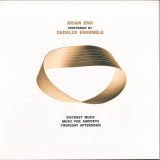
With »Discreet Music« (1975), »Music for Airports« (1978) and »Thursday Afternoon« (1985), Brian Eno invented a new music genre, Ambient Music, which he defined as »able to accommodate many levels of listening attention without enforcing one in particular; it must be as ignorable as it is interesting«. These versions performed and arranged by Dedalus Ensemble, according to the musicians and the critics who listened to it, goes beyond what we expect from it. A mental base that takes us far away. One of the only music without beginning or end in which we want to stay as long as possible.
The Dedalus Ensemble is a contemporary music ensemble based in Toulouse, founded in 1996 by Didier Aschour. Its repertoire includes works by classics of minimalism such as Christian Wolff, Phill Niblock, Frederic Rzewski, Tom Johnson, Moondog or Philip Glass.
Black Truffle is pleased to announce Symphony No. 107 –The Bard, a previously unheard archival recording of the legendary improvising ensemble MEV (Musica Elettronica Viva), captured in concert at Bard College, New York in 2012. Formed by a group of American expat composers in Rome in 1966, the MEV ensemble played an important role in the development of free improvisation, bridging the live electronics tradition begun by Cage and Tudor and the high-energy squall of free jazz. Early recordings like Spacecraft or The Sound Pool unleash volleys of metal and glass amplified with contact microphones, howling winds, primitive synthesizer bleep and raucous audience participation, the intensity of which puts much later ‘noise’ to shame. In later decades, the ensemble would go through many iterations, often including legendary free players like Steve Lacy and George Lewis. In its final years, MEV settled into the core trio of founding members heard here: Alvin Curran, Frederic Rzewski, and Richard Teitelbaum, using piano, electronics, and small instruments.
Curran, Rzewski, and Teitelbaum were life-long friends blessed, as Curran says, with ‘incompatible personalities’: major figures in the post-Cagean experimental tradition, they explored countless divergent and even contradictory paths as composers and performers, from agitprop songs to brainwave-controlled synthesis. MEV is the sound of these three personalities coming together, their contributions radically individual yet attaining a state of ‘fundamental unity’ that Rzewski, in a text written in the collective’s earliest years, defined as the ‘final goal of improvisation’. Of course, listeners familiar with aspect of the trio’s individual works might hazard some guesses about who is doing what: the crisp piano figures are probably Rzewski’s, the cut-up hip-hop samples most likely Curran’s, the sliding, squelching synth possibly Teitelbaum’s. But often these identities are dissolved in a constantly shifting hall of mirrors, the listener unable to tell which of these pianos is live and which is a sample of a past virtuoso, or whether a horn blast derives from ethnographic documentation or Curran cutting loose on Shofar. The two side-long sets here occupy a similar terrain of constantly shifting texture and instrumentation, unexpected interruptions, and moments of sudden beauty. The first set is sparser, at times almost ominous, as a bell repeatedly sounds across wheezing harmonica, seasick orchestral textures, and creaking wood, making room for episodes of yodelling and delicate prepared piano before exploding into a storm of buzzing synth and piano fragments. The second set is more frenetic, moving rapidly across centuries and continents: cars crash into post-serial piano pointillism, wailing voices collide with chopped and screwed hip-hop samples, Hollywood strings are buried under layers of electronic gurgles. The performance slows in its final moments, making way for a sampled voice repeating the phrase ‘protest and the good of the world’, reminding us that MEV’s idea of freedom was always more than musical. Symphony No. 107 –The Bard is a beautifully recorded example of the endlessly multi-layered later MEV sound, accompanied by new liner notes by Alvin Curran (now the only surviving member of the group) and a selection of previously unseen photographs from across the many decades of the group’s activity. Arriving in an elegant sleeve bearing a beautiful photograph by Francis Zhou of the Olin Hall at Bard College where the concert was recorded, this is an essential document from a major group in the history of experimental music. As Rzewski wrote, this music is ‘like life, unpredictable, sometimes making sense, mostly not’.
Canto A Lo Divino is the unique musical expression of the Chilean peasant world - a conversation with the divine nourished by Biblical and other sacred texts. It is communal music, played in packed rooms throughout the night on the 25-string guitarron, its ancient melodies transmitted through the 10-line decima form originating in Spain and found across the Caribbean, South America, and even into the Mississippi Delta. Rooted in the remote Central Valley of Chile at the skirt of the mountains and following the slopes of the major rivers, the Canto tradition has persisted for centuries in the voices of hundreds of men and women who sing of saints, divine images, and angelitos (very young children who have died). The verses are also centered around daily life in the valley - labor and drought, family, animals, and plants. There are countless entonaciones (melodies) that define this region, its communities, and its unique worldview. Mississippi Records is privileged to work with the Museo Campesino En Movimiento and their archive of hundreds of hours of intimate field recordings of the Canto - music rarely, if ever, heard outside of the region. Artwork is provided by another inhabitant of Chile's Central Valley, a baker called Frederico Lohse, who brought divine visions from the Cantos to life, painted on reused flour bags. Canto A Lo Divino celebrates the complexity and solemn, stunning beauty of this nocturnal, communal form of musical devotion. Double vinyl LP comes housed in deluxe gatefold jacket with 8 pages of lyric translations and liner notes about the Canto tradition by researcher Danilo Petrovich.
Deprived of sanity, Paul Régimbeau aka Mondkopf found new territories of expression with »Spring Stories«, a collection of post-rapture moods full of glorious chaos, ready to absorb and re-ignite all that is worn.
As a phoenix raising from the ashes, »Spring Stories« captures the earth in full bloom. Darkness & Insanity looses it´s grips as the roots and fresh leaves creates a slow dance towards the sun. Similarly sine-wave drones move around exploding electric guitar improvisations as new light beams on shadow cast corners. The album feels like a 60ies jam set in the post-world psychedelic underground. Heavy, absurd, beautiful and ready to sooth burnt out, depleted minds. Paul has citied that he´s affected as much by folk improvisors such as Master Wilburn Burchette & Robbie Basho as well as the doom drone of giants Earth & Sunn O))). Spring Stories invokes on these, while feeling like a personal blow-out, coming right from the core. Touching and grand, like spring itself.
The album also features Frederic D. Oberland on two tracks playing variously Duduk & Alto Saxophone. Lastly, The Necks drummer Tony Buck shakes & rattles all over the final - and seriously epic - piece “Continuation”, as the world aligns while the sun rises over its near-dead shape.
One of the main figures in Alabama’s music scene, Frederick Knight arrived at Stax in 1972 and hit with the country soul of "I've Been Lonely For So Long", making number 8 on the R&B chart, and the subsequent album was a real milestone in his career.
Prior to this he played a significant part as a producer/writer at Neil Hemphill's Sound of Birmingham Studios where the Stax album was cut. Later that decade Knight would again achieve commercial success with his own record label, Juana, and the recordings of The Controllers and, most notably, Anita Ward.
These early 70s tracks have never surfaced on vinyl before, both of which were also recorded in Birmingham. The plaintive ballad "You've Never Really Lived" with its subtle tempo will have you hooked from the off, while "How, When Or Where" is a mid-tempo opus that will please the dancers out there.
Two utterly fabulous tunes.
The electronic music producer and DJ whose catalogue of collaborations namechecks acts as diverse as Agoria, Green Velvet, Roman Flugel to Nitzer Ebb, Depeche Mode and David Holmes is set to release his 6th studio album The Strand Cinema on the 24th March on his own label PKR.
The last five years have seen an evolutionary shift for the electronic musician, undertaking more soundtrack work, including for film (Nightride on Netflix, Rough), radio (The Northern Bank Job BBC R4) and theatre (East Belfast Boy).
The Strand Cinema album is a tribute to the art deco cinema building , The Strand, where Phil’s recording studio is. A stirring and beautiful record, it seamlessly traverses the worlds of contemporary classical to beautifully elevated dance music with a recognisably cinematic influence. Managing to sound both grand and expansive, as well as minimal and introspective – it’s a record that explores the macro and the micro.
The opening track “Strand Cinema”, begins with a steady, gentle, looping pulse, almost recalling the kosmische ripples of Cluster, before sweeping and enveloping strings enter, resulting in a track that manages to sound both grandiose and tender in one fell swoop.
Lead single “Atlantic” perhaps most perfectly encapsulates the various sonic worlds that Kieran is operating in, merging a bordering on euphoric dance beat layered with infectious melodies, while remaining anchored to organic sounds, as strings and percussion collide with the driving and hypnotic groove of the track.
“Strike the Match” showcases Kieran’s talents for detail, in a track that feels almost palpably textural and rich in complexity but without feeling overly busy or superfluous; while “Elephant in Castle” utilises intense, almost gargling electronics, that drone with a foreboding and ominous tone, but also produces fractured moments of light, beauty and poignancy.
Created during Covid Kieran’s method was “To literally be like a tuning fork and ask: What's in my chest? If I were to describe what's inside me, and what's going on in the outside world, If I had to score that in a film, what would it sound like right now? I guess I sort of soundtracked my own life”
“One positive side of lockdowns was that we spent more time in natural surroundings where I’d make field recordings. I’d also record acoustic sounds: cello, violin, percussion, guitar etc and then create my own sample bank from all these single one-note sounds. So, creating your own loops and drones. The album was created from organic sounds manipulated by machines; melted, mangled and hacked with computers but machines only sound as good as the human spirit put into them.
The idea of nature and humans versus technology is the concept behind the album’s A/V show which debuts in Belfast in March before touring. Featuring works by 11 artists from across the worlds of film, animation, advertising, architecture, computer science and dance such as Scottish BAFTA nominated Simone Smith, LA based director Frederico Marzio Vitetta who is famous for skateboarding films like ‘Wet Dream’ with Spike Jonze, to futuristic CGI from BAFTA nominated Kris Kelly and a video from contemporary dancer Oona Doherty. onscreen visualisations that explores The visuals explore nature and technology along a timeline from past, present to future with cinema as a loose reference point with varying degrees of utopian versus dystopian moods.
- A1: Fado Hilário
- A2: Há Festa Na Mouraria
- A3: Povo Que Lavas No Rio
- A4: Solidão
- A5: (Canção Do Mar)
- A6: Maria Lisboa
- A7: Foi Deus
- B1: Estranha Forma De Vida
- B2: Ai Mouraria
- B3: Lisboa Não Sejas Francesa
- B4: Barco Negro
- B5: Primavera
- B6: Tudo Isto É Fado
- B7: Cansaço
- B8: Nem Ás Paredes Confesso
- B9: Uma Casa Portuguesa
She not only popularized fado throughout South America, she reinvented it; singing material that moved far beyond the traditional tales of failed romance to explore instead the deepest crises of the soul and spirit.
Limited edition audiophile pressing on 180gram premium vinyl.
Thanks to her, an internationally unknown folk music like Portuguese fado became a medium of universal expression known throughout the world. This collection includes some of her greatest hits, including such perennial classics as
"Uma Casa Portuguesa", "Ai Mouraria", and the unforgettable "Coimbra", also known as April in Portugal.
AMÁLIA RODRIGUES, vocals, with:
Jaime Santos - Portuguese guitar, Santos Moreira - Spanish classical guitar, Domingo Camarinha - Portuguese guitar, Castro Mota - Spanish classical guitar,Raul Nery - Portuguese guitar,José Nunes - Portuguese guitar. Orchestra conducted by Frederico Valério.
Sessions recorded between 1951 and 1962 in Lisbon Paris, and London.
- A1: 54-46 Was My Number
- A2: Night And Day
- A3: One Eye Enos
- A4: Bim Today – Bam Tomorrow
- A5: She’s My Scorcher
- A6: Peeping Tom (2Nd Version)
- A7: Struggle
- B1: Monkey Man
- B2: Never You Change
- B3: Don’t Trouble Trouble
- B4: School Days
- B5: Johnny Cool Man
- B6: Reborn
- B7: Pressure Drop
- C1: Sweet And Dandy
- C2: Walk With Love
- C3: Water Melon
- C4: African Doctor (Aka Doctor Lester)
- C5: It Must Be True Love
- C6: Scare Him
- C7: We Shall Overcome
- D1: Do The Reggay
- D2: It’s You (Reggae Version)
- D3: Just Tell Me
- D4: Alidina
- D5: Monkey Girl
- D6: Oh Yea
- D7: Pressure Drop
Led by the dynamic Frederick ‘Toots’ Hibbert, the Maytals are rightly regarded as one of the greatest singing trios in the history of Jamaican music. During an incredible recording career that spanned six decades, the group scored hit after hit on the island’s music charts, with their inimitable, unique blend of fervent gospel and downhome country seemingly impervious to changes in styles and fashion.
The best of their work, however, is widely regarded to be their rock steady and early reggae recordings for Leslie Kong’s revered Beverley’s Records during the late Sixties and early Seventies; a period that spawned groundbreaking work such as ’54 46’, ‘Monkey Man’ and ‘Do the Reggay’, to name but a few.
The Essential Artist Collection brings together the very best of their output from this period, including the above tracks, along with numerous other classics, such as ‘Sweet And Dandy’, ‘Pressure Drop’ and ‘Night And Day’.
Available as a 28 track double vinyl LP and a comprehensive 2CD compilation, both collections superbly demonstrate just why the unforgettable music of the Maytals will continued to be loved and revered for many years to come.
The story about the lost recordings of Ghia continues: Following the recently released "At The Hilton" single, our label is extremely proud to present "Curaçao Blue", the band's first full-length album. And it is simply mind-blowing, to say the least! The LP features 10 unreleased tracks in a similar Balearic vein as featured on the single.
Incredibly, it was only just a few months ago that these tracks were rediscovered on some old tapes by band members Lutz Boberg and Frank Simon. Could anyone imagine that two physics students from a small German town could create such beautiful, thrilling music in their home studio? Although the technical aspects in the creation of the band's earliest tracks may have been straightforward, the outcome is high-quality, creative, modern jazz-funk, with one step in the electro-funk genre due to the use of a drum machine and synthesizer basslines. The album features mostly 4-track recordings, based mainly on the musicians' weapons of choice: a DX21 keyboard (later updated to the legendary DX7) and a guitar. Many things had to be done live in just one take, though the artists were unafraid of using overdubbing techniques to weave their instrumental journeys. The DIY aesthetics just add more beauty and uniqueness to the songs and compositions, and the result is an extremely harmonic work of undeniable musicality. Ghia delivers Balearic jazz-funk at its finest.
Though the music was recorded in Germany, Ghia had a true relationship with the Balearic region and effortlessly applied the vibes to their compositions. As a side note, one track on their earliest demo tapes was called "3 AM at Moëf Gaga" and we did not know what it meant. The band explained that Moëf Gaga is a nightclub on the Spanish coast that is actually still active today. Boberg and Simon, the two original band members of Ghia, visited the club in the early 80s and spent their holiday close to the sea. With their music, they intended to create a summery vibe, capturing a relaxed and soulful view of the seashore, likely with a drink in hand... Perhaps a Blue Curaçao?
The album starts with a revised version of the title track. The drums in this take are much punchier, and we thought that it would fit just perfectly as an introduction. We continue with the already classic "Down At The Hilton" that was featured on the single, but like us, we are sure you could happily listen to this track on repeat. Next up, "Jump In The Water" opens with a catchy delayed melody, which develops into another perfect jazz-funk piece with an extended guitar solo. Another remarkable song might be "In The Fast Lane". As the name suggests, an uptempo number, now with an electro-funk beat combined with speedy keyboard solos that almost sounds like a marimba. On side B, the album keeps the relaxed seaside vibes flowing. To round out the album, we are treated to two pieces that originated after the return home, with memories of the Spanish coast fading but still lingering, likely recorded between 1986 and 1988. Both are instrumental versions of songs to be used later for studio sessions with their new band member, singer Lisa Ohm (who you will hear on Ghia's next album!). On "Crystal Silence In Dub" we get a perfect downtempo groove, positively reminding us of the sound of the 1980s UK funk scene. The album ends with "Keep Your House In Disorder", here as an earlier, rougher, and funkier take than on the final vocal version, which could be found on the B-side of the "What's Your Voodoo" single.
We hope you love this album as much as we do! Nothing like this has yet been released out of Germany. We hardly can recall any privately produced, home recorded jazz-funk/fusion from the 1980s as free, creative, and uninhibited as Ghia's Curaçao Blue. The playful and creative approach, coupled with those nostalgic tones should make this LP an essential pick for any record collection, whether you are a DJ, a home listener, a music lover, or a modern jazz-funk/synth-funk aficionado.
The album is out now on The Outer Edge, the new label by record collector DJ Scientist, aka John Raincoatman. We also want to thank Frederic Stader for his awesome work mastering and sound restoration of the material on this LP.
- A1: Horvitz Morris Previte Trio - Todos Santos
- A2: Christina Petrie - Ballads
- A3: Christmas Decorations - Broken Leg Hours
- A4: Gilles Chabenat And Frederic Paris - De L'eau Et Des Amandes
- B1: Antonietta Borgoli - Dindindino Dindindalo
- B2: Tanto Pressanto - I Mues Immer A Di Tanke
- B3: Yuko Kono - Triangle
- B4: The Unthanks - Waiting
- C1: David Lang - Just (After Song Of Songs)
- C2: Rachel Bonch-Bruevich - Untitled (Ddr 1972)
- D1: Merula - Dags Att Sova
- D2: Stella Vander - Ondes
- D3: Hydroplane - The Love You Bring
Over the better half of a decade, Time is Away, the London-based duo of Jack Rollo and Elaine Tierney, have made tender and heartfelt transmissions through countless mixes, sound works and radio. Exploring deeply human themes of memory, persistence and resistance using an assemblage of source material, the duo's unique mode of storytelling culminates in Ballads, a new suite of songs and, significantly, their first officially licensed compilation.
From the opening notes of Horvitz Morris Previte Trio's jazz romanticism to Gilles Chabenat and Frédéric Paris's lively reimagined standard, the haunting vocal seance of Tanto Pressanto and the mesmerising swirls of The Unthanks, Yuko Kono and Rachel Bonch-Bruevich, the spirit of Ballads roams through generations of affectionate songwriting and conjures images both candid and surreal. The voice of poet and longtime collaborator Christina Petrie appears briefly and contemplates the "sighs and replies… the space between verses" of the Ballad, its beauty, its place in our lives. What is the Ballad but a reflection of our soul? "Perhaps I'll wander in search of it", she bittersweetly concedes.
At the suite's cusp is an alternate version of David Lang's 'Just (After Song of Songs)', a thirteen-minute meditation on devotion which featured in Paolo Sorrentino's Youth (2015). The track's universal themes of faith and desire radiate throughout and elucidate Time is Away's peerlessly precise yet gossamer touch.
New Hampshire born, New Brunswick based, singer-songwriter Jason
Anderson has spent the last five years making Canada home, landing first
in Toronto before settling in Fredericton - The idea of home the places we
come from, the places we return to is a powerful theme throughout his
epic new record First Light
First Light is a compelling, cathartic listen, as Anderson's poetic lyrics and
anthemic melodies make for an inspired fit with producer Thomas Wincek.
Drawing on his All Tiny Creatues project as well as his work with Justin Vernon's
Volcano Choir, Wincek has created a huge sonic backdrop here. Anderson's
expansive narratives and sing-along hooks weave through explosive rockers like
Caps Ridge Line and Still Life, pastoral mood pieces like Looking Glass and
Streetlamps , and haunting ballads like the pensive "Tower in the Fog and
gorgeous closer Halloween. The whole thing feels a bit like indie- folk stadium
rock, as if The Weakerthans were fronted by fellow Canadian Bryan Adams. As
Anderson puts it, € What started as a text exchange between me and Tom about
Joni Mitchell in the 80s turned into something strange and awesome. What's
perhaps most awesome about the project is hearing a bedroom singer-songwriter
pushing themselves in such a fun and unexpected way. First Light is a really
special record.
+ 10 Tracks for download
Preceded by the successive releases of lead singles "Sandcastles" and "My Mind", here comes the versatile debut full-length offering from Tel-Aviv-based producer Kadosh on Stil vor Talent, "Unanimously". Bridging the club universe with that of deeper, further immersive off-floor narratives, Kadosh entices us down a compelling path of rhythmic enlightenment and all-embracing togetherness. Casting mutable strains of EBM, house, pop and exotica entangled in one dizzying polyphony throughout the album, the Israeli vibist has us surfing our way across his musical headspace effortlessly.
From the stealth, neo-noir-like opening sequence of "Interstellar" feat. Marc Piñol to the epic Luso-Italo vibrations of "Sandcastles" feat. vocal hoodooist Abra~o, via the exquisite Afro-informed piano house and all-round atmospheric luxuriance of "My Mind" feat. Floyd Lavine and Erika Krall's supremely smooth yet characterful timbre, Kadosh swings the pendulum with constant surprise and bravura. Aside from his compositions' obvious hooking nature, there's also great lots of textural back funk to dive in at every corner. Hauntingly transporting, "From Jaffa to Frederichshain" feat. Upon You's Marco Resmann works a more jagged programming, flush with big-room reverbs and muted drums, while the slo-evolving "Pronto" feat. Emanuel Satie morphs from a low-key DJ tool into a full-fledged, melancholy-charged peak-time burner.
Bearing both Kadosh and David Mayer's signature, "1999" lets the 80s-inherited arsenal of iridescent Casio synths and lashing percussions talk in unhindered fashion, whereas "Volantage" feat. Murat Uncuoglu goes all in on the trampling kicks, sooty claps and prismatic keyboard stabs. Sensual to the fullest, "Moran" in collaboration with Rodriguez Jr. is certainly one of the album's highlights with its impeccably laid-down melange of bassy thunder and shapely Latin rhythmic backbone ushering us down an irresistibly poignant and hypnotic tunnel of sound. A joint effort with Locked Groove, "Far Too Close" is a further loopy discoid affair reminiscent of the French filtered-house scene's heyday, while the album's closer "Think it Over" feat. Stereo MC's is that perfect pop-indebted electro chugger that'll rev up any tired engine with reinvigorated, ecstasy-inducing horsepower.
THE NEW STUDIO ALBUM FROM THE JAPANESE LEGENDS - AN OPUS
OF DARK & ECLECTIC BLACKENED HEAVY METAL, SHROUDED IN
TRADITIONAL EASTERN INFLUENCES..
Cult Japanese black metal legends Sigh formed in 1989/90, featuring
mainman Mirai Kawashima, Satoshi Fujinami & Kazuki Ozeki
Following initial demos, Shinichi Ishikawa was brought in & Sigh set about
recording the masterpiece debut 'Scorn Defeat' for Euronymous' Deathlike Silence
Productions, going on to become one of the country's greatest & most revered
metal exports. With a journey through the strange & the psychedelic,
incorporating a whole eclectic mix of genre styles & experimentation throughout
their career, Sigh has remained a vital creative force in the avantgarde field whilst
maintaining their old school roots.
'Shiki' marks the latest chapter in the Sigh legacy & includes some of the band's
heaviest & darkest material for some years; a fine hybrid of at times primitive
black metal akin to early influences such as Celtic Frost amid more epic melodic
heavy metal riffing & solos. The album also utilises a whole host of instruments
to give further texture & dynamics to the compositions & eerie atmosphere,
incorporating traditional oriental instruments such as the Shakuhachi & Sinobue
flutes.
The word "Shiki" itself has various meanings in Japanese such as four seasons,
time to die, conducting an orchestra, ceremony, motivation, colour. The two
primary themes for the album are "four seasons" & "time to die".
The concept & artwork is based around a traditional Japanese poem & on 'Shiki'
Mirai explores how at this stage of life he himself is going through Autumn, with
Winter coming soon & so empathises with the contrasting sentimental feelings
from watching cherry blossoms (a symbol of spring) in full bloom.
Joining Mirai & Dr Mikannibal for this release are Frédéric Leclercq of Kreator,
plus US drummer extraordinaire, Mike Heller of Fear Factory, along with an
appearance by long-time member Satoshi Fujinami on bass. 'Shiki' was recorded
across multiple studios & mixed & mastered by Lasse Lammert at LSD studios in
Germany.
Dans Dans is back (already), with their most unfiltered, most spantenous, most 'punk' album to date. Three musicians, three days in the studio, one burst of energy.
April 23th, 2021. Breaking a five year silence, purveyors in ambiguous jazz-rock hybrids Dans Dans drop a new, fifth album. Throughout the media, Zink is hailed as another triumph for the Antwerp based trio. 'A bold and thrilling noise trip', according to Humo. 'The best live band of the Western hemisphere is back', celebrated OOR, while De Morgen hailed the 'organic but cleverly constructed jams'. The following summer, the band made the best of a temporary easing of local Covid restrictions, and played some rapturous shows, such as during Jazz Middelheim in their hometown and an Unday Records label night during the Boomtown festival in Ghent. A string of dates in Eastern Europe followed, but, alas, the remainder of a national and international tour in autumn was cancelled. Third wave, fourth wave, who was still counting?
At the tail end of 2021, Bert Dockx, Frederic Lyenn Jacques, and Steven Cassiers, the unholy trinity that make up Dans Dans since 2012 - yep, that's a ten year anniversary! - decided to turn setbacks into sound blasts, grief into grooves. Rehearsals were planned. New music was made. And before you know, a studio was booked. This is how an instrumental corona-album happened. Not one of contemplation through isolation or new found domestic bliss, not your usual, subdued track record of socially distant, monotonous times. '6' might be a reaction to all of that, but it's definitely more than that.
Dans Dans is back (already), with their most unfiltered, most spantenous, most 'punk' album to date. Three musicians, three days in the studio, one burst of energy.
April 23th, 2021. Breaking a five year silence, purveyors in ambiguous jazz-rock hybrids Dans Dans drop a new, fifth album. Throughout the media, Zink is hailed as another triumph for the Antwerp based trio. 'A bold and thrilling noise trip', according to Humo. 'The best live band of the Western hemisphere is back', celebrated OOR, while De Morgen hailed the 'organic but cleverly constructed jams'. The following summer, the band made the best of a temporary easing of local Covid restrictions, and played some rapturous shows, such as during Jazz Middelheim in their hometown and an Unday Records label night during the Boomtown festival in Ghent. A string of dates in Eastern Europe followed, but, alas, the remainder of a national and international tour in autumn was cancelled. Third wave, fourth wave, who was still counting?
At the tail end of 2021, Bert Dockx, Frederic Lyenn Jacques, and Steven Cassiers, the unholy trinity that make up Dans Dans since 2012 - yep, that's a ten year anniversary! - decided to turn setbacks into sound blasts, grief into grooves. Rehearsals were planned. New music was made. And before you know, a studio was booked. This is how an instrumental corona-album happened. Not one of contemplation through isolation or new found domestic bliss, not your usual, subdued track record of socially distant, monotonous times. '6' might be a reaction to all of that, but it's definitely more than that.
Playing in Dixieland jazz bands during his teens and then passing through some Kansas City jazz acts, New York-born alto saxophonist Steve Lacy became associated with the avant-garde jazz movement from the mid-1950s, playing on free jazz pianist Cecil Taylor’s influential debut LP and early work by the Canadian pianist Gil Evans, before serving a long tenure with the idiosyncratic improv pianist Theolonius Monk, whose work he would continue to reference throughout his career. Visiting Europe from the md-1960s, starting with a trip to Copenhagen with pianist Kenny Drew (who made the Danish city his home thereafter), Lacy later travelled to Italy to form a quartet with Italian trumpeter Enrico Rava (who had earlier played in Argentinian sax player, Gato Barbieri’s group), plus South African exiles and former Blue Notes members Johnny Dyani on double bass and Louis Moholo on drums. Lacy subsequently moved to Paris, which became his permanent base from 1970, leading a sextet there whilst also exploring the limits of the alto saxophone as a solo instrument. The disparate and often discordant album Threads was recorded in Rome at Mama Dog studio in 1977 for filmmaker-turned-record producer Aldo Sinesio’s Horo Records label; comprised of six of Lacy’s own compositions, the album saw Lacy supported by Alvin Curran on piano and Frederic Rzewski on flugelhorn, synthesizer and percussion, the pair both longstanding members of the experimental group, Musica Elettronica Viva.GO