quête:fright

Genres
Tout
Vercetti Technicolor - Black September Tape

Vercetti Technicolor's ficticious soundtrack to the 1972 Munich Massacre, is a bleak, cold and somber work. Partly inspired by the 1999 Documentary by Kevin Macdonald, Vercetti creates a tense and brooding approach to this, the most darkest of subject matter. This is far from dancefloor material, this is doom-electronics at it's most frightening. Giallo Disco is proud to present our first LP, Vercetti Technicolor's Black September, closer to minimal wave than moroder and all the better for it. Remixes come from Mexico's PLAYTONTO and Creme Organization signing's Francesco Clemente.
Limited to 100 copies, first time on cassette for our very first LP by Vercetti Technicolor. Pro duplicated with re-edited artwork by Eric Adrian Lee.

pas en stock

Commandez maintenant et nous commanderons l'article pour vous chez notre fournisseur.

6,68

Last In: 7 years ago
Stave & Grebenstein - Live From Frankfurter Strasse
 
3
également disponible

White Vinyl[8,87 €]


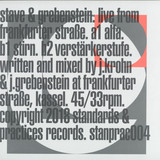
The first release on Standards & Practices since the widely acclaimed remixes of Talker's 'Battle Standards' EP (by Surgeon / Regis / Broken English Club) from late last year, 'Live From Frankfurter Strasse' represents the first recorded collaborative effort from Jonathan Krohn (Stave, also 1/2 of Talker) and Jan Grebenstein (Downwards, Horo).

Culled from recording sessions following several successful improvised live performances in San Francisco, Los Angeles, & Berlin, 'Live From Frankfurter Strasse' is 3 tracks of seismically powerful, industrial dub music that represents a new direction for the pair and is unquestionably some of their strongest material to date.

The twitchy, pared-to-the-bone opener 'Alfa' is at once vast and frighteningly claustrophobic, recalling the brutal, clinical precision of Mika Vainio & Ilpo Vaisanen's output, with a brilliantly tricky arrangement that continually pulls the rug out from under the listener - it's vertigo-inducing twists and turns are simultaneously disorienting and endlessly hypnotic. On the flip, the brooding, scorched-earth 'Stirn' & 'Verstarkerstufe' work at a much slower tempo, uncurling like a plume of smoke with a spacious, cerebral quality that occasionally brings to mind early Gescom.

pas en stock

Commandez maintenant et nous commanderons l'article pour vous chez notre fournisseur.

8,87

Last In: 6 years ago
Stave & Grebenstein - Live From Frankfurter Strasse  - White Vinyl
 
3
également disponible

Black Vinyl[8,87 €]


The first release on Standards & Practices since the widely acclaimed remixes of Talker's 'Battle Standards' EP (by Surgeon / Regis / Broken English Club) from late last year, 'Live From Frankfurter Strasse' represents the first recorded collaborative effort from Jonathan Krohn (Stave, also 1/2 of Talker) and Jan Grebenstein (Downwards, Horo).

Culled from recording sessions following several successful improvised live performances in San Francisco, Los Angeles, & Berlin, 'Live From Frankfurter Strasse' is 3 tracks of seismically powerful, industrial dub music that represents a new direction for the pair and is unquestionably some of their strongest material to date.

The twitchy, pared-to-the-bone opener 'Alfa' is at once vast and frighteningly claustrophobic, recalling the brutal, clinical precision of Mika Vainio & Ilpo Vaisanen's output, with a brilliantly tricky arrangement that continually pulls the rug out from under the listener - it's vertigo-inducing twists and turns are simultaneously disorienting and endlessly hypnotic. On the flip, the brooding, scorched-earth 'Stirn' & 'Verstarkerstufe' work at a much slower tempo, uncurling like a plume of smoke with a spacious, cerebral quality that occasionally brings to mind early Gescom.

pas en stock

Commandez maintenant et nous commanderons l'article pour vous chez notre fournisseur.

8,87

Last In: 4 years ago
Our Girl - Stranger Today

Our Girl

Stranger Today

12inchHYMNS16LP
Cannibal Hymns
15.08.2018

At first, it's difficult to pinpoint exactly what makes Our Girl so special, or why the Brighton-formed, London-based trio's music stands out within a busy crowd of fellow guitar-wielding-types. But if an explanation didn't jump out when they first emerged with a debut EP of mighty fuzz-soaked songs in November 2016, it surfaces with 'Stranger Today', a debut album of personal, emotional juggernauts that could have only been made by these three people: Guitarist / vocalist Soph Nathan, bassist Josh Tyler and drummer Lauren Wilson.

Since forming in Nathan and Tyler's Brighton home four years ago - Wilson joining as a late recruit when she was wowed by a demo of their self-titled debut track, and 'Stranger Today''s opener - Our Girl's members have only had pockets of time to work together. A day booked in a local studio here, a soundcheck there, full-time jobs and other projects meant the three rarely had a concentrated, collective patch. This changed in September 2017, when they stayed in Eve Studios in Stockport for a week, recording with Bill Ryder-Jones. Their week in Stockport became a crucial catalyst for what would follow. Ryder-Jones is a guitar virtuoso himself ('He did stuff neither me or Soph had ever seen anyone do before,' Tyler remarks), and he became an unofficial fourth member of the group.

'Stranger Today' is a special debut for several reasons: First, because it's the sound of a band beginning to grasp their own value and place in the world. Secondly, because you can hear the trio's hunger to finally get in the same room and put to tape years' worth of scrapbooks, half-finished ideas, and a slowly-forming feel for how their first album would actually sound. 'What band isn't itching to make their debut But it's quite frightening, knowing you're about to do it,' Wilson remembers.

The real clincher, however, is Our Girl's dynamic, and how it plays out across 'Stranger Today'. Best friends in person, the trio share the same close kinship and chemistry on record. On one side is Nathan's visceral lyricism, which has a habit of detailing and chipping away at precise moments; the first heart-flutter of a new crush; the moment a long-term friendship begins to ebb away. Around her, Tyler and Wilson's rhythm section carefully mirrors each feeling Nathan conveys. When she sings pointedly about love ('I Really Like It'), she's backed by a major-key afterglow. When the subject turns on its head ('Josephine'), out steps a wall of taut, earth-shaking noise. They each 'serve the song,' in Wilson's words, moving in sync but with their own personal slant. Not least on the closer 'Boring', where all restraint is thrown aside and the trio let out one final, violent thrash. They inhabit a space bigger than the first loves, sleepless nights and growing pains that define this record.

Nathan remembers being in Brighton four years ago, shortly after Our Girl formed, and realising, 'I was finally in the band I wanted to be in.' Almost half a decade later, and this eureka moment is sewn up on 'Stranger Today'. It's the sound of three friends totally at ease in their own space, discontent with being anywhere else; a vibrant document of what it's like to be young, invigorated and amongst people who feel the same.

pas en stock

Commandez maintenant et nous commanderons l'article pour vous chez notre fournisseur.

22,65

Last In: 7 years ago
Sonae - I Started Wearing Black

"The kind of melancholia I'm talking about, by contrast, consists not in giving up on desire, but in refusing to yield. It consists, that is to say, in a refusal to adjust to what current conditions call 'reality' - even if the cost of that refusal is that you feel like an outcast in your own time." (Mark Fisher, Ghosts Of My Life, Zero Books 2014, p. 24) In Ghosts of My Life: Writings on Depression, Hauntology and Lost Futures', the author Mark Fisher outlines - to put it in a big way - a resistant melancholy. This stands in contrast to leftist melancholy resignation', as well as something which Fisher does not talk about: its common masculine counterpart, habitual post-left cynicism - as in seen it all before'. Fisher calls this hauntological melancholy. Haunting, spooks, ghosts and apparitions are an almost constant presence on I Started Wearing Black', the second album by the Cologne-based artist Sonae (pronounced so-nah'). The term hauntology shares a fate with retro-futurism when it comes to inflationary overuse and abuse. It's a conceptual container that looks good and can hold a lot, indeed, too much. Furthermore, hauntology has its peak season behind it, a term on the threshold of its expiration date. Nevertheless, I would like to rehabilitate hauntology and use it properly to characterize I Started Wearing Black', because the term is rarely as compelling to describe music as is the case here. The most recent other example could be Asiatisch' by Fatma Al Qadiri, but with a completely different frame of reference. What are the ghosts of this music It rustles, crackles, ruffles, crunches, rattles, scrapes, sometimes a beat emerges from the constant noise, sometimes an obscure voice mumbles incomprehensibly, sometimes a melancholy piano figure is prevented by this noise from coming too much to the foreground. It definitely is eerie - to bring into play another term used by Fisher in the title of his latest book, The Weird and the Eerie'. In British pop-jargon, eerie first occurred to me more often when referring to particularly leftfield, spooky and... well... ghostly dub, a bass-heavy, echoing noise, from Augustus Pablo to Creation Rebel to Burial. Unlike the Wald & Wagner records by Wolfgang Voigt, Sonae is not a kind of neo-romantic veiling with a tendency for escapist nebula. It is more a noise of latency. The noise signals a latent - not necessarily acute - threat, a latent uneasiness about... yes... about what About a System Immanent Value Defect' That's the name of a track on I Started Wearing Black' where something that sounds like a French Horn (or a foghorn) battles for attention through or against the background noise. An email from Sonae: The piece 'System Immanent Value Defect' should actually be called 'I See Turkey'. I wrote it for my fellow student Elif - she is a pianist and Gezi Park activist from Istanbul. Through her I witnessed the inner conflict and agitation that political circumstances can create: her feelings of guilt when there was an attack, with her safe in Germany as a student, watching the events from afar. It was horrible. When her mother begged her not to come home because she feared for her safety, I felt a cold shiver run down my spine. I started with the piece from this mood, beginning with the piano, then the noise (modulated sinusoidal curves), which reminded me of waves and the then heatedly discussed Mediterranean sea: atmospheric, melancholy motifs. In contrast is the anger, the pressure, represented in corresponding sounds - hopefully audible! - During this time I started to think about world views as they can be found around the globe, in how far they held by societies and their political representation. I realized that I know of no political system that is actually about the people and what would do them good. It's always about positions, power, money. I thought that was a lot more frightening on a global scale than merely viewing Turkey in isolation. That's why the piece is called "System Immanent Value Defect", because our world suffers from precisely that. Everywhere, it's all about the wrong things.' Between the wrong things there are happy moments. In the title track, after 184 seconds of rattling and hissing, a beat is unleashed, like an arrow released from a spanned bow, a beatific relief, if there is such a thing. White Trash Rouge Noir' first meanders along spookily, then after 144 seconds it transforms itself into a distant cousin of Einstu¨rzende Neubauten's Yu¨ Gung', but there is no Big Male Ego to be fed here, and the black in the album title is a completely different type of black from that of the Neubauten. Furthermore, I Started Wearing Black' was finished long before the black dresses were worn at the Golden Globes as a sign of protest against sexual violence. Sonae writes that she herself started wearing black some time ago. Her reasons are so-called personal ones: ... resulting from an individual situation (lovesickness), I started to wear black (gaining weight and feeling ugly).' The political dimension of gaining weight, feeling ugly and therefore dressing in black in I Started Wearing Black' lurks within the noise and never becomes explicit and only rarely manifest - or a manifesto. Sonae writes about the track We Are Here': A piece for minorities... in this case, considering the current pop-feminist discourse, explicitly for women. Female artists have long been saying loud and clear that 'we are here' and 'electronic music is not a boys club!' But this pop-feminist moment should only be seen as one part of the dedication of the piece. It is for minorities, for the oppressed, who didn't belong enough.'

Klaus Walter

pas en stock

Commandez maintenant et nous commanderons l'article pour vous chez notre fournisseur.

17,19

Last In: 7 years ago
Stanislav Tolkachev - Catacomb Saints

Following the hugely appreciated reissue of Stanislav Tolkachev 'Why are you so frightened' we proudly present 'Catacomb Saints'. Two songs written during the same period as 'Yes, Today' and 'Imago', originally planned to come out in 2011 but halted due to a severe traffic accident in label manager Rivet's life followed by years of hospitalization. But times are brighter now! We hope you enjoy this quite weird and simply singular 10" by the eastern genius that is Tolkachev.

pas en stock

Commandez maintenant et nous commanderons l'article pour vous chez notre fournisseur.

7,86

Last In: 8 years ago
Fantastic Twins - Obakodomo

Optimo Music is delighted to release a first album by Fantastic Twins (formerly known as The Twins). We'll let them tell you the story behind this inspired and beguiling record -
Obakodomo (Au Balcon Du Monde) is a soundtrack I created for a piece of contemporary dance, performed by two dancers for a young audience from the age of 4. It is the story of an imaginary journey in Antartica where two explorers go on an adventure. They encounter a colony of penguins and will progressively learn to understand their habits and respect their environment. Essentially, Au Balcon Du Monde is a metaphor of how to exist next to each other, how to share a territory, how to learn to live together and share resources.
The scenography and stage accessories were designed in a minimalistic and non-obvious form to leave all the space for imagination. The penguins were made of translucent material to provide light effects and were programmed to move in a swaying motion, allowing interaction with the dancers and the music. LED system could be wireless piloted.
With the soundtrack, I wanted to create an atmosphere that would immediately transport the children into this terra nova - a poetical space, like a cold sphere, where the strange meets the frightening and the playful. Translating the immense vs the small, the far-off vs the near, the collective vs the individual, the strange vs the familiar or the cold vs the heat. My intention was to follow the thread of the story in a narrative, yet non-caricatural way. Music for children doesn't have to be 'childish'. Children love to be scared or even just challenged. They love to love and react instantly to what they hear through their emotions. Ultimately, the soundtrack aims to provide different levels of 'reading' so that it becomes something more universal. So we, adults, just have to accept the invitation.

pas en stock

Commandez maintenant et nous commanderons l'article pour vous chez notre fournisseur.

14,92

Last In: 8 years ago
Voidloss - A Life Of Dissent EP 2x12"

This EP was made during a period where my whole outlook on everything was transforming. The Voidloss project started as an investigation, I was conducting a lot of research and study on the mind, the occult, on different thought modes, and the Voidloss project represented this. The idea was about a leap in to the void. A leap of abandonment into the dark, with total acceptance, total commitment. The idea was to lose myself to the void. This was mainly a spiritual journey for me, and could be best explained by 3 things, the void of Miyamoto Musashi from Go Rin No Sho, The concept of the Tao from the writings of Lao Tzu, and the concept of the abyss from the works of Aleister Crowley. Part of this journey deep inside the self was frightening and horrific, the total loss of self, of all identity and ego, and part of it was beautiful and enlightening. I wanted the music to reflect this, and I wanted the music to change as I changed, as I went to and through all these interesting places. In essence this was about freedom. So fast forward some years and I felt I had sharpened my mind quite effectively, the music had twisted and changed and flowed with me. At the point I began making the music for this EP, I had grown quite angry with the amount of conformity I was perceiving in life. Politically, socially, musically, there was this drive of conformity in the world. I think part of it, and only a part, comes from the prevalence of social media, the need to belong and to be liked, the idea of judging yourself and your works through the perception of others. Musically I felt that within techno there was a tendency for the music to fit within a set of confines dictated by fashion and hype, and this was reducing the diversity of the music, it seemed also that the practices of commercial music were seeping in to techno as the music became more popular. Hype and business driven decisions, brand building and so on. I always felt techno was more about art, and I began to get frustrated. Equally I felt that politically there was less and less choice, as all decisions seemed to lead to the same outcomes. I became more interested in the concept of anarchism, of the idea that government was no longer needed. I have always in my life had a drive to question everything. I've always been 'naughty' and rebellious and done things my way, to my advantage or my disadvantage, I could never accept being anything other than myself all the way. If everyone walks in one direction, I will walk the other way, even if it takes me over the edge of a precipice, just to see what is there. All this stuff influences my music, and during the period of making this EP I was angry, kicking against the things I no longer liked or wanted, screaming dissent. There is a lot of anger and rage, and of course rebellion. I wanted the music to capture that unbridled fury you have when you are in your late teens, when you just start learning about yourself and you start rebelling and questioning things around the time the world is really pushing you to conform. I was soundtracking my own philosophical riot. Previous to this my Voidloss stuff had been more introverted, more pensive and melancholy, more self destructive, more cerebral. For this new music I wanted something more immediate but without being too obvious. In terms of the choices I made I still leaned more towards broken rhythms for beat structure. I find it very difficult to do anything interesting with 4x4 kicks any more, it's too rigid for me, it limits my freedom. I like the looseness you get from more 'drummer' like beats, I guess probably because I have been playing drums all my life. The challenge is to get the same rolling power from broken rhythms as you get from 4 to the floor. It's not easy, there is a ridiculous amount of trial and error and the rejection percentage is high. I also was trying to use less 'synthy' sounds. I wanted to try to take a more acousmatic approach to sound design. With the current modular synth revival in techno I was hearing a lot of 'old' synth sounds re-emerging, and this didn't seem like a progression to me. I wanted to make sounds that were hard to source for the listener, where they weren't sure if it was synth or real world sample, digital or analogue. This involved a lot of experimentation. My process involved a lot of field recording, especially with contact microphones, which open up a whole new world of interesting sounds. You are effectively recording sounds through objects in the environment, 'hearing' the world as these objects hear them, I was using guitars, feedback loops, handmade instruments as well. So I was combining this with different synthesis, granular synthesis, sample synthesis, physical modelling, FM synthesis and of course analogue. Everything was reprocessed and re-synthesised, I tried hard to obscure the source and make something new as much as possible. The stuff on this EP was part of my live PA for some time, so as I learned how the music worked live I could go back and make changes, sometimes the environment I was playing in transformed the sound as well, and so I would try to go back an incorporate this in to the music. For remixes I wanted to choose artists that I respected for their vision as well as for their output, so my list of people I wanted was extremely short. Inigo Kennedy has always been an artist I have respected greatly. His music has always been unique to himself, he remains outside of fashions and trends even though his name has become very big recently. He takes risks with his work, experimenting and exploring, yet remaining relevant to the club, and just tirelessly forging ahead, seemingly for the sake of art above all else. And he's just a really nice guy to deal with. His remix is everything I expected it to be in that it is the unexpected. Regis is another artist who forges his own path in music, you cant really even begin to discuss the avantgarde in techno without including his name, he is one of the foundation stones for artistry and the outsider mentality in techno. His music is always unique to his own vision, and along with it comes an interesting artistic philosophy taking in situationism, post punk and industrial ideology and a good dose of tricksterism ala PT Barnum, all of which comes out in his music and the way it is presented. The man is a truly singular force and it is an honour to have him on this record. Overall the concept here is that of rebellion and dissent. Of asking questions, following your own path, of maintaining some place in yourself that burns like a forest fire.

Whether or not I have succeeded I guess is down to the listener, I'm never happy with my music, I keep wanting to move forwards, or somewhere else, and am constantly trying and failing to capture some essence of perfection. But like Bukowski said
'It's the only good fight there is'

pas en stock

Commandez maintenant et nous commanderons l'article pour vous chez notre fournisseur.

14,41

Last In: 10 years ago
Rockwell - Aria Ep 2x12"

Rockwell

Aria Ep 2x12"

2x12inchCRIT051
Critical Music
31.01.2011

Rockwell's rise to prominence as a rare, distinctive talent has been exciting the electronica music circuit the world over. Critical, thankfully, being the trusty forefront for all things audio-aesthetically delicious, presents the 'Aria EP' - 4 tracks of sound sublime, exemplifying Rockwell's refreshing angle on energy in the club combined with the characteristic, meticulously playful technicals, precise and thrilling as ever. The charmingly rustic intro of 'Aria' unleashes striking Flinstones-esque wooden triplets, scaling the track as stirring vocals weave through; haunting and uplifting at once, the title-track exudes sheer class. Slightly more buoyant, 'Live For The Moment' infuses an energetic tempo with profusions of ear-carressing funk and those ever-characteristic percussive twists - naughty all over. Swiftly plunged into apocalyptic darkness, the Ulterior Motive boys take a sinister liking to 'Noir'. Distinctly menacing and genuinely frightening, what better to bully the atmosphere than Hell-raising bass and staccato violins. Listen out for the breakdown bass - horrific and enriching, this track is dark by Devil's definition. Icing on the cake collaboration with underground legend Untold comes in the form of 'Rehoku Sunrise', a tribal earthy worldly masterpiece of running drums and raw, wild samples, glazing the soul in bliss. Bellissimo.

pas en stock

Commandez maintenant et nous commanderons l'article pour vous chez notre fournisseur.

14,08

Last In: 15 years ago
Articles par page:
N/ABPM
Vinyl
