From the very start of "Drawing Dead" through the memorable lead line in the slower-paced closer "Big Sky Theory," Dozer assembled a work of impeccable songwriting and deep-rooted character. In the arc of their career, every record was another step forward, and just as 2001's Madre de Dios built on the debut and 2003's Call it Conspiracy built on that, so too did Through the Eyes of Heathens pick up from where its predecessor left off. Its sound was still rooted in a heavy rock feel, but Dozer were able to translate that into something more aggressive when they wanted - their sound had bite as well as lumber, and while a cut like "Born a Legend" could be traced back to their desert-minded beginnings in its basic structure, by the time it was finally executed, it was something else entirely. The Obelisk
Cerca:future sound
From the very start of "Drawing Dead" through the memorable lead line in the slower-paced closer "Big Sky Theory," Dozer assembled a work of impeccable songwriting and deep-rooted character. In the arc of their career, every record was another step forward, and just as 2001's Madre de Dios built on the debut and 2003's Call it Conspiracy built on that, so too did Through the Eyes of Heathens pick up from where its predecessor left off. Its sound was still rooted in a heavy rock feel, but Dozer were able to translate that into something more aggressive when they wanted - their sound had bite as well as lumber, and while a cut like "Born a Legend" could be traced back to their desert-minded beginnings in its basic structure, by the time it was finally executed, it was something else entirely. The Obelisk
Wild Pink’s last album, 2018’s Yolk In The Fur, concluded with a song about the strange sense of relief that comes with “letting go of youth.” Frontman John Ross, then in his early thirties, was singing from a place of newfound comfort and wisdom, but it ended with a repetition of the line, “I don’t know what happens next.” The song, titled “All Some Frenchman’s Joke”, is a beautifully concise rendering of a universal milestone: leveling up from the wide-eyed naivety and self-destructive routines of our youth, only to realize that we’re as unprepared for the future as we were for the past. On Wild Pink’s third album and first for Royal Mountain Records, A Billion Little Lights, Ross explores that dichotomy of finally achieving emotional security—of accepting the love and peace he deprived himself of in his twenties—while also feeling existentially smaller and more directionless than ever before. The record is a two-pronged triumph: an extraordinary reflection on the human condition presented through the sharpest, grandest, and most captivating songs Wild Pink have ever composed. The band, which is rounded out by bassist T.C. Brownell and drummer Dan Keegan, formed in New York City in 2015 and put out a handful of EP’s before releasing their critically acclaimed self-titled debut in 2017. It was a sophisticated showing for a band’s first album, but it was the striking maturation of Yolk In The Fur that established Wild Pink’s unique sound: a glistening variety of pastoral indie-rock akin to The War On Drugs, Death Cab For Cutie, and Kurt Vile, but informed by classic American rock poets like Bruce Springsteen and Tom Petty.
Angel Tears in Sunlight is Pauline Anna Strom's first album in over thirty years; an assemblage of music that refracts the expansiveness, and minutiae, of imagined realms while embracing the kaleidoscopic echoes of our distant epochs. The capacity to collapse time might elucidate the enigma of Pauline Anna Strom. A mystic force in music, emerging during the dawn of new age as the Trans-Millenia Consort, the pioneering synthesist channelled primordial energies into future-facing sound through a series of full-length releases between 1982 and 1988. Little was known about her, except by a constellation of devoted followers who saw a unique legacy forming amidst the (mostly male) synthesist canon of the time. Following the 2017 release of Trans-Millenia Music, an anthology revitalizing the most evocative parts of Strom's catalog, the Bay Area visionary sensed the universe telling her to return to music. As with her work in the 80s, Angel Tears in Sunlight was composed and recorded in the same San Francisco apartment where Strom has lived for almost four decades in synthesis with her machines and "dinosaurs." Populated by a compact array of modern instruments that streamline the sound of her analog past and her beloved iguanas, Little Soulstice and Ms Huff, the terrarium of her home forms an intimate yet limitless ecosystem that defies the constraints of the outside world. Within this sanctuary, Strom becomes lost in time, drawing on the ancient energies of her inner visions. Her hardware forms the crux of translating these ideas into sound. "It's the only way this stuff can be pulled out of myself, the universe, Little Soulstice, an ammonite_," Strom notes. "It couldn't be done without this machinery, because there's no other way to draw and capture these frequencies into sonic interpretation." Strom's process of recording transient live-takes enriches the mystery of her work. She renders the machinery a composer itself, a cohabitation with a living other. "Many musicians wouldn't go that far because of ego," Strom muses. "The equipment has to become part of you and your creativity. That's how I think it all comes together." Music-making becomes a harmonic language of intuition with an instrument, where Strom cultivates sound for a harvest that defies season. Shaped by circadian contours, Angel Tears in Sunlight is a celestial observatory of earthborn phonic mosaics. Strom uncovers a symbiosis between hardware frequencies and apparitions of nature in the record's arena of organic tones, emulating the melodic pulses of primeval terrain. The album transcends both shadow and light, falling to hushed stretches of sound as if not to awaken antediluvian animals, before soaring through the treetops where ancient skies peer over reptilian traffic and unsparing rains.
Steven Rutter aka B12 is one of techno’s most influential artists, famed for many releases on the iconic Warp Records including "Electro-Soma" that defined what is now the deep techno genre.
B12 was originally a duo before Steven Rutter took over the alias as a solo artist, but after a string of new releases on labels like Soma and Delsin, he decided to start producing under his own name.
Deciding it was time to look to the future with a new lease on life, Steven Rutter kept his sound the same, but shed the skin of B12 to mark a new point in his musical career.
Battling with personal demons, the B12 sound had become dark and introverted, and the Steven Rutter style keeps that same moody atmosphere, while adding upbeat rhythms and more jovial chord progressions without losing focus of the core sound that’s made his music so influential.
In addition to a numerous EP, “Riddle Me Sane” is the third album Steven Rutter has done under his own name, and it's in the timeless B12 style that's adored by his fans in all four corners of the world.
Cosmic melodies and sci-fi influenced textures with dystopian sound design, the thought provoking album paints pictures of alien landscapes, while its down tempo grooves also have the key elements needed for the dance floor.
Comfortingly familiar for those who love the classic B12 style, it also marks a distinct turning point in the sound that Steven Rutter has been looking to focus on.
Tracks like “Techno Prisoner” perfectly embody the style this release is aimed to purvey, but this masterpiece has been expertly programmed to play as a continuous piece of music rather than a selection of solo cuts.
It has been almost 30 years since Mantris shared music with the world. Together with his good friend Christoph Waelkens, the producer was the driving force behind pioneering house outfits The Black Sun and Brown Hardware Inc. Their creative connection led to three consecutive releases in 1992 on cult label Elektron, a short-term sublabel of USA Import Records. A productive music career was forecasted, but Mantris vanished into thin air and no more music was ever heard of him.
Until early 2020, when Brussels based Kong DJ got his hands on a mysterious playlist. Sent from Bombay in India, little information was annexed apart from a reference to the above mentioned records Mantris produced - favorites in Kong’s record bag for many years. Blown away by what he heard, the DJ decided to launch a new record label and invited good friends Hill Men to join forces. Borrowing the original playlist’s title ‘Souvenirs From Imaginary Cities’ as label name, their first release is what you hold in front of you.
mantris, real name Dirk Eggermont, prefers to stay under the radar. In his small apartment in Bombay he hasn’t stopped making music ever since he left Belgium twenty years ago. He composes instinctively, far away from hypes and contemporary scenes, creating intriguing and timeless jams. Utterly cinematic, his story-telling is rich and phantasy provoking. Each of the 10 tracks pencils a singular atmosphere, yet the 40 minutes entirety comes as a coherent whole full of surprising sounds and meandering dreams. Close your eyes for a unique musical vision here offered as a 12” album, reminiscing of the finests UK leftfield experiments, Detroit future sounds of jazz and sophisticated house not house.
Tape / Cassette
"Like water drops, gently hovering, slowly bursting one by one, reassembling themselves simultaneously." An imagery that shaped this shining debut album "klondike" by hanisii - a mysteriously operating artist who has been flying under the radar for half a decade now yet scattering some highly unique re-interpretations via Soundcloud.
After a no-contact-no-contract-deal with Rico Puestel about remixing and editing his music back in 2016 and 2017 (working out both stunningly and skillfully), it took three years until this album at hand emerged out of the blue. Adapted to the circumstances, Rico Puestel constructed a way of presenting this specialty item appropriately on his large-scale project "Time In The Special Practice Of Relativity": A "slight bit" beyond the usual, showcasing the entire album on a limited cassette tape together with an exclusive SD card, carrying its digital audio version + bonus material.
As one might cynically state that God created music, the devil the ones writing about it, it feels right to keep it short and simple about the album itself here: Setting the scene itself with an intro and outro of genuine beauty (letting even an old broadcasting signal sound like those multifarious water drops of elegancy), everything in between profoundly passes through the depths of electronic onomatopoeia in nine diverse yet coherent and organic shapes, melting the groovy energy of House music with a pervasive serenity and clearness of Techno aesthetics.
While "klondike" allows itself to only raise the singular claim of wanting to get listened to, the scent of a future classic might be floating around the ether...
As part of their ambitious ‘The Feeding of the Five Thousand Remix Project’, punk pioneers Crass are returning with another exclusive coloured 12” single featuring remixes by industrialists Test Dept and LA based artist Maral. Late last year Crass took the step of making the original separate track stems of their seminal debut album ‘The Feeding of the Five Thousand’ available as a free download. With a call to take the original sixteen track recording in its pre-mix state, the intent was for people to create their own remixes and interpretations and breathe fresh life and ideas into this revolutionary music. First released in 1978, ‘The Feeding of the Five Thousand’ pre-empted rap and grime in its hard-on-the-beat, fast fire, uncompromising lyrics and the iconic sounds and messages are ripe for reinterpretation. Crass encouraged people to rip apart the sound and ideas and create something new, then send the files to Crass Records for future releases and charitable projects. The message is DIY like it never was before. “Yours for the taking, yours for the making,” Crass said.
Industrial techno fine art sound... With a Cyber-Punk freaky attitude.
The new world disorder !
DeWolff return with their new album, Wolffpack, released on 5th February 2021 via Mascot Records.
DeWolff, the kaleidoscopic warriors were not long into their 2019 Tascam Tapes European Tour when the Covid19 pandemic broke and they, like so many others, had to turn back and head home. They started working on the new album Wolffpack.
The album kicks off with the first song they finished, the soulful psychedelic funk of "Yes You Do," featuring Ian Peres and longtime friend of the band, Judy Blank. "We wrote it in a Zoom meeting!" Pablo says. "Treasure City Moonchild," struts in with a funky swagger and Piso's trademark swirling Hammond, with Dawn Brothers' Levis Vis providing some Bass juice. "Do Me," includes Theo Lawrence on vocals and is through the eyes of an anti-hero who realizes he isn't worthy of the woman of his dreams, and dates back to 2019 and the Next of Kin live show. "I consider this the best song I ever wrote, so I couldn't stand the idea that it was only used for those Next of Kin shows and then never again! That's why I brought it to DeWolff, but it needed some rearranging," he says. Another song from the Next of Kin sessions was "Sweet Loretta" and features Dawn Brothers' Stefan Wolfs and Darilyn's Diwa Meijman. "Loretta is the protagonist's childhood sweetheart. She has a rich dad, but he's really conservative, and so she can only inherit his money if she marries a man. But she's lesbian. So, the protagonist, who's also out for this old guy's money, suggests they play pretend and marry so they can split the money."
They sweep through disco on "Half Your Love," swamp rock on "Bona Fide" and take on sci-fi and the Old Testament on "RU My Savior." Their tour buddies The Grand East show up on "Roll Up the Rise." Written in the first days of quarantine, it's about the end of the quarantine - told from a future perspective. "Lady J," came after Pablo watched the documentary "13th." "I was quite shaken up by it," he admits. "The lyrics are based on the idea that Lady Justice seems to have a scale that doesn't measure the "weight" of your crime but the tone of your skin. She is supposed to be blindfolded, but the people who act in "her" name aren't blind at all: they discriminate between white and black."
The album ends with the forlorn "Hope Train." Based on the Pulitzer prize-winning novel by Colson Whitehead about two slaves in the US during the 19th century, who make a bid for freedom from their Georgia plantation. "I found it really hard to envision the world in which it takes place," he says. The band used a 1970s Fisher-Price Toy cassette recorder in the intro, "We wanted to see if we could somehow approach the sound of those very early country blues recordings, like the ones by Blind Willie Johnson.”
- Sunday Women
- Computer Of Love
- Up All Night
- Another Lonely Day
- Don’t Overthink It
- Cartoon Music
- Feminine Walk
- Dada Bois
- Now You Know
- Not That Bad
- Got What I Wanted
Every now and then an artist comes along who makes you remember why you started listening to albums in the first place: Aaron Lee Tasjan is that artist. With his wrecked cool, off-centre charm and restless creative dazzle, he makes music with conviction that has its roots in rock’s murky past, armed with an arsenal of songs that spill over with humour, intelligence, irony and, at times, prophecy.
An obsessive creative, Aaron Lee Tasjan writes pop songs with a twist, a little overdriven and far too honest at times. He updates the idea of androgyny but dispels the emotional and social ambiguity with lyrics that reflect his own geographic and artistic wanderings.
Tasjan! Tasjan! Tasjan!’ is 11 songs. The man who began the album is not the same man who completed it, transformed both by the experiences that inspired the songs and by crafting them. This is not anxious music for anxious times but rather music as an antidote for anxious times. It is the sound of the future arriving.
Gatefold vinyl
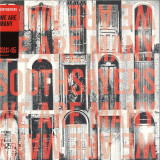
South London-based band Soothsayers are set to release their ninth studio album 'We Are Many'. Held together by heavy basslines, solid grooves, and socially and politically charged lyrics; the album takes the listener into different sonic spaces with elements of dub, Afrobeat, improvisational jazz and electronica.
The initial steps in recording 'We Are Many' came in January 2019 when the band's founders - saxophonist Idris Rahman and trumpeter Robin Hopcraft - set out on a journey to Brazil. With executive production in the Sao Paulo studio by renowned music journalist and author David Katz, they hooked up with bass player and producer Victor Rice who they'd met sharing the bill at Freedom Sounds festival in Cologne, Germany a year earlier. Victor organised a session in Studio Traquitana, home of acclaimed Brazilian band Bixiga 70, and invited a selection of local musicians. Percussionist and singer Ligia Kamara contributed lyrics and melodies written in the studio, and drummer Bruno Buarque, guitarist Joao Erbetta and bassist Victor provided some solid, personality-driven input. Fresh and vital, what came out was a fascinating blend of Soothsayers' dub and Afrobeat mixed with distinctly Brazilian inflections.
After arriving back in the UK, Idris and Robin set about creating the remainder of the album in a different, yet complimentary way, and called on the services of Wu-Lu and Kwake at their The Room studio in South London. Things started to take shape very quickly, Wu-Lu and Kwake combining Soothsayers' music with electronic elements, while also referencing elements of the current UK jazz scene.
When lockdown hit in March 2020, there was still a lot of work to do in order to complete a full album and Robin and Idris set about working on tracks with their musicians remotely. Having time to consider the album as a whole, they found strong connections between the music recorded in Brazil and the tracks recorded in London and they set about fusing and combining these elements further into a satisfying whole.
UK based Sengalese singer Modou Toure was enlisted to guest on one track while percussionists Satin Singh and Maurizio Ravalico were engaged to help affirm a sound-world where Brazilian flavours, such as the low-end Surdo drum, were combined with sounds more readily associated with reggae and Afrobeat.
Soothsayers' three part vocal harmony is a defining factor in this album. With strong references to the vocal styles of reggae legends such as The Gladiators, Mighty Diamonds, Heptones, and Abyssinnians; it has benefited from the long-standing friendship between Robin, Idris and Julia Biel. Lyrics, melodies and harmonies were presented, discussed, explored and recorded at Idris' and Julia's home studio in Streatham in a relaxed and positive way, with concepts from social and political commentary turned into powerful songs.
Themes cover political observations of Trump and beyond alongside Brazil's president Bolsanaro (Rat Race), speaking out against increasing levels of violence from the Brazilian government towards its native and indigenous people (Love And Unity) and keeping hopeful despite the impending horrors of a no-deal Brexit (We Won't Lose Hope).
Elsewhere they discuss striving to create space for meditation and reflection against the background noise of 24/7 news and social media (Move In Silence), the daily grind (No Sacrifice) and workers' rights (Slave), while highlighting those that fall through the cracks in society and end up without a permanent address, what led to this and how close we all are from this happening (One Step Away).
'We Are Many' represents a positive and uplifting statement in the face of challenging times - the overriding force, power and positivity of the music to continue forward, pushing the boundaries of musical concepts into the future.
"Whilst heavy questions of life and death and the future of our species surround us all, music is a guide that can help us perceive the challenges in a different way - a guide that can help us towards a deep inner peace. If we listen, music can help light the way. We hope you will listen, and we hope you will experience the joy, meditative power and beauty in the connection of different musical cultures that was experienced in the creation of this album."
140 gram black vinyl, Double sided record sleeve, Double sided photo insert
In 2013, a 16-year-old LORDE quietly, yet confidently asserted herself as the voice of a generation with her full-length debut, Pure Heroine. The album would go triple-platinum, selling over 4 Million worldwide, win two GRAMMY® Awards, a BRIT and spawned the seven-times platinum record-breaking international juggernaut single, Royals,' and quadruple-platinum follow up Team.'
She also curated the official soundtrack for The Hunger Games: Mockingjay - Part 1 and recorded Yellow Flicker Beat' as the lead single. Her last trip to the UK was when she was personally asked by David Bowie's family to perform her spellbinding tribute to the late artist at 2016 BRIT AWARDS. Having once been described by David Bowie himself as "the future of music', Lorde is proving to be that and much more.
Following LORDE's triumphant return with comeback single Green Light,' the singer released her second full-length album Melodrama on June 16.
Melodrama will now be released on standard & deluxe vinyl this April
Unique composer duo Rebekka Karijord & Jon Ekstrand create compelling, hybrid score to intimate portrait of teenage climate activist Greta Thunberg `I Am Greta', the intimate Hulu documentary by Swedish director Nathan Gross-man, tells the story of teenage climate activist Greta Thunberg through compel-ling, never-before-seen-footage. Starting with her one-person school strike for cli-mate action outside the Swedish Parliament, Grossman follows Greta in her rise to prominence. The film culminates with the extraordinary wind-powered voyage across the Atlantic to speak at the UN Climate Action Summit in New York. To musically accompany Greta and the children of the Fridays for Future movement on their journey, composers Rebekka Karijord and Jon Ekstrand spent time searching for the right balance when it comes to how much emotional triggers the music should of-fer: "With the music for `I Am Greta' we aimed to find a sonic counterpoint to the friction between the shy, contemplative inner world of Greta, and the unbounded ener-gy of the natural world and climate change movement. From the start we found it useful to separate the score into three distinct voices: Greta's Voice, the voice of the natural world, and the voice of the climate change movement." "We choose to work with repetition and persistent musical patterns, often illustrated through energetic string arpeggios. This we felt helped underline the remarkable persistence and focus of Greta has on the climate issue, as well as that of the re-lentlessness of nature. Then we found a few places throughout the score, where more melodic aspects could be introduced and carry the story through its dramaturgical journey. It allowed the melodic aspects to shine through when they are introduced." "The score consists of a string octet, modular synthesisers and a voice instrument built by Rebekka of 25 unique singers sampled in their full range. Our soloist on the soundtrack is the cellist Linnea Olsson, whom has a very specific airy and organ-ic tone." "Rebekka and Jon's dynamic score to `I Am Greta' is huge and intimate, uplifting and melancholic, and manages to carry the emotional nuance of Greta's story. The score forms a musical parallel to Greta's journey and narrative voice throughout the film. It's energy, urgency and emotional depth reminds us that the time for climate action is now." - Nathan Grossman, director of `I Am Greta'
South London-based band Soothsayers are set to release their ninth studio album 'We Are Many'. Held together by heavy basslines, solid grooves, and socially and politically charged lyrics; the album takes the listener into different sonic spaces with elements of dub, Afrobeat, improvisational jazz and electronica.
The initial steps in recording 'We Are Many' came in January 2019 when the band's founders - saxophonist Idris Rahman and trumpeter Robin Hopcraft - set out on a journey to Brazil. With executive production in the Sao Paulo studio by renowned music journalist and author David Katz, they hooked up with bass player and producer Victor Rice who they'd met sharing the bill at Freedom Sounds festival in Cologne, Germany a year earlier. Victor organised a session in Studio Traquitana, home of acclaimed Brazilian band Bixiga 70, and invited a selection of local musicians. Percussionist and singer Ligia Kamara contributed lyrics and melodies written in the studio, and drummer Bruno Buarque, guitarist Joao Erbetta and bassist Victor provided some solid, personality-driven input. Fresh and vital, what came out was a fascinating blend of Soothsayers' dub and Afrobeat mixed with distinctly Brazilian inflections.
After arriving back in the UK, Idris and Robin set about creating the remainder of the album in a different, yet complimentary way, and called on the services of Wu-Lu and Kwake at their The Room studio in South London. Things started to take shape very quickly, Wu-Lu and Kwake combining Soothsayers' music with electronic elements, while also referencing elements of the current UK jazz scene.
When lockdown hit in March 2020, there was still a lot of work to do in order to complete a full album and Robin and Idris set about working on tracks with their musicians remotely. Having time to consider the album as a whole, they found strong connections between the music recorded in Brazil and the tracks recorded in London and they set about fusing and combining these elements further into a satisfying whole.
UK based Sengalese singer Modou Toure was enlisted to guest on one track while percussionists Satin Singh and Maurizio Ravalico were engaged to help affirm a sound-world where Brazilian flavours, such as the low-end Surdo drum, were combined with sounds more readily associated with reggae and Afrobeat.
Soothsayers' three part vocal harmony is a defining factor in this album. With strong references to the vocal styles of reggae legends such as The Gladiators, Mighty Diamonds, Heptones, and Abyssinnians; it has benefited from the long-standing friendship between Robin, Idris and Julia Biel. Lyrics, melodies and harmonies were presented, discussed, explored and recorded at Idris' and Julia's home studio in Streatham in a relaxed and positive way, with concepts from social and political commentary turned into powerful songs.
Themes cover political observations of Trump and beyond alongside Brazil's president Bolsanaro (Rat Race), speaking out against increasing levels of violence from the Brazilian government towards its native and indigenous people (Love And Unity) and keeping hopeful despite the impending horrors of a no-deal Brexit (We Won't Lose Hope).
Elsewhere they discuss striving to create space for meditation and reflection against the background noise of 24/7 news and social media (Move In Silence), the daily grind (No Sacrifice) and workers' rights (Slave), while highlighting those that fall through the cracks in society and end up without a permanent address, what led to this and how close we all are from this happening (One Step Away).
'We Are Many' represents a positive and uplifting statement in the face of challenging times - the overriding force, power and positivity of the music to continue forward, pushing the boundaries of musical concepts into the future.
"Whilst heavy questions of life and death and the future of our species surround us all, music is a guide that can help us perceive the challenges in a different way - a guide that can help us towards a deep inner peace. If we listen, music can help light the way. We hope you will listen, and we hope you will experience the joy, meditative power and beauty in the connection of different musical cultures that was experienced in the creation of this album."
- Idris Rahman and Robin Hopcraft
Transversales Disques is very glad to announce the release of the never released before piece Un Monde Lacéré by electroacoustic music pioneer Pierre Henry. This piece is a special tribute to Jacques Villeglé and his work. It is the world opening performance of this
opus, recorded in studio Son/Ré. Pierre Henry was born in 1927 In Paris. He started studying music as early as the age of seven. In 1944, guided by Olivier Messiaen, he imagined and started composing music for the future. His meeting with Pierre Schaeffer was crucial for his creation. Inventing new technical composition processes which in time have become widely used on a large scale, he has constantly given this music a far reaching power no one expected at the start. He
has also invented his own sound, as easily distinguishable as the sound of the most famous jazz musician.
The Gordons crashed upon the do-it-yourself scene of early 1980s Christchurch with torrential force, self-releasing two foundational planks of the vibrant New Zealand underground. Future Shock, a three-song 7-inch released in 1980, is a wild-eyed rampage, as staggering as any feedback-addled punk then being recorded at Southern Studios. The Gordons LP, which followed in 1981, matches the abandon with motorik churn and livewire dissonance, evoking New Zealand antecedents as divergent as This Kind Of Punishment and the Dead C. Brought together on this release, they’re a noise-rock landmark anticipating fans such as Sonic Youth.
Flying Nun Records, the storied Christchurch label and symbol of the island nation’s rich independent music scene, re-released The Gordons and Future Shock together in 1988 following the formation of Gordons outgrowth Bailter Space, which frontman Alister Parker founded with Clean drummer Hamish Kilgour. Bailter Space, which would also come to include founding Gordons members Brent McLachlan and John Halvorsen, settled on a droning shoegaze sound, drawing comparisons to Dinosaur Jr. and the Pixies. The Gordons and Future Shock, however, represent the trio’s unreformed id, as startling today as upon release.
THERION have always been a band that have challenged themselves to explore new paths, while remaining true to their musical core values. For their 17th studio album, mastermind Christofer Johnsson and his collaborator Thomas Vikström have created something that has been previously unthinkable to the guitarist and the singer. "We have done the only thing that was left of all the different angles to explore", explains Christofer. "We have decided to give the people what they kept asking for. 'Leviathan' is the first album that we have deliberately packed with THERION hit songs."
True to the Swede's words, the album opens with the catchy and swift tune 'The Leaf Of The Oak Of Far' featuring female and male antiphonal singing as well as a choir that seems to have evolved straight out of THERION's breakthrough full-length "Theli" (1996). This is immediately followed by the obvious highlight 'Tuonela', in which Christofer cleverly underscores this hit-track's Finnish vibe by employing NIGHTWISH’s "metal voice" Marko Hietala. Next up in this parade of future fan-favourites is the title track 'Leviathan' that offers classic THERION material with operatic female vocals and a massive choir.
Christofer Johnsson's passion for classic voices, choirs, and orchestral elements as well as his penchant for epic melodies in combination with rock and metal shines clearly through the following sing-along ballad 'Die Wellen Der Zeit', which indicates another nod to German romantic composer Richard Wagner. "Ever since 'Theli', Wagner has been and will always be at the core of THERION", emphasises Christofer. "When we started to combine metal and opera, it was something new and original. Today, symphonic metal has long been a firmly established genre."
When THERION came into being in 1988 by changing name from the already existing band BLITZKRIEG, which was founded a year earlier, Christofer had rather taken inspiration from SLAYER's "Reign In Blood" among other classic metal albums. At the beginning, the Swedes were firmly rooted in death metal, a genre which they helped to define, as witnessed by their debut album "Of Darkness...." (1991). Yet even back then, there were hints of "something else" lurking beneath the rough surface.
The use of female vocals is another core ingredient of THERION today, which developed gradually. CELTIC FROST had basically introduced the female element to extreme metal on "To Mega Therion" in 1985. THERION began with both a female and male vocalist emulating a church like choir already in their sophomore full-length 'Beyond Sanctorum' (1992). With Symphony "Masses: Ho Drakon Ho Megas" (1993) and "Lepaca Kliffoth" (1995), Christofer continued to developed his trademark sound by gradually drifting towards cleaner vocals and more keyboards. With "Theli", the Swedes had firmly established a reputation of pushing the boundaries of metal in the 90s – among such acts as their compatriots TIAMAT, THE GATHERING, and MOONSPELL that were often referred to as "gothic metal" at the time.
THERION continued to break new ground leaving inspiration for others to follow in their wake: On "A'arab Zaraq - Lucid Dreaming" (1997), Christofer further explored the use of Near Eastern music in metal which he had already begun in 1992, while "Secret Of The Runes" (2001) dared to have Swedish lyrics in some songs. While critics were left confused and fans challenged, THERION were often ahead of their times and vindicated in hindsight. Even the band's 25th anniversary excursion "Les Fleurs Du Mal" has by now overcome the initial shock the album caused and is only beaten in terms of streaming by the classic "Vovin" (1998).
When Christofer faced the question of where to go next after the dramatic "Beloved Antichrist" (2018) had finally fulfilled his musical mission, his answer is "Leviathan" named after a giant sea monster from Judeo-Christian myth that has roots in Babylonic lore: THERION have created a giant hit album – and for the first time in the history of the Swedes, their fans are not asked to explore something new, but simply to lean back and enjoy the best from their band!
NEW REPRESS IN HARD CARDBOARD SLEEVE + OBI + INSERT WITH LINER NOTES
+ RESEALABLE OUTER SLEEVE.
Christopher were an underground acid rock trio featuring future Josefus drummer Doug Tull. They evolved from United Gas, a psychedelic band from Houston who rubbed shoulders with legends like The 13th Floor Elevators and Moving Sidewalks . After relocating to Los Angeles - where they changed his name to Christopher - they played at numerous biker parties and recorded their sole album in 1970 for the Metromedia label. It’s an amazing example of West Coast psychedelia / acid-rock featuring strong fuzz-wah guitar, great compositions and superb musicianship. It was housed in a terrific cover depicting the band at the same hippie crash-pad where some scenes from the “The Trip” movie were filmed.
One of the holy grails of American psychedelic-rock and the rarest album originally released by the collectable Metromedia label.
Remastered sound, original artwork, insert with liner notes.
Note: This is the only legitimate, fully-authorized vinyl reissue of Christopher in the current market. Beware of inferior, low-quality bootlegs.