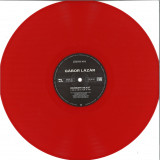
“Reflex” is Gábor Lázár’s debut album on raster. His new record is a collection of seven tracks, featuring an extended sound palette of percussions and synthesizers drawing our attention towards the essential soundscapes of techno while maintaining his distinct, uncompromising and meticulously detailed style. While the tracks do not follow traditional narratives, the album has an evolution: it gently builds up from challenging, unpredictable, and organically composed structures to linear yet playful forms of techno-infused tracks, taking us on a journey from home listening environments to club contexts.
Our senses are stimulated by micro-variations of textures and patterns, leading us to the feeling of here and now, allowing us to observe our own reactions and thoughts evoked by the listening experience. Gábor’s consistent production techniques and intuitive compositional approach work together coherently, addressing the listener’s cognition from different angles simultaneously, offering a variety of ways for the listener to get immersed.
“Reflex” will be released on raster in September 2024 on vinyl and CD.
Cerca:gabor lazar
- 1
**Hardcore, FWD dance music from two leading sound artists. Edition of 500, Mastered and cut by Matt Colton** Mark Fell and Gábor Lázár ratchet the game with their razor-sharp debut collaboration, 'The Neurobiology of Moral Decision Making'. As promised in the wake of Gábor's acclaimed vinyl debut, 'EP16', the duo have colluded on a full set of ten tracks, ranging from short synapse bursts thru to an uncannily emotive 12 minute masterpiece on the closing side. As the 10th release on The Death of Rave, it demonstrates the distance travelled since the early '90s paradigm shift of original rave culture, effecting a radical recalibration of meter and tone conventions in electronic/dance music, and by turns, acutely probing our perception of time and space. Essentially it's incredibly "funky", if "funk" is taken to mean syncopation or a play on tension-and-resolution. By utilising the grid-morphing potential of Max/MSP software, they unlock mutant ballistic patterns cleanly weaving between and recoding the tendons and ligament of techno, garage, footwork and hardcore with muscle memory-reprogramming impact. Kicks, claps and visceral chromatic stabs land at irregular, blind-spot junctures, acutely rewiring our sense of rhythmic anticipation and offering a thrilling new freedom of expression and dancefloor discipline in the process. It's a masterful step forward from Yorkshireman, Mark Fell's Sensate Focus output and SND classics, and, likewise, a logical leap from Budapest-based Max whizz, Gábor Lázár. If you're into Mumdance, Errorsmith, Lorenzo Senni, Autechre, Actress or SND; we'd say it's as essential as they come.
Gábor Lázár’s “Boundary Object” is a collection of eight real-time recorded, unedited tracks made in Budapest and Prague between 2020 and 2022 using a self-designed compositional interface. It's Gábor Lázár’s second album for Planet Mu following “Source” in 2020. The title comes from the idea of a Boundary object as a flexible concept of sociology and computation of how collaborations could happen between groups of people who have different kinds of backgrounds and different levels of knowledge. A Boundary object could be anything which translates between these groups to make a collaboration happen. Boundary objects are plastic, interpreted differently across communities but with enough common identity across social words and contexts to maintain integrity. This is a neat summary of how Gábor’s approach and working process led to his music on this album. Prismatic, flexible, and functioning on different levels of interpretation. On “Boundary Object”, the shiny surfaces and uniformity of “Source” have collapsed inward, leaving intact the recognisable pulse and frames of his music. While each individual track has a non-linear structure, the album as a whole has a strong narrative. Passages that start out Trance-like and familiar warp and weft into different shapes as if Gábor is examining the music like a 3d object, pulling at the edges, breaking and rebuilding what he examines, turning expectations inside-out. “Boundary Object” is intense, full-spectrum and a lot of fun.
Gábor Lázár's colourful discography extends from sound art to his more recent dancefloor detonations. From his first release on Lorenzo Senni's Presto! label to his collaborations with Russell Haswell and his popular 'seizure inducing' team-up with Mark Fell entitled 'The Neurobiology of Moral Decision Making' to his last album 'Unfold' on The Death of Rave, where he balanced relentless, snappy rhythms and wonky melodic tones against more measured chords to create a deliciously fruity futurism.Gábor has now signed to Planet Mu for his new album 'Source' which moves forward with the dance music direction he started to formulate with 'Unfold'. Gábor first fell in love with electronic music simultaneously through dance music and it's IDM offspring, and also with harsher, noisier computer music on labels such as Editions Mego. This collection, which develops slowly over 8 tracks, works its way through his own take on these influences, moving across themes and loops as if each track is a different stage in a process. All these tracks sound incredible on a club sound system. The listener can hear nods to hoover bass and 2-step in 'Phase', or trance techno in ‘Excite', the dive-bombing bass of dubstep in 'Effort ' or the frantic techno influence of 'Route', emulated in the minimal forms Gábor has created with a sound artist's precision and a strict adherence to his vacuum-like grids. Gábor bends his sounds, abstracts them and re-contextualises them; basslines fire out of the grid at strange angles and squirm as if they've come alive, shards of melody shoot off at wild angles, attacking with drama and a thrilling sense of energy
Mark Fell inaugurates his new label – The National Centre for Mark Fell Studies – with his first solo electronic material in years; a slinky, ravishing volley of unique dance drills that have been in the works for over a decade, feeling somehow like Derek Bailey dissecting Singeli, or Autechre and Hermeto Pascoal dancing in hyperspace. There’s nothing else quite like it.
Back on the floor for the first time since dealing a pair of deep house 12”s with DJ Sprinkles, sending a contemporary classic in »Protogravity« with Errorsmith, plus a lauded collab with Gábor Lázár – all in 2015 – Fell taps back into core club concerns last explored to this uncompromising extent on his string of »Sensate Focus« EPs released between 2012–2013. He’s hardly been slacking since then, with a slew of far-reaching avant collabs with everyone from Rian Treanor to Limpe Fuchs, Okkyung Lee to Pat Thomas, Explore Ensemble to Will Guthrie – each one blurring distinctions between producer, composer, and conductor.
The »Nite Closures« EP is worth the wait – and then some. As ever, Fell manages to retain a highly distinctive, instantly identifiable sound while also tracing and mapping new bends in the continuum. His exploration of contemporary styles and patterns is here distilled and articulated with a rare, daring playfulness and sinuous intricacy – for over half an hour he flows from frantic to almost emotional at the drop of a snare. Trust it’s not your everyday / everynight club music, with an asymmetric angularity bound to wrong-foot fresher feet, but also the type of absolutely future-facing, skewed machine funk that clubs are crying out for, even if they don’t quite realise it.
As someone who’s witnessed the dominance of colouring-book Jive Bunny DJs recycle tested ideas ad infinitum, the message is a firm do-one to myopic ravers in »Nite Closures«. From the displaced anticipations tested in its extended dub and ravishing, tweaked polymetrics on its version, through a »Large Modulos #3« teeming with organismic details, to the hair-kissing swang of »auchterhouse (inversion)« and its clipped, cascading 2.1-step reprise, Fell offers thrilling new options for the loosey-gooseyest dancers at each turn. For us, it’s perhaps his greatest record this century.
Clear Vinyl
Written and conceived by Stephan Crasneanscki, ‘LOVOTIC’ is a concept album by Soundwalk Collective, composed in collaboration with lauded actress and singer/songwriter Charlotte Gainsbourg. Featuring veteran techno stalwart AtomTM, rising singer/composer/performance artist Lyra Pramuk, celebrated actor Willem Dafoe, and writer/philosopher Paul B. Preciado, the album is released by the new Berlin-based Analogue Foundation.
Inspired by a relatively new field of research that seeks to explore and develop the possibilities of sexual and emotional relationships – and even love – between humans and robots, ‘LOVOTIC’ interrogates the impulses, ideas, and needs underlying this phenomenon. The project ventures into a future where sex, intimacy and desire are reformulated through the connection of humans, robotics, and artificial intelligence.
In an age of such hybrid entanglement with the machine, human identity requires the construction of new forms of intimacy, gender, and sexuality. At present, however, such technologies are primarily used to produce programs of limited sexual iterations that do not question the preformatted categories of gender and sexual orientation. In contrast, on ‘LOVOTIC’, Soundwalk Collective ask whether the future of sex and sexuality could instead be an exponentially expanding kaleidoscope. Where does the impulse of preference come from? What sets of words from our vocabulary can be communicated to the AI mind to generate a new identity for desire? Could the machine be another technology that brings us closer together?
Sonically ‘LOVOTIC’ is unidentifiable, artificial, and genuinely futuristic, occupying an amorphous androgynous netherworld at the borderlands between biotic and android. Traditional musical signposts are virtually non-existent, instead offering a mercurial, formless sound which mirrors the flourishing of gender fluidity it suggests could be on the horizon.
The production tangibly evokes the odd, rubbery textures of faux flesh, the slick virtual glide or glitchy mishaps of software, and the sleek shine of hardware. Gleaming sound design creates shard-like surfaces redolent of Alva Noto and Ryuichi Sakamoto’s ‘Glass’, the slippery stretched sonics Gabor Lazar, and the unsettling dark ambience of TOWERS and Hallmark ‘87.
At turns intimate and inviting, with whispering-in-your-ears ASMR vocals evoking blissful, heightened sexual states, within ‘LOVOTIC’ there’s optimism, but also unease; As well as the positive, it implies the negative ramifications of technology. At points a synthetic siren’s call appears to lure the listener to a darker place, with audio malfunctions suggesting dystopian science. Voices morph from gentle to distorted – a glitch in the system causing the mask to slip, like virtual lizards – ‘They Live’ or ‘V’ (?), for the metaverse age.
Here, Charlotte Gainsbourg invokes a being of unknown identity – an artificial eve, the oracle and the portal – speaking from an unspecified time in the future. The voices of AtomTM, Lyra Pramuk and Willem Dafoe weave in and out of Charlotte’s, often overlapping, merging into one another, expressing the entity of a being that’s ephemeral and in constant flux, oscillating between the natural and artificial. The record’s other bonafide singer, Lyra Pramuk’s delivery alternates between spoken word, operatics and partially- unintelligible language.
A multi-media project, ‘LOVOTIC’ also features the work of writer, philosopher and curator Paul B. Preciado – a leading thinker in the study of gender and body politics. Paul contributes a post-apocalyptic, quasi scientific and fictional text, which adds further fantasy, artistic and intellectual depth, augmenting the listener’s experience. Like all the best Sci Fi, his words seem prescient, describing what could become a likely reality in the future. Paul performs his written texts on the opening and closing tracks of the album; ‘The Age Of Mutation’ (in Spanish) and ‘Primate Love’ (in English).
Soundwalk Collective is an experimental sound collective helmed by Stephan Crasneanscki in collaboration with Simone Merli, which operates in a continuously rotating constellation of sound artists and musicians. The Collective’s approach to composition combines anthropology, ethnography, non-linear narrative, psycho- geography, the observation of nature, and explorations in recording and synthesis.
- A1: Johanna Knutsson - For Gwendoline
- A2: The Belgium - Sleep Will Do
- A3: Ylia - Regen
- A4: Leif - Nq6
- B1: Steve Hauschildt - Ecce Reverie
- B2: Telefon Tel Aviv - The Means Whereby Lovers Are Waylaid
- B3: Gacha Bakradze - Martivi
- B4: Attraktta - Closer
- C1: Pye Corner Audio - I Follow You
- C2: Patricia - Low And Slow
- C3: Karen Gwyer - Mahler's Heartbeat
- D1: Chevel - Slip
- D2: Gábor Lázár - Wubs And Wahs
- D3: Machine Woman - Technoo
- D4: Rrucculla - Hielo Helio
"QUINZE" -"fifteen" in Catalan- is the title of the new release from Barcelona’s Lapsus Records. Lapsus celebrates its fifteenth anniversary with the launch of a new compilation comprised of today’s most compelling, experimental and ground-breaking electronic music. Fifteen unreleased songs from artists that best define the Lapsus sound: Attraktta, Chevel, Gábor Lázár, Gacha Bakradze, Johanna Knutsson, Karen Gwyer, Leif, Machine Woman, Patricia, Pye Corner Audio, RRUCCULLA, Steve Hauschildt, Telefon Tel Aviv, The Belgium and Ylia. "QUINZE" will be released in late February and two different versions will be available: A standard double LP edition; and a collector's edition LP packaged inside a bespoke cement case of which only fifteen units will be manufactured.
- 1