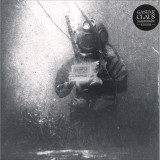
Scaphandre' is the story of an image found in a lost time on the internet a few years ago. It inspired two sound pieces conceived so that one can dive into it as into the sea.
Once their composition was finished, I looked for the origin of this image. It is one of the very first submarine pictures in history, taken by Louis Boutan in 1893 in the bay of Banyuls-sur-Mer... my home town. The original photo as well as a fantastic series of archives documenting this event can be found at the Arago Laboratory, where I often went as a child, after school, amazed by what the researchers were showing me. They just had never told me this story.
This is how this record found its scenery.
Gaspar Claus
The two pieces Gaspar Claus brought together on Scaphandre form an abstract and mysterious B-side of Tancade, released in the fall of 2021. Both composed during the long, initial period of his first album's conception, this mini album's two episodes, each tinged with minimal and noisy abstractions, unfold more than 10 minutes of total immersion into the abyss of experimental music on the first, and drone for the second.
In their own way, these tracks are a form of raw, unadorned escape, a film negative of the cellist's surface creations, which we know are bathed in sunshine and fresh air.
'Inside' is a moment of distraction while Gaspar worked on a film soundtrack. The title took time to mature in the musician's head, abandoned then picked up again and modified until it found its signature progression of strings where time seems suspended. The reverberations dress its fourteen-minute sound canvas in a way that is reminiscent of endless, sub-marine darkness.
'Beyond' was recorded in three takes during a writing session for his first album with David Chalmin in the Basque Country. The post-production phase required a long process of refinement to obtain this invasive sound material that cuts the listener off from their real environment and films them with a hypnotic feeling of depths and apnea.
Taken in 1898 by Louis Boutan a few dozen kilometres from the beach of Tancade in Banyuls sur mer - Gaspar's family village - the photographs of Scaphandre seal the vinyl sleeve with a unique auditory experience presenting the submerged side of the cellist. Obscure, dense, haunting, excitingly weightless.
Cerca:gaspar claus
- 1
Tancade is the solo debut by experimental cellist Gaspar Claus. Following on from his previous soundtrack work and a wealth of collaborations (incl. Bryce Dessner, Sufjan Stevens, Jim O'Rourke), Claus brings forth a collection of pieces which free the cello from its own limitations. Majestic and adventurous, stormy and radiant, dreamy and rigorous, Tancade defies categorisation, evoking chamber music suspended in the fourth dimension, the soundtrack of an experimental film or the strange folk music of an undiscovered tribe.
In 2009, following the death of Jhonn Balance four years earlier, This Immortal Coil's "The Dark Age Of Love" appeared as a tribute to the superb work of the British band Coil over two decades.Formed by musicians from all walks of life, the album was praised by critics but also, and most importantly, by Peter Christopherson himself! 13 years have passed and this passion for the band has never wavered. Following the death of Peter Christopherson in 2010 on the one hand, and meetings with musicians such as David Chalmin or Massimo Pupillo from Zü who in turn wanted to pay tribute to this gigantic band, on the other hand, Stéphane Grégoire's desire to make a new opus took shape in 2017 with a first recording of the title "Where Are You". Just like the first one, more than 5 years will be necessary to realize this new album so that it is at the height of Coil's genius. The Ici d'Ailleurs team is very proud to unveil This Immortal Coil's second album 'The World Ended A Long Time Ago'.That will be available on December 09, 2022 in several formats that will be revealed very soon. The artists this time are Coil lovers but without the album being a "lovers" cover, that would be the opposite of Coil's image. Many, many thanks to Shannon Wright, David Chalmin, Matt Elliott, Christine Ott, Aho Ssan, Gaspar Claus, Aidan Baker, Ulver (Kristoffer Rygg, Ole Alexander Halstensgard, Stian Westerhus), Massimo Pupillo, Mattia Cipolli, Elisa Bognetti, Stefano Michelotti, Francesco Bolognini, Marton Csokas, Ivan Chiossone and Eric Aldéa who make this project a reality.
- 1: Corybantic Ennui
- 1: 2 Where Are You
- 1: 3 Titan Arch
- 1: 4 Dark River
- 1: 5 Cold Cell
- 1: 6 A White Rainbow
- 2: 1 Magnetic North
- 2: Christmas Is Now Drawing Near
- 2: 3 Fire Of The Mind
- 2: 4 Going Up
- 3: 1 The Dark Age Of Love
- 3: 2 Red Queen
- 3: Ostia
- 3: 4 Chaostrophy
- 3: 5 Love Secret Domain
- 4: 1 Tattooed Man
- 4: 2 Teenage Lightning
- 4: 3 Amber Rain
- 4: Cardinal Point
- 4: 5 Blood From The Air
- 4: 6 Outro Lsd
- 5: 1 Dark River (Aho Ssan Remix)
- 5: 2 Tattoed Man (Third Eye Foundation Remix)
- 5: 3 Magnetic North (Geins't Naït Remix)
- 5: 4 A White Rainbow (Geins't Naït Remix)
- 5: Chaostrophy (Deadverse Remix)
- 5: 6 A White Rainbow (Instrumental Version)
2x12"[23,32 €]
In 2009, following the death of Jhonn Balance four years earlier, This Immortal Coil's "The Dark Age Of Love" appeared as a tribute to the superb work of the British band Coil over two decades.Formed by musicians from all walks of life, the album was praised by critics but also, and most importantly, by Peter Christopherson himself! 13 years have passed and this passion for the band has never wavered. Following the death of Peter Christopherson in 2010 on the one hand, and meetings with musicians such as David Chalmin or Massimo Pupillo from Zü who in turn wanted to pay tribute to this gigantic band, on the other hand, Stéphane Grégoire's desire to make a new opus took shape in 2017 with a first recording of the title "Where Are You". Just like the first one, more than 5 years will be necessary to realize this new album so that it is at the height of Coil's genius. The Ici d'Ailleurs team is very proud to unveil This Immortal Coil's second album 'The World Ended A Long Time Ago'.That will be available on December 09, 2022 in several formats that will be revealed very soon. The artists this time are Coil lovers but without the album being a "lovers" cover, that would be the opposite of Coil's image. Many, many thanks to Shannon Wright, David Chalmin, Matt Elliott, Christine Ott, Aho Ssan, Gaspar Claus, Aidan Baker, Ulver (Kristoffer Rygg, Ole Alexander Halstensgard, Stian Westerhus), Massimo Pupillo, Mattia Cipolli, Elisa Bognetti, Stefano Michelotti, Francesco Bolognini, Marton Csokas, Ivan Chiossone and Eric Aldéa who make this project a reality.
Catalina Matorral is a duo; Marion Cousin and Borja Flames make up its double head and four hands. At the beginning of the 2010s, they were called June et Jim -- they released some disturbing EPs before joining the label Le Saule (a small, chivalrous table whose holy grail is everything unheard, where folk- singing is avant-garde and avant-garde is synonymous with enchantment). Their first LP, Les Forts (2012), evoked the songwriting of indie-hobos inspired by Latin America, contributing to the rejuvenation of French music. Noche Primera (2013) went even further by vibrating in various reveries, from African songs to Spanish medieval music, from Purcell to Bach. It blew hot and cold under a psychedelic candlelight. The record in question has been maturing for seven years in eccentric barrels, marinating in the shadow of Marion and Borja's respective evolutions, nourished by their individual obsessions. Marion fixated on songs and dances from the Iberian Peninsula. This gave birth to a minimalistic, organic record featuring the cellist Gaspar Claus, where humming trembles among frowning pizzicatos, thin drones and throbbing arpeggios. She went on to release another album with the electronic duo Kaumwald, an oeuvre at the crossroads of vernacular narratives and experimental music, simmering everyday songs in an insolently modern production. Meanwhile, Borja leaned towards an intellectual, synthetic and furious pop; made two albums to awaken the dead, somewhere between Moondog and Battiato. They are two conceptual, electrifying and dance-inducing recordings for the phosphorescent masses. ...chimeric narration, heady verses, pop fragments, horizontal synths, distorted technologies. One would think they're listening to an opera composed by Robert Ashley or Laurie Anderson, based on an improbable libretto written by anthropologist Jeanne Favret-Saada, and performed by holograms of Brigitte Fontaine and Areski -- who unexpectedly regurgitate bits of blunt folk, binary jazz, baroque songs and ghostly madrigals. Micro-events, great enchantments. This record was written and recorded by two people, tinkering feverishly for seven years. It was blessed with the furtive appearances of faithful friends: Gaspar Claus played the cello; Igor Estrabol the clarinet, trumpet and flugelhorn; Renaud Cousin the drums; Ernest Bergez played the violin and whimsically mixed the tracks like a bonesetter-scientist. At the crossroads of worlds, eras and moods, Catalina Matorral invents a curiously rural science fiction that confounds poetry with white magic and puts French music in a permanent tension between the cosmos and manure...
Sharing his InBach album with the world in 2020 set events into motion that ultimately led to Arandel making second edition in the critically acclaimed, borderless project that unites rare instruments, musical reimanigation.
Arandel unites once again behind the musical phrases of the Leipzig composer specialists of ancient and modern instruments (Thomas Bloch), modern synthesizers and moogs, strings experts (Gaspar Claus), and the poetic spoken word of Myra Davies and Bridget St.John.
Textextext - (add your write up)
"There is a Bach for everyone" Arandel says, "and that discovery is what led me here, to InBach". Beneath the intricate history, the godlike adoration placed upon Bach, he was a playful musician, an eclectic one even. And so, a full year after the release of the first InBach record on InFiné, there is enough material to make a second one. "There is so much about Bach I didn't even know when making the first one - but after the release, people kept coming to me, telling me about certain pieces I should listen to or rework; songs that I had never even heard of."
The second InBach grew like a garden from the seeds of the first one - an eclectic journey through melodic fantasies, intricate sound design and a certain Pop silver lining. Some tracks were born out of Arandel's band performing on stage, experimenting with the songs live and composing them anew, like "Nos Contours", a new, French-lyrics version of Bodyline with Ornette, Arandel's stage partner.
InBach vol. 2 is a logical consequence then, of someone diving into a pool of music and history so large that it is being chronicled to this day. A substantial part of the instruments used on the lofty, eclectic album were recorded at the Musée de la Musique Paris: rare instruments like the *Erard square piano, ondioline, Zach's cello, Stroh violins*. They help shape the unique sound of Arandel's InBach project: sometimes _eerily familiar, always otherworldly and elusive.
In the vein of rare instruments, the first guest musician Arandel approached for InBach was Thomas Bloch, who lends his gift to four tracks over the two albums, playing the ondes Martenot, one of the first electronic musical instruments ever invented. Thomas has worked with many major artists in his career of ike of Radiohead, Gorillaz, Marianne Faithful, Tom Waits, Daft Punk.
The record travels *between styles, ideas and moods elegantly - it is a distinctly fun and personal album. Freeing himself from the weighty shackles of expectation surrounding the classical maestro, Arandel goes for the core of every Bach piece he tackles, making them his own. on "Octobre", based on Air On G-String, from Orchestral Suite No. 3 D-dur, BWV 1068, his nephew tells a dreamlike story of an ominous gang of children, literally blossoming in the mud. "Fabula" - featuring the French singer Scalde - based on the melancholic, Christian lament Meine Seele wartet auf den Herrn, becomes a grandiose, auto-tuned pop ballad on InBach vol. 2, featuring the virtuoso cello of fellow InFiné associate *Gaspar Claus*.
The use of spoken word is another new layer to InBach, and acts a lyrical thread carrying the listener through InBach vol.2: the closing track features Bridget St.John, John Peel-associated folk legend from the UK to offer to collaborate on a poem for this second volume, she replied to him with a line from André Gide : "You can't discover new land if you aren't willing to lose sight of every shore". A lovely way to sum up the InBach experience for both artist and listener.
There are records with empathy, records which are your friends and then there's the others... There might be little difference between them, a certain "je ne sais quoi", an "almost nothing but still something" which makes the difference between almost pointless and vital records. Despite, or rather thanks to his cynical despair, Matt Elliott's music never holds up a moralizing mirror to us - on the contrary, it creates a compassionate dialogue with listeners like the rhythm of two steps that synchronize to become as one. In 2016, Matt Elliot brought out his seventh solo album The Calm Before whose obscure title is neither exactly threatening nor comforting... the calm before what? Before the storm for sure but maybe also before the great record, the immediate classic we felt might be coming for a long time in the dual discography of the Bristol-born artist working under his own name and his electronic alias Third Eye Foundation. The elegant details and perspectives of Little Lost Soul (2000) already hinted at the upcoming masterpiece from the English singer-songwriter. The Mess We Made (2003) was Matt Elliott's first solo album and portrayed a universe in a kind of flight towards Balkan horizons made up of visceral despair. With the Songs trilogy, he put aside the electronic side of his work to continue working with a minimalist, stark and lucid style of writing. The Broken Man (2012) was full of tears and long laments sometimes carried by Katia Labèque's piano on a record which painted new shades of grey. On this record Matt began working with the producer, arranger and multi-instrumentalist David Chalmin (La Terre Invisible) who has kept on collaborating with the Bristol-born singer since then. Their partnership continued on Only Myocardial Infection Can Break Your Heart (2013) and The Calm Before (2016). Stéphane Grégoire is the head of the Ici D'Ailleurs label which has accompanied Matt Elliott since 2005 and perhaps he describes this album the best: "This new record by Matt is without a doubt his best album to date, a record that takes him into another dimension where he fully asserts himself as a songwriter and singer of the calibre of artists like Bill Callahan, Leonard Cohen or Johnny Cash." Matt Elliott's other records all seemed like empathic links between each other. Farewell To All We Know is an instant classic based on the sensitive piano and superb arrangements of David Chalmin, the sensitive cello of Gaspar Claus, the subtle bass of Jeff Hallam (who has also played with Dominique A and John Parish). There is a clear form of alchemy in all of this and still we find Matt Elliott's usual atmospheres and scenery, the same Eastern European folk music, long songs that take time to settle over time. Everything is the same but also is transfigured. By making his music stark and purifying and redefining the subject matter, Matt Elliott's work became so much more delicate. However this work is never frail nor really turned in on himself and thus becomes like a vital tune that vibrates and unfolds. The opening song Farewell To All We Know seems torn between the fear of what tomorrow may bring, inevitability and hope for the future in a permanent and progressive dramatic tension expressed by his Spanish guitar, the impressionist style piano and Matt's voice teetering on the edge of whispers. A funereal tribute to endless twilights and the dawns we all dream of seeing. There are touches of Leonard Cohen from Songs from a Room or Thanks For The Dance in The Day After That with Gaspar Claus's counterpoint cello. There is no spirit of resignation in Matt Elliott's work - life's path has to be followed against all odds. We have to follow the river's flow to reach the immense ocean and its infinite freedom. The haunted instrumental Guidance Is Internal harks back to the atmospheres of Howling Songs (2008) with its guitar parts full of scansions and muted threats. The music is transcendental but never seems afraid of the risk of falling. This is also what Bye Now tells us with its quasi-obsolete simplicity and sunburst melancholy reminiscent of the work of Luiz Bonfá, Bill Evans on Peace Piece or laidback crooners of the 50s. In Farewell To All We Know, Matt Elliott incessantly alternates between the dual desires to face up to the world or to protect himself from it. Hating The Player, Hating The Game is a lucid statement about the dullness of our daily lives sometimes, our right to get out of the game and no longer want to be part of it. Matt Elliott is tender but spares no one, particularly himself. Aboulia speaks of the tiredness of living and of looming death while Crisis Apparition says that there is always a time for reconstruction after chaos. This is like initially wearying wandering in the ruins of Aleppo with the slow dilution of the melody into a hallucinated drone. However the smell of great fires always fades and the earth always regenerates. Matt Elliott seems to suggest that the survival instinct is stronger than any cold winds could ever be. Matt Elliott never sings of certainties and prefers possibilities. Possibly the worst is over? Maybe... Maybe the storm has passed and devastated everything, now we just have to rebuild and live again. Farewell To All We Know shows us the distance that still needs to be walked and he walks next to you - right next to you, he is the friend who doesn't spare you the truth like all true friends really do.
Born in Majorca, Marc Melià is a composer/producer, who’s been based in Brussels for over 10 years. First spotted alongside Françoiz Breut, Lonely Drifter Karen or Borja Flames, he released Music for Prophet in 2017. It was issued on Gaspar Claus’s label Les Disques du Festival Permanent, as part of Flavien Berger’s curation.
On that first album, Marc Melià had explored the possibilities of a mythic synth; on Veus, as if sloughing, he applied the process of sound modification to his own voice, until becoming an android. But an android who sings of love and dreams, a sensitive automaton who plays with the tropes of pop music. Through this device, Marc Melià knowingly seeks poetry and beauty within transgenics, in the search of a universe where one can surf though waves of profoundly moving chord patterns, hear voices unconstrained by range limitations, or dance freely, as in zero gravity.
Part of the album has been recorded in Une ferme dans les Vosges, courtesy of Rodolphe Burger. It was recorded with Roméo Poirier, one of the most promising figures of ambient, and the elegant multi-talented Lou Rotzinger. As if progressing in parallel with his own linguistic experience, to add another layer to the sloughing, side A is sung in Catalan, Marc Melià’s mother tongue, and side B in French, his adopted language.
Like an echo to his previous album, Veus opens with an instrumental, “Pulse on a E”, which starts with a sequence created with a single note transposed to its octave, just like “Fata Fou”, the last song on Music for Prophet.
Although the title seems to reference an iconic 80s synth, “DX7” is actually about the seven days of the week. It is a love song, about the temperamental oscillations which make every morning the blank canvas of an unpredictable story. Wednesday, I hate you, Sunday, I love you. With few words and a lot of emotion, a synthetic voice is trying to grow more human each day.
“Dent de Serra” deals with the weight of memory on our relationships, but also with the way we revisit them constantly in order to integrate souvenirs within present relationships. Suddenly, the song stops and enters a new dimension, everything is different, as if what had just happened was now forgotten forever.
Oxytocin (“Oxitocines” in Catalan) is said to be the hormone of love. This song deals in a playful way with the duality between science and faith, between rational and magic, when it comes to sentimental relationships. Love is a universal theme, it is everywhere in the world, and love songs have been written for a very long time. But this particular love song is an ode to an aspect of love that has been less sung about: biology, which makes it possible to feel like you’re floating in space when you fall in love.
“Les étoiles” is a trio with Flavien Berger and Pi Ja Ma. The song is about attraction. What attracts humans to each other, but also the inevitable gravitational attraction. The song is also about accidents, magic moments that take us outside of our daily lives and give us the possibility to imagine a sidereal, infinite love.
“A propos d’une chanson” was born after Marc Melià had dreamed he had written the most beautiful song he’d ever created. When he woke up, he realized that song was actually O Superman by Laurie Anderson.
Aside from these songs, Marc Melià offers a few breaks, instrumental but no less narrative.
“Final d’hivern” conjures these quiet moments between two intense events; sleeping at night between two days; the calm that settles in after a hard winter, right before spring properly starts.
Using a musical language that clearly references Ryuichi Sakamoto, “Romain”, with its theme based on a melancholic chord pattern, could be the soundtrack to a 1970s movie lost in time. Little by little, elements that seem to come from a completely different context find their place, while turning the initial mood into something strange and unexpected.
Finally, “Retorn”, which finishes the album, is a reprise of the theme of “DX7”.
From the chords that make up a song, to the days that make up our lives, existence is but a cycle, and Veus is an exploration of them. Marc Melià keeps on drifting on his personal path, between homage to the past and visions of the future.
2021 Repress
Rone is a stalwart of the French electronic scene and returns with his fourth album, 'Mirapolis', a synesthetic journey with features from Bryce Dessner (The National), Baxter Dury, John Stanier (Battles) and Saul Williams. The artwork was created by the critically acclaimed director Michel Gondry.
Stepping into Rone's music is like sleepwalking through a vividly colourful dream, eventually stumbling across a strange, scintillating Megapolis of saturated light and colours: 'Mirapolis'. Its twelve tracks / districts, each with their own specific planning, pulsate as though animated by their musical mastermind.
The project was an opportunity to get reacquainted with long- time stage and studio partners John Stanier, Gaspar Claus and the Vacarme band and Bryce Dessner (guitarist for The National,) while bringing in new collaborators (and thus, new interpretation of Rone's dreams). We find American slam-poet Saul Williams, who happened to be in Paris for a moment and contributes a searing anti-Trump screed, Baxter Dury, who brings an irresistible East London touch to 'Switches', a kind of fan fic that reimagines the Beatles' Sergeant Pepper lounging pensive in a club chair, Israeli electronic music muse Noga Erez, who inspired 'Waves' which, despite being recorded remotely, betrays a euphoric partnership, and finally, Kazu Makino, Blonde Redhead's bewitching singer and multi- instrumentalist, who contributes to the album's closer, the gauzy 'Down For The Cause'.
Rone remains a producer of grand instrumental pieces, which cannot be easily categorized in the architectural canon of our electronic music galaxy. Hypnotic, cinematic opening track 'I Philip' is an offshoot from the score for the first French virtual reality fiction, built around Philip K Dick - the perfect gate into a city that then opens up myriad temporal perspectives.
The Chilean/French duet are known for their hypnotic music which incorporates eerie sounds generated by raw and mineral materials (metal, rocks etc) to create tracks that are in turn hyper-rhythmic and dreamy, poised between postpunk rock and electronic dance music. The band have also been very active in the field of multimedia & performance arts, and Xpujil explores that other dimension of their talent. Released on Crammed's revered MADE TO MEASURE series (which is dedicated to experimental, minimal & ambient music), Xpujil consists of a single 40-minute track, which draws the listener into an aural, immersive experience. Based on sounds recorded by Nova Materia during a trip in the Mexican jungle, in Maya territory (Xpujil is the name of an old Mayan city, now lost in the middle of the forest), the album was then produced in the band's Parisian studio, and features contribution by electronic musician/drummer Ikue Mori (of DNA fame) and cellist Gaspar Claus. The album was mixed in binaural, and is best enjoyed on headphones. Nova Materia will be performing Xpujil in appropriate settings (museums, performance arts spaces), with multichannel immersive sound systems. Nova Materia are Caroline Chaspoul and Eduardo Henriquez, formerly with Panico, the alternative rock band they had created in Chile, with which they toured around the globe and released several albums.
ehind Dosage there is Sayoko, a Japanese woman living in Paris, who works with a rich, organic, yet destabilized musical style, but with a pulsating life that makes her pieces fascinating.
His songs - since they are songs here - on the edge of pop music, are made for re-listening; each passage revealing new secrets hidden in the complex mechanics of his compositions. Evidence is never at the rendezvous, and yet the pleasure of listening, the joy of being carried away by texts that border the surreal without ever complacent, grooves that always seem on the verge of "collapse without ever poking the nose, this pleasure and this joy, unique, do not leave us from one end to the other of this theory of the pink, UFO album, for those who seek this, and to surprise the others too.
Sayoko: voice, piano, bass, electronics;
Buz: battery; Franca Mai: poems;
Dirty_Pink: guitar;
Gaspar Claus: cello;
Vincent Epplay: electronics;
Nicolas Laffererie: guitar;
BN Würtz: electronics, bass, composition;
Simon Takahashi: electronics, composition
- 1