For her second full-length as Plume Girl, Sowmya Somanath crafts a space where boundaries of language, feeling, and sound start to dissolve. ‘Unnameable Glory’ ruminates on the limits of expression, and the luminous freedom that emerges when we let go of the need to name. Elaborating on the exploratory songs of her debut, Plume Girl continues to bring together Hindustani classical improvisation, ambient soundscapes, and experimental pop.
Somanath’s voice—from gentle murmur to radiant call—guides the listener through dreamlike arrangements: sunrise guitar arpeggios, humming choirs, heartbeat kickdrums, and synths tremble. Elsewhere field sounds and old family recordings are collaged, a woman’s giggle transposed into a piano melody, a sloshing body of water mirrored by synth bleeps. Plume Girl conjures moments of revelation, drawing from the natural beauty and intuition, that unnameable glory.
Is there a divinity or a wholeness that exists beyond language, belief, or tradition? Unnameable Glory both celebrates and gently challenges the notion: Can we honour the creative richness of culture while also seeing through the divisions it creates? Can we meet the world—and each other—without assumption, without fear, with eyes made new? In these songs, the sacred is found not in grand gestures, but in the anonymous freedom of simply being: the iridescence of oil and water on a street, the smile of a stranger, the hush that settles by a creek.
At the heart of the album is a sense of curiosity and surrender—a willingness to listen without judgment, to let the moment be unnameable, to allow wonder to arise and dissolve. And yet, as Somanath notes, there’s an impulse to capture that’s tough to ignore; a need to replicate and remember. Unnameable Glory dwells in this tension: between holding and letting go, between the urge to define and the beauty of what cannot be contained. There is a quiet, revolutionary joy in simply living and sensing together. Music becomes a meeting place for the whole, the holy, and the unnamable.
quête:gentle people
- Follow You Where You’re Talking
- Shortly Forgotten Pleasure
- Loose Enchantment
- Exile In Exile
- Work (Feat. Steven Brown Of Tuxedomoon)
- Soap
- Spy V Spy
- Theme From “Other People’s Lives”
- Window In Your Eye
- Western Folly: Floating Love/ Drying Off In The Rain/How Seconds Work
Over and through the hot cement of North East L.A., an almost-dry riverbed winds like a snake through the city. Coyotes lap at its trickling stream by moonlight, as pedestrians rush past it by day without a second glance, their thoughts tangled up in the distractions of life in a sprawling metropolis. Here, amongst the many avenues and gentle hills, we find Coffin Prick (alias: Ryan Weinstein).
Loose Enchantment, this latest Coffin Prick record, is music conceived of in a different frame of mind for humans living in a world nearly-disenchanted with itself. The album consists of eleven new pieces of music recorded by Coffin Prick himself at his home in Los Angeles, a great city of quicksand-like commitments and those who love them enough to uphold the ends of their collective bargains. A record as much about the confusion of modern life as it is endeavored to expose the lusts in the very loins of creation. Sounds enchanting enough for you? Let’s look a little more closely…
On the heels of 2023’s Laughing (Sophomore Lounge), Coffin Prick got busy. And fast. Playing shows into the year with a newly minted live band, while simultaneously working day and night in his home studio laying the ground for what would become Loose Enchantment. Whereas he was essentially a recording know-nothing at the inception of his last LP, he’d learned a thing or two about better capturing his ideas by this point, taking the sidesteps and victories born of the experience Laughing provided and turning the bright lights on them. As many of Los Angeles’s drivers choose to do, it was time to take some surface roads. Odes to self-delusion, the mysteries of creation, cleanliness, and the secrets in other people’s lives.
A little Loose Enchantment for everyone, basically.
- A1: Do U Fm
- A2: Novelist Sad Face
- A3: Green Box
- A4: Dusty
- A5: The Linda Song
- A6: Dm Bf
- B1: I Tried
- B2: Melodies Like Mark
- B3: Wildcat
- B4: How U Remind Me
- B5: Pocky
- B6: Bon Tempiii
- B7: Pt Basement
- B8: Alberqurque Ii
- B9: Mary's
Yellow Coloured Vinyl[29,37 €]
Kneading dough is tricky – you should know how it’s supposed to feel. If you try too hard you could make it worse. It’s a beautiful practice – creation with a gentle touch, to work at something so it can be left alone. “If it’s too drawn out it’s awful. It’s easy to give too much.” Dance in the mirror. Contemplate your veiny hands. Who do they remind you of?
You begin by mixing flour and water. “What happens when your people die? Why’d they move the rock to the other side of Ulster Park?” Eliza Niemi asks two seemingly unrelated questions in a rising melody with guitar accompaniment, like fingers playing spider up to the nape of your neck. Gentle pressure. Strands of gluten form to bind the mix. A new question lingers in the binding. When she admits “but I don’t know how to tell if I’m feeling it or not,” that question surfaces through the text. It is reiterated throughout the album. When I’m working with dough I think the same thing to myself.
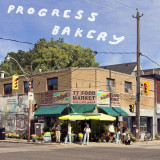
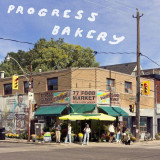
On Progress Bakery, her second album as a solo artist, Eliza knows to leave some questions alone – to let juxtaposition and tension be the proof. It doesn’t have to be hard. The feelings and revelations they provoke rise in the heat. The smell is sweet. Crispy on the outside and soft all the way through. She playfully slip-slides through words and sounds and images, delighting in surprise, skimming ideas like stones cast across clear water, touching down briefly with uncommon grace.
The question provoked between those opening lines resurfaces in the strands between songs – “Do U FM” is fully formed and beautifully layered, while “Novelist Sad Face” is a short, acapella rendering of gentle curiosity. What is holding these ideas together? Some songs demand more, seem to carry a whole load – eventually the skipping stone will halt to sink and resume its idle duty – while others drift in and out of focus, the way thoughts and dreams become interwoven before the mind is sunk into true sleep.
Music and words don’t always have to interact. Where she decides to keep them apart gives a new contour to where and how she puts them together. The kind of thing you’re supposed to take for granted with songs and their singers comes alive in Eliza’s hands – the little miracle of mixing, kneading, stretching, and stopping.
So often on Progress Bakery, Eliza teases out truth and meaning by asking questions. “Do I wanna be crying?” “Do you want me good or do you want me bad?” “Do I need an eye test?” “I’m writing songs in my head while you’re going over stuff with me — is that cruel??” In “Pocky” Eliza ends with a question that feels to me like the actual biography, succinct and revealing:
I don’t wanna be made to see
I just wanna ask “what’s that?”
Grace that ought to be rare, but in its care and precision is offered humbly, with great generosity, and without announcing itself. Eliza’s simple, miraculous music is given further form and shape by a group of collaborators – invaluable guest musicians Jeremy Ray, Evan Cartwright, Steven McPhail, Kenny Boothby, Ed Squires, Carolina Chauffe, Dorothea Paas, Louie Short, and Avalon Tassonyi. Together with Louie Short, who recorded, mixed, and produced the album along with Jeremy Ray and Lukas Cheung, Eliza has cultivated a richness in sound and texture that prods and provokes the ticklish ear. Barely audible guitar tinkering, a brief lo-fi field recording of trumpets, the harmonic clicking of a looped synthesizer, a flourish of reeds, a child’s conversation, each uncanny sound perfectly placed, rippling out under a soft breeze.
Lay in bed alone at night and ask aloud to the stillness,
“What were you doing at the Albuquerque Airport?
What were you doing there??”
And hear your question answered by a dream of swelling, undulating cellos. Try to grasp at the melody and structure. It’s not an answer (if there could be one), but it moves deeper, closer to the weird layer of fleeting moments and disconnected images, barely perceptible at its core. Wait for the dream reel to click into place.
Eliza took me for a ride in Nicole (her beloved Dodge Grand Caravan) and told me she’d been thinking of the album as an embodiment of transition – and I think every transition, known or unknown, carries the weight of new meaning, skittering off the surface tension of life as you know it, creating ripples, sometimes bouncing off and sometimes breaking through. There is a trick you can use to tell if a dough is glutinous enough. You’re supposed to stretch it out as thin as you can without breaking it and hold it up to the light. If you can see through, even if it renders the world murky and uncertain, you should leave it alone. I love this trick. It’s one that Eliza seems to know intuitively: work gently and ask questions and don’t always expect answers, and when you can, take a glimpse at something new, and then leave.
Kneading dough is tricky – you should know how it’s supposed to feel. If you try too hard you could make it worse. It’s a beautiful practice – creation with a gentle touch, to work at something so it can be left alone. “If it’s too drawn out it’s awful. It’s easy to give too much.” Dance in the mirror. Contemplate your veiny hands. Who do they remind you of?
You begin by mixing flour and water. “What happens when your people die? Why’d they move the rock to the other side of Ulster Park?” Eliza Niemi asks two seemingly unrelated questions in a rising melody with guitar accompaniment, like fingers playing spider up to the nape of your neck. Gentle pressure. Strands of gluten form to bind the mix. A new question lingers in the binding. When she admits “but I don’t know how to tell if I’m feeling it or not,” that question surfaces through the text. It is reiterated throughout the album. When I’m working with dough I think the same thing to myself.
On Progress Bakery, her second album as a solo artist, Eliza knows to leave some questions alone – to let juxtaposition and tension be the proof. It doesn’t have to be hard. The feelings and revelations they provoke rise in the heat. The smell is sweet. Crispy on the outside and soft all the way through. She playfully slip-slides through words and sounds and images, delighting in surprise, skimming ideas like stones cast across clear water, touching down briefly with uncommon grace.
The question provoked between those opening lines resurfaces in the strands between songs – “Do U FM” is fully formed and beautifully layered, while “Novelist Sad Face” is a short, acapella rendering of gentle curiosity. What is holding these ideas together? Some songs demand more, seem to carry a whole load – eventually the skipping stone will halt to sink and resume its idle duty – while others drift in and out of focus, the way thoughts and dreams become interwoven before the mind is sunk into true sleep.
Music and words don’t always have to interact. Where she decides to keep them apart gives a new contour to where and how she puts them together. The kind of thing you’re supposed to take for granted with songs and their singers comes alive in Eliza’s hands – the little miracle of mixing, kneading, stretching, and stopping.
So often on Progress Bakery, Eliza teases out truth and meaning by asking questions. “Do I wanna be crying?” “Do you want me good or do you want me bad?” “Do I need an eye test?” “I’m writing songs in my head while you’re going over stuff with me — is that cruel??” In “Pocky” Eliza ends with a question that feels to me like the actual biography, succinct and revealing:
I don’t wanna be made to see
I just wanna ask “what’s that?”
Grace that ought to be rare, but in its care and precision is offered humbly, with great generosity, and without announcing itself. Eliza’s simple, miraculous music is given further form and shape by a group of collaborators – invaluable guest musicians Jeremy Ray, Evan Cartwright, Steven McPhail, Kenny Boothby, Ed Squires, Carolina Chauffe, Dorothea Paas, Louie Short, and Avalon Tassonyi. Together with Louie Short, who recorded, mixed, and produced the album along with Jeremy Ray and Lukas Cheung, Eliza has cultivated a richness in sound and texture that prods and provokes the ticklish ear. Barely audible guitar tinkering, a brief lo-fi field recording of trumpets, the harmonic clicking of a looped synthesizer, a flourish of reeds, a child’s conversation, each uncanny sound perfectly placed, rippling out under a soft breeze.
Lay in bed alone at night and ask aloud to the stillness,
“What were you doing at the Albuquerque Airport?
What were you doing there??”
And hear your question answered by a dream of swelling, undulating cellos. Try to grasp at the melody and structure. It’s not an answer (if there could be one), but it moves deeper, closer to the weird layer of fleeting moments and disconnected images, barely perceptible at its core. Wait for the dream reel to click into place.
Eliza took me for a ride in Nicole (her beloved Dodge Grand Caravan) and told me she’d been thinking of the album as an embodiment of transition – and I think every transition, known or unknown, carries the weight of new meaning, skittering off the surface tension of life as you know it, creating ripples, sometimes bouncing off and sometimes breaking through. There is a trick you can use to tell if a dough is glutinous enough. You’re supposed to stretch it out as thin as you can without breaking it and hold it up to the light. If you can see through, even if it renders the world murky and uncertain, you should leave it alone. I love this trick. It’s one that Eliza seems to know intuitively: work gently and ask questions and don’t always expect answers, and when you can, take a glimpse at something new, and then leave.
- A1: Special
- A2: B.a.b.e
- A3: Fantasy
- A4: Not Hell, Not Heaven
- A5: Tonight (I’m Afraid)
- B1: Fleshed Out
- B2: Let You Down
- B3: Cellophane
- B4: Suffer The Fool (How High Are You?)
- B5: Haunted
- B6: Are We All Angel
Olive Green Vinyl[28,15 €]
Scowl is a band that sounds exactly like their name implies. Venomous, fierce, antagonistic. A sneer not to be crossed. Over the last five years, the Santa Cruz, California, band has firmly planted their flag in the hardcore scene with their vicious sound and ripping live show, sharing stages around the world with Circle Jerks, Touché Amoré, and Limp Bizkit, and filling slots at prominent festivals like Coachella, Sick New World, and Reading and Leeds. But with their new album, Are We All Angels (Dead Oceans), Scowl is aiming to funnel all that aggression through a more expansive version of themselves. Much of Are We All Angels grapples with Scowl’s newfound place in the hardcore scene, a community which has both embraced the band and made them something of a lightning rod over the past few years. Standout single “Not Hell, Not Heaven” outright rejects the narratives cast onto them by outsiders. “It’s about feeling victimized and being a victim, but not wanting to identify with being a victim,” explains vocalist Kat Moss. “It’s trying to find grace in the fact that I have my power. I live in my reality. You have to deal with whatever you're dealing with, and it ain’t working for me.” The band breaks from a sense of disassociation to seek deeper connections on “Fantasy.” “It’s incredibly challenging to try to balance my love for the scene while also feeling, in some spaces, extremely alienated and hated,” Moss says. “‘Fantasy’ is about feeling like I don't know how to connect with these people anymore, because I have shelled myself away so hard.” The album ends in a philosophical place on the closing, titular track, “Are We All Angels,” asking questions like, “Is this all there is?” and ultimately putting it on the listener to decide. “It’s about the personal struggle between good and evil. It doesn’t matter how ‘good’ or ‘bad’ you are, there are systems that will try to rewrite your narrative no matter what you actually do,” explains Moss, noting that punctuation on “Are We All Angels” has been deliberately omitted in an attempt to leave the statement open-ended. Are We All Angels is the highly anticipated follow-up to Scowl’s debut, 2021’s How Flowers Grow, a 16-minute primal scream over punishing riffs. But amidst the pounding chaos, it was the record’s sonic outlier, a cleaner interlude called “Seeds to Sow,” that, true to its name, planted the seed for what was to come for the band. “It kind of laid out this destiny for us, and I feel like now we’re fulfilling that,” says drummer Cole Gilbert. The band continued to expand their sound on 2023’s widely acclaimed Psychic Dance Routine EP, incorporating more pop hooks and favoring gentler singing over heavy screaming, paving the way for what would come next. Scowl’s growth got a huge boost from producer Will Yip (Turnstile, Title Fight, Code Orange, Balance and Composure), who broadened the band’s scope. “Will would say, ‘Everything you have here is correct, but it’s in the wrong place,’” says Gilbert. Moss adds: “Will really helped restructure a lot of the material. Some songs he tore apart to make more space for the really good hooks and choruses.” But even through this more eclectic approach, Scowl loses none of their edge, and still manages to convey the anger and frustration that lies underneath. They are deeply committed to carrying the ethos of punk and its sense of community. “Hardcore and punk have sculpted how we operate, what we want to do as a band, and how we participate,” says guitarist Malachi Greene. “At our core, we are a punk and a hardcore band, regardless of how the song shifts and changes.
'It begins with a shoebox of mysterious provenance, full of recordings from the Vendée department on France’s western seaboard: songs of love and war, life and death, played out on land and sea. Songs passed down and sung by ordinary men and women, gracefully delivered with the poetic economy which unites the folk song of all peoples.
Next it takes a group of contemporary musicians to make selections from this treasure trove and sing these old songs anew; to sing them for their beauty, of course, and to reclaim the people’s tradition from those who would seek to exploit it for nefarious political ends. Who better for this task than Tartine de Clous, a singing trio from Vendée’s neighbouring department of Charente-Maritime, who burst into national and international consciousness with their debut album "Sans Folklore" in 2015? The result of their shoebox rummagings, the new album "Compter les dents", recorded in 2019 and finally seeing the light of day, is bound to delight old fans and win them many new ones.
Time makes many’s the alteration, and "Compter les dents" finds 'les garçons' - Geoffroy Dudouit, Thomas Georget and Guillaume Maupin - in a different state of being from their debut release. The trio, friends since youth, have certainly matured between albums, as one would expect; consequently the newer performances are more considered and poised, unfolding with a patient confidence. A relaxed domesticity prevails, something to do with the fact that the album was entirely recorded chez les amis, in contrast to the first album, which was mostly recorded at live performances in bars and night-spots across France.
Lending gravitas to the grain of their voices we mark a deepened richness, doubtless born of the various vicissitudes of daily existence which these gentlemen - and we too as citizens of this turmoiled globe - have weathered in the intervening years. Not too dissimilar, in fact,
from some of the vicissitudes detailed in those old Vendée songs. Plus 'ça change', right?
There’s a greater complexity and subtlety to their unique three-part harmonising, too. Their voices mesh in even stronger - almost telepathic - 'fraternité' than ever before: now commanding and mighty as a full-rigged counter-vessel, now gentle and lulling as a mother’s
cradle-croon, or as the whisper in a lover’s ear.
Three legendary figures of French traditional music, now sadly departed, preside as tutelary spirits over Compter les dents. They are: the late Claude Flagel, musician and ethnomusicologist; and the late Jean-Loup Baly of the well-known 1970s band Mélusine. Most of the album was recorded by Claude in the Brussels home he shared with his late wife Lou Flagel. The album is dedicated to the memory of Jean-Loup, Claude and Lou.
For the first time there are several guest instrumentalists working their magic to expand the Tartine de Clous sound. Jean-Loup plays a characterful accordéon on the song ‘La Veuve'. The other guests are: Maurice Artus (voice), Robert Thébaut (violin), Quentin Manfroy (piccolo, contrabassoon), Marceau Portron (cigar box guitar). Their contributions add even more conviviality to that which the trio of singers already share, a sensation which will doubtless be shared by those who happen to find a place in their lives for "Compter les dents".'
Liner notes by Alasdair Roberts.
- A1: Do U Fm
- A2: Novelist Sad Face
- A3: Green Box
- A4: Dusty
- A5: The Linda Song
- A6: Dm Bf
- B1: I Tried
- B2: Melodies Like Mark
- B3: Wildcat
- B4: How U Remind Me
- B5: Pocky
- B6: Bon Tempiii
- B7: Pt Basement
- B8: Alberqurque Ii
- B9: Mary's
Kneading dough is tricky – you should know how it’s supposed to feel. If you try too hard you could make it worse. It’s a beautiful practice – creation with a gentle touch, to work at something so it can be left alone. “If it’s too drawn out it’s awful. It’s easy to give too much.” Dance in the mirror. Contemplate your veiny hands. Who do they remind you of?
You begin by mixing flour and water. “What happens when your people die? Why’d they move the rock to the other side of Ulster Park?” Eliza Niemi asks two seemingly unrelated questions in a rising melody with guitar accompaniment, like fingers playing spider up to the nape of your neck. Gentle pressure. Strands of gluten form to bind the mix. A new question lingers in the binding. When she admits “but I don’t know how to tell if I’m feeling it or not,” that question surfaces through the text. It is reiterated throughout the album. When I’m working with dough I think the same thing to myself.
On Progress Bakery, her second album as a solo artist, Eliza knows to leave some questions alone – to let juxtaposition and tension be the proof. It doesn’t have to be hard. The feelings and revelations they provoke rise in the heat. The smell is sweet. Crispy on the outside and soft all the way through. She playfully slip-slides through words and sounds and images, delighting in surprise, skimming ideas like stones cast across clear water, touching down briefly with uncommon grace.
The question provoked between those opening lines resurfaces in the strands between songs – “Do U FM” is fully formed and beautifully layered, while “Novelist Sad Face” is a short, acapella rendering of gentle curiosity. What is holding these ideas together? Some songs demand more, seem to carry a whole load – eventually the skipping stone will halt to sink and resume its idle duty – while others drift in and out of focus, the way thoughts and dreams become interwoven before the mind is sunk into true sleep.
Music and words don’t always have to interact. Where she decides to keep them apart gives a new contour to where and how she puts them together. The kind of thing you’re supposed to take for granted with songs and their singers comes alive in Eliza’s hands – the little miracle of mixing, kneading, stretching, and stopping.
So often on Progress Bakery, Eliza teases out truth and meaning by asking questions. “Do I wanna be crying?” “Do you want me good or do you want me bad?” “Do I need an eye test?” “I’m writing songs in my head while you’re going over stuff with me — is that cruel??” In “Pocky” Eliza ends with a question that feels to me like the actual biography, succinct and revealing:
I don’t wanna be made to see
I just wanna ask “what’s that?”
Grace that ought to be rare, but in its care and precision is offered humbly, with great generosity, and without announcing itself. Eliza’s simple, miraculous music is given further form and shape by a group of collaborators – invaluable guest musicians Jeremy Ray, Evan Cartwright, Steven McPhail, Kenny Boothby, Ed Squires, Carolina Chauffe, Dorothea Paas, Louie Short, and Avalon Tassonyi. Together with Louie Short, who recorded, mixed, and produced the album along with Jeremy Ray and Lukas Cheung, Eliza has cultivated a richness in sound and texture that prods and provokes the ticklish ear. Barely audible guitar tinkering, a brief lo-fi field recording of trumpets, the harmonic clicking of a looped synthesizer, a flourish of reeds, a child’s conversation, each uncanny sound perfectly placed, rippling out under a soft breeze.
Lay in bed alone at night and ask aloud to the stillness,
“What were you doing at the Albuquerque Airport?
What were you doing there??”
And hear your question answered by a dream of swelling, undulating cellos. Try to grasp at the melody and structure. It’s not an answer (if there could be one), but it moves deeper, closer to the weird layer of fleeting moments and disconnected images, barely perceptible at its core. Wait for the dream reel to click into place.
Eliza took me for a ride in Nicole (her beloved Dodge Grand Caravan) and told me she’d been thinking of the album as an embodiment of transition – and I think every transition, known or unknown, carries the weight of new meaning, skittering off the surface tension of life as you know it, creating ripples, sometimes bouncing off and sometimes breaking through. There is a trick you can use to tell if a dough is glutinous enough. You’re supposed to stretch it out as thin as you can without breaking it and hold it up to the light. If you can see through, even if it renders the world murky and uncertain, you should leave it alone. I love this trick. It’s one that Eliza seems to know intuitively: work gently and ask questions and don’t always expect answers, and when you can, take a glimpse at something new, and then leave.

- 1: Maybe It Was All A Dream
- 2: Waiting On The Dust To Settle
- 3: The Music Man
- 4: Dirty Martini
- 5: I Got People
- 6: Twin Sized Beds
- 7: Deja Voodoo
- 8: A Bigger World
- 9: Holiday (Crush)
- 10: Nobody Meant To Slow You Down
- 11: Do Not Disturb Me
- 12: Dreams Come True
The Austin, TX-based singer-songwriter—whose decades-long career has seen six full-length studio albums, three EPs, countless collaborations, and an illustrious supergroup project in Glorietta—spent a season of rest away from his focus on writing songs. In the wake of the end of a long relationship, he wanted to prioritize processing his grief as a human, not as an artist bleeding on the page. “I love all the records I’ve made in the past. But in making them, there was always the thought in the back of my mind of where and what it could get me. I made both creative and business decisions with a goal in mind... a goal that often never came. This time it was all about just the joy of making it, about having fun with it.”
Profile 1
KONISHI yasuharu
Band leader, songwriter, arranger and producer of the now disbanded Pizzicato Five (1985- 2001). Although having 2 successful world tours and 5 international albums under his belt, with fans ranging from London’s Karminsky Experience to Karl Lagerfeld, many of his fans know him as a DJ, spinning in Tokyo’s hotspots such as Shibuya’s ‘Organ Bar’. He tours regularly throughout Japan and abroad. In the Jackson 5 Remix Album, his remix ‘I want you back (readymade 524 mix)’ received an extraordinary amount of national radio play.
The remix album itself has scored healthy rankings in major record stores. In 1998, his own project ‘Punch the Monkey!’ (in which he remixes the theme tune of a popular Japanese cartoon series ‘Lupin the Third’) sold over 700,000 records, and this, some say, began Japan’s remix rush. His achievements truly invaded the mainstream when in 2000, he produced the No.1 single ‘Oha-Rock’ which became a social phenomenon in itself. Most
recently, he set up his own record label, ‘readymade international inc.’ from he which he plans to release new exciting solo works.
His talents also embrace film and photography and he is well known as a director in promotional videos, shows and advertisements. T-shirts and original goods which Konishi personally designed are sold in select shops such as BEAMS of Shibuya.
He is also a writer having regular columns in various magazines, and has also written several books. A collection of his essays have been published under the title ‘Kore wa koi de wa nai’ (’This is not love’
)
Profile 2
IKEDA masanori (Mansfield)
Began his DJ career in London, 1991, while working in Soho’s Soul Jazz Records. After becoming resident DJ at ‘Blow-Up’ in London’s Wag Club, he has toured the country and the rest of Europe. With his friends Karminsky Experience and Gentle People, he has also organised numerous club events, compiled CDs and produced radio programs. Returning to Japan in 1997, as the DJ with the rarest records in the East, he immediately made his name Djing at many popular events up and down the country. He is recognised for rocking dancefloors on a global scale having completed a very well-received European tour in 2000.
Apart from his DJ work, he has contributed remixes for Konishi Yasuharu’s ‘Punch the Monkey!’. His solo releases include his mix CD series ‘Spin Out’ , ‘Spin Out 2’ (V2 Records Japan). His albums ‘6 Complexions of Mansfield’ and ‘It’s a mans’s man’s field’ (readymade records) released under his alias Mansfield have established his name as a sound creator. He is expecting to release a new album from readymade international early 2002. This
is the DJ/composer that everyone’s talking about.
In Todmorden, the oddly-named market border town in West Yorkshire with a habit for embracing the weird and wonderful, a burst of sunshine is a precious thing. Through the thick of Winter, through every season in fact, the town’s folk are used to the wind and rain, fog and mist. As much a part of the town as the trademark deep valley it sits in, here the lay of the land invites the weather in, just as it does the many musicians, artists, and unique characters that have come to call the place home over the centuries.
Bridget Hayden is one such soul who found a home among these hills. The experimental musician, who invites the ghosts in for the classic folk songs that make up her stunning new album, knows only too well about such weather, how rare and treasured the breaks from it are. Her favourite thing to do in the valley, she says, is “to make the most of every tiny minute of sunshine.”
Such aspirations nearly derailed the recording of Cold Blows the Rain, her new eight-song collection released via the Todmorden- based label Basin Rock. Having hired the town’s Oddfellow’s Hall to record these new songs in the late summer of 2022, Hayden says the weather was so good she ended up basking in every second of it, only moving inside to begin recording when the sun was setting, working deep into the night to make up the time.
There’s a good chance, however, that it had to be this way. The songs that make up Cold Blows the Rain are not made for the sunlight. They come, instead, wrapped in mist and coated with drizzle, those elements shaping the album as much as the voice and the instruments held within, as real but ambiguous as the ghosts that linger in the shadows. The sound of the dark valley floor.
Mostly centred around meditative and experimental improvisation, Bridget’s work to-date has seen her spend more than two decades recording and performing on the underground music scene. She’s also toured internationally both as a solo artist and as part of bands such as Schisms and The Telescopes, while working on various side-projects with the likes of Folklore Tapes.
For all of this sonic exploration, so much of her work has been formed around elements of traditional folk aesthetics and, over time, she began to piece together a collection of reinterpreted traditional songs that she absorbed as a child from her mother: through The Dubliners and Muddy Waters, to Bessie Smith and The Leadbelly Songbook. Harvesting her love for Nina Simone, Karen Dalton, Margaret Barry, and more, Bridget takes these traditional songs and transforms them into something uniquely evocative
"It goes back to the womb,” Bridget says of that connection. “I would not call it a memory as it is so deep within my blood and bones. My mum was the source, she sang all the time, as part of life. So it was a very lulling and natural introduction. It seemed common to hear her singing – unbeknownst to her – in time with a raindrop dripping at the window,” Bridget continues. “I’ve always wanted to do a folk record as I love these songs so much. It comes much more naturally to me to sing other people’s words, especially when they’re as beautiful as these old verses.”
Underpinned by waves of analogue reverb, and led by Bridget’s stirring and weather-beaten voice, the songs on Cold Blows the Rain drift and crawl like low heavy clouds on flat-top hills, shaped by the land. The backdrop is equally as arresting, all subtle gloom cast in shadow, a gentle but pronounced swirling of textures, crafted from harmonium and violin courtesy of The Apparitions (Sam Mcloughlin and Dan Bridgewood-Hill).
“The weather speaks the most eloquently about human loss,” Bridget says, articulating such sentiments. “It’s good to feel enveloped by something so much vaster than ourselves. The rain and the tears all become one.”
'Challenge Me Foolish' is an almost lost album of µ-Ziq material circa 1998-99, an era that saw Mike Paradinas release 'Royal Astronomy' on the now defunct Virgin subsidiary Hut records, and also tour with Björk.
It's an era of his music that's definitely worth re-exploring, in which Mike went against the grain by producing music that was baroque, melodic and whimsical, while the IDM movement he was lumped with made instrumental music that was often neurotic and complicated. His taste for melody and dreamy beauty above roughness and intricacy confused people who were hanging on too tightly to the rules. He even brought in Japanese vocalist Kazumi, adding an extra human touch.
'Challenge Me Foolish' is something of a companion to the Royal Astronomy record, arguably even better given the fresh ears selecting the material. It's imbued with a confident sense of pastoral colour, and a gentle optimism, utilising bells, studied orchestral arrangements and airy synthesisers that sit the album somewhere between, Jean Jacques Perrey (the French electronic composer whose whimsy was always balanced with serious innovation and chops) and the colourful, optimistic soundtracks of Joe Hisaishi. There's a strange sense of the old and new throughout, the sentimental and utopia, with nary a hint of darkness. Even when the album dips into the hyperkinetic rhythms of jungle, the melodies and mood still retain a sense of gentle warmth. Dive into peak time Paradinas.
Since the late 90"s, Jakob "Dino" Dinesen has become a stalwart of the Danish jazz scene, performing with nearly everyone of note in the country as well as internationally celebrated names such as Kurt Rosenwinkel, Jeff "Tain" Watts, Jakob Bro and Paul Motian. Finding joy and inspiration in the building of bridges between genre boundaries, his career in music has seen him travel and perform all over the world, enriching his sound and soul with every new experience. His new record seeks to convey his dream of a future world at peace with itself. "Slow Flow" is set to release on January 25th on April Records. "I envision a world where people from every corner of the globe come together, dancing, sharing meals, and finding joy through my music. My children are a blend of Africa and Denmark, and I hope they"ll carry the traditions and wisdom of both their mother and father as they navigate their path. I would love for music like this to be the soundtrack to their journey through life." Rooted in the playful live sound of an atypical quintet featuring cello and djembe, Slow Flow sits in a unique space somewhere between earthy, simplistic, and acoustic and contemporary, electronic, and unexpected. The record"s sound is soft spoken and full of compassion-a dark-timbred music where the intimate, warm breath of his tenor saxophone intertwines with the crisp, organic tones of the cello. Together, they float over smooth, analog synths and electronic loops, while the carefully crafted lines of the bass and the gentle rhythm of hands on drum skins carry the music forward. Occasional erratic, quirky bursts from an affected keyboard and weaving improvisations offer moments of energy and contrast. Each of the album"s nine original compositions paint musical pictures of contentment that are dear to Dino, as well as offering musical tributes to four of his heroes in Yusef Lateef, Wayne Shorter, Coleman Hawkins and Eddie "Lockjaw" Davis". Drawing on modern European jazz, African rhythms, Italian circus music, and reggae, Slow Flow plays as a deeply personal exploration of Dino"s identity, whilst providing a dream-like message of global peace that promises to resonate with like-minded people all around the world..
"When it travels, the voice is a double agent, a trickster, or a dubious guru, but when it pauses for a recording, it's historical, capturing a mood or an emotion for all time. I didn't expect that I would hardly recognize the people who made Salt — myself and Hessel Veldman — a year and a half after recording it, but this is where I find myself now, so I'll say a few words about this temporary prosopagnosia.
Twelve years ago, when I moved to the Netherlands from Japan, I made a piece called How to Lose Your Voice. It was a YouTube hit because people wanted to learn how to actually lose their voices, though I doubt they found what they were looking for in the video. But I mention it because it's like a diary for me: my voice simply isn't the same now as it was then.
I wonder where my voice has gone.
I just listened to a radio interview with a woman who had her larynx removed.
About fifteen minutes after listening to her new voice, altered by the use of a voice prosthesis to make her audible, the interviewer played a recording of her pre-surgery voice. Of course, I was curious to hear it, and although it was immediately obvious that the gentle ease of her first voice was gone, this new voice, with its raw, gravelly sound, was even more intriguing because of its determined power to express that which needed to be expressed.
When Hessel and I first listened to the Salt in its entirety, I said in astonishment, "who wrote this?"
Marianna Maruyama, sure, but this artist goes by more than one name. Many voices spoke through me in this album. You might even recognize one of them as yours."
- Christmas 1979
- Christmas (I Can Hardly Wait)
- Christmas Tree On Fire
- Merry Christmas (I Don't Want To Fight)
- Silver Bells
- God Rest Ye Merry Gentlemen
- Santa Claus
- Stop The Cavalry
- City Of Christmas Ghosts
- Little Stars
- The Cute Lepers Christmas Song
- Xmas Bloody Xmas
- Ding Dong Merrily On High
- Guinnes And Wine
- Merry Christmas Fritz
Repress of this Christmas classic, 300 copies on snowy WHITE vinyl! "At long last! Finally on vinyl! Can Fifteen Great Christmas Songs be collected together on one lovely 12-inch vinyl disc featuring bands and artists from the Damaged Goods archives? ...you betcha bottom dollar they can! Each song has been recorded with the Christmas spirit in full flow and we'd guess the odd mince pie was consumed along the way as well. The full-on Christmas feeling that is flowing through these wonderful tracks is a joy to behold and we implore you to not just read these sleeve notes but to go crimble-crumble-crazy and actually buy this record and treasure it, not only this year but for many years to come. We are very proud to have put this album together as Christmas is our favourite time of the year. We love the feeling at special Christmas gigs - the overinflated people and prices of things and the way everyone just has to go out and drink as much as they possibly can in the name of the good old lord Jesus. We did this for you, and only for you because we really, really care and want to share the joy that only Damaged Goods Records can bring you at this special time of the year. So enjoy some great music from the likes of Will Billy Childish, Miss Holly Golightly, Helen Love, Goldblade & Poly Styrene, The Courettes and so many more and remember, this LP is not just for Christmas it's for LIFE!" - Ian Damaged, National Elf
- 01: Magnificent (She Says)
- 02: Gentle Storm
- 03: Trust The Sun
- 04: All Disco
- 05: Head For Supplies
- 06: Firebrand & Angel
- 07: K2
- 08: Montparnasse
- 09: Little Fictions
- 10: Kindling
elbow return with their seventh studio album on 3rd February 2017. 'Little Fictions' was recorded in Scotland and Manchester and sees the band collaborate with the string players of The Hallé Orchestra, the Hallé Ancoats Community Choir, members of London Contemporary Voices and session drummer Alex Reeves. As with the previous three elbow albums it was produced by Craig Potter.
'Little Fictions' is emphatically a band album. Having written individually for its chart-topping predecessor, 'The Take Off and Landing of Everything', sessions this time were collective affairs, with all four members gathered initially in a house in Scotland before moving to Guy's attic in Prestwich and finalising recordings in the familiar setting of Blueprint studios, Salford.
'Little Fictions' is an upbeat album. All the band talk of the sessions being 'joyful', Mark summarises it as 'the sound of four people who love what they do and each other', of an album that came into being naturally and, at times even unconsciously. Lead single 'Magnificent (She Says)' was embraced for the joyous, thrilling piece of music it is, positive and outward looking. Mark never even considered his audible switch towards electric guitars, most notable on the psychedelic lushness of 'All Disco', until the very end of the process.
The departure of drummer Richard Jupp prior to commencing the writing and recording process in earnest saw early sessions characterised by new approaches to rhythm, with the band utilising percussive noises, sampling and loops to build tracks. The grooves that run through much of the album, from the go-go beats of 'Gentle Storm' through the jagged trip hop of 'Kindling' to the soulful 'Firebrand & Angel' represent both the band's widest musical palette and a newfound sense of experimentation borne from both necessity and desire. That desire fuelled the title track, an eight minute piece that is epic without at any point feeling excessive. As a shorthand for the album it is perfect, crossing musical genres and experimenting with sound in ways that demonstrate the confidence and enthusiasm of the band throughout the recording process.
'Little Fictions' is, therefore, more than just yet another brilliant elbow album. In many ways it marks the start of a new chapter for the band, characterised by a rediscovery of shared purpose in doing the thing that has always brought them together, the place that Mark describes as 'the creative space where we all meet'.
Robert Glasper’s holiday album In December was released last year as an Apple Music exclusive. We’re now able offer it widely available to physical retail and all DSPs!
Is there anything to be done with carols like “God Rest Ye Merry Gentlemen” and “Joy to the World” that hasn’t been done in the past 300 years? If there is, Grammy-winning pianist, composer, and producer Robert Glasper is the kind of artist to do it. “I like covering songs that people know well,” Glasper tells Apple Music. “That’s what I’ve done throughout my whole career.” It’s true: As a jazz pianist, he’s obviously learned his way around making classics his own, whether they were written by Mongo Santamaría or Kurt Cobain. But, he says, “The biggest challenge in making a holiday album was trying to do it in a way that feels festive but at the same time feels real and not corny.”
He succeeds on both fronts on In December, his holiday album that mixes classic carols with a set of originals, and which was recorded in Spatial Audio. Part of what keeps it credible is the fact that Glasper’s hiphop/R&B/jazz fusion is done on a compositional level instead of just a cosmetic one (no collages of sampled sax solos and drum loops here). The covers reveal a lot about his musical worldview: Sung by Tony winner Cynthia Erivo (The Color Purple), “God Rest Ye Merry Gentlemen” is turned into dark, airy neo-soul, while “Joy to the World”—sung by Alex Isley—feels like a Stevie Wonder ballad. But the originals reveal even more. “The intention for this album was less about Christmas songs and more about songs that feel good during the holidays,” Glasper says. “I stayed away from thinking too much about Christmas and its traditional lingo, and concentrated on real things people go through during the holiday season.”
The prolific & visionary artist known for his work with TV ON THE RADIO, and SPACEK emerges from the shadows with this extremely limited 7" on his newly formed label SPA. This will not be repressed so get it while you can! Full pic sleeve. (SPA) NUJAZZ SOUL HEADZ
"COULD IT BE UR LOVE" introduces a gentle and soothing half-time rhythm, inviting the audience to experience a love bruk atmosphere. SPACEK draws inspiration from the heavenly nights at Plastic People, creating a track that resonates with selectaz who love to move on the dance floor. The warm and luscious sonic of this piece is a testament to SPACEK's meticulous attention to detail and passion for creating music that transcends boundaries.
On the flip side, "DANCING IN THE LIGHT" presents a horse-step rhythm that underpins a future lovers rock style track. With synths and bass pulsating, this track is tailor-made for dance floor enthusiasts who enjoy a one-foot skank.
The unconscious and unknown must be really nice places. In any case, if you take the second album of Menelaos Tomasides under his given name as travelogue. A trip into dreamlike territory, yet concrete enough, a journey without target yet looking forward and looking back into familiar places, „dreamhike“ both continues and departs from the style Menelaos has found earlier, in “When the Moon Comes Through”, or his more conceptual-intentional “31 Minuten” works. As the album title - which roughly translates to “dream hiking” but also hints on “walkabout” and “songlines” – suggests, we are rambling between the real and the imaginary. From the bucolic border triangle of Belgium, Germany, and the Netherlands to the buzzing streets of the capital of Cyprus, where Menelaos has lived for many years, the tracks are about real places, about real experiences and emotions yet interwoven with a dreamlike fabric. Something that is just not tangible, yet substantial and palpable. Something concrete that manifests in the genuine and special sound design of this records - basically all of Menelaos’ works - his really special treatment of dynamics and loudness. It is one of the very few records where the established language of music making, specifically Techno, House, Dub, and early 2000’ Electronica, the clicks, thumps and plops from an earlier age of electronic music, transmogrify into slow movements of something new. Something that is gentle and truly personal, looking inwards. There are four-to-the-floor beats, there is wobbly bass, and dubby chords, even sublimated clarion calls. There is an immense energy in these tracks, the sheer materiality of low frequencies of a massive sound system manifested in a tiny room. Yet it is without any aggression, stripped bare of sonic pressure. It is quiet music no matter how high you turn up the volume. A rare treat, that requires exceptional skills and exceptional restraint and control on the technical side of music making. Probably it is a result of Menelaos specific combination of instinctual, intuitive approach to making music, which meets a genuine love for sound in seemingly endless loops of refinement that can lead to such a result as „dreamhike“. The elegant floating balance of control and playful experimentation manifests for example in a track that continues the ongoing collaboration with seasoned Cologne improviser Achim Fink on bass trumpet. Not only in this respect, the album can be described as a product of openness. It comes from a lot of taking in the world, of travel, of places and people met, of friendship and conversation (not necessarily with words). The deep trip of “dreamhike” further manifests Menelaos as one of the truly independent voices of electronic Cologne and beyond. Somewhat alike in character and attitude probably to what late Pete Namlook has established for Frankfurt with his label Fax +49-69/450464 (though ultimately warmer and much less uncanny) Menelaos has found his very own sound and vision. Music that answers to no one but speaks to everyone. Uncompromising yet gentle to the core: kind sounds from a kind spirit, arguably the most extraordinary and valuable quality music can have these days.