Dutch/American trio Gilded Form brings you the spiritual side of stoner & doom. Calm, introspective and minimal music for pondering and reflection. Inspired by giants like Earth, early Santana and Bohren & Der Club Of Gore, their single-song, self-titled debut lifts up its listeners onto divine rays of grandeur into infinity. Gilded form is founded by members of internationally acclaimed underground bands such as Desertion Trio, Dead Neanderthals, Many Arms, MNHM, Plague Organ, Cryptae and Imperial Cult, and consists of: Nick Millevoi (guitars), Otto Kokke (synthesizers) and Rene Aquarius (drums).
Cerca:gilded form
- 1
Calm, introspective and minimal music for pondering and reflection. Inspired by
giants like Earth, early Santana and Bohren & der Club of Gore, their single-song,
self-titled debut lifts up its listeners onto divine rays of grandeur into infinity.
Gilded Form is founded by members of internationally acclaimed underground
bands such as Desertion Trio, Dead Neanderthals, Many Arms, MNHM, Plague
Organ, Cryptae and Imperial Cult.
FFO: later period Earth
Nick Millevoi: guitar
Otto Kokke: synthesizer
Rene Aquarius: drums
- A1: She's Getting Married In August
- A2: Evenin' Rain
- A3: Les Papillons
- A4: Zeena
- A5: Virgin Morn
- A6: Seeds
- B1: Crystal Blue
- B2: Lady Carole
- B3: Lotus Child
- B4: Last Prayer
- B5: Hymn For Today
- C1: Boston
- C2: Blackbird Charlie
- C3: My Sun
- C4: Closer To The Truth
- C5: Strange News
- D1: Moonchild
- D2: Red Shoe Truckin
- D3: Beautiful
- D4: Opal Blue Sunday
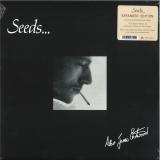
First time vinyl reissue, expanded and deluxe double gatefold 140g double vinyl, remastered audio with restored artwork and fresh liners written by Paul Hillery (Folk Funk & Trippy Troubadours)
Alan James Eastwood's glorious Seeds is a certified folk-funk lost-classic.
But who was Alan James Eastwood? He had never hit the big time and commercial success eluded him. By the mid-1970s, his musical career was pretty much over and he was almost unknown except among deep heads, amongst whom he would gain cult status.
Original copies of the 1971 vinyl release of Seeds exchange hands for high sums, if you can find one. This expanded 2LP contains an extra record, collecting 9 rare non-album singles and is presented in a gatefold sleeve complete with freshly commissioned liner notes courtesy of Paul Hillery (Folk Funk & Trippy Troubadours).
With the long overdue deluxe reissue of this prized artefact, we hope to finally shine a light on the unheralded genius of Alan James Eastwood. RIYL Nick Drake, Rodriguez, Richie Havens.
Alan James ‘Bugsy’ Eastwood was a renowned musician and singer who came to prominence in the late 1960s with The Exception, an unsung but excellent band from Birmingham. The Exception released many singles, the first featuring friend Robert Plant on tambourine, before an album, The Exceptional Exception. However, by this time, Bugsy was feeling constrained and restless; he left the band within weeks of the release.
Having vanished from the scene, he was honing a deeper, introspective edge to his songwriting. His demos found their way to the sound engineer and producer Mike Cooper at Pan Music Studios in Denmark Street. Loving what he heard, Eastwood soon entered a recording session with Cooper. The session was just Alan, his guitar and harmonica and - by all accounts - it was remarkable. With the songs, the voice and such an exceptional talent, it was hard to go wrong. Says Mike: "We had John Hawkins do the big string arrangements and Richard Hewson arranged the string quartet. We overdubbed the orchestrations on Alan's original session recordings, adding Chris Karan on tabla and various percussion. We considered re-recording the vocals but found that the magic on that original session was so exceptional overdubbing would not be as good as the atmospheric 'live' performance."
Mike and Alan viewed each track as a different entity, giving the album a diverse sonic palette. Assessing each song individually, they decided which would be suitable for each arranger. Top-flight session musicians were added to the roster to complete the sound, with Byron Lye Fook (father of musician Omar) on drums, bassist Mike Ward, Brian Pickles on marimba and jazz drummer Chris Karan on tabla and percussion. Recorded in a matter of days in Pan's small 8-track studio, they carefully added overdubs, rhythm sections and four string sessions arranged by Hawkins, with Hewson's arrangements recorded at Trident Studios.
Seeds was Alan James Eastwood's debut solo album – indeed, his only solo album - and was originally issued on President in 1971. It melded Eastwood’s impressive rock sensibilities with a folk thread to superb effect. His arresting voice - its deep, rough-hewn soulfulness - coupled with gorgeous string-drenched backing, make this a phenomenal listen. It really is a great 70s singer-songwriter record - with touches of acid-folk and folk-funk throughout.
It opens with "She's Getting Married In August", a mellow tune with Richard Hewson's strings arranged around Alan's straightforward guitar structure. Up next, the joyous, sun-dappled guitar and strings workout "Evenin' Rain" glides by before the fragile, accordion-enhanced "Les Papillons" breezes out of the speakers. The bluesy "Zeena" follows, featuring vocals and acoustic guitar and showcasing Eastwood's effortless harmonica. Starting out as a ballad, "Virgin Morn" builds with soaring strings and gospel-tinged backing vocals from Marilyn Powell and jazz singer Josephine Stahl. The A-side closes with the title track, "Seeds". With a chugging mid-tempo beat, soulful vocals and a beautiful Bacharach-esque string arrangement, it truly is stop-you-in-your-tracks spectacular.
Side B opens with "Crystal Blue", gilded by Lye Fook's marimba, lush gospel-esque backing vocals and handclaps. Eastwood's acoustic guitar begins "Lady Carole", which starts as a bluesy ballad and builds with more string arrangement, lifting the track to another height. A towering highlight of epic proportions, "Lotus Child" is a true masterpiece of arrangement. It opens with simple yet stunning do-do-dah vocal harmonies blended with John Hawkins's strings, bass lines and rhythmic beats, forming a vibe very much in conversation with the sounds coming from LA's Laurel Canyon. Next up, the heartwarming "Last Prayer", dedicated to Alan's first and last love, contains a melancholic vocal with a wistful string-drenched arrangement that would sit comfortably in a Federico Fellini score. Bringing the album to a close, "Hymn For Today" is a melodic raga with tabla, strings and a soft-psych feel. Eastwood's prophetic whisper - "I am real. At last, I am real" - profoundly hits home.
Kicking off the extra disc is the sparsely funky and country-tinged "Boston", released as the flip to the astonishing "Seeds". Next up are the two tracks that comprised Alan’s debut solo 7" single from 1968. The laconic, Bobby Charles-esque "Blackbird Charlie" evidences a real depth and charm in Eastwood's songwriting whilst the starkly brilliant flip, "My Sun", was a horizontal, atmospheric folk-tinged soundtracky precursor to his later work on Seeds.
In 1972, two further standalone singles followed. The first was the evergreen flute-driven folk-funk bomb, "Closer To The Truth", backed by the funky blues of "Strange News". The second, a deeply moving Havens-inspired "Moonchild" - rightly fawned over to this day - was flipped with "Red Shoe Truckin'", a groove-infused track. Eastwood also paired up with Marilyn Powell for a single produced by Powell's partner, Mike Cooper. Under the name Eastwood & Powell, they released their staggering rendition of "Beautiful", a rock-blues-pop song arranged by Ivor Raymonde and written by Carole King. Over on the flip, a funky Eastwood original "Opal Blue Sunday" lurked. This is not to be overlooked.
Over the years, Alan remained active on the music scene, but problems with alcohol and health complications from diabetes severely impacted his career. He spent his latter years living in London until his untimely death from heart failure on 25 October 2007, just one day before his 62nd birthday and without his music having received the real acclaim it so dearly deserved.
This deluxe reissue, spellbinding from beginning to end, should hopefully go some way to rectifying this tragic fact. Mastering for this special double vinyl edition was overseen by Be With regular Simon Francis and it was cut by the esteemed Cicely Balston at Abbey Road Studios to be pressed in the Netherlands by Record Industry. The original artwork has been lovingly brought back to life at Be With HQ, with the addition of passionately written liner notes specially for this landmark reissue by none other than Paul Hillery.

Recital releases The Holy Restaurant, the new full-length album by Derek Baron, and their first solo LP since Curtain (Recital, 2020).
The album is built from years of miniature transcriptions of improvisations, functioning in many ways as a sister to Curtain. Half-thoughts and mistakes are revisited, gilded, and illuminated. The floorboards of the album are laid with piano, organ, string pads, while serrated accruements (distortions, flourishes, and recording interferences) step and drop overhead. The resulting conflux, as Baron notes in the accompanying booklet “becomes the point and the problem to explore.”
The second track “Oven Girls” opens with us galloping on a horse in some video-game meadow on a bed of MIDI strings. Abruptly, a helicopter soars over us and we transition to a latticed guitar and woodwind exploration. The album rolls on in this fashion, juxtaposing musical half-sentences within a museum of sounds rag-picked from history and daily life. Emotional interviews with Midwestern friars who build and sell caskets are set against gothic piano and guitar duets. On “Music in the Casket,” A disorienting and hilariously epic guitar solo erupts. The penultimate titular piece, “The Holy Restaurant,” sets a text written by Baron’s grandfather. A small chorus voices his words, echoing the humanistic storytelling of “Blue” Gene Tyranny’s A Letter From Home. Under sunlit piano progressions, a fleet of smokey trumpets emerges.
Running throughout the album is a series of “traces”: short melodic phrases painted over again and again with different real and MIDI instrumentation. The “luxurious asceticism of doubling” as Baron puts it. They explain, “Part of the allure for me is that the ‘original’ material is itself kind of thin, sketchy, meaningless, maybe calling attention to itself only by way of a felicitous mistake. Hearing, transcribing, and learning what was basically only ever played first on accident becomes the guiding concern.”
The album’s shifting, variegated forms and voices pass quickly; the record feels both comforting and elusive, suitable for any hour of the day.
The Holy Restaurant features guest players Ed Atkins, Lucy Liyou, Quentin Moore, Emily Martin, Dominic Frigo, Jacob Wick, and several of Baron’s family members. It is released in a limited edition vinyl pressing of 200 copies, accompanied by a booklet of effusive program notes by the composer, alongside an assemblage of photographs, scores, and artwork.
Wild and untamed Swedish teenage heavy metal from 1981-1985. Includes their ultra rare single plus previously unreleased studio recordings. The album includes a booklet with interviews and photos documenting TRP’s wild stage shows and the local Swedish hard rock youth gangs of the 1980s. Blood splattered vinyl - limited edition of 600 copies worldwide.
The teenage boys that formed TRP came together in the small town of Fjälkinge outside of Kristianstad in southern Sweden back in 1981. In 1982 they recorded and released their legendary after single. They immediately became very popular with the local hard rock you gang’s attracting wild and rowdy crowds.
TRP performed wild and loud shows gilded by the bands furious use of pyrotechnics, smoke bombs, leather, studs and gallons of fake blood.
Their stage show combined with their music got the band banned in Sweden and it was said that they were obscene and promoted satanism.
The band didn’t let that stop them and instead they went into a studio and recorded several tracks with their new lead guitarist. However, these amazing recordings were never released...until now that is. Then in 1985 TRP performed their last show. Their final stand was heavy metal mayhem supreme and the whole stage went up in flames.
“I had welded a guitar slide with one end closed and filled it with chimney test smoke, then I screwed it to the top of the neck of the bass. It burned constantly for two songs, but the effect was cool. We spat blood, as usual, and Peter just kept firing off bombs like crazy. He managed to shoot one right up into Fredrik’s ass during a guitar solo…”
Repress on Limited Crystal Clear Vinyl and Black Vinyl to coincide with new album ‘Daylight’ release
The album was recorded at the top of an East London tower block, mixed in a beach hut on Camber Sands and gilded by Bollywood strings is already setting its sights hide and wide, but when the sound and vision encompasses panoramic electronic soul laced with a viscerally personal reaction to the mad times we’re living through, we’re in the presence of something special
Our two British protagonists are Sean Dickson, a former indie star who reinvented himself as an electronic adventurist - musician, DJ, producer – whose last album Ft. featured a stellar line-up of guest vocalists, including Yoko Ono, Fred Schneider (B- 52’s), Alan Vega, Crystal Waters (fronting ‘Testify’, which topped the US Billboard dance chart) and David McAlmont - the last, a thrilling singing sensation with an illustrious history, from indie-soul pioneers Thieves and the legendary McAlmont & Butler to purer soul and jazz recordings and a striking collaboration with minimalist composer Michael Nyman.
Black Vinyl[23,49 €]
Repress on Limited Crystal Clear Vinyl and Black Vinyl to coincide with new album ‘Daylight’ release
The album was recorded at the top of an East London tower block, mixed in a beach hut on Camber Sands and gilded by Bollywood strings is already setting its sights hide and wide, but when the sound and vision encompasses panoramic electronic soul laced with a viscerally personal reaction to the mad times we’re living through, we’re in the presence of something special
Our two British protagonists are Sean Dickson, a former indie star who reinvented himself as an electronic adventurist - musician, DJ, producer – whose last album Ft. featured a stellar line-up of guest vocalists, including Yoko Ono, Fred Schneider (B- 52’s), Alan Vega, Crystal Waters (fronting ‘Testify’, which topped the US Billboard dance chart) and David McAlmont - the last, a thrilling singing sensation with an illustrious history, from indie-soul pioneers Thieves and the legendary McAlmont & Butler to purer soul and jazz recordings and a striking collaboration with minimalist composer Michael Nyman.
It"s 2023, and even the turn of century seems a long time ago now - but oddly, Purling Hiss"s guitar-band ethos feels ever more timeless. The Hiss aren"t just a simple part of the tradition going back 50-odd years Their DNA, pulsing in waves of punk and classic radio rock, grunge and slacker, is ineffably, re-singably music - but their signature crushed guitar harmonics, fused with deep soulfulness, meld into something that cuts us with fresh heartbreak, an eternal recurrence that seems to be happening right now today, as it pours off the turntable and runs down the street. Drag On Girard, the first Purling Hiss album in six years, cruises through these states of mind and places in time. As before, but with new twists, Mike Polizze and his gang let loose with the chaos and noise implied by their name, applying high-end splatter and slow-rolling low end to eight vehicles, running the gamut from gleaming pop gems to head-cleaning epic jams before they"re done. One of the unique qualities of Drag On Girard is a specific lead-rhythm arrangement of the guitars, emitting the expected formidable roar while setting a certain type of rhythmic strut for the band. The two guitars style also trips power-pop impulses in the tunes, with sung-along harmony vocals that evoke classic collective magic and burnish the tunes one by one. Once this vibe"s established, side two turns around and stretches out with the molten flow of Purling Hiss at their very most epic; couched within loose improvisatory structures, the title track and "Shining Gilded Boulevard" play further with the yin/yang of nostalgia and truth as they trade places looking meditatively back to them old days and all their harshness and beauty.
In the musical universe of the Brazilian singer-songwriter Raphael Gimenes, wild landscapes are metaphors for unspoken feelings. The Copenhagen-based artist writes hauntingly visual, and poetically surrealistic stories, in which he can be hunted by sun-kissing jaguars, chased by thirsty horizons, become a kaleidoscope of butterflies, or turn into dream-singing birds. His 2016 debut album, "Raphael Gimenes & As Montanhas de Som", was elected the best Brazilian album of 2016 by the Dutch website Written in Music, received 5 stars on Jazzism, and was hailed as a "conceptual masterpiece" by the Japanese magazine Latina. His sophomore release, "A tongue full of suns", is co-produced by the Faroese singer-songwriter Teitur, who also features on synths. On this new album, Gimenes explores his non-Brazilian influences and his life outside of Brazil. The songs are sung in English, a language that he learned when he lived in the United States as a boy. The lyrics are inspired by the mountainous landscapes of Jotunheimen, Norway, where he goes trekking on a yearly basis. The production and the arrangements draw heavily on sounds he heard on vintage European prog rock bands, particularly Yes and PFM. The music itself does not stray far from the universe of his debut album, but the songs do take more symphonic, progressive forms, while the Brazilian rhythms are substituted by the more meditative, minimalistic tabla played by the German musician Jan Kadereit. "A tongue full of suns" also features two guitar virtuosos from Argentina and the Netherlands: Matias Arriazu and Tim Panman. The fictitious story behind the concept album is presented as a poetic short text written by Gimenes himself: "These are the last songs written by The Painter, a broken-hearted sorcerer who disappeared on a journey of self-discovery in the vast canvas of the great wild. They were found floating above the silence of an ageless rock, in a valley of slumbering glaciers. It is said that on his odyssey, he learned the hypnotic dialects of the trees, and deciphered the translucent poetry of the moon; that he unearthed ancient vestiges of rhymeless metaphors, and mastered the alchemy of cosmic verbs. It is believed that The Painter could enter the memories of rivers, interpret the dreams of birds, and that his sun-gilded tongue carried melodies that filled entire horizons. Legend says that he is now a wanderer of the infinite; a sacred secret, revealed only by the colors of the solstice alpenglow on inaccessible, rugged peaks."
- A1: He's A Rebel - The Crystals
- A2: Spanish Harlem - Ben E. King
- A3: Under The Moon Of Love - Curtis Lee
- A4: Every Breath I Take - Gene Pitney
- A5: Zip A Dee Doo Dah - Bob B. Soxx & The Blue Jeans
- A6: Anyone But You - Ruth Brown
- A7: I'm So Happy (Tra La La La La La) - The Ducanes
- A8: I Love How You Love Me - The Paris Sisters
- B1: To Know Him Is To Love Him - The Teddy Bears
- B2: World Of Tears - Johnny Nash
- B3: Puddin' N' Tain - The Alley Cats
- B4: The Basic Things - The Top Notes
- B5: Pretty Little Angel Eyes - Curtis Lee
- B6: Talk To Me, Talk To Me - Jean Du Shon
- B7: Gonna Git That Man - Connie Francis
- B8: Uptown - The Crystals
In late 1961 Spector formed Philles Records with Lester Sill, buying his mentor out the
following year. The slogan was ‘Tomorrow’s sound today’, and Phil Spector proceeded to live
up to that boast. Three-track tape machines were then state of the art, and he perfected the
method of ‘bouncing’ the tracks to get the biggest possible sound. As time went by, his ‘twominute symphonies for the kids’ would be increasingly gilded by his ‘everything but the kitchen
sink’ production including Strings, Percussion and banks of Vocals. Spector gained his
second U.S. chart-topper and his first as a Producer in 1962 with the Gene Pitney penned,
He’s A Rebel. Spector became increasingly obsessed by the production process. ‘My records
are built like a Wagnerian opera. They start simply and end with dynamic force, meaning and
purpose. I dreamed it up.’ He retired from the music business, returning only sporadically to
work with first The Beatles (their Let It Be album, plus solo LPs by George Harrison and John
Lennon), plus a handful of other artists including Dion, Cher and the Ramones.
- 1: Interference
- 2: Eolian
- 3: Supra
- 4: Penumbra I
- 5: Isochrone
- 6: Halo
- 7: Fermion
- 8: Penumbra Ii
- 9: Axion
- 10: Aurora
Smoked clear LP[25,63 €]
Robert Hampson, the indefatigable visionary behind inspirational sonic architects Loop, whose eagerly anticipated fourth LP Sonancy (Latin for “to create noise”) is the perfect document for these strange times. Dynamic, dystopian, righteously angry and unashamedly Loop-ian, it’s an album that marks a vital re-emergence for Hampson and co. Formed in South London in the mid-1980s, Loop blazed a trail with their potent mix of motorik beats and heavy guitar riffs, recording a trio of brilliant albums that set the indie charts alight before imploding in 1990 after the release of album number three, A Gilded Eternity. As critics enthused at the time, Loop were the sound of Suicide jamming with the Stooges aboard a spaceship built by Hawkwind and piloted by CAN. They were post-psychedelic, pre-shoegaze figureheads in a world of anodyne pop jangle and baggy rhythms, and even their closest contemporaries like Spacemen 3 and My Bloody Valentine didn’t plough such a distinctive furrow as theirs. Today, Loop stand as innovators in a musical world that has embraced and followed their defiantly individual sound – there are hundreds of contemporary neo-psych artists out there who arguably would not exist without Loop’s pioneering music, music that continues to evolve and grow in the most startling of ways on Sonancy.
“South Africa’s lost jazz history contains many an overlooked classic. But even within that hidden tradition, there are few albums that suffered such an unlucky fate as Spring, the monumental 1968 debut album by pianist Ibrahim Khalil Shihab, formerly Chris Schilder.
Though Shihab was only twenty-two when Spring was recorded, he was already a lynchpin of the Cape Town scene, and the album was to be his first major statement as leader and composer. It is a magnum opus gilded by the presence of the upcoming saxophonist Winston ‘Mankunku’ Ngozi, who was soon to find huge acclaim with the hit album Yakhal’ Inkomo.
Three months of touring southern Africa in 1968 honed the band to the point that this entire album was recorded within the just two hours of allocated studio time. This album was repressed just once before the master tapes were destroyed by an ignorant record company executive. While it has remained out of print since then, the album was ‘kept alive’ as an ‘add-on’ to a 1996 CD of Mankunku’s Yakhal’ Inkomo. As a result, many modern jazz lovers still incorrectly believe these five compositions come from Yakhal’ Inkomo.
With this edition of Spring, Matsuli Music corrects an historic wrong. This edition of Shihab’s stunning debut, produced with the blessing of the man himself, is the first time it has been properly available in over forty years, and the first time it has ever been available outside South Africa. Restored and presented with new liner notes by Valmont Layne, Spring can now be seen for what it is: a peerless masterwork of Cape Jazz, blessed by the presence of the great Mankunku, but truly animated by the subtle vision and original musical spirit of its creator, Ibrahim Khalil Shihab.”
• The monumental 1968 debut album by pianist Ibrahim Khalil Shihab, formerly Chris Schilder.
• Almost lost recording is back on vinyl after more than 50 years.
• Heavyweight 180g vinyl with remastered audio, inner sleeve with photographs and new notes by Valmont Layne
With his new album, Year Of The Living Dead, Vienna-born and LA-based producer John Tejada finds a blissful extended moment of balance between the new and the familiar. Anyone who’s followed his career to date, which has included four previous albums for Kompakt, outings for storied labels like Plug Research, Playhouse and Cocoon, and numerous remixes and collaborations – most recently, his Wajatta duo with actor and musician Reggie Watts – will immediately sense the warmth and eloquence that Tejada brings to his gilded, pliant techno and electro hybrids. But there’s more here, too; an explorer’s glimmer in the producer’s eye, as he gets to grips with new ways of working and being, while offering a reflective opening for the listener, something echoed in artwork by graphic designer and ‘contemplative artist’ David Grey.
“The album was started using tools I was unfamiliar with, which became an interesting exploratory process,” Tejada says. “Staying away from the obvious and having to re-learn simple things was a fun challenge.” You can hear these new creative pulsions pushing the eight tracks on Year Of The Living Dead ever-forward; the album has an unique cast, and though there are trace elements of the genres Tejada has indulged previously, he’s never quite put them together this way before. There’s the dubwise glitter sprinkled across the moody opener “The Haunting Of Earth”, the kind caresses found amongst the deftly woven textures of “Sheltered”, and the churchy melancholy, all hymnal and golden, of “Echoes Of Life”.
Year Of The Living Dead also speaks obliquely to its moment, though Tejada works this implicitly, allowing the strange circumstances of 2020 to cast their inevitable shadow without being obvious or didactic. “The production process began right before lockdown and continued through what felt like a very serious time for all of us,” he recalls. “Not being able to see or touch our loved ones made me feel we are all like ghosts. We can observe from a distance but cannot really be there. We are isolated and alone.” And yet, Year Of The Living Dead’s tenderness offers an out for that anxiety and loneliness, its intimate immensities gifting the album a redemptive and compassionate core. Compact and glistening, Year Of The Living Dead sculpts unassuming beauty.
Mit seinem neuen Album “Year Of The Living Dead“ findet der in Wien geborene und in Los Angeles lebende Produzent John Tejada die richtige Balance zwischen Neuem und Vertrautem. Wer seine bisherige Karriere verfolgt hat, seine vier Alben für Kompakt, Beiträge für Labels wie Plug Research, Playhouse und Cocoon, zahlreiche Remixe und Kollaborationen wie zuletzt das Projekt Wajatta zusammen mit dem Schauspieler und Musiker Reggie Watts, spürt sofort wieder die Wärme und Eloquenz, die Tejada in seine geschmeidigen Techno-Elektro-Hybride einbringt. Doch es geht auch noch einen Schritt weiter. Da ist dieses Aufblitzen des Entdeckers im Auge eines Produzenten, der sich mit neuen Arbeits- und Seinsweisen auseinandersetzt und dem Zuhörer gleichzeitig etwas sehr Offenes und Nachdenkliches anbietet, etwas, das im Artwork des Grafikdesigners und "kontemplativen Künstlers" David Grey nachklingt.
"Ich hatte angefangen, das Album mit mir noch unbekannten Tools zu produzieren, was sich zu einem interessanten Forschungsprozess für mich entwickelte", sagt Tejada. "Sich vom allzu Offensichtlichen zu trennen und einfache mal Dinge neu lernen zu müssen, war eine recht spaßige Herausforderung.“ Man kann diese neuen kreativen Impulse hören, die “Year Of The Living Dead“ auf einer Länge von 8 Tracks nach vorne treiben; das Album hat einen einzigartigen Ansatz, denn obwohl es Elemente der Genres gibt, denen Tejada zuvor gefrönt hat, hatte er sie doch noch nie zuvor so zusammengefügt wie hier. Da ist dieses dubbige Glitzern im atmosphärischen Opener "The Haunting Of Earth", die freundlichen Zärtlichkeiten, die man in den Texturen von "Sheltered" findet, und schließlich die heilige Melancholie im hymnischen "Echoes Of Life".
Auch “Year Of The Living Dead“ enthält Andeutungen auf die momentane Situation und erlaubt es, den seltsamen Umständen des Jahres 2020, ihren unvermeidlichen Schatten zu werfen, ohne dabei zu offensichtlich oder gar belehrend zu sein. "Der Produktionsprozess begann kurz vor dem (ersten) Lockdown und setzte sich in einer Zeit fort, die sich für uns alle als eine sehr ernste Zeit anfühlte", erinnert er sich. "Da wir nicht in der Lage waren, unsere Lieben zu sehen oder zu berühren, hatte ich das Gefühl, dass wir alle wie Geister sind. Wir können nur distanzierte Beobachter sein, aber wir können nicht wirklich anwesend sein. Wir sind isoliert und allein." Und doch scheint die Zärtlichkeit von "Year Of The Living Dead" einen Ausweg aus dieser Angst und Einsamkeit anzubieten, die grenzenlose Intimität des Albums enthält einen erlösenden und mitfühlenden Kern. Derart konsistent und schillernd formt "Year Of The Living Dead" eine unprätentiöse Schönheit.
The Gilded Palace of Sin is the first album by the country rock group the Flying Burrito Brothers, released in 1969. It continued Gram Parsons’ and Chris Hillman’s work in modern country music, fusing traditional sources like folk and country with other forms of popular music like gospel, soul, and psychedelic rock. Pressed on heavyweight 180gm black vinyl.
Sarah Davachi presents her masterpiece, Gave In Rest. Her most fully studio-recorded album ever, she collaborates with Montreal heavyweights to create an album that uses both modern minimalism and early church music as departure points.
Sarah Davachi has quickly risen in prominence since her first release five years ago, and Gave In Rest represents her highest artistic achievement. By infusing her compositional style within a predilection for medieval and Renaissance music, Davachi unearths a new realm of musical reverence, creating works both contemplative and beatific, eerie yet essentially human. Gave In Rest is a modern reading of early music, reforming sacred and secular sentiments to fit her purview and provide an exciting new way to hear the sounds that exist around us.
Between January and September of 2017, Sarah Davachi lived in flux; storing her belongings in Vancouver, she spent the summer in Europe, occasionally performing in churches and lapidariums and seeking respite from her transitional state while surrounded by such storied history. This latest album echoes that emotional state of solitude and ephemerality, reaching towards familiar musical landscapes but from oblique perspectives.
'I named each track after a particular time of day as a way of expressing my experiencing different moments of quietude, how morning and night are both independent and interconnected entities in this regard,' she says. Her titles evoke canonical phrases referring to morning or evening prayers, as well as Latin and German phrasings for metaphors about the time of day. 'From my perspective, there is a lot of loneliness on this record, and I think it is as much about beginnings as endings,' she continues. 'In a way, it's about the prospect of the unknown as it manifests alongside a very inward form of grieving—really the essence of what constitutes a period of transition.
Davachi has mined a bottomless landscape where listeners can witness music's participation in their solitudes. Gave In Rest lends a voice to her personal exploration with a firm, intuitive stance.
Tracklisting
- 1