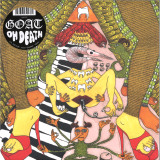
Formidable psychic warriors, channelers of the mystic and proponents of a spiritual quest that transcends this realm, Goat remain a band shrouded in mystery. Travelling from their inscrutable origins in the Swedish village of Korpilombo across the stages and festivals of the world in the last decade, this band has created their incendiary music entirely according to their own co-ordinates. With all this in mind, the casual observer might have guessed from its title that 'Requiem', their beatific and melancholic album of 2016, was to be their last. Yet the ancestral spirits summoned by their art are always restless. Thus the eternal cycles of rebirth have triumphantly produced 'Oh Death' - a ceremonial conflagration as powerful as any this band has made. Invigorated by forces we can only guess at the origins of, 'Oh Death' is a party to which all are welcome. Blithely waving away easy classification, these heat-hazed serenades are just as comfortable in the headspace of vicious '70s funk as they are in zesty ZE records post-punk. Folk-haunted incantations and free jazz skronk here find common ground, buoyed by relentless forward motion and raucous energy. Yet all of the above is locked into a delirious gnostic groove that threatens to throw the whole shebang spiralling into orbit. 'Oh Death' is driven by a supernatural charge that unifies, invigorates and transcends borders, whether geographical, musical, or between this world and the next. In the hands of these sages and soothsayers, this is just the beginning. Goat Is 'Oh Death', Long Live Goat!
Suche:goat dance
Black Vinyl[33,57 €]
Smoked Coloured Vinyl[36,09 €]
Strawberries & Cream Coloured Vinyl[28,15 €]
Raspberry Ripple Coloured Vinyl[28,15 €]
Yellow Vinyl[26,01 €]
Pink Vinyl[26,01 €]
Black Vinyl[26,01 €]
Black Vinyl[23,11 €]
Black feminist punk band Big Joanie have announced their upcoming second album 'Back Home', set for release 4th November on Daydream Library Series in the UK and Kill Rock Stars in the US. The brand new album 'Back Home' follows on from last month's one-off single 'Happier Still', and the release of their 2020 single ‘Cranes in the Sky’, a cover of Solange Knowles released on Jack White’s Third Man Records. Recorded at Hermitage Works Studios in North London, 'Back Home' was produced and mixed by Margo Broom (Goat Girl, Fat White Family) and features violin courtesy of Charlotte Valentine of the experimental art rock project No Home, who recently collaborated with the LA-based artist SASAMI. 'Back Home' is a dramatic leap forward for the band; the band build on their tightly knit, lo-fi punk formula to bring forth a collage of blazing guitars, down tempo dance punk, and melancholic strings that evoke the full depth of the band’s expansive art punk vision. The album title references a search for a place to call home, whether real or metaphysical. “We were really ruminating on the idea of a home and what it means,” explains Stephanie. “It’s about the different ideas of home, whether that’s here in the UK, back in Africa or the Caribbean, or a place that doesn’t really exist; it’s neither here nor there." The band worked with multidisciplinary artist Angelica Ellis to design the striking embroidered cover art, which is a depiction of Chardine’s nephew at the barbers. The artwork is a reference to the embroidered wall hangings popular in Caribbean homes post-Windrush that were a callback to the homes they left behind. The album’s strength lies in the band’s bold and varied new sound. Album opener ‘Cactus Tree’ is an eerie, gothic folk tale that tells the story of a woman waiting for her lover while a wall of euphoric harmonies and screaming feedback roll in the background. Lead single ‘Happier Still’ is a driving, Nirvana-influenced track that grapples with the idea of wanting to push through a depressive episode. Inspired equally by the melodic rock of Hüsker Dü and the mystical sensibilities of Stevie Nicks, closer ‘Sainted’ brings the club-ready sentiment of the 2018 single ‘Fall Asleep’ to its natural conclusion. Big Joanie live dates 2022 Sun 31st July - Liverpool International Festival @ Camp & Furnace Sat 20th August - La Route Du Rock Festival St Malo, France Sun 28th August - Greenbelt Festival, Kettering, United Kingdom Could the song splits across the sides be changed to this: Side A 1.Cactus Tree 2.Taut 3.Confident Man 4.What Are You Waiting For? 5.In My Arms 6.Your Words 7.Count to Ten Side B: 1.Happier Still 2.Insecure 3.Today 4.I Will 5.In My Arms (Reprise)6.Sainted
[l] 12. IN MY ARMS [REPRISE]
Black Vinyl[33,57 €]
Smoked Coloured Vinyl[36,09 €]
Strawberries & Cream Coloured Vinyl[28,15 €]
Raspberry Ripple Coloured Vinyl[28,15 €]
Yellow Vinyl[26,01 €]
Pink Vinyl[26,01 €]
Black Vinyl[26,01 €]
Red Vinyl[24,79 €]
Black feminist punk band Big Joanie have announced their upcoming second album 'Back Home', set for release 4th November on Daydream Library Series in the UK and Kill Rock Stars in the US. The brand new album 'Back Home' follows on from last month's one-off single 'Happier Still', and the release of their 2020 single ‘Cranes in the Sky’, a cover of Solange Knowles released on Jack White’s Third Man Records. Recorded at Hermitage Works Studios in North London, 'Back Home' was produced and mixed by Margo Broom (Goat Girl, Fat White Family) and features violin courtesy of Charlotte Valentine of the experimental art rock project No Home, who recently collaborated with the LA-based artist SASAMI. 'Back Home' is a dramatic leap forward for the band; the band build on their tightly knit, lo-fi punk formula to bring forth a collage of blazing guitars, down tempo dance punk, and melancholic strings that evoke the full depth of the band’s expansive art punk vision. The album title references a search for a place to call home, whether real or metaphysical. “We were really ruminating on the idea of a home and what it means,” explains Stephanie. “It’s about the different ideas of home, whether that’s here in the UK, back in Africa or the Caribbean, or a place that doesn’t really exist; it’s neither here nor there." The band worked with multidisciplinary artist Angelica Ellis to design the striking embroidered cover art, which is a depiction of Chardine’s nephew at the barbers. The artwork is a reference to the embroidered wall hangings popular in Caribbean homes post-Windrush that were a callback to the homes they left behind. The album’s strength lies in the band’s bold and varied new sound. Album opener ‘Cactus Tree’ is an eerie, gothic folk tale that tells the story of a woman waiting for her lover while a wall of euphoric harmonies and screaming feedback roll in the background. Lead single ‘Happier Still’ is a driving, Nirvana-influenced track that grapples with the idea of wanting to push through a depressive episode. Inspired equally by the melodic rock of Hüsker Dü and the mystical sensibilities of Stevie Nicks, closer ‘Sainted’ brings the club-ready sentiment of the 2018 single ‘Fall Asleep’ to its natural conclusion. Big Joanie live dates 2022 Sun 31st July - Liverpool International Festival @ Camp & Furnace Sat 20th August - La Route Du Rock Festival St Malo, France Sun 28th August - Greenbelt Festival, Kettering, United Kingdom Could the song splits across the sides be changed to this: Side A 1.Cactus Tree 2.Taut 3.Confident Man 4.What Are You Waiting For? 5.In My Arms 6.Your Words 7.Count to Ten Side B: 1.Happier Still 2.Insecure 3.Today 4.I Will 5.In My Arms (Reprise)6.Sainted
[l] 12 IN MY ARMS [REPRISE]
Opaque pink vinyl LP. For fans of: Tirzah, Caroline Polachek, Erika de Casier, Oklou, Smerz. Between the ages of 2 and 18, Cora Gilroy-Ware lived in a haunted place. On the outside, this small edge of Connecticut coastline was a quintessential New England town. Yet beneath its quaint surface was a netherworld that got steadily darker over the course of those sixteen years. From a serious drug problem to environmental pollution leading to deadly illnesses, frequent suicides and an above average number of fatal accidents, something about this place was cursed. Amid this world Cora was an outsider, someone who preferred pop and RnB to the music of her peers, who mostly subscribed to the dregs of a Deadhead culture that was more nihilistic than utopian. Still, she found herself on weekends drinking in the woods with the rest of them, playing along until it was time to leave. Christmas breaks and summer months were spent across the Atlantic in a completely antithetical environment. In London, the city of her birth, Cora spent her teen years taking the bus home at dawn after raves under the railroad arches, or riding the tube to her cousin’s house in Camden. For a long time, Cora’s life was composed of these two strands—ghostly East Coast suburbia and inner-city London—which she was forced to fold in and out of one another like a two-strand French braid. She quickly learned to adapt and be whoever the particular moment demanded. Her outsider status was intensified by the fact that, being of mixed Afro-Caribbean and European descent, her family didn’t look like the others in Connecticut. In the 2000s, this meant Cora had to contend with a deeply ingrained kind of folk-racism, both conscious and unconsciously expressed. Nobody talked about these things back then, and she internalized a lot of shame. The ability to shape-shift became integral to Cora’s artistic practice. Her survival mechanism at school was to carve out her own worlds through visual art and dance. Music was less of a creative outlet than a way of life, something like a form of religion for her family, who all played instruments and saw music as the form to which all art aspires. She studied violin and learned enough guitar chords to write her first songs. Cora always wanted to be a performer, but, having moved around constantly, craved stability and independence. Eager to make her own way in the world, she began to write about painting and sculpture, which eventually led to time spent working in Naples, Italy and a day job teaching the History of Art at university level. It wasn’t until 2018 that Cora first shared her first songs with the wider world. Having collaborated and played live with Jam City (Jack Latham, who has co-produced each of her releases), she finally embarked on a solo career, which for her felt inevitable, only a matter of time. Following four acclaimed EPs—Toxic Femininity (2018), Lashes in a Landfill (2019), Dreamcatcher (2020) and Maiden No More (2021), this year will see the release of her debut album The Golden Ass. For her artist name she chose, “Fauness”: a play on the Latin faunus, a woodland god with the body of a man and the horns, ears, and legs of a goat. The feminine equivalent—fauness—is a modern invention, made up by rococo sculptors in 18th century France. Cora was drawn to this pseudonym because of its temporal layers and amalgamation of beauty and beast, which, for her, captures something of her complex personal story. an utterly individual voice in underground pop music" - The FADER // "a sparkling sweet pop ride" – NYLON // “It is hard to write a perfect pop song. It’s even harder to make it look as easy as London artist Fauness” - GUARDIAN GUIDE // Tracks 01. Lonely 02. Mystery 03. Peaches 04. Hours 05. Siena 06. Grape & Grain 07. Laura 08. High 09. Cinnamon 10. Girl In The Moon
GoaTekk is a mind blowing blend of sharp breakbeat rhythms and flying Goa Trance feeling with a huge blow of Acid influence. On this 5 dancefloor killer tracks plate you will find the diverse palette of mutating genres. The opener ‘deleting_your_data313’ is a tribute to Techstep domination times: gated Reese bass with evolving trance pads goes together on the basement of classic break. Next comes the ‘digital_trance’ stomper - rolling 101 baseline, huge 4x4 kick served with 303 acidline and vocal stabs in breaks. The second side starter - minimalistic ‘primal_code’ utilizes fast 808 drum pattern alongside with ripping roaring acid lead which conquer all frequency spectrum. B2 ‘hyperplane’ is a heavy mid tempo Electro tune with long tailed pitfall and flangy 101 bass. The closing one, ‘poison_bit’ creates a dreamy soundscape where fast 160pbm Juke drum pattern interflow with gated Goa pads and melancholic 101 arpeggios. The ultimate seduction....
Los Angeles-based experimental producer Al Lover will release his new studio album ‘Cosmic Joke’ on May 27th via Fuzz Club Records.
A staple of the global psychedelic scene, Lover has spent nearly a decade fine-tuning a broken, abstracted form of electronica that pools together a tapestry of trip-hop, synthesised krautrock, dub and dark ambient. Utilising an arsenal of samples, drum machine, analogue synths and live instrumentation, Lover’s is a kaleidoscopic sound that’s J-Dilla, DJ Shadow and Lee Scratch Perry by way of Brian Eno, Kraftwerk and Kluster. Central to Lover’s music is a desire to explore the fringes of psychedelic music and the common threads that run through its far-reaching styles, drawing elements from the past and connecting them to the future. Through the years he has released a number of studio albums and beat tapes, remixed the likes of Osees and Night Beats, been resident DJ for the Levitation and Desert Daze festivals and collaborated with the likes of Goat, Anton Newcombe, Cairo Liberation Front and White Fence. Now, Lover returns with his latest studio album, ‘Cosmic Joke’ – a series of synthesised philosophical meditations on modern life, in all its tragicomic absurdity. "'Cosmic Joke' came from observing the rising, compounded absurdity in recent years and seeing structures of normalcy dissolving. It’s my attempt to view these things as part of a higher-order process, through a metaphysical lens rather than an ideological one. It’s been an exercise in holding the paradoxical relationship of comedy and tragedy, joy and pain, growth and decay, scale and decline as part of an interlocked system that, at a deep level, is essential to how we interface with the world.”
Deluxe Edition is on 180g transparent green vinyl, gatefold sleeve, printed inner-sleeve.
Los Angeles-based experimental producer Al Lover will release his new studio album ‘Cosmic Joke’ on May 27th via Fuzz Club Records.
A staple of the global psychedelic scene, Lover has spent nearly a decade fine-tuning a broken, abstracted form of electronica that pools together a tapestry of trip-hop, synthesised krautrock, dub and dark ambient. Utilising an arsenal of samples, drum machine, analogue synths and live instrumentation, Lover’s is a kaleidoscopic sound that’s J-Dilla, DJ Shadow and Lee Scratch Perry by way of Brian Eno, Kraftwerk and Kluster. Central to Lover’s music is a desire to explore the fringes of psychedelic music and the common threads that run through its far-reaching styles, drawing elements from the past and connecting them to the future. Through the years he has released a number of studio albums and beat tapes, remixed the likes of Osees and Night Beats, been resident DJ for the Levitation and Desert Daze festivals and collaborated with the likes of Goat, Anton Newcombe, Cairo Liberation Front and White Fence. Now, Lover returns with his latest studio album, ‘Cosmic Joke’ – a series of synthesised philosophical meditations on modern life, in all its tragicomic absurdity. "'Cosmic Joke' came from observing the rising, compounded absurdity in recent years and seeing structures of normalcy dissolving. It’s my attempt to view these things as part of a higher-order process, through a metaphysical lens rather than an ideological one. It’s been an exercise in holding the paradoxical relationship of comedy and tragedy, joy and pain, growth and decay, scale and decline as part of an interlocked system that, at a deep level, is essential to how we interface with the world.”
LP on white vinyl! What if a song was not a culmination but a singe, an imprint, or a crater left in the wake of creative process? On her new record "Jade", Pan Daijing composes at a different scale than that we've come to know. Since the release of her groundbreaking LP "Lack" in 2017, Daijing has expanded her operatic vision into a series of major commissioned exhibition-performances at institutions including the Tate Modern, Martin Gropius Bau, and the Haus der Kulturen der Welt. Developed for full casts of opera singers and dancers, and reaching for an all-encompassing durational experience of intensity for both performer and audience, the development of these works was for Daijing as emotionally disarming as it was thrilling. In order to continue accessing her own limits, Daijing had to develop a place of sanctuary within her own practice. Its nine tracks written and recorded over the last three years, "Jade" is the sound of solitary release and refuge, of creative self-sustenance. Written without the imperatives of direct address to performers or audience, "Jade" speaks inward, while inviting a kind of rhetorical listening. The artist draws on materials familiar from her previous work: namely, ascetic electronic textures that rumble and pierce, and voice bent in irreverent directions. In place of catharsis, however, her arrangements here linger in tension, extending curiosity towards the delicate void that nourishes extremes. They toy with the minor capacities of song: repetition, chant, observations that conclude without resolving. "Jade" comes from a vulnerable place, tender as in an undressed wound caught in the midst of healing over. Vocals, mostly Daijing's own, arrive as wordless sequences of notes soaring alongside a drone, or plain laughter, or in a few places spoken word. What is said or sung provides fragments of experience and reflection. In the process of piecing together these fragments, the listener is confronted with the tender parts of her own. "Solitude is like an immense lake you're swimming through," says Daijing of these songs. "Sometimes you dip your head in and sometimes you lift it above. On album centerpiece "Let," she speaks to us over the sound of rippling water, returning between anxious scenes to a refrain: "I take my bath in the ocean." We are not just consuming Daijing's story; we are being invited to join her in the water. The album is mixed and mastered by Rashad Becker, featuring artwork by Pan Daijing, cinematography by Dzhovani Gospodinov & design by NMR.
The fourth studio album from Melbourne’s 7-piece heavy groove combo is an abstruse journey into the darker fringes of instrumental music, drifting from funk to spiritual jazz and through to psychedelic fuzz rock.
Inspired by the catastrophic year that was 2020, the bands recording sessions were rescheduled three times due to extended Melbourne lock downs, before finally being recorded in November 2020. The album’s title, The Old World, refers to life before the onset of the pandemic which shattered 21stcentury humanity’s sense of stability and invincibility. Arcing back to the simplicities and blissful ignorance that existed before the grim onset of empty supermarket shelves, deserted streets and a world locked down.
The album begins with psychedelic-soul lament, Death of the Old Gods, before rolling into apocalyptic-dancefloor-fillers Hold Fast to the Void and Abode of the Clouds, then momentarily mellowing out on laid-back number, Never Again. Side 2 opens with Harry Cooper pt II (a tribute to the bands sax player and a follow up to part I from their 2017 album Drinking Water) before launching into brutal and fiery, The Beast, then finally closing with the epic 12 minute spiritual-jazz title-track, The Old World. The astute listener may also hear sprinkled across the album hints of Afrobeat, Free-Jazz and Stoner-Doom (yep, Stoner-Doom), along with plenty of the bands new favourite instrument, the goat bell.
Released on local Melbourne label, Northside Records, the album will be available on limited edition night-sky marbled vinyl and features cover artwork by Australian artist, Daniel Hend.
‘Bad Time’ is the new EP from Peeping Drexels. The London based 5-piece, who have been together since they were sixteen, have to date released a series of singles on the Permanent Creeps and Fierce Panda labels. This is their first release on BY Records. They've previously received support from the likes of Steve Lamacq, DIY, So Young among others. They've also performed live with artists such as Shame, Goat Girl and Public Practice.
First single, High Heels, sees Peeping Drexels eulogise about white pills and night thrills - anxious overtones abound until the crescendo of guttural angst takes over. "High Heels is a dimly lit journey through the narrow corridors and backrooms of a twisted underground club, all whilst under the influence of an unknown substance. The song is the first taste of Peeping Drexels rebirth; experimental new sounds, broader instrumentation, yet pop music to the bone. A never ending loop of bad-trip fuelled excess, and there is no way to escape."
Prior to lockdown, Peeping Drexels played a Sold Out Parallel Lines headline show at London’s Bermondsey Social Club and ended it with a sold out main support slot for Fat White Family at EartH (Evolutionary Arts Hackney).
The project takes influences from a broad musical spectrum, from the dance vibes of Gary Numan and Mr. Fingers to the intensity of Tyler The Creators' synth-heavy Cherry Bomb and the maximalist work of Kanye West.
Optimo Music presents “Janara” the new album from Italy’s José Manuel. We always have our ears open for music that is unique, powerful and that can conjure up a ritualistic atmosphere, and this meistrerwerk did all that, and then some. We knew we had to release it after the first listen.
We’ll let José tell you about it….
This album is a result of the necessity of exploring and opening my mind to new musical horizons, by testing the main traditional instrument of the Italian region Campania, whose name is “Tammorra”. It is a big drum, which must not be confused with the typical tambourine, made from a wrap of wood shaped in a circle and covered with dried skin (almost always goatskin or sheepskin). This instrument was used during playful events, especially during rituals and ceremonies, such as the frequent devotional pilgrimages in honour of the Virgin Mary. By using this instrument, the sound, the rite and the magic could take possession of the mind and the body creating a perfect union. Also, the dancers, as if they were bitten by a tarantula and possessed by a strange evil, launched themselves to an uncontrolled dance by moving every part of their body.
In addition to the Tammorra, I also inserted some texts, which have been written by some Neapolitan friends and interpreted with Neapolitans voices, in honour of the “JANARA”. The Janara represents a popular belief of the Southern Italian regions, particularly of the Benevento area. The Janara is one of the many types of witches represented by folktales belonging to the rural tradition.
The Janara was expert in medical herbs, which were also be used for her magical practices, such as the manufacturing of ointment. The ointment gave her the power to become incorporeal with the same nature as the wind. According to the tradition, in order to snatch the Janara it was necessary to grab her by the hair. It was also said that if anyone was able to capture the Janara during her incorporeal moment then Janara herself would offer protection to them and their family for seven generations, in exchange for her freedom.
With this work I hope that the listener might get carried away by the spirit of this pagan and popular legend that can be still be considered as current. As a matter of fact, the folk tales speak of a probable comeback of the Janara, who after being burned at the stake seems to be thirsting for revenge for the evil suffered.
Kristian Craig Robinson, aka Capitol K, is a multi-instrumentalist and record producer with a long history in London’s most interesting under-the-radar music places and spaces. With a musical story like his, you can expect side streams. New record ‘Birdtrapper’ is “the sound of an initiation rave in a utopian hidden village”, and his latest exploration of Mediterranean audio mythos following from ’Goatherder’ (2018). The six track mini-album was similarly formed from ritualistic improvisations performed in Malta (where Capitol K was born), using home-made flutes, reed pipe, bamboo percussion, drum machine, bass guitar, but this time features a wider use of synthesizers, with the alternative dance floor in mind. Where ‘Goatherder’ was an awakening of genetic primitivism, ‘Birdtrapper’ is an evocation of sonic bird callers, proto-rave abandon, ambient resonance and an ecstatic captive state, along with the previous work's visions of hunters, temples and scrub land music
‘Goatherder’ caused a quiet kind of quake and was beloved by The Quietus, BBCR3 and 6Music. Vinyl Factory described it as “like a series of manipulated field recordings that have an ancient, ritualistic quality … Goatherder shimmers with Balearic strangeness, rooted in an earthy outer-national dance music tradition”. For the last seven years K has been behind the consoles at the heavily influential Total Refreshment Centre, recording and mixing records with the likes of Trash Kit, The Comet Is Coming, Rozi Plain, Alabaster DePlume, Dry Cleaning, Flamingods Cykada, Ibibio Sound Machine, BAS JAN and John Johanna. It’s not just recording. He’s also become an influential if understated mentor to a new wave of producers and bands. His experience in studio environments is long and storied, including stints at Studio Plateaux on an island in the middle of the Thames and in the Royal Symphonia’s squatted rehearsal rooms. Capitol K has released seven albums and the 'Birdtapper EP' follows a legacy of influential releases on early 2000s electronica labels including Planet Mu and XL. Aside this he also runs the record label Faith & Industry. It’s a friends and family, love not money affair and he has released music by Champagne Dub, John Johanna, Super Best Friends Club, Blue House & Clémentine March.
- A1: Lotus Eater - Tripholium
- A2: Shifted - K Pop
- B1: Efdemin - Entropie
- B2: L.b. Dub Corp - Look Shiny
- C1: Rrose - The Myth Of Purity
- C2: Lucy - The Goat God
- D1: James Ruskin - From Here On
- D2: Denise Rabe - Paralysed Spheres
- E1: Zeitgeber - Double Down
- E2: Adriana Lopez - It All Adds Up
- F1: Chevel - Va Lavorar
- F2: Alessandro Adriani - Two Journeys
- F3: Serena Butler - Giubia
Stroboscopic Artefacts releases ‘X – Ten Years Of Artefacts’, a 13-track album curated by Lucy, the nom de techno of Luca Mortellaro. It celebrates ten years of his label by boldly confirming its raison d’être: a continual redefinition of modern techno.
‘X – Ten Years Of Artefacts’ is a various artists album in which the label’s key artists respond to its tenth anniversary with fresh compositions. Artists with divergent perspectives and MOs are equally at home expressing themselves. These tracks’ timbres, tempos and moods differ greatly yet—somewhat improbably—they seem together, ideologically unified.
The album will be later complemented by a special remixes EP, with four new reworks of pivotal back catalogue material from the label (Donato Dozzy, Caterina Barbieri, Xhin and Klock). And from fall 2019, Lucy and an incredible cast of Stroboscopic Artefacts artists will begin an extended club tour to mark the anniversary.
On ‘X – Ten Years Of Artefacts’, Mortellaro features solo as Lucy, in collaboration with Rrose as Lotus Eater and together with Speedy J as Zeitgeber. (Rrose also appears alone with “The Myth of Purity.”) Shifted, Efdemin, L.B. Dub Corp (Luke Slater), James Ruskin, Denise Rabe, Adriana Lopez, Chevel, Alessandro Adriani and Serena Butler each feature, representing a group of singular artists whose relationships with the label range from years to months—Stroboscopic Artefacts’ past, present and future must exist simultaneously.
Back in September 2009, Lucy released “Why Don’t You Change/Dub Man Walking,” the first record from Stroboscopic Artefacts, which began a discography that, ten years later, is almost unparalleled in its ambition and vision. Put simply, Mortellaro wanted to create something that didn’t exist. Stroboscopic Artefacts would be respectful of, and indebted to, the great techno and electronic music artists of the past but would develop new paths forward for the label and the genre. The label refused to perpetuate the established dichotomies of electronic music — between the dance floor and home listening, between club music and experimental music, between the past and the future. It took risks knowing it wouldn’t always work. But within a year or so of the label’s inception, it was obvious Stroboscopic Artefacts’ approach had captured imaginations far beyond its Berlin base, showing us that the boundaries of techno are often constructs of limited imagination.
The label pursued constantly evolving methods of releasing music. It created concept-driven series like Monad, Stellate and Totem, establishing frameworks that would give freedom in limitation. Standout albums by Lucy, Xhin, Dadub, Zeitgeber, Chevel, Kangding Ray, Lotus Eater and Alessandro Adriani were deeply considered longform presentations.
With this new album, remix EP and tour, now is the moment for Stroboscopic Artefacts to look fondly at its past while drawing breath, reenergised, and hinting at new chapters.
If you check the credits of The Rolling Stones' Goats Head Soup LP from 1973 you'll find a certain "Pascal" listed on the percussion section. That is none other than Los Angeles based artist Nicolas Pascal Raicevik (1933-1994), aka 107-34-8933, aka Head, aka Nik Pascal, aka Nik Raicevic. Besides his hitting the bongoes on the Stones album, Nik was a great artist on his own, both as a painter and as a musician. As a musician, he was a pioneer in the use of synthesizers, preceeding the Berlin school by some years when his Head LP was released on on Buddah in 1970. Buddah probably saw in Head the opportunity to cash in some money from the remains of the psychedelic scene - the three tracks on the LP are named after drugs used in the late sixties. The sounds, however, are accomplished works that show Raicevic as one of the most interesting pioneers in the use of synths. The album probably didn't do too well, since Buddah didn't renew the contract with Raicevic, who instead took his own way releasing his works on his very own Narco Records and Tapes label. Between 1968 and 1975 Narco would issue 4 LPs credited either to Nik Raicevic (Beyond The End... Eternity) or Nik Pascal (The Sixth Ear, Magnetic Web and Zero Gravity) plus one credited to 107-34-8933 (Numbers, which is in fact the same LP as Buddah's Head, albeit with different cover art). Copies of these LPs came with an ironic sticker over the shrinkwrap that read "Do not listen to this LP if you are stoned".
Magnetic Web was released in 1973. It appeared under the Nik Pascal monicker and showed a clear evolution in sound, favoured by the addition of an Arp 2600 and some rhythm boxes. It also included percussions and cymbals. The Two Headed Dog site thinks "this is his masterpiece in all of its acid-laced glory."
Besides his musical explorations, Nik was also an interesting painter. His paintings are auctioned from time to time, and are consciousness expanding works influenced by abstract cubism and surrealism, some kind of Salvador Dalí on drugs exploring the outter and inner space. All the artwork on the sleeves of his LPs is done by himself. Spacey landscapes and psychedelic colours that fit perfectly to the music they contain.
"Nik Raicevic's music is at the intersection of radical psycho-electronic weirdness and kraut kosmische music (in particular the scifi-hypno-minimal modules of Conrad Schnitzler in Grun, Rot and Blau). It presents mega epic & tripped out electronic improvisations.
"This is an absolute must for collectors and fans of visceral, neurotic soundscapes."
"As far as late-60s / early-70s American Bedroom' Electronic Music goes, these LPS have to be among the first transmissions from this sector, made all the more attractive when coupled with Raicevic's alien topographIes - the covers are high-color portrayals of Venusian lanes, knotted growths, & future-past architecture in a style you might equate with Vintage' sci-fi pulp-novel covers - & copious Downer' sentiment. This music is imbued with a sort of lonely, anti-social sensibility that's about as far as you can get from the Academic' Early Electronic vector. I will say that if the Steve Birchall, Cellutron & the Invisible, and/or Pythagoron™ seed your garden, this will likely do the same."
Never reissued before on vinyl format, the Wah Wah reissue features original sleeve artwork made of paintings and drawings by Nik himself, and reproduction of the famous ironic "Do not listen if you are stoned" sticker. Limited edition, 500 copies only.
Goatherder is the seventh album from underground London producer Kristian Craig Robinson, AKA Capitol K. This ace manipulator of audio and punk warlord of groove has crossed a tapestry of styles and approaches with his own secret compass since 1998.
Along with everything from Chinese pop to the marching band music of the United Arab Emirates in his early musical vocabulary, the influence of rave, new wave, grunge, and noise-core would collide to create a bold new sound. His early studio experiments gave birth to his debut, Sounds of the Empire (Planet Mu, 1999) built upon a heady balance of samples and live sources that placed Capitol K at the forefront of the UK's electronic scene. The follow-up, 2002's Island Row, was released via XL Records, with lead single Pillow becoming a daytime Radio 1 crossover. Nomad Junk (2005) combined Asian field recordings into a vibrant psychedelic collage, while Notes From: Life On The Wire With A Wrecking Ball (2008) paid homage to London's squats and free anarchistic artistic spaces of which K was a part for many years. Andean Dub (2012) was an exploratory South American-influenced album of heavy synth laden cumbia sound system tracks.
The last seven years have seen Capitol K's stature as a producer elevated with his establishment of the renowned Total Refreshment Studio and recording work with musicians such as the Mercury Music prize nominated The Comet Is Coming, global dance act Ibibio Sound Machine (Merge), the pan-Arabic Flamingods (Moshi Moshi), Serafina Steer and her BAS JAN project, and contemporary folk artist Rozi Plain, among many more.
This latest work was developed and recorded in his native Malta, where he built a studio in a cave (a former goat stable). K gathered bamboo instruments collected around the world, including an ancient Quecha reeded pipe (his new-found lead instrument), and various resonating vessels and percussive objects including dry fennel storks collected from Punic troglodyte sites, and atonal flutes built from fresh cut farmland reed. Ritualistic improvisations took place over a series of seasonal visits, awakening genetic memory and plant communication.
Back in London the tracks were interfaced and expanded with post-industrial machine beat and bass guitar lock down. Homage is paid to New Age synthscapes, while a Spirit Jazz overtone arrives from K's recent years as the sonic muscle behind a plethora of luminous albums born in his Total Refreshment Studio. Goatherder follows on from the 2016 collaborative incarnation LOOSE MEAT and sonically abridges 2012's Capitol K album Andean Dub.
Outside of studio production and his solo repertoire as Capitol K, Kristian has toured as guest musician with multiple bands over the last 15 years, including Brazil's Cibelle (Crammed Discs), Archie Bronson Outfit (Domino) (whom he also co-produced), and recently Du Blonde (Mute Records).
His last project, Loose Meat, was a collaborative album of poetic dance music received lots of radio play in the UK and toured across the country for a year, performing a number of festivals.
He established the Faith and Industry record label which handled his subsequent releases and through which now he releases a number of other artists that he develops and produces.



