
Suche:got some

6
Eritrean-born and Amsterdam-based singer-songwriter RIMON returns with her latest six-track effort, I Shine, U Shine. RIMON brings some rather high-profile friends along for the ride, tapping Denzel Curry for "Got My Back" and Darrell Cole for the title track. I Shine, U Shine showcases a dynamic range of sounds, from the emotional electric guitar solos on "The Morning" to the soulful saxophone backing on the Denzel-assisted "Got My Back."

Lance Ferguson is back for a killer follow-up 7" to his second volume of classic re-works and re-imaginings, Rare Groove Spectrum Vol. 2 - released on Freestyle in late January on LP, CD and digital formats.
We just couldn't resist putting this take on Pucho & His Latin Soul Brothers cover of Gladys Knight's Got Myself a Good Man on a 45. Keeping true to the source, yet somehow simultaneously sounding like no-one else, this version is 100% guaranteed to put a spring in the step of any crowd as the sun starts gradually to come out from hiding. Aside from the faithfully executed and expertly recorded drum-track, which sits pretty higher up in the mix than it's precursor, the star of this particular show comes midway through when Lance's lilting and sun-kissed guitar solo comes gliding in. If you can't move to this, even just a little bit, then you might actually be lacking a pulse. Backing things up is the undeniable latin-funk strut of Mandrill's Mango Meat. Given an instrumental work-out here with Remco Keijer's Flute and Daniel Mougerman's keys putting in work over a heavy-as-lead rhythm section, those delectable salsa-inflicted horns upping the spice levels.
Lance's work across the Rare Groove Spectrum series can often be looked on as something akin to a "live re-edit" on the originals, at times switching up sections or extending the groove. These two choice cuts however are a masterclass in subtly teasing out some of the original elements on the tracks that really make them work on a dance-floor, and bringing those to the fore while retaining 100% respect for the OG arrangements.

10
After a first amazing LP released in 2020, Mama put once again UF095 in charge, but this time, she said: « You’ve got 10 tracks to blow our mind sweetie. Use your difference to make the difference ». Same high-potential kid, no different outcome. And same singularity! Ride with UF095 and learn some good shit about weird techno, IDM and early gabber ! MTY006 brings you through one deep introspection looking for your own uniqueness: please explore yourself.
For this new Mama told ya’s LP, the fury(ous) artwork has been commissioned to french digital artist sltcamille. Her ability to tell melancholic fantasy stories let us all stand in awe. Diplomatie Studio took care of the design, mastering was entrusted to Sixbitdeep - no difference here.
No doubt that with this second Album released on the label, UFO95 shows once again that he has something more. A little ounce of digression that makes him very unmistakable.

- A1: Sampuesana - Los Dinners
- A2: La Borrachita - Junior Y Su Equipo
- A3: Paga La Cuenta Sinverguenza - Manzanita
- A4: Infinito - Hugo Blanco Y Su Arpa Viajera
- B1: El Jardinero - Manzanita Y Su Conjunto
- B2: Feito Parrandero - Los Feos
- B3: Bien Bailadido - Junior Y Su Equipo
- B4: Saturno 2000 - Los Santos
- C1: La Danza Del Mono - Lucho Gavilanes
- C2: Capricho Egipcio - Conjunto Tiupico Contreras
- C3: El Chacarero - Los Gatos Blancos
- C4: Pa Oriente Me Voy - Los Atomos De Paramonga
- D1: Alegrate - Junior Y Su Equipo
- D2: Todo Lo Tengo De Ti Menos Tu Amor - Grupo Celeste
- D3: La Fuga Del Bandido - Los Ecos
15
Analog Africa delves deep into the scene of the Mexican's sonideros (sound-system operators) to present the "Rebajada" movement they've created using locally made pitch controls, speakers and sound effects.
"In 2010, I had asked Eamon Ore-Giron - aka DJ Lengua - if he would be interested in compiling a Latin project for Analog Africa, and if so, if he had a theme in mind. He replied, “Have you ever heard of rebajada?“ The question mark above my head, together with the wall of China, must have been the only other object visible from out of space because Eamon, probably noticing I got paralysed, continued, “Rebajada in Spanish means “to reduce, to lower”. It’s basically Mexican sonideros (soundsystem operators) slowing down the beat of a Cumbia to create a much more tangible music to dance to. I’ll send you a mix I made last year and let me know what you think.“ And so he did.
That mix was called Rebajada Mota Mix and I began listening to it on a loop. Although I was not immediately hooked it was intriguing from the get-go, and so I kept listening until magic began unfolding. Slowed down music allows you enough time to hear right through it, revealing itself in ways I had rarely experienced before. Everything became more transparent and I was noticing sounds normally only perceptible by bats. A near psychedelic experience. That mysterious mix included a few Ecuadorian songs by Junior y su Equipo - aka Polibio Mayorga (a cult figure in the sonidero scene), a couple of Mexican tunes, one Colombian, and various Peruvian songs, undoubtedly the driving force behind this project.
The sonidero who brought Peruvian and Ecuadorian music to Mexico was the legendary Pablo Perea from Sonido Arco-Iris, and although his fingerprints are all over the compilation Saturno 2000, this selection of songs in rebajada is exclusive to DJ Lengua. With the exception of a few classics from Polibio Mayorga and La Sampuesana – the queen of all rebajadas – most of these songs were probably never performed as such before, let alone released.
So how did rebajada come to be? In a nutshell; Rebajada started with two families of brothers – the Pereas and the Ortegas – who travelled all over Latin America and returned to Mexico with heavy loads of records which they would sell to the various sonideros always on the lookout for new tunes. Colombian beats especially seemed to fit almost perfectly with the Mexican dance steps – but they were just a bit too fast. As a result some sonideros began experimenting with equipment, and Marco Antonio Cedillo of Sonido Imperial created a revolutionary pitching system that could slow records down to an extent other players could only dream about. And so rebajada was born . . . or so we thought.
At the same time in north of the country, in Monterrey, sonidero Gabriel Dueñez almost got electrocuted by a short circuit that nearly set his record player on fire. As a result the platter started spinning in slow motion for the rest of the party, turning Cumbia into a different affair altogether. The youngsters went crazy for it and started harassing the sonidero with requests to record cassettes for them. Reluctant at first, Dueñez finally began recording a series of pirated cassettes called “Rebajada” which included mainly Colombian cumbia and porro in slow-mo exclusively. Those tapes took the city by storm and turned rebajada into a celebrated and defiant movement of the youth.
Of course it would not be a Mexican urban legend if it didn’t include dramaturgical elements, and so for nearly 30 years, until this day and probably for ever, both cities have been arguing and claiming ownership the creation of rebajada for themselves. But sonidera Joyce Musicolor, who never has time for such trivial arguments, got straight to the point: “Rebajada, and the equipment to perform it, is from here Mexico City but it was Monterrey that popularised it.“

10
Very few artists have attempted, or succeeded, in improving the standard template for classic blues records set some 50 years ago in the golden age of Muddy Waters and Howlin’ Wolf. Buddy Guy is one of those guys that had a big influence on the development of the blues during the centuries. Damn Right, I’ve Got the Blues is the Grammy Award winning comeback album by the blues master, released in 1991. Legendary musicians like Eric Clapton, Jeff Beck, and Mark Knopfler all turn up on this album. This album put the spotlight back on Buddy Guy and deservedly so.

- A1: Ceremony
- A2: All Roads Lead To Los Angeles (Feat Jaleel Shaw)
- A3: Blaming Mercury
- A4: Window To A Shimmering World
- A5: Chemical X
- B1: A Ring On Each Finger
- B2: Kamishinjo (Feat Jacob Mann)
- B3: Inner Crooner
- B4: Wax Hands (Feat Brandee Younger)
- B5: You've Got To Pull It Up From The Ground (Feat Theo Croker)
10
"We're a bunch of outsiders who refused to be kept out," says High Pulp drummer Bobby Granfelt. "We've never had an academic approach to jazz-most of us grew up playing in DIY bands-so it was the rawness and the energy and the absolute freedom of the music that called to us in the first place." Indeed, there's something defiant, something utterly liberating about High Pulp's remarkable ANTI- Records debut, Pursuit of Ends. Drawing on punk rock, shoegaze, hip-hop, and electronic music, the band's brand of experimental jazz is both vintage and futuristic all at once, hinting at times to everything from Miles Davis and Duke Ellington to Aphex Twin and My Bloody Valentine. The songs here balance meticulous composition with visceral spontaneity, and the performances are nothing short of virtuosic, fueled by raw, ecstatic horn runs ducking and weaving their way around thick bass lines and dizzying percussion. While the Seattle-based collective is centered around a crew of six core members, they also make judicious use of a broad network of collaborators on the album, wrangling special guests like sax star Jaleel Shaw (Roy Haynes, Mingus Big Band), harpist Brandee Younger (Ravi Coltrane, The Roots), GRAMMY-nominated trumpet?er Theo Coker, and keyboardist Jacob Mann (Rufus Wainwright, Louis Cole) to help stretch the boundaries of their already-expansive sonic universe. The result is a lush, cinematic collection that's as unpredictable as it is engrossing, an urgent, exhilarating instrumental album that manages to speak to the moment without uttering a single word.

16
Ironman is the debut solo album by Wu-Tang Clan rapper Ghostface Killah, released in 1996. Produced by Wu-Tang Clan mastermind RZA, the album’s music and lyrics draw prominently on Blaxploitation films and soul samples. Many music critics have praised the album for Ghostface Killah’s imaginative lyricism and RZA’s production style, with some revering it as one of the greatest Wu-Tang solo albums of all time. The album contains Ghostface Killah’s highly praised unique up-tempo, stream-of-consciousness rhyming style, which he would go on to further utilize on his highly acclaimed second studio album Supreme Clientele. Ironman debuted at number two on the Billboard 200 and Top R&B/Hip-Hop Albums, and is certified platinum.
Although a solo album, Ironman features many Wu-Tang collaborations, with furthermore Raekwon and Cappadonna. In addition, the album features the hit “All That I Got Is You” featuring Mary J. Blige.
To celebrate the 25th anniversary of one of the greatest hip hop debuts of the 90’s, Ironman is available as a limited anniversary edition of 4000 individually numbered copies on translucent blue (LP1) and translucent red (LP2) coloured vinyl.

3
Munich’s most flexible shapeshifter comes equipped with three new weapons. Needless to mention he’s got full support of the RFR squad for his subversive revolutionary plans.
„Don’t try this at home“- a warning that has always been more of an encouragement to do forbidden things than inspire cautiousness. But basically correct, and for want of a booming club life, you better enjoy this Detroit burner with a proper car system or in an abandoned warehouse that is gettin cut into pieces by stroboscope lightning. Of course, under the correct appliance of all hygiene measures.
No, this ain’t a Trumpesque call to arms in order to charge for the Reichstag. On the contrary, it shows how any stable foundation can be undermined with a healthy dose of 90s acid. If you don’t believe it, just listen to Rakim’s „Stay in bed remix“ of „How to bring down your government“.
For the end of our adventure we are given a nice „Sidequest“. As for the reward, there’s a shiny loot box with legendary items, beautifully wrapped in trancey techno. Lovers of Aril Brikha might find some valuable treasure here.
- A1: Travis - The Beautiful Occupation
- A2: Avril Lavigne - Knockin On Heaven's Door
- A3: Paul Mccartney - Calico Skies
- A4: David Bowie - Everyone Says Hi (Metro Mix)
- A5: George Michael - The Grave
- B1: Ronan Keating - In The Ghetto
- B2: Beverly Knight - Love's In Need Of Love Today
- B3: Moby - Nearer
- B4: New Order - Vietnam
- C1: Basement Jaxx - Love Is The Answer (Feat Yellowman)
- C2: Spiritualized - Hold On (War Child Mix)
- C3: The Charlatans - You Gotta Have Peace
- C4: Beth Orton - Ooh Child
- D1: Tom Mcrae - Border Song
- D2: Billy Bragg - The Wolf Covers It's Tracks
- D3: Yusuf Islam - Peace Train
16
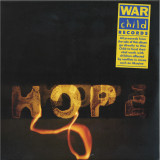
Hope was first released in partnership with The Daily Mirror in April 2003 as a response to the Iraq War, the artist community came together for War Child once more with some of the biggest names in music recording an album of exclusive tracks in just three weeks to raise vital funds to give hope to the children of Iraq. The vinyl release of Hope features alternate artwork using the original concept designed by Nick Robertson that has never been used before. Hope is part of a series of four re-releases by War Child Records making the amazing music artists have donated to the charity available on DSPs and vinyl for the first time. All proceeds from these releases will directly fund War Child’s life saving work with children affected by conflict.

2
The Hill District were a group of working musicians assembled by bassist Walter “Sonny” Hughes who following one afternoon rehearsal session together the very same evening recorded their only ever 45 outing the somewhat elusive and now sort after amongst group harmony collectors “Your Scared Of Falling In Love”. The other group members were Sonny’s brother Richard Hughes (Lead Guitar), Anthony Law (Keyboards), William M. Standard Jr (Piano), Mark Smith (Drums) and Daniel S. Lee Jr (Lead Vocals). The groups name was taken from a grouping of African American neighbourhoods in the city of Pittsburgh P.A. locally referred to as ‘The Hill’. The recording session was held under the direction of record producer and song writer James Richard Calloway (A.K.A) Rich Calloway. Calloway would go on to release “Your Scared Of Falling In Love” on his own ‘C-Way Records’ label featuring a instrumental version on the flipside. Rich Calloway hailed from Uniontown P.A. with Uniontown being known affectionately by the local black community as ‘Oniontown’ the name which Calloway adopted for his publishing company. Unfortunately for the Hill District the final mastering of their song left something be desired (a scenario we’ve now rectified with our release) and as a result local Pittsburgh Disc jockeys refused to plug their song leaving their one and only 45 outing to fade into obscurity with the group members going their own separate ways to continue their careers as session musicians with other ensembles. Producer and lyricist Rich Calloway also continued with his own C-way Productions company later composing both sides of The Cleveland Ohio group ‘The Entertains’1975 outing for Steel Town records “Love Will Turn It Around/Why Couldn’t I Believe Them”. Calloway was no stranger to Cleveland having been earlier employed by Way Out Records owner Lester Johnson to compose the lyrics to Jesse Fisher’s “Your Not Loving A Beginner”, the songs arrangement’s being originally laid down by members of the Way Out group The Soul Notes, William Bell (A.K.A Bill Spoon), John Washington and Ricki Dannison under the working title of “I’ve Been Waiting For Your Love”. Prior to the Hill’s District release Rich Calloway had penned and released a 45 single on another local Pittsburgh artist Richie Merrett. The 1973 outing You’ll Always Have Yesterday Standing By” b/w “I Gave It Up” (C-Way 103). Merritt a professional singer who performed with several groups including The Electron’s on their 1968 outing “Turn On Your Lovelight (Shock 209) recorded his first solo outing on the Nashville Deltron label “Can I Get A Rebate/It’s Never Too Late” which he later released again on his own R.A.M label followed by two early 90’s outings, the modern soul favourite’s “Where Did I Go Wrong” and “You Got Problems”. Richie still performs today doing one off shows in between his solo performances aboard 7 Day Cruise ships travelling between Los Angeles and Sant Cabos, Mexico. “You’ll Always Have Yesterday Standing By” was later produced by Walt Maddox under the shortened title of “Yesterday’s Standing By” on his own group ‘These Gents’.
Therefore Soul Junction brings you two 70’s soul/Lowrider in demanders back to back for your delectation.

11
In March 2020, Tahiti 80 had a plan to start recording their new album in the studio. That plan, of course, along with everything else in the world, got derailed. But the five-piece group was resilient and resourceful. They quickly shifted to a socially distanced plan B that included file swapping and virtual sessions, all refereed by producer Julien Vignon. The result, due for release in March 2022, is the buoyant Here With You, a collection of eleven upbeat songs that unfold like a prescription for a post-pandemic panacea.
“When lockdown in France happened, we said, 'We're not going to stay at home not doing anything,'” says singer-guitarist Xavier Boyer. “And our new plan became a hopeful thing, waking up every morning and seeing what the other guys had worked on. It wasn't always easy, but this new method allowed a freer approach where we could really go all the way with an idea without being influenced by each other’s suggestions. It must've been overwhelming for Julien, who ended up selecting all our arrangements. But he stayed positive all the way through.”
To help stay inspired and focused during their time in isolation, the band created a mood board, with the centerpiece a photo of an early '90s rave in the UK.
Boyer says, “Whenever you see pictures from this era, people seem very innocent. There are no cell phones and everybody is in to what they are experiencing. We kept that picture in mind as a kind of mantra that would help everyone feel connected to this idea of people celebrating, gathering and just having fun. We were missing the connection with people, and thought it would be great if we could create music that would inspire that kind of emotion.”
Indeed, the songs on Here With You are brimming the feeling of communion that we've all been missing over the past two years. It's there in the catchy opener Lost in the Sound, which walks the walk with Chic guitar flicks, urban nightfall sparkles and an inviting chorus (“Your heart grooves like a thousand 808s on the right time”). It's there in the Jackson 5-style syncopated bounce of “Vintage Creem,” the lush, dreamy “Breakfast in L.A.” and the panoramic sweep of “UFO.” And it's there in the first single “Hot,” which matches an irresistible groove with a neon-lit, percolating arrangement that evokes the disco clubs of 1979.
What's remarkable is that though Tahiti 80 displays a clear affection for sounds of the past, from bubble gum to '70s soul, they never trade in mere pastiche. Their take is more a slightly warped and playful carnival mirror mash-up of classic pop styles, given depth through Boyer's hang-gliding, coolly emotive vocals and lyrics that often rub against the euphoric grain of the music.
“I like to think of songs as a three-minute drama,” says Boyer. “This concept of drama definitely adds different levels to our music. There's the melody, the lyrics, then the production that can maybe emphasize or counterbalance the interaction between the yin and yang in a song.
“There's a difference between the very upbeat, sunshine-y soft rock and the lyrics, even on our past albums,” he continues. “Not dark, but a little more melancholy, and also looking for some kind of motivation, talking to yourself. Like with a lot of Motown songs, you get that feeling where you body’s dancing while your mind’s reflecting, reminiscing.”
That alluring blend of happy-sad has been a signature part of the Tahiti 80 sound from the time Boyer and bassist Pedro Resende formed the group in 1993, as students at the University of Rouen. Taking their name from a souvenir t-shirt given to Boyer's father in 1980, the duo recruited guitarist Mederic Gontier in 1994, and with the addition of drummer Sylvain Marchand a year later, the lineup was complete. The foursome released a self-produced and self-financed EP, 20 Minutes, in 1996, which resulted a record deal with French label Atmospheriques in 1998. Their full-length debut Puzzle, produced with Ivy's Andy Chase and mixed by Tore Johansson, went gold and featured the international hit “Heartbeat” that established the band throughout Europe and Asia.
In the years since, Tahiti 80 – with the additions of Raphaël Léger on drums and Hadrien Grange on keys - has released eight acclaimed albums. The band has fused what MOJO called a “glorious entente of old and new technology” (including singles like “Yellow Butterfly,” “1000 Times,” “Sound Museum,” “Crush!” and “Big Day,” which was featured on a FIFA video game soundtrack), while collaborating with such producers and arrangers as Richard Swift, Tony Lash and Richard Anthony Hewson, who famously arranged The Beatles' “Long and Winding Road.” Boyer has also put out two solo albums, the first under the anagram Axe Riverboy and the second under his name. In 2019, the band released Fear of an Acoustic Planet, a stripped-down reimagining of some of their best-loved tracks from the previous twenty years. It served not only as a look back but a reminder of their formidable songwriting skills.
Boyer is definitely a student of the timeless three-minute pop song format pioneered by '60s artists like The Beatles and The Beach Boys. He says, “I see it as kind of a frame for a painting. Most of the songs on this album, I wrote a verse, pre-chorus and chorus. There aren't many middle eights. I wanted it to be very concise. I feel like people have less attention. There's so much music. It's too easy to switch off or skip to another track, so I want to hook the listener. The three-minute song is kind of an easy code to crack, but at the same time you have to figure out a new way to tell the stories that we've heard before.”
And the stories on Here With You are very much about the longing for connection. Of the album title, Boyer says, “In the world right now, that can mean a lot of different things. Like missing our fans, missing going to concerts. In a way, it can be a statement of what happened last year, and a wish of 'I want to be here with you again.' It's our ninth album. We've had some had some very open, conceptual titles like Puzzle, Activity Center. Sometimes they were more specific like Fosbury orWallpaper for the Soul. Here with You, seems more personal, more engaging in terms of relationships. When I suggested that title, everyone in the band said, 'Yeah, that's it.'”
Until Tahiti 80 can resume a full tour schedule, Boyer says he hopes the new record will make that personal connection. “If I see from the point of view as a music fan, sometimes I see albums I like as companions throughout my life. So if we can be a part of people's existence, even if it's a song that reminds them of the time they were driving with the windows open and it was sunny. Or a sad song that resonates with them after a breakup. That's what we're all looking for when we're making music. You do this very personal thing and you want it to touch as many people as possible.”

- 1: Rock And Rolling This House
- 2: The Way She Loves A Man
- 3: A New Way To Love
- 4: Going Back To Reno
- 5: African Hunch
- 6: Just You And I
- 7: Messin' With The Blues
- 8: One More Time
- 9: Somebody Tell That Woman
- 10: Stewball
- 11: After While
- 12: Got You On My Mind
- 13: Don't Let The Music Die
- 14: Pigalle Love
- 15: I Aint Gonna Be No Monkey Man
- 16: I Got A Razor
- 17: Wish Me Well
17
Blues from Chicago to Paris pays rousing tribute to two of Chicago's
postwar blues legends, piano-pounding Memphis Slim and bass-slapping
powerhouse Willie Dixon
Focused in particular on the period when the two giants of the genre teamed up
to tour the globe during the late 1950s and early '60s, the album presents a wellrounded collection of favorite songs as well as those innovative tunes that have
inspired and influenced blues players ever since.
"Memphis Slim and Willie Dixon were a team, and their styles worked great
together," says Kenny. "Out of many other blues piano players that I've listened to,
I found a playfulness between these two men unlike the many other great blues
pianists." - Kenny Blues Boss Wayne
Legendary blues piano master Kenny "Blues Boss" Wayne was inducted into the
Boogie Woogie Piano Hall of Fame in Cincinnati, Ohio in 2017. He is recognized
by Living Blues Magazine for his six-decade career of bringing the piano back to
the front ranks of contemporary blues. This Juno Award winner, WCMA winner
and multiple Maple Blues Award winner is at the forefront of modern day blues
piano.
Advertising in Blues In Britain and RnR

11
The disjointed space between personal happiness and global sorrow is
where Smrtdeath's new album it's fine makes its home
Written and recorded during the pandemic, one of the most dramatically isolating
experiences of our lives, the album finds Smrtdeath's Mike Skwark in a
surprisingly contented state, newly coupled up and living in bliss.'It's Fine' was
produced by Matt Malpass, who Skwark calls "fucking incredible." He's a Grammynominated producer who has worked extensively with Blink 182, along with other
artists surfing across similar genre borderlines as Smrtdeath, like Trippie Redd,
Machine Gun Kelly, and 311. His bombastic approach to sound blends perfectly
with Smrtdeath's near-spiritual use of harmony.
it's fine is loaded with amazing featured artists, a who's who in the pop punk
scene. The first song recorded for the album , "Adding Up," features Blink 182's
Mark Hoppus on vocals and guitar, and his presence brings an epicness to the
track. On "Sober," it's clear that falling in love has helped him grow up—but not too
much. Skwark calls the song, which features both Lil Lotus and Lil Aaron, the
result of "an internal conversation I've been having." It balances both the
seriousness of the subject with the fun he wants to leave behind perfectly.
"I like this album the most out of anything I've done, and I want everyone to like it
the most," Skwark says. He hopes to tour the record when the pandemic allows,
with a live band. "I want to do something less familiar to everyone, something
more like, Whoa. Something where I'm larger than myself," he says.

7
"We’ve reached book IV in Rupert Clervaux’s series of “Zibaldone” audio diaries, at which point we find him telling a different kind of story.
“The first three all had very specific themes, while this one feels a little bit looser and doesn’t have just one thematic thrust,” he tells me, which maybe explains why listening feels a bit like annotating. I’m underlining, emphasizing, drawing arrows from here to there, highlighting symbols and noting motifs, realising, questioning, eureka-ing. An impressionistic meaning’s been encoded in and we’re lucky to be given the space to play that most poetic and boundless of all mental games: narrativization.
There are no wrong answers, but Rupert offers some clues either way. If there’s any cipher here it’s “something like a meditation on the concept of ‘depth’––in all its connotative forms.” Think below the surface, (the) underground, yawning oceans, being ‘down in the dirt’, soil, roots, rootlessness, pulling at the dregs, collapse, profundity, stable and unstable horizons, distance, perspective, intuition, not to mention relative opposites: to be shallow, to be above, to be beyond.
It’s got me thinking of Bresson’s “Bring things together that have as yet never been brought together and did not seem predisposed to be so.” His: “Dig deep where you are. Don't slip off elsewhere.” Rupert has realized these—two favourite goals of mine!—here.
This is music that catches you at your own periphery, gives pause, has you offering a little “huh” to, asking “I wonder why” to. Again, it’s got me musing on another mindworm, this time from New York publisher and multi-sensory reading room Dispersed Holdings: “Feeling-making-knowing feedback loop; cartography of feeling; water as text, read to know the land beneath and around it, and body as reader.”
Is it ok to offer up these other contexts out of context? I think so, because Zibaldone IV articulates a similarly swirly tone. Like, we’ve got Rebecca Solnit talking through Kropotkin’s “Mutual Aid” and later calling out to Michael Ruppert a ways away, and “Easy Rider” is playing in the wings. We’ve got Susan Sontag magically contextualizing Mariah Carey with poet Thylias Moss triangulating in order to sketch out (Rupert again) “something a little more interesting than wilful eclecticism or that laboured and patronising kind of pop-savvy.”
Are we following? Whether yes or no Vanessa Bedoret follows on with a performance of a performance of Moss’s 'Water Road’: to be once or twice removed, via strange transitions, purposeful confusions, and, suddenly, seagulls. We’re on a boat with Ingeborg Bachmann—and how I wish I could actually be! But maybe thanks to this music I can as literature, films, friends, lethargy, coincidences, little mental links, eternal wormholes, lingering notions come together to imagine something better."
Text by Natalia Panzer

10
At its essence BAIT is a band that has become a long distance relationship. For 18 months it’s lived in the cloud, with a rope around its neck. We’ve all had enough restrictions but restrictions force you to work with what you’ve got. Restrictions are precisely what BAIT needed to breathe out, sink to the bottom and propel itself back into the light of day clutching a new record.
‘Sea Change’ is the debut full-length album from BAIT. It’s a digital post-punk lockdown docu-record which watches the clock, gets the jitters, and lashes out just like the rest of us. It’s an internal monologue that accounts the anxiety, the struggles, the pressures experienced living by the sea during a global pandemic.
“This record is true to the environment it was created in, everything was developed remotely and we were forced to collaborate through isolation. I had to sing lower to avoid fucking off the neighbours…At one point I drove out to the middle of nowhere to demo some screaming parts in the driver’s seat of my car, I’m lucky I wasn’t arrested.” - Michael Webster

- A1: Hands High (Feat. Jamelle Bundy)
- A2: Fans (Feat. Large Professor)
- A3: A's & E's (This What We Do) (Feat. Marsha Ambrosius)
- B1: Lil Young
- B2: Reminds Me
- B3: Black Ice Interlude
- B4: Good Music (Feat. Posdnuos, Light & Jamelle Bundy)
- C1: Pass The Mic (Feat. Krs-One)
- C2: Over There
- C3: Round & Round (Feat. Doitall)
- D1: Ei8Ht Is Enuff
- D2: Here I Go Again (Feat. Jamelle Bundy)
- D3: Dancin' Like A W.g. (Feat. Chester French)
13
Repressed! When asked at the time about what to expect from this collaboration with Edo G, the legend Masta Ace fired back without hesitation: “People are gonna be surprised when they hear the mixture of styles. We both have a different approach. It’s like the old Reeses commercial... Ya got peanut butter walking down the street. Coming from the other direction is chocolate. Someone trips and blam, a peanut butter cup was born. Something new and amazing was created that no one had ever thought of!” When one thinks of Boston and New York, the first thing that comes to mind is the infamous Red Sox/Yankees rivalry. But this time when Boston met New York, it was a collaborative effort to bring the world one of the tightest Hip Hop efforts of 2009. Two of the game’s most exceptionally creative and well-rounded artists, Edo. G and Masta Ace brought the two cities together with Arts & Entertainment. Like their home cities, these artists have a long history and have influenced the world. Hailing from Brownsville, Brooklyn, Masta Ace got his proper introduction setting off the quintessential Juice Crew posse cut, “The Symphony.” Not long after, Edo G’s debut Life Of A Kid In The Ghetto and it’s lead single “I Got To Have It” went to the top of the Billboard Rap Singles chart with heavy rotation on Yo! MTV Raps. Both Ace and Edo have continued to stay relevant, drop albums, tour the globe, and influence up and coming artists everywhere. Joining the duo on Arts & Entertainment was a notable list of prominent artists from NYC and the Bean including Posdnuos of De La Soul, Large Professor, DJ Spinna, KRS-One, Marsha Ambrosius, Mr. Lif, Akrobatik, Chester French, Double O of Kidz in the Hall, M Phases, and more. The album continues to be a fan favorite to this day, especially the never-gets-old cuts “Little Young” and “Dancin’ Like A White Girl,” and this re-issue is sure to be well received once again.

9
The legendary Disk Union Japan and 180g present the best of today's Brazilian music!
A completely unique and beautiful album from contemporary Brazil blending soft pop, indie folk, sixties psychedelia, lo-fi and flavors of the brazilian Clube da Esquina!
- First ever vinyl release of this top album out of contemporary Brazil
- Essential solo effort from former member of Brazilian underground leaders Diesel, Udora and Transmissor
- Analog recording process
- 180g heavy vinyl, comes with download card
---
Leonardo Marques makes a kind of music that creates bucolic and romantic scenarios whose sound goes among indie folk, sixties psychedelia, lo-fi and the brazilian Clube da Esquina.
As Chicago's Dusty Groove tell us about the album:
"A really beautiful album from contemporary Brazil – but one that resonates with some of the best soft pop elements of the late 60s and early 70s! Vocals are in English and Portuguese, and the instrumentation is this fantastic blend of light elements given a really airy spin – almost as if Nick DeCaro and Sean O'Hagan got together in the studio to work on a set that has slight bossa inspirations – but is something completely unique! This is the first we've ever heard of Leonardo Marques, but we'll sure be watching out for him in the future – as he's got this way of embracing so many elements of things we love, yet never stays slavishly in their own territory – wending his way beautifully through songs that include "Ainda E Cedo", "All The Hearts", "Nao Te Escuto", "The Girl From Bainema", "Um Sopro", "In Your Arms", and "So Que Me Enfeita"."

- A1: Intro
- A2: I Know That You've Been Wounded (Church Hurt) (Church Hurt)
- A3: He'll Make A Way (Trust In The Lord) (Trust In The Lord)
- A4: Talk To God
- A5: In The Name Of Jesus (Everytime) (Everytime)
- B1: To Be Used By You (I Want To Be A Good Man) (I Want To Be A Good Man)
- B2: Who Do Men Say I Am?
- B3: Storm Of Life (Stand By Me) (Stand By Me)
- B4: In The Service Of The Lord
- B5: I Just Want To Be A Good Man (To Be Used By You) (To Be Used By You)
10
This album is a tribute to Pastor Wylie Champion, who died while we were in the process of releasing this, his first record, and his wife, Mother Champion, who died a few months earlier. We met Pastor Champion a few years ago while we were putting together another release, The Time for Peace Is Now: Gospel Music About Us. We found him in a collection of YouTube videos from the 37th Street Baptist Church in Oakland, California, put together by the pastor there, Bishop Dr. W.C. McClinton. There was quite a lot of talent in those videos, and among them was Pastor Champion whom we liked so much that we decided to make a record with him. Pastor Champion wasn’t like any other pastor you’ve ever met. As an itinerant preacher, a carpenter, and a father of five, he made a name for himself traveling up and down the California coast with his electric guitar. He traveled alone and he played alone, well into his seventies. The easiest way to describe him would be as an outsider gospel artist. Other than these bare facts, we never learned much about him—except that he was also the brother of the well-known soul singer Bettye Swann. In fact, most of what we knew about him we got from his sister’s Wikipedia page. We decided that because we met Champion through the 37th Street Baptist Church, we would record him there too. We recorded him live on a two-track Nagra reel to reel, as we wanted the album to be analog in the style of traditional gospel recordings. Over the course of two evenings (when the workday was done), Champion taught his band—musicians who had never played together before—a handful of songs, a small selection of the nearly 2,000 fragments of songs and sermons that he regularly performed. We listened in as they all got more familiar with the material and each other over time. At some point, we mentioned to Champion that he would have to be interviewed by someone to write notes for the album. He wasn’t too pleased with this idea, saying he’d had a hard life and he didn’t want to talk about it. Over the next few months, we kept asking Champion to talk to someone about his life. He told us that he didn’t want to talk about growing up in Louisiana, his mother being accosted by the Klan, or that his father was a gambler. He didn’t want to talk about being jailed for 90 days for using a whites only bathroom, being in gangs or having a street name. We told him that was fine—he could talk about what he wanted to talk about. And he told us that he didn’t want to talk about anything. You know, there are times when you make a record where it’s already made in your mind before you start. But then in the end, the record you thought you were making is not the record you made. We spent years puzzling over this one, trying to figure out what it was saying, who it was for, and how to get people to pay attention to it. But Champion knew that this record wasn’t going to be for everyone. He didn’t really care. The important part for him was just getting the message out there in the same way that he always had, travelling alone with his electric guitar. “I want to say what I mean,” he said, “be practical, precise, to the point, and, at the same time, diplomatic.” In other words, he just wanted to be a good man. God bless Pastor Champion and Mother Champion, peace be with them and their family. Love to all.

10
Back in May 2019, Vancouver trio Corner Boys released their sole album… and promptly split a few months later. In retrospect, they couldn’t have known that the album’s title (‘Waiting For 2020’) would soon seem grimly ironic - and we all know why, right? No reason to go over all that shit again. But while the past two years have at least seen drummer/songwriter Patrick McEachnie staying active across two essential records with hardcore heroes Chain Whip, lockdown saw him switching roles. Basically, he bought a guitar and made an excellent record all on his lonesome, and as followers of his other projects will have come to expect, it’s fucking excellent. ‘Glad To Be Forgotten’ is the debut album by Pack Rat - in some ways you can see some level of crossover with Corner Boys in its manic energy and dedication to hooks (cuts like ‘Next Time Hit Me’ and ‘My Own Reality’ are so damn catchy, you could be forgiven for thinking you’ve already been listening to ‘em on repeat for the past 20 years). Familiar reference points show up (the melodies of the Pointed Sticks; the garage-slanted rifferama of Rudi or The Undertones) while a tinny budget synth keeps things ticking along nicely, just to remind you that this is a homespun DIY project. But honestly, this has the feel of a fully fleshed-out project and leaves you desperate for another fix of its sweet’n’sour tang. For anyone who loves the collision point between ‘New Rose’, powerpop sunshine and sheer rock’n’roll exuberance, this is essential. For everyone else, this is surely the gateway to all of that good stuff. You want to hear the tunes that’ll star on future generations’ equivalents to the Killed By Death comps? That’ll set your pulse soaring and your pogo muscles into overdrive? That’ll remind you of why this punk rock business still feels worth dedicating your life to, even after all this time? Hey, Pack Rat’s got ‘em. Now do your part
