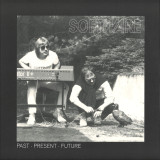
Swedish drone alchemist Mats Erlandsson is sitting in a fictional room on ‘Gyttjans Topografi’, imagining a virtual chamber orchestra using zithers, tapes, double bass, harmonium, organ, and various synthesisers to draft a treatise on alternative tuning and non-normative harmonic structures. Transcendent material.
“The music on this recording is performed by a kind of fictitious chamber ensemble situated in an imaginary room outlined by textures that alternate between gestural foreground and passive landscape. The three pieces contained within this release are tied together by sharing similar harmonic material and instrumentation and could ideally be perceived as parts of one long performance stretching through the two sides of the record. The textural room in which this musical performance operates is unreliable, unstable, constantly shifting in size and activity from sparse and open to dense and claustrophobic. Inside this non-euclidean performance space a chamber ensemble made up of zithers expanded through analog tape transposition, harmonium and organ, double bass, digital FM, feedback-convolution and Serge modular synthesizer perform a music made from justly tuned intervals arranged in a way that blurs the distinction between traditional minor and major tonal harmony in favour of harmonic progression within an essentially modal framework.
‘Oxidationstabell för Hytta A’ unfolds the harmonic material slowly in three sections where individual lines move independently initiated by the attack of the zither while the textural properties of the room shifts and shimmers. ‘Törnar’ forms a dense harmonic counterpoint where lines built from the same intervallic relationships gradually shift the balance from one spectral focal point to the next while the textural-spatial elements move under pressure and permeate the harmonic layers. The double bass heard on this piece was performed by Yair Elazar Glotman.
The whole of Side B is made up of one piece - ‘Sänka’, using a series of chords made from harmonic inversions of a single set of intervals as an anchor, or synchronisation point, for voices gliding towards, or away, from their designated goal as parts of the harmonic structure of the piece. In addition to the harmonic and textural layers previously present, a third percussive voice is present here whose rhythmic material is intimately tied to the intervallic relationships present throughout the record.
The material used to make these pieces included non-harmonic sounds and contaminated field-recordings that have gone through a sort of feedback process between digital and analog, or acoustic, processing where the recordings were edited, processed and re-amplified and recorded again in acoustic spaces to shape their character and imprint acoustic identities on the recordings. The tonal instruments were treated in a process analogous to this - harmonic material built from recordings and digitally generated synthesis recorded, transcribed, rearranged and overdubbed again with additional electronic or acoustic instruments to form a composite electroacoustic instrumental sound.
Mats Erlandsson is a composer and musician, part of the vibrantly reemerging field of drone music in Stockholm, Sweden, associated with practices characterised by the extensive use of sustained sound. Erlandsson presents his work both as a solo artist and in collaborations, most notably together with Yair Elazar Glotman and Maria W Horn.
Cerca:grad u
"The Concert" is the first discographic collaboration between percussionist Alexandre Babel and visual artist Latifa Echakhch. The record is intimately linked to the eponymous exhibition presented at the Swiss Pavilion during the 59th Venice Art Bienniale.
For her exhibition in the Swiss Pavilion, Latifa Echakhch created an orchestrated and enveloping experience, a rhythmic and spatial proposal that allowed the visitor a complete perception of time and of his own body. What is the origin of rhythm? How does the body perceive time? How does the mind rearrange it? Can we substitute one perception for another, the visual for the sound? Can fragments of memory go back in time and recreate a different story?
Her proposal entered a dialogue with the building around it, designed by Bruno Giacometti. The artist revisited its architectural programme as well as the prototypical progression of these exhibition spaces, originally defined for the display of classical art. She appropriated the entirety of the spaces, simultaneously exploring continuity, movement and sequence. Their relationship to light, and the different sounds that emerge from them. Yet the exhibition was entirely silent and the musical composition "The Concert" functions as its sound rendering, by following a similar path.
This one-sided vinyl is a complementary and inseparable partner piece to the exhibition and its eponymous catalogue, the latter having been published in April 2022 by Sternberg Press. The music features field recordings made at the Swiss Pavilion itself as well as pre-recorded percussion sounds and significant contributions by the Berlin-based musicians Jon Heilbronn, Rebecca Lenton, Theo Nabicht, Nikolaus Schlierf.
The record, available only after the closing of Latifa Echakhch’s exhibition offers a concluding phase to the project. The resonance of its sensory score. It reactivates the experience of the physical journey of the installation, without imposing itself as a transcription or an illustration. Through texture, temporality and its totality, the record stands as a resonance of the rhythms that have structured the pavilion, the harmonies that have composed it and the sounds that have inhabited it.
Latifa Echakhch Lives and works in Vevey, Switzerland. She graduated from the École nationale supérieure d’arts in Cergy-Pontoise and the École nationale des beaux-arts in Lyon. Galleries representing her include kamel mennour (Paris and London), kaufmann repetto (Milan and New York), Dvir Gallery (Tel Aviv/Brussels) and Pace (New York). She took part in the main exhibition of the Venice Biennale Arte in 2011 and was awarded the prix Marcel-Duchamp in 2013 and the Zurich Art Prize in 2015. Through her interdisciplinary installations, Latifa Echakhch is recognized for the fine balance between forcefulness and fragility of her visual language, inserting surrealist and conceptual elements, and her use of symbols that–in her own words–are both "political and poetic".
Alexandre Babel Lives and works in Berlin. He is a drummer, composer, and curator. His projects redefine the boundaries of musical convention, confounding listener expectations in the conquest of new contexts. Babel has been the artistic director of the contemporary percussion group Eklekto 2013–2022. In 2020, the monographic Festival Les Amplitudes in La Chaux-de-Fonds focused on Babel’s compositional and curatorial work. He is a laureate of the Swiss Music Prize from the Federal Office of Culture 2021.
- A1: Tymon - Server
- A2: Satronica & Lenny Dee - Call The Man - Buzz Fuzz Remix
- A3: 909 Junkies - Thirty Fucking Years
- B1: Satronica - My Kick Drum
- B2: Ape - Foreign Land
- B3: Fiend - Unseen Power
- C1: Lenny Dee Vs Malke - Fnyc
- C2: Technohead - Xtra E Edit
- C3: Berzeker - 30 Years
- D1: The Sin Project & Dj Delirium - Revolutionary
- D2: The Braindrillerz - High Grade Ganja
- D3: Art Of Fighters, Lenny Dee & Unexist - Hard Electronic
- D4: Sonico - Power Of Core
30 years after... their first record !!!!
Limited Edition RED Vinyl – 100 units Hand numbered
Omid's parents were Iranian but he spent his childhood in Putney, London. He grew up listening to rock music, and listed Jimi Hendrix, Neil Young and the Cure among his favourite artists – after Robert Smith became a fan Omid would later remix various Cure songs. He learnt to play guitar and formed a rock band, but after hearing hardcore records played on pirate music stations he began making his own tracks on basic equipment that he had bought. Beginning in 1995, his early house and techno singles were released on his own Alola and Disclosure labels under the names of 16B and Phaser, but they soon attracted the attention of big-name DJs such as Derrick Carter, François Kevorkian and Sasha, and he signed to Sven Väth's Eye Q label to release his debut album Sounds from Another Room in March 1998, which was described by the Independent on Sunday as "avant-garde" and by Muzik as "quite breathtaking".
Although he started out as a producer, Omid gradually moved into DJing, at the request of friends who asked him to play records at parties. He secured a regular spot playing the Elements club night run by Hooj Choons record label boss Red Jerry. In October 2001 Omid released The Witch/Which Equation under the alias of the Sixteen Million Dollar Man.Inspired by Prince initially releasing his Planet Earth album as a covermount with a British newspaper, Omid released his third studio album Like 3 Ears and 1 Eye (Part 1) in a similar manner as a covermount with the November 2007 issue of DJ Mag.
Omid also formed the SOS collective of DJs, consisting of him, Desyn Masiello and Demi. The trio secured a residency at London's Ministry of Sound nightclub, and were asked to produce the club's first mix CD in 2010
Easily one of the greatest roots reggae albums of all time, Soul Rebels resulted from the intensive partnership brokered by the group and maverick producer, Lee 'Scratch' Perry. It was the first Wailers 'concept' album, conceived as a long-player based on a rebellious theme, rather than a collection of isolated singles, and the presence of the Barrett brothers in the rhythm section pointed the way for greater glories to come. The Wailers first formed as an unruly five-piece in 1963, with Junior Braithwaite as lead singer and Beverley Kelso an early member, sometimes replaced by Cherry Green. During their long tenure at Studio One, Bob Marley gradually shifted to the lead vocal role and the robust core of Marley, Peter Tosh, and Neville Livingston, aka Bunny Wailer, soon emerged as the mainstays of the group. Perry was involved with the Wailers at Studio One, using their talents for backing vocals on some of his solo work, but the partnership that yielded Soul Rebels was in an entirely different league. The title track, Tosh's anguished "400 Years and "Corner Stone" are legendary for their intense power; "It's Alright" set the template for the later "Night Shift," "My Cup" was an individual barebones reading of James Brown's "I Guess I'll Have To Cry Cry Cry," while the playful "Try Me" and "No Water" are suggestive odes. Tosh's dejected "No Sympathy" and the spirited "Soul Almighty" are other winners and the "Cloud 9" revamp "Rebel's Hop" is another joy. All killer, no filler!
Lyburnum Wits End Liberation Fly was the one and only full-length album by experimental post-punk innovators, Moss Icon . Recorded in 1988, Lyburnum would not be released until 1993 - several years after Moss Icon 's demise. Originally released on Vermiforn - the esoteric noise label founded by Sam McPheeters of Born Against - the vision that Moss Icon 's Tonie Joy had for Lyburnum failed to manifest in its finished product. Of the process of preparing Lyburnum for its eventual release, Joy recalls, "My creative mind was well into its next chapter, onto an apocalyptic order referring to Joy's post- Moss Icon band, Universal Order of Armageddon . Getting Lyburnum to look like what I envisioned in my mind became an uphill battle that involved misplaced photos, misunderstood instructions by the printer, increasing apathy, and lack of advanced printing knowledge (on my part), amongst many other technical and creative issues. With a deadline near it ended up being an it-is-what-it-is situation. Some corrections were attempted for the second pressing the following year, but a further lack of coordination between various parties saw it losing even more of the original vision." Despite these challenges and shortcomings, Lyburnum Wits End Liberation was instantly cherished as a feral masterpiece - a singular entity that would become a defining influence on post-hardcore and emo in the 1990s and beyond. Nothing before sounded like this, and nothing since has quite captured the same mysterious fury. Now, finally, Moss Icon 's seminal Lyburnum Wits End Liberation Fly LP will be released exactly as it was always intended to look, sound, and feel. The artwork has been fully restored, and includes previously unpublished photos that were inadvertently missing from the original release. Brilliantly remastered by Alan Douches at West West Side Music, the vinyl has been newly cut by Bob Weston at Chicago Mastering Service, and pressed onto audiophile-grade vinyl at Record Technology Inc.
CRYSTAL CLEAR VINYL
Lyburnum Wits End Liberation Fly was the one and only full-length album by experimental post-punk innovators, Moss Icon . Recorded in 1988, Lyburnum would not be released until 1993 - several years after Moss Icon 's demise. Originally released on Vermiforn - the esoteric noise label founded by Sam McPheeters of Born Against - the vision that Moss Icon 's Tonie Joy had for Lyburnum failed to manifest in its finished product. Of the process of preparing Lyburnum for its eventual release, Joy recalls, "My creative mind was well into its next chapter, onto an apocalyptic order referring to Joy's post- Moss Icon band, Universal Order of Armageddon . Getting Lyburnum to look like what I envisioned in my mind became an uphill battle that involved misplaced photos, misunderstood instructions by the printer, increasing apathy, and lack of advanced printing knowledge (on my part), amongst many other technical and creative issues. With a deadline near it ended up being an it-is-what-it-is situation. Some corrections were attempted for the second pressing the following year, but a further lack of coordination between various parties saw it losing even more of the original vision." Despite these challenges and shortcomings, Lyburnum Wits End Liberation was instantly cherished as a feral masterpiece - a singular entity that would become a defining influence on post-hardcore and emo in the 1990s and beyond. Nothing before sounded like this, and nothing since has quite captured the same mysterious fury. Now, finally, Moss Icon 's seminal Lyburnum Wits End Liberation Fly LP will be released exactly as it was always intended to look, sound, and feel. The artwork has been fully restored, and includes previously unpublished photos that were inadvertently missing from the original release. Brilliantly remastered by Alan Douches at West West Side Music, the vinyl has been newly cut by Bob Weston at Chicago Mastering Service, and pressed onto audiophile-grade vinyl at Record Technology Inc.
- A1: Mirror (2:17)
- A2: I'm Back Sleeping Or Fucking Or Something (3:10)
- A3: The Life (2:45)
- A4: Divinity Cove (4:57)
- A5: Locket (4:34)
- B1: Kick The Can (2:49)
- B2: Lyburnum Wits End Liberation Fly (11:24)
- B3: Cricketty Rise (Haverton Road - Browns And Greens) (1:41)
- B4: As Afterwards The Words Still Ring (3:53)
- B5: Happy (Unbounded Glory) (5:20)
Crystal Clear Vinyl[31,30 €]
Lyburnum Wits End Liberation Fly was the one and only full-length album by experimental post-punk innovators, Moss Icon. Recorded in 1988, Lyburnum would not be released until 1993 several years after Moss Icon’s demise.
Originally released on Vermiforn – the esoteric noise label founded by Sam McPheeters of Born Against – the vision that Moss Icon’s Tonie Joy had for Lyburnum failed to manifest in its finished product. Of the process of preparing Lyburnum for its eventual release, Joy recalls, “My creative mind was well into its next chapter, onto an apocalyptic order referring to Joy’s post-Moss Icon band, Universal Order of Armageddon.
Getting Lyburnum to look like what I envisioned in my mind became an uphill battle that involved misplaced photos, misunderstood instructions by the printer, increasing apathy, and lack of advanced printing knowledge (on my part), amongst many other technical and creative issues.
With a deadline near it ended up being an it-is-what-it-is situation. Some corrections were attempted for the second pressing the following year, but a further lack of coordination between various parties saw it losing even more of the original vision.”
Despite these challenges and shortcomings, Lyburnum Wits End Liberation was instantly cherished as a feral masterpiece a singular entity that would become a defining influence on post-hardcore and emo in the 1990s and beyond.
Nothing before sounded like this, and nothing since has quite captured the same mysterious fury. Now, finally, Moss Icon’s seminal Lyburnum Wits End Liberation Fly LP will be released exactly as it was always intended to look, sound, and feel. The artwork has been fully restored and includes previously unpublished photos that were inadvertently missing from the original release.
Brilliantly remastered by Alan Douches at West West Side Music, the vinyl has been newly cut by Bob Weston at Chicago Mastering Service, and pressed onto audiophile-grade vinyl at Record Technology Inc.
- A1: Mirror (2:17)
- A2: I'm Back Sleeping Or Fucking Or Something (3:10)
- A3: The Life (2:45)
- A4: Divinity Cove (4:57)
- A5: Locket (4:34)
- B1: Kick The Can (2:49)
- B2: Lyburnum Wits End Liberation Fly (11:24)
- B3: Cricketty Rise (Haverton Road - Browns And Greens) (1:41)
- B4: As Afterwards The Words Still Ring (3:53)
- B5: Happy (Unbounded Glory) (5:20)
Black Vinyl[27,69 €]
Lyburnum Wits End Liberation Fly was the one and only full-length album by experimental post-punk innovators, Moss Icon. Recorded in 1988, Lyburnum would not be released until 1993 several years after Moss Icon’s demise.
Originally released on Vermiforn – the esoteric noise label founded by Sam McPheeters of Born Against – the vision that Moss Icon’s Tonie Joy had for Lyburnum failed to manifest in its finished product. Of the process of preparing Lyburnum for its eventual release, Joy recalls, “My creative mind was well into its next chapter, onto an apocalyptic order referring to Joy’s post-Moss Icon band, Universal Order of Armageddon.
Getting Lyburnum to look like what I envisioned in my mind became an uphill battle that involved misplaced photos, misunderstood instructions by the printer, increasing apathy, and lack of advanced printing knowledge (on my part), amongst many other technical and creative issues.
With a deadline near it ended up being an it-is-what-it-is situation. Some corrections were attempted for the second pressing the following year, but a further lack of coordination between various parties saw it losing even more of the original vision.”
Despite these challenges and shortcomings, Lyburnum Wits End Liberation was instantly cherished as a feral masterpiece a singular entity that would become a defining influence on post-hardcore and emo in the 1990s and beyond.
Nothing before sounded like this, and nothing since has quite captured the same mysterious fury. Now, finally, Moss Icon’s seminal Lyburnum Wits End Liberation Fly LP will be released exactly as it was always intended to look, sound, and feel. The artwork has been fully restored and includes previously unpublished photos that were inadvertently missing from the original release.
Brilliantly remastered by Alan Douches at West West Side Music, the vinyl has been newly cut by Bob Weston at Chicago Mastering Service, and pressed onto audiophile-grade vinyl at Record Technology Inc.
yellow marbled vinyl
Kicking off the release in style, ASC serves up a thunderous atmospheric amen break assault with The Arcane. A calming intro with clean breaks and swirling fx, welcome eerie keys before heavy kicks thrust the track into life with crisp weighty amens snatching your attention. The undertone bass complements the break work perfectly, and the atmosphere gradually ratchets up over a subtle backdrop of effects and pads. A true aural statement.
Dreamy synth-work, lush pads and an understated bassline punctuate State Of Mind, before the apache takes centre stage amidst mournful melodies and echoed snares, setting an unforgettably melancholic tone. A subtle but bliss love letter to yesteryear.
An impeccable, ever-building composition up next, as stabbing breaks and synths, introduce Force Majeure. A moody bassline sets the tone before 'whooshing' soundscapes flood the senses. Myriads of elements are frequently added into the mix, as the atmosphere envelopes relentlessly throughout, resulting in a production masterclass.
Closing the EP is the cleverly titled Threeform. A chilled-out treat dialling back the intensity with a luscious calming vibe over freestyle 3/4 time signature jazz breaks. Infused with relaxing brass samples and a laidback approach, ASC provides yet another example of his production skills.
Words by Chris Hayes (Spatial / Red Mist)
red marbled vinyl
Crisp beats open a serene, relaxing track in Celestial Beings. Smooth synth work fades in and the dreamy atmosphere builds and smoothly carries the listener along for a blissful ride, which Aural Imbalance fans will be well accustomed to.
Washing in with a lush pad-work intro, light analogue breaks creep in gradually over a deep brooding bassline, setting the tone for a delightful pad-laden journey through time and space.
Smooth glorious pads & light hi-hats welcome exquisite beat-work using the classic Circles break, a collage of delicate samples lightly adding to the ambient tone of the track.
Another treat for the ears with Caladan Shores, Aural Imbalance conjuring serene atmospheric vibes with graceful, elegant pads and synths complemented by that classic understated 808 bassline.
Words by Chris Hayes (Spatial / Red Mist)
Aussie composer Cat Tyson Hughes is an experimental artist whose new album Crossing Water on Past Inside The Present marks her debut long player. It comes after she's been involved with several other projects and offers a fragile and delicate mix of subtle instrumentation and rich voice textures imbued with an array of lovely field recordings. These are superbly patient and slow-burn tracks that really have a cathartic effect as nature and natural sounds permeate each composition. The melodies take your mind away as the freely structured, minimal arrangements really make you take note.
'Unconscious Collective' is the first album by PS5 - the new ensemble led by Pietro Santangelo (Nu Guinea, Slivovitz, Fitness Forever) - and it will be out for Hyperjazz Records on 21th May 2021.
It's a musical experiment where layered memories and hidden feelings resonate as if they arise directly from the most recondite part of the unconscious and produce a suspension of the stream of consciousness. With the aim to create a state of trance and override the human reason, this is an imaginary round trip across the Mediterranean Sea and the Atlantic Ocean, ideally connecting Naples with North Africa and Latin America.
The arrangements wrote by Santangelo are based on great freedom of improvisation: while the melodic textures of the two saxophones didn't give any clear references, the other musicians followed the rhythmic pulse and its unpredictable ways. The music moves naturally along an imaginary line highlighting the ancestral connection between Jamaica and Ethiopia or between Nigeria and Cuba. In the background, Naples is a synthesis of all the sonic ingredients, mixed and cooked in its own mystical and spicy belly.
Besides Santangelo himself on the tenor and soprano saxophones, the collective is made up of: Paolo Bianconcini, a brilliant Neapolitan percussionist with a very deep Afro-Cuban background; Giuseppe Giroffi, young and talented alto and baritone saxophonist; the bassist Vincenzo Lamagna and the drummer Salvatore Rainone, both loyal members of the former Santangelo's trio.
Recorded live at the Auditorium Novecento in Naples, the legendary studio of Phonotype Records, 'Unconscious Collective' is mixed in analog format by Fabrizio Piccolo, and mastered by Davide Barbarulo at his 20Hz20KHz Studio.
Pietro Santangelo
Pietro was born, lives and plays in Naples. As a saxophonist and composer, he has released five albums with Slivovitz and one with his PS3 trio (Clinamen, Emme records 2017). Graduated in Digital Sound Processing at the Faculty of Physics of Federico II University, he is involved and engaged in the Italian scene of radical improvisation (Franco Ferguson, Elio Martusciello and Officina Arti Soniche, Collettivo NISE).
Multi-instrumentalist since forever, he has collaborated with Nu Guinea, Enzo Avitabile, Fitness Forever, Marzouk Mejri, Dennis Bovell and many others.
He's also author of soundtracks and electronic musician. He appreciates analog photography, loves walking outdoors. He hates biographical notes.
FÜR FANS VON: Steel Panther, Mötley Crüe, Poison, The New Roses, Kissin' Dynamite, H.E.A.T.
Am 17. März 2023 veröffentlichen die 80er-Hair-Metaller John Diva & The Rockets Of Love ihr drittes Album „The Big Easy“. Während die Band auf
ihrer zweiten Platte „American Amadeus“ noch die Grenzen des Glam Metal auslotete, kehren die fünf Musiker auf Album Nummer drei zu dem
zurück, was sie am besten können: gradlinigem, erfrischendem Rock mit markanten Riffs, harten Beats, vielschichtigen Texten und einem Frontmann
in Bestform. Keine Schnörkel, kein Bullshit, sondern Stadionhymnen für die ganz große Bühne. Wir haben darauf gewartet und endlich ist es so weit:
JOHN DIVA is back! „Remember 80-something — we never seemed to miss a thing“. Schon die ersten Zeilen des neuen John-Diva-Songs „Back In The
Days“ vermitteln, für welches Gefühl die Band steht. Spandex-Hosen, jugendlicher Leichtsinn, Partystimmung und volle Batterien im Walkman: John
Diva & The Rockets Of Love holen die sorglosen Momente der 80er in die Gegenwart und lassen sie klingen wie den neuen heißen Scheiß. Und
können wir nicht alle ein bisschen Sorglosigkeit gebrauchen? John Diva & The Rockets Of Love stehen für fette Partys, leidenschaftliche
Bühnenshows, aber auch für liberale Botschaften in ihren Lyrics. Bullshit? Fehlanzeige. So erteilen die fünf Musiker dem Genre-üblichen Sexismus in
ihren Texten eine klare Abfuhr, zum Beispiel in Songs wie „Boys Don’t Play With Dolls“. „Bei uns ist jeder willkommen und wird wertgeschätzt“, stellt
Frontmann John Diva klar. Gut so. Denn wir können wohl alle ein bisschen Sorglosigkeit gebrauchen.
Das dritte schwarzweiße Album ist da. Mit "Insomnia? bringen Trettmann und KitschKrieg ihre Albumtrilogie zum Abschluss.
Es geht darauf um Trennung und die Liebe danach. Vor allem aber geht es um Menschlichkeit: wie wir wurden, wer wir sind,
und wie wir bleiben, wer wir waren.
Die zehn Songs auf "Insomnia? zeichnen einen Weg, der über Eskalation und die Flucht in die Abgründe der Nacht führt, den genialen Selbstbetrug des frischen Verliebtseins und Momente absoluter Klarheit, wie sie nur entstehen können, wenn davor viel Nebel war.
Die Musik trägt ihn auf dieser Reise, wie es in der Vita des ewigen Romantikers Trettmann immer der Fall war, egal ob die grad dolce war oder eher bitter schmeckte.
Sie hat ihm eine Identität gegeben und ihn gerettet, wenn es eng wurde. Die klanglichen Eckpfeiler sind dabei dieselben geblieben: der neue Flex aus USA und UK, aus Accra und Montego Bay, aus den Dancehalls in Jamaika und den Tanzhallen in Berlin.
Als explizite Referenzen aber treten sie auf "Insomnia? merklich in den Hintergrund . Insomnia? ist in dieser Hinsicht der Höhepunkt der KK-Tretti-Ära, ihr endgültiges Manifest. "Insomnia? ist echt, persönlich und vor allem menschlich.
Weil diese Musik wirklich für alle da ist.
Veils Of Transformation 1972 - 1980 is a collection of the earliest works of Gregory Kramer, one of the 20th century masters of textural electronic music. This collection is available on CD and cassette with liner notes from Gregory Kramer and Kaitlyn Aurelia Smith, who first brought this fascinating work to the attention of Important Records.
“Greg is one of the pioneers of electronic music and these pieces are unique opportunities to discover how intricate and dynamic early synthesizers are.” Kaitlyn Aurelia Smith
Kramer developed a musical language focused on continuous transformation of timbre, yielding a continuity of attention. This musical language, formed of timbral change, is a compelling aesthetic in its own right and a source of meditative experience. The four works on this album share a deep sense of order derived not from organizing pitches or rhythms, but from the evolution of timbre itself.
Gregory Kramer (b. 1952) is a pioneering electronic composer, inventor, researcher, teacher and author. In 1975 he co-founded Electronic Musicmobile, a synthesizer ensemble later renamed Electronic Musicmobile, a series of synthesizer concerts in New York from which he formed the Electronic Art Ensemble, a highly regarded all electronic quartet. His work extended to developing synthesizers and related equipment. Kramer also co-founded the not-for-profit arts organization Harvestworks in New York City. He is recognized as the founding figure of the intensely cross-disciplinary field of data sonification. Since 1980, Kramer teaches Buddhist meditation.
The four compositions collected here each represent Kramer’s unique approaches:
The structure of Meditations on 32 Parts of the Body (1978) is derived from the means of its production. Recording 5 people chanting an ancient meditation text, then layering to gradually achieve more than one million voices. The layering was all done using analogue tape recorders. The decomposition of the sound reflects the anomalies of tape machines out of sync, and the build up of artifacts from the audio tape itself, such as uneven response curves and tape hiss, are all engaged as musical materials.
Role (1972) was generated using one complex patch on a large hybrid Buchla 200/100 system. Emerging from a zeitgeist that valued pure synthesis as a combined artistic and technological research. At the time this piece was realized its as exceedingly difficult to produce electronic sounds that were internally complex.
Blue Wave (1980) is built on Kramer’s timbral development technique Veils Of Transformation which allows for disparate timbres to be woven into a continuously developing sound.
Monologue (1977) is a virtuosic performance of a massive patch on a Buchla/Electron Farm hybrid electronic instrument. Built into the patch is a pathway for continuous transformation of voice and voltage-controlled synthesizer. The blunt, raw and sometimes harsh sounds of this piece reflect an attitude prominent among composers that music can, or even should, be difficult, contrary to what’s already been done and, by all means, new.
German project founded in 1984 by Peter Mergener and Michael Weisser. This release features two cheery picked exemplary moments in downtempo contemplative cosmic travels. A side sends the listener well out of orbit with a 10 min long gradient of Krauty arpeggiated showers that grows elegantly, a concerto to the astros of the mind. Flip it and it gets better as your space capsule gets sucked into some distant planet's gravitational pull, feelings of other-worldly sounds, slowed down beautifully almost eerie nuances one won't forget so easily. Sunrise on a Balearic island from another solar system. Berlin-School by trade but also heard on mixes by Jose Padilla. Heftily remastered.
As a self-described “sponge for club music”, London-based Bristol transplant Ian DPM has cut a singular figure in both the West Country and the capital in just a handful of years. Already situated as the tastemaker behind music curation platform Definite Party Material, co-owner of Scuffed Recordings, and Noods Radio and Rinse FM resident, Ian DPM’s emergence as a producer has marked him as an expansively curious, bass-forward figure at the bleeding edge of genre boundaries.
After retreating to his hometown of Portsmouth during lockdown to absorb the blueprints of ‘90s techno, Ian emerged with a new phase of experimentation: techno-inspired and indebted, yet eschewing loops and grids for a loose-limbed, open minded engagement of the form.
Taking inspiration from the iconic carnival rides that are inseparable from their high-octane happy hardcore soundtrack, “One For The Waltzers” begins with a distant rumble of muffled breakbeats that inch ever closer. But rather than dizzying lights and in-the-red maximalism, “One For The Waltzers” gradually reveals its knowingly deep shimmy and groove. It is a drum-heavy and rhythmic production, masterfully using negative space to showcase every contour of its slowed-down rave horns and acid house synth lines.
“KE01” inhabits the flipside of the same sonic world “One For The Waltzers”. Here, feverish percussive energy contrasts against pensive melodic synth chords. It’s a heady warehouse affair, familiar and complex, referential yet contemporary, and only adds to the momentum that Ian DPM is gathering.
Dismantling the acoustic to feed the electronic, Editions Mego presents Telepath, the new album by Material Object. Born out of a single improvised recording session with a lone Violinist, Telepath is a startling album of future electronic music, resulting in an LP of unique and timeless tracks that reimagine a classic sound for an endless future.
Boldly departing from his previous canon of largely 'ambient' work, Material Object's Telepath renders itself out as something much stranger, something more spacious, more subtle and gradual. Moments of bouncing minimalism meet moirés of delayed pure tones phasing in and out of resolution, giving way to a series of strobing foreground gestures arranged and offset in disorienting landscapes which scatter themselves asymmetrically amongst crystal pools of reverb.
Revelling in the creative dismemberment of the original source material, Material Object slowly and patiently induces the violin to undergo every category of torsion, pressure and rupture. Its vivid acoustic qualities pass over and across the event horizon of the digital domain. Shattering then crystallising into points and coordinates, intersections, disjunctions, planes and reverberant figures. An uncanny geometry perceived only between the ears, at once dissolving and reconstructing itself.
Not to be missed here is the essential, but bonus only, add-on (available with all Bandcamp purchases) "Auxiliary Apparition", a hallucinatory expanse that traverses the same liminal geography as the LP proper but as some refracted, ghostly counterpoint. More nocturnal, overpowering phantasms looming out of a droning noise floor before fading away. A hypnotic and time-dilated recapitulation of what's gone before as if looking back from beyond a mirror. When it finally resolves in the closing moments and returns you home, you realise you haven't really moved at all.
Equally abstract, haunting and daring, Material Object’s Telepath is a singular work that abandons all notions of genre. Erupting with a tension of opposites that unfolds as a truly unique story, told in four dimensions and draped in deafening colour.