Zru Vogue is a two man post punk avant-pop group from Palo Alto, California, combining the talents of Andrew Finkle and Rick Cuevas.
The band began in 1980 as a four member group: Rick, Andy, Tom Sanders and Nancy Miller. Tom and Nancy left the group shortly after the first single, "Nakweda Dream", was released by independent San Francisco label Adolescent Records in February 1981. Inspired by rave reviews and heavy airplay on alternative radio stations, Andy and Rick went back into the studio, now as a duo, to record some new ZRU tracks.
The self-tilted LP was released on the band’s Zero Risk Records in 1982. It contains eight compositions blending African tribal and Middle Eastern rhythms, avant-garde rock, minimal electronics, and funk-rock guitars.
The duo’s sound is inspired by the art and anti-art movements of Dada and Surrealism. All songs have been remastered by George Horn at Fantasy Studios. Each copy is housed in a replica of the original jacket, which features artwork by the group members, and includes the original 2-sided lyric sheet.
Cerca:group a d
L’Illustration Musicale, Sonimage, Técipress-In Editions (Timing), Musax, Freesound,
Montparnasse 2000 in France but also De Wolfe and Chappell in England, every of these
sound illustration labels have in common to bring out as a legendary spectre the name of Jacky
Giordano and his aliases. Widespread practice in the library music world, Joachim Sherylee,
chosen for the In Motion album, is one of his plentiful aliases (with José Pharos, Jacky
Nodaro, Gruppo Sounds, Rubba...) used by the french composer, that we regain as well for
Black Devil with Bernard Fèvre or even for the Shifters with Yan Tregger.
For his enthronement on the mythical English label De Wolfe, it's under the obscure name of
the Rubba collective that Jacky Giordano aka Joachim Sherylee sneaked in the londonian De
Wolfe studios with the companionship of British colleagues such as John Hyde (aka John
Saunders, James Harrington, Astral sounds or even Wozo) and his wife Monice Hyde (aka
Monica Beale), Alan Howe (aka John Collins), Robert Poole and Tim Broughton.
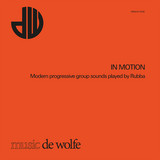
Published in 1980, the In Motion: Modern Progressive Group Sounds Played By Rubba LP
and its minimalistic and utilitarian red record cover which contains 13 tracks, mainly composed
by Joachim "Giordano" Sherylee and was never reissued since then. This record became cult
over time; it will have taken that the Hip-Hop world seizes it in order to dig out from the
disregarded and underestimated musical gems graveyard. First of all with beatmaker Madlib
and Freddie Gibbs in 2011 with the track “Thuggin'”, in which he sampled the track “Way Star”,
also used more recently by Mil and the rapper Westside Gunn on his track “Brains Flew” by
(1964 Version).
Nearly 40 years after, the Farfalla Records label, after publishing Timing Archives, presents
another aspect more progressive and psychedelic of the multi-faceted composer Jacky
Giordano by fully reissuing at last this coveted, mysterious and mesmerizing "Rubba". Very
desired by crate-diggers, In Motion appears in the want-list of plenty enthusiasts in this
enigmatic world of the library music. (Erwann Pacaud)
"a kind of Radiophonic Workshop Rebel Alliance…" - The Quietus
Modern music concrete quartet Langham Research Centre follow-up their debut album, Tape Works, Vol. 1 with a short EP of remixes, also on nonclassical. Remixes come from a fan of theirs – experimental veteran Jim O'Rourke – and Berlin-based industrial duo group A.
On Side A, Jim O'Rourke uses 'Quasar Melodics' as his source material, transforming fizzing grains of sound into an oceanic swirl of noise. On the flip, group A find metallic rhythms and eerie melancholy in 'Perpetual Motion'.
On 7" and digital, the EP has gained radio play on BBC's Late Junction.
Super dope and classic '88 double A side 7" release by Kev-E-Kev & Ak-B with 'Listen To The Man' on side A and 'Keep On Doin' on Side B (both tracks one record).
This release is sanctioned by the group and has never been released in this format before, with a nod to the original release label design by Mr Krum.
“Ta Da” is the debut full length from J. McFarlane Reality Guest, the collective name for the trio headed by the eponymous McFarlane. As a member of the group Twerps, McFarlane has traversed guitar-centric, melodic pop music for some years while honing a highly unique, personal musical language. Ta Da is the first recorded unveiling of McFarlane’s affecting, oblique songwriting panache. Originally released in her native Australia on Hobbies Galore, Ta Da will be released worldwide by Night School in June 2019.
Wheezing into view with a troubled reed instrument set against a s of whoozy synth lines, Human Tissue Act is a foggy curtain the listener is invited to peel back. The dissonant notes are left to dance entwined, with clarinet heralding a Harry Partch-esque mallet percussion interlude. It’s a mood. With no resolution in sight, an audience dragged closer into uncertainty is suddenly drenched with the light of inter-weaving wah wah synth and saxophone. I Am A Toy introduces us to McFarlane’s vocal, an effortless and matter-of-fact, accented statement that quietly takes the reins. While McFarlane’s previous work in Twerps might reference 80s UK and antipodean guitar pop, Ta Da showcases a different influences immersed in psychedelic music and synths. It’s a brilliant, deft concoction swimming in Young Marble Giants-type minimalism washed with bare pop and harmony similar to Kevin Ayers making sense of a Melbourne suburb full of faces half-recognised in the blanching sun.
What Has He Bought begins with a Casio-keyboard rhythm pattern, palm-muted guitars and immaculately enunciated vocal give way to a burnt melodica part that elevates the spirits. Simple patterns repeated, like a well-tempered pop song that does what it needs to do and no more, build into the sound of summer leaking orange juice. They’re moments of joy, layered on top of each other like a melting cake. Do You Like What I’m Sayin’ recalls Marine Girls covering a classic ‘66 Garage nugget, organ lines fighting funk with guitar chords played just behind the percussion. “In a talking world, meanings are the same. Words want to hold on to the people they contain. Do you like what I’m sayin’?” We’re in a Beckett play perhaps, obtuse absurdities rendered pretty. Alien Ceremony is a heart-melter, given a melancholic timbre by bowed double bass it’s a tragi-comic piece that almost reeks of Robert Wyatt at his mid-whimsical twisting a fugue completely out of shape. Beneath the layers of harmony and twinkling instrumentation you sense there’s a genuine sadness somewhere even if it remains veiled.
Through out Ta Da, McFarlane plays with counterpoint and contrast to sometimes delirious effect. On Your Torturer, a simple, upbeat chord progression is hard panned, underpinning a flute solo which seems out of place, hence making it completely in place on this warmly surreal album. My Enemy is a slowly swinging eulogy to a failed relationship punctuated by analogue synth burbles, with our protagonist simply asking, in the aftermath, “can we be nice?” Here McFarlane’s vocal is straight forward, lyrically conversational but still not completely in focus, a surreal kitchen sink drama filtered through a dream where everything is in the wrong place. It’s a fine precursor to Heartburn, which similarly borrows BBC Radiophonic Workshop-style noise synths and the use of space to carve up the simple “You Will Make My Heart Burn” line. At this point, the listener has been in such close proximity to McFarlane’s show, the reality guest in a performance where they’re the sole audience member, that when Where Are You My Love rises on the horizon as a sleepy, psychedelic send off it’s uplifting. The vocal drifts away into the sunset, simple and direct. It leaves the listener slightly confused, perhaps, but grateful for the gentle surprise.
- A1: Bees Around The Lime Tree
- A2: Memory Gore
- A3: Confession Bay
- A4: It`s A Low
- A5: Decompression
- A6: Carcass
- B1: The Golden Bough
- B2: Palm Hex Arndale Chins
- B3: Babes Of The Plague
- B4: Four Bibles
LIME W/ SMOKE Vinyl[20,97 €]
Coming out of London and the South West of England, Hey Colossus are one of Europe's great live bands. Since 2003 the 6-piece has been driving around the continent with their “pirate ship” backline of broken amps and triple-guitar drang, elevating audiences in every type of venue imaginable; a doctor’s waiting room in Salford, an industrial unit in Liege and a vast field next to a river in Portugal. Wherever they may roam.
Four Bibles is their twelfth studio album and the first to be released by London label ALTER, whose sole proprietor (the electronic producer Helm) encountered the group at their first gig in 2003. Recorded by Ben Turner at Space Wolf Studios in Somerset, it's their most direct album yet and follows a well-documented trajectory of evolution that began (in the truest sense) with 2011’s RRR for Riot Season and continued across three albums for Rocket Recordings. Lead vocalist Paul Sykes sounds more in focus than before, dialling down the effects and using reverb / delay to carry his lyrics rather than smother. The band has also fine-tuned to leave some room for extra depth. Piano, electronics and violin (by Daniel O'Sullivan of This is not This Heat / Grumbling Fur) all find a way in amongst a familiar mesh of interlacing guitars, wrapped round a taut rhythm section. Like every other Hey Colossus record before, the line-up has altered and the sounds reflect this.
From the weight of “Memory Gore”, to the subtlety and swag of “It's a Low”, via the sonic extremes of “Palm Hex/Arndale Chins” this is exactly as the band are live; raging & rail-roading but somehow in control. Grooves for those who want to dance or for those who want to hug a wall and nod...bleak dystopian imagery submerged in relentless rhythms and low-end rattle. The songs breath life and soul - Hey Colossus have never sounded fresher or more on point.
- A1: Tidal Wave
- B1: Tidal Wave (Instrumental)
- A2: Tidal Wave (Boot Remix)
- A3: Tidal Wave (Nasa Remix)
- A4: Tidal Wave (R.e.d.a. Remix)
- A5: Tidal Wave (Lex Boogie Remix)
- B2: Tidal Wave (Boot Remix Instrumental)
- B3: Tidal Wave (Nasa Remix Instrumental)
- B4: Tidal Wave (R.e.d.a. Remix Instrumental)
- B5: Tidal Wave (Lex Boogie Remix Instrumental)
- B6: Fool\'S Gold (Feat. J Lawson)
Claiming Montreal as his new home town, Brussels-born Senz Beats has been building an impressive body of work with underground veterans from both coasts of the US (Dave Dub, Megabusive, Lex Boogie From the Bronx..) and beyond. Cappo, Nottingham's very own veteran MC, needs no introduction having already made waves at home and abroad with his impeccable string of solo albums as well as his work with the Nottingham super group VVV.
Here, Senz Beats and Cappo join forces to present a stark reminder of where humanity is headed if we continue to place our values in capitalist ideals. The raw, driving energy of the beat offers the perfect backdrop for Cappo to deliver his warning to those caught up in the materialistic rat-race: the tidal wave is close approaching.
4 experts in their field offer up remixes of this epic track. Boot Records very own Jazz-T (Jehst, Lee Scott, J-Zone...), ex-Def Jux engineer and artist Uncommon Nasa (Vast Aire, Aesop Rock, Mr. Lif...), Lex Boogie From The Bronx (Marq Spekt, Rass Kass, Vordul Mega...), and R.E.D.A. (Insight, Main Flow, M. Sayyid...) each give this track their own distinctive flavour to devastating effect.
Lastly, on the bonus track Fool's Gold, J Lawson echos Cappo's Tidal Wave warnings concerning lusting after riches at the expense of everything else, also produced by Senz Beats. One of the few remaining songs from over 2 years of collaboration roughly 10 years ago, this song has stood the test of time and is ready and eager to be presented to the world.
[a] 1. Tidal Wave [clip]
[f] 6. Tidal Wave (Instrumental) [clip]
Vanishing Twin is songwriter, singer and multi-instrumentalist Cathy Lucas, drummer Valentina Magaletti, bassist Susumu Mukai, synth/guitar player Phil MFU and visual artist/film maker Elliott Arndt on flute and percussion; and on this album they have made their first artistic statement for the ages.
Some of its great power comes from liberation. The album was produced by Lucas in a number of non-standard, non-studio settings. 'KRK (At Home In Strange Places)' summons up the spirit of Sun Ra's Lanquidity and Broadcast And The Focus Group Investigate Witch Cults Of The Radio was simply recorded on an iPhone during a live set which crackled with psychic connectivity on the Croatian island of Krk.
The magical Morricone-esque lounge of 'You Are Not an Island', the blissed-out Jean-Claude Vannier style arrangement of 'Invisible World' and burbling sci fi funk ode to a 1972 cult French animation, 'Plane`te Sauvage', were all recorded in nighttime sessions in an abandoned mill in Sudbury. The only two outsiders to work on the recording were '6th member' and engineer Syd Kemp and trusted friend Malcolm Catto, band leader of the spiritual jazz/future funk outfit The Heliocentrics, who mixed seven of the tracks (with Lucas taking care of the other three).
Vanishing Twin formed in 2015 - their first LP, Choose Your Own Adventure, which came out on Soundway in 2016; followed by the darker, more abstract, mostly instrumental Dream By Numbers EP in 2017. The band explored their more experimental tendencies on the Magic And Machines tape released by Blank Editions in 2018, an improvised session recorded in the dead of night, offering a glimpse into their practice of deep listening, near band telepathy, and ritually improvised sound making. These sessions formed the basis of The Age Of Immunology.
Over the years, Claremont 56 has played host to some memorable collaborative
projects, most notably Bison, an unlikely super-group whose members included
Holgar Czukay, Ursula Kloss, Liquid Liquid’s Sal Principato, Ben Smith and label
boss Paul ‘Mudd’ Murphy. Now Murphy is at the helm of another collaborative
outft, Hillside, whose seductive debut single contains two deliciously pie eyed
instrumental workouts.
Hillside is very much a family affair, with Murphy joining forces with two old
friends: bassist/guitarist Alex Searle and percussionist Patrick Dawes. The trio
has a collaborative history that stretches right back to Murphy’s time in Akwaaba
in the mid nineties. For their debut outing, Hillside has also welcomed a very
special guest musician: award-winning jazz violinist and long-time Bert Jasch
collaborator Mike Piggott.
As opening gambits go, “Hidden Port” is an emphatic statement of intent. The
audio equivalent of sailing slowly around a cluster of sun-baked islands in
search of shelter from an approaching storm, the track sees Searle wrap bluesy,
Peter Green style guitar passages around a shuffing, Latin-tinged groove rich
in Dawes’ distinctive percussion patterns and Murphy’s languid electric piano
and synthesizer lines. As the track progresses, Piggott steps up to make his
mark, with his undulating electric violin lines complimenting Hillside’s impeccable
instrumentation while adding extra emotional weight to proceedings. It’s a
stunning beginning to the Hillside story.
Piggott also makes a big impression on accompanying cut “The King’s Tun”,
delivering fuid and energy-packed solos that weave in and out of a bright
and breezy instrumental track rich in jangling acoustic guitars, subtly spacey
electronics, freside-warm bass and more sparse-but-intricate percussion
courtesy of the effervescent Dawes. Searle’s eyes-closed, rock style guitar solos
cap another memorable excursion from Claremont 56’s latest in-house band.
Influenced by the social and political climate of the modern
world, MOTSA’s debut album, ‘Perspectives’, is inspired by his
acute awareness of modern society’s dependence on
technology and the social media bubble also responsible for
the civic polarisation seen globally. The 11 track album takes
the listener on an emotional journey with dark, yet hopeful,
detailed compositions, each representing their own personal
story. The title “Perspectives” refers to a problem we all face:
differing perspectives of the same situation, which in turn
leads to conflict, be it in personal relationships, families and
even political discussions globally. With individuals and
groups often losing perspective in disagreements, MOTSA’s
debut LP calls for more empathy, highlighting our current
trajectory of an ego-driven society. Encouraging listeners to
spend less time behind computer screens and more time
outside in nature to broaden our horizons and reflect on
human decisions, many of the album’s samples were recorded
from MOTSA’s own environment. Using the sounds of children playing in the sand on a Balearic beach, crickets in the grass,
or the ambient soundscapes of bells recorded from his
father’s apartment in Moscow, the producer also recorded and
sampled his own voice to create distant, choir-like melodies in
many of the tracks. The artist’s signature sound – a soulful yet
driven harmonic blend – continues to propel the multi-talented
artist to the highest acclaim into 2019 and beyond.
U Know Me Records proudly presents a special album showcasing Polish drumming scene - each track was produced by a different drummer - these are their portraits.
official video promo: https://youtu.be/qxuTYjMRUMM
In the 21st century drummers imperceptibly switched from the background to the front line, despite popular music not exactly pandering to them. In the early days of rock culture this joke made the rounds "What's the last thing a drummer says in a band?" "Perhaps we could play one of my songs…?"
In popular music the drummer became the first to compete with machines. They were the first band members that consequently began disappearing, however, as contemporary electronic music took hold, they were also the first to return. First they were incorporated into compositions but gradually - took centre stage. Thanks partly to the ubiquitous culture of Hip Hop recognising the drummer's role as key in any recording, alongside the eclecticism of new music, which demanded fluid transitions between musical forms, a drummer's adaptive skills – as a trained multi instrumentalist – became truly impressive. This new generation of drummers seen on Polish stages today are exceptional even against the backdrop of today's unusually creative and well-educated music scene which rejects narrow minded or genre-centric views.
This album exhibits portraits from the cream of today's Polish drummers. Kovalevo Tone Bank by Michał Bryndal tags the 1980's, the era which began stealing drummers' bread. Incidentally, the heavy groove laid down by the artist references a hit by Wham!, the same hit in which the group decided to cut the drummer's part because he was late and replace him with a LinnDrumm machine. Hubert Zemler in The Life and Death of Ben Bekele and Łukasz Moskal in Father Sparrow show they've found themselves perfectly in close cooperation with electronic instruments.
Multifaceted improvisors - Qba Janicki (Kabina projekcyjna) and Jan Młynarski (Roj) - transform their drums kits into multifunctional devices capable of delivering wildly diverse palettes of sound. Rafał Dutkiewicz (Displaced) showcases drums as the lead instrument on a club track. Marcin Rak (Alpaka) does the same, but with the conventions of Funk and Hip Hop, whereas Krzysztof Dziedzic (Vagabonde) gravitates towards the edges of jazz. Each of them here is a leader and… plays one of their songs.
Bartek Chaciński
(translation: Sean Palmer)
Born in 1949 in Recife (Brazil), Roberto De Melo Santos, despite a very light discography, is among
the true icons of the Brazilian Soul music under his artist alias, Di Melo. He’s indeed only needed an
eponymous album, released in 1975 on Odeon, to assert himself as a star in his native country, but
also as a legend for all collectors and connoisseurs of the world. More than 40 years after its release,
this famous album sells for several hundred euros in its original version, and even for the few
reissues that were offered. Not very active since then, Di Melo however returned in 2016 with the
album O Imorrível, released on the Brazilian label Casona Produções.
It is then that a year later, came a meeting with the French group Cotonete, that Florian Pellissier,
founding member and keyboard within the band tells us about: “On tour in Brazil with Cotonete, we
had a few days off in Sao Paulo and I really hoped to make a collaboration with an important artist or
band from the Brazilian funk scene. We had thought of Marcos Valle, Meta Meta or Ed Motta... but
Rafaela Prestes our Brazilian "sound ingineer/genious" told me she’d worked with Di Melo for his
recent comeback and gave me his number. No sooner said than done, as I'm a huge fan of Di Melo.
The next day he arrived at our house with Jo, his wife, and Gabi, his daughter. He takes the guitar in
front of us and gives us a private show of 3 hours… we cried the tears of joy. He had 400 original
songs never recorded, a gold mine. On the same night, we started working the arrangements for 2
days, followed by a rehearsal and two small gigs in Sao Paulo. Immediately after, we recorded in the
magical Epsilon B studio. This album is the summary of this moment, of these 5 days of madness
spent together between “the best band in the world” and the legend Roberto Di Melo… Simple,
beautiful, Brazilian-French, human music…”
Today, Atemporal found its final version in collaboration with Favorite Recordings and is proudly
presented as what we believe will become the genuine long-awaited follow-up to the classic Di
Melo’s LP.
- A1: J B. De Carvalho E Seu Terreiro - Fui À Umbanda
- A2: Trio Ternura - A Gira
- A3: Alcione - Figa De Guiné
- A4: Impacto 5 - Longe Daqui Aqui Mesmo
- A5: Abaeté - Pisa No Taboado
- A6: Tobias - Coisa Sentimental
- A7: Os Flippers - Estrelar
- B1: Spaceark - Don’t Stop (Unreleased Long Version)
- B2: Pure Release - I'll Know It's Love For Sure
- B3: Luther Davis Group - You Can Be A Star
- B4: Marumo - Khomo Tsaka Deile Kae?
- B5: Splash - Peacock
- C1: Gyedu Blay Ambolley - Highlife
- C2: Harari - Senyamo
- C3: Kaleidoscope - Let Me Try
- C4: Elias Rahbani - I Want To Be
- C5: Tokyo Academy Philharmonic Chorus Group – Taharazaka
- C6: Cesar Roldão Vieira – Zé Do Trem
- C7: Elias Rahbani - Dance Of Maria
- C8: Galt Macdermot – Coffee Cold
Volume Three in the Mr Bongo Record club series. Another showcase of recent vinyl finds and favourites from our DJ sets and radio shows. This is an extra special one however, as it lands in 2019, the year that we celebrate 30 years since it all began way back in 1989.
Compiled by David Buttle and Gareth Stephens, assisted by Graham Luckhurst and Gary Johnson.
“Last night I turned into a cat. Just like that.” A Colourful Storm presents an album by Brunnen aka Freek Kinkelaar, one of the everlasting beacons of the Dutch underground. One half of fabled group Beequeen (1988-2015) with Frans de Waard and collaborator with the likes of Nurse With Wound, Paul Panhuysen, The Residents, Merzbow and Edward Ka-Spel, Kinkelaar presents The Garden of Perpetual Dreams as a newly visioned recording of a cassette from 1989. Produced with Raymond Steeg of The Legendary Pink Dots and mastered by Steeg and Peter Van Vliet (Mekanik Kommando, De Fabriek, The Use Of Ashes).
Chen Yi aims for a collective approach of art. As an isolated group of humans/numbers operating directly from a secret place in Chelmsford (UK), they developped a personnal and “bizarre” utilisation of guitars, machines, voices, distortion, giving as result an unconventional regroupment of compositions amongst a lot of lost/unreleased recordings. This is likely what got John Peel interested which leads to an inexplicable CBS contract. More couldn’t be finalised, because CBS suddenly pulled out of the contract. “Due to their raw and alternative ’self-made’ musical approach, they’ve been compared to the likes of Throbbing Gristle, Borghesia & Severed Heads or more underground names as Het Zweet, Biting Tongues…
Standing tall above his peers, multi instrumentalist Guy Bartell AKA Bronnt Industries Kapital has left an impressive mark on cinematic electronica, having spent the last decade being commissioned to soundtrack everything from legendary silent film Haxan: Witchcraft Through The Ages to 1930s Soviet documentary Turksib, Bronnt has been there long before the 3rd wave of Italian Library Fetishists and long before this thing called Horror Disco even had a name. Force The Line sees a group soaked in the soundtracks of a thousand low-budget-straight-to-video action-slashers, the sound of heavily dubbed Martial Art imports where vampires jump and acid-laced revenge thrillers invented on demoscene message boards. Bronnt’s first studio album since the 2009 Get Physical LP ‘Hard For Justice’ is all that we might ever want from this underground legend, dance floor heavy, krautrock zombie epics for the past present and future. Miss this at your peril.
- A1: I Had It All
- A2: It Doesn't Have To Be That Way
- A3: Rain
- B1: Try It, You'll Like It
- B2: I Can't Believe You're Gone
- B3: Livin' High Off The Goodness Of Your Love
- B4: When Love Was A Child
- B5: Well Worth Waiting For Your Love
Cosmo Vitelli hasn’t slept since 1973. Instead, he’s replaced slumber with the tireless exploration of electronic music, sharing his finds as an accomplished DJ and label manager as well as an esteemed producer, with heaps of records, remixes and edits under his belt. With his upcoming two-part LP on Malka Tuti, Cosmo brings forward his more diverse and somehow mature musical side, combining elements of post-punk, krautrock, electronica and pop on this first of 2 four-track records. The songs on the LP transcend style and genre. They manage to hold and playfully sustain an idea that echoes throughout them all - a musical “saying” as well as a personal life experience, and they reflect Cosmo’s prolific studio work of the past 2 years since he moved to Berlin. On the opening song A Brand New City he collaborates with longtime friend Julienne Dessagne (aka Fantastic Twins). Dessagne's vocals cut through the quirky and addictive percussion groove and synth sequence, leading to a a strong emotional melancholic melodic catharsis. On the following two songs Groupe Surdose & Die Alraune we find Cosmo collaborating with Sebastian Lee Philipp (of Die Wilde Jagd fame) to show his more post-rock/krautrock side. Groupe Surdose is an instant classic slow burning dance floor Krautrock tune while in Die Alruane we find poetic German lyrics sung by Lee-Philipp on top of organic grooves, guitars and an epic Saxophone line that together create a distinctive highlight for the record. The closing track Kuldip is the curve ball of them all, sealing the first part of his album with a Mediterranean mid tempo dance tune for the selectors and the middle-eastern inspired electro aficionados.
Lloyd Parks is one of the greatest bass player in Jamaican music history, but he’s also a brilliant singer. He started his singer carrier in 1967 at Studio One with The Termites and then had numerous hits with songs like “Officially”, “Slaving”, “Ordinary Man”, “Mafia” or “We’ll Get Over It”. In 2013, Fruits Records producer Mathias Liengme travelled to Jamaica to record The Inspirators album, an all stars group gathering Leroy “Horsemouth” Wallace, Lloyd Parks, Earl “Chinna” Smith and Anthony “Sangie” Davis playing and singing together. Taken from these recording sessions, Lloyd Parks’ “No Bother Chuck It Pon Me” is for the first time available on 7” record including a wicked dub version on the B side by Roberto Sánchez.
Celebrating its 25th anniversary, Far Out Recordings proudly presents two albums of previously unheard Azymuth demo recordings from 1973-75
Since their debut album release in 1975, Azymuth have risen to rank alongside the world’s greatest jazz, funk and fusion artists. As young men in Rio de Janeiro, they stood out for both their exceptional talent as musicians, and their wild rock ‘n’ roll antics in the predominantly middle-class worlds of bossa nova and jazz. Their signature ‘Samba Doido’ (crazy samba) sound ruptured the tried and tested musical structures of the day, resulting in what can only be described as an electric, psychedelic, samba jazz-funk hybrid.
Before they became Azymuth, José Roberto Bertrami (keyboards), Ivan ‘Mamão’ Conti (drums), Alex Malheiros (bass) and Ariovaldo Contesini (percussion) played backing band to just about every major artist in Brazil. Bertrami was also contracted as an arranger and songwriter at some the biggest labels of the era: Polydor, Philips, Som Livre, and EMI being just a few. Azymuth’s name can be found on record sleeves by the likes of Jorge Ben, Elis Regina, Marcos Valle, Ana Mazzotti and countless others. But at the dawn of the seventies, fascinated by developments in improvisational music - from jazz in the US, to progressive rock in the UK and of course samba, bossa and tropicália on home turf - the energetic young group were inspired and ready to move forward. Any spare moment in which they weren’t in sessions and writing music for other artists, they would be carving out their own sound.
These previously unheard recordings took place between 1973-75 at Bertrami’s home studio in the Laranjeiras district of Rio de Janeiro. At the time of recording, there was nothing in Brazil, less the world that sounded anything like them, so perhaps it’s unsurprising that when Bertrami presented his demos to the record companies he had been working for, he was turned away, and told in effect that the music was ‘wrong’.
One of the demos ‘Manhã’ would be picked up by Som Livre and Azymuth released their seminal debut album in 1975. Throughout the late seventies and eighties, the group released a series of now classic albums for Milestone Records, before taking an indefinite hiatus to pursue their individual careers.
When English producers Joe Davis and Roc Hunter arrived in Brazil in 1994 to record the first Azymuth album in over a decade, Bertrami dug out the demos which had sat virtually untouched for over twenty years. Joe recalls how he was “blown away by the freedom and intensity of the music, as well as the genius of the ideas musically.” Beginning a long and fruitful relationship, ‘Prefacio’ would be the first track Azymuth recorded for Far Out Recordings and was released on the Carnival album (1996).
Along with ‘Manhã’ and ‘Prefacio’, only a handful of these demos were ever professionally recorded and released, making this the first opportunity to hear many of these early Azymuth compositions in their raw, original form.
On every track the frenetic energy in the studio is palpable, giving the recordings a beautifully personal feel and a sense of the phenomenally creative vision Bertrami, Malheiros and Conti were realising at the time. Fifty years on, Azymuth’s earliest recorded music retains an ineffable, futuristic quality, standing amongst their most captivating and moving work.
Credits:
Keyboards: José Roberto Bertrami (Mini Moog Series One, Arp Omni, Arp 2600, Arp Solina Strings, Fender Rhodes 88, Hammond B3 with box speaker, Clavinet with Wah Wah)
Drums: Ivan ‘Mamão’ Conti
Bass: Alex Malheiros
Percussion: Ariovaldo Contesini
Produced by Azymuth and Jose Roberto Bertrami
Recorded at José Roberto Bertrami’s home studio in Laranjeiras, Rio De Janeiro, Brazil between 1973–1975.
Issue and project co-ordinator: Joe Davis
Tape transfers by Roc Hunter (thanks to Simon Hitner)
Mastered by Daniel Maunick at the Sugar Shack, Lanark, Scotland
Mastered by Frank at Carvery Cuts
All tracks published by Far Out Music Publishing/Westbury Music LTD