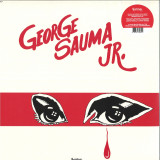
Favorite Recordings proudly presents an exclusive eponymous LP by Brazilian singer and composer George Sauma Jr., originally produced in 1985. Imagine a never-marketed release on which you’d hear not only the beautiful and genuine George’s songs but also the work from two figures of the Brazilian Music Golden Age: Arthur Verocai and Junior Mendes! A much-needed album for all Brazilian connoisseurs.
Back in the days, George Sauma Jr. was a young artist from Rio de Janeiro, learning on his side how to play chords and compose songs since he was 10. Still at the university, he’s influenced by Brazilian artists like Cassiano or Tim Maia, deeply fascinated by the arrangements and the “levada” (the groove) of all these new Brazilian songs. Simple and romantic music that resonated to his soul and creativity.
Around 1985, the story took an unexpected turn. George tells: “Dna Deyse Lucidy, the mother of Junior Mendes was a candidate for deputy and went to my father’s company to advertise. When I saw her, I shouted, “I’m a big fan of your son!” ” Of course, she could not praise more the work of her son. On her advises, George went to his studio on Rua Siqueria Campos at Copacabana. Junior loved the project and sent him to Arthur Verocai to improve the arrangements. Without money, the decision was taken to record everything at Junior Mendes’ studio on an 8-channel mixer. It was a small set-up but the emotions were there! George surely had other plans for some of his songs but without the budget, they ended up doing everything the best they could. And they did very fine with a top-notch team of musicians: Paulo Black on Drums, Arthur Verocai on Guitar, Ricardo Do Canto on Bass and Helvius Vilela on Keyboards.
Leaving the studio with the tapes, George tried to knock doors of international labels, but none did even dare to give him an answer. With less than 1000 copies pressed back in the days and without any distributor or label behind him, he went with proud to record stores, but received nothing than a strong reality check regarding the difficulties for a young Brazilian artist to achieve something on the saturated market of the 80s. Even for free, record stores didn’t want it. In the end, he ended up giving copies to friends and families, knowing deep inside that the songs were good! George tells: “I decided to leave, calm and conscious. I’ve still made three more albums, however on tapes, as it was more affordable. This time, just for my pleasure…”.
Thirty-five years after, it’s with great emotion that this first album by George Sauma Jr. is now made available as Vinyl LP with its original offset printed innersleeve & CD
Suche:h paul
WRWTFWW Records is beaucoup happy to announce the official reissue of Pierre Barouh's hard-to-describe-but-easy-to-enjoy French flair meets Japanese avant-garde lost treasure of experimental-electronic-chanson-pop with a new-wave-minimal-bossa touch, Le Pollen. Originally recorded July 1982 at Nippon Columbia Studio in Tokyo and composed, arranged, and played by a who's who of Japan's most groundbreaking musicians of the 80s, the album comes as a LP with bonus 7inch, housed in a heavy sleeve displaying two immaculate photos of Barouh and holding a printed lyrics insert.
A free-spirited world traveler with an incredible ear for music, Paris-born singer and activist Pierre Barouh introduced the sounds of Brazil (and more) to Europe and pushed the envelope with his pio-neering label Saravah, home of adventurous innovators Brigitte Fontaine, Areski, Jacques Higelin, Naná Vasconcelos, and Roland Bocquet's Catharsis among many others. His bohemian border-free vision of modern chanson, blending musical tradition from various parts of the globe with forward-looking artistry, resonated particularly well in Japan, where the scene spearheaded by Yellow Magic Orchestra fell in love with everything Barouh.
And so one day in 1981, Pierre Barouh received an invitation from a Japanese label to come record an album in Tokyo. Not one to turn down an escapade around the world, the French visionary jumped on a plane and landed in a studio surrounded with a dream line-up of musicians: Yukihiro Takahashi (who had named his solo debut Saravah! after Barouh's imprint) and Ryuichi Sakamoto of YMO, Yasuaki Shimizu and his Mariah bandmates Masanori Sasaji and Hideo Yamaki, members of the Moonriders, Motohiko Hamase, Mitsuru Sawamura of Interior, Kazuhiko Katoh and the list goes on. Also participating in the making of the album were longtime collaborator Francis Laï and the mys-terious and beautiful David Sylvian.
The result is Le Pollen, a sincere and affectionate mix of nouveau chanson, techno-pop, post-punk, jazz, bossa, ambient, and minimalism. And probably something else entirely. Honestly impossible to classify in a particular genre, Pierre Barouh's fascinating cosmopolitan music melting pot is, above all, a reassuring ode to humanity, where friendship, exchange, and collaborative creativity breeze freely. Making music together. It's all love.
Pierre Barouh sadly passed away in December 2016, leaving behind a monumental legacy of music and art for us to cherish, and a life philosophy that's well worth considering:
La vie, qu'elle soit longue ou brève
Moi, tous mes rêves
Je les prends toujours au sérieux
Quand l'utopie brise les chaînes
C'est l'oxygène,
De ceux qui sont restés curieux
Life, be it long or brief
Me, all my dreams
I always take them seriously
When utopia breaks the chains
It's the oxygen,
Of those who've remained curious
From the song "L'Autre Rive" on Le Pollen.
Until Now, Jilala has been a much sought-after phantom in relation to their better-known musical and spiritual contemporaries, The Master Musicians of Jajouka. Culled from three and a half hours of 1965 recordings by writers/artists/poets Brion Gysin and Paul Bowles, the first batch of Jilala recordings were released on a 1965 LP that was scarce even upon its initial release. The second batch of Recordings, which this LP has drawn from, came in the form of a CD by Baraka Foundation in 1998, which is also now long out of print. The Jilala brotherhood -- like the better-known Jajouka culture -- has pre-Islamic roots in Sufi mysticism that span across northern Africa from Morocco to India. Jilala shares the kinds of small, portable instruments historically favored by nomadic cultures. Even among the more ardent aficianados of "world music" these recordings have seldom been heard. In the original liner notes Ira Cohen provides a breakdown of the Jilala ensemble: "The instruments used are the shebaba, a long transversal cane flute, which leads the way; the bendir, a handheld drum resembling a tambourine without cymbals; and the karkabat which is a double castanet made of metal. On this record there are usually three flutes, six drums and one pair of castanets." In conjunction with the qraqaba -- an iron analog to the wooden castanets featured heavily in the Flamenco music of the Roma people that also flourished over the centuries mere miles to the north in southern Spain. These bendir drums provide a range very similar to that covered in contemporary popular music by the bass drum, snare, and cymbals that make up standard drum kit. The Trance-inducing grooves were major influences on such bands as Led Zeppelin, Agitation Free, Can and the Rolling Stones. The collective rhythms are often reminiscent early hip hop. oFirst time these tracks appear on vinyl - Pressed on 180 Gram Black Vinyl o Recorded by Brion Gysin & Paul Bowles in Morocco 1965 o Limited Edition of 300 Copies - DMM: Direct Metal Mastering o New Liner Notes by Peter Wetherbee o Contains insert of original liner notes from 1965 Jilala LP o Long out of print in any format for over 20 years.
In early 2018, Nathan Jenkins returned from the coast of Arrábida to his new home studio in a cottage tucked behind the grand hotel setting of Wim Wenders’ Lisbon Story. Breaking for lunches under a Datura tree in the garden and a far cry from the Finsbury Park basement flat he rented the previous year, a set of recordings followed that galvanised into an EP - ‘We Had A Good Time’. Music informed by out-of-town trips in a 1987 Renault 9 Super, Pitchfork attributed “remarkable healing powers” to lead song ‘Hula’.
After leaving London for a spell in Portugal, Nathan lost his taste for the night life and drew a line under a long-running NTS radio show. Much of the time spent abroad was dedicated to a longstanding collaboration with Westerman, whose album they recorded in a remote part of the Algarve countryside in 2019. Nathan’s own discography opened in 2007 with ‘Pet Sounds: In The Key Of Dee’, before pivoting in a more electronic direction via ‘Get Familiar’ and ‘Young Heartache’. From the sampledelia of 2011’s ‘Too Right’, the new wave and rave of ‘Say Arr Ee’ to the Robert Wyatt-influenced ‘Love Me Oh Please Love Me’, he’s mapped a deliberately peculiar path. 2015’s ‘Rooster’ was Eno & Byrne’s ‘Bush Of Ghosts’ given a shangaan-electro lick and clip. While Nathan’s partnership with fellow out-there pop auteur Jesse Hackett, as Blludd Relations, staggered like a half-cut Prince.
Collaged, rhythmic alternatives. Syncopated avant-garde sambas. Off kilter Sci-Fi jazz. Think Asha Putli in the spot at the Star Wars cantina. Arty, angular. Rich, but uncluttered. Frenetic, electric, blurring the boundaries between what is sampled, what is played. Nathan’s is a wilfully weird Pop, showcased in 2016 on his album ‘Loop The Loop’. Wayward but woven with hooks that come out of nowhere. Lyrical, often beautiful, solos on violin, oboe and desiccated guitars. Songs that demonstrate a nose-thumbing playfulness, a refusal to sit still. Where there’s always the urge to interrupt a carnival beat with a burst of galloping horse hooves. Or juxtapose ambient chords with a kazoo.
A roll call of Nathan’s broader musical adventures encompasses work with Paul Epworth, Sampha, Westerman and Nilüfer Yanya. Commissioned remixes reach from Dita Von Teese to Model 500, Tricky, Todd Terje and Lee “Scratch” Perry. Solo efforts gracing labels Honest Jon’s, R&S, Young Turks, Whities and The Trilogy Tapes. ‘Blue Pedro’, on the latter, making it into Crack Mag’s Top 100 Tracks Of The Decade.
In 2012 Nathan started his own label, DEEK Recordings, assuming the role of inhouse producer to collaborators. The imprint’s tagline and aesthetic - Pop, not slop! - is illustrated by an ongoing playlist of the same name and further explored in a series of compilations where Nathan and friends cover and reinterpret unsung ‘unclassics’ from alt. country to obscure 80s European arthouse scores, bouncing between Captain Beefheart, The Pixies, Sade and Mazzy Starr. DEEK’s roster is equally eccentric, non-linear and pop-literate. Laura Groves and Nautic - the realization and crystallization of a shared love for the Cocteau Twins.
12” pressed on crystal clear vinyl.
The saga of composer Tim Story's 1982 debut is a case study in the shifting sands of the early progressive music industry. Recorded on a Tascam 4-track reel-to-reel in his basement bedroom in Whitehouse, Ohio using a ragtag array of equipment – salvaged vibraphone, pawn shop Les Paul, his mother's spinet piano, a PAiA synth kit assembled by his girlfriend's father, and a Yamaha CS-30 – Story optimistically dubbed six cassettes and sent them around the world. Following a polite rejection from Klaus Schulze, the French avant-garde label Atem (This Heat, Univers Zero, Art Zoyd) reached out with an offer to release Threads via their new instrumental electronic subdivision, Labyrinthes. After several letters confirming terms of the arrangement as well as multiple rounds of test pressings, correspondence suddenly ceased. Some months later the label folded, never having begun. Synchronistically, however, Schulze's copy ended up in the glovebox of an engineer associate, who happened to play it for a couple visiting journalists with contacts at a newish Norwegian imprint, Uniton Records (Popul Vuh, Harold Budd).
Impressed, they connected Story to the label head, but by then he'd already recorded a follow-up, the more neoclassical-leaning In Another Country, which became his inaugural release. Finally, 40 years later, Dais Records is rectifying history's error by properly issuing Threads on vinyl for the first time. It's a beautiful, beguiling work, exploratory but emotive, documenting, as Story puts it, “the path not taken... like the first chapter of a book that was set aside to begin another.” Despite only being in his early twenties at the time of its creation, Threads feels finessed and considered, weaving through a diverse spectrum of moods and minimalist melodies. From sunburst synthesizer devotionals (“Tethered By A Thread”) to shadowy cosmic drift (“Without Waves,” “Iso”) to fragile piano vignettes (“Burst,” “Scene And Artifact”), Story's compositional instincts skew subtle and sophisticated, carving gemstones of fluctuating radiance. He cites his discovery of tape loops as a central tool in the process, allowing him to generate recurring patterns of echoes and texture, decaying in volume and fidelity as desired: “A whole new and inspiring world opened up.” As both time capsule and discographical fountainhead, Threads vividly captures the threshold sensation of early 1980's electronic music: post-kosmische, prenew age, before ambient became codified, just as synthesizers began slipstreaming into the underground. It's an album of beginnings and forking paths, inner space voyaging towards limitless horizons, born of “youthful dedication to something one loves, in a world that feels uncertain.”
· First ever vinyl edition, originally set to be released in 1982 but due to original label's untimely demise, it was never issued until now.
· Collaborative releases with Hans-Joachim Roedelius and Dwight Ashley, with releases on notable labels Uniton, Windham Hill, and Hearts of Space.
· For fans of Harold Budd, Brian Eno, Roedelius, Nils Frahm, Klaus Schulze, Popol Vuh, Vangelis, Jean-Michel Jarre · The song "A Thousand Whispers" has been in regular rotation at Sirius XM.
· Tim Story is a Grammy nominated artist in 1988 for his "Legend of Sleepy Hollow" recording with Glenn Close.
Legendary pedal steel player Susan Alcorn presents her music as curated and arranged by cellist and composer Janel Leppin. This recording is from a live performance from her residency at Issue Project Room in July 2012. Leppin’s arrangements and curation emotes the brilliance, transparency and resonance of the pedal steel guitar. Through this ensemble, the mastery of Susan Alcorn's compositions shine.
Susan Alcorn has taken the pedal steel guitar far beyond its traditional role in country music. Having first paid her dues in Texas country & western bands, she began to expand the vocabulary of her instrument through her study of 20th century classical music, visionary jazz, and world musics. Struck by the music of Messiaen she began transcribing classical music from recordings and scores on her instrument. Soon, she began to combine the techniques of country-western pedal steel with her own extended techniques to form a personal style influenced by free jazz, avant-garde classical music, Indian ragas, Indigenous traditions, and various folk musics of the world. By the early 1990s her music began to show an influence of the holistic and feminist “deep listening” philosophies of Pauline Oliveros. As her records gained a cult following she moved to Baltimore, MD. She performs internationally and is a key figure in the free improv scene in the US.
Janel Leppin is a core member of the Washington, D.C. experimental, jazz, punk and improvisational scenes and is a celebrated visual artist as a weaver. DownBeat Magazine describes her as “An absolute virtuoso”, NPR Music says “instrumental intimacy swept up in arrangements that cluster around her voice, as delicate and as imposing as a sheet of falling ice.”. Janel leads and writes for her free jazz sextet, Ensemble Volcanic Ash “a rarity..ahhh-vant garde at it’s finest." -Capital Bop. Leppin and Alcorn also recorded the composition “Thick Tarragon” by Eyvind Kang from the album Visible Breath on Ideologic Organ. Leppin appears as a string arranger on many recordings on labels from Dischord Records to Sacred Bones.
• This is the only LP released by The Mighty Tom Cats, a house band for Paul Winley (who launched his Winley Records in 1956).
• Originally released in 1974 ‘Soul Makossa’ is rumoured to have George Benson, Willis Jackson and Buddy Lucas taking part
• Features a brilliant take on the mighty ‘Soul Makossa’ track made famous by Manu Dibango
• Reissued on 140g black vinyl with original artwork and printed inner sleeve
The mystifying 9th album in the Field Works series, Cedars combines cosmic Americana with Western ambient and Middle Eastern influences. Delicate layers of pedal steel, banjo, oud, and hurdy-gurdy float atop looping guitar drones to create a soothing, atmospheric chamber where folk and electronic music coalesce. Set to Arabic and English poetry, the song cycle examines some of Earth's most iconic and ancient forests, revealing our complicated relationship with the natural world. For this special dual-language release, Field Works producer Stuart Hyatt has assembled a supergroup of musicians, poets, and artists. The album is narrated by Youmna Saba and H.C. McEntire. Instrumentalists include Marisa Anderson, Fadi Tabbal, Dena El Saffar, Danny Paul Grody, Bob Hoffnar, Tomás Lozano, Nathan Bowles, Alex Roldan, Youmna Saba, and Stuart Hyatt. Renowned illustrator María Medem brings poems by Todd Fleming Davis and Youmna Saba to life in the accompanying full-color Risograph comic book; and longtime Field Works collaborators PRINTtEXT design the packaging.
The incredible sonic beauty of the Sphincter Ensemble results from musical spontaneity, a random jam session undertaken by a loose group of friends in the unlikely setting of the
Harrovian Club in Barnes, west London, on 2 January 1972. The sumptuous free jazz/prog rock/avant-classical fusion features top session players at their peak, with Trevor Morais’
funky drumming loosely tied to Quatermass bassist John Gustafson’s rough melodic lines, embellished by Anne Odell’s far-out synths, Martyn Ford’s French horn and arrangements by Elton John’s orchestrator, Paul Buckmaster. This hugely enjoyable rarity is appearing on vinyl here for the very first time—a thing of wonder for all discerning prog fans.
An album of our times, Newcastle band Maximo Park return with
their seventh full length, ‘Nature Always Wins’.
The album arrives as something of an examination, zeroing in on the
notion of the self, identity as a band and that of humanity as a
whole. The album’s title nods to the famous Nature vs Nurture
debate. Discussing whether change is capable under the influence of
time, perspective, environment or if we are destined to be bound by
our own genetics, it asks, “who are we, and who do we want to be,
and do we have any control over it?”
“I’m so happy we were able to make this album during lockdown, as
it’s been a challenging time for everyone. After almost 4 years since
‘Risk To Exist’, we wanted to explore new musical territory (for us)
without sacrificing our trademark melodic twists and heartfelt lyrics.
As always, the passing of time looms large, although the songs
contain more affection for the past than before, and there are
occasional hints of the fractious, divided time that we live in.” -
frontman Paul Smith
Produced by Atlanta-based Grammy-winning producer Ben Allen
(Animal Collective, Deerhunter), who afforded the band freedom to
play and create. What wasn’t anticipated was how that freedom
would be soon be stripped, as lockdown restrictions left the band
recording remotely across Newcastle, Liverpool and Atlanta with
audio files bounced back and forth, 4000 miles across the world.
An album of our times, Newcastle band Maximo Park return with
their seventh full length, ‘Nature Always Wins’.
The album arrives as something of an examination, zeroing in on the
notion of the self, identity as a band and that of humanity as a
whole. The album’s title nods to the famous Nature vs Nurture
debate. Discussing whether change is capable under the influence of
time, perspective, environment or if we are destined to be bound by
our own genetics, it asks, “who are we, and who do we want to be,
and do we have any control over it?”
“I’m so happy we were able to make this album during lockdown, as
it’s been a challenging time for everyone. After almost 4 years since
‘Risk To Exist’, we wanted to explore new musical territory (for us)
without sacrificing our trademark melodic twists and heartfelt lyrics.
As always, the passing of time looms large, although the songs
contain more affection for the past than before, and there are
occasional hints of the fractious, divided time that we live in.” -
frontman Paul Smith
Produced by Atlanta-based Grammy-winning producer Ben Allen
(Animal Collective, Deerhunter), who afforded the band freedom to
play and create. What wasn’t anticipated was how that freedom
would be soon be stripped, as lockdown restrictions left the band
recording remotely across Newcastle, Liverpool and Atlanta with
audio files bounced back and forth, 4000 miles across the world.
- A1: Wouldn't It Be Nice
- A2: You Still Believe In Me
- A3: That's Not Me
- A4: Don't Talk (Put Your Head On My Shoulder)
- A5: I'm Waiting For The Day
- A6: Let's Go Away For Awhile
- A7: Sloop John B
- B1: God Only Knows
- B2: I Know There's An Answer
- B3: Here Today
- B4: I Just Wasn't Made For These Times
- B5: Pet Sounds
- B6: Caroline No
The ultimate pressings of the Beach Boys discography from Analogue Productions!
Original mono mix produced by Brian Wilson
One of 10 titles featuring 33 1/3 mono and stereo remastered editions: Surfin' USA, Surfer Girl, Little Deuce Coupe, Shut Down Vol. 2, All Summer Long, Today!, Summer Days (And Summer Nights!!), Beach Boys Party!, Pet Sounds and Smiley Smile
Mastered by Kevin Gray at Cohearent Audio, most from the original master tapes or best sources available
Lacquer plating by Gary Salstrom and 180-gram vinyl pressing by Quality Record Pressings!
"It was Pet Sounds that blew me out of the water…I love the album so much. I've just bought my kids each a copy of it for their education in life. I figure no one is educated musically 'til they've heard that album." – Paul McCartney
"All of us, Ginger (Baker), Jack (Bruce), and I consider Pet Sounds to be one of the greatest pop LPs to ever be released. It encompasses everything that's ever knocked me out and rolled it all into one." – Eric Clapton
"For those in search of an original mono in pursuit of sonic quality, search no more. This Analogue Productions pressing is now the definitive pressing and the one we chose to feature at our Classic Album Sundays events to honour the 50th anniversary of Pet Sounds, an album that helped change the course of pop music." — Colleen ‘Cosmo' Murphy, Classic Album Sundays
"Overall though, this new reissue is the best sounding of all. The bottom end has more weight and solidity and the instrumental separation and front to back layering is nothing short of astonishing compared to the pleasing mush offered up by other editions. ... Pet Sounds belongs in every serious rock record collection and if you're going to have but one version this one from Analogue Productions is the one to have." — Music = 11/11; Sound = 11/11 - Michael Fremer, AnalogPlanet Read the whole review here.
"What I can say is that Kevin Gray has been able to extract every last bit of information from whatever tape is in the box, and present it in a way that is pleasing and natural to the ear. ... in my opinion, the Analogue Productions pressings are now THE definitive issue of each Beach Boys album, and will be my reference copies until if and when something better comes along — which may be never." — Lee Dempsey, Endless Summer Quarterly, Summer 2015 Edition
To meet the standards of Analogue Productions, our Beach Boys album reissues had a mission to achieve: Present the band's music the way that Brian Wilson — famed co-founder, songwriter and arranger — intended. Mono mixes created under Wilson’s supervision were how the surf rockin’ California crew rose to fame! And we’ve got ‘em!
For the early part of the Beach Boys' career, all of their singles were mixed and mastered and released only in the mono format — they didn't release a single in stereo until 1968. In those days, hits were made on AM radio in mono. And the mono of those times worked well for Wilson, who suffers from partial deafness. In fact, for their first 13 albums, Wilson originally turned in all the final mixed Beach Boy albums to Capitol Records only in mono. The mono mixes were where Wilson paid intense attention, and the dedication paid off!
We’ve taken 10 of the most classic, best-sounding Beach Boy titles ever and restored them to their mono glory!
But there’s no disputing that the close harmonies and one-of-a-kind rhythms of hits like “Surfer Girl,” “In My Room,” “Little Deuce Coupe” and more lend themselves naturally to stereo. So we’ve got your 2-channel needs covered with prime stereo mix versions as well.
Mastered by Kevin Gray, most from the original master tapes, and plated and pressed by Quality Record Pressings, the finest LP pressing facility in the world, these are awesome recordings to experience. And the look of each album befits its sonic superiority! Presented in "old school" Stoughton tip-on jackets, these time honoured favourites shine brighter than the originals!
Pet Sounds is famous for its use of multiple layers of unorthodox instrumentation as well as other cutting edge audio techniques for its time. It's considered the best Beach Boys album, and one of the best of the 1960s. The group here reached a whole new level in terms of both composition and production, layering tracks upon tracks of vocals and instruments to create a richly symphonic sound.
Conventional keyboards and guitars were combined with exotic touches of orchestrated strings, bicycle bells, buzzing organs, harpsichords, flutes, Theremin, Hawaiian-sounding string instruments, Coca-Cola cans, barking dogs, and more. It wouldn't have been a classic without great songs, and this has some of the group's most stunning melodies, as well as lyrical themes which evoke both the intensity of newly born love affairs and the disappointment of failed romance (add in some general statements about loss of innocence and modern-day confusion as well). The spiritual quality of the material is enhanced by some of the most gorgeous upper-register male vocals (especially by Brian and Carl Wilson) ever heard on a rock record. "Wouldn't It Be Nice," "God Only Knows," "Caroline No," and "Sloop John B" (the last of which wasn't originally intended to go on the album) are the well-known hits, but equally worthy are such cuts as "You Still Believe in Me," "Don't Talk," "I Know There's an Answer," and "I Just Wasn't Made for These Times." It's often said that this is more of a Brian Wilson album than a Beach Boys recording (session musicians played most of the parts), but it should be noted that the harmonies are pure Beach Boys (and some of their best).
VH-1 named Pet Sounds as the No. 3 album in the Top 100 Albums in Rock 'n' Roll History, as judged in a poll of musicians, executives and journalists. It's been ranked No. 1 in several music magazines' lists of the greatest albums of all time, including NME, The Times and Mojo Magazine. It was ranked No. 2 in Rolling Stone's 500 Greatest Albums of All Time list.
The self-titled, full-length debut from Bones Owens is a selection of songs both gloriously gritty and undeniably euphoric. In a bold departure from the moody Americana of his acclaimed EPs Hurt No One and Make Me No King, the Missouri-bred musician’s first release with Thirty Tigers delivers a powerful sound deeply inspired by ’60s garage-rock, Hill Country blues, and the swampy roots-rock of bands like Creedence Clearwater Revival (“the first record I remember stealing from my dad when I was ten and just starting to play guitar,” according to Owens). A potent showcase for his formidable guitar work—a talent he’s displayed in performing with artists as eclectic as Yelawolf and Mikky Ekko— Bones Owens arrives as a full-tilt expression of Owens’ wildest impulses, all swinging rhythms, and swaggering riffs. Featuring heavily playlisted hits like “White Lines” and “Keep It Close,” Bones Owens came to life at The Smoakstack in Owens’ adopted hometown of Nashville. With production from studio owner Paul Moak—a five-time Grammy Award nominee who’s also worked with Joy Williams, Marc Broussard, and The Blind Boys of Alabama. “This album really came from opening for some good people over the last few years, from feeding off that energy from the crowd and wanting to write more songs that would feel exciting to play live,” says Owens, who’s recently toured with Reignwolf and Whiskey Myers. “It felt like the right approach to keep the production simple and record everything to tape - I think it creates a good type of nervousness that brings out the best in everyone. Nobody wants to be the one to mess up the take. Besides, all my favorite records were made that way. You can’t fake that sound.”
- Rock 'N' Roll
- Go Man Go (Album Version)
- Our Love Will Change The World
- Social Debris
- $1000 High Heel Shoes
- Hail Mary
- Detroit City 2021 (Album Version)
- Drunk And In Love
- Independence Dave
- I Hate You
- Wonderful World
- Sister Anne (Album Version)
- Hanging On By A Thread (Don't Give Up
- Shut Up And Rock
- East Side Story (Album Version)
“I was born here” said Alice Cooper, “and so was the sound and spirit of Alice Cooper.” Named for the city that launched the original Alice Cooper group, “Detroit Stories” followslast year’s “Breadcrumbs” EP as a modern-day homage to the toughest and craziest Rock n Roll scene there ever was. Alice Cooper and Bob Ezrin gathered some legendary Detroit musicians (Wayne Kramer, Johnny “Bee” Badanjek, Paul Randolph and many more) in a Detroit studio to record “Detroit Stories”, Alice Cooper’s new album that celebrates that spirit for a new era. Finally, it would not be a proper collection of Detroit tales if it didn’t include a few songs featuring the Original Band members, Mike Bruce, Dennis Dunaway and Neal. Joe Bonamassa also makes an appearance on the intro track “Rock ‘n’ Roll”. If 2019’s “Breadcrumbs” EP laid down the trail to the city, “Detroit Stories” drives like a muscle car right down Woodward Ave. Discover Detroit Stories as they were meant to be told. Available across 5 formats: CD / CD+DVD / 2LP Black, Boxset. Boxset inclues CD, T-shirt, Face Mask, Torch Light, 3 Stickers. Expected reviews across the broadsheets and tabloids. Daily Mail already picked this album as one of their 2021 albums to look out for! Current single playlisted at BCR2.
This reissue of the all-time best-selling jazz album ‘Kind of Blue’ by the legendary trumpeter Miles Davis includes 4 bonus tracks.
The all-star line-up features Julian “Cannonball” Adderley on alto sax, John Coltrane on tenor sax, Bill Evans and Wynton Kelly on piano, Paul Chambers on bass and Jimmy Cobb on drums. The bonus tracks are ‘Blue in Green’ by the Bill Evans Trio and 3 tracks from a session recorded in 1956 with John Coltrane, Red Garland, Paul Chambers and Philly Joe Jones. The 20-page booklet contains complete information with specially prepared liner notes by Penguin Guide to Jazz’s writer Brian Morton and by France’s prestigious Jazz Magazine.
It is the simple thing that is so hard to do. This is the paradox that musician Lael
Neale has lived within throughout her development as an artist. It is the reason she
became enthralled with poetry. Poems are a distillation. Lael says, “this challenge to
winnow away what is unessential is the most maddening and, ultimately, rewarding
part of writing a song.”
Lael’s new album ‘Acquainted With Night’ is a testament to this poetic devotion.
Stripped of any extraneous word or sound, the songs are lit by Lael’s crystalline
voice which lays on a lush bed of Omnichord. The collection touches on themes that
have been thread into her work for years: isolation, mortality, yearning and reaching
ever toward the transcendent experience.
Lael grew up on a farm in rural Virginia but for nearly 10 years called Los Angeles
home. Those years were spent developing her songwriting and performing in venues
across the city but the right way to record the songs proved more elusive. She says,
“Every time I reached the end of recording, I felt the songs had been stripped of
their vitality in the process of layering drums, bass, guitar, violin, and organ over
them. They felt weighed down.”
In a moment of illumination, the solution presented itself: do the simple thing. In
early 2019, in the midst of major transition, she acquired a new instrument - the
Omnichord - and began recording a deluge of songs. Guy Blakeslee, who had been
an advocate for years, set up a cassette recorder in her bedroom and provided
empathic guidance, subtle yet affecting accompaniment and engineering prowess.
Limited to only 4-tracks and first takes, Lael had to surrender some of her
perfectionism to deliver the songs in their essence.
The first song she recorded was ‘For No One For Now’, which calls to mind the
agitated beat of driving fast on the freeway against the backdrop of the San
Fernando Valley’s bent palms. The song contrasts romantic idealizations with the
banality of folding sheets and toasting bread. It highlights her oft-thwarted attempts
to enjoy the day to day while her mind wanders off toward the dream, the ideal.
While Lael returned to her family farm in April 2020, Los Angeles is a player on this
album and ‘Every Star Shivers in the Dark’ is an ode to the sprawling city, the
outskirts of Eden. One can envision her walking from Dodgers Stadium to downtown,
observing strangers and her own strangeness but determined to find communion
with others. ‘Blue Vein’ is her personal anthem, a Paul Revere piece that gallops
through the town as a strident declamation. It is an amalgam of thoughts, concerns
and lessons as she nearly speaks the words, unmasked by flourishes, ensuring the
meaning cuts through.
Normally a morning person, Lael recorded most of these songs in the darkening of
the early evening, and so became ‘Acquainted With Night’.
CD in gatefold altpack.
LP first pressing on white vinyl.
Cassette with three-panel J-card in clear case.
It is the simple thing that is so hard to do. This is the paradox that musician Lael
Neale has lived within throughout her development as an artist. It is the reason she
became enthralled with poetry. Poems are a distillation. Lael says, “this challenge to
winnow away what is unessential is the most maddening and, ultimately, rewarding
part of writing a song.”
Lael’s new album ‘Acquainted With Night’ is a testament to this poetic devotion.
Stripped of any extraneous word or sound, the songs are lit by Lael’s crystalline
voice which lays on a lush bed of Omnichord. The collection touches on themes that
have been thread into her work for years: isolation, mortality, yearning and reaching
ever toward the transcendent experience.
Lael grew up on a farm in rural Virginia but for nearly 10 years called Los Angeles
home. Those years were spent developing her songwriting and performing in venues
across the city but the right way to record the songs proved more elusive. She says,
“Every time I reached the end of recording, I felt the songs had been stripped of
their vitality in the process of layering drums, bass, guitar, violin, and organ over
them. They felt weighed down.”
In a moment of illumination, the solution presented itself: do the simple thing. In
early 2019, in the midst of major transition, she acquired a new instrument - the
Omnichord - and began recording a deluge of songs. Guy Blakeslee, who had been
an advocate for years, set up a cassette recorder in her bedroom and provided
empathic guidance, subtle yet affecting accompaniment and engineering prowess.
Limited to only 4-tracks and first takes, Lael had to surrender some of her
perfectionism to deliver the songs in their essence.
The first song she recorded was ‘For No One For Now’, which calls to mind the
agitated beat of driving fast on the freeway against the backdrop of the San
Fernando Valley’s bent palms. The song contrasts romantic idealizations with the
banality of folding sheets and toasting bread. It highlights her oft-thwarted attempts
to enjoy the day to day while her mind wanders off toward the dream, the ideal.
While Lael returned to her family farm in April 2020, Los Angeles is a player on this
album and ‘Every Star Shivers in the Dark’ is an ode to the sprawling city, the
outskirts of Eden. One can envision her walking from Dodgers Stadium to downtown,
observing strangers and her own strangeness but determined to find communion
with others. ‘Blue Vein’ is her personal anthem, a Paul Revere piece that gallops
through the town as a strident declamation. It is an amalgam of thoughts, concerns
and lessons as she nearly speaks the words, unmasked by flourishes, ensuring the
meaning cuts through.
Normally a morning person, Lael recorded most of these songs in the darkening of
the early evening, and so became ‘Acquainted With Night’.
CD in gatefold altpack.
LP first pressing on white vinyl.
Cassette with three-panel J-card in clear case.
Trumpeter Bill Hardman (1933-1990) was a long-time front-line Jazz Messenger.
This New York session from the summer of 1989 became Hardman’s last recording and saw him joined by tenor saxophonist Junior Cook and trombonist Robin Eubanks.
Plus the rhythm section of Mickey Tucker (piano), Paul Brown (bass) and Leroy Williams (drums). Bill Hardman was one of the leading trumpeters in the hard bop era of 50s playing with Art Blakey, Horace Silver, Charles Mingus among others. Hardman lived in Paris in the last years of his life. “(Hardman) has cultivated a strikingly personal style, which emerges on this album.”
(Birger J rgensen - Arhus Stiftstidende on What’s Up)
“In 1989 he made an excellent sextet album, What’s Up (SteepleChase), reuniting with Cook and adding Robin Eubanks’ trombone. At about the same time he moved to Paris, where he died Dec. 5th, 1990 of a cerebral stroke at 57.” (from the article Lest We Forget by George Kanzler - New York City Jazz Record, Dec. 2020)
Angel Tears in Sunlight is Pauline Anna Strom's first album in over thirty years; an assemblage of music that refracts the expansiveness, and minutiae, of imagined realms while embracing the kaleidoscopic echoes of our distant epochs. The capacity to collapse time might elucidate the enigma of Pauline Anna Strom. A mystic force in music, emerging during the dawn of new age as the Trans-Millenia Consort, the pioneering synthesist channelled primordial energies into future-facing sound through a series of full-length releases between 1982 and 1988. Little was known about her, except by a constellation of devoted followers who saw a unique legacy forming amidst the (mostly male) synthesist canon of the time. Following the 2017 release of Trans-Millenia Music, an anthology revitalizing the most evocative parts of Strom's catalog, the Bay Area visionary sensed the universe telling her to return to music. As with her work in the 80s, Angel Tears in Sunlight was composed and recorded in the same San Francisco apartment where Strom has lived for almost four decades in synthesis with her machines and "dinosaurs." Populated by a compact array of modern instruments that streamline the sound of her analog past and her beloved iguanas, Little Soulstice and Ms Huff, the terrarium of her home forms an intimate yet limitless ecosystem that defies the constraints of the outside world. Within this sanctuary, Strom becomes lost in time, drawing on the ancient energies of her inner visions. Her hardware forms the crux of translating these ideas into sound. "It's the only way this stuff can be pulled out of myself, the universe, Little Soulstice, an ammonite_," Strom notes. "It couldn't be done without this machinery, because there's no other way to draw and capture these frequencies into sonic interpretation." Strom's process of recording transient live-takes enriches the mystery of her work. She renders the machinery a composer itself, a cohabitation with a living other. "Many musicians wouldn't go that far because of ego," Strom muses. "The equipment has to become part of you and your creativity. That's how I think it all comes together." Music-making becomes a harmonic language of intuition with an instrument, where Strom cultivates sound for a harvest that defies season. Shaped by circadian contours, Angel Tears in Sunlight is a celestial observatory of earthborn phonic mosaics. Strom uncovers a symbiosis between hardware frequencies and apparitions of nature in the record's arena of organic tones, emulating the melodic pulses of primeval terrain. The album transcends both shadow and light, falling to hushed stretches of sound as if not to awaken antediluvian animals, before soaring through the treetops where ancient skies peer over reptilian traffic and unsparing rains.
The 12" EP A Momentary Convergence of Differently Paced Trajectories is a heterogenous dj-oriented release, prelude and companion of Maurizio Ravalico's first solo percussion album Nobody's Husband, Nobody's Dad, released in November 2018 with the Funkiwala label. It comes in 180gms vinyl on a hand-numbered run of 300 individually screen-printed 320gsm brown card sleeves.
THE MUSIC
Side A opens with a full-size batucada version of Fear of Mapping, one of the tracks from No Fiction Now!, the 2013 debut album of Maurizio's trio Fiium Shaarrk.
It is followed by a personal take on one of Collocutor's second album tracks, Here to There to Everywhere, arranged here as a spacey 5/4 drum'n'bass epic.
Side B contains an old-school jungle remix of Just Bring Your Toys, one of the tracks from Maurizio's forthcoming album, by the Italian d'n'b veteran Enjoy (Omni Music, Bustle Beats). The EP closes with an edited version of the same track: a taste of the album.
Despite being both loosely presented as remixes, neither of the two arrangements on side A makes use of samples from the respective releases, and any material not progammed or played anew by Maurizio comes from either unreleased off-cuts or preliminary demos.
"One of the finest avant-garde percussionists in the world. Maurizio Ravalico is incredible to watch and hear. Catch him live somewhere soon!"- Jean-Claude Thompson, IfMusic uk
"Creative, deep and intriguing. Percussion avantgarde at its best." - Vince Vella, Dj, producer, Havana Cultura
Italian-born visionary cross-genres percussionist Maurizio Ravalico has been one notably eclectic presence in the London music scene since his arrival in the UK, in 1991.
Regularily seen on stage and on releases with the like of Jamiroquai and the James Taylor Quartet throughout the nineties, as well as with virtually every salsa and Cuban-oriented projects to originate from London in the same period, he has subsequently collaborated on many of the projects of the experimental music label Not applicable (Icarus, Isambard Khroustaliov, Alex Bonney, Tom Arthurs) since 2005, and is now an established name in both the London and Berlin improv and experimental scene, having played with John Edwards, Oren Marshall, Steve Beresford, Pat Thomas, Frank Paul Schubert and many others.
Maurizio Ravalico's peculiar approach to percussion is one of the distinctive traits of Tamar Osborn's modal jazz 5-piece band Collocutor (On the Corner records) and of the pan-European trio Fiium Shaarrk (on BBC3 Late Junction's 12 Best Albums of 2017). Maurizio Ravalico also collaborates with the string quartet Phaedra Ensemble, the composer Fred Thomas and the French contemporary dance company Silenda.


