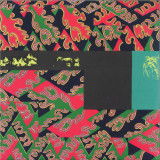
Faitiche releases an album version of the radio piece Vom Rohen und Gekochten (The Raw and The Cooked) originally composed and produced by Jan Jelinek for the state broadcaster SWR2. The album The Raw and The Cooked brings together five sound collages that deal with the consistency of material and its mutability.
Solid, raw, boiling, powdery, liquid, broken and folded - categories which describe the nature of material. They can also be read in a chronological sequence: solid becomes broken becomes liquid becomes powdery... Material tells of its essence as it drifts through its states, always in correspondence with external energies. The Raw and The Cooked observes the artists Thomas & Renée Rapedius as they design their paper and metal objects and the artist Peter Granser as he ritually prepares Japanese tea, it shatters glass, bends metal and burns wood. The resulting audio documents capture processes of material transformation as sound.
The Raw and The Cooked was created with the help of ITO Raum Stuttgart and Thomas & Renée Rapedius. Originally produced for radio broadcast on Südwestrundfunk in 2020 it contains a variation of the collage Zwischen/Raum that was made with funding from Musikfonds. Many thanks to Eckhart Holzboog and Beatrice Theil, as well as Frank Halbig/SWR.
quête:hel iv
Released on CD and digital on the 21st May 2021, this eagerly anticipated LP from I Grade Records immediately soared to the number one position in the iTunes reggae charts. The LP is now being released on 12" vinyl and cassette tape courtesy of Before Zero Records.
Polarities is the 13th and final full album of new material from Vaughn Benjamin and I Grade Records, the culmination of a 20 year working relationship that began with 2001's Nemozian Rasta album, which was Midnite's 4th album released to date at that time.
Polarities was produced jointly by the Zion I Kings production team, with Tippy I of I Grade at the production helm, alongside Vaughn Benjamin himself.
The album also includes two notable guest features: Tiken Jah Fakoly of Ivory Coast on "Everything Bless" and Chronixx of Jamaica on "Black Carbon", which were both released in 2020 as the first singles off of Polarities.
Runnner's Always Repeating yearns for a sense of place. The project of the now LA-based songwriter/multi-instrumentalist Noah Weinman, Runnner's poignant reflections on the isolation and anxiety caused by a sense of rootlessness radiate with wit and charm. Self-produced and recorded wherever he called home at the time, Always Repeating documents this cycle of looking back and moving forward, of alienation changing to reconciliation. For Weinman, Runnner is primarily a solo endeavor with an ever - expanding musical community of musicians collaborating on his albums and shows, which at times have been known to feature up to a 7-piece live band (he also has a burgeoning career as a producer, notably working on Skullcrusher's critically-acclaimed debut EP for Secretly Canadian). Weinman completed Always Repeating last fall in Western Massachusetts and Woodstock using a mobile studio set-up. He played the majority of the instruments himself, including guitar, bass, trumpet, banjo, piano and synth. The goal was to create the perfect balance of intimate and melancholy songwriting through the lens of hi-fi/lo-fi dynamics, inspired by his favorite artists like Bon Iver, the Microphones, and Julien Baker. The 10-track collection is composed of five re-recorded versions of songs that appeared on Runnner's 2017 debut, Awash, and 2020's One of One EP. Although the songs were written over the course of three years, all find Weinman grappling with the same thing: feelings of uncertainty about his life. Always Repeating ultimately tells the start of Weinman's journey as Runnner, and his cyclical feelings of being connected and then disconnected from the world over and over again.
Cole Pulice is a saxophone player from Minneapolis. An improviser of Ambient Jazz who earned his merits touring with Bon Iver, working with Godspeed You! Black Emperor and releasing wonderful electroacoustic gems with the groups Iceblink (Moon Glyph) and LCM (Orange Milk). With Gloam - his solo debut - Cole Pulice offers us six spacious audio holograms, one-take recordings of his saxophone entangled with live electronic hardware. We hear undulating pitch shifters, ring modulations and spectrally rich harmonizers. Cole applies all signal processing live, augmenting the calm, serene melodies Cole plays on his saxophone. The electronics never serve as a mere effect here. Instead, Cole’s fine-tuned setup functions as one whole instrument with which he effortlessly morphs shapes and colors, like fractals within a kaleidoscope or fragments of stained glass in a rock tumbler. Cole mentions the Synchromism visual art movement as an influence for this record, an American avantgarde style of the early 20th century in which colour and sound were treated as equivalents. It’s a spot-on analogy for these musical gems which serve to immerse us in imaginatory prisms. Cole’s sessions conjoin artificial processes with the vibrations of his breath to create electro-acoustic lullabies which reveal ever more timbral layers with each listen. Gloam was released on tape by the Moon Glyph imprint from Portland during the first lockdown in 2020 and has been licensed to Pingipung for this vinyl edition.
Bjarki’s bbbbbb records welcomes its first-ever non-electronic project as Icelandic rock band Skrattar joins the label to unveil their thirteen-track album, ‘Hellraiser IV’.
Four-piece outfit Skrattar can be described as cigarette rock with an electronic vibe that makes your upper lip sweat. Having already developed a loyal fanbase in Iceland as a powerful live act with an energetic and provocative stage presence, the band now look further afield to global horizons as they reveal their latest album, ‘Hellraiser IV’.
With the release of ‘Hellraiser IV’, bbbbbb broadens its catalogue beyond dance and electronic music. While the label’s primary focus will remain electronic, several other genres will also feature - the connecting factor being that the music is Icelandic, experimental and fresh... the best that grassroots has to offer.
‘Good music should be heard, and this is my take on delivering probably the best music coming from Iceland at the moment. It’s an honest, wild love story of true friendship and creativity coming together in one album’ - Bjarki
‘Hellraiser IV’ contains thirteen tracks written over three years, with the oldest songs composed the year the band was founded, 2016. In 2019, when a good foundation for an LP had been laid as the band gained followers and honed its sound, they locked themselves in the studio until they completed the album. With many of the tracks composed in the dead of night, containing both lyrics written over a long period as well as improvisation, the final product is a record made by them from A to Z, in line with the band’s endearing DIY ethos.
‘Skrattar’ is Icelandic for a specific type of demon that you can’t control, but in Swedish, it means ‘to laugh’ - with laughter involved across many of the tracks on ‘Hellraiser IV’ as if to mock the dualism of seriousness. Their subject matter is chaos and anarchism - but their humour and satire are never far away. The music is an ode to the eternal void, while at the same time laughing in its face.
In addition, a remix album will be released digitally alongside Hellraiser IV, reimagined and reworked by a host of fellow musicians, producers, and artists. Among them, label regular Kuldaboli, bbbbbb boss Bjarki, DJ Flugvél og Geimskip, russian.girls, KGB and Anton Newcombe - the founder of The Brian Jonestown Massacre.
- Tkay Maidza - Where Is My Mind? (Pixies)
- U.s. Girls - Junkyard (The Birthday Party)
- Aldous Harding - Revival (Deerhunter)
- The Breeders - Dirt Eaters (His Name Is Alive)
- Maria Somerville - Seabird (Air Miami)
- Tune-Yards - Cannonball (The Breeders)
- Spencer. - Genesis (Grimes)
- Helado Negro - Futurism (Deerhunter)
- Efterklang - Postal (Piano Magic)
- Bing And Ruth - Gigantic (Pixies)
- Future Islands - The Moon Is Blue (Colourbox)
- Jenny Hval - Sunbathing (Lush)
- Dry Cleaning - Oblivion (Grimes)
- Bradford Cox - Mountain Battles (Breeders)
- Sohn - Song To The Siren (Tim Buckley)
- Becky And The Birds - The Wolves
- Act I And Ii (Bon Iver)
- Ex:re - Misery Is A Butterfly (Blonde Redhead)
- Big Thief - Off You (The Breeders)
In 2020, 4AD turned 40. Never one to be on time for a party, the label is
commemorating that landmark this year with the release of ‘Bills & Aches & Blues’.
The compilation features 18 of its current artists covering a song of their
choosing from 4AD’s past: a creative experiment rooted in the spirit of
collaboration and a snapshot of 4AD, 41 years after its inception.
‘Bills & Aches & Blues’ will be released on double CD and double LP. The
first 12 months’ profits from ‘Bills & Aches & Blues’ will be donated to The
Harmony Project, a Los Angeles-based after-school programme for children
from communities and schools that lack equitable access to studying the arts
or music.
‘Bills & Aches & Blues’’ 18 recordings contain fascinating connections
between artist and track. The earliest song chosen (by U.S. Girls) is The
Birthday Party’s ‘Junkyard’, from 1981; the most recent are the two Grimes
covers (‘Genesis’ and ‘Oblivion’, respectively by Spencer. and Dry Cleaning)
from 2012. Suitably, for the one band that bridges 4AD past and present, The
Breeders are all over ‘Bills And Aches And Blues. They’re covered three
times - ‘Cannonball’ by Tune-Yards, ‘Mountain Battles’ by Bradford Cox of
Deerhunter and ‘Off You’ by Big Thief, whilst The Breeders cover ‘The Dirt
Eaters’ by their ‘90s contemporaries His Name Is Alive.
Landmark songs such as ‘Cannonball’, ‘Song To The Siren’ and Pixies’
‘Where is My Mind?’ will feel comfortable to casual fans, however by
contrast, much joy can be found in the album’s surprise choices, such as Air
Miami’s ‘Seabird’ and the Lush B-side ‘Sunbathing’, covered respectively by
new signings Maria Somerville and Jenny Hval.
‘Bills & Aches & Blues’ is named, arguably (as Elizabeth Fraser never
published the lyrics), after the opening line of Cocteau Twins ‘CherryColoured Funk’. Perhaps too unique and uncoverable in their own right, their
legendary take on Tim Buckley’s ‘Song To The Siren’, under the name This
Mortal Coil (along with Buckley’s pre-Starsailor acoustic version) informs
SOHN’s cover.
Some tracks unearth hitherto hidden shared DNA, such as Future Islands’
and Colourbox’s ‘The Moon Is Blue’; other tracks are more akin to
reinvention. Aldous Harding distils the melodic essence of Deerhunter’s
‘Revival’ and recasts it in her own uncanny image. U.S. Girls’ future-disco
‘Junkyard’ and Bing & Ruth’s neo-classical instrumental ‘Gigantic’ are even
more radical interpretations. Leading off the album, Tkay Maidza brings both
her Art Rap and R&B game, but also an unexpected ‘80s synth pop template,
to Pixies’ ‘Where Is My Mind?’, a perfect title for these chaotic times.
"These Exit Times" is the name of a newsletter sent by an environmental organisation advocating the extinction of the human race as a solution to save the planet. When Victor Ramirez first came across the group on the internet a couple of years ago, it brought a smile to his face. But after some pondering on the subject, he decided that "Exit Times" would be the name of his sensational third album as Ramirez Exposure.
The record started to take shape in early 2020, after a musical hiatus that had lasted a year. It had been somewhat of a dark period, and Victor felt it was time to go back to recording songs. It would be the first time he would be doing so at home. He had managed to set up a small studio that would allow him to make some proper recordings, and without having to use a computer. He'd also started a new job, as an orderly in a hospital, which gave him time to record and cash to pay the rent.
Victor was ready to take on the task of making the album with the help—albeit from a distance, this time—of Ken Stringfellow (Posies, Big Star) and Brian Young (Jesus & Mary Chain, Ivy, Fountains of Wayne), both regular accomplices of the Valencian in production and instrumentation. Working with the two of them feels very natural for him, even though they are in three different countries.
Looking back, it seemed as if he'd prepared himself for what was coming.
And so, the pandemic happened, and Victor found himself turning the ideas he had outlined on his phone into the songs for Exit Times. He was in a good place, personally and, despite the situation, he was happy to be able to contribute to society through his job at the hospital and, after coming home, to concentrate on his music and isolate himself from everything else.
Gradually, the sketches turned into luminous songs, with bright harmonies and lyrics that exude a fine irony. Victor admits that he strives to be a good pessimist every day, and the songs reveal a way of understanding life that relativises almost everything in order to stick with what's really important. This subtle sense of humour in the lyrics, like the luminosity of his music, is vintage Ramirez, and is present throughout the album, and even on the cover. The artwork is a painting by German painter Angela Dalinger, depicting Victor himself, their dog, Colombo, and some meaningful objects. The vinyl record featured is George Harrison's Brainwashed.
Exit Times is a shiny collection of songs with a universal vocation, bathed in sunshine pop with touches of new psychedelia. All simmered under the Mediterranean sun—the same sun that illuminates the entire planet.
- A1: Sonny Knight & The Lakers - Sugar Man
- A2: Gloria Ann Taylor - Jolene
- A3: Don Julian & The Larks - Shorty The Pimp
- A4: Foster Sylvers - Misdemeanor
- A5: Florence Miller - The Groove I'm In
- A6: Mac Rebennack & The Soul Orchestra - The Point
- A7: Clarence Reid - The Best Part Of A Man
- A8: Doris Duke - Woman Of The Ghetto
- A9: Gwen Mccrae 90% Of Me Is You
- A10: Helene Smith - Help Me To Keep What I've Got
- A11: Teddy Reynolds - Ain't That Soul
- A12: Miss Lavelle - Stop These Teardrops
- B1: Millie Jackson - I Cry
- B2: The Whatnauts - Why Can't People Be Colors Too?
- B3: George & Gwen Mccrae - Mechanical Body
- B4: Gino Washington - Puppet On A String
- B5: Chet "Poison" Ivey & His Fabulous Avengers - Soul Is M
- B6: Betty Padgett - Sugar Daddy Pt 1
- B7: Brother To Brother - In The Bottle
- B8: Class - Get Your Chic Together
- B9: Latimore - Let's Straighten It Out
- B10: C B. & Ten Others With Axes - Rosie
- A1: Pandemonium
- A2: Dawn Of Corruption
- A3: Hellmouth
- A4: Cryogenesis
- A5: The Void
- A6: Temple Of Taglaroth
- A7: The Eternal Lament
- A8: Aeons Of Oblivion
- A9: Graveborn
- A10: Dusk Of Anguish
- A11: The Offering
- A12: Oedipism
- B1: Ritual I : Cyklus
- B2: Argent Debt (Bonus Track)
- B3: Ritual Ii : Ravka
- B4: Ritual Iii : Vermillion Rivers
- B5: Ritual Iv : Hull Of Crows
- B6: The Tyrannt's Covenant
- B7: Maledictus
The conclusive chapter of the two part EP series by DISTANT, which started with 'Dawn of Corruption' in October 2020, was follwed by 'Dusk of Anguish' in March 2020 and is now full embodied in its final form with AEONS OF OBLIVION. Taking the material from both EPs, arranged in the order of the lore accompanying the project - a hellish hour of punishing Downtempo Deathcore.
- A1: Pandemonium
- A2: Dawn Of Corruption
- A3: Hellmouth
- A4: Cryogenesis
- A5: The Void
- A6: Temple Of Taglaroth
- A7: The Eternal Lament
- A8: Aeons Of Oblivion
- A9: Graveborn
- A10: Dusk Of Anguish
- A11: The Offering
- A12: Oedipism
- B1: Ritual I : Cyklus
- B2: Argent Debt (Bonus Track)
- B3: Ritual Ii : Ravka
- B4: Ritual Iii : Vermillion Rivers
- B5: Ritual Iv : Hull Of Crows
- B6: The Tyrannt's Covenant
- B7: Maledictus
The conclusive chapter of the two part EP series by DISTANT, which started with 'Dawn of Corruption' in October 2020, was follwed by 'Dusk of Anguish' in March 2020 and is now full embodied in its final form with AEONS OF OBLIVION. Taking the material from both EPs, arranged in the order of the lore accompanying the project - a hellish hour of punishing Downtempo Deathcore.
The Slovakian-Norwegian orchestra Angrusori releases its debut-album “Live at Tou” on Hudson Records in May 2021.
This album combines, and at times fuses two distinctive spheres of musical culture: on the one hand, an ancient migratory song tradition, and on the other, contemporary, experimental improvisation. Since 2016, a group of musicians from the Norway based Kitchen Orchestra and the Slovak Roma community have collaborated on the project Phuterdo re (open ear), now renamed as the band Angrusori (ring).
New connections have been developed between contemporary improvised
music from Norway and traditional Slovak Roma music, beautifully re-composed and hybridized by Nils Henrik Asheim and Iva Bittov - helped along by
contributing musicians and hours of collaborative work.
For a number of years, researcher Jana Beli ov has worked with the Roma
population in Slovakia, collecting and documenting songs rarely heard outside
the Slovakian countryside. This album offers a collection of these songs in a
remoulded and repackaged format, inviting both old and new listeners of Roma
music, and appealing to diverse audiences within and outside the Slovakian
vernacular.
These are songs from an otherwise secluded society, songs usually shared in
people’s homes and kitchens. They are songs telling stories of a different European reality, encompassing experiences of social segregation, abject poverty
and ill health, or love, jealousy and loss - stories of specific and universal human
tragedies, which nevertheless bear within them enduring qualities of resilience
and togetherness.
It is music that seeks to give renewed hope for our shared and interdependent
humanity, through its ability to cross borders.
Rich in musical associations yet utterly singular in its voice, joyous with an inner tranquility, the music of Natural Information Society is unlike any other being made today. Their sixth album in eleven years for eremite records, descension (Out of Our Constrictions) is the first to be recorded live, featuring a set from London’s Cafe OTO with veteran English free-improv great Evan Parker, & the first to feature just one extended composition. The 75-minute performance, inspired by the galvanizing presence of Parker, is a sustained bacchanalia of collective ecstasy. You could call it their party album.
This was the second time Parker played with NIS. Joshua Abrams: “Both times we played compositions with Evan in mind. I don’t tell Evan anything. He’s a free agent.”
The music is focused & malleable, energized & even-keeled, drawing on concepts of ensemble playing common to musics from many locations & eras without any one specific aesthetic realization completely defining it.
“The rhythms that Mikel plays are not an exact reference to Chicago house, but that’s in there,” Abrams says. “I like to take a cyclic view of music history, can we take that four-on-the-floor, & consider how it connects to swing-era music? Can we articulate a through line? I dee-jayed for years in Chicago & lessons I learned from playing records for dancing inform how I think about the group’s music. The listener can make connections to aspects of soul music, electronic music, minimalism, traditional folk musics, & other musics of the diaspora as well. It’s about these aspects coming together. I don’t need to mimic something, I need to embody it to get to the spirit, to get to the living thing.”
For jazz fans, the sound of Parker’s soprano & Jason Stein’s bass clarinet might evoke Coltrane & Dolphy, even though they didn’t necessarily set out to do that & they play with complete individuality. Abrams sees a bridge to the historical precedent, too. “Since we first met in the 1990s, one of the things that Evan and I connected on was Coltrane’s music,” he says. “I hoped that we would tap into that sound world intuitively. In this case, I think that level of evocation adds another layer of depth, versus a layer of reference.”
Indeed, this is a performance in which the connections among the ensemble & the creative tension between improvisation and composition build into a complex mesh of associations & interactions. While the band confines itself to the territory mapped out by Abrams’ composition, they are remarkably attentive & responsive, making adjustments to Parker’s improvisations. When Parker’s intricate patterns of notes interweave with the band, the parts reinforce one another & the music rockets upward. Sometimes, Parker’s lines are cradled by the group’s gentle pulse & an unearthly lyrical balance is struck.
Drummer Mikel Patrick Avery is locked-in, playing with hellacious long-form discipline, feel & responsiveness. Jason Stein’s animated, vocalized bass clarinet weaves in & out with Lisa Alvarado’s harmonium to state the piece’s thematic material; the pulsing tremolo on the harmonium brings a Spacemen 3 vibe to the party. Abrams ties together melody & rhythm on guimbri, a presence that leads without seeming to. Like his bandmates, he shifts modes of playing frequently, improvising & then returning to the composed structure.
“As specific as the composition is, the goal is to internalize it & mix it up,” Abrams says. “The idea is to get so comfortable that we can make spontaneous changes, find new routes of activity, stasis & byways every gig. It’s like a web we’re spinning. If someone makes a move, we all aim to be aware of it, make room for it. Experiencing & listening is what it’s about, & Evan supercharges that.”
& “supercharged” is the word for this album. With Parker further opening up their music, descension (Out of Our Constrictions) is the sound of Natural Information Society growing both more disciplined and freer, one of the great bands of its time on a deep run.
Aguirre edition: Mastered by Helge Sten, Audio Virus, Oslo. Lacquers by Dubplates & Mastering. Liner Notes by Theaster Gates. LPs pressed on premium audiophile-quality vinyl at Pallas Records. US 2xLP edition available thru Eremite records.
“This is the time. And this is the record of the time.”
Laurie Anderson’s 1982 debut album, Big Science, will return to vinyl for the first time in 30 years with a new red vinyl edition on Nonesuch Records. The release includes the re-mastered original album first released on CD for the 25thanniversary in 2007.
In the early 1980s, Laurie Anderson was already respected as a conceptual artist and composer, adept at employing gear both high-tech and homemade in her often violin-based pieces, and she was a familiar figure in the cross-pollinating, Lower Manhattan music-visual art-performance circles from which Philip Glass and David Byrne also emerged. While working on her now-legendary seven-hour performance art/theater piece United States, Part I–IV, she cut the spare ‘O Superman (For Massenet)’, an electronic-age update of 19th century French operatic composer Jules Massenet’s aria ‘O Souverain’, for the tiny New York City indie label 110 Records. In the UK, DJ John Peel picked up a copy of this very limited-edition 33⅓ RPM 7” and spun the eight-minute-plus track on BBC Radio 1. The exposure resulted in an unlikely #2 hit, lots of attention in the press, and a worldwide deal with Warner Bros. Records.
’Cause when love is gone, there's always justice.
And when justice is gone, there's always force.
And when force is gone, there's always Mom. Hi Mom!
At the time of its original release, the NME wrote of Big Science, ‘There’s a dream-like, subconscious quality about her songs which helps them work at deeper, secret levels of the psyche.’ With instrumentation ranging from tape loops to found sounds to bag pipes, Big Science anticipated the tech-savvy beats, anything-goes instrumentation and sample-based nature of much contemporary electronic and dance music. On the album’s 25th anniversary, Uncut noted, ‘The broader themes of alienation and disconnection still resonate, while Anderson’s use of loops and traditional/synthesized instrumentation is prescient.’
“In the ’70s I travelled a lot,” Anderson recounts. “I worked on a tobacco farm in Kentucky, hitchhiked to the North Pole, lived in a yurt in Chiapas, and worked on a media commune. I had my own romantic vision of the road. My plan was to make a portrait of the country. Big Science, the first part of the puzzle, eventually became part two of United States I–IV (Transportation, Politics, Money, Love). My goal was to be not just the narrator but also the outsider, the stranger. Although I wasfascinated by the United States, this portrait was also about how the country looked from a distance. I was performing a lot in Europe, where American culture was simultaneously booed and cheered. But the portrait was also a picture of a culture inventing a digital world and learning to live in it. Big Science was about technology, size, industrialization,shifting attitudes toward authority, and individuality. It was sometimes alarmist, picturing the country as a burning building, a plane crash. Alongside the techno was the apocalyptic. The absurd. The everyday. It was also a series of short stories about odd characters – hatcheck clerks and pilots, preachers, drifters and strangers. There was something about Massenet’s aria ‘O Souverain’ – which inspired ‘O Superman’ – that almost stopped my heart. The pauses, the melody. “O souverain, ô juge, ô père” (O Lord, o judge, o father). A prayer about empire, ambition, and loss.”
Laurie Anderson is one of America's most renowned – and daring – creative pioneers. Her work, which encompasses music, visual art, poetry, film, and photography, has challenged and delighted audiences around the world for over 40 years. Anderson released her first album with Nonesuch Records in 2001, the critically lauded Life on a String. Her subsequent releases on the label include Live in New York (2002), Homeland (2010), the soundtrack to Anderson’s acclaimed film Heart of a Dog (2015), and her Grammy-winning collaboration with Kronos Quartet, Landfall (2018). Additionally, Anderson’s virtual-reality film La Camera Insabbiata, with Hsin-Chien Huang, won the 2017 Venice Film Festival Award for Best VR Experience, and, in 2018, Skira Rizzoli published her book All the Things I Lost in the Flood: Essays on Pictures, Language and Code, the most comprehensive collection of her artwork to date.
Luca Yupanqui was not yet born when she recorded her debut album. The music on the aptly titled Sounds of the Unborn is the expression of life in its cosmic state _ pre-mind, pre-speculation, pre-influence, and pre-human. It is the first album created by a person while they were still inside the womb, the expression of a soul that hasn't yet seen the light of day nor taken a single breath of air. It is a message that comes from a different realm, a sublayer of our existence. Sounds of the Unborn was made with biosonic MIDI technology, which translated Luca's in utero movements into sound. With the help of her parents, Psychic Ills bassist Elizabeth Hart and Lee Scratch Perry collaborator Iván Diaz Mathé, Luca's prenatal essence was captured in audio. They designed a ritual, a kind of joint meditation for the three of them, with the MIDI devices hooked to Elizabeth's stomach, transcribing its vibrations into Iván's synthesizers. They let the free-form meditations flow without much interference, just falling deeper into trance and feeling the unity. After five hour-long sessions, the shape of an album began to emerge. Elizabeth and Iván then edited and mixed the results of the sessions, respecting the sounds as they were produced, trying to intervene as little as possible, allowing Luca's message to exist in its raw form. This cosmic soul summoning created new sounds, striking into uncharted territory for Elizabeth and Iván as musicians. A new language was being created, a new form of communication. It was a music without intellect or intentionality behind it, with no preconception or attempt to create any specific sound or melody. Every note on Sounds of the Unborn occurred naturally. It is human nature to wonder what life is like inside another human being's consciousness. How does it feel? What does it sound like? All these questions became stronger and more important to Elizabeth and Iván while they were waiting for Luca to come into the world. At a certain point the questions turned into, What would she say if she could speak? How would she react to the outer world? And ultimately, What kind of music would she play if she was able to? This album is an attempt to answer those questions. RIYL: Brian Eno, Mort Garson, Kaitlyn Aurelia-Smith
In between acting as Producer on all of the Black Jazz label releases, keyboardist Gene Russell also cut two fine albums for the imprint, of which this is the second, released in 1973. Judging by the quality of their respective solo outings for the label, the fact that Russell’s band includes bassist Henry Franklin and guitarist Calvin Keys bodes very, very well for the quality of this record. And indeed, Talk to My Lady represents a sterling stylistic leap for Russell from his New Direction album, which was the first release issued on Black Jazz; here, he’s leading an electric band instead of the basic piano trio format found on the former record, and playing a number of original, soul jazz compositions like “Get Down” and the title tune. As for the covers, both “Me and Mrs. Jones” and “You Are the Sunshine of My Life” are heartfelt renditions given a little extra bounce by Russell’s ivory tickling and Franklin’s expressive bass playing in particular, while the version of “My Favorite Things” goes way out beyond what John Coltrane played on his original Atlantic studio version. It’s hard to go wrong with a Black Jazz album and you won’t on this one from the label’s creative helm. First-ever LP reissue!
In his essay ‘The Meaning of My Avant-Garde Hillbilly and Blues Music’, Henry Flynt talks about how his music should be analysed as an intellectual tribute to the music of the autochtone, setting aside plain folk references, but adopting academic insights to mold the music one makes as a folk creature. Much of Flynt’s discourse applies to the music of Glen Steenkiste’s Hellvete. Over the past twenty years he has been thoroughly investigating both the ethnic musical language of various regions as well as the contemporary pioneers that preceded him as a drone musician, internalizing concepts such as e.g. deep listening or just intonation. Casting off any redundant ideas or sounds, and stripping down the focus to develop singular concepts, his working method lead to pieces such as ‘Droomharmonium’, in which he shapes the endless variations on a theme, emphasizing detail and nuance rather than multitude. The Indian harmonium here serves as the main device to worship ancient ghosts and masters, and to preserve a continuum in a tradition that touches both folk and avant-garde culture. The materialisations are sustained tone compositions which become a means of appreciation of the people and cultures that paved the way for forms of mutual escapism. This might well be the core of what Hellvete’s music is about. As much as it is a form of self-entertainment – like folk music in the old days – it also invites the listener to a shared experience of sonic reverie, it is a casual gift to the community.
This is certainly true for the pieces presented on this album. They were first presented in a smoke filled and darkened art space in Ghent, Steenkiste surrounded by only a couple of candles and just enough stage light to see him erratically moving to the rhythm of the piece, occasionally twiddling the knobs of a Doepfer synth that processed the prerecorded harmonium tracks. Unlike most of his other performances this piece embraced the audience in a trance that was similar to that of an old-school rave club. Flynt writes: ‘The music should be intellectually fascinating because the listener can perceive and participate in its rhythmic and melodic intricacies, audacity of organization, etc. At the same time, the music should be kinesthetic, that is, it should encourage dancing.’ ‘Voor Harmonium’ does exactly that; it builds on the artistic ideas that have long been established in Hellvete’s oeuvre, but the ecstatic nature of these pieces merges the usual spiritual transcendence with one of determined physical bliss. It encourages both mind and body to step into the sound, to be enraptured, to celebrate.
‘The Fountain was supposed to be a full length album but as the songs took shape, I realized that there was something cohesive going on with a smaller batch.
They all focused on the theme of platonic love with a sense of gratitude. I think that traditionally, I had mostly written yearning, romantic odes and it was nice to focus on what was right in front of me,’ says Justin Sullivan, who records as Night Shop and also plays with Kevin Morby.
Fittingly, The Fountain is a family affair, with friends and collaborators bringing the songs to life. The E.P. features Katie Crutchfield (Waxahatchee) on backup vocals, Meg Duffy (Hand Habits) on guitar and bass, Sofia Arreguin (Wand) on piano, Jarvis Taveniere (Woods), engineering and playing a host of instruments, Anna St. Louis on backup vocals, Tiffanie Lanmon (Jess Williamson) on drums and Flat Worms bandmates Ivy and Hellman.
- A1: Xtra Brux - Hot Shot
- A2: Cengiz - Reminiscing
- A3: Entek - Yeye
- B1: Reginald Omas Mamode Iv - 400 Years
- B2: Wonky Logic - Boss Slug
- B3: Trev - Of The Sorcerer
- B4: Turbojazz - Rewind
- C1: Namebrandsound - Home Demo (Feat Aleisha Lee)
- C2: Szajna - Wriggle Shuffle
- C3: Evm128 - Bun Dat
- D1: Lcsm - Virtual Signal
- D2: Sivey - Secret Circuit
- D3: Coach Leo - Give It Up (Groove Chronicles Remix)
CoOp Presents an all-new double-album compilation entitled 'Plug One'. It features a plethora of global talent from in & around the world of bruk and beyond - some already well-established in the field, some very much on the come-up and some brand new artists - this compilation is an acknowledgment of a continually evolving sound from the label formed by IG Culture & Alex Phountzi a few years ago. 'Plug One' affirms this electric movement, with a deeply fluid current running throughout, with tracks ranging from the cosmic psych jazz of LCSM, to the classic UKG tweaks of Groove Chronicles, to the thought-provoking vibes of Reginald Omas Mamaode IV, to a veritable who's who of 2020 bruk talent including Xtra Brux, Sivey, EVM128, Cengiz, Wonky Logic & many more.
From its beginnings as a classic club night and label in the early 2000's, CoOp always carried an undefinable and potent creative energy. A sense of freedom and uninhibited exploration was positioned at the core of CoOp's sprawling community and consciousness, communicated via movement and sound. From this seed and throughout the years that followed, this same energy permeated the worldwide underground music ecosystem. As CoOp's legacy continued to influence new generations of music makers far and wide. The syncopated rhythms, soulful keys and infectious grooves synonymous with the broken beat sound, now known simply as Bruk, became entwined with new concepts and progressions, leading to new movements carrying on the essence of the bruk energy.
IG Culture and Alex Phountzi took the helm of their CoOp Presents label in 2018, with the vision of championing these new waves of emerging artists, continuing the all-important exchange of energy at the heart of the original CoOp movement, but also giving room for the music to be pushed into new and uncharted territories. With burgeoning producers from around the globe being drawn to the explorative and expressive nature of the project, an incubator was created, providing a space and platform for these ideals to take on new shapes and sounds. Just as every generation must rewrite its own history books, CoOp Presents was born from a combination of influences, ideas and personalities, and in turn is now encouraging the next generation to do some re-writing of its own.
'Plug One' will be released on vinyl & digital on CoOp Presents in November 2020.