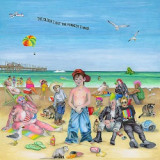
The third and most seasoned Drugdealer album, Hiding In Plain Sight, almost didn't happen at all. Frustrated and insecure with his own singing voice prior to the pandemic, Drugdealer founder and primary songwriter Michael Collins was nearly ready to throw in the towel. Due to a frequent impulse to hand over the microphone to friends and collaborators like Weyes Blood, Jackson MacIntosh, and his trusty musical companion Sasha Winn, Collins became increasingly unsure of himself as a singer. While attending Mexican Summer's annual Marfa Myths festival, a chance encounter with artist and composer Annette Peacock changed his outlook. Collins says, "I was so inspired by Annette. But similarly to all these other vocalists I'd worked with, I didn't feel like I had it in me." he recalls. "I told her my plight, then I played her a song, and she told me I wasn't singing high enough for my speaking voice. When I returned to LA, I started coming up with new progressions, which I'd modulate up three half steps. It forced me to find a new way to sing." "Madison," is the first song Collins wrote singing in this suggested range. His newfound confidence as a yarn-spinning vocalist in the gruff tenor tradition of Nick Lowe, or even Van Morrison, is readily apparent, with Conor "Catfish" Gallaher's pedal steel adding a dusting of cosmic country to Collins' down-hard love song. When Collins wrote the would-be AM Gold hit, he was summoning an imaginary vision of a love that had eluded him in reality. Tim Presley sings on the second song, "Baby," and Collins had a clear role in mind for the California avant-rock mainstay. "I love White Fence so much, but I also wanted to hear Presley sing a song that sounded like an early '60s sock hop band who had never tried drugs in their life." Meanwhile, Kate Bollinger floats an effervescent lead vocal over the Rhodes-driven groove in “Pictures of You.”. Taking inspiration from a canon of gruff but soulful rock vocalists like Phil Lynott, Collins looks back on his nocturnal meanderings through LA's warrens of bars and clubs ("New Fascination"). He’s right up front in the mix, detailing a search for love in all the wrong places.
Buscar:her friends
As three souls plunge down from the heavens, death and destruction can be felt hanging in the air like a foul stench. Red clouds swirl around a black sun that never sets and an erratic clock ticks off-tempo, moving faster and slower before rewinding and starting anew.
“Let me paint you a picture…” vocalist Mikey Arthur sings, welcoming listeners with a dramatic opening scene. It takes a skillful guide to navigate the darkest depths of hell. And, as The Gloom In The Corner depict in their second full-length album Trinity, death is merely the beginning of the series of chilling adventures
Purposefully aligning their song count with unlucky number thirteen – a reoccurring symbol in the ever-unfolding Gloom Cinematic Universe or GCU – it comes as little surprise to longtime fans that each of the Australian quartet’s enticing tracks intertwine to form an interlocking tale; this time centered around the appropriately labeled unholy trinity.
Comprised of previously deceased characters Rachel Barker, Ethan Hardy, and Clara Carne, the group’s bloody battle is woven throughout the album as the anti-heroes determinedly claw their way back to Earth from the Rabbit Hole dimension, slashing, shooting, and extinguishing anyone who dares to oppose their quest. Yet, for the Girl of Glass, Ronin, and Queen of Misanthropy, there is clearly more to the story than what can be contained within a single package.
Projecting a wide and complex web of lore, plot twists, and tongue and cheek humor, frontman Mikey Arthur, guitarist Matt Stevens, bassist Paul Musolino, and drummer Nic Haberle, have been producing highly detailed concept releases since their formation. And, consistently filling in more missing pieces of the puzzle with every body of work, the band equate each new record to a fresh season of The Umbrella Academy dropping on the streaming service of your choice. Because, just as a great TV series captivates viewers with its music and storytelling, the quartet’s work provides a complete experience designed to allow fans to check in with their favorite characters, all the while enjoying a cinematic new soundtrack.
For those just joining the GCU, as well as those looking for a quick refresh, 2016 debut album Fear Me introduced listeners to main protagonists Julian “Jay” Hardy, a Section 13 agent consumed by anger over his girlfriend Rachel’s death, and Jay’s gloom (later known as Sherlock Adaliah Bones), a demonic entity who at times takes over Jay’s body as a host vessel. 2017 EP Homecoming tells the tale of Jay’s brother Ethan, a war veteran suffering from PTSD, who upon discovering his brother’s struggle, kills himself as part of a Dante-style rescue mission to bring Rachel back to life. In 2019 EP Flesh and Bones, we’re introduced to Clara Carne, a past witness to one of Jay and Sherlock’s crimes, who instead of taking revenge, began a twisted love story with Sherlock, only to be murdered by his forced hand. And 2020’s Ultima Pluvia EP where we finally learn of Sherlock’s past as an ancient warlord under the tyrannical King Baphicho, and see Sherlock and Jay’s deaths ushered in by Section 13 opponent and New Order leader Elias DeGraver and his gloom Atticus Encey.
After 2016’s Fear Me, the band admit that their original intention was to jump straight into the events of Trinity before pivoting to create Homecoming, Flesh and Bones, and Ultima Pluvia. However, upon reflection, primary storywriter Mikey Arthur believes that pushing the timeline back actually provided greater opportunity for the group to properly flesh out the songs and plotlines for their sophomore studio record.
Indeed, while Trinity re-introduces the three central “heroes” of this new arc, it’s important to understand that while familiar, the characters are not carbon copies of who they were earlier in the story. And neither is the band who brought them to life.
Fully embracing the weird and whacky has never been a struggle for The Gloom In The Corner. Rather, it’s together with this attitude that the group come away with special moments such as the fascinating old and new dynamic between neighboring tracks “Red Clouds” – a song whose initial version predates the formation of The Gloom In The Corner as an official band – and “Gravity” in which a demo intended for future material was adjusted to fit the sonic drop.
Mirroring this evolution in the band’s musical approach, a sense of growth can also be seen projected in the characters and story that the quartet chronicle across the thirteen tracks.
Classifying their individual sound as an intricate form of “cinema or theater-core” due to the depth and breadth of their musical approach, features, samples, symphonic elements, and conceptual nature, The Gloom In The Corner continue to prove that they’re more than just a simple concept band.
In fact, similar to character theme music in movies and video games, the group seamlessly play off their diverse sonic story in a variety of ways. Continuing to breathe new life into older staples from their catalog, the quartet reworked their infamous “Oxymøron” breakdown from Fear Me into an impactful moment in Trinity’s “Nor Hell A Fury” and sprinkled audio easter eggs of this sort all throughout their new music for fans to discover.
Listeners are also brought further into the world of the GCU with the help of what The Gloom In The Corner call their “casting process.” Like picking actors for a musical, the band meticulously selected eleven different vocal features and several additional voice actors to bring the album and characters to life. Described as a 50/50 split between notable talents such as Ryo Kinoshita (Crystal Lake), Joe Badolato (Fit For An Autopsy), and Lauren Babic (Red Handed Denial), as well as talented friends and family like Elijah Witt (Cane Hill) and Mikey’s sister Amelia Duffield, each featured artist brought their own touch and realistic spark to the characters they portrayed.
For in the end, as much as Trinity and it’s cast live within the confines of their own supernatural worlds, themes such as falling out of love (Gatekeeper), battling depression (Obliteration Imminent), and standing behind women’s empowerment (Nor Hell A Fury), are ones that many can relate to or understand. And, while most individuals may avoid drowning their woes by way of transforming into full-on egotistical murderers like the Queen and King of Misanthropy and the gang, The Gloom In The Corner have illustrated that time and time again, life’s a little more fun when you can crack a smile. Taking a page from the trinity’s playbook: try to avoid the end of the world. But if you can’t…at least spend it with a killer soundtrack.
2022 repress.
Monopolis.
It is in this fictional capital of the West, imagined by Michel Berger for Starmania, that the Pirouettes have decided to settle down to write their second long format: an album that wants to be more narrative, giving pride of place to storytelling, whether in the form of a love story, a true/false diary, or even... an oriental tale.
A perspective, a decentring and a will to open up which is also felt in terms of composition, since the duo has this time collaborated with several musician friends (Dodi El Sherbini, Lewis OfMan, Krampf, or Vaati). A way of renewing themselves of course, but above all of surpassing themselves, and of keeping ahead of the competition.
Oliver Johnson alias Dorian Concept veröffentlicht am 28. Oktober 2022 sein neues Album, „What We Do For Others“, auf Brainfeeder. Es ist das dritte Studioalbum des österreichischen Produzenten und Synthesizer-Experten, der für seine einzigartigen, wunderschön detaillierten Klangteppiche und wilden, gar euphorisierenden Live-Keyboard-Jam-Videos bekannt ist.
„What We Do For Others“ ist ein entspanntes, ruhiges, selbstbewusstes und intimes Album, das auf herrlich lockeren Arrangements und rückgekoppelten Klanglandschaften basiert und mit Fetzen seines eigenen verfremdeten Gesangs unterlegt ist, der eher als zusätzliche Instrumentierung denn als lyrische Phrasen präsentiert wird. Alle Elemente und Schichten wurden ohne Unterbrechungen aufgenommen und absichtlich nicht bearbeitet. „Ich glaube, deshalb hat diese Platte so etwas wie einen ‚Bandsound‘.“, erklärt Johnson. „Ich spiele alle Arten von Tasteninstrumenten, singe und benutze Effektgeräte, um diese freien Kompositionen zu schaffen.“ Der in Wien lebende Johnson ist ein fester Bestandteil der experimentellen Jazz-/ Elektronik-Szene, die im Umfeld von Brainfeeders Aushängeschild Flying Lotus floriert und sich diversifiziert hat. Mit frühen Veröffentlichungen auf dem Kindred Spirits-Label Nod Navigators und Affine Records spielte Johnson bei den ersten internationalen Label-Nächten von Brainfeeder im Jahr 2009 (Off-Sónar in Barcelona und die berüchtigte Hearn Street Car Park-Session in London) und bildete eine starke familiäre Bindung mit der Brainfeeder-Crew, die auf der gemeinsamen Liebe zu freaky Elektronik-Jazz-Fusion beruht. Johnson war an der Produktion von Thundercats „The Golden Age Of Apocalypse“ beteiligt, spielte die Tasten auf Flying Lotus' bahnbrechendem Album, „Cosmogramma“, und tourte mit den Live-Bands von FlyLo und The Cinematic Orchestra. Außerdem steuerte er die Tasten auf MF DOOMs „Lunchbreak“ bei, das von FlyLo und Thundercat produziert wurde. Kürzlich arbeitete er mit Kenny Beats an dessen Debütalbum, „Louie“, zusammen, wobei er bei drei Stücken die Tasten beisteuerte, und tat sich mit einem weiteren Pionier zukunftsorientierter Elektronik - Mark Pritchard - zusammen, um Musik für Damien Jalets zeitgenössische Tanzperformance, „Kites“, an der Göteborger Oper zu komponieren. Im Jahr 2020 arbeitete Oliver mit einem der weltweit führenden Ensembles für zeitgenössische Musik zusammen, dem Klangforum Wien, und komponierte ein Stück namens „Hyperopia“, das beim TRANSART Festival in Österreich aufgeführt wurde. Johnson veröffentlichte sein Debütalbum, „Joined Ends“, 2014 auf Ninja Tune, bevor er 2018 auf Brainfeeder landete, um „The Nature Of Imitation“ zu veröffentlichen: ein Album mit schwindelerregenden Partituren, kakophonischen Breakdowns und formidablen Rhythmen, von denen Pitchfork schwärmte: „Dorian Concept schafft etwas, das Elektro-Funk-Autoren der 70er und 80er Jahre wie Kraftwerk, George Clinton und Roger Troutman angedeutet haben: Computermusik, die den Funk unverhohlen imitiert, anstatt ihn nur zu faken.“.
The five tracks that became Abbondanza all materialized from Summer to Winter of 2020, a time of unprecetended productivity in the home studio. Some of them developed from first time fiddlings on new synthesizers, some from unaccompanied jams on percussion instruments. I hope these tracks capture my naive fascination and joyful jamming I had while creating them.My Florentine friends of the Intro-Spettiva collective introduced me to the concept of "stalla" (stables) - their codeword for a proper party. At a particularly memorable Tuscan stalla in 2019, I got to know Edizioni Mondo head Francesco de Bellis and his amazing music. A year later, we listened to the first demos of this record in his damp basement studio close to Vatican City and here it is in all its abundance!
The Older I Get, the Funnier I Was, which follows Thomas’ brilliant 2020 HBO special The Golden One and his Can't Believe You're Happy Here EP released earlier this year, surveys a range of emotion and offers a broad sonic palette, moving between pop punk, electro, and the obvious influence of the singer-songwriters he grew up listening to in early childhood. It conjures the ennui of Bright Eyes alongside the barefaced storytelling of John Prine, the overstuffed lists of Fred Thomas with the lackadaisical humor of Colleen Green, among many others.
Thomas attributes the dexterity of the record to Duterte, who recorded and engineered most of it in addition to serving up plenty of encouragement when Thomas got down on the process. “As a comic, I used to test out new songs during sets to see if the funny bits were hitting, but since I wrote this in isolation I ended up writing lyrics and worrying less about making jokes,” Thomas says. That said, the album’s plenty funny. Stand-out and lead single “Rigamarole” opens with a Thomas-voiced infomercial that recalls his oft-cited lookalike Jim Carrey as the Grinch, before launching into a buoyant pop song about being depressed.
Whitmer Thomas will admit that when he traveled home to small town Gulf Shores, Alabama to record his HBO stand-up special, The Golden One, he expected to be greeted as a returning hero, a conquering king, or at minimum, a guy with a moderately successful career as an entertainer in Los Angeles. “I expected a big welcome home, open arms, but when I went back I realized: nobody fucking knows me. Nobody remembers me,” Thomas says. “In the years I’d been performing that show, I’d been romanticizing my childhood in this mythologized place, but the visit made me see that I’m not really from there anymore.”
The sense of alienation compounded when Thomas recognized how few people in town remembered his mom, to whom The Golden One is dedicated and largely about. Thomas grew up watching her perform with her twin sister at the legendary Flora-Bama Lounge, where he set the special, and still counts her as one of his musical influences. His new album, The Older I Get, the Funnier I Was, isn’t overtly about his mom, her presence is deeply felt throughout. While in Gulf Shores, Thomas discovered dozens of her old recordings, all of which had been wrecked by Katrina, but upon returning to LA, Thomas paid “a fancy place in Hollywood” to fix the tapes and hired Melina Duterte (Jay Som, Bachelor, Routine) to mix them. The two struck up a collaborative friendship, and Thomas had the sound of his mom’s voice back. “I was listening to songs she recorded when she was about my age, just these heartfelt, sweet Americana songs,” he says. “I decided then that I wanted to lose the Ian Curtis voice I always sing with; I wanted to do what came naturally, because my mom always sounded like herself, even when she was singing some cheesy reggae song about, like, Jamaica.”
Thus he went into The Older I Get, the Funnier I Was knowing it was time to retire his darkwave persona, and leaning into his natural, chirpier voice, which he says sounds “like a 12-year-old’s.” It makes sense: much of the album chronicles what Thomas calls “being a kid and feeling like you have no control and overcompensating by being annoying.” “So much of the album is about witnessing drug and alcohol addiction as a kid and seeing what it does to people, but also realizing that there's nothing you can do about it,” Thomas says. It’s familiar territory (see: “Partied to Death”) but the methodology is different this time around; true to its title, The Older I Get, the Funnier I Was isn’t always looking for laughs. Thomas might’ve left his hometown behind, but his kid self is still tagging along, a Peter Pan shadow he can’t untether himself from. The first line he sings on The Older I Get, the Funnier I Was is: “There should be a room at every party where you can just sit and watch a movie.” Find a 12-year-old who wouldn’t say the same.
Massimiliano Pagliara returns to Permanent Vacation with his fourth studio album "See You In Paradise". After the highly acclaimed "Nothing Stays In One Place For Long" EP from 2020, this is the first full-length from the Italian-raised and Berlin-based producer for the label. Albums in the dance music genre can often be a challenge in terms of finding the right balance between the dancefloor and listening at home. Massimiliano, however, mastered this craftmanship perfectly while reviving the art of the album format.
Mostly written and produced in the lockdown period of spring 2020 these 10 tracks offer the whole sonic spectrum from the "Massi universe". The hardware enthusiast blends analogue-heavy and bright synthesizer melodies, pop hooks, Chicago house groove with more technoid tracks and atmospheric soundscapes. Taking you on a journey through his mind, body and soul: From his underground disco passion and pulsating dancefloor moments to ethereal and meditative ambience.
Inspired, both musically and aesthetically - one of his favourite carnal catchphrases titles the album - by Disco hero Patrick Cowley, Massimiliano channelled past, present and future in searching for new adventures within his music. For the first time working with live musicians (saxophone and piano) to bring a new facet on the table, that flows with the production seamlessly.
Communication and getting into a dialogue is a crucial part for Massimiliano as an artist. Whether it used to be as a ballet dancer, as a DJ, most prominently as a resident of the legendary Berghain / Panorama Bar, a producer and in collaboration with other artists and musicians: Maestro Massi has gathered an illustrious group of friends and like minded artist such as Snax, Fort Romeau and Init (with whom he has worked before), as well as new collaborators including Curses, Coloray and Vanessa. Under the artistic direction of Massimiliano each artist was able to bring his own unique talent into the album's coherent production and together with Massimiliano they created something that is more than the sum of its parts: A refuge full of beauty and harmony and free from worries in an upside down world. In other words: "See You In Paradise”
- A1: Rock This Mother
- A2: Talk To Me Girl
- A3: You Can Find Me
- A4: Check This Out
- A5: Jesus Going To Clean House
- A6: Hope You Understood
- A7: Is It What You Want
- A8: Love Is Everlasting
- A9: This Is Hip-Hop Art
- A10: Opposite Of Love
- A11: Do You Know What I Mean
- B1: Saving All My Love For You
- B2: Look Out Here I Come
- B3: Girl You Always Talking
- B4: Have A Great Day
- B5: Take My Hand
- B6: I Need Your Love
- B7: Your Town
- B8: Talk Around Town
- B9: Booty Head/Take A Little Walk
- B10: I Love My Mama
- B11: I Never Found Anyone Like You
Vinyl LP[23,49 €]
As the sun sets on a quaint East Nashville house, a young man bares a piece of his soul. Facing the camera, sporting a silky suit jacket/shirt/slacks/fingerless gloves ensemble that announces "singer" before he's even opened his mouth, Lee Tracy Johnson settles onto his stage, the front yard. He sways to the dirge-like drum machine pulse of a synth-soaked slow jam, extends his arms as if gaining his balance, and croons in affecting, fragile earnest, "I need your love… oh baby…"
Dogs in the yard next door begin barking. A mysterious cardboard robot figure, beamed in from galaxies unknown and affixed to a tree, is less vocal. Lee doesn't acknowledge either's presence. He's busy feeling it, arms and hands gesticulating. His voice rises in falsetto over the now-quiet dogs, over the ambient noise from the street that seeps into the handheld camcorder's microphone, over the recording of his own voice played back from a boombox off-camera. After six minutes the single, continuous shot ends. In this intimate creative universe there are no re-takes. There are many more music videos to shoot, and as Lee later puts it, "The first time you do it is actually the best. Because you can never get that again. You expressing yourself from within."
"I Need Your Love" dates from a lost heyday. From some time in the '80s or early '90s, when Lee Tracy (as he was known in performance) and his music partner/producer/manager Isaac Manning committed hours upon hours of their sonic and visual ideas to tape. Embracing drum machines and synthesizers – electronics that made their personal futurism palpable – they recorded exclusively at home, live in a room into a simple cassette deck. Soul, funk, electro and new wave informed their songs, yet Lee and Isaac eschewed the confinement of conventional categories and genres, preferring to let experimentation guide them.
"Anytime somebody put out a new record they had the same instruments or the same sound," explains Isaac. "So I basically wanted to find something that's really gonna stand out away from all of the rest of 'em." Their ethos meant that every idea they came up with was at least worth trying: echoed out half-rapped exhortations over frantic techno-style beats, gospel synth soul, modal electro-funk, oddball pop reinterpretations, emo AOR balladry, nods to Prince and the Fat Boys, or arrangements that might collapse mid-song into a mess of arcade game-ish blips before rallying to reach the finish line. All of it conjoined by consistent tape hiss, and most vitally, Lee's chameleonic voice, which managed to wildly shape shift and still evoke something sincere – whether toggling between falsetto and tenor exalting Jesus's return, or punctuating a melismatic romantic adlib with a succinct, "We all know how it feels to be alone."
"People think we went to a studio," says Isaac derisively. "We never went to no studio. We didn't have the money to go to no studio! We did this stuff at home. I shot videos in my front yard with whatever we could to get things together." Sometimes Isaac would just put on an instrumental record, be it "Planet Rock" or "Don't Cry For Me Argentina" (from Evita), press "record," and let Lee improvise over it, yielding peculiar love songs, would-be patriotic anthems, or Elvis Presley or Marilyn Monroe tributes. Technical limitations and a lack of professional polish never dissuaded them. They believed they were onto something.
"That struggle," Isaac says, "made that sound sound good to me."
In the parlance of modern music criticism Lee and Isaac's dizzying DIY efforts would inevitably be described as "outsider." But "outsider" carries the burden of untold additional layers of meaning if you're Black and from the South, creating on a budget, and trying to get someone, anyone within the country music capital of the world to take your vision seriously. "What category should we put it in?" Isaac asks rhetorically. "I don't know. All I know is feeling. I ain't gonna name it nothing. It's music. If it grabs your soul and touch your heart that's what it basically is supposed to do."
=
Born in 1963, the baby boy of nine siblings, Lee Tracy spent his earliest years living amidst the shotgun houses on Nashville's south side. "We was poor, man!" he says, recalling the outhouse his family used for a bathroom and the blocks of ice they kept in the kitchen to chill perishables. "But I actually don't think I really realized I was in poverty until I got grown and started thinking about it." Lee's mom worked at the Holiday Inn; his dad did whatever he had to do, from selling fruit from a horse drawn cart to bootlegging. "We didn't have much," Lee continues, "but my mother and my father got us the things we needed, the clothes on our back." By the end of the decade with the city's urban renewal programs razing entire neighborhoods to accommodate construction of the Interstate, the family moved to Edgehill Projects. Lee remembers music and art as a constant source of inspiration for he and his brothers and sisters – especially after seeing the Jackson 5 perform on Ed Sullivan. "As a small child I just knew that was what I wanted to do."
His older brother Don began musically mentoring him, introducing Lee to a variety of instruments and sounds. "He would never play one particular type of music, like R&B," says Lee. "I was surrounded by jazz, hard rock and roll, easy listening, gospel, reggae, country music; I mean I was a sponge absorbing all of that." Lee taught himself to play drums by beating on cardboard boxes, gaining a rep around the way for his timekeeping, and his singing voice. Emulating his favorites, Earth Wind & Fire and Cameo, he formed groups with other kids with era-evocative band names like Concept and TNT Connection, and emerged as the leader of disciplined rehearsals. "I made them practice," says Lee. "We practiced and practiced and practiced. Because I wanted that perfection." By high school the most accomplished of these bands would take top prize in a prominent local talent show. It was a big moment for Lee, and he felt ready to take things to the next level. But his band-mates had other ideas.
"I don't know what happened," he says, still miffed at the memory. "It must have blew they mind after we won and people started showing notice, because it's like everybody quit! I was like, where the hell did everybody go?" Lee had always made a point of interrogating prospective musicians about their intentions before joining his groups: were they really serious or just looking for a way to pick up girls? Now he understood even more the importance of finding a collaborator just as committed to the music as he was.
=
Isaac Manning had spent much of his life immersed in music and the arts – singing in the church choir with his family on Nashville's north side, writing, painting, dancing, and working various gigs within the entertainment industry. After serving in the armed forces, in the early '70s he ran The Teenage Place, a music and performance venue that catered to the local youth. But he was forced out of town when word of one of his recreational routines created a stir beyond the safe haven of his bohemian circles.
"I was growing marijuana," Isaac explains. "It wasn't no business, I was smoking it myself… I would put marijuana in scrambled eggs, cornbread and stuff." His weed use originated as a form of self-medication to combat severe tooth pain. But when he began sharing it with some of the other young people he hung out with, some of who just so happened to be the kids of Nashville politicians, the cops came calling. "When I got busted," he remembers, "they were talking about how they were gonna get rid of me because they didn't want me saying nothing about they children because of the politics and stuff. So I got my family, took two raggedy cars, and left Nashville and went to Vegas."
Out in the desert, Isaac happened to meet Chubby Checker of "The Twist" fame while the singer was gigging at The Flamingo. Impressed by Isaac's zeal, Checker invited him to go on the road with him as his tour manager/roadie/valet. The experience gave Isaac a window into a part of the entertainment world he'd never encountered – a glimpse of what a true pop act's audience looked like. "Chubby Checker, none of his shows were played for Black folks," he remembers. "All his gigs were done at high-class white people areas." Returning home after a few years with Chubby, Isaac was properly motivated to make it in Music City. He began writing songs and scouting around Nashville for local talent anywhere he could find it with an expressed goal: "Find someone who can deliver your songs the way you want 'em delivered and make people feel what you want them to feel."
One day while walking through Edgehill Projects Isaac heard someone playing the drums in a way that made him stop and take notice. "The music was so tight, just the drums made me feel like, oh I'm-a find this person," he recalls. "So I circled through the projects until I found who it was.
"That's how I met him – Lee Tracy. When I found him and he started singing and stuff, I said, ohhh, this is somebody different."
=
Theirs was a true complementary partnership: young Lee possessed the raw talent, the older Isaac the belief. "He's really the only one besides my brother and my family that really seen the potential in me," says Lee. "He made me see that I could do it."
Isaac long being a night owl, his house also made for a fertile collaborative environment – a space where there always seemed to be a new piece of his visual art on display: paintings, illustrations, and dolls and figures (including an enigmatic cardboard robot). Lee and Issac would hang out together and talk, listen to music, conjure ideas, and smoke the herb Isaac had resumed growing in his yard. "It got to where I could trust him, he could trust me," Isaac says of their bond. They also worked together for hours on drawings, spreading larges rolls of paper on the walls and sketching faces with abstract patterns and imagery: alien-like beings, tri-horned horse heads, inverted Janus-like characters where one visage blurred into the other.
Soon it became apparent that they didn't need other collaborators; self-sufficiency was the natural way forward. At Isaac's behest Lee, already fed up with dealing with band musicians, began playing around with a poly-sonic Yamaha keyboard at the local music store. "It had everything on it – trumpet, bass, drums, organ," remembers Lee. "And that's when I started recording my own stuff."
The technology afforded Lee the flexibility and independence he craved, setting him on a path other bedroom musicians and producers around the world were simultaneously following through the '80s into the early '90s. Saving up money from day jobs, he eventually supplemented the Yamaha Isaac had gotten him with Roland and Casio drum machines and a Moog. Lee was living in an apartment in Hillside at that point caring for his dad, who'd been partially paralyzed since early in life. In the evenings up in his second floor room, the music put him in a zone where he could tune out everything and lose himself in his ideas.
"Oh I loved it," he recalls. "I would really experiment with the instruments and use a lot of different sound effects. I was looking for something nobody else had. I wanted something totally different. And once I found the sound I was looking for, I would just smoke me a good joint and just let it go, hit the record button." More potent a creative stimulant than even Isaac's weed was the holistic flow and spontaneity of recording. Between sessions at Isaac's place and Lee's apartment, their volume of output quickly ballooned.
"We was always recording," says Lee. "That's why we have so much music. Even when I went to Isaac's and we start creating, I get home, my mind is racing, I gotta start creating, creating, creating. I remember there were times when I took a 90-minute tape from front to back and just filled it up."
"We never practiced," says Isaac. "See, that was just so odd about the whole thing. I could relate to him, and tell him about the songs I had ideas for and everything and stuff. And then he would bring it back or whatever, and we'd get together and put it down." Once the taskmaster hell bent on rehearsing, Lee had flipped a full 180. Perfection was no longer an aspiration, but the enemy of inspiration.
"I seen where practicing and practicing got me," says Lee. "A lot of musicians you get to playing and they gotta stop, they have to analyze the music. But while you analyzing you losing a lot of the greatness of what you creating. Stop analyzing what you play, just play! And it'll all take shape."
=
"I hope you understood the beginning of the record because this was invented from a dream I had today… (You tell me, I'll tell you, we'll figure it out together)" – Lee Tracy and Isaac Manning, "Hope You Understand"
Lee lets loose a maniacal cackle when he acknowledges that the material that he and Isaac recorded was by anyone's estimation pretty out there. It's the same laugh that commences "Hope You Understand" – a chaotic transmission that encapsulates the duality at the heart of their music: a stated desire to reach people and a compulsion to go as leftfield as they saw fit.
"We just did it," says Lee. "We cut the music on and cut loose. I don't sit around and write. I do it by listening, get a feeling, play the music, and the lyrics and stuff just come out of me."
The approach proved adaptable to interpreting other artists' material. While recording a cover of Whitney Houston's pop ballad "Saving All My Love For You," Lee played Whitney's version in his headphones as he laid down his own vocals – partially following the lyrics, partially using them as a departure point. The end result is barely recognizable compared with the original, Lee and Isaac having switched up the time signature and reinvented the melody along the way towards morphing a slick mainstream radio standard into something that sounds solely their own.
"I really used that song to get me started," says Lee. "Then I said, well I need something else, something is missing. Something just came over me. That's when I came up with 'Is It What You Want.'"
The song would become the centerpiece of Lee and Isaac's repertoire. Pushed along by a percolating metronomic Rhythm King style beat somewhere between a military march and a samba, "Is It What You Want" finds Lee pleading the sincerity of his commitment to a potential love interest embellished by vocal tics and hiccups subtlely reminiscent of his childhood hero MJ. Absent chord changes, only synth riffs gliding in and out like apparitions, the song achieves a lingering lo-fi power that leaves you feeling like it's still playing, somewhere, even after the fade out.
"I don't know, it's like a real spiritual song," Lee reflects. "But it's not just spiritual. To me the more I listen to it it's like about everything that you do in your everyday life, period. Is it what you want? Do you want a car or you don't want a car? Do you want Jesus or do you want the Devil? It's basically asking you the question. Can't nobody answer the question but you yourself."
In 1989 Lee won a lawsuit stemming from injuries sustained from a fight he'd gotten into. He took part of the settlement money and with Isaac pressed up "Saving All My Love For You" b/w "Is It What You Want" as a 45 single. Isaac christened the label One Chance Records. "Because that's all we wanted," he says with a laugh, "one chance."
Isaac sent the record out to radio stations and major labels, hoping for it to make enough noise to get picked up nationally. But the response he and Lee were hoping for never materialized. According to Isaac the closest the single got to getting played on the radio is when a disk jock from a local station made a highly unusual announcement on air: "The dude said on the radio, 107.5 – 'We are not gonna play 'Is It What You Want.' We cracked up! Wow, that's deep.
"It was a whole racist thing that was going on," he reflects. "So we just looked over and kept on going. That was it. That was about the way it goes… If you were Black and you were living in Nashville and stuff, that's the way you got treated." Isaac already knew as much from all the times he'd brought he and Lee's tapes (even their cache of country music tunes) over to Music Row to try to drum up interest to no avail.
"Isaac, he really worked his ass off," says Lee. "He probably been to every record place down on Music Row." Nashville's famed recording and music business corridor wasn't but a few blocks from where Lee grew up. Close enough, he remembers, for him to ride his bike along its back alleys and stumble upon the occasional random treasure, like a discarded box of harmonicas. Getting in through the front door, however, still felt a world away.
"I just don't think at the time our music fell into a category for them," he concedes. "It was before its time."
=
Lee stopped making music some time in the latter part of the '90s, around the time his mom passed away and life became increasingly tough to manage. "When my mother died I had a nervous breakdown," he says, "So I shut down for a long time. I was in such a sadness frame of mind. That's why nobody seen me. I had just disappeared off the map." He fell out of touch with Isaac, and in an indication of just how bad things had gotten for him, lost track of all the recordings they'd made together. Music became a distant memory.
Fortunately, Isaac kept the faith. In a self-published collection of his poetry – paeans to some of his favorite entertainment and public figures entitled Friends and Dick Clark – he'd written that he believed "music has a life of its own." But his prescience and presence of mind were truly manifested in the fact that he kept an archive of he and Lee's work. As perfectly imperfect as "Is It What You Want" now sounds in a post-Personal Space world, Lee and Isaac's lone official release was in fact just a taste. The bulk of the Is It What You Want album is culled from the pair's essentially unheard home recordings – complete songs, half-realized experiments, Isaac's blue monologues and pronouncements et al – compiled, mixed and programmed in the loose and impulsive creative spirit of their regular get-togethers from decades ago. The rest of us, it seems, may have finally caught up to them.
On the prospect of at long last reaching a wider audience, Isaac says simply, "I been trying for a long time, it feels good." Ever the survivor, he adds, "The only way I know how to make it to the top is to keep climbing. If one leg break on the ladder, hey, you gotta fix it and keep on going… That's where I be at. I'll kill death to make it out there."
For Lee it all feels akin to a personal resurrection: "It's like I was in a tomb and the tomb was opened and I'm back… Man, it feels so great. I feel like I'm gonna jump out of my skin." Success at this stage of his life, he realizes, probably means something different than what it did back when he was singing and dancing in Isaac's front yard. "What I really mean by 'making it,'" he explains isn't just the music being heard but, "the story being told."
Occasionally Lee will pull up "Is It What You Want" on YouTube on his phone, put on his headphones, and listen. He remembers the first time he heard his recorded voice. How surreal it was, how he thought to himself, "Is that really me?" What would he say to that younger version of himself now?
"I would probably tell myself, hang in there, don't give up. Keep striving for the goal. And everything will work out."
Despite what's printed on the record label, sometimes you do get more than one chance.
South-east Turkey born DJ, sound artist and producer Banu uses music as a political tool. For her, the strong message carried through sound is a vehicle to express emotions as well as a means of fighting against oppression. Using participation, social design, ecology, feminist and queer theory to create multimedia installations with sound as a main element, Banu‘s practice is closer to contemporary art and activist spaces than the club realm.
Banu‘s debut album TransSoundScapes is an exercise in female solidarity between her as a migrant woman and her sisters from the trans community, where an artist from one marginalised group is showing support towards her trans sisters, using her platform to help them amplify their voices and building a bridge towards a mutual understanding of femininity.
Conceptually, TransSoundScapes comes in continuation of Banu‘s previous research-based work, using music as a positive tool for change while working with various marginalised communities. The album originated from the very real experience of being confronted with verbal harassment in Berlin on a daily basis, particularly aimed at her transfeminine friends and companions. As a queer woman of Turkish and Kurdish origin, Banu did not only observe the verbal aggression directed at her friends, but also understood most of the insults shouted in languages such as Arabic. Seeing how she got signifi cantly more verbal violence directed at them when in company of trans people made a lasting impression on her, so she wanted to try and use her relative privilege to amplify transfeminine voices through her music.
Coming from a very conservative family, making music has been her lifelong dream. It was the moment she had the opportunity to work with the iconic Arp 2600 synthesiser (a younger sibling to Eliane Radigue‘s infamous 2500 machine) that all her disparate interests came into place to create an empowering soundscape with the aid of analogue drum machines. TransSoundScapes has a very full, porous sound, where every element that comes into play sounds soft yet clear. Across the 7 tracks, Banu conjures pounding subterraneous bassy techno („Surgery“), slithering tentacular EBM („First Time“) and pulsating cavernous soundscapes („Harem“), where oversized dancefl oor elements are woven with poetic spoken word passages, resulting in sensusous yet political anthems. Banu artfully merges loosely related genres such as techno, electro, dub and sound poems into a sound that is at once deeply personal and extremely compelling.
All of the tracks are collaborative efforts, Banu seeing the process as an exchange of care and shared experiences, while integrating research into her writing process. The lyrics in „Transition (part 1+2)‘‘ are an adaptation of Sara Ahmed’s “Living a Feminist Life”, while „Surgery“ was born out of series of interviews with trans people, channeling the metallic sounds of a surgery room to refer to society‘s perception of transness as a medical condition. Tracks like „First Time feat. Patricia“, „Harem feat. Prince Emrah“ or „We feat. Aérea Negrot“ document her encounters with various trans women, centering their life experiences while also developing a deep dialogue through the process of making music together.
The darkest and perhaps the most emblematic track is ‚‘Bianka (In Memory Of)‘‘, dedicated to the late Bianka Shigurova, a 22-year old Georgian actress found dead in her apartment. It was her Tbilisi photographer friend George Nebriedze who told her Bianka‘s tragic story, whose death is suspected to be an assasination due to transphobia. Banu chose one of Nebriedze‘s analogue photos of Bianka as the album‘s cover art.
High quality, 2 x 180g pink marbled vinyl, gatefold sleeve and download
code containing the digital album in multiple formats. Singer Nishla
Smith creates vivid, enigmatic stories through sound, her voice stretching
from melancholic sweetness through to dark intimacy
Her debut album 'Friends with Monsters' confirms Smith as a major new vocal
talent and sees the vocalist's affinity for inventive narratives extended over the
span of a full album. The Australian performer travelled via Berlin to eventually
settle in Manchester and is joined here by some of the city's most talented
improvisers. Richard Jones and Johnny Hunter cover piano and drums
respectively, whilst bassist Joshua Cavanagh-Brierley and trumpeter Aaron Wood
add graceful touches to complete the quintet's intimate feel. Smith's depictions of
night-time have an enigmatic quality, inviting listeners on an atmospheric journey
but all the while pointing to something greater.
Smith's work moves swiftly through genres, driven by her unique artistry. A City
Music Foundation artist, she has received commissions from Manchester
Collective and Opera North, as well as Manchester Jazz Festival and Jazz North.
As co-creator of theatre company Ulita, she also creates collaborative pieces that
blend theatre, music and visual arts. 'Friends with Monsters' continues that
theatrical drive - "I'm a very natural storyteller, I just love to tell stories. I find
myself weaving everyday events into tales that are very narratively pleasing."
Set over the course of a single evening, 'Friends with Monsters' explores changing
states of insomnia, informed by Smith's own sleepless nights. It's realised in four
distinct sections; each is introduced by a scene-setting interlude. Delving deeper
into the dreamy world of Smith's storyland rewards greatly.
In the five years since, Larsen has moved across the country, studied philosophy
at a small liberal arts college, dropped out, and then moved across the country
again. Their life was also put on pause after the sudden death of their first love.
“This loss left so many people with so many unanswered questions, myself
included. I haven’t always arrived at answers to these questions, but songwriting
has provided me with a way to at least ask.” The first voice we hear on Good Grief
does not belong to Larsen, but to their first love. “Ready?” she asks. As if to
answer her, the album begins with an audio recording from 2013 of Larsen and
their high school friends singing Sufjan Stevens’ song "The Predatory Wasp Of
The Palisades Is Out To Get Us!" around a campfire. “When the record starts and
my ex says “ready?” there’s a part of me that feels like - in some way - she’s
asking grown-up-me if I’m “ready” to share my songs about grief now.” Good Grief
captures a coming-of-age story - of an artist and of a human being - as they try to
navigate the terrain of their existence and that of those around them. It’s an
experience of their loss but also honours the person that was lost to them. The
record closes with a reprise of the “Wasps” audio recording, marrying the past
and present as the old voice memo slowly fades into a newer one. Present-day
Larsen sings, “I can tell you I love her each day”: a testament to the fact that their
grief is-- finally--good.Packaging: LP Opaque "Yellowjacket" LP, with cover mount
marketing sticker
Both Aesop Rock and Homeboy Sandman are regarded as top tier lyricists known for pushing the envelope of creativity in their writing, while covering a wide range of topics and moods. However, sometimes things are inherently simple. Take for example, the origin of their collaboration, born from a mutual appreciation for each other as artists Which became fully realized when Aesop Rock invited Homeboy Sandman to join him on tour in 2015. Traveling the country together, they built a connection beyond the music, resulting in a friendship that led to recording a few songs together, and before they knew it, there was an infestation...Lice. Initially released in 2015 as a free direct download, followed by an extremely limited vinyl pressing sold exclusively on tour, Aesop Rock and Homeboy Sandman's Lice is finally available to fans everywhere. The first in a series of EP releases, Lice featured production from DJ Spinna, Optiks, Blockhead, Alex "Apex" Gale and Mike Shinoda. The original cover art was designed by renowned illustrator Jeremy Fish.
Based in Winnipeg, Manitoba, an "inland island that floats on infinite
prairie ground," Living Hour has always been a band that's thrived in
seclusion.Helping to foster a thriving local community, and taking
inspiration from the faces and places of their hometown, the band have
always been motivated by the belief that their own music only gets more
interesting when it includes other voices
For their new album, Living Hour called upon friends from near and far.
The result is "Someday Is Today", the band's third full-length effort and the muchanticipated follow- up to their 2019 "Softer Faces" LP, acclaimed by the likes of
NPR, Stereogum, Paste, Vice, Bandcamp, and more. On "Someday Is Today", the
group's sound is collaborated with a variety of drummers including Jason Tait
(The Weakerthans, Broken Social Scene) and is fleshed out further with the help
of three producers: Melina Duterte (Jay Som, Bachelor, Chastity Belt), Jonathan
Schenke (Parquet Courts, Snail Mail, The Drums), and Samur Khouja (Cate le Bon,
Deerhunter, Regina Spektor) all of whom impart their own backgrounds on the
album's finished glow.
"Someday Is Today" is Living Hour at their most pensive and longing. It was
recorded over seven straight days during the dark depths of a Manitoba winter,
with the band cocooned in the sounds they were making as the temperature hit
-30 outside the door. The album thrives by keeping just enough connection
across its varied palettes to feel like one cohesive world. Whether it's the album's
soft and gorgeous harmonies or the captured sound of wind tubes being swung
above their heads, the songs here feel bound by something bigger than
themselves; an energy that flourished in spite of it all, a human connection that
grips just strongly enough even when pushed to its frayed, unreachable extremes.
Canary Yellow vinyl[29,71 €]
Freedy Johnston is one of those rare singer-songwriters who counts
critics among his biggest fans — and whose heroes consider him a peer.
Not bad for a self-proclaimed "geek in glasses who never left his room."
Johnston's 9th album, 'Back on the Road to You' is a record steeped in
wit, humor, pathos, love, and friendship drenched with memorable,
infectious melodies
Johnston recorded the album in Los Angeles with producer Eric Corne after
setting up house in nearby Joshua Tree. The new surroundings seem to have
imbued the album's mood and instrumentation with echoes of The Byrds,
Jackson Browne, Joni Mitchell, and Neil Young. Joining Johnston in the studio
were Aimee Mann, Susanna Hoffs of The Bangles, and longtime collaborator,
Susan Cowsill, along with an all-star roots music band, including Doug Pettibone
(Lucinda Williams), Dusty Wakeman (Jim Lauderdale), Dave Raven (Shelby Lynn)
and Sasha Smith (Priscilla Ahn).In 1994 Rolling Stone named Johnston the
'Songwriter of the Year', describing him as "A master storyteller, (who) sketches
out full- blown tragedies in a few taut poetic lines." Adding, "He joins that elite
cadre of songwriters—Bob Dylan, Neil Young, Elvis Costello—whose brilliant pop
compositions turn magical with the addition of a defiantly idiosyncratic singing
voice."
'Back on the Road to You' is a return to grace for this gifted songwriter. It
embodies the sound of an American original reminding us that he is still
considered one of the best songwriters of his generation.
Black Vinyl[26,01 €]
Freedy Johnston is one of those rare singer-songwriters who counts
critics among his biggest fans — and whose heroes consider him a peer.
Not bad for a self-proclaimed "geek in glasses who never left his room."
Johnston's 9th album, 'Back on the Road to You' is a record steeped in
wit, humor, pathos, love, and friendship drenched with memorable,
infectious melodies
Johnston recorded the album in Los Angeles with producer Eric Corne after
setting up house in nearby Joshua Tree. The new surroundings seem to have
imbued the album's mood and instrumentation with echoes of The Byrds,
Jackson Browne, Joni Mitchell, and Neil Young. Joining Johnston in the studio
were Aimee Mann, Susanna Hoffs of The Bangles, and longtime collaborator,
Susan Cowsill, along with an all-star roots music band, including Doug Pettibone
(Lucinda Williams), Dusty Wakeman (Jim Lauderdale), Dave Raven (Shelby Lynn)
and Sasha Smith (Priscilla Ahn).In 1994 Rolling Stone named Johnston the
'Songwriter of the Year', describing him as "A master storyteller, (who) sketches
out full- blown tragedies in a few taut poetic lines." Adding, "He joins that elite
cadre of songwriters—Bob Dylan, Neil Young, Elvis Costello—whose brilliant pop
compositions turn magical with the addition of a defiantly idiosyncratic singing
voice."
'Back on the Road to You' is a return to grace for this gifted songwriter. It
embodies the sound of an American original reminding us that he is still
considered one of the best songwriters of his generation.
B. Bravo (aka Adam Mori) returns to Bastard Jazz with the long-awaited follow-up to his 2017 debut LP, "Paradise," with a fresh full-length offering: "Vizionz." Replete with his signature future funk vibes, infectiously soulful grooves, and talkbox excursions, "Vizionz" sees the multifaceted artist take the classic West Coast into outer space. If B. Bravo's last album sought to get lost in paradise - enjoying the moment here and now - "Vizionz" looks forward, feet placed firmly in an established LA vibe, while the matured eyes of a veteran producer gaze keenly to the future.
"Vizionz" arrives following a slew of diverse singles, which highlight B. Bravo's stunning versatility as a songwriter, producer, and collaborator. Last year's "Lifted (What U Waiting 4)" came first, at the end of May, 2020, pairing g-funk talk-box verses and synth lines with rich vocal harmonies and a dance-floor-ready beat. Frequent collaborator Reva DeVito (Miami Horror, Kaytranada) makes a standout vocal appearance on "Fly Bye," the second single. Here, Adam surrounds Reva's vocals with ambient pads, a Dilla-inspired beat, and an irresistible bassline, while Reva's dreamily sings about getting away from it all. The final single, "Believe," sees Chuck Inglish (of the famed duo The Cool Kids) rhyme in his distinctive baritone over a bass-heavy instrumental meant to rattle some car stereos.
The singles offer a view into the rest of the album: Solo B. Bravo joints include "Moon Bounce," a talk-box boogie jam begging for late-night drives with the top down; the largely-instrumental synth improvisation, "Midnight Rider;" the upbeat "Penelope," which showcases Adam's vocal and harmonic prowess; a bumping g-funk interlude, with "Flip Out;" as well as the laid back album opener, "Da Essence."
Further vocal assists come by way of Sally Green on the flirty "10/10," and Rojai on the slow jam ""No Regrets" . Both singers have worked on B. Bravo projects in the past, with Rojai additionally joining forces with Adam to form the duo Kool Customer, whose self-titled debut album was released on Bastard Jazz in 2018. Two more hip-hop-leaning tracks are aided by Def Sound ("Back Times Two") and Nico Fasho ("Ms. Stardust"); leaning heavy into outerspace G-Funk Hip-Hop vibes.
Taken as a whole, "Vizionz" is a much needed boost of serotonin: Uncompromisingly positive, sometimes nostalgic, sometimes aspirational, but always funky. The range of styles is a testament to Adam's indelible production chops, songwriting skill, and ability to collaborate. While it has been a long 5 years since "Paradise," "Vizionz" proves more than worth the wait.
Born and raised in California, with roots in Japan, B. Bravo's signature style of Cosmic Funk and late night synth grooves have made him a favorite among DJ's, dancers, and music lovers worldwide. A tasteful producer, sought after remixer, party rocking DJ, master of the talkbox, band leader, and alumnus of the Red Bull Music Academy, Mr. Bravo is an accomplished performer both at home and abroad.
Heavily inspired by the synthesizer-enhanced R&B grooves of the late '70s and early '80s, B. Bravo debuted in 2009 with the seven-track "Analog Starship" EP. A deeper impression was made the following year with a shorter extended play, "Computa Love," the title track of which was supported by BBC DJ Benji B months prior to release. Additional strides were made with a batch of singles and EPs that followed throughout the next few years, as Bravo toured and performed at numerous festivals around the world.
His relationship with the Brooklyn tastemaker label, Bastard Jazz Recordings, began in 2016 with the 7" single "I'm For Real / Stay The Night' (which notably featured a Mr. Carmack remix of the latter). Bravo's debut solo LP quickly followed with 2017's critically acclaimed "Paradise" - which shone a light on vocalists and frequent collaborators Reva DeVito, Trailer Limon, Kissey, and Lauren Faith - with a remix album appearing six months later.
Additional solo releases have found a home on Gilles Peterson's Brownswood Recordings and Frite Nite, while production credits have appeared on releases from the legendary Blue Note Records, HW&W, All City, Friends of Friends, and Tokyo Dawn. B. Bravo has worked on projects with the likes of Salva, Mr. Carmack, Teeko, DJ Lean Rock, Reva DeVito, Lauren Faith, and Kate Stewart.
Having toured throughout the US, Latin America, Europe and Asia, he's shared the stage with performers like Erykah Badu, Flying Lotus, DāM-FunK, Hudson Mohawke, at a world-spanning range of festivals such as Detroit Electronic Music Fest, HARD LA, Northern Nights, Laneway Singapore, Sonar in Barcelona, Snowglobe, SXSW, Basscoast, Do-Over, Low End Theory, Boiler Room, and Soulection.
B. Bravo's "Vizionz" LP is out on Brooklyn's Bastard Jazz Recordings Spring, 2022.
Repressed !
Raised on Colombia’s Caribbean coast and united by it’s capital, Bogota, Ghetto Kumbé combine the rich musical heritage of their home, to invoke the spirit of digital rumba in audiences all over the world. The secret behind their irresistible electronic sound lies in their powerful percussion base; Caribbean house beats and traditional afro-Colombian rhythms inherited from West Africa. The album’s co-producer, The Busy Twist, adds all the legacy of the UK’s Bass scene to the Afrofuturistic sounds of the 3 Colombians.
Inspired by the different revolutionary movements emerging all over the world, their self-titled debut is visceral, committed, and rebellious, denouncing through frantic rhythms the inequalities and abuses imposed by corrupt governments, while simultaneously enticing listeners to join in the fight. Dance mingles with awareness to create a global community, where family, friends, and strangers come together through our shared love of music and activate change amongst themselves.
Using musical motifs from Africa and Colombia’s Caribbean coast such as the gaita, call-and-response vocals, and an array of hand drums and rhythms, coupled with the elegant electronic production of Techno and House, Ghetto Kumbé creates an Afro-futurist soundscape with lyrics to motivate, elevate, and inspire. This has not gone unnoticed and they’ve played Barranquilla’s world-famous Carnival, Boiler Room, and have even opened for Radiohead.
- 1: バイババビンバ / Baibaba Bimba (2022 Remaster) 04:37
- 2: 鳴咽と歓喜の名乗り歌 / Oetsu To Kanki No Nanoriuta (Given Song By Sob And Joy) (0 Remaster) 07
- 3: まあるいひと / Marui Hito / Everyone (2022 Remaster) 04:17
- 4: ワン・スワン・スイム / One Swan Swim (2022 Remaster) 06:02
- 5: ウンバレパ! / Umbarepa! (2022 Remaster) 04:03
- 6: アビ、トラベルと / Abi And Travel (2022 Remaster) 03:14
- 7: ローリン・トレイン / Rolling Train (2022 Remaster) 04:44
- 8: うたがないのに / Uta Ga Nainoni / Like No Songs (2022 Remaster) 04:51
- 9: グッド.B / Good. B (2022 Remaster) 03:24
Just over a decade ago, Japanese indie-pop duo Tenniscoats recorded »Papa's Ear« (2012) and »Tan-Tan Therapy« (2007), two albums made with musical and production help from Swedish post-rock/folk trio Tape. Originally released on Häpna, they are beautiful documents of the exploratory music made by a close-knit collective of musicians, fully at ease with each other, playing songs written by Tenniscoats and arranging them in gentle and generous ways. Released during a prolific phase of collaboration for Tenniscoats – during the late ‘00s and early ‘10s, they would also collaborate with Jad Fair, The Pastels, Secai and Pastacas – they have, however, never been available on vinyl. In collaboration with Alien Transistor, Morr Music is now reissuing these albums with bonus material.
Filled with graceful pop songs, autumnal folk tunes, and gentle yet risk-taking improvisations, »Tan-Tan Therapy« was the first Tenniscoats album to be released in Europe, after a run of albums on Japanese labels, and the excellent »Live Wanderus« (2005) on Australian imprint Chapter Music. It was also the first recorded evidence of their collaboration with the three members of Tape and that group’s extended musical family. It opens with one of Tenniscoats’ signature songs, the pop fantasia of »Baibaba Bimba«, with Tenniscoats singer Saya repeating a light-headed incantation over joyous brass. The essence of Tenniscoats is contained in »Baibaba Bimba«: uplifting melody and playful musicianship, tinged with distant echoes of winsome melancholy.
From there, »Tan-Tan Therapy« explores many hues of lustrous blue. »Oetu to kanki no Namoriuta (Given Song of Sob and Joy)« is an aquatic arbour, the musicians’ gentle performances growing together like vines and seaweed as Saya’s voice swims through the waterway. »Umbarepa!« is full of play and pleasure, sparkling with glockenspiel as snare drum tattoos push the song ever-forward. »Abi and Travel« floats past, a lovely instrumental built from shifting layers of synthesizer and pianet; »Good B.«, an extra track originally only available on the Japanese edition of »Tan-Tan Therapy«, is added to this reissue, and follows a similar thread, its humming pump and Hammond organs swirling under beautiful vocals from Saya and guest performer Kazumi Nikaido.
Throughout, you can sense the deep empathy the members of Tenniscoats and Tape have for one another. It’s a conversational, tender and, at times, fragile music that can only be created out of mutual trust and kindness, with each of the players contributing to the community of sound they’re building. There’s an element here, too, of feeling out the possibilities of what this creative meeting can achieve, something reflected in the loose-limbs sprawl of »Marui Hifo (Everyone)«, which echoes the seaside drift of Bristol post-rock group Crescent, and the following »One Swan Swim«, a dreamsong redolent of the sleepy sensorium of Robert Wyatt’s »Rock Bottom«.
The freedom and liberty at the heart of Tenniscoats is something Tape and their friends have picked up on, beautifully so, and run with during the entirety of »Tan-Tan Therapy«. This is music with its wings outstretched, wanting to take to the air, ready to fly.
Quality over quantity. That’s what characterises Shamek Farrah and Norman Person’s recorded output. They may have a small discography between them but it’s a stable of recordings that centrally locate them in the development of the black jazz of America. BBE Music is delighted to present a new edition of a rare, relatively unknown, and unheard gem. Recorded between 1988 and 1991 across a series of concerts, ‘Live’ was released in 1991 and was only available for sale at their gigs. Issued on audio cassette on Farrah’s private Heritage Industries label, ‘Live’ is a raw, uncompromising selection of deep, conscious jazz featuring three original compositions and two covers: ‘Aisha’, written by Person, was inspired by Person’s daughter and is a majestic joyous groove that extends out into a percussive jam; ‘Negative Forces’ is a fiercely paced hard bopper worthy of the Jazz Messengers. Written by Person, he tells how “it had to be like a torpedo, man. It had to come out strong and fight against those negative forces”. The one Farrah/Person co-write on the album is ‘Timeless Beings’, a short freeform improvisation that creates a distinct moment of space and light in an otherwise intensely focussed, yet highly accessible album. The two covers on the album reflect the instruments of the co-leaders: sax and trumpet. ‘Footprints’, the classic written by the Newark Flash himself, Wayne Shorter, and first heard on ‘Miles Smiles’ in 1967 is delivered deftly by Farrah and co. Here, the band pays a respectful yet adventurous rendition, with some superbly colourful piano from Sonelius Smith. The second cover is a tribute to the great trumpeter Clifford Brown, who died in a car accident in 1956, aged just 25. ‘I Remember Clifford’ written by Benny Golson, is handled with suitably delicate reverence. “I still listen to Clifford Brown today,” says Person. “He’s still my teacher.” On ‘Live’, saxophonist Farrah and trumpeter Person - friends for decades - capture an energy and vibration that is infused with the spirit of their youth – whether drawing on the hard bop of the late 50s and early 60s or the Afrocentric spiritual jazz of the early 70s, of which Farrah is intimately linked via his albums on Strata East, ‘Live’ is a document of two masters at work. ‘Live’ has flown under the radar to many a fan of prime black conscious and spiritual jazz but now BBE brings back this astonishing set by two giant talents accompanied by a group of musicians who shine with brilliance and verve. Available for the first time on CD, digital, and double vinyl set cut at 45rpm by the Grammy-nominated The Carvery mastering studio, ‘Live’ also comes with an extended interview with Shamek Farrah and Norman Person by Tony Higgins.
Auf „Tread“ steigert Ross From Friends die komplexen und gefühlsbetonten Qualitäten seines Produktionsstils, die Mixmag bereits dazu veranlassten, seine „eigenwillige Fingerfertigkeit“ zu loben, die „nicht nur dein Herz schmerzen lässt, sondern auch direkt aus deiner Brust tanzt“. „Tread“ ist eine Platte, die gleichzeitig glatt und melodisch, aber auch hervorragend tanzbar, nostalgisch und doch brillant modern ist, mit Anspielungen auf Sounds und Stile, die nicht so sehr reflektiert, sondern durch Weatheralls Linse gebrochen und neu kontextualisiert werden. Genauso einzigartig wie die Musik auf „Tread“ ist die Art und Weise, wie sie entstanden ist. Frustriert von den Arbeitsabläufen im kreativen Prozess, die bei der Aufnahme von Hardware und Instrumenten über einen Computer entstehen - die ständige Notwendigkeit, die Aufnahme zu starten und zu stoppen, alles zu speichern und zu katalogisieren - beschloss Weatherall, seine eigene Software zu schreiben und zu entwickeln. Das daraus resultierende Plugin mit dem Namen „Thresho“, das über Abletons Max For Live-Plattform erhältlich ist, startet die Aufnahme, sobald das Audiomaterial einen benutzerdefinierten Schwellenwert erreicht, und stoppt sie, sobald dieser Schwellenwert unterschritten wird, wobei die resultierenden Clips automatisch mit Zeitstempeln gespeichert und indiziert werden.