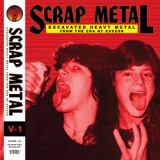
By now you’re probably familiar with our wildly popular Brown Acid series of rare, lost and unreleased proto-metal and stoner rock singles from the 60s-70s. In the endless pursuit of those glorious gems, we often uncover equally brilliant rarities from the late-70s to late-80s Golden Age of Heavy Metal that also just must be heard, but they don’t fit the series’ aesthetic. Scrap Metal, Volume 1 collects some of the greatest unknown and lost Heavy Metal tracks, long buried beneath the avalanche of the era’s classic output.
We all know the old adage that history is told by the winners. But sometimes the losers tell the best stories. And while none of these bands found fame and fortune, this artifact and the volumes to come are testament to the enduring power of heavy music. You can hear the blood, sweat and beers that went into each of these singles. The recordings may be low budget, but the inspiration and talent is immutable. Not only are the amps turned up to 11, the boyish sexual innuendo is cranked to 69. You can hear the convergence of influences — NWOBHM, thrash, glam metal, doom, etc — colliding at once as the era birthed a wellspring of subgenres.
Many of these singles are self-released and were thus limited to a small run of copies. Those that remain are hoarded by collectors and sold for exorbitant amounts. We’ve collected the best of the best for you here. As with Brown Acid, all of these tracks are licensed legitimately and the artists all get paid. Because it’s the right thing to do.
LINER NOTES:
Rapid Tears launch this series with the perfect christening. The Toronto, ON quintet’s 1981 single “Headbang” is such the pinnacle of heavy metal madness that it almost sounds like a spoof. There’s also enough of the rapid-fire sputum that inspired Metallica to bang the head that doesn’t, as such, engage in said practice, to be found on the band’s sole full length Honestly. But “Headbang” is a straightforward glammy anthem for the ages.
Air Raid’s “69 In A 55” may be lyrically so sophomoric that it’s actually pretty clever, but this 1983 Bay Area power metal single is loaded with sleek Judas Priest riffs and interwoven melodies that are downright sublime. The band’s sole release, the 2-song Rock Force 7” features a curious band photo in which 3 band members — dolled up in Crüe makeup and leather — are sexually menacing the lead singer/guitarist tied to a bed. Another low budget highlight is when singer/guitarist Tommy “Thrasher” Merry imitates a delay effect on his vocals as he sings, “tonight!...tonight...night.”
Hades’ “Girls Will Be Girls” has a real demo cassette feel to its vastly uneven mix, but the energy to the performance makes this an undeniable keeper. The long running Paramus, NJ quintet’s 1982 2- song debut 7” titled Deliver Us From Evil features this blistering thrasher dominated by shimmering leads and confident vocals that show why the band went on to near-fame on Metal Blade Records.
Resless don’t need no T to prove that they’ve got “The Power” with this 1984 driving mid-tempo rocker in the vein of Mötley Crüe and Ratt. The River Vale, NJ quartet’s tight crunch wails all over Bon Jovi posers but it’s the band’s unique and subtle deployment of background vocals that gives this rager its staying power.
Pittsburgh, the Steel City, is home to Don Cappa, a band that pays tribute to the burgh, the metal, and the awesomeness of both with “Steel City Metal.” Their lone single, issued in 1987 with only 300 copies released, sounds like the work of some serious steel driving men, with a drummer who might’ve forgotten to wear a hard hat one too many times on the construction site.
The Beast has more of a punk feel to their aggressive “Enemy Ace” track from the 4-song Power Metal EP from 1983 — something like Dr. Know meets D.O.A. But their look, artwork and lyrics all prove that Heavy Metal is where their hearts lie. And this hook filled monster delivers repeated lines like, “I command them all in my lofty realm,” with commendable conviction.
Dead Silence from Denver, Colorado, debuting in 1984 is not to be confused with Dead Silence from Denver, Colorado, who also debuted in 1984. The former a workman’s hard rock bar band, the latter a political peace punk band and neither knowing of the other’s existence throughout their tenure. The pre-internet days were a marvel, indeed.This Dead Silence spits out a slick, Nugent tinged rocker called “Can’t Stop” about life on the road.
The Danger Zone is, by all accounts, not the place to be. And, Hazardous Waste of Boston, MA saw fit to add their two cents on the matter with this 1986 single that combines Van Halen’s flashy musicianship with NWOBHM aggression that sounds so awesome it teeters on itself entering the “Danger Zone.”
Czar’s heavy, doomy “Iron Curtain” single from 1982 hearkens to the sleazy sounds of Saint Vitus and Pentagram with its cranked up DOD Distortion pedal in a Peavey combo amp guitar tone and meaty, barking vocals. The upstate NY quintet only issued this 2-song single, but its driving rhythm, nosedive whammy-bar guitar solos and comparatively mature Cold War subject matter show they had real potential.
Not much is known about Real Steel’s majestic “Viking Queen” from 1987, other than it rocks hard and the 7” 45 sells for upwards of a grand on the collectors market. The Flint, Michigan band recorded at the home studio of local radio personality Bill Lamb, who primarily released Christian Gospel recordings. So, perhaps the band was struck down by a bolt of lightning shortly after this rare single’s release. Whatever the case may be, it’s a must have for fans of classic metal mayhem.
Buscar:highl
It is highly likely that you will have hummed a song by
Charles Trénet at some point in your life. Thus ‘La Mer’
(aka ‘Beyond the Sea’), a song written on a train
between Narbonne and Montpellier in July 1943, is sung
in Tokyo as well as in Los Angeles and its popularity is
universal. And this is not the only one, among the 700 or
so songs that Charles Trénet submitted to Sacem during
a career of exceptional longevity: nearly seventy years.
10 CD box set features 277 tracks, including 11 rarities.
This edition presents the complete studio recordings
1937-1962 plus several bonus titles from 1933-1936.
2LP vinyl format offers a selection of 29 of his most
famous songs.
What they said about Charles Trénet:
“This new pulse, this extraordinary joie de vivre brought
by the songs that this dishevelled boy was throwing by
dozen, were born from the conjuncture of a remarkable
poetic gift and the vitality of jazz fully assimilated by a
fine sensitivity.” - Boris Vian
“The Sun-King of songs” - Henri Salvador
“He’s a giant … someone who brought everything to
French song. The ‘Singing Fool’ was not only a singerpoet, he was someone extraordinary who is part of the
heritage. He will be teached in schools, he will be talked
about in universities around the world” - Charles
Aznavour
“Charles never asked for anything, but he knew exactly
which place was his, which is the first.” - Alain Delon
GENRE: Modern Classical, Experimental, Ambient Metal. RIYL: György Ligeti, Sarah Davachi, Stars Of The Lid. 180g LP pressed at Optimal, 350gsm jacket, inner & DL card. Jessica Moss Also Known For Her Tenure In Thee Silver Mt. Zion (2002-2015), Black Ox Orkestar (2002-2007), Recordings By Vic Chesnutt, Carla Bozulich, Arcade Fire, Basia Bulat, Roy Montgomery, Sarah Davachi, Big Brave & More. A phosphene is “the phenomenon of seeing light without light entering the eye.” The title of the heart-rending and resolute new album by composer/violinist Jessica Moss could not be better chosen. Moss is by now a seasoned practitioner of immersive isolation music; across three previously acclaimed solo records of minimal and maximal post-classicism, her acoustic, amplified, and electronically-shifted violin is the raw material for deeply expressive, palpably haunted, wholly committed compositions. But Phosphenes inscribes fleeting halos of refracted ghostly light out of a prevailing darkness with especially plangent determination and intensity. This is the most overtly searching, mournful and inexorable music Moss has made to date. The pieces on Phosphenes exquisitely navigate consonance and dissonance, building patiently from single notes to multiple voicings, harmonic stacks and clusters. These compositions channel themselves like slow-moving water in a dark cave, finding small eddies and catching glints of luminescence from within. Signal processing is kept to a minimum in the three-movement “Contemplation” suite on Side One, where Moss deploys amplification chiefly in the service of activating overtones and pitch-shifts, thickening and widening the sonics, carving out her unique timbral space. Based on a four-note sequence that sets whole tones against one another, “Contemplation” is a bona fide requiem that finds Moss at her most instrumentally naturalistic, measured, and modern. Side Two unfolds in a more foreboding vein: “Let Down” is marked by cavernous octave-dropped arco and pizzicato, providing a gothically-inflected substratum upon which hauntingly wordless vocal invocations and cumulative gyres of violin melody unfurl. “Distortion Harbour” grinds with noisier grit and a more harrowing complexion, highlighting Moss’s ambient-metal sensibility and her distinctive palette of industrial-inflected power electronics a reminder of why she’s also been a go-to player on albums by the likes of Big Brave, Oiseaux-Tempête and Zu in recent years. These two songs also feature upright bass from old friend and former bandmate Thierry Amar (Godspeed You! Black Emperor, Thee Silver Mt. Zion, Black Ox Orkestar). Album closer “Memorizing & Forgetting” is inarguably the most tender and beautiful song in Jessica’s oeuvre: a keening lullabye of sorts, on which she plays piano, violin and guitar, joined by her partner Julius Levy in a lustrous ambient vocal duet. Everyone has been trying to find a way through and out of pandemic, lockdown, social isolation and often darkened hope and for many musicians, the absence of touring, of live performance, live sound, live audiences, and a living. For Moss, it’s also been “like when you press your fists hard against your eyes and eventually there is fireworks.” The light gets in where it can, even or maybe especially as imaginative sensory simulacra (if/when we shut down our screens and are left to our own devices). Phosphenes is a stoic, acutely sensitive, superlative musical statement from Moss
- 1: Unidentified Members Of The Royal Drums Ensemble (Mujaguzo) - Mujaguzo
- 2: Erusana Lutwana & Budo African Music Club - Ffe Basajja Ba Kabaka
- 3: Albert Bisaso Ssempeke & Band As The Lyres, Fiddles, And Drums Ensemble (Abadongo) - Akasozi Bamunanika Keyagaza
- 4: Kopolyano Kyobe & Band As The Xylophone And Drums Ensemble (Abantamiivu) Ssematimba Ne Kikwabanga
- 5: Unidentified Members Of The Royal Flutes And Drums Ensemble (Abalere) - Akwana Omwami Tagayala
- 6: Evaristo Muyinda - Sewaswa Kazala Balongo
- 7: Maria Nanemba Muyinda - Twaliraana Mayumba Emmeeme Tezaalirana
- 8: Evaristo Muyinda - Twabonabona
- 9: Unidentified Members Of The Royal Trumpets Band (Abakondere) - Bagabye Mukwenda Owange Talina Nnaku
- 10: Kalema Hassan Katipa & Band - Byananyinimu
- 11: Unidentified Members Of The Royal Big Xylophone Ensemble (Abakadinda) - Bandaba Okulya Etoke Bampita Mulamu Dala
- 12: Temutewo Mukasa, Royal Harpist (Omulanga) - Okwagala Omulungi Kwesengereza
- 13: Unidentified Members Of The Royal Drum-Chime Ensemble (Abatenga) - Kifwe Kze Kya
- 14: Semuwemba George William - Kubikira Amadinda
- 15: Semuwemba George William & Sekindi John - Emirembe Ngalo
- 16: Albert Ssempeke - Omusango Gw’abalere
- 17: John Ssempeke & Sebuufu Steven - Osiibye Otyano
From its founding in the late 14th century, the kingdom of Buganda has been celebrated through sound and nurtured a rich musical tradition in its royal court. Coming from across the kingdom, musicians would take turns in the palace to sound drums, xylophones, flutes, lyres, and more to praise and honour the existence of the kingship. In recent years however, the tradition has been more difficult to maintain, especially since 1966 where there was a violent attack on the palace that abruptly abolished the kingdom and during which royal musicians fled or were killed. And while the kingdom was re-established in 1993 as a cultural institution, many of the remaining musicians had since chosen to sideline their skills to deal with the issues of their day to day lives, the practice of the royal tradition waning in popularity, especially with younger listeners and players. But all is not lost. Scattered across the kingdom, a motivated team of older veterans and attentive young players are still keeping the tradition alive. Offering a transversal glimpse into the past and the present, "Buganda Royal Music Revival" collects recordings made in between the late 1940s and 1966 illustrating the older generation's skills, and presents them alongside recent recordings featuring old and young musicians who still carry on this musical tradition, some even performing for the current king, Muwenda Mutebi II. The later were made during the shooting of the 2019 documentary "Buganda Royal Music Revival" that presents through a film what this album conveys through sounds: a packed dive into a century-old tradition. The music displayed here is diverse and vibrant, presenting a variety of styles and highlighting instruments that illustrate the depth and sophistication that stemmed from the royal court experience of Buganda. As a starter, the album opens with 'Mujaguzo'. Often translated as 'The Drums of the Kingship', the mujaguzo is a crucial ensemble for the cultural tradition, made from drums collected by the kingdom throughout its long history and numbering around 100 drums (historical records suggest there were at some point over 300). They are the vitality of the kingship packaged into sound. From here, we're introduced deeper to an array of instruments and textures, like the buzzing Bugandan lyre (endongo) by contemporary royal player Albert Bisaso Ssempeke, the resonant akadinda xylophone with its 21 large wooden keys, Temutewo Mukasa's restless praise sung with his harp (ennanga), the hand-made gourd trumpet (amakondere), the entenga "drum-chime" and its core set of 12 drums tuned like the amadinda xylophone, or the tightly intertwined melodies of the flutes ensemble (abalere). With the music, the hissing and swishing sounds of old tapes reminds at times the listener of the long process, from the original recording to its archival digitization, that allows the talent of past musicians to still vibrate nowadays. This rousing selection of music and moods is a unique and all too rare exploration of sounds that celebrates the common history of generations of musicians, and the question remains open as to how this rich cultural tradition will shape and be shaped by the upcoming Bugandan future, and what engagement it will trigger among audiences within, but also beyond, the kingdom of Buganda.
Maurice Louca is one of the most gifted musicians and composers on Egypt's thriving underground music scene. This forthcoming full-length album draws voraciously on Arabic music, psychedelic folk. The title Saet el Hazz is a coded saying in Egypt to refer to a good time and usually implies a great deal of debauchery. “When you mention to someone that you’ve had a saet hazz, there are no questions asked. It is what it is.”
The initial spark for Saet El-Hazz (The Luck Hour) was Louca’s desire to collaborate with 'A' Trio, the Lebanese improvisational group featuring Mazen Kerbaj on prepared trumpet, Sharif Sehnaoui on prepared guitar, and Raed Yassin on prepared double bass. 'When the three of them come together they create a sonic cosmos entirely their own. I started by composing music that I wanted to have exist within this sonic world— at times in harmony, or clashing with it, and all the emotional ranges in between.' Just as 'A' Trio served as the spark, a commission from Mophradat, an arts organization based out of Brussels, was the tinder. The commission was for a new composition to be performed using instruments that Louca would modify to play microtonally. This led him to Turkey and Indonesia. In Istanbul, he worked with a Lutheran to custom-make a guitar. In Surakarta, he ended up with an instrument maker tuning a Serang—referred to as the Indonesian xylophone, part of the family of Gamelan tuned percussion instruments. These new modified instruments opened up the composition to new tonal possibilities which drove Louca to expand his line up to include Khaled Yassine, a longtime collaborator and versatile percussionist and drummer, Christine Kazaryan, a dynamic harpist whom he met via Praed Orchestra, and Anthea Caddy, a cellist who came highly recommended from the Berlin free improv scene.
'There is something about linking luck to decadence that resonates with me, and even if I can't fully articulate it in words, the drive behind the music of this album and how it came to be, and the energy between us at the studio rehearsing and recording it, was in a lot of ways for me a saet hazz.'
Saet El Hazz (The Luck Hour) is a long form composition of six movements, recorded over the course of a week in August 2019 at A/B studios in Brussels.
GRAMMY® Award winning duo Twenty One Pilots released their new album, Scaled And Icy, earlier this year and it reached #3 in the UK Official Album Chart. They are now releasing the album on vinyl for the first time, set for release on 19th November. Scaled And Icy is Twenty One Pilots’ first studio album in three years and follows their RIAA Platinum certified LP, Trench.
Written and largely produced by Joseph in isolation over the course of the past year at his home studio, with Dun engineering the album’s drums from across the country, Scaled And Icy is the product of long-distance virtual sessions and finds the duo processing their upended routines along with the prevailing emotions of 2020 - anxiety, loneliness, boredom, and doubt. The duo had to forgo their normal studio sessions but reached a new of level of introspection in the process, adopting a more imaginative and bold approach to their songwriting. The result is a collection of songs that push forward through setbacks and focus on the possibilities worth remembering.
In 2020, Twenty One Pilots surprised fans with standalone singles “Level of Concern” and “Christmas Saves The Year.” “Christmas Saves The Year” arrived at the tail end of 2020 and debuted on Billboard’s “Alternative Airplay” chart becoming the first holiday-themed song to make the list since 2012.
Furthermore, Twenty One Pilots scored one final accolade in the final moments of 2020, officially breaking the GUINNESS WORLD RECORD™ for the longest music video with their history-making regenerative visual for “Level of Concern.” Besting the previous record holder, Pharrell and his 24-hour long video for “Happy,” Twenty One Pilots’ ‘Never-Ending Music Video’ for “Level of Concern” broadcasted for 177 days straight with a total run time of 4,264 hours, 10 mins, 25 seconds.
Twenty One Pilots’ 2018 LP Trench ushered in a new era for the duo from Ohio. A true global phenomenon having surpassed two billion streams worldwide, Trench is highlighted by the alternative hits “The Hype,” “Chlorine,” and “Jumpsuit.” “Jumpsuit” stands as the decade’s fastest rising song to reach #1 on Billboard’s “Alternative Songs” chart and earned the duo their fourth GRAMMY® nomination (Best Rock Song).
Back in 2018, previously unheard artist James Infiltrate impressed via a punchy EP of club-focused electro numbers. It later emerged that the mysterious producer was none other than Constant Sound founder Burnski. Here he dons the alias once more for a full-length excursion three years in the making. It's a fine album, too, with the long-serving producer delivering a winning combination of punchy, club-ready beats, sci-fi fired synth sounds, moody Michigan bass and the kind of authentically spacey atmosphere that has long been associated with the greatest electro records. There's also enough subtle variety in terms of tempo and style to guarantee that you'll not get bored of it any time soon. Highly impressive, but did we really expect anything less?
Russian Producer Volta Cab presents himself i n MM Discos with Balearic Balsam EP, a record that explores the borders of the sound that was born i n the white i sland, blending i t with a “new-wave” oriented vibe.
On the A side, Saint Petersburg based producer, shows us what he l ikes the most partying obscure rhythms with summery-soothing atmospheres. “Shujumi'' plays along with more ethnic and oriental sounds while “Balearic Balsam” gets highly influenced by t he 80’s new wave.
On the B side, the talented Greek producer “Anatolian Weapons” takes over the control by remixing Shujumi, he twists the original track and adds different acid elements building a perfect 4x4 killer straight to your brain. Volta Cab finishes the EP with “Vedic Space Vehicle”, getting a l ittle darker than the previous tracks on the
A side but without changing the vibe, delivering an excellent new-age-elektro rooted anthem.
- A1: Leonardo Marques - Acordei
- A2: Bernardo Bauer - Coragem
- A3: Moons - Creatures Of The Night
- A4: Giovanni Leao - Nao Se Emburreca
- A5: Douglas Scalioni Domingues - Saideira
- B1: Gui Hargreaves - Pra Ela
- B2: Leonardo Marques - Ilha Do Corvo
- B3: Arthur Melo - Forca
- B4: Rodrigo Damati - Bonita
- B5: Invisivel - Dignity & Devotion
● 180g heavy vinyl pressing, comes with a 4p insert including an interview with Leonardo Marques, artists biographies and exclusive pics.
● Multi-talented musician, singer songwriter, music producer, and sound engineer Leonardo Marques selects ten musical gems recorded at his Ilha Do Corvo studio in Belo Horizonte, Brazil. The studio is equipped with vintage instruments and gear from various decades which creates a unique sonic landscape and sound signature in each record it produces. Ilha do Corvo is also an indispensable creative hub for the inimitable Belo Horizonte and Minas Gerais musical scene. This compilation highlights some of the best works recorded at Ilha Do Corvo over the past few years and features some of the brightest talent to record in the studio, with music by Bernardo Bauer, Moons, Giovanni Leão, Douglas Scalioni Domingues, Gui Hargreaves, Arthur Melo, Rodrigo Damati, Invisível and Leonardo Marques himself. This is essential Brazilian music at its best!
During Blitzzega’s live concerts there is always that one guy, a big fan, jumping and dancing to the music while shouting and cursing: “Play fucking DISCO fuckers!!!”. So this was the main inspiration for Blitzzega’s next album ‘DISCO-5H-DMT’. It’s more light, accessible and more danceable than its predecessor ‘Highlight Reel’, more focus on the disco backbeat, but the slow kind, the Belgian kind. 5-HO-DMT is Bufotenine, it’s that stuff Blitzzega wants you to lick off a psychoactive toad before you enter that disco-moshpit.
- 1: Main Theme
- 2: Steel Thy Shovel
- 3: One Fateful Knight
- 4: Strike The Earth! (Plains Of Passage)
- 5: The Rival (Black Knight - First Battle)
- 6: For Shovelry! (Boss Victory)
- 7: The Starlit Wilds (Campfire Scene)
- 8: The Adventure Awaits (Map Screen)
- 9: In The Halls Of The Usurper (Pridemoor Keep)
- 10: The Decadent Dandy (King Knight Battle)
- 11: High Above The Land (The Flying Machine)
- 12: The Spin Controller (Propeller Knight Battle)
- 13: An Underlying Problem (The Lost City)
- 14: The Claws Of Fate (Mole Knight Battle)
- 15: No Weapons Here (Village)
- 16: Pastorale (Village Interiors)
- 17: The Local Happenstance (Village Basement)
- 18: Watch Me Dance! Spin Ye Bottle (Minigame)
- 19: A Thousand Leagues Below (Iron Whale)
- 20: The Bounty Hunter (Treasure Knight Battle)
- 21: Of Devious Machinations (Clockwork Tower)
- 22: The Schemer (Tinker Knight Battle)
- 23: The Destroyer (Tinker Tank Battle)
- 24: The Donor's Despair (Hall Of Champions)
- 27: Waltz Of The Troupple King
- 28: The Defender (Black Knight Battle)
- 29: Courage Under Fire - Armorer Village
- 30: Bucklers And Bonnets - Armorer Interior
- 31: Fighting With All Of Our Might
- 32: Flowers Of Antimony (The Explodatorium)
- 33: The Vital Vitriol (Plague Knight Battle)
- 34: La Danse Macabre (Lich Yard)
- 35: The Apparition (Spectre Knight Battle)
- 36: A Cool Reception (The Stranded Ship)
Shovel Knight began as a modest, yet highly promising Kickstarter project in March 2013. Billed as “a groundbreaking love letter to 8 bits!” by Indie developer Yacht Club Games, this 2D side-scrolling platform game released in June 2014 to universal praise and accolades.
Fans and industry professionals praised Shovel Knight for its charming retro-2D visuals, humorous story, fun characters and strong gameplay design, which all came together to offer a game that is nostalgic yet very modern. The efforts of Yacht Club Games paid off when Shovel Knight was won the prestigious “Best Independent Game” award at The Game Awards 2014. The game’s chiptune soundtrack, composed by Jake Kaufman and Manami Matsumae, is integral to the game’s modern-retro identity and has been similarly praised for its outstanding arrangements, memorable melodies and strong technical composition. This definitive soundtrack contains all music from the original Shovel Knight game released in June 2014, with a vinyl tracklist crafted by Jake Kaufman himself. The package cover and inner-gatefold have been designed exclusively for the soundtrack by Hitoshi Ariga; an interview with co-composer Manami Matsumae; and character artwork from the game.
Reunited after some fourteen years, following the historic success of their first collaboration Raising Sand (2007), which reached #2 on the UK album chart, generated multi-platinum sales, and earned six Grammy Awards including Album and Record of the Year.
Like its predecessor, Raise The Roof was produced by T Bone Burnett, who worked with Plant and Krauss to expand their collaboration in thrilling new directions, accompanied by drummer Jay Bellerose, guitarists Marc Ribot, David Hidalgo, Bill Frisell, and Buddy Miller, bassists Dennis Crouch and Viktor Krauss, along with pedal steel guitarist Russ Pahl among others.
The album features twelve new recordings of songs by legends and unsung heroes including Merle Haggard, Allen Toussaint, The Everly Brothers, Anne Briggs, Geeshie Wiley, Bert Jansch and more. Other highlights include a Plant-Burnett original, “High and Lonesome,” and the Lucinda Williams classic “Can’t Let Go”.
The release is a reference to the party sound of 90s - funny, clear and bright music with punchy kicks and running grooves. The touch of techno without any excess subliminal messages. Syberian98 goes further exploring simple tropes and melody loops. Game samples set up a computer-like joy, happiness of arcade delight. In short, these tools are dancefloor oriented to swing & rock, highly charged with love.
"To make this concept a cohesive whole, Hybrids took a couple of years to compile. It reflects a certain shift in my sound, where I've try to maintain a constant balance between experimentation and efficiency - surprise, technique and playability... It's a highly functional object crafted from a subversive standpoint, breaking the rules while following them all. Auto-referential musical artifacts blend into composite shapes, and ultimately manifests into five exercises in style, trespassing traditional boundaries of genre, tempo, and (good) taste. While this record probably expresses an inner conflict at the intersection of hypermodernity and conservatism, I hope it accomplishes, at least, its primitive function-to put the body in motion."
- TENEBRE
Germany-based metal band OBSCURA launch trilogy concept on stunning new album “A Valediction”. The group’s first (sixth overall) album for Nuclear Blast pivots on many fronts. Advanced, elegant, and yet refreshing, “A Valediction” sums up past endeavors effortlessly as it gazes with purpose and conviction into the future. OBSCURA are fan-renowned and critically acclaimed for challenging and then expanding upon norms. From “Cosmogenesis” (2009) through “Diluvium” (2018), the band flourished and made significant progress in a musical genre unprepared for a creative shot of German invention. “A Valediction” spearheads OBSCURA into a new era of extreme metal.
Guitarist/vocalist Steffen Kummerer founded OBSCURA in 2002. Early on, he set out to improve, redefine, and push forward. Under his self-label creation, the Bavarian released debut album “Retribution” (2006), followed by heavy touring throughout Europe. Word quickly spread that a brand-new band from the south of Germany was on the rise. Buzz lead to a deal with U.S.-based Relapse Records. The first record out was “Cosmogenesis”. In Europe, Metal Hammer Germany awarded the album 6/7 while in the U.S., “Cosmogenesis” hit the Billboard charts at #71. The cross-continental praise and fevered momentum landed OBSCURA on high-profile tours in Europe, North America, and Japan.
When follow-up “Omnivium” arrived in 2011, they upped their chart success (Billboard #11; Media Control #14), received more accolades from publications like Terrorizer, Rock Hard, and Decibel, had another massive round-world tour cycle, while enhancing and making progress on their clever brutality. OBSCURA further developed their sound on “Akróasis” (2016). Moored by jaw-dropping tracks like ‘Sermon of the Seven Suns,’ ‘Ode to the Sun,’ and the title track, “Akróasis” elevated OBSCURA to the highest levels of international renown, having climbed up the Billboard charts (#5) as well as earning top marks in Rock Hard (8.5/10), Metal Hammer Germany (6/7), and Revolver (4/5). The Germans toured the world yet again, playing over 100 shows in support of “Akróasis”.
OBSCURA’s most significant accomplishment was, however, just around the corner. The final part of a tetralogy, “Diluvium” (2018), fiercely pursued OBSCURA’s multi-album transformation into musical innovators and metal powerhouses. Music videos for the title track, ‘Emergent Evolution’ and ‘Mortification of the Vulgar Sun,’ in concert with a substantial interest in virtuosic, forward-thinking metal, posited OBSCURA in the good graces (yet again) of the worldwide press in addition to rocketing up, for the very first time, the official album charts in Germany (#58) and Switzerland (#93). The Germans also topped out at #3 on the Billboard Heatseekers chart with “Diluvium”.
OBSCURA‘s stats have been impressive: Twenty years active; six highly prized albums; over 600 shows on four continents. Worldwide fan and press engagement—the videos for ‘The Anticosmic Overload,’ ‘Akróasis,’ and ‘Diluvium’ have over 4.5 million views—is only getting stronger the longer OBSCURA continue to offer up and interact with (via play-throughs and member/gear spotlights) their very captive audience. This is only the tip of Kummerer’s custom ESP guitar, however. A Valediction finds OBSCURA turning the page to a new chapter in the band’s evolution. A year in the works, the songwriting sessions followed a new approach, where the framework was relaxed, allowing new inspirations, imagining, and opportunities to arise. Songs like the opening epic ‘Forsaken,’ the '80s-tinted ‘When Stars Collide’ (featuring Soilwork/The Night Flight Orchestra frontman Björn Strid), the brutal groove of ‘Devoured Usurper,’ the ethereal artistry of ‘Heritage,’ and the fleet-fingered title track benefitted compositionally (refined structures) and aesthetically (more dynamism) from OBSCURA’s restyled songwriting stratagem.
OBSCURA wrote, recorded, and finalized “A Valediction” during the pandemic. The stipulations of working during this time allowed OBSCURA to work cross-country, tracking each respective part—drums, guitar, and bass—in national studios across The Netherlands, Austria, and Germany. Once the pieces were completed, the recordings were shipped off to award-winning producer Fredrik Nordström and Studio Fredman (In Flames, Architects) in Gothenburg, Sweden, where Kummerer and Münzner completed vocals and acoustic guitars using custom-built ENGL amps. Nordström was also tapped to mix and master. The final result is a deeper, heavier, yet more rounded production.
Lyrically, “A Valediction” is layered in structure and meaning. The word ‘valediction,’ by definition, deals with goodbyes and farewells. In a way, this is auf wiedersehen to the four-part album series while also addressing complex topics of Kummerer’s personal life. Instead of obscuring issues of loss, death, and abandonment in metaphor and allusion, the German laid bare his torment across songs like ‘Forsaken,’ ‘Solaris,’ ‘In Unity,’ ‘The Neuromancer,’ and ‘In Adversity.’ But for every line of desperation, he also offers positivity. Indeed, new beginnings—physical, emotional, or environmental—can provide light in the darkness. Lauded artist Eliran Kantor (Testament, Helloween) was brought on board to visualize the leitmotif. The bronze-themed colourway Kantor used exemplifies OBSCURA’s resistance to individual and sonic corrosion.
In 2021, OBSCURA will lighthouse their musical prowess, thematic complexity, and lyrical ambition on “A Valediction”. The group continue to be a beacon for change. No doubt OBSCURA’s new stats will amaze, but what they’re focused on is the release of “A Valediction” and then taking it on the road. Several high-caliber tours of Europe, North America, and Asia are planned through to 2023, with routes are in the works for the band to visit Australia, South America, and beyond. Truly, there is no band quite like OBSCURA. “A Valediction” proves that persistence, perseverance, and enterprising minds can achieve anything. Welcome to the next level!
Reunited after some fourteen years, following the historic success of their first collaboration Raising Sand (2007), which reached #2 on the UK album chart, generated multi-platinum sales, and earned six Grammy Awards including Album and Record of the Year.
Like its predecessor, Raise The Roof was produced by T Bone Burnett, who worked with Plant and Krauss to expand their collaboration in thrilling new directions, accompanied by drummer Jay Bellerose, guitarists Marc Ribot, David Hidalgo, Bill Frisell, and Buddy Miller, bassists Dennis Crouch and Viktor Krauss, along with pedal steel guitarist Russ Pahl among others.
The album features twelve new recordings of songs by legends and unsung heroes including Merle Haggard, Allen Toussaint, The Everly Brothers, Anne Briggs, Geeshie Wiley, Bert Jansch and more. Other highlights include a Plant-Burnett original, “High and Lonesome,” and the Lucinda Williams classic “Can’t Let Go,”.
Reunited after some fourteen years, following the historic success of their first collaboration Raising Sand (2007), which reached #2 on the UK album chart, generated multi-platinum sales, and earned six Grammy Awards including Album and Record of the Year.
Like its predecessor, Raise The Roof was produced by T Bone Burnett, who worked with Plant and Krauss to expand their collaboration in thrilling new directions, accompanied by drummer Jay Bellerose, guitarists Marc Ribot, David Hidalgo, Bill Frisell, and Buddy Miller, bassists Dennis Crouch and Viktor Krauss, along with pedal steel guitarist Russ Pahl among others.
The album features twelve new recordings of songs by legends and unsung heroes including Merle Haggard, Allen Toussaint, The Everly Brothers, Anne Briggs, Geeshie Wiley, Bert Jansch and more. Other highlights include a Plant-Burnett original, “High and Lonesome,” and the Lucinda Williams classic “Can’t Let Go,”.
Black Vinyl[24,50 €]
Black & Orange Pinwheel Vinyl[24,50 €]
Yellow vinyl[26,01 €]
Pink/White Swirl Vinyl[26,01 €]
II[27,69 €]
THERION have always been a band that have challenged themselves to explore new paths, while remaining true to their musical core values. For their 17th studio album, mastermind Christofer Johnsson and his collaborator Thomas Vikström have created something that has been previously unthinkable to the guitarist and the singer. "We have done the only thing that was left of all the different angles to explore", explains Christofer. "We have decided to give the people what they kept asking for. 'Leviathan' is the first album that we have deliberately packed with THERION hit songs."
True to the Swede's words, the album opens with the catchy and swift tune 'The Leaf Of The Oak Of Far' featuring female and male antiphonal singing as well as a choir that seems to have evolved straight out of THERION's breakthrough full-length "Theli" (1996). This is immediately followed by the obvious highlight 'Tuonela', in which Christofer cleverly underscores this hit-track's Finnish vibe by employing NIGHTWISH’s "metal voice" Marko Hietala. Next up in this parade of future fan-favourites is the title track 'Leviathan' that offers classic THERION material with operatic female vocals and a massive choir.
Christofer Johnsson's passion for classic voices, choirs, and orchestral elements as well as his penchant for epic melodies in combination with rock and metal shines clearly through the following sing-along ballad 'Die Wellen Der Zeit', which indicates another nod to German romantic composer Richard Wagner. "Ever since 'Theli', Wagner has been and will always be at the core of THERION", emphasises Christofer. "When we started to combine metal and opera, it was something new and original. Today, symphonic metal has long been a firmly established genre." When THERION came into being in 1988 by changing name from the already existing band BLITZKRIEG, which was founded a year earlier, Christofer had rather taken inspiration from SLAYER's "Reign In Blood" among other classic metal albums.
At the beginning, the Swedes were firmly rooted in death metal, a genre which they helped to define, as witnessed by their debut album "Of Darkness...." (1991). Yet even back then, there were hints of "something else" lurking beneath the rough surface. The use of female vocals is another core ingredient of THERION today, which developed gradually. CELTIC FROST had basically introduced the female element to extreme metal on "To Mega Therion" in 1985. THERION began with both a female and male vocalist emulating a church like choir already in their sophomore full-length 'Beyond Sanctorum' (1992). With Symphony "Masses: Ho Drakon Ho Megas" (1993) and "Lepaca Kliffoth" (1995), Christofer continued to developed his trademark sound by gradually drifting towards cleaner vocals and more keyboards.
With "Theli", the Swedes had firmly established a reputation of pushing the boundaries of metal in the 90s –among such acts as their compatriots TIAMAT, THE GATHERING, and MOONSPELL that were often referred to as "gothic metal" at the time. THERION continued to break new ground leaving inspiration for others to follow in their wake: On "A'arab Zaraq -Lucid Dreaming" (1997), Christofer further explored the use of Near Eastern music in metal which he had already begun in 1992, while "Secret Of The Runes" (2001) dared to have Swedish lyrics in some songs.
While critics were left confused and fans challenged, THERION were often ahead of their times and vindicated in hindsight. Even the band's 25th anniversary excursion "Les Fleurs Du Mal" has by now overcome the initial shock the album caused and is only beaten in terms of streaming by the classic "Vovin" (1998). When Christofer faced the question of where to go next after the dramatic "Beloved Antichrist" (2018) had finally fulfilled his musical mission, his answer is "Leviathan" named after a giant sea monster from Judeo-Christian myth that has roots in Babylonic lore: THERION have created a giant hit album –and for the first time in the history of the Swedes, their fans are not asked to explore something new, but simply to lean back and enjoy the best from their band!
Multi-dimensional duo Divide and Dissolve present
an intense package of reworkings taken from their
highly acclaimed ‘Gas Lit’ album. The EP includes
remixes from Chelsea Wolfe, Moor Mother and
one to be announced.
“Collaboration for us means resonance. A means
of achieving a deeper understanding,” the band
explain as to the origins of the project.
Chelsea Wolfe and Moor Mother add full vocals to
their respective reworks.
Pressed onto dark green 12” vinyl in a spined
heavyweight sleeve.