finally repressed !
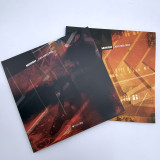
ARCHIELONG LP album consists of 8 intensely rolled tracks dating between 2012-2020. The release unfolds on 4 discs of 180gr, with gatefold covers, coated in Sani Stranskiʼs artwork.
Throughout ARCHIELONG LP, we are absorbed by what typically characterizes his narrative: a peculiar style of story in constant development. Structure and flow are a hallmark feature of his selections, adding one more trippy, eerie minimal style on top of the other, creating a rich and quirky haunted sphere.
A – The opening track, I HEAR VOICES THROUGH THE PIPE sets the scene for whatʼs to come, stirring the imagination with its dreamy, cinematic, organic sounds in disguise. The track provides a guidebook to distilling story, emotion and image into sonic form.
B – EXCESS ALL AREAS – hypnotizes the dancers with endless, reverberating grooves and a punchy 4/4 beat, introducing the audience to his gloomy world of emotions.
C – LA MANIA – lights up some dark pitched atmosphere around you and makes you feel like you are on the mythical La Mania club dancefloor in complete harmony, surrounded by strange and beautiful trippers. The song is like a painting, with frames that evoke flashbacks.
D – NEW LIFE – is a perfect minimalist setup of a percussion loop, throbbing chords and a sinewy walking bass, and itʼs almost intimidatingly heady. Its militant kick and incessant hi-hats propel the beat – definitely a dancefloor highlight.
E – MELODROM – percolates with Latin percussion and shuffling snares, which commingle with an array of voices and whispers that come from every corner of the song. From toolish to melodic, itʼs the diversity that creates the magic.
F – SING AND RUN – is one of those tracks that gives you nostalgia and reminds us of early mornings at the end of the party when the sun would be coming in through the windows and the dancefloor was in total harmony. Could easily cast a spell with the right audience.
G –RUMBLING DREAM – is a ritualistic-sounding slice, crossing towards the kind of slow-burning, atmospheric cuts that doubtless inspire his intricate studio productions. The vocals are unusually illustrative and make a lasting impression.
H – KLAUS DID IT – is an intriguing interplay between dark functionality and high velocity grooves — the type of deep, trippy, IDM-tipped tunes. Its warped tones are forming dank, lurching rhythms that trap you like a spiderweb, venturing into a bizarre, rewarding territory. The conclusion? You can spend a decade honing a very particular personal vision and not run short of inspiration. Mihigh is a world-builder: everything he does is about further extending and reinforcing that world.
ARCHIELONG LP is capturing the beauty at the intersection of experiment and perpetual learning
Поиск:image of life
Все
Necrot continue their ascent to the forefront of American aural extremity, pushing the boundaries of style and continuing to recast metal in their image. Founded by bassist, vocalist and principal songwriter Luca Indrio and drummer Chad Gailey in 2011 – guitarist Sonny Reinhardt joined the next year – the Oakland, California, trio offer Lifeless Birth (in continued collaboration with Tankcrimes) as a culmination of their to-date efforts to encapsulate and push forward the deathly stylings of 2020’s Mortal and their 2017 debut, Blood Offerings. It’s not about giving up a ferocity that’s helped make them a household name among the converted. Instead, Necrot use that same, by-now-characteristic intensity as the backdrop for an expanded songwriting palette. They’ve always been a band who stood out. The maturity they show on Lifeless Birth confirms that’s been the plan all along. It is a vision of what metal can be and do in 2024, tearing down old barriers and keeping those traditional elements that make it stronger. Recorded with Grammy-winning producer Greg Wilkinson (who has helmed all three Necrot albums) and mastered by Brad Boatright at Audiosiege, Lifeless Birth pivots fluidly between technical intricacy, progressive poise and all-out brutality. Scouring lead work will have thrash heads nodding knowingly, and an overarching groove reaches out across the metal microgenres with a righteous call to worship. Its songs are memorable and varied, unpretentious but able to rear up with statelier violence. At the same time, “Drill the Skull,” “Cut the Cord,” “The Curse” and others prove that just because a song is beating you into the ground doesn’t mean it can’t also be forward-thinking. Or catchy. After having their Mortal tour plans scuttled owing to the covid pandemic, family health issues that led Luca, who became a US citizen in 2016 and currently lives in Mexico, to return to Italy for a time canceled what would have been their first tour post-plague. Still, despite this and Chad suffering a broken back, requiring multiple surgeries and intense physical therapy to be able to drum again, period, Luca being struck with Bell’s Palsy the night before he was originally due to fly to the studio to record, and Sonny requiring multiple surgeries on his hands in the months since they finished, Necrot charge forward with material distinguished in its real-world point of view and willingness to look beyond extreme metal tropes in lyrics, the melodies of its guitar solos, and unbridled audience engagement. For a collection of songs that feel so much written for the stage, it should be no surprise tours early in 2024 and summer festivals are to be announced. Mortal (2020, Tankcrimes) was #2 on Billboard's Top New Artist chart, #30 on the Top Current Albums chart, #4 on the Current Hard Music, and #10 on the Heatseeker Albums chart for week of release. Necrot have toured in North America, Europe, Australia and Japan, and shared the stage with Cannibal Corpse, Immolation, The Black Dahlia Murder, Suffocation, Morbid Angel, and hundreds of others. Expect no letup as Lifeless Birth brings Necrot all the more to their own place among metal’s superlatively aggressive proliferators. – JJ Koczan
Formed in London in 1977 by Mark Perry and Alex Fergusson, then editors of the punk fanzine Sniffin' Glue, Alternative TV was a post-punk group known for incorporating reggae rhythms and pushing the boundaries of the definition of punk toward the experimental and avant-garde. Their first album, The Image Has Cracked, came out originally in 1978 and is a wholly unique piece of British post-punk. Beloved by John Peel, and close confidantes of Throbbing Gristle, Alternative TV is one of the most original and beguiling groups of the era.
The Good the Bad and the Zugly have been delivering premium class, antiquated rock for almost 15 years straight. They’ve always been the real deal. True heroes of the Armageddon. Whenever responsibility came knocking at the door they stuck to their guns and kept living the rock life to the fullest. Their contemptuous look at everything and
everyone who doesn’t fit into their world view has always been prominent in their sound, and their musical and lyrical expression has stayed uncompromised.
No one has yet dared to confront their satirical know-it-all attitude, but recently water has started to seep through their seemingly waterproof façade. Band members have on several occasions been observed at the Oslo’s local shopping malls wearing reading glasses, down jackets, and sensible footwear, pushing strollers filled with blaring,
chocolate devouring children. With wistful eyes they’re seen pushing strollers through to the suburbs, far away from dirty dens credible dark nooks and shitty toilets.
To mend this rapidly declining rock image they´ve decided to release what they consider to be their worst album so far: A collection of B-songs that have never made the list when assembling the list of Norwegian Grammy nominated classics. This upcoming album is
nothing less of a wonderful bouquet of contemptuous elegies who haven't yet found a place on the big, dark web. Truth be told the opinionated armor GBZ has been hiding behind was mostly for show, they’ve always beat around the bush – or as we say in Norwegian: had a walk around the porrid
The Good the Bad and the Zugly have been delivering premium class, antiquated rock for almost 15 years straight. They’ve always been the real deal. True heroes of the Armageddon. Whenever responsibility came knocking at the door they stuck to their guns and kept living the rock life to the fullest. Their contemptuous look at everything and
everyone who doesn’t fit into their world view has always been prominent in their sound, and their musical and lyrical expression has stayed uncompromised.
No one has yet dared to confront their satirical know-it-all attitude, but recently water has started to seep through their seemingly waterproof façade. Band members have on several occasions been observed at the Oslo’s local shopping malls wearing reading glasses, down jackets, and sensible footwear, pushing strollers filled with blaring,
chocolate devouring children. With wistful eyes they’re seen pushing strollers through to the suburbs, far away from dirty dens credible dark nooks and shitty toilets.
To mend this rapidly declining rock image they´ve decided to release what they consider to be their worst album so far: A collection of B-songs that have never made the list when assembling the list of Norwegian Grammy nominated classics. This upcoming album is
nothing less of a wonderful bouquet of contemptuous elegies who haven't yet found a place on the big, dark web. Truth be told the opinionated armor GBZ has been hiding behind was mostly for show, they’ve always beat around the bush – or as we say in Norwegian: had a walk around the porrid
Octave One stride into 2024 with a fresh four-track EP that once again showcases their unique take on techno with three new versions of classic tracks alongside an all-new cut.
Detroit's legendary Burden Brothers had a big 2023 that saw them release their superb Never On Sunday album, which was a nod to their 90s downtempo project of the same name. The bumper collection traversed deep techno, house, and tech in their usual inimitable style while the pair themselves continued to push techno forward with their incomparable live show at the world's most notable clubs and festivals. They now show that their creative reserves continue to run deep with four more essential tracks.
The first one is a new Mothership Remix of 'Price We Pay' with long-time vocal collaborator Karina Mia. The original appeared on Never on Sunday and this version comes on strong with vast rubbery kicks powering a deep and seductive groove. Muted synths roam down low while twinkling melodies fall from above next to the controlled, soulful vocal. The superb 'Mirror Image' is a new track that rides a heavy broken beat. Downtempo chords are melancholic but stirring and have a dramatic sense of finality to them.
'A Better Tomorrow' also gets a new Mothership Mix following its original release on the Burn It Down album back in 2015. Here it is a surging cut with funky guitar riffs and bleeping synth sequences that bring to life the thundering low end. It's a hi-tech and soulful fusion of the organic and the synthetic that will blow the roof off.
Last of all is a Mothership Instruments version of 'Price We Pay' that powers along on thudding drums with edgy synth stabs riding up and down the scales. Deft keys shine and twinkle and signature Octave One arps break out at the midpoint to take things to a higher level.
These are four more classic techno sounds steeped in great synth craft from The Burden Brothers.
Recorded by award-winning mastering engineer Kevin Gray's record label, Anthony Wilson's Hackensack West is Cohearent Records' follow-up to Kirsten Edkins' Shapes & Sound album. Produced by Joe Harley and recorded all-analogue/all-tube at Gray's studio, Cohearent Recording, the AAA vinyl release is pressed on 180-gram vinyl at RTI and housed in a deluxe tip-on gatefold jacket.
From the liner notes:
The week before these sessions in the summer of 2023, I sat down each morning with the goal of composing one new song by day's end. I knew I'd soon be in the room with my dear friends Gerald Clayton, John Clayton, and Jeff Hamilton, three musicians whom I trust the most, and with whom I've played the most over the last couple of decades. I tried to imagine themes that would feel natural to us, the kinds of songs we could simply dive into without much thinking. When we headed to Kevin Gray's studio to record, I brought seven new songs along with me. Five are included on this album.
"Daido" is dedicated to Japanese photographer Daido Moriyama, who became known in the late 1960s for his grainy, sometimes blurry, high-contrast black and white images made throughout Japan. I love his pictures taken on the streets of various Tokyo neighbourhoods such as Shinjuku. His portrait of a menacing stray dong, from his series "A Hunter," is the kind of picture that, seen just once, is unforgettable. These days Daido is still out on the street making pictures, at the ripe young age of 85.
"Verdesse" has a sinuous, chorinho-like melody and rhythmic feel. The tune seems to weave and bob playfully in a space of brightness the way a grapevine seems to curl towards the sunlight. So I named it after a wine grape native to the pre-Alpine region of Isère, near Grenoble in eastern France, that makes a particularly delicious and drinkable white wine.
I wrote "Sunday," well...on Sunday. It unfolds slowly, like a good Sunday does when there's nothing to do, you can sleep in, you've got your person beside you, and you just relax into the day.
"The Lands" is dedicated to a family very dear to my heart: that of tenor saxophonist Harold Land. My mother met Harold when they were both teenagers growing up in San Diego, California. The two of them became lifelong friends, and a little later, Harold enjoyed a fruitful musical association and close friendship with my father, Gerald Wilson. Harold, his lovely wife Lydia, and their son Harold Jr. were extended family for us; they looked after me with love and care. Some of my first gigs ever as a young guitarist were with Harold's incredible band that included Oscar Brashear, Billy Higgins, Richard Reid, and Harold Land Jr.
I've loved Todd Rundgren's "Marlene" since I first heard it on his epic double-album Something/Anything. With its tender, well-contoured melody buoyed by a few special harmonic surprises, it almost seems like something from the pen of Burt Bacharach. It tells such a complete musical story. Rundgren's recorded version has a beautiful endlessly repeating tag. So we played the melody simply, and used the tag as a small staging area for a bit of improvising.
Hackensack West is our alias for engineer Kevin Gray's studio Cohearent Recording, a place inspired by Rudy Van Gelder's first studio in Hackensack, New Jersey. Located inside Van Gelder's parents' home, the musicians played in the living room! It was there, in 1954, that Thelonious Monk recorded his classic tune "Hackensack," a "contrafact" melody over the chord changes to the Gershwins' "Oh, Lady Be Good!" In contrafact-like fashion, my own bebop-spirited melody "Hackensack West" seems to nod toward the changes of a few recognizable standards, without corresponding to any particular one.
Violet vinyl[26,26 €]
New super-band featuring desert rock legends Mario Lalli, Brant Bjork, Sean Wheeler and Ryan Güt !!! The first release from this band of pioneering Desert rock musicians captures the band and its purest form exercising the desert born ethic and approach of rock improvisation, psychedelic and flowing, heavy and explorative. The foundation of Mario Lalli's grooving heavy bass lines and meditative themes with a intuitive guitar work with Brant Bjork and percussion of Ryan Güt set the scene for Sean Wheeler's poems and songs capturing the dark and beautiful stories and images of life in the Mojave desert of Southern California. This is a representation of desert rock in its purest form. A very special live performance in Gold Coast Australia.
Black Vinyl[23,32 €]
Violet vinyl, limited to 400 copies. New super-band featuring desert rock legends Mario Lalli, Brant Bjork, Sean Wheeler and Ryan Güt. The first release from this band of pioneering Desert rock musicians captures the band and its purest form exercising the desert born ethic and approach of rock improvisation, psychedelic and flowing, heavy and explorative. The foundation of Mario Lalli's grooving heavy bass lines and meditative themes with a intuitive guitar work with Brant Bjork and percussion of Ryan Güt set the scene for Sean Wheeler's poems and songs capturing the dark and beautiful stories and images of life in the Mojave desert of Southern California. This is a representation of desert rock in its purest form. A very special live performance in Gold Coast Australia.
- A1: Love Images (Ka Baird Remix)
- A2: For Papa (Xiu Xiu Remix)
- A3: Return From La Ii (Moor Mother Remix)
- A4: Nocturnes No 4 (Jlin Remix)
- A5: Return From La Ii (Tom Vr Remix)
- A6: Love Valentine (Lex Luger Remix)
- B1: Bounding (Levon Vincent Remix)
- B2: Return From La Ii (Jlin Remix)
- B3: For Pauline (Yu Su Remix)
- C1: Return From La I (Jefre Cantu-Ledesma Remix)
- C2: Vibrafono Studio (Prefuse 73 Remix)
- C3: For Papa (Dj Marcelle/Another Nice Mess Remix)
- C4: Vibrafono Studio (Fennesz Remix)
- D1: Jennifer (Loraine James Remix)
- D2: Divertimento (Lafawndah Remix)
- D3: Roman (Xiu Xiu Remix)
- D4: For Pauline (Prefuse 73 Remix)
- D5: Jennifer (Carmen Villain Remix)
'Moments Remixes' began from a conversation with Jlin. We did an interview together for Talkhouse in fall of 2019, in season with the original Moments release on Unseen Worlds. Her poignant and effusive dialogue sparked the inspiration for us to do a remix together. That organically evolved into a full project idea. Xiu Xiu did the second remix in January 2020, and before things continued further - the pandemic was upon us. During the course of the pandemic, it evolved more, and organically became a more focused project for the isolation and lack of in-person collaborative environments/performance halls. All of but one remix were completed by 2021, and then refined and curated further over the following (four) years. The highlighted dialogue across the album is how these sparse, melodic minimalism of piano and vibraphone could manifest in a diversity of experimental sub-genres: electronica, IDM, avant-rock, drone/ambient. The careful curation and illustrative collaborators elicit the transportive 'new moments' and permeable qualities of the core compositions, that discover uncharted life in this project. (Michael Vincent Waller, October 2023)
ORANGE VINYL
Daniel Boeckner understands the grit and gravel that accumulates in the heart and that it takes an unwavering courage to crack through that clutter and burrow to the other side. And in Boeckner's hands, that quest comes via post-apocalyptic synth and guitar heroism, a rallying cry for those always coming home through the scorched clouds. Throughout his work with Wolf Parade, Handsome Furs, Divine Fits, Operators, Atlas Strategic, and more, the iconic Canadian indie rocker recognizes that few feelings are more gratifying-more memorable, more generative, more abundant-than hope. But it takes getting the hell out of your own way. A culmination of that deep library of musical reference, Boeckner is set to release his first album under his own name: Boeckner! No matter where his genre exploration has taken him, there's something about growing up in punk and DIY spaces that puts collaboration in Boeckner's blood. Composed of a collection of intimately familiar elements, Boeckner! elicits the same thrill of young passion and discovery. It's a jet-powered chase through a tech-noir cityscape-fueled by a dream and that special someone in the passenger seat. That urgency and passion have always been a trademark of Boeckner's, and writing on his own pushes those feelings further into the center of the scope. But while Boeckner may be the clear driving force behind the album, he's not without collaborators for his solo debut. After meeting producer Randall Dunn while contributing to the soundtrack to the Nicolas Cage-starring psychedelic horror film Mandy, Boeckner knew he'd found the perfect counterpart for his solo debut. "I'd been a fan of his forever, especially the Sunn0))) records he produced," Boeckner says. "Working with Randall really unlocked some suppressed musical urges, things that I enjoy in my private life but don't normally weave into what I'm releasing-like occult synth, pseudo-metal, krautrock, and heavy psych influences." That base allows Boeckner to thoughtfully weave between emotional imagism and more grounded storytelling. Throughout the record, his imagery delves into science fiction, but it's charged first and foremost by experience. The trio of Boeckner, Dunn, and drummer Matt Chamberlain (Pearl Jam, David Bowie, Fiona Apple) formed a sort of dark engine for the album, and Chamberlain's ingenious approach of triggering a vintage Arp synthesizer simultaneously with each drum track helped Boeckner shape the record's atmosphere. That tense futurism was influenced by Boeckner's time staying in Dunn's Circular Ruin studio, a dusky, electronic aura burned into every track. By the end of the album, Boeckner! eases from sci-fi epic into something more akin to a torched VHS copy of a John Cassevetes film, the chemtrails and nuclear fallout fading long in the distance. Like all good sci-fi, the emotion and pain hits home for the author and listener alike, and the genre flourishes bolster the human experience. In revealing more than ever before, Boeckner! ratchets up the musical intensity to unforeseen levels and hopes to find some peace at the end of the journey.
Miles Davis created just one studio album with his original sextet: Milestones. And he made every moment count. Pairing with Cannonball Adderley, John Coltrane, Red Garland, Paul Chambers, and Philly Joe Jones, Davis not only laid the groundwork for the modalism that immediately followed but tailored a genuine modern-jazz masterwork laden with performances among the most explosive of his distinguished career. Sandwiched between the more famous 'Round About Midnight and the epochal Kind of Blue, Milestones remains a seminal work of art.
Sourced from the original master tapes and pressed on dead-quiet SuperVinyl, Mobile Fidelity's numbered-edition 180g LP grants each musician their own space amid broad soundstages. Afforded the benefits of a nearly non-existent noise floor and supreme groove definition, this vinyl reissue doubles as a time machine back to the February-March 1958 recording sessions.
Colors, shapes, and dimensions appear in the manner that resembles what you'd glean from behind a studio control room's window. Davis' burnished trumpet is rendered in three-dimensional perspective and seemingly coaxes the band to play with unburdened zest. Coltrane's trademark saxophone teems with lifelike tonality and images with specificity; his solos work in tandem with and against the driving rhythms. Garland's swaggering piano lines? Visualize the keys as he hits full stride, the chords and fills slithering around skeletal frameworks.
Inducted into the Grammy Hall of Fame and selected as a "Core Collection" record by the Penguin Guide to Jazz, Milestones is as famous for its title track – widely considered ground zero for modalism and bolstered by Jones' hallmark "Philly Lick" rim shot – as the players that produced it. The launching pad for many of Davis' improvisational flights, the album teases the explorations Coltrane would soon chase. Davis' own solo work broaches territories that far exceed what he had done in his bop-rooted past. Every song is a highlight.
Take the bravado "Dr. Jackle," featuring a hot-foot pace and bebop strains, or "Sid's Ahead," which continues the album's blues theme while juggling edgy harmonics and inside-out structures. On "Billy Boy," distinguished with an arco bass solo from Chambers, Garland gets a turn in the spotlight and channels the openness practised by one of his heroes, Ahmad Jamal. Even more instructive is the band's reading of Dizzy Gillespie's "Two Bass Hit." Three years removed from the version Davis and company recorded for the trumpeter's Columbia debut, this interpretation demonstrates the extent to which the group had jelled in a relatively short amount of time.
Then there's "Straight, No Chaser," the definitive rendition of Thelonious Monk's signature piece. Coltrane's marbled playing pulls at the tune's borders, Adderley takes liberty with solos, and Davis dances around his mates, at one point quoting "When the Saints Go Marching In" while demonstrating his knowledge of tradition and casting an eye towards the future.
About that future. Garland already had one foot out the door during the Milestones sessions to the extent Davis spells him on "Sid's Ahead." Jones would stick around for a bit longer but soon plot his exit. History proves Davis navigated the changes with visionary aplomb. Yet the chemistry, excitement, and beauty the sextet achieves on Milestones cannot be overstated. This reissue helps put the album in proper perspective – and presents the music the fidelity it deserves.
Love Is Yes is the first album by Sander van der Toorn and Dax Niesten, an audio-visual duo de force of the same name.
This heady debut is rooted equally in the worlds of fine art and experimental music. Sound and image meld wonderfully across 10 tracks, with shifting movements of music accompanied by a wealth of paintings and animations.
Niesten's work summons the likes of Philip Guston and Maurice Sendak - with its crestfallen, cartoonish voids and cockle-warming grotesquery. Serenely contorted creatures are rendered on large canvases, and brought to fuzzy, maudlin life through a full-length animation that can be viewed alongside the record.
Musically, the pair cite influences ranging from Vashti Bunyan to Morton Feldman. There is an ornate fragility, smeared by zero gravity focus shifts. Some glimpses suggest a corroded grail of Boards of Canada samples; motorik guitar, whispered messages, euphoric vistas and tangled memories all bathing in atomic glow.
Dave Saved makes his debut release on studio 33 with Passing Images, an entrancing suite of hazy dance floor mementos, infused with a characteristic chopped and screwed soul.
As if heard through the dusty circuits of an android's dying memory drive, replaying songs picked up during its lifetime and mixing them into elegiac reveries in a final flashback of its existence, the sound is glowing with a patina hued warmth that feels uncannily familiar.
It's a considerably more dance oriented work than Dave's previous output but with a distinctly textural approach to the composition as well. The result is a densely vaporous sublimation of pure emotion. All refracted through an almost ghostly view of dance music's potentially hypnagogic effect, by way of repetitive progression and dreamy abstraction.
- 1: Specht0' 55
- 2: Sonne' 10
- 3: Skulptur2' 12
- 4: Immenweide2' 06
- 5: Glaswände1' 03
- 6: Weidplan2' 07
- 7: An Der Mühlenau2' 46
- 8: Zement2' 12
- 9: Am Morgen2' 30
- 10: Pflugacker1' 34
- 11: Plattenladen1' 45
- 12: Sark1' 25
- 13: Wildacker2' 21
- 14: Magnolien2' 22
- 15: Zentimeter2' 02
- 16: Feldmark2' 25
- 17: An Der Kollau2' 18
- 18: Am Abend0' 56
Perifaerye is a multi-part work of art comprising of 18 soundscapes, 36 digital drawings and 24 writings. Perifaerye is at once a record release, a book, a website; in the autumn of 2023 a series of playlists were published on billboards, linking the online soundscapes to the real-life physical realm. This publication is an artistic hybrid: a vinyl record / book combining sound, image and text.
The 18 audio works condense the sounds of the urban periphery into a sonic cartography. In Hamburg-Eidelstedt, people live in smaller detached houses and in larger apartment blocks. New housing estates have been developed recently in direct neighbourhood to the motorway, and currently in the district centre; a district where post-war housing estates and architectural remnants from a village past co-exist. Even meadows and fields, surrounded by the noise of motorways and other traffic, aeroplanes (the airport is close by) and railways (passenger and und freight trains, long distance, regional and local services). This collection of soundscapes – each a short composition on its own – presents a sonic portrait of a contemporary urban area.
In spring 2023, Jorn Ebner recorded the urban spaces of the Hamburg district of Eidelstedt. For each audio piece there is an image. The artist’s writings reflect and accompany the creative process.
For this book and record, Sebastian Kokus and Thomas Korf created a very haptic design. Each part of the whole can be experienced as a single piece: the A2-sized poster is part of the outer sleeve; the booklet presents image and text (German only); the record is visible through the holes in the inner and outer sleeves and forms part of the cover.
Psychedelic Anxiety, as a mood, goes something like this: overwhelming, existential, vertigoic, arising when we stare into the void. This metaphysical unease also serves as the title for Brooklyn-based musician Frances Chang’s second album, and as a feeling it’s present throughout, charged by all things occultish. Recorded by Chang and engineer Andrea Schiavelli, featuring a cast of revered NYC DIY players, including Schiavelli (Eyes of Love) and Liza Winter (Birthing Hips), Psychedelic Anxiety relishes in the refining of aesthetic, in the electricity of improvisation, in balancing bleakness with humor. It embodies an idiosyncratic genre Chang calls slacker prog — offbeat, but brimming with spiritual and emotional resonance. The record infuses artifacts of the mundane with otherworldliness— even the love songs live more in the realm of fantasy (or horror) than the romantic. The psychic twin and mirror image of Chang’s 2022 debut full-length Support Your Local Nihilist, Psychedelic Anxiety by comparison is less urgent, leaving space for more nuance and storytelling. Together, these albums represent a new cycle of creativity for Chang, a reset to zero. “Eye Land,” captures Chang on a tour around the Irish and English countryside, in a moment of major life change. “Lying around your spare room,” she sings, “Sky is cloudy here in June.” Around her, guitar sputters and stops. Vocals branch off like vines on the side of an old house. It is a profoundly lovely song, a freaky miniature in the way that a Broadcast song is a freaky miniature. “Darkside” opens up with a particularly memorable narrative moment. “Last night I saw Parasite,” sings Chang, describing how she saw it alone, how regular life that week was acute, weird, intense. How she found comfort in resignation. After all: Psychedelic Anxiety is a serene, bizarre record full of alien sounds and big introspection.
Longtime enthusiasts of ambient music have much to celebrate as Rafael Anton Irisarri's cherished out-of-print cassette, "Midnight Colours," returns in a meticulously remastered edition and makes its inaugural debut on vinyl. The significance of this album's announcement is accentuated by its historical resonance, coinciding with the same day in 1952 when the world bore witness to the first-ever test of the hydrogen bomb.
"Midnight Colours" is far more than a mere album; it's an exploration of the enigmatic relationship between humanity and time. Conceived as a sonic interpretation of the Doomsday Clock, which symbolizes the world's existential vulnerabilities, Irisarri's work beckons listeners to contemplate the gravity of our existence and the delicate balance that envelops it.
"I wanted to capture the essence of humanity's relationship with time, both the anxiety and the serene beauty that coexists within the shadows of the night," explains Irisarri. "The vinyl format adds a tactile dimension to the experience, inviting listeners to physically engage with the music."
Known for his contributions to the ambient and electronic music genres, Irisarri often explores themes of introspection, nostalgia, and the interplay between sound and emotion.
Recorded in 2017, when the Clock was at 2½ minutes-to-midnight (and at the time, the second-closest to midnight since the Clock's inception in 1947), "Midnight Colours" permeates with the melancholy of memories resurfacing as one approaches the end of life: the regrets, the closure, the uncertainties, the anxieties.
Originally released as a limited tape on the beloved Atlanta-based label Geographic North, "Midnight Colours" swiftly garnered praise and acclaim within the ambient music sphere. Now, with this newly remastered edition on his own Black Knoll imprint, fans, both longstanding and newfound, can rediscover the album's captivating beauty in unprecedented clarity and depth.
"I've wanted to release 'Midnight Colours' on vinyl since it first came out, and I'm thrilled to finally be able to. The remastering process, brilliantly done by Stephan Mathieu, has breathed new life into the work, and I'm eager for listeners to experience it in this format."
The reissue of "Midnight Colours" features band-new artwork and design by the renowned Mexican visual artist Daniel Castrejón. A frequent collaborator and friend of Irisarri, Castrejón's imagery impeccably complements the album's mood and themes, extending a compelling invitation for listeners to explore its aural world visually.
This landmark release serves as a testament not only to Irisarri's enduring impact on the ambient music genre but also as a long-awaited gift to those who have patiently anticipated the album's vinyl debut.
- Live Your Life Be Free
- Do You Feel Like I Feel?
- Half The World
- You Came Out Of Nowhere
- You’re Nothing Without Me
- I Plead Insanity
- Emotional Highway
- Little Black Book
- Love Revolution
- World Of Love
- Loneliness Game
Released in October 1991, Belinda’s fourth solo album after leaving The Go-Gos saw Rick Nowels sharing the
producing credits with other names, but he provided Belinda with the hit singles: “Live Your Life Be Free” and “Do
You Feel Like I Feel?”. “Half The World” and “Little Black Book”, produced by Richard Feldman, were also hits.
Charting around the world, the album achieved Gold sales in the UK.
This new edition has been expertly mastered by Barry Grint at AIR Mastering from the original stereo tapes using
precision half-speed mastering. Half-speed mastering is a vinyl cutting technique that improves groove accuracy
and transient information creating an incredibly detailed stereo image with a natural high frequency response.
Presented in its original sleeve, pressed on 180 gram heavyweight black vinyl, featuring an obi strip and housed
in a poly-lined inner sleeve, with all the lyrics and credits on the 4 page insert.
toechter is an all-female trio operating from Berlin. toechter’s 2nd full-length album »Epic Wonder« sees its classically trained members blend elaborate string arrangements with ethereal indie pop and delicate rhythms. Katrine Grarup Elbo, Lisa Marie Vogel and Marie-Claire Schlameus exclusively use analogue sound sources (such as violin, viola, cello, and their voices), which were then electronically processed.
Named after the Greek god of the wind, toechters 2022 album »Zephyr« exhaled deeply with concurrently invigorating and confusing sounds. »Epic Wonder«, their second album, was created in the spring and summer of 2023. Playing with forms and contours, the music sounds like the awakening of something new. One seems to be listening to an ongoing conversation, an exchange about what music could be, where it wants to go and how it contributes to our view of life. It all rests on a simple premise:
»Every sound you hear in our universe comes from us. The string trio is the core of toechter, the starting point of all our work.«
Those looking for new worlds of sound can find them in the work of this classically- trained musicians. Whether they add voices or percussive instruments, sample the sounds, or manipulate them electronically; ultimately they are exploring the string trio's place in a world shaped by the digital.
»Prelude« opens the album, seemingly a conversation, yet not only between humans. We catch the word ›love‹ which soon morphs into pure sound images, while a violin theme tentatively takes over. Is it the dawning of a new day? The chorus of sound transforms into a fascinating rhythmic figure, creating a club-like experience that fades out in delicate structures. A perpetual transformation.
According to toechter, »Epic Wonder« is all about making connections. Connections between people, animals, plants, fungi, rocks, soils, oceans, ice caps, stars, and planets. One imagines oneself in a folk-pop song of the 60s, or even blown around by Morricone's desert wind:
»The world as we see it is in desperate need for a deeper understanding; for compassion, for empathy. We have to understand that we are all part of the same organism. Epic Wonder is a dream, a wish, a longing for kinship between all species that share the world - all that is alive.«
The acoustic throbbing and knocking in »Sea Of Serenity« makes you think of encounters with mythical creatures or planetary oceanography; and out of the mechanically clacking groove of »Shift Souls« a gentle, but steady movement awakens with voices that seem to sound from the depths of the sea. Everything is in flux, floating in and out of dimensions and elements.
The album ends with »Mercury«, spherically elegant and almost science fiction-like. Here, a pizzicato melody leads us back to the baroque, simultaneously representing a detail of intertwined sonic worlds, while the steady, housy baseline develops its driving theme.
»Creating the music for the album, we allowed ourselves to waft away with the aspiration that connections are possible. Sometimes dwelling on subtle, yet marveling phenomena like the evening fog covering a valley on Midsummer, sometimes on grandiose splendors like the genesis of mountains or the birth of a child - letting interactions and encounters with other beings float through the musical universe as drips of emotional perceptivity.«
For the visual manifestation of »Epic Wonder«, toechter has engaged with Finish up-and-coming lens-based artist Aino Kontinen. Her work will grace both the cover art of the album and accompany the first single and video as an ephemeral tale in motion.
- A1: Grana
- A2: Vorsichtig - Mutiger - Verloren
- A3: The Idea Of A Horizon
- A4: View From My Parents House
- B1: Folie
- B2: X-Pulse
- B3: Ungeheuer Ist Vieles
- B4: Seance
- B5: Nexus Ii On The Beach
- B6: Langsame Bewegung
- B7: Zwischen Luft
- C1: Chez Charles
- C2: P-Analyse
- C3: La Caduta Degli Dei
- C4: Aavikon (No Water)
- C5: Что Такое Человек
- D1: Dark Matter Art Cabinet
- D2: Hatch On A Hunch
- D3: Theban Constitutional
- D4: Kismet
- D5: No Noosphere
ESP Institute artist Bartellow, one third of the project Tambien and otherwise known in the Contemporary Classical sphere as Beni Brachtel, returns to the label with his second full-length release, Noosphere. While currently heading the SVS label and residency series out of Munich, Beni’s resume expands well beyond electronic music to include immersive sound installations such as The Adven- ture Of The Empty House (solo live performance across seven floors of Walter Henn’s Deckelbau building), a slew of compositions for the Bavarian State Opera (for which he doubled as conductor), and a prolific career of over twenty-five theater scores for institutions such as the Münchner Kammerspiele, Schauspiel Basel, Maxim Gorki Theater Berlin, Berliner Ensemble, Schauspiel Köln, Schaus- piel Graz and with directors Ersan Mondtag, Alexander Eisenach, Jessica Glause and Tobias Staab among others.
Noosphere is a compendium excerpting from theatrical scores WUT (Elfriede Jelinek, at Schauspielhaus Köln, directed by Ersan Mondtag, 2020), Ödipus and Antigone (Maxim Gorki Theatre Berlin, directed by Ersan Mondtag, 2017), Der Zauberberg (Thomas Mann, Schauspiel Graz, directed by Alexander Eisenach, 2017), Hass Tryptichon (Sybille Berg, Wiener Festwochen / Maxim Gorki Theatre, directed by Ersan Mondtag, 2019), Wonderland Ave. (Sibylle Berg, Schauspielhaus Köln, directed by Ersan Mondtag, 2018), Die Verdammten (after Visconti ́s film, Schauspielhaus Köln, directed by Ersan Mondtag, 2019) and Roi Ubu (Alfred Jarry, Theater Neumarkt, Zurich, directed by Alexander Eisenach, 2018).
The work traverses homages, infusing everything from Baroque to Impressionism, and while these types of references are certainly built into the canon of Theatre as a discipline, here we gather histor- ic layers in an even wider net. Under the self-referential thumb of Contemporary Classical music, this sort of "hindsight" approach has been largely avoided, however, in today’s all-access arena, the constant stream of historic causal-chained events has opened a delta where anything is possible. This defines Bartellow’s stance among his colleagues as well as his cultural position as a composer.
Beni considers beauty a fleeting objective in the arts, that expression is often expected to follow notions of Destructivism or the unfulfilled. Art will pore over wounds, collective angst, mourn- ing a loss of natural habitat or a fear of technological invasion, yet there is a bitter irreverence for the friction or salvation in beauty itself. Acknowledging this subjectivity — what one audience considers superficial pleasure may be deeply profound to another — he leans into musical instinct as if composing via divine conduit.
Noosphere conjures a array of suspense, ecstasy, melancholy, and dread, but in isolating the work from its theatrical component, Brachtel directs our focus toward formal qualities, clearing unim- peded space to conceive fresh narratives and examine dynamism and interconnectivity. In sympathy with often difficult theatre pieces, the passages can be dark and transgressive, but more importantly they remain relative to Brachtel’s circumstances at their time of creation. The title Noosphere speaks to the evolution of human thought and knowledge, opening a door to subjective points-of-view. For example, Nexus II On The Beach refers to both Roberto Musci’s Water Messages On Desert Sand as well as the film Bladerunner, invoking the image of an android enjoying the sunset, but whether or not this abstraction may be considered beautiful depends the listener’s cumulative life experience and perspective.
This is hybrid chamber music, augmented by electro-acoustic layers, juxtaposing various periods and successively processing their residual themes into a trans-generational rendering of “now.”


