Echolocation is the debut album by Pamela Z, the pioneering Bay Area intermedia composer and performance artist. Written and recorded over three years, and self-released and distributed on cassette in 1988, Echolocation is genre-defying document of Z’s earliest experiments with live voice and delay, and the impetus of an artist’s three decade search for sounds yet unfelt.
Born and raised in Buffalo, New York, Z traded one snowy backdrop for another to attend the University of Colorado in Boulder at the tail end of the 70s, where she pursued a degree in music while taking local gigs covering Joni Mitchell and Malvina Reynolds b-sides on an acoustic guitar. While a host at KGNU, Z discovered a vast world of avant-garde music in the community radio station’s library, and was inspired to create towards, and alongside, the fringe sounds she pulled from the stacks and broadcast. This revelation intersected with a new era of accessible and affordable instruments and home recording technology, and a diversifying community of artists self-releasing music on cassette and finding an audience through underground publications.
Z moved again to San Francisco in 1984, legally changed her last name, and furthered her practice of vocal processing in live environments. A city simultaneously nurturing and stratifying the free spirit of the two decades prior, Z assumed an immediate role in the Bay Area’s interdisciplinary performance art scene, and began curating Z Programs, her own concert and event series.
quête:instruments
Soopasoul is a legendary name inthe UK funk scene. Originally known as a producer in electronic music circles, Danny Soopasoul stuck gold one day, putting together a band to record in a session where everything was played in live and loops and plug-ins were dropped in favour of real instruments and talented players. The final piece in the puzzle was realised when he stumbled upon on a local horn section so steeped in tradition and quality that it was immediately obvious they would bring the final magical ingredient to the table. Once they were brought in, the instant classic LP 'Twin Stix' was born.
Pleas for 7"vinyl singles from this revered album have been a constant since it's release. However calls for the album to make it's debut on vinyl too have gone unheard until now. This floor-shuffling, hip-swaying, jazz funk party monster is packed with funky beats and some seriously hefty signature brass action. Add the sassy vocals from ladies like Dionne Charles (Record Kicks /Tru Thoughts) and Sitzka, and you're guaranteed to discover that this gem of an album will be enjoyed for the foreseeable future.
Tracks by Wisp and Alek Stark. This record was only available previously as a gift to those who pre-ordered the box when Fundamental Records released it. It's a tribute to Ikutaru Kakehashi, founder of Roland Corporation, pioneer in electronic music instruments and creator of the original Roland TR-808. The Time Capsule project, also known as 808 Box, is a project created by Fundamental Records. The six boxes released in recent years include 56 records with over 300 tracks from artists from every corner of the world. Some warehouse copies have surfaced of the 5th 808 Box, and these will be available individually. These are new copies in perfect condition, with the original sleeves printed with the classic Roland TR-808.
If one always looks at the sky, he will end up with wings, a wise French man once declared. Halifax, Nova Scotia based musician Jeremy Costello had wings, long before he looked up. Wings of imagination. Brandishing in his head, transforming deep-rooted emotions into poetry and sound. Since 2012 the Canadian self-releases music as Special Costello, a moniker under which he records solo or with local friends like Saxophone player Nick Dourado or guitarist Dave Burns. His lyrics are sincerely woven poetic enunciations that balance between introspective emotions and existential philosophical demands. Lyrics from a spirit that is in love without an object, unconditional, mirroring his very own subconscious inner being. The music reflects his tempers in many colours. Glimpses of Synth-Pop, psychedelic rock nuances, traces of new romantic utopia, infantile Casio minimalism, Shoegaze haze, drama wave: Special Costello blends many styles, uniting all in his very own musing grandeur of pop music.
After an array of digital releases, Berlin based label Marmo Music now publishes the Special Costello touch for the first time physically fabricated on vinyl. Seven songs featuring the longing voice of Jeremy Costello, sometimes in correlation with spoken words and dialogues by noted artists, poets, and scientists. All creations have been recorded by himself between Spring 2017 and winter 2020, using the extrasomatic help of instruments and machines like Farfisa Combo Compact transistor organ, Roland JX3P polyphonic analog synthesizer, Roland D50 linear synthesizer, Roland Rhythm Composer TR-08, Arturia Microbrute monophonic analog synthesizer or a Gibson Thunderbird IV bass guitar. In communication with his sensitive inner blues, they created an atmospheric voyage into the heart of Special Costello, that fulfils Arthur Russel’s sapient declaration: being sad is not a crime! Seven musical paintings full of intimate, vibrant feelings and existential thoughts, veiled in an antidepressant neo new romantic glam. An epic tune like “The Next Day”, in which Costello’s singing links with thought-provoking spoken word samples, sounds like Robert Ashley is meeting Hans-Joachim Roedelius in a psychic séance with Brian Ferry. In comparison, a song like “If Not Depression, Then What?” grooves with a pulsating wave bass figure and an overall gently floating electronic majesty, while Costello’s voice takes deep listeners to an unknown higher ground. On the other hand, a composition like “Unsetting” offers a nonchalant graceful funk drift with reverberant hand claps, minimal guitar strains and a chromatic synth pop grace. Above all the music Costello’s voice cries, screams, whispers, and weeps with a compelling introspective elegancy, that invites to associate intensely with the nonpareil Special Costello touch.
Written, composed, and recorded by Jeremy Costello between 2016 to 2020 in Halifax, Scotch Village and Toronto (Canada).
Instruments used by the artist: Farfisa Combo Compact transistor organ, Roland JX3P Programmable Preset Polyphonic Synthesizer, Roland D50 linear synthesizer, Yamaha DX7 Frequency Modulation/Programmable Algorithm Synthesizer and TX7 FM Expander, Roland Computer Controlled Rhythm Composer TR-08, Arturia Microbrute Analog Synthesizer, Gibson Thunderbird IV bass guitar, MicroKorg Synthesizer/Vocoder, Electro Harmonix Small Stone Phaser, Memory Boy Analog Delay, Alesis Quadraverb, and finally, their voice was recorded using Shure Beta57A and AKG D 330 BT dynamic microphones.
International power duo Dasom Baek (traditional Korean flutes) and Violeta García (cello) present their debut album. is the sound of two leading composers and improvisers pushing their instruments to the technical and creative limit, then beyond into places unnavigated, futuristic and often haunting.
Dasom and Violeta tussle with playful and at times brutal mastery between passages of sparse melody, acrobatic percussion and harmonic drift, while interjecting voices fracture and reassemble into intimate, improbable forms. It is hard to imagine an album more abundant in ideas and motifs, all atomised as soon as they are brought to life. The effect is a tapestry of rugged spirits - moving, and at times just plain beautiful.
Recommended for fans of Okkyung Lee, John Butcher, Messiaen, or Ernst Reijseger.
Dasom Baek is a composer, improviser and performer of traditional Korean instruments, mainly Daegeum, Sogeum. Dasom pursues ground-breaking and modern music rooted in traditional Korean instrumental performance. She is a Certified Master of Important Intangible Cultural Asset, no.45. She has achieved Bachelor's and Master's degrees from the Korea National University of Arts, and is currently undertaking a PhD course at Seoul National University. She has also represented Korea at the International Flute Festival. In 2019 she was selected as a fellow for the OMI Music residency in New York, collaborating with various genres of musicians from different countries. In 2020, she released her debut album, titled . In 2021 she was selected as a showcase artist at SXSW Festival.
Violeta García is a cellist, improviser and composer born in 1990 in San Nicolás de los Arroyos, Buenos Aires, Argentina. She studied at the Conservatory Astor Piazolla, and holds a degree in Composition from the Conservatory Manuel de Falla, with Ricardo Capellano. She also has a degree in Musical Arts, specialising in violoncello, from the Universidad Nacional of Arts (U.N.A).
Portico Quartet announce Terrain, a three-part suite drawing on American minimalism and ambient music alongside their own rich heritage as they explore new musical vistas
When Duncan Bellamy and Jack Wyllie – the driving force behind Portico Quartet got together in their East London studio in May 2020 and started work on the music that would become their new album, the world, or most of it, was in the midst of the first lockdown. The unique impact of the events of 2020 became the backdrop to their time composing and recording; causing them to take stock, re-think, and plot a new musical path.
Indian novelist Arundhati Roy expressed the sense of grief and rupture from the pandemic as "a portal, a gateway between one world and the next", and as they created the music that would become Terrainthey were drawn towards longer, slowly unfolding pieces, which are perhaps the most artistically free and also the most beautiful they have ever made.
These are compositions more in the lineage of Line and Shed Song (Isla/2009), Rubidium (Portico Quartet/2012) and Immediately Visible (Memory Streams/2019). Wyllie expands: "We've always had this side of the band in some form. The core of it is having a repeated pattern, around which other parts move in and out, and start to form a narrative. We used to do longer improvisations not dissimilar to this around the time of our second record Isla. On Terrain we've really dug into it and explored that form. I suppose there are obvious influences such as American minimalism, but I wasparticularly inspired by the work of Japanese composer Midori Takada. Her approach, particularly on 'Through the Looking Glass', where she moves through different worlds incorporating elements of minimalism with non-Western instruments and melodies were at the front of my mind when writing this music".
Terrain I, II & III are all subtly different, but a short rhythmic motif that repeats is the starting point in all three movements. There is a sense of a shared journey to all these pieces, they move throughdifferent worlds, with a sense of horizontal movement that lends the music real momentum. Terrain I was the first piece they worked on and it started with a hang drum pattern, improvised by Bellamy, who added cymbals and synthesiser. From there on it grew, Wyllie adding saxophone, another synthesiser section, strings. For Bellamy "It felt more like filmmaking than music making, a bricolage of conflicting, shifting signs, subtle tension and multiple narratives. Andrei Tarkovsky's 'Mirror' and British artist John Akomfrah's incredible 'Handsworth Songs' were pivotal points of reference for me." Wyllie expands the point. "There is a sense of conversation between us both, in that someone presents a musical idea, the other person responds to it with something else, which would then be responded to again... until it feels finished. These responses are often consonant with each other but there is also a dissonance to some of this work. The music slowly evolves through these shared conversations."
It is this sense of dialogue, both between the composers, and between tranquillity and a subtly unsettling melancholy, that makes Terrain such a powerful statement. One that speaks to both our interior and exterior worlds, to our own personal landscape, to our Terrain.
Black Truffle is thrilled to announce ViewFinder / Hide & Seek, a new release from acclaimed American experimental composer David Behrman, presenting recordings made in collaboration with Jon Gibson and Werner Durand between 1989 and 2020. Last heard from on Black Truffle as part of the collaborative art song/live electronics madness of She’s More Wild, these recordings find Behrman continuing the pioneering work in interactive electronics that have established him as one of the major living experimental composers.
Side A presents excerpts from two live realisations of Unforeseen Events (1989), the fourth in a series of pieces focussing on the interactions between instrumental performers and responsive software. Like the classic earlier works in the series, On the Other Ocean (1977), Interspecies Smalltalk (1984) and Leapday Night (1986), Unforeseen Events is an “unfinished composition” in which a computer system listens for and responds to specific pitch cues from an instrumentalist. Performed by the composer on electronics and Werner Durand on soprano saxophone in Berlin in 1989, the first realisation immediately ushers the listener into an environment of long soprano notes, lush, sustained synth harmonies, randomised percussive interjections and distantly burbling arpeggiated patterns.
The 1999 realisation recorded in New York with Jon Gibson on soprano shows how much room for the instrumentalist to affect the course of the music exists in Behrman’s interactive pieces, in which, as he notes, ‘performers have options rather than instructions’. Beginning in a roughly similar area to the version with Durand, this later recording eventually becomes substantially more active, as polyrhythmically layered arpeggios and percussive patterns respond to fast chromatic lines and dynamic phrases from the saxophone, moving Gibson in turn to respond with cycling figures and moments of extended technique that touch on the soprano languages pioneered by players like Steve Lacy and Evan Parker. Yet even at its most active, the lack of conventional forward movement in the music allows it to retain what Behrman’s friend Jacques Bekaert called its ‘fragile tranquillity’, as episodes of activity appear only as momentary disruptions of an underlying calm.
On the B side, we are treated to a new collaborative work from Behrman and Werner Durand, building on the 2002 installation work ViewFinder, in which a camera detecting physical motion triggered changes to electronic sound. The piece presented here is a long-distance studio construction, recorded by Behrman in the Hudson Valley and Durand in Berlin, offering up an expansive duet between Behrman’s lush, gliding synth tones and the alien, untempered tones of Durand’s invented and adapted wind instruments. Presented in a stunning gatefold sleeve with art from Terri Hanlon, archival photographs and new liner notes from Behrman and Durand,ViewFinder / Hide & Seek is an essential release showcasing the continuing vitality of a legendary figure in experimental music.
- 01: Shadow From The Sky
- 02: Yellow
- 03: Crying Like A Lamp
- 04: These Days
- 05: Tuesday Alabama
- 06: Rags
- 07: Lightening Strikes My Crown
- 08: Sad
- 09: Water
- 10: Visions Of Clay
- 11: Like A Wave
- 12: Light As My Fire
- 13: Cant Stop Waiting
- 14: Blue Dust
- 15: Seventeen
- 16: What I Want
- 17: Daylight
- 18: Trouble
- 19: The Wrong Hour
Hannah Zhalih Mickunas is a multidisciplinary artist currently living on the Northern California coast. After a first album recorded for eilean rec. in 2018, she comes back 3 years later on LAAPS with her second LP, "They Call".
All songs, voices and instruments by Hannah Zhalih Mickunas. Recorded between 2013 and 2021.
Beats/electronic by:
Michael J Collins on "Shadows from the sky", "Water", "Blue Dust"
Jake Holmen on "Like a Wave", "Seventeen", "Trouble"
Beth Navah co-wrote "Visions of Clay" and "Crying like a Lamp"
Clap de fin for the "Cabinet des Curiosités" : 15th and last episode of Vol.1 with The Architect.
Since last fall, Al'Tarba has been able to mix his talents with those of a beatmaker, a producer or a rapper, for hybrid experimental collaborations, composed with 4 hands or more, mixing styles and sounds. In November 2020, somewhere in France, we could hear the noise of some machines breaking a silence of lead, due to the general fever of the cultural scene. In a studio-laboratory looking like a "Cabinet des Curiosités", where far-fetched ideas are piled up on as many dusted shelves, Al'Tarba and his instruments were still running at full speed.
Anxious to find the antidote, a handful of beatmakers, producers and rappers, all gathered under the aegis of the Toulouse-based scientist, have been fine-tuning, week after week and month after month, the ingredients of their new serum. Over the seasons, they have unveiled, with regular intake, hybridizations of composed styles. Between sharing sounds, ideas, sample loops and vocal takes, like a "Cabinet des Curiosités" containing a thousand and one unusual objects.
On this foggy road and until the lightning, crossed Mounika, Structural Anomaly, Aguirre and Prometheus, Yous MC, Beus Bengal, Goomar, DeZordre, ProleteR, Degiheugi, K.D.S and Stabfinger, DJ Low Cut, DJ Nix'on, Sarbacane, Mani Deïz, Slim Paul and Grin. The day when the echo of the party is heard again in the distance, the sky is discovered the time of a new story. The clouds finally dissipate, for the last chapter of this first volume.
Between two rocks, the sea and its blue, bathed in sunlight. On the horizon, the authentic "Orange Sea" sailing in the distance. It is Al'Tarba and The Architect who arrive against all odds, to tell us the last story of the "Cabinet des Curiosités", first volume. The Architect, overproductive beatmaker and informed digger, knows how to take his audience on a journey through the world and styles. A last collaboration which promises the great crossing, its hot and ardent breath like fire, bell sound of the beginning of summer found and its epics.
Melancholy of a past world and dreamlike flights of fancy, hope of the world after, will rub shoulders in a double-vinyl album that will bring together the entire adventure. Pre-orders are now open !
So many bright perspectives, which would even let us foreshadow a forthcoming release of Al'Tarba's second solo album on I.O.T Records: "La Fin des Contes".
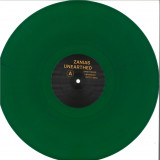
With her second full-length album, Zanias condenses her post-punk, techno and italo influences into a collection of simultaneously brooding and uplifting pop songs. ‘Unearthed’ explores the multiplicities of human connections, written at a time when connectedness was a resource more scarce than ever before. Field recordings from nature, vocal samples and an array of acoustic instruments are manipulated within a structure of catchy melodic synth maneuvers and driving rhythms, accompanied by her familiar and powerful voice conveying personal musings on hopeless desires and stoic acceptance. ‘Unearthed’ seeks the light and finds it within the exquisite pain of reckoning loneliness.
Green Gold Vnyl
With her second full-length album, Zanias condenses her post-punk, techno and italo influences into a collection of simultaneously brooding and uplifting pop songs. ‘Unearthed’ explores the multiplicities of human connections, written at a time when connectedness was a resource more scarce than ever before. Field recordings from nature, vocal samples and an array of acoustic instruments are manipulated within a structure of catchy melodic synth maneuvers and driving rhythms, accompanied by her familiar and powerful voice conveying personal musings on hopeless desires and stoic acceptance. ‘Unearthed’ seeks the light and finds it within the exquisite pain of reckoning loneliness.
Clear Gold Vnyl
With her second full-length album, Zanias condenses her post-punk, techno and italo influences into a collection of simultaneously brooding and uplifting pop songs. ‘Unearthed’ explores the multiplicities of human connections, written at a time when connectedness was a resource more scarce than ever before. Field recordings from nature, vocal samples and an array of acoustic instruments are manipulated within a structure of catchy melodic synth maneuvers and driving rhythms, accompanied by her familiar and powerful voice conveying personal musings on hopeless desires and stoic acceptance. ‘Unearthed’ seeks the light and finds it within the exquisite pain of reckoning loneliness.
After a trilogy of spectacular explorations of relentlessly driving rhythms – Sagittarian Domain (2012), Quixotism (2014) and Hubris (2016) – Simian Angel finds Oren Ambarchi renewing his focus on his singular approach to the electric guitar, returning in part to the spacious canvases of classic releases like Grapes from the Estate while also following his muse down previously unexplored byways. Reflecting Ambarchi's profound love of Brazilian music – an aspect of his omnivorous musical appetite not immediately apparent in his own work until now – Simian Angel features the remarkable percussive talents of the legendary Cyro Baptista, a key part of the Downtown scene who has collaborated with everyone from John Zorn and Derek Bailey to Robert Palmer and Herbie Hancock. Like the music of Nana Vasconcelos and Airto Moreira, Simian Angel places Baptista's dexterous and rhythmically nuanced handling of traditional Brazilian percussion instruments into an unexpected musical context. On the first side, 'Palm Sugar Candy', Baptista's spare and halting rhythms wind their way through a landscape of gliding electronic tones, gently rising up and momentarily subsiding until the piece's final minutes leave Ambarchi's guitar unaccompanied. While the rich, swirling harmonics of Ambarchi's guitar performance are familiar to listeners from his previous recordings, the subtly wavering, synthetic guitar tone we hear is quite new, coming across at times like an abstracted, splayed-out take on the 80s guitar-synth work of Pat Metheny or Bill Frisell. Equally new is the harmonic complexity of Ambarchi's playing, which leaves behind the minimalist simplicity of much of his previous work for a constantly-shifting play between lush consonance and uneasy dissonance. Beginning with a beautiful passage of unaccompanied percussion dominated by the berimbau, the side-long title piece carries on the first side's exploration of subtle, non-linear dynamic arcs, taking the form of a gently episodic suite, in which distinctive moments, like a lyrical passage of guitar-triggered piano, unexpectedly arise from intervals of drifting tones like dream images suddenly cohering. In the piece's second half, the piano tones becomes increasingly more clipped and synthetic, scattering themselves into aleatoric melodies that call to mind an imaginary collaboration between Albert Marcoeur and David Behrman, grounded all the while by the pulse of Baptista's percussion. Subtle yet complex, fleeting yet emotionally affecting, Simian Angel is an essential chapter in Ambarchi's restlessly exploratory oeuvre. --- Oren Ambarchi - guitars & whatnot Cyro Baptista - percussion & voice Recorded by Randall Dunn, Joerg Hiller, Iuri Oriente and Oren Ambarchi. Edited by Joerg Hiller and Oren Ambarchi at Choose Studios, Berlin. Mixed by Joe Talia and Oren Ambarchi at Good Mixture, Tokyo. Cut by Rashad Becker at D&M, Berlin. Executive Producers: Konrad Sprenger & Dick Wolf. Photography by Traianos Pakioufakis. Design by Lasse Marhaug.
Featuring Anthony Green of Circa Survive, Adam Lazzara and John Nolan of Taking Back Sunday and additional percussion from Benjamin Homola of Grouplove, Fuckin Whatever is a fluid project born of longtime friendships and late nights on the road, but what it could grow to become is entirely unwritten. It all started on the 2016 Taste Of Chaos tour. After Green wrapped his opening set with Saosin each night, itching to play more music, he started setting up impromptu acoustic gigs in the parking lots after his set. One night, his restless energy led to an impromptu backstage jam session with Lazzara, Nolan, Homola, and others––except there were no instruments involved. Using just their voices and a stomp or two in lieu of percussion... before they even realized it, Fuckin Whatever was born. They decided to start recording these nightly jam sessions on their phones, and by the end of the tour, there were literally dozens of recordings. There are some as long as 17-minutes, some recorded in bathrooms, and even one in the legendary tunnel between the stage and sound booth at Red Rocks Amphitheatre in Colorado. What they share in common is the camaraderie of the many talented voices (and sounds) involved. Fast forward to 2020––ugh. With a creative need to continue making and releasing music, Anthony approached the group about releasing some of those recordings. Feeling a similar restlessness, Nolan suggested they try making and recording something for real instead. "I'm Waiting On You" is what came next, and it's truly the spark that led to the rest of this EP coming together. There are zero instruments on Fuckin Whatever's self-titled debut. "It's pretty much 80% mouth noises and 20% Ben slapping things around the house," Lazzara explains. Those voices, however, are among some of the most recognizable in modern rock music, yet here they take on a new life. Call it a band, or a supergroup... it's Fuckin Whatever.
Clive Nolan is a British musician, composer and producer who has played a prominent role in the recent development of progressive and symphonic rock. He has been a regular keyboard player in bands such as Pendragon, Arena, Shadowland, Strangers on a Train and Caamora. He is the lyricist and composer of numerous rock albums and musicals, including the Arena catalogue, a monumental rock opera "She" and two Victorian inspired Steampunk musicals, "Alchemy" and "King's Ransom". 'Song of the Wildlands' by Clive Nolan's is a secular oratorio with elements of rock, progressive rock, folk and classical music. The story is based on one of the oldest English poems "Beowulf", which is an account of life and heroic deeds by the mighty warrior protecting the land from the vicious monsters. The album was recorded during the 2020 pandemic and features vocalists and instrumentalists from the UK and Norway playing a variety of rock and Nordic folk instruments, as well as a 200-voice choir recorded distantly by singers from all over the world singing in Old English (Anglo-Saxon). 'Song of the Wildlands' is the biggest music venture from Clive Nolan so far.
Will Varley is pleased to announce new album “The Hole Around My Head”, his first new material since 2018. With it comes the single ‘Pushing Against Us’.
The album will be the first to be released on Yellow Cake, a brand new record label and artist protection entity set up by record producer Cameron McVey (internationally renowned for his work with Massive Attack, Portishead, Sugababes, and his wife Neneh Cherry). McVey produced Varley’s last album, 2018’s The Spirit Of Minnie, and the two stayed in touch. “When I started writing this new album I gave Cam a call and he told me he was starting a label, so things went from there,” Varley explains.
The singer songwriter self-produced the new album over the Winter lockdown in his makeshift studio on the Kent coast, playing most of the instruments himself. Having never produced an album before, he had McVey on hand via video call to offer encouragement and advice from his family spread deep in the Swedish forest.
Ross Sinclair is a drummer, guitarist and founding member of The Soup
Dragons. In the early 1990s Sinclair left the group to complete his studies at
the Glasgow School Of Art.
Ross Sinclair is best known for his Real Life project, initiated in 1994 when he
had the words ‘Real Life’ tattooed across his back. Since then Real Life has become a 23-year performance project, taking form in a wide range of exhibitions, public art and publication contexts. Over the two decades of the Real Life
project, Sinclair’s work has employed various mediums including performance,
painting and music, often at the same time.
Through installation and audience participation Real Life has sought to challenge the conventional exhibition practice and connect with the public. These
projects have been exhibited worldwide. Throughout the course of the project,
a consistent thread of Sinclair’s work has sought to address the nature of the
individual, collective and national identities of Scotland.
During August 2015, Sinclair exhibited his work in 20 Years of Real Life at Edinburgh’s Collective Gallery which celebrated 20 years of his Real Life project.
Sinclair worked with teenagers to create 5 bands and produce an LP titled Free
Instruments for Teenagers. Real Life is Dead/Long Live Real Life The most recent incarnation of the Real Life project came as part of a two-week residency
Ross Sinclair undertook at the Shanghai Himalayas Museum in China, ahead of
his solo exhibition titled Real Life is Dead/Long Live Real Life.
This exhibition served to herald a new phase of Sinclair’s on-going Real Life project. For the exhibition Sinclair added the text ‘Is Dead’ to the ‘Real Life’ tattoo.
The residency focused on the consistent themes of participation, performance
and collaboration, coupled with Sinclair’s use of music in his art throughout his
career. Sinclair worked with students at the GSOA over a period of two years to
develop and record two songs (Real Life is Dead and Long Live Real Life) which
lay at the core of the exhibition. The songs were recorded in both English and
Chinese.
In Shanghai, Sinclair worked with local musicians, artists and singers to create the Chinese-Scottish Real Life Orchestra - a musical dialogue between the
Chinese audience and Sinclair’s Real Life Project. The group came together in
a collective voice, in English and Chinese, to share experiences through music.
The orchestra presented a live performance at the opening reception of the
Phase Three exhibition of CURRENT: Contemporary Art from Scotland, which
provided the soundtrack to Sinclair’s installation consisting of multiple editions
of banners and videos representing the 23-years of the Real Life project. Participants were also invited to respond to the themes of Real Life is Dead/Long
Live Real Life with words and pictures which were displayed on banners and
placards.
Stolen Body are super stoked to announce the addition of French Psych/World rockers Gondhawa to our ever evolving roster.
Gondhawa is a musical laboratory - a fusion between Fela Kuti’s groove and Hendrix’s electricness.
Formed in 2018 in Angers (France) by Idriss (vocals and guitar), Clément (drums) and Paul (bass), the band explores different styles with a boundless energy. Inspired by French sci-fi literature, they invented a language. Outcomes Gondhawii, a fusion of sounds from all over the world and others as yet unidentified. With this new language the whole mind immerses into a delicious trance where we cross odd rhythms, quarter-tone riffs, oriental groove and electric explosions as well as stringed instruments from other countries. (n'goni, sanxian, microtonal guitar)
Gondhawa release their first album, “Kâampäla”. Six powerful and eclectic tracks dipped in stoner, afrobeat and progressive rock. Six tracks linking convoluted rhythms and inventive riffs.
Through the micro-tonal groove of Raba Dishka, the Afrobeat Stoner power of Käampâla, or the softness of Djoliko, a beautiful ballad lulled by the melancholy of acoustic strings from around the world, Gondhawa delivers the soundtrack of an interstellar road movie. An electric tornado with an abundance of rhythms and textures.
Grains is the debut album by Numinos on Mille Plateaux. The Cologne-based producer, DJ, author and lecturer has been writing the tech-reviews in "Groove" for many years, tests equipment for various specialist magazines and teaches at the Institute for Pop Music (IFPOM) and Institute for Computer Music and Electronic Media (ICEM) of the Folkwang University.In his current creative phase, he conceptually deals with the topic of "granular synthesis".
A "grain" is thus, to a certain extent, a tiny spectral snapshot from a larger musical context - an infinitely expandable, flowing intermediate state. This is also where the connection to the cover motif is found that shows the negative of a photograph of a wild field and has been taken Bernd Adamek-Schyma: The negative as an eternal intermediate state between the motif and the developed image. And despite the fact that "Numinos" has a fully equipped studio with a wide range of instruments, the 20 Euro iPad app "Borderlands Granular" turned out to be the creative catalyst that enabled the trained pianist to implement his sound ideas with direct haptic influence.The app gives the Cologne-based sound artist the opportunity to extract tiny fragments from the sample based on their specific tonality, to recontextualize them and thus work out structures that are not audible at the original tempo.
The results are polyrhythmic sound scenes that appear harsh, artificial and strange in a moment, only to transform into contemplative, warm and familiar frequency stratification minutes later. Numinos deceives the listener in many ways. Above all with the supposed rhythm that does not exist. Because in fact almost all granular clusters within the pieces run in completely asynchronous loops. The addition of a simple kick drum then forces the brain to suddenly hear apparent triplets, quintoles or dotted eighths in these mathematically completely chaotic structures, which are purely fallacy.
Horace Tapscott's Pan-Afrikan Peoples Arkestra (P.A.P.A.) was one of the most transformative, forward-thinking and straight-up heavy big bands to have played jazz in the 1960s and 1970s. If P.A.P.A. doesn't have the interstellar rep of that other famous Arkestra, and if the name Tapscott doesn't ring bells like Monk or Tyner, there's a reason why: in an industry dominated by record labels, a band that doesn't record doesn't count. And the Pan-Afrikan Peoples Arkestra didn't record for nearly twenty years. But recording success was never their concern -- they weren't about that. First formed as the Underground Musicians Association in the early 1960s, Tapscott always wanted his group to be a community project.
From their base in Watts, UGMA got down at the grassroots. The group was renamed the Pan-Afrikan Peoples Arkestra in 1971, and soon after they established a monthly residency at the Immanuel United Church of Christ which ran for over a decade, while still playing all over LA and beyond. But they never released a note of music. It was the intervention of fan Tom Albach that finally got them on wax. Determined that their work should be documented, Albach founded Nimbus Records specifically to release the music of Tapscott, the Arkestra, and the individuals that comprised it. The first recording sessions in early 1978 yielded enough material for two albums, and the first release was Flight 17. The album commences with the magnificent title track. It is effectively in three parts. It begins with unaccompanied pianos. Then the ensemble embark on a dense, circular and mechanical movement, a platform for horns and pianos to swoop and dive. We return to Earth with a beautiful solitary flute. The second track, the piano-centric, ‘Breeze’ is different to ‘Flight 17’ in intensity and also brevity but it is quietly as daring as the title track. It concludes with a moving lush wash from the full Arkestra, which sound almost like strings only more substantial. These first two tracks take full advantage of the texture of the unusual mix of the various instruments. Next though, it’s a significant change with ‘Horacio’, which is an exuberant Latin infused jingle. It’s unlike anything else on the album. I like to think it was named after the conductor’s Cuban alter-ego! ‘Clarisse’ gracefully switches between slow blues and bop and is bookended with a grand vaguely East Asian theme. The busy bass line introduces ‘Maui’. As with the previous track, it moves between a number of contrasting melody lines and rhythms but there’s still space for a tuneful sax solo.
This is a must-have album. I think the first two tracks on their own make this release essential. Kevin Ward/UK Vibe/Boomkat