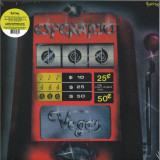
After the recent reissue of their first eponymous album, Favorite Recordings proudly presents Vegas, the second LP from Venezuelan band Esperanto. Rare and sought-after for many collectors, it was recorded in between Las Vegas and Caracas and originally released in 1981. Following bandleader Jorge Aguilar in his musical trip to the infamous American city bathing into flashing lights and vivid colors, we're invited to an excursion in Disco, Boogie and Jazz-Funk territories. Finally reissued, fully remastered, Vegas will be available as Gatefold Tip-On Vinyl LP.
With great care and attention to details, Esperanto managed to create a very convincing sequel to their Jazz-Funk debuts. Vegas keeps indeed a perfect balance between various influences. Through energic disco beats with intense funky solos, catchy AOR-influenced songs, where Jorge delivers convincing vocal performance, or sunny jazz-funk slow jams, the album still reveals something quite authentic. And this feeling echoes surely the one that could have been felt by Jorge Aguilar while discovering USA on a trip - where it all started for the music he loves. Like sometimes a foreigner's enriching view on some local specialty, he surely brought with the band all his authenticity and young but vibrant experience while convincing at the same time major labels for distribution.
With certain notoriety coming with the release of their first album, Jorge Aguilar and his drummer Pablo Matarazzo planned to go to Los Angeles for a few gigs. But once there, they realized their contact had to leave for Tina Turner's tour in Europe. Before that, he invited them to come along to Las Vegas and eventually meet musicians there. Luckily, the plan worked perfectly: Jorge came back to Los Angeles with a lot of contacts then moved to Boston and NYC before finally coming back to Caracas. He told: "I was so impressed with this trip that I told myself that one day I would return to Los Angeles and Las Vegas. The first tracks I did them in Los Angeles with Kenny More, James Gadson and other session musicians from that city. Later, I took the tracks to Caracas where the musicians of the band recorded overdubs. After that, I returned to Los Angeles to master with Bernie Grundman who was still working in his small studio at A & M records studios in Hollywood. As can be seen in the title of some of the songs like "Hollywood", "Vegas", "Kenny's Place", were only the translation of my experiences at the time."
Buscar:intense
Tara Nome Doyle is a 24-year old singer-songwriter with Norwegian-Irish roots. In April 2018 her first release, the song Down with You came out. Since then it has been streamed more than four million times. More singles and an EP called Dandelion followed. In January 2020 her debut album Alchemy was celebrated by the German press (“… like Kate Bush singing songs by Nick Cave at Berghain”, SPIEGEL). TND’s second album, Værmin, will be released in January 2022 on Modern Recordings. The album was produced by Simon Goff, a Grammy-award winning producer (for his work for Hildur Guðnadóttir’s Chernobyl score), violinist and engineer.
TND likes to collaborate: In spring 2021 she co-wrote an original song with Isobel Waller-Bridge (Fleabag) for the upcoming Netflix feature film Munich - The Edge Of War. In July 2021 the EP The Moments We Keep, which she co-wrote and co-produced with the Italian pianist Federico Albanese, came out on Mercury KX. In late 2020 TND released recordings with Malakoff Kowalski (Bad Dreams) and 1k Flowers (Clemency). TND has also collaborated twice with Max Rieger (Die Nerven; producer of e.g. Caspar and Drangsal).
On Væermin TND tells a tragic love story, rich in symbolism and nuances, orchestrated with piano, violin and synthesizer and sometimes pulsating beats – and with singing that is both intense and varied, sometimes angelic, sometimes rough and threatening. Væermin is touchingly beautiful – and yet it also celebrates the supposed ugliness that lives in all of us and that we like to suppress and ignore. All songs are named after animals that are considered undesirable pests: leeches, caterpillars, snails and worms. Væermin celebrates their beauty and thus also asks a political question: What would happen if we welcomed these vermin instead of rejecting them? Wouldn't we then arrive at a much richer, balanced relationship with ourselves, to a more differentiated relationship to the world around us and to other people?
Værmin is a grand, wise, deeply moving album. And the songs get stuck in your head immediately, pulling you into their depths: existential music by an extraordinary artist.
- A1: Opening Credits
- A2: The Chase
- A3: Saved/Captured
- A4: The Bracelet
- A5: Council Of Draags (Part 1)
- A6: Terr & Tiwa
- A7: The Knowledge (Part 1)
- B1: The Fight
- B2: The Knowledge (Part 2)
- B3: The Initiation
- B4: Escape
- B5: The Big Tree
- B6: The Ritual
- B7: The Duel
- C1: Theft/Zarek
- C2: The Bird
- C3: The Free Oms
- C4: The Purge
- C5: The Journey To Ygam
- C6: Council Of Draags (Part 2)
- D1: The City Of Free Oms
- D2: Robot Attack
- D3: The Fantastic Planet
- D4: The Final Battle
- D5: Terr
- D6: End Credits
White / Pink LPs[30,21 €]
Double BLACK Vinyl, Gatefold sleeve, DL card. René Laloux’s celebrated 1973 sci-fi animation ‘La Planète Sauvage (Fantastic Planet)’, is overhauled with a re-imagined soundtrack by electronic modernists Stealing Sheep and legendary sound innovators The Radiophonic Workshop. This exclusive release is part of Fire Records’ re-imagined score series. “No institution has had a greater impact on the development of electronic music than the BBC Radiophonic Workshop.” The Vinyl Factory. It’s a real pre-Avatar conundrum that Stealing Sheep, with the help of Bob Earland, Dick Mills and Roger Limb from the Radiophonic Workshop, unravel. Creating an ethereal excursion that’s narrated by Roger Limb; like a futuristic Martin Denny, or Dr Who gone ambient techno, with a hint of Forbidden Planet 50 years on. It’s an analogue swirl set in an off-world paradise; a field recording from the future. This is a creative, generation-spanning, union brought together to score this unique cult film. A must for fans of psyche electronica and Stealing Sheep’s formidable ‘Big Wows’ album. “Stealing Sheep devour a broad range of styles, incorporating everything from the dark dance-pop of Grace Jones to the experimentations of Radiophonic Workshop pioneer Delia Derbyshire and John Carpenter soundtracks.” The Guardian // ‘La Planète Sauvage’ is a thing of ambient beauty punctuated with electronic earworms that switches from intensely ominous to otherworldly dream like moments.
After more than a year of strengthening our bodies through workout, our poetic endeavors via the discovery of our inner worlds, and also the life of plants and mushrooms, insects, arachnids, birds and wild mammals, after a year and a half that saw us in lockdown, shattered around the planet, after one a and a half year in which we deepened our production skills and also the meaningfulness of our work, Cómeme returns to a new planet with new music.
The beginning is this unique collaboration between Medellín based musician and DJ Julianna, and Matias Aguayo aka “The Don” himself.
In this deep therapeutical exploration of rhythm and sound, these artists established a magical dialogue on distance, leading up to this EP called “Que si el mundo”, roughly translated: “What if the world”.
Between soulful industrial expressions, emotional breakdowns but also discoveries free of any grids and algorithms, Julianna and Aguayo have created a beautiful piece of work, intense as the movements that we had to experience mentally and economically. “Que si el mundo” is state of the art electronic music of today, a work that is both introspective but also extremely open to the outside world and the universe. Compositions reminiscent of Coil, Angelo Badalamenti, Closer Musik, Steve Pointdexter or Mark Broom, shaped this EP that can be considered a short album in its conceptual layout and narrative. Let’s dive into it...
A1. Hiedra
One of the more danceable tunes, ideal for both a sensual warmup or the very late night to the rising sun sensitivity, is polyrhythmical melancholy and hypnotic inevitability, slow dance, deep trance.
A2. Primer Paso
A fat, slick and modern synth sequence, accompanied by heavy drumming and celestial drops that seem to fall onto the body of the listener or dancer, this post EBM stomper is a manifestation of elegant minimalism and reason. As if Liaisons Dangereuses reincarnated in a cloudy forest, to then pause towards the end of the track, with sentimental and gloomy synth chords that open the view towards the horizon.
B1. Que Si El Mundo
The title track keeps up the more melodic approach - somewhere between ambient, avant- garde and late night jazz. Morphing melodies that are both disturbing and soothing at a time encounter smooth free jazz drumming with drums that seem to have travelled from the sixties to today’s world.
B2. Bajo Tierra
This track continues the deep drumming experience that this record means, between laid back rides and intense taikoesque drumming. Distorted dark pads and subterranean choirs build up to a heavy sadness and intensity. Again, a therapeutical track to send those demons fly.
B3. Micelio
A more hopeful conclusion of the EP is “Micelio”. Open chords, soothing and melancholic, spread over profound drum grooves of champed and house. Nothing seems as it was before. A new life has begun.
Six months on from the release of their critically-acclaimed fourth album, ENTERTAINMENT, DEATH, Philadelphia trio SPIRIT OF THE BEEHIVE closeout 2021 with brand new 7” THE DOOR, comprising two previously-heard but never physically released songs in “THE DOOR IS OPEN” and “THE DOOR IS CLOSING”.
A special and limited release, 500 copies of the single have been pressed on cloudy teal vinyl. The 7” is led by “THE DOOR IS OPEN”, a 2020 single that marked a new chapter for the band ahead of the release of ENTERTAINMENT, DEATH. The song “continues to defy definition”, Stereogum said upon its initial release, before adding: “It’s amazing that they made such a short track feel like such a dreamy journey.”
It’s backed by “THE DOOR IS CLOSING”, a bright and skewed gem of a track that was originally released earlier this year via Through The Soil, a charity compilation that benefited the NAMI COVID-19 Mental Health Support Fund.
Whether opened or closed, THE DOOR is a bold reminder of SPIRIT OF THE BEEHIVE’S many layered and colourful ideas. It also ribbon-ties a brilliant 2021 for the band, one which saw ENTERTAINMENT, DEATH labelled as “an intensely beautiful, intensely difficult record” by Pitchfork, a “sprawling odyssey of haunting dissonance and blissful euphoria” by Flood Magazine, and a "storm of sound with a deep humanity coming through” by Fader.
SPIRIT OF THE BEEHIVE is Zack Schwartz, Rivka Ravede and Corey Wichlin.
Miles Kane is back with brand new album 'Change the Show', set for release on 21st January 2022 via BMG.
Following a chance “no frills session” with psych-rock duo Sunglasses For Jaws at the band’s Hackney studio, Miles’ fourth solo album ‘Change the Show’ really began to take shape. “I saw myself in their energy, but also their taste and their knowledge of music,” Miles explains. “It was the first time I’d felt old!”
Opening with the honest soft croon of ‘Tears are Falling’, the album is a joyous ride from start to finish and features a surprising, but spectacular appearance from Grammy-nominated singer Corinne Bailey Rae for a duet on ‘Nothing’s Ever Gonna Be Good Enough’. ‘Don’t Let It Get You Down’, the first track released from the record, is Miles Kane at his very best: energetic, infectious and full of swagger, the track opening with a sample from fellow Wirral alumnus Paul O’Grady. It's an album that best represents Miles himself: charmingly authentic, and like nothing else you'll hear in pop music today.
“This album was born out of an intense period of self-reflection; having all this unexpected time on my hands,” Miles said of the last 18 months. “I wrote songs about big highs, big lows, daydreams, true friends and deep feelings. I learnt to let the future unfold of its own accord, while staying true to myself and that has led to what feels to me like a really uplifting album!”
A record for fans both new and old, ‘Change the Show’ is the Miles Kane album we’ve all been waiting for. The apotheosis of his previous works, incorporating those classic rock and glam influences, but focusing more closely on Motown, soul, and Fifties R&B.
BURNING THE OPPRESSOR is a group founded in 2012 by passionate musicians with different influences and armed with remarkable stage dynamism. With intense texts and brutal riffs, BTO puts into words and sounds the trials of modern life and the sufferings of a society in turmoil. Militant in favor of social equity and the inclusion of all people, the band denounces discrimination and oppression through its work.
Nusrat Fateh Ali Khan & Party lose themselves in this collection of ancient songs whose lyrics recall Sufi poetry and stories. Shahbaaz is intense, ecstatic and uplifting. Nusrat Fateh Ali Khan is one of the key artists on Real World Records and certainly one of the most influential. His voice is universally recognised as one of the greats in musical history and he was key in bringing the Qawwali music tradition—a form of Sufi devotional music popular in South Asia—to the Western world. In his lifetime, Khan collaborated with many Western musicians, including Peter Gabriel, Eddie Vedder and Michael Brook. His vocals appeared on soundtracks to films directed by Martin Scorsese, Oliver Stone and Tim Robbins. The foremost reason for his popularity is inventiveness—an ability to bring together separate traditions. To the popular Qawwali (devotional Sufi) form he has blended elements of the highly classical vocal tradition known as Khal (Persian for imagination). In this way he has created a wholly original fusion. More importantly perhaps he also draws on a range of lyrical material. It is as though he is continually both forgetting and reliving the six centuries of his family’s musical experience in a quest to find new and ever more daring paths to the sublime, carrying both eastern and western audiences to that realm known to the Sufis as Isshq— the state where earthly passion and divine love are reconciled.
The ninth album in BBE Music's J Jazz Masterclass Series presents ‘At the Room 427’ by Koichi Matsukaze Trio Featuring Ryojiro Furusawa, a rarely heard exemplar of post-modal power bop and free jazz. Delivered by a trio playing with an intensity and energy that draws on classic Eric Dolphy and mid-era Coltrane but definitely with its own particular vibe, At the Room 427 is an exemplar of febrile improvised jazz that could only come from Japan. This deluxe reissue sees a welcome return to the J Jazz Masterclass series for saxophonist Koichi Matsukaze. Originally issued in 1976 on the cult ALM label, At the Room 427 is the debut album from one of the most exciting and forward-thinking instrumentalists to emerge in the mid 1970s. Matsukaze's distinctively angular, deconstructive style adds an unpredictable quality to the session that is balanced by the muscular bass of Koichi Yamazaki and the kinetic drumming of Ryojiro Furusawa, who provides a sound footing for Matuskaze’s fiery solos and free-form chemistry. The album opens with the epic Acoustic Chicken, a 20-minute tour de force of dynamic and explosive interplay. Featured on J Jazz: Deep Modern Jazz From Japan volume 3 and written by Furusawa, Acoustic Chicken's strong melody lines and scorching sax finely mesh with the driving rhythm section. Furusawa’s Elvin Jones-like rolls and batteries of percussion are underpinned by Yamazaki’s driving and rounded bass. At the Room 427 also includes a radical deconstruction of the Billie Holiday classic Lover Man and three more original compositions by Matsukaze. The album was recorded live in November 1975 before a small audience in – as the title states – Room 427, a classroom in Chuo University, the alma mater of both Matsukaze and Furusawa. However, despite the rudimentary surroundings, the recording by Yukio Kojima, founder of ALM, manages to give the listener the feeling of being in the room itself, up close to the band, bristling with an intense energy. This reissue of a long-lost rarity of post-bop/free playing maintains the exceptionally high standard set by the previous releases in the BBE Music J Jazz Masterclass Series. As with all releases in the series, At the Room 427 comes with full reproduction artwork and extra sleeve notes, with artist interviews and biographies. The J Jazz Masterclass Series is curated by Tony Higgins and Mike Peden for BBE Music.
C.Z. debuts on LA's Evar Records with the uncompromising Heat Index EP.
The Los Angeles-based producer, beatmaker and DJ sets a course through IDM, techno, jungle and trance to deliver five frenetic, emotionally-charged dancefloor cuts.
Over the course of an intensely productive career, Colby Zinser (aka C.Z.) has made music spanning genres like pop, rap, hardcore and jungle. As well as releasing music as C.Z., he's operated multiple aliases, including the prolific Ice Underlord. Drawing from a longstanding fascination with breaks, trance and the IDM of artists like Warp Records' Clark, he's developed his own rich and eclectic style of club music - a sound that crystalized on his 2020 debut album Hyperfocus.
C.Z. emerged from 2020 armed with a mass of new dancefloor tracks, freshly inspired to make club music a central focus, after years of smuggling techno, trance and breaks elements into the rap beats he was making for others. As he explains: 'It's great to come back to music and just make what I love, I don't want to be someone else's secret weapon, I want to be my own.' Heat Index refuses to toe a line, steering skillfully through genres and setting a tone that oscillates between club-fuelled euphoria, heartbreak and the looming threat of planetary crisis.
Opener 'Midnight' rattles along at a breathless 160 BPM, transporting you to a breakdown in the middle of a pounding hard trance set. Within a minute the rushing neon trance synths collide with huge, sub destroying kicks. The title track 'Heat Index' follows, with brooding pads bolted onto a tight breakbeat, leaving space open for the razor sharp, searching synth line.
Moving rapidly through the gears, 'Hurricane' is an aptly titled exercise in precision programmed classic jungle breaks, carried forward by bubbling earworm melodies. 'Retrograde' shifts the focus again - a pitch-black, dark, fast and seething techno track ripe for warehouses and dungeons, before 'Radial Lens', a melodic, anthemic set-closer built on a muscular, downtempo break.
C.Z.'s first appearance on Evar Records, the LA label founded in 2020 by Trickfinger and Aura T-09, follows a series of hard-hitting releases from Speed Dealer Moms, Limewax and Kilbourne, all artists who like C.Z., are able to traverse twisted electronica, club music and pure abstraction with ease. 'I want to help encourage a more open electronic music space, less pretentious, and encompassing all genres.' C.Z. says. 'It's an important goal of mine, and one the label shares.' Heat Index is a wide-ranging EP from a versatile producer, and a celebration of unfettered expression, for minds and dancefloors free from inhibition or genre restriction.
At the center of Dadub's SA020 lie the myths of the ancient Greek goddess Demeter - her search for daughter Persephone, the drink at the Eleusinian Mysteries ceremonies in her honour, and the fungus which gave the drink its psychoactive properties. The opening track is 'Mistresses March', a thumping narrative of Demeter's search for her abducted daughter Persephone. At the fundament lies a test of a new generation VST - 'Diachronic' - which is used to manage audio samples. The textures which merge during the near 12-minute march scrape and plummet, raining down upon the ominous marching band beat. This is an odyssey, unhappy and unflinching. Based on the handmade modular synth system from Nicola Buono and Lino Monaco, the representation of ceremony drink 'Kykeon' is on one hand a flowing narrative and on the other a demonstration of intense artistic scrutiny: a perfect, unremitting thud. There is, at five minutes, a subtle key pattern, light but not impermanent under the cacophony of chaos. This is indicative of the ceaseless self-examination. Little details, significant differences. Powered by a sound and groove generator invented by Daniele de Santis (Grün), 'Ergot Kernel' is a chemical cauldron. It's a beat continuously emerging from the undergrowth; an imperious column rising; a train ploughing on, coursing through an arid landscape. Conversely, the atmosphere is bright, full of electricity and warmth, with moisture descending. Dadub's SA020 is a journey through a Greek myth, with textural magnificence and technological innovation.
Six years on since his latest appearance on the label's main series, Stroboscopic Artefacts boss Luca Mortellaro, aka Lucy, returns with 'Dyscamupia' - an introspective, multisensory techno triptych revolving around the core sequence of Albert Camus' classic existentialist novel, 'The Stranger'. Also known as the 'killing of an arab', this pivotal moment in Camus' seminal book - which also inspired The Cure their song 'Killing An Arab' back in the day, is here evoked through three variedly intense, deep and hypnotic techno variations - flexing from 120 to 130, onto 140 BPM - each of them translating a particular step in the author's minute, focal-shifting depiction of the unknown man's murder on the beach.
Embodying Meursault for a minute, Jason Snell lends his voice to the narrator and his inner demons, casting a strange, ominous spell on the club and its crowd. Willing to explore and dig up further into the textural wealth and crucial warmth of organic sounds and synthetic treatments, Lucy made wise use of the binaural microphones technology during the vocals recording process, greatly enhancing the immersive force of his compositions to create thoughtful, dystopic narrative bubbles that stand in their own right.
The first number, ' Dyscamupia (Forward)', happens before and right until the actual killing - hence time flowing at a metronomic, heartbeat-like tempo; the second cut 'Dyscamupia (Pause)' takes place right after the nameless man's death, when the narrator enters a kind of existential 'pause' and a whole new flow of consciousness begins; the third sequence, 'Dyscamupia (Backward)', plumbs the depths of the action itself as played backwards, like an equally hazed-out and dizzying reminiscence of the sad encounter's mechanism. Don't let its seemingly conceptual framework fool you though, like most of his past output 'Dyscamupia' also aims to bring dancefloors to a steady simmer, whilst maintaining Lucy's ascending momentum towards an all-round genre-busting, thought-provoking apex.
- A1: Amore Adesso (No Time For Love Like Now) (No Time For Love Like Now)
- A2: Canta La Vita (Let Your Love Be Known) (Let Your Love Be Known)
- A3: The Scientist
- B1: Wicked Game
- B2: Luce (Tramonti A Nord Est) (Tramonti A Nord Est)
- B3: Follow You Follow Me
- C1: Natural Blues (Feat Mahmood)
- C2: Fiore Di Maggio
- C3: Human
- C4: Con Te Partiro
- D1: High Flyin' Bird
- D2: Ho Visto Nina Volare (Feat Fabrizio De Andre)
- D3: Lost Boys Calling
DISCOVER" is the new album by ZUCCHERO "SUGAR" FORNACIARI. It is the first cover album of Zucchero’s career, who stripped and restyled in his own iconic view, Italian and international music masterpieces. The first single will be "Follow you follow me", an engaging reinterpretation of one of the first great worldwide Genesis’ hits. “DISCOVER” unites Zucchero’s two musical souls of the best Italian melodic tradition and the deepest Afro-American roots. Also important are the collaborations with BONO in "Canta la Vita" (Italian version with Italian written lyrics by Zucchero of Bono's song "Let Your Love Be Known"), with ELISA in "Luce (Tramonti a Nord Est)", and with MAHMOOD in “Natural Blues”, Moby's version of Vera Hall's song “Trouble So hard”. Also included is the intense duet" Ho visto Nina volare " with FABRIZIO DE ANDRÉ.Reviews Daily Express, Daily Mail, Uncut, Sunday Times, Telegraph Ads Sunday Times, Uncut. LP Version.
Grace Cummings is an actor and musician from Melbourne, Australia. Grace
learned piano as a child and took up the guitar as a young adult, but only
began to write and perform music in 2018. She went from a debut gig at
Melbourne’s Old Bar to a breakthrough performance at Boogie Festival in the
space of six months, picking up support slots with J Mascis and Evan Dando
along the way.
With buzz building around her powerhouse live show, Grace grabbed the
attention of Flightless Records (King Gizzard and The Lizard Wizard), who
released her debut album, ‘Refuge Cove’, in late 2019. Refuge Cove won
praise from publications around the world, including Pitchfork and All Music,
and Grace was tapped for support slots with Weyes Blood, Cash Savage,
Teskey Brothers and Allah-Lahs.
In 2020, Grace recorded the single ‘Sweet Matilda’ for Mexican Summer’s
‘Through the Looking Glass’ series before landing a worldwide deal with
indie powerhouse ATO Records (Alabama Shakes, My Morning Jacket, King
Gizzard and the Lizard Wizard). Her sophomore album, ‘Storm Queen’, is
now set for release.
Available on CD and opaque white vinyl. (Once the coloured vinyl format has
sold out, a standard vinyl format - ATO0589LP - will be made available.)
A graduate of the drama program at the Victorian College of the Arts, Grace
appeared in Elbow Room’s award-winning production ‘Prehistoric’, which
played to packed houses and widespread critical acclaim at the 2018
Edinburgh Fringe. In 2021, she made her debut with the Melbourne Theatre
Company in 2021, in Joanna Murray-Smith’s ‘Berlin’.
“Cummings isn’t content to merely sing along to her melodies. She tears her
low, surging voice to shreds, braying like she’s beckoning you from the
opposite end of a crowded room. It adds an eerie, intense quality to her
music - a desperation behind the calm of her arrangements.” - Pitchfork
“One of Melbourne’s hottest new talents... filled with raw power.” - Beat
Magazine
“Cummings has a voice that demands to be heard, while her lyrics cut
through to the heart, leaving listeners gasping for air.” - Folk Radio UK
“Like a combination of Sandy Denny, Odetta, Tom Waits, Leonard Cohen
and Marianne Faithfull... as the last piano chord ends, you are left wanting
more.” - Your Music Radar
“There’s a striking androgyny in her tone, it brings the power needed for
these songs to make you stop and listen...Her wit is very sharp and it bites
back with cunning rhetoric.” - Stomp and Stammer
“Take notice of Cummings as a fresh new Australian talent.” - X-Press Mag
Dodging Dues is a startlingly expansive record “startling” in part because it’s relatively short (seven songs, all but one hovering around the four minute mark), but also because it traverses so many moods and styles: languid and dreamy one moment, surging and intense the next. Garcia Peoples (these days a six-person band) “hit their stride” a long time ago, but here they seem to be hitting a dierent one, working themselves loose of in‑uences (though this tree has roots: traces of Thin Lizzy, of more arcane bits of U.K. folk-prog, of vintage Meat Puppets in some of the softer passages) while at the same time opening themselves up to their own individual strangeness, becoming ever more singular and ever more free.
Duane Pitre returns to Imprec with Omniscient Voices, an articulate, intense and emotionally resonant set of five pieces for justly tuned piano and electronics.
Omniscient Voices is a uniquely distinct work that follows Pitre's trilogy of releases which culminated with 2015’s Bayou Electric and included the critically acclaimed Feel Free (2012) and Bridges (2013) albums. Where those albums were rooted in long form pieces, Omniscient Voices is a collection of shorter pieces, offering more harmonic variety than previous works, with a unique sound and feel that is still unmistakably the work of Duane Pitre.
In 2019, after a five year period where Pitre did not focus on outward facing music, but instead on his own personal practice, a small idea in the form of a question came to him: would the combination of his latest computer- and electronic-based experiments, used in conjunction with justly tuned piano, produce interesting results; simply put, would it “work”? Concurrently, Pitre was studying a handful of Morton Feldman scores for their focus on tonal clusters, reading a book on Arvo Pärt’s life and work, and contemplating the pulse-based rhythms of Steve Reich and Phillip Glass.
In 2020, with no intention of making a new album, the composer tried to answer this question. The results would spawn five pieces that would become Omniscient Voices. On this new work, Pitre finds himself giving equal priority to both piano and electronics, utilizing his Max/MSP-based generative network to real-time convert precomposed piano motifs, into data, which is then used to communicate with two polyphonic, microtonal hardware synthesizers whose patches Pitre authored; this process generates the electronic component of the album. Pitre also utilizes controlled improvisation to interact with the piano-reactive electronics in a spontaneous and inspired manner, going back and forth between these two pianistic approaches. In all, this approach creates a “musical feedback loop” of sorts.
Despite Omniscient Voices being the culmination of 15 years of hard work and inspiration, this beautiful album somehow materialized in a natural, intuitive and effortless way (like any artist's best work.)
Artist's statement: “When making the pieces that would become Omniscient Voices, I often viewed the piano as human action, a single note becoming a single gesture that has the potential to change the electronic environment, the electronics becoming the environment surrounding that human in the natural world, who then has the power to change their actions based on their surroundings. All actions have consequences. The interconnectedness of everything. Single actions making waves of change.”
RIYL: Arvo Pärt, Morton Feldman, Steve Reich, Phillip Glass
Mastered and cut by Golden and pressed at RTI for maximum fidelity.
*Limited edition of 200 copies, heavy weight vinyl, comes with poster* fmvee joins Queeste with who do u love?, an EP of fractious songs recorded over a tumultuous four-month period in Los Angeles. Having debuted in 2018 with a set of club contortions touching on jungle and 2-step, the US artist returns with a work of intense self-reflection. Lived experiences are transmuted into an amorphous bricolage of pummelling kicks, synthetic textures, and diaristic details, what they describe as an act of "remembrance." Working and living in LA, the "grind" alongside "aspirational partying," and the confrontation of depression during an intense relationship, informs the EP on levels both sonic and thematic. The slippery rhythm and melodic stabs of 'the way you see yourself' embodies a state of flux, also recalling the early experiments of the LA beat scene. Distant jazz drumming fills its peaceful coda before 'everythingUneverKnewUwanted' introduces an echo lifted directly from the artist's life: a trickling courtyard fountain. This first phase of the release finds resolution with 'thewayothersseeyou,' a conceptual mirror to its start, and one which carries a notable shift in tone; gleaming percussion has given way to ominous synths. Despite the EP's personal nature, collaboration is crucial. 'Seed Perfuming (LoLo v665)' is an fmvee original transformed into a cascading breakbeat by New York producer and engineer Loric Sih AKA LoLo, an ecstatic yet familiar form nestled amidst otherwise bruising encounters. 'sobbing' follows, a digital-age ballad of original lyrics exploring dependency: emotional, physical, and otherwise. It's a poignant conclusion to an appropriately hallucinogenic collection, an intoxicating chemistry of love and loneliness co
With Magma, Faust was one of the most important of all the European groups of the 70's. Compiled from "lost" and unreleased material, originally released as "Munich & Elsewhere" on the 10th Anniversary of their disbandment (including prophetic pre-dub mixing) as well as most of the unreleased "Faust Party 3" LP. Intense, eccentric, hypnotic, a true timeless classic. Finally out as a double LP, 71 Minutes is the second in our series of reissues of Faust. 180 gram vinyl.
"Emotional Response celebrates its 50th release with a special limited-edition from label stalwart Roy Of The Ravers. Following 2019’s magnum opus White Sunrise II is the accompanying “Soliel”, where our nom dee plume delves further into his archives of recently rediscovered disks to present an 8-track double pack, cut loud for DJ play.
The music too is more expansive, with the ambient and techno signatures matched with touches of jazz keys, Balearic sampledelica and even acoustic outtakes, all with that Ravers humour included.
The opening cinematic symphonies of The Smell Of Orange Peel and Kliszewicz Klopcic Klim highlight again a side not seen on his more acid / club cuts found on various labels. However, it’s the B side that compounds expectations with the deep house meets techno melodics of City Limits, before the ever-expanding feel-good vibrations of center piece Feathers hooks all. Sometimes a simple groove and catchy vocal sample is all you need to create a classic.
The second half then glides with 14 minutes of house dramatics via Versace 101624, a master of arrangement and beats, preempting the interlude of Clock House’s return. To close, EL-9400’s intense scatter percussion melds with anthemic acid undertones before its 2nd half melts to a choral ambience, leading to the closing acoustic jam dub curiosity My Brother And His Mate and the curtain for another stage in the Roy sagas. "


