The latest addition to Chick Corea's remarkable discography is Chick
Corea Akoustic Band 'LIVE', the long-anticipated reunion of his beloved
Akoustic Band with bassist John Patitucci and drummer Dave Weckl,
together as a trio for the frst time in more than two decades
Under any circumstances, these thrilling live recordings would be a welcome
addition to Corea's prodigious discography. With the news of his passing still so
fresh in listeners' minds, its release comes as an opportunity for fans to bid
farewell while cherishing the communal energy and playful vigor that made the
pianist a favourite of jazz lovers around the world for nearly 60 years. 'LIVE', the 2-
CD/3-LP set was recorded January 13, 2018 at SPC Music Hall in St. Petersburg,
Florida. The trio's intricate interplay and highwire jousting refects more than 30
years of collaboration between Corea's Akoustic and Elektric Bands and serves as
a celebratory reminder of Corea's singular genius, with more than two hours of
inspired playing and spirited camaraderie.
Chick Corea attained iconic status in music. The late keyboardist, composer and
bandleader was a DownBeat Hall of Famer and NEA Jazz Master, as well as one
of the most nominated artists in GRAMMY Awards history with 68 nods - and 24
wins, in addition to 4 Latin GRAMMYS. From straight-ahead to avant-garde, bebop
to jazz- rock fusion, children's songs to chamber and symphonic works, Chick
touched an astonishing number of musical bases in his career after playing with
the genre-shattering bands of Miles Davis in the late '60s and early '70s
quête:intricate
Together, René Audiard and Ali Cakir are Düve: The symbiosis of René Audiard's electronic programming virtuosity and Ali’s expressive oud playing. Their first EP on Mesma, “Part 1”, compiles four diverse productions compatible with late night dances as well as escapist mind-wandering. Combining elements of dance music with improvisational oud performance and poetry, Part 1 oscillates between house, experimental music and free jazz. As a return to beat-based electronic music, Düve’s Part 1 reconnects Mesma to its love for moody microscopic house.
The opening track, “Baglama”, introduces Ali’s acoustic presence with an atonal improvisation, soon turning into a rough and upbeat rhythmic jam under’s Soren electronic direction.
“Djinn Tonic” is an intricately layered progression of loops generating an unsettling atmosphere, both futuristic and nostalgic.
Following the introductions, the full breadth of Düve’s project is developed in Avvad: A dark, textured and moody journey into an ever-changing world of echoed and looped oud phrases over a familiar house beat, connecting the whole to smokey underground dance floors.
Finally, “Santr”, the EP’s longest piece, is a hypnotic promenade led by Ali’s voice and oud and accompanied by Soren’s chopped up drums and bouncy bass — an expressive and performative track, evoking dance music only in a volatile manner.
We Are FTR welcomes Haf to the label as the collective returns with the talented artist's Foreign Dreams EP. There's much to enjoy here starting with the powerful driving opener "Paranoia", a dark and heady affair perfectly suited to keeping things moving into the small hours. "Shamooli" follows up with intricate shuffling hats, groovy bassline and plenty of atmospheres to get lost in. The immersive and meditative cut "Urgull" stretches out over the full B-side rounding off the EP in fine style with a more laid back feel.
Repress
It's a big pleasure for us to welcome back Mario to the label after a long while. He delivers four raw cuts of harsh techno, crude, direct to the bone but always with a wise use of the elements to make things intelligent and intrincated.
First cut "Pattern execution" proves all this as a statement. Obsessive sequences, distorted groove elements, tension all over an ever changing arrangement.
"Path of authority" reminds the early Birmingham days, again using distortion as weapon. Bringing the heritage of the best records from the nineties to this dystopian present we live in.
"Balance of power" runs over similar parameters than the previous two, increasing the BPM rate and delivering more intricate sequence lines and paranoia.
"Frontline" closes this crude exercise, still fast, still hard but yet mental and futuristic.
A variety of ambient and experimental cuts to be found here. A re-release of sorts, all original tracks were done by Enitokwa (Takashi Hasegawa) as rehearsal for a live performance at Tokyo - Batofar Festival in Paris in 2001 and were released on a limited CDR "promo." in 2002. All 8 tracks were recorded and mixed live in one sitting, and have been remastered, given names and pressed on heavy vinyl with a beautiful cover design by Berlin artist Nik Patrick.
The sample sources were largely inspired by records that Takashi listened to in High School - and feature two hugely well known British hands (one of whom have just reformed and have a new album out…), some old Jazz, Bossa Nova and Hawaiian records, as well as samples from ambient legends Deep Forest and Brian Eno. The result is an earthly nostalgic feel with deep moods to match the times we are living in.
The first track ‘Pop’ bursts into life with an etherial presence. ‘Ssab’ and ‘Chinese Girl Goes to Hawaiii’ have a rather filmic quality to them, whilst ‘Resonating’ seems to float over the wreckage of human activity, a post apocalyptic vision of Planet Earth. ‘Liquid Sky’ is a minimal groove which could be a sonic report from an eerie space station, which is itself a remix of Dub Sonic aka Takehito Nakazeto’s ‘Donigma Dub’.
‘Hope on Hop’ will appeal to today’s generation with its Techno and D’n’B influences, and features voices taken from Wim Wender’s ‘Paris Texas’. Track 7, ‘Mingos’ turns Gal Costa’s voice into a soaring atmospheric haze of digital memory, and the track ‘Holy Spiral’ is a combination of this one and ‘Resonating’, an ascendent 12 minute march to the release’s final close.
Takashi Hasegawa is a respected DJ, producer and live performer who plays live electronic and DJ sets regularly today in venues and festivals across Japan. He has been producing house, techno, experimental and ambient music since the 90’s - spending some of that time in the United States, including working in the music scene in the New York, before returning to Japan working as a sound engineer, A&R and producer for the famous Tokyo-based record label Club Yellow. Now based in Osaka-Fukuoka, Takashi’s music is still resonating with fellow music lovers around the world.
Now, 20 years on from its creation, this music is rediscovered and given a wider audience. The sound on ’Re-Promo’ interestingly gives an insight into the music Enitokwa is currently working on - reflecting the cyclical nature of creative output - and represents a slight departure from the swirling delicate ambient textures that you can hear in o.n.s.a and on the intricate and more musical 2069, released in 2017 and 2016 respectively.
Each track has a video accompaniment to be released in various media outlets, the label head Tom Ransom having partnered with diverse artists in Colombia, Denmark, Japan, Poland, France, Britain and China to create a wide range of visual outputs.
The release also sees two digital only remixes, one coming from London and Wigan’s enigmatic Isherwood (Edward Regan), and the other from Mat Fink - a unique DJ and up and coming producer raised in Pittsburgh and Berlin. Watch out for these…
Machines used:
Yamaha SU700
Sequential Circuits Pro One
Roland TR909
Roland TR808,
TC Electric D-Two
MAM RS3
Pedals
Remastering and additional audio treatment by Kabamix (LMD) on Dec.4.2017.
Dedicated to Takehito Nakazato (SONIC PLATE)
- A1: 1/4 Dead
- A2: Blissful Myth
- A3: The Psycho Squat
- A4: Rotten To The Core
- A5: Poppycock
- A6: Cosmic Hearse
- A7: The Cloud Song
- A8: Vampire State Building
- A9: Blasphemy Squad
- A10: When You Are A Martian Church
- A11: Pig In A Blanket
- B1: Inside
- B2: Nothing But A Nightmare
- B3: Flesh Crucifix
- B4: Slimy Member
- B5: Love Is Not
- B6: Radio Schizo
- B7: Happy Farm
- B8: Alice Crucifies The Paedophiles
- B9: Army Of Jesus
- B10: Dutchmen
The words legendary, seminal, and classic get thrown around at will these days, but Rudimentary Peni’s debut album is all of them. Recorded over two days at Southern Studios by John Loder and originally released in 1983 by CRASS off-shoot label Corpus Christi, “Death Church” showed a band moving away from the urgency of their two early 7”s and into their own realm. Creating a template that bands have been trying to replicate ever since, while ticking all the boxes to become a genre-defining album. Iconic artwork, a unique sound and their own lyrical universe. All merging seamlessly. Sonically the album is full of Nick Blinko’s extraordinary vocals and equally remarkable guitar, Grant Matthews’ big meandering driving basslines and Jon Greville's tight and relentless drum work which together made something intricate and hard hitting, with a sequence that makes the 21 songs on the album flow perfectly. Visually, the album is every outsider art lover’s wet dream. A six-panel poster sleeve with every inch covered in Nick Blinko’s claustrophobic black and white line drawings, while lyrically the songs deal with madness, religion, death, and questioning humankind from a dark poetic place rarely found in any art form. Remastered from the original master tapes by Arthur Rizk and housed in a replica poster sleeve, including the original insert, “Death Church” is back in print in LP, CD and cassette after nearly a decade of no official reissues.
10th Year Anniversary Reissue on Silver Colored Vinyl, Deluxe mirror board jacket, includes CD insert of Oscillate Wisely (2021), with expanded liner notes by Eric Harvey. Bonus Video + Audio of Live recordings included in Digital Download. Recommended If You Like: Pedro The Lion, The Sea and Cake, David Bazan, Major Murphy, Kurt Vonnegut & Guided by Voices. For ten years now, I’ve understood “Oscillate Wisely” as a play on the Smiths’ instrumental “Oscillate Wildly”--itself, of course, a pun on Morrissey’s muse, Oscar Wilde. This is not to say that anything about Mike Adams and his band reminds me of the Smiths (especiallyMorrissey), as much as the idea that rock bands like Mike Adams At His Honest Weight take shape more or less as a thesaurus of past ideas--winking at them, borrowing them like a library book, checking them out from across the room, cloning them. But the best stuff is more ineffable, far more than just cut-and-paste. There’s a weird grandeur to Adams' music, starting with that fully formed, geekily majestic 2011 debut LP Oscillate Wisely, that I don’t hear in anything else, before or since. A sense that Adams is guiding his listeners toward a cosmic joke so personal, so inscrutable, so funny (“funny”), if you give him your attention. It's in his blood, I think. He's not Oscar Wilde, but a uniquely Midwestern type of deeply sincere romantic and dyed-in-the-wool goofball cast from the mold of Hoosier icons like Letterman and Vonnegut. He doesn’t want to believe in anything, he didn’t create this body, helovesa parade. It’s all in fun, but it gets so personal. Onstage, Adams is gregarious and playfully self-effacing, a college town denizen telescoping backwards to the brief early 90s moment when “college rock” entered the corporate suite, and performers forced to become showmen retreated to the comfort of their native tongue: irony.AndOscillate Wiselyhas demonstrated for a decade that earnestness and sarcasm are as intricately bound in rock and roll'slingua francaas hang-ups and chill hangs. I’ve never heard any musician summon everything I love about being from Indiana so perfectly. And I’mfuckingold. Eric Harvey.
For fans of Tall Heights, Sufjan Stevens, & Indie Folk! Steadily building their artistic style and audience for the past seven years, New Jersey based alternative folk band Cold Weather Company carries a diverse sound, rich with harmonies and instrumental builds. The band combines the various writing approaches and influences of its three members, Brian Curry, Jeff Petescia, and Steve Shimchick, to create unique arrangements with intricate layering. Over the past few years, the band has earned over eight million cross-platform digital streams and supported acts such as Tall Heights, Jamestown Revival, and Juke Ross. On their fourth full-length album, Coalescence, Cold Weather Company continues to expand their acoustic-forward, alternative folk sound into new territory. With delicate additions of synths and electronic instruments, as well as a broadened palette of horns, percussion, strings, and harmonies, "Coalescence" explores each song down to its smallest sonic niche. Conceptually, the album revolves around growth by highlighting our capacity to better ourselves and our connections through introspection and reflection. Often occurring cyclically, especially in nature, the idea of growth also inspired the release process for the album which will be split into three parts, each representing a different conceptual facet. "With their spot on songwriting and boisterous melodies, Cold Weather Company is set to follow in the alt-folk leaning sounds of Avett Brothers, Ben Howard George Ezra
The latest thrilling incarnation of master rock'n'roll storyteller Tex Perkins (The Cruel Sea, Beasts of Bourbon, Thug, Tex Deadly and the Dum Dums, Tex, Don et Charlie.) and the Fat Rubber Band began with a rare vinyl copy of Link Wray's Beans and Fatback album, recorded in 1971. Perkins and his respected musician, songwriter, producer and bandmate Matt Walker share a mutual admiration of the American electric guitar innovator, whose iconic power chords in his signature 50s rock'n'roll instrumentals, had a profound influence on the evolution of rock guitar. The Fat Rubber Band is borned with this rare vinyl, the pair have enjoyed countless musical conversations over the decade while hanging out backstage and on the road. Walker offered the debut album's opening track, the wide-screen drama of "Pay The Devil's Due". Perkins responded with the plaintive blues of "My Philosophy". Walker replied with the album's fuzz driven debut single "Danger Has Been Kind" and Perkins countered with the glacially-paced, intimate "Poor Simple Minded Fool". The pair road-tested their works in progress as a duo before enlisting bassist Steve Hadley, drummer Roger Bergodaz and Evan Richards on percussion to complete the Fat Rubber Band line-up to record the album's ten tracks at Walker's Stovepipe Studios in Victoria's Dandenong Ranges. "At Matt's studio - you open the door to the studio and nature floods in," Perkins says. "We wanted it to sound rural, to feel the dirt and the grass and the leaves." Even after all these decades, when you think you know that gravelly baritone inside out, Perkins finds new emotional tones in the service of the Fat Rubber Band's songs vivid narratives, with their characters wrestling, but sometimes dancing, with the tougher, darker qualities of the human condition. This is truly existential blues. Bubbling underneath those upfront vocals and raw harmonies are intricately entwined guitar conversations and unexpected percussive flourishes. "Another aspect that we wanted was for the sound to be sometimes a collision and sometimes a marriage of acoustic and electric instruments. We wanted that tension between mandolins and bouzoukis meeting fuzz guitars." "We also considered percussion to be a vital element of the sound we were going for; we noticed in the recordings we loved from the 50s and 60s that often the tambourine hit, or the maracas, or whatever percussion, was right up there in the mix, right next to the vocal," Perkins says.
Spiralling through the space-time continuum, Alberta Balsam's debut EP amalgamates clipped breakbeat with lithe IDM and sawtooth electro. Inspired by the visionary author Ursula K. Le Guin, the vinyl is presented by Dekmantel Records together with a transcendental sci-fi narrative. Printed on a poster-inlay designed by British artist Alex Morgan, the story tells of a quest for survival on a planet ravaged by ecological collapse.
In a bid to rescue all lifeforms from impending destruction, a lone holobot frantically consults her neurobiological interface. Humans can no longer subsist on Earth: waterways are contaminated, and the unbreathable atmosphere has taken on a toxic purple, almost holographic hue. Faced with environmental apocalypse, she turns skyward, to take root among the stars. With nods to the utopian futurism, attunement to nature and alien visions of pioneering electronic artists such as Drexciya and Delia Derbyshire, Alberta transmutes a synergy that's entirely her own. Higher Dreams journeys elsewhere on a passage that's equal parts intergalactic and introspective, questioning how, on the brink of the abyss, we can find hope.
Blasting off the A-side with 'Atuan Tombs' – a reference to Le Guin's masterful Tales From Earthsea series – a cyborg voice narrates plundering through the skeletal remains of an urban landscape. Hollowed out kick-drums thunder in 'Cascade;' glitched-out beats that shatter into incandescent, intricate melodies. On the B-side, the titular track crescendos, it’s biblical vocals conveying the gravitas of an approaching dystopia. Yet Higher Dreams is far from doom-inducing – the EP closes off with ‘Suspended in the Manifold,' the vibrant Roland TR-808 rhythm fuelled by the colossal power of a solar flare.
Renowned for her live hardware-based sets, Alberta flexes her immeasurable skill as a tech-savvy producer adept at constructing danceable, yet simultaneously lush and expansive interludes. Having trained as an epidemiologist, the theme of care reverberates through her music. Crucially, she regards dance as medicine – a primordial remedy to sustain our interconnected existence.
With his first release as EBM outfit Voltage Control on Antler Subway in 1989, Utrecht-based Arno Peeters can easily be considered one of the Dutch Dance pioneers.
Influenced by hip hop, electro and acid house, and his uncontrollable urge to experiment, he moved on to produce techno. Disappointed by the genre s conventions, he rather suddenly stopped with dance music altogether around 1995, letting a wealth of DATs with unreleased material collect dust in his studio.
To our great pleasure, U-TRAX was allowed to pick some nuggets from these archives, resulting in this Titanic EP and an album later this year.
Arno started experimenting with sound at very young age, resulting in his first cassette releases with experimental soundscapes in 1983. In 1986 he joined the notable Centre for Electronic Music (CEM), where he was able to take his experiments to a new level in a professional studio-environment.
In his techno episode , he recorded several 12 -es and CDs as Sp@sms and The Implant, and as part of Random XS, Urban Electro, African Nightflight and The AWAX Foundation, with most of his records being released on the famous DJAX label.
After turning his back on techno, he applied himself to more experimental music again. In 1996, he created AeroSon, a 40-minute sound collage that won him the first prize in the category Composers Under 30 at a high-brow international contest for electro-acoustic music. This piece was later released on the prestigious Mille Plateaux label.
Since then, his focus has shifted away from releasing music, towards working more project-based: on remixes, compilations and interactive (installations, video, sound design), building himself a successful career as radio maker, teacher and engineer, contributing to several award-winning documentaries and podcasts.
This EP is a nice cross section of Arno s dance productions, serving you some acid, techno and electro.
Titanic V1 was originally created to be a Random XS track, the techno band he formed in 1991 with Sander Friedeman. It was performed during their live set at one of the G.U.R.U. parties, organized by U-TRAX label boss DJ White Delight and label artist P.A. Presents.
This acid track was remixed into a techno monster when Friedeman replaced the 303 with a 101 and added a ton of delay on the bass drums, resulting in the woofer destroying Titanic (Underwater Dub).
The flipside sees a rare post-1995 recording by Arno: CEM Traxx 1. As the title suggests, this melancholic electro gem was created using the intricate machinery of the CEM Studio. Originally created as one half of a two-part composition for some project in 2003, it was never released before.
The EP closes with a typical Arno brainchild, the tongue-in-cheek acid banger XD5 Acid Master, from 1994. Tracks like this happen if you leave Arno unattended with a rather un-hip machine like the Kawai XD-5: he turns it inside out and uses it for things it was never intended for. Buckle up!
All tracks have been produced by Arno Peeters and mastered by Ruud Lekx. Label art by Botterman Ontwerp.
white & blue marbled vinyl
With his first release as EBM outfit Voltage Control on Antler Subway in 1989, Utrecht-based Arno Peeters can easily be considered one of the Dutch Dance pioneers.
Influenced by hip hop, electro and acid house, and his uncontrollable urge to experiment, he moved on to produce techno. Disappointed by the genre s conventions, he rather suddenly stopped with dance music altogether around 1995, letting a wealth of DATs with unreleased material collect dust in his studio.
To our great pleasure, U-TRAX was allowed to pick some nuggets from these archives, resulting in this Titanic EP and an album later this year.
Arno started experimenting with sound at very young age, resulting in his first cassette releases with experimental soundscapes in 1983. In 1986 he joined the notable Centre for Electronic Music (CEM), where he was able to take his experiments to a new level in a professional studio-environment.
In his techno episode , he recorded several 12 -es and CDs as Sp@sms and The Implant, and as part of Random XS, Urban Electro, African Nightflight and The AWAX Foundation, with most of his records being released on the famous DJAX label.
After turning his back on techno, he applied himself to more experimental music again. In 1996, he created AeroSon, a 40-minute sound collage that won him the first prize in the category Composers Under 30 at a high-brow international contest for electro-acoustic music. This piece was later released on the prestigious Mille Plateaux label.
Since then, his focus has shifted away from releasing music, towards working more project-based: on remixes, compilations and interactive (installations, video, sound design), building himself a successful career as radio maker, teacher and engineer, contributing to several award-winning documentaries and podcasts.
This EP is a nice cross section of Arno s dance productions, serving you some acid, techno and electro.
Titanic V1 was originally created to be a Random XS track, the techno band he formed in 1991 with Sander Friedeman. It was performed during their live set at one of the G.U.R.U. parties, organized by U-TRAX label boss DJ White Delight and label artist P.A. Presents.
This acid track was remixed into a techno monster when Friedeman replaced the 303 with a 101 and added a ton of delay on the bass drums, resulting in the woofer destroying Titanic (Underwater Dub).
The flipside sees a rare post-1995 recording by Arno: CEM Traxx 1. As the title suggests, this melancholic electro gem was created using the intricate machinery of the CEM Studio. Originally created as one half of a two-part composition for some project in 2003, it was never released before.
The EP closes with a typical Arno brainchild, the tongue-in-cheek acid banger XD5 Acid Master, from 1994. Tracks like this happen if you leave Arno unattended with a rather un-hip machine like the Kawai XD-5: he turns it inside out and uses it for things it was never intended for. Buckle up!
All tracks have been produced by Arno Peeters and mastered by Ruud Lekx. Label art by Botterman Ontwerp.
Acclaimed L.A. rapper Blu has left an indelible mark on the hip-hop landscape, crafting an impressive catalog instilled with the essence of the vibrant city he calls home. Now, the gifted lyricist is back with the new album "The Color Blu(e)". Among Blu’s most conceptual projects to date, "The Color Blu(e)" is an artistic thesis statement, celebrating and reflecting on a remarkable creative journey. The word “Blue” is featured in every song title, and “Blue” is also weaved into each of the album’s soundscapes. “This album is the ultimate cartoon series about myself,” Blu explains. “The Color Blu(e) is the cool breeze. Another day in the life of being Blu.” While he typically works with a single producer on each project, Blu recruited Sirplus, J57, and longtime collaborator Exile to shape the album’s sonic texture. An unapologetically personal collection with no features, "The Color Blu(e)" is packed with intricate wordplay and dynamic production, reaffirming the unique talent of the artist known as Blu
The very first live stream on 9128.live broadcast from the studio of Rafael Anton Irisarri, as he and Thomas Meluch (Beno�t Pioulard) pieced together a completely live improvisation, christening the newly created 9128 airwaves and setting the bar for many more live takeovers. With one album between them as Gailes, and profound work individually (also together as Orcas), Rafael and Thomas are masters of the ambient craft, combining intricate field recordings, guitar, pedals, vocals and heady reverb across a 40-minute non-stop immersive listen, split into two 20-minute sides for the inaugural 9128 vinyl release. The 9128 label aims to document significant live performances by artists that previously performed on the 9128.live platform. With recordings initially created for a singular collective listening moment, and often as part of a festival or takeover weekend, label recordings will re-present this music for further listening across various formats that best suit each release. Gailes - Session Two, will be available as a digital download and 12", printed in a reverse-board die-cut sleeve, black vinyl.
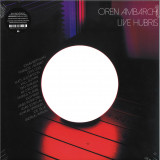
Black Truffle is pleased to announce Live Hubris, documenting the hypnotic and electrifying live performance of Oren Ambarchi’s 2016 LP Hubris by a fifteen-strong band at London’s Café Oto. Over three days in May 2019, Oto toasted Oren Ambarchi at 50/Black Truffle at 10 with Ambarchi and a large group of close friends and collaborators in a series of performances that interspersed existing projects with new collective endeavours, culminating with this: fourteen members of the extended Black Truffle family together on stage, joined by one special virtual guest, to translate the intricately studio-constructed layers of Hubris into a muscular live band workout.
Operating with only the bare minimum of pre-gig preparation after the planned afternoon rehearsal had to be wrapped up prematurely due to noise complaints, the gargantuan group lurches into motion with a 21-minute rendition of ‘Hubris Part 1’, powered by the pulsating electronics of Konrad Sprenger (the ‘ringmaster’ at the ensemble’s core) and no less than seven electric guitars spinning a web of intricately interlocking palm-muted polyrhythms. The layers of closely related but metrically distinct lines create ripples of shifting accents, flickering changes in emphasis that ricochet along the endless central pulse. Gradually building in density, this motorik continuum becomes the backdrop for the haunting tones of Eiko Ishibashi’s processed flute and an extended feature from long-distance guest Jim O’Rourke on guitar synth.
After the brief interlude of the second part, where Albert Marcoeur-esque guitar arpeggios accompany a halting attempt at phone conversation, the full ensemble gears up for the epic side-long rendition of ‘Hubris Part 3’. Now joined by the astonishing triple drum line-up of Joe Talia, Will Guthrie and Andreas Werliin, the layered pulse of the opening piece becomes a burning funk-fusion groove. Beginning on a medium simmer, the ensemble initially stick to its pulsating one-note mantra, over which Ambarchi unfurls a beautiful example of his signature shimmering Leslie-toned guitar harmonics, eventually joined by Ishibashi’s flute and some brooding, distorted dissonance from Julia Reidy’s guitar. Building steadily for the first nine minutes, the heat then rises dramatically with a first, gloriously loose chord change: with the all drummers now rolling and tumbling like a twice-cloned Jack DeJohnette circa 1970, Mats Gustafsson enters on baritone, his tortured roars and shrieks driving the band to peaks of insane intensity. Finally, the exhausted ensemble drops out, leaving only the jagged, skittering fuzz of Ambarchi’s guitar, brought to an abrupt conclusion at the command of crys cole. Arriving on hot pink vinyl with artwork by Lasse Marhaug and an extensive selection of live photos by Ivan Weiss and Fabio Lugaro, Live Hubris brings this ambitious and outrageous evening of music to the safety of the home stereo.
- A1: Begin
- A2: Betweemus
- A3: Soaky In The Pooper
- A4: Because You Are The Very Air He Breathes
- B1: Under The Same Moon
- B2: I Will Drive Slowly
- B3: Oh, What A Disappointment
- B4: Hellmouth
- C1: Bon Soir, Bon Soir
- C2: Hickey
- C3: Breathe Deep
- C4: So I Hear You're Moving
- D1: Let's Go Bowling
- D2: What Was He Wearing?
- D3: Cowboy On The Moon
- D4: Or Thousands Of Prices
- D5: The Pack-Up Song
Back in 1994, when Lambchop first lurched lackadaisically into public view, they seemed to many people freakish, outlandish, destined at best for the pages of photocopied fanzines and the graveyard hours of specialist radio stations. A sprawling collective of Nashville musicians —eleven were credited on the sleeve of I Hope You’re Sitting Down / Jack’s Tulips, one of them apparently responsible for “open-end wrenches” —they’d named themselves after a sock puppet, inexplicably given their album two titles, and stuck a painting on the cover of a small, barefooted child holding a dog whose cock and balls are on proud display. Perhaps to counteract this bold depiction of canine masculinity, the inner sleeve offered a black-and-white shot of what the more refined sometimes call a “lady garden.” The back cover offered a painting detail of a wedding dress. So far, so weird.
Where Lambchop brought us was somewhere so singular and bewilderingly gripping that — to perhaps no one’s greater surprise than
the band themselves, whose homeland remained baffled for quite some years to come — the album ended up in British music paper NME’s Top 50 Albums of the Year. In case anyone were to consider this an anomaly, France’s similarly influential Les Inrockuptibles placed it at number 25 on their own list. Not bad for a band who had gathered since the mid-1980s, once a week, purely for pleasure, in that smoky, dimly lit basement. Not bad, either, for a record whose sessions were initially only expected to produce enough material for a handful of 7 -inch singles. Disheveled yet tender, anarchic yet intricate, I Hope You’re Sitting Down / Jack’s Tulips instead provided the springboard for a career — still ongoing, despite repeated reinventions, and still compelled by stubbornly freakish, outlandish intentions — during which Lambchop’s ever-changing line-up has continued to confound expectations. Wagner, meanwhile, remains one of our most cryptic but crucial voices, an authentic poet of the magical banal. Sure, it was weird here, but it was wonderful, too. Over a quarter century later, it still is.
Sharing his InBach album with the world in 2020 set events into motion that ultimately led to Arandel making second edition in the critically acclaimed, borderless project that unites rare instruments, musical reimanigation.
Arandel unites once again behind the musical phrases of the Leipzig composer specialists of ancient and modern instruments (Thomas Bloch), modern synthesizers and moogs, strings experts (Gaspar Claus), and the poetic spoken word of Myra Davies and Bridget St.John.
Textextext - (add your write up)
"There is a Bach for everyone" Arandel says, "and that discovery is what led me here, to InBach". Beneath the intricate history, the godlike adoration placed upon Bach, he was a playful musician, an eclectic one even. And so, a full year after the release of the first InBach record on InFiné, there is enough material to make a second one. "There is so much about Bach I didn't even know when making the first one - but after the release, people kept coming to me, telling me about certain pieces I should listen to or rework; songs that I had never even heard of."
The second InBach grew like a garden from the seeds of the first one - an eclectic journey through melodic fantasies, intricate sound design and a certain Pop silver lining. Some tracks were born out of Arandel's band performing on stage, experimenting with the songs live and composing them anew, like "Nos Contours", a new, French-lyrics version of Bodyline with Ornette, Arandel's stage partner.
InBach vol. 2 is a logical consequence then, of someone diving into a pool of music and history so large that it is being chronicled to this day. A substantial part of the instruments used on the lofty, eclectic album were recorded at the Musée de la Musique Paris: rare instruments like the *Erard square piano, ondioline, Zach's cello, Stroh violins*. They help shape the unique sound of Arandel's InBach project: sometimes _eerily familiar, always otherworldly and elusive.
In the vein of rare instruments, the first guest musician Arandel approached for InBach was Thomas Bloch, who lends his gift to four tracks over the two albums, playing the ondes Martenot, one of the first electronic musical instruments ever invented. Thomas has worked with many major artists in his career of ike of Radiohead, Gorillaz, Marianne Faithful, Tom Waits, Daft Punk.
The record travels *between styles, ideas and moods elegantly - it is a distinctly fun and personal album. Freeing himself from the weighty shackles of expectation surrounding the classical maestro, Arandel goes for the core of every Bach piece he tackles, making them his own. on "Octobre", based on Air On G-String, from Orchestral Suite No. 3 D-dur, BWV 1068, his nephew tells a dreamlike story of an ominous gang of children, literally blossoming in the mud. "Fabula" - featuring the French singer Scalde - based on the melancholic, Christian lament Meine Seele wartet auf den Herrn, becomes a grandiose, auto-tuned pop ballad on InBach vol. 2, featuring the virtuoso cello of fellow InFiné associate *Gaspar Claus*.
The use of spoken word is another new layer to InBach, and acts a lyrical thread carrying the listener through InBach vol.2: the closing track features Bridget St.John, John Peel-associated folk legend from the UK to offer to collaborate on a poem for this second volume, she replied to him with a line from André Gide : "You can't discover new land if you aren't willing to lose sight of every shore". A lovely way to sum up the InBach experience for both artist and listener.
strumentalist Teddy Lasry's story is noteworthy not just in regards to the music he released, but in the ways approached the craft of composing and experimenting with sounds and sonics.
Always intrigued with the capabilities of instruments, their groove and their feel, it was very much his family’s influence that helped to fuel these life long affections. As a performer in a parisien cabaret, Teddy’s father Jacques would mingle with giants like Serge
Gainsbourg and Charlie Chaplin (impressed by his ability to improvise, Chaplin wanted him to become his accompanist, but the pianist politely refused). Jacques and his wife (Teddy’s mother Yvonne), would later become members of the innovative experimental group Les Structures Sonores, and surround their children’s lives with sounds. Electronic music was still in its infancy and Les Structures Sonores, with their resonators that produced long, mysterious tones, were deemed ‘cosmic’. It was the era of the launching of the first Russian Sputnik and every time a radio or television station wanted music for their science fiction programs, they turned to one of their compositions. Showing a natural ability with multi instrumentalism, Teddy was rewarded with a spot in the band, allowing him to really explore unconventional methods of composition.
Following a brief stint with Ariane Mnouchkine's avant-garde Théâtre du Soleil after graduating school, Teddy joined the pioneering prog band Magma, with whom he would record three groundbreaking records during the early 1970s (According to former member
Laurent Thibault, their album Mëkanïk Dëstruktïẁ Kömmandöh and its sound were strong influences on David Bowie during the recording
of Low and Iggy Pop’s The Idiot at Hérouville). Despite the successes with these projects, Teddy was constantly searching for new ways
of expressing himself through music, leading him into the beginnings of a solo career that would last the better part of three decades.
Teddy’s transition into his solo career came with contrasting fortunes, in that he was now becoming a music to image composer but with the unfortunate realisation that his eyesight was gradually worsening (due to being diagnosed with retinitis pigmentosa at an early age). Nonetheless, his solo career would begin in 1975, and for the rest of the decade his sound would become increasingly mired in electrified Funk-Fusion and its endless sonic possibilities. The resulting music would serve to highlight Teddy’s love affair with the possibilities found within tireless instrumentation, with the flute and particularly synthesisers becoming a mini-obession of his (he once spent a 7,000 Francs loan, which was meant to be spent on fixing his roof, on synths).
To this day Teddy continues to record and experiment with music, a passion which in many ways has never left his sid, even at the age of 75. His career was one that was fuelled by innate curiosity and an intrinsic desire to discover new methods of expressionism, be it through the realms of Jazz-Funk, ambient electronics, Swing music or indeed through the medium of instrumentation itself. On this compilation, we look to encapsulate the essence of his innovative sound, and from start to finish a sense of his ingenious approach to composing structure and mood is made abundantly clear. The funk-jazz fusion style that embodied the majority of his 70s work is on full display here, with the vibrant flute driven "Los Angeles", the Miles Davis inspired "Blue Theme", the progressive and driving
"Chamonix", and the deeply intricate "Krazy Kat", along with one of his finest 80s slow jams, "Funky Ghost". Two cuts off the ‘Back To
Amazonia’ album are also featured (Teddy’s last album including his Prophet T8, Yamaha DX7 and Oberheim drum machines). "Raising
Sun in Bali" and the title piece both emphasise an ever present passion for synthesisers. "Birds of Space", a standout track off the e=mc2 album, closes the comp, and is a fitting way to end this journey.
Pulled together in close collaboration with Teddy and his family, this collection of songs looks to introduce new listeners to his work and we are proud to present this limited and carefully remastered compilation on vinyl, including extensive liner notes.
- A1: Slowly Sinking In (2021 Remaster) 06 48
- A2: Awake On The Fifth Floor (2021 Remaster) 07 12
- A3: In Spite Of Everything (2021 Remaster) 08 35
- B1: Your New God (2021 Remaster) 07 08
- B2: Daydream Belief (2021 Remaster) 06 35
- B3: That Empty Feeling (2021 Remaster) 03 16
- C1: And I Got Left Behind (2021 Remaster) 07 55
- C2: Nothing, Still Nothing (2021 Remaster) 09 28
- D1: Dry Retch (2021 Remaster) 10 45
- D2: Always A Part (2021 Remaster) 08 11
For its 20th anniversary, Keplar presents an absolute milestone in the history of IDM and ambient music for the first time in its definite form: »Together Is the New Alone« by Donnacha Costello was originally released on Mille Plateaux in 2001 as the second LP under the Irish producer’s given name and firmly established him as one of the leading artists in the field of forward-thinking electronic music after he had primarily made a name for himself with house and techno releases under the Jayrod moniker. This vinyl reissue with an entirely new artwork comprises all ten tracks originally only included on the CD version in their edited and final form in which they were last presented on the digital re-release under the name »Together,« remastered by Stephan Mathieu and self-published by Costello, in 2015.
Truly prescient artists rarely opt for introspective sounds, however that was the case when Costello set out to produce »Together Is the New Alone« during nightly session in his hometown Dublin between April and July in 2001, and it also explains the album’s enduring appeal and unwavering radiance twenty years on. While many of his contemporaries dedicated themselves to explore the musical zeitgeist and notions of the future in conceptual terms, Costello made them emotionally tangible, allowing his audience to feel their underlying ambiguity rather than just reflect on it. »Together Is the New Alone« is an album that wordlessly speaks of the paradoxical sense of social alienation and isolation expressed by its title and thus seems even more topical today than it did at the time of its release.
Working with elements from techno culture, glitch aesthetics, intricate IDM rhythms and lush ambient textures, Costello never once throughout the album adheres to tried and tested formulas and conventions, but holistically moulds complex compositions out of distinct and discrete parts. The result is a record that is at once easily accessible and deeply affecting, but also infinitely rich and stunningly sophisticated in musical terms. A personal record expressing a universal sentiment—a truly timeless statement that will reverberate for decades to come.
(Kristoffer Cornils)
It's a great pleasure to introduce Leed's based newcomer Alfred for his eagerly awaited debut release on 20/20 Vision following a string of cutting edge releases on Reference Mark Recordings.A'Direct Hit' is packed with an array of intricatelyAwoven electro, breaks and perfectly executed peak-time club weapons.A
'Direct Hit'Afuses techno andAbroken beats withAa bottom heavy bass theme reminiscent ofAclassic Kevin Saunderson,Asoaring arpeggiated synth lines, slick drumAprogramming and a killer break. TheAhighly sought after Dublin basedAproducer CignolAdelivers a perfectlyAexecuted acid electro remix that adds lush strings additional synths to the originalAtheme.A
'Iris', is a nifty high fidelity breaks workout, loaded with an abundance of Alfred's signature flourishing arpeggios and modulating synths backed by an infectious groove, and a fragmented bass line. 'Core Velocity' rounds off the record with perfectly nuanced synth polyphony giving it a deep, tripped out braindance flair, punchy bass and irresistible groove.