Plastic Crimewave Syndicate returns with one collective foot in overdriven space-biker scuzz rock, but the other bigfoot kicking upward into new galaxies of synth punk, no-prog, and freek funk. Yes, dare we say it, the new PCWS LP, Tales From the Golden Skull, GROOVES--but from the perspective of the Japan n' Kraut/Eurorock undergrounds, coated in some nasty Windy City grime. Aided by the Chicago Cosmonaut Couriers Crew, ala famed renaissance man Mac Blackout (synths/horns/electronics), Przemyslaw Krys Drazek (trumpet) of longtime zone-jammers Drazek Fuscaldo/Mako Sica, Will MacLean on Moog keytar (!-- of local Silver vocoder-ed Apples lovin' treasures Protovulcan), plus the oldest-school synthlord Bil Vermette, who's been modulating since the 70s. We'll call Tales From the Golden Skull a near-concept lp (aren't they always?) that looks back at fallen friends and collaborators, and then into the unwritten golden future (as PCW himself hit the golden 50). The sonic journey dips into dark textural valleys, and chugging riffs rising to thee fiery heavens, as the thundering-but-subtle rhythm section of Jose "Beast but Best" Bernal and Rob "Dead Feathers" Rodak know when to crash and when to burn (one). Sir PCW lays down his trademark big muff-blastage and echo-cries, to channel the despair and feral bark of the mighty Vega/Hammill/Iggy/Dickie P/Haino/Mojo-Risin/Mizutani, but also knows when to shut up for some layered instrumental Embryo/Harvester/Fausty trance rock and dabbed/dubbed out "not-quite-shoegazin" calmness in the eye of the Ur-storm. This might be the most expansive, detailed yet furious PCWS LP yet, recorded at Rec Room studios with Eric Block, who has done all from a band with Sonic Youth's Steve Shelley to recorded Rhys Chatham 100+-peeps guitar orchestras. So strap the headphones on and absorb the tales of this spaced ritual-rock opus. Artwork - Steve Krakow
quête:it electronics
Scored by the legendary Italian film composer Armando Sciascia, Sea Fantasy is a conceptual suite of twelve exotic themes evoking the many moods and dramas of life under the sea. Recorded in 1972 for Sciascia's own Vedette label, the album is a key recording within the micro-genre of Italian underwater library music. A mosaic of evocative modern classical, flamenco textures and a surge of raw analogue synthesizers. Mysterious aquatic music that sits comfortably alongside other Italian Soundtrack and Library recordings including the lush bossa of Daniele Patucchi's Men Of The Sea (CAM) as well as the experimental electronics of Biologia Marina by Amedeo Tommasi & Alessandro Alessandroni (Rhombus). With several cues used for the English-version soundtrack to Harald Reinl's 1976 (Erich von Däniken inspired) mondo-documentary Mysteries Of The Gods, Sea Fantasy is reminiscent of the exotic mood-music scored for Folco Quilici's documentary Oceano composed by Ennio Morricone as well as Luigi Scattina's legendary tropical sexploitation film Il Corpo composed by Piero Umiliani. This new 2019 edition has been newly remastered and expanded with additional liner notes and photos.
Remastered and expanded edition.
Legendary Italian underwater Library recording
Replica vinyl reissue of the rare 1972 LP
Mysterious aquatic mood music
Having spent their formative years in São Paulo Brazil, as a teenager, Lau Ro found themself uprooted from their home. Moving with their family to Europe in search of a better quality of life, their story was like that of many immigrants in the same position. Lau Ro's parents found work in factories and cleaning jobs, for the first few years in the North of Italy and then in Brighton on England's Southern coast. "We never managed to visit back home, so my connection to Brazil became largely made up of childhood memories and my fascination with all the 60s and 70s music I could find from there."
In Brighton, the young non-binary singer and composer would immerse themself amongst the city's vanguard of free-thinking artists and musicians. Lau Ro formed Wax Machine whose prefigurative, psychedelic community provided a glimmer of countercultural hope amid a backdrop of national political decline. From 2020-23, Wax Machine birthed three cult-favourite albums in as many years; indebted in part to their British psychedelic forebears from progressive folk, rock and jazz yore. But the kernel of Lau's Brazilian sound was already beginning to blossom across Wax Machine's releases. Now, taking root deeper still, Lau Ro steps forward with their debut album: Cabana.
Named after the small wood cabin at the bottom of their garden where the album was recorded, Cabana is a deeply personal record of memory, self-discovery and imagination. Melancholy and hope combine across ten tracks of dreamy bossa, ambient folk, fuzzy tropicalia and majestic MPB. The music is swathed in masterful string arrangements and trippy electronics in equal part, while Lau Ro's delicate, yet quietly confident voice takes acerbic aim (in both English and Portuguese) at polluted city life, while dreaming of a utopia, rich with nature and wildlife.
Like the musical equivalent of semantic drift, Lau Ro's displacement led to the creation of another Brazil. A mythic place in Lau's soul, as they put it, "where the sunshine and joy of my childhood remained untapped." Lau continues: "It's music that might sound as if it came out of a parallel universe Brazil, rather than its modern day landscape. I am nowadays rediscovering Brazil, going back as often as I can and trying to stay connected to these different parts of the world and myself."
Philip Clemo’s seventh studio album, Through the Wave of Blue, is a journey through a father’s response to profound adversity. His narratives traverse through fear, darkness and disorientation as his youngest daughter becomes seriously ill, culminating in the eventual light of joy as she recovers.
From the haunting depths of “Stalker” and intensity of “Maze” to the serene “Rest” and celebratory “Dawn, Through the Wave of Blue offers an immersive experience that engages both viscerally and emotionally.
Each composition has its own sonic identity, inviting listeners to delve deep into the intricate dialogues and textures that unfold. Clemo blends complex drones & atmospherics with brass, woodwind, strings, guitar, piano, electronics and hypnotic rhythms to create mesmerising soundscapes that captivate the senses.
''One Foot in the Rave'' is a vibrant collection that showcases Jonny's signature style--a blend of melodic, melancholic acid jams, bleepy funk, and warm analog electronics. Whether for the stereo or the sound system, the LP moves from the upfront bounce of ''The Apocalypse is Now'' and ''Raymond Tuesday's Big Day Out'' to the shimmering reverb of ''Starry Night'' and the birdsong-infused ''Ringfort.'' Listeners will find themselves in familiar Automatic Tasty terrain, rich with psychedelic exploration. According to Jonny, ''What to say about this record? I don't really know and it hardly matters. I wrote them on different bits of gear; ye olde faithful Roland SH101, my MC202 (pencil and paper de rigeur), a battered x0xb0x 1.0 (thx Daniel!), a beloved Yamaha Cs-5, a similarly beloved Roland SH5, a truly hammered Juno106, a Roland JX3P, a Nord something or other, an MPC2500, my TR606, and a Vermona DRM1 MKII being sequenced via a bedraggled TR626. Also Jay's TR808 is on there (thx Jay!) and a TR8 being squashed through a Mutronics Mutator (wheee Damo!) and a Zoom H4n recorder. I edited them on a dilapidated laptop, with no headphones or monitors, steering by the tiny speakers on the computer and playing them in my car, twiddling the mix as I went. But these are frivolous and unimportant details. All that matters is that these songs were made out of love. Cheerio, Jonny. P.S.: This record is dedicated to Jay 'Winthorpe' Kelly.'' ''One Foot in the Rave'' will be available on vinyl and digital platforms starting October 14th.
2024 Reissue
"Still Smiling" is the first album of songs written in four hands by Teho Teardo and Blixa Bargeld; a work conceived and composed over two years, with dedication, working side by side, deciding and choosing every sound, every word, every silence together. The album, contains 12 songs: 10 previously unreleased, a new version of "A Quiet Life" and the cover "Alone with the moon" by Tiger Lillies. On the album, recorded between Rome and Berlin, in Teardo"s Rome studio and in Einstürzende Neubauten"s "Andere Baustelle" (the historic band of which Bargeld is leader), cellist Martina Bertoni and the Balanescu 4et collaborated. Teho and Blixa dialogue in symbiosis, Blixa"s deep and intense singing ranging from Italian to English and German, Teho"s music sublimating and enchanting between strings, electronics and experimentation. The maturation of ideas and intentions, in the numerous journeys between the two capitals, the desire, listening and meeting of their respective expressions, have left their mark. Still Smiling is a record that gives time, it is a privileged vision that covers all the sky between Rome and Berlin. The collaboration between the two artists began in 2009 for "Ingiuria", a performance by Raffaello Sanzio"s "Societas" that featured Alexander Balanescu on stage in addition to Bargeld and Teardo. In 2010, Bargeld and Teardo collaborated again to record A Quiet Life, the title track of the soundtrack of the film "A Quiet Life" with Toni Servillo. After these two experiences, a strong understanding and artistic affinity was born, which has led to the genesis of "Still Smiling".
Nearly a decade after the release of his breakthrough debut album 'Sunday', Swedish producer HNNY (aka Johan Cederberg) returns with the album Light Shines Through, released independently via HNNY's own imprint.
For his first album in almost a decade, HNNY has returned to the electronic soundscapes that inspired his earliest releases. It's made for the quiet, brain-tingling moments of solitude at home and contains a consistent thread throughout, not just in the ambient sounds used, but also more conceptually with what the songs evoke and what they are about: the album lands at a particularly pivotal moment of HNNY's life after the birth of his two daughters which have given him a new perspective on life.
HNNY's melodies are a gentle alternative to the more complicated corners of dance music. Debuting on Studio Barnhus in 2011, HNNY aka Johan Cederberg quickly became one of house music's most talked about artists with a signature sample driven style. He has won a Swedish Grammy in the electronic music category, toured the world globally and created a following both in and outside of the dance music community for his bittersweet strain of dance music.
Shortly after the release of his critically acclaimed debut album Sunday, the producer stopped touring solely focusing on production. Since then, HNNY has racked up hundreds of millions of streams, released a number of singles and EPs on the likes of Let's Play House, Puss and Omena and he is now finally ready to return to the LP format for the first time in nearly a decade with the album Light Shines Through.
Flame is Slow collects together three acclaimed seven-inch EPs (originally released on the Noisebox label in 1996 and 1997) by the mysterious, mercurial Navigator. The post-Loveless UK underground of the early 1990s was a vibrant place, despite what music biographies may tell you. What might now be lumped together as “post-rock” was in fact a varied and forward-thinking group of artists creating inquisitive music in the wake of the grunge goldrush. Contemporaries such as Hood, Flying Saucer Attack, Movietone and – of course – Mogwai and Arab Strap are rightfully seen as timeless nearly thirty years on but they’re really just the tip of the iceberg. Navigator might get mentioned less but their story is every bit as intriguing as any of their peers. Navigator formed in Norwich in 1994. Their music was consistently introspective and melancholic, but their brief existence of five years saw them move rapidly from traditional song structures towards noise, found sound, free improvisation, electronics, primitive instrument building and – ultimately - silence. They were an enigma back then and they remain so now. They released four seven inches before a solitary album Nostalgie (1997, Swarf Finger Records). Each release felt different to the last but always intimate and peculiar. Their use of sound and space is nothing short of magical. Rough and unsettling textures rub against each other, selected and mixed instinctively. Another band’s discarded mistake becomes a key element in their hands. The band received much acclaim and some genuine commercial success when single When the Wires Fall ended up in the indie charts. They shared stages with Low, David Thomas, Aerial M, Stars Of The Lid and Labradford and toured with Mogwai and Arab Strap culminating in the now-notorious, equipment-levelling performance at The Garage in London. The original version of the group played live for the last time in 1999 before quietly disappearing. It was perhaps inevitable that a band so committed to exploring and refining their sound should end by removing themselves from it entirely. Aside from a brief (and excellent) reformation in 2006 and a CDR compilation of those early seven inches, Navigator have been quiet for over 20 years until now. Flame is Slow assembles the blue, red and green Noisebox EPs into one cohesive album-length collection, remastered with care and reassembled by the band. It rightfully places Navigator where they belong – as one of the most curious, adventurous, and beautiful groups this island has ever produced. “Whenever I think of bands that more people should’ve heard than did, I always think about Navigator. It’s great that the music they made is going to be available again as it is truly special and deserves to be heard by more people” – Stuart Braithwaite
DJ MAG:
"Spanning 10 tracks, 'The Fifth Chakra (Ambient Space Tea)' explores sound system culture, covering one of the British-Jamaican artist's biggest influences. The record is largely beatless and focuses on the power of sub-bass and other electronics, moving away from the percussive house energy of much of his past material."
909Originals:
"The largely ambient album is a departure from the thumping beats that Mr G has become famous for, but it also displays his personal, emotional side - tracks like Constant, Solar Eclipse NYC and The 5th Chakra encapsulate an artist allowing himself the freedom to roam through his influences."
Resident Advisor:
"Never did I think I'd get to a meditative place and learn restraint,' he said. "This is the album I've always wanted to make, never thinking I could. Also, after loving others' bass-heavy albums, it's a joy to put my own into the mix. But I always remember my thing is weight and tone in whatever I take on. Especially in this flat, compressed world."
- A1: Somewhere In My Memory (Main Title)
- A2: Holiday Flight
- A3: The House
- A4: Star Of Bethlehem
- A5: Man Of The House
- B1: The Drifters - White Christmas
- B2: Scammed By A Kindergartner
- B3: Southside Johnny Lyon - Please Come Home For Christmas
- B4: Follow That Kid!
- B5: Making The Plane
- B6: O Holy Night
- C1: Carol Of The Bells
- C2: Star Of Bethlehem
- C3: Setting The Trap
- C4: Somewhere In My Memory
- C5: The Attack On The House
- D1: Mom Returns & Finale
- D2: Mel Torme - Have Yourself A Merry Little Christmas
- D3: We Wish You A Merry Christmas (End Title)
John Williams' Home Alone soundtrack is a heartwarming classic that perfectly complements the holiday season. Known for his work on Star Wars, E.T.and Harry Potter, Williams brings the same orchestral magic to this beloved Christmas film. The score includes memorable tracks like 'Somewhere in My Memory,' a recurring theme throughout the film, and 'Star of Bethlehem,' which captures the festive spirit with choral and orchestral elegance. The standout track, 'Setting the Trap,' diverges from Williams' usual orchestral sound, incorporating electronics and percussion to enhance Kevin's creative showdown with the burglars. Alongside traditional Christmas carols like 'O Holy Night' and 'Carol of the Bells,' the soundtrack blends nostalgia with whimsy. Though the album repeats familiar motifs, its charm makes it a refreshing alternative to typical holiday music. The Home Alone soundtrack is available in a limited edition red and gold vinyl 2xLP, making it an essential for any festive playlist. Whether it's playing while decorating the tree or enjoying Christmas cookies, this release brings the holiday spirit alive.
8 cuts of minimalist electronic bliss
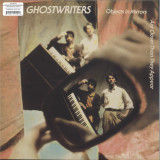
"Dark Entries calls on Philadelphia experimental duo The Ghostwriters to resurrect their 1981 LP of minimalist mayhem, Objects In Mirrors Are Closer Than They Appear.
The late Buchla maestro Charles Cohen and multi-instrumentalist Jeff Cain joined up in 1971 to craft electroacoustic chaos as Anomali, later renaming themselves The Ghostwriters. Their collaborations with choreographers and visual media artists led to their singular style, straddling improvisation and composition, the oneiric and the immediate.
1981 saw the release of their debut album, Objects In Mirrors Are Closer Than They Appear, a whirling, messy, telepathic slipstream cascading across an imaginary landscape. Recorded in Don Buchla’s childhood home, Objects offers 8 cuts of minimalist electronic bliss, equal parts icy and quirky, with standout cuts including the grooving havoc of “Fix it in the Mix” and the otherworldly hymn “Moon Chant.” These angular pearls will be cherished by fans of John Bender, Ceramic Hello, and all strains of outsider 80s electronics.
Objects In Mirrors Are Closer Than They Appear has been freshly remastered and includes an insert with photos and liner notes. Proceeds from the album will be donated to SOSA (Safe from Online Sex Abuse), a nonprofit that combats online child sex abuse and trafficking"
2024 Repress!
Ahead of two albums worth of Severed Heads reissues on the excellent Medical Records, their West Coast compadres Dark Entries present a 12" edition of what is perhaps the band's most iconic track. One of three records due this month to celebrate Dark Entries fifth anniversary, this 12" is themed around "Dead Eyes Opened", perhaps Severed Heads' most iconic track and presented here in extended 12" mix version. Anyone with a passing interest in primitive electronics should be more than familiar with "Dead Eyes Opened" which sounds remarkably ahead of it's time even today. Both the B Side tracks from the original 1984 pressing make the cut too and Dark Entries have done a wonderful job in replicating the artwork too.
In 2007 an Italian film festival invites Mouse on Mars to score a film of their choice. The organizers claim to be able to clear the rights for any movie the band chooses. Werner Herzog’s fictional documentary Fata Morgana, which merges footage of several desert explorations by Herzog and his team into one continuous association, has long been a band’s favorite. The film comes with a soundtrack by Mozart, Leonard Cohen, Third Ear Band and field recordings. Andi Toma and Jan St. Werner are sent a DVD to Düsseldorf and start working. The idea is to score the film in real time so instrumentation has to be readily at hand: guitar, percussion, electronics, mouth harp, pedals, software, tapes, samplers. Once the arrangement for the three-part film is sorted Mouse on Mars bring their score to stage. Herzog Sessions is performed twice: first when the band still thought the rights had been cleared, and a second time at London’s Southbank Center knowing that Herzog would have never approved a new score.
--
Mouse On Mars – London Queen Elizabeth Hall soundtracking Werner Herzog.
By Mike Diver, 24.04.2009
Filmed in 1971, Fata Morgana is perhaps not one of Herzog’s best-known works (think Grizzly Man, Rescue Dawn, et cetera…), but then Mouse on Mars have never been ones to embrace the mainstream, quietly letting their modern, experimental take on krautrock do the talking over the years, thus producing some quietly brilliant electronica that far outweighs their modest profile.
The film itself is not altogether dissimilar to the wonderful, Phillip Glass-scored Koyaanisqatsi, with sweeping landscape shots and no obvious plot or narrative, though Fata is concentrated purely in one place – in and around the Sahara Desert, switching from images of barren wasteland to desert tribes and dead, skeletal cattle.
The obvious thing to do when soundtracking such powerful imagery is to vie for dreamy electronic soundscapes which can be sustained for a long period, and whilst this ambient shoegaze approach was present and correct (also carefully constructed and highly effective), Mouse on Mars added a human element to the performance, incorporating a live dimension by using and looping guitars, harmonicas, processed vocals and even a live horn player (quite possibly a flugelhorn. Look it up if you don’t believe me) for the final section of the film.
Some of the most interesting points arose when the duo suddenly switched from solemn, ambient tones to glitchy, bouncing electro (reminiscent of their more upbeat work) whilst on the same film shot – causing the audience mood to flick from tripped-out bliss to attentive semi-wired, utterly subverting any idea of a narrative the film may have possessed. Clever stuff.
Ranging from sinister to surreal to humorous, all the moods portrayed in Fata Morgana were successfully matched by Mouse on Mars’ live rescore – no mean feat. The duo also went above and beyond the call of duty with their own soundtrack, adding a fascinating personal signature to an already unique film.
The debut recording from the duo of multi-award-winning Scottish author David Keenan and Bruce Russell, the guitarist from the greatest underground rock band of the late 20th century, New Zealand’s The Dead C, was recorded live in Christchurch, NZ, as part of the WORD festival in August 2023. A series of live improvised settings that pair readings from Keenan’s monolithic and critically-acclaimed modernist masterpiece, Monument Maker (White Rabbit 2021), with guitar and electronics from Russell, the music takes off on the kind of post-VU fantasy of punk-primitive free music posited by Russell in projects like A Handful of Dust while expanding on Russell’s no-technique blues w/scalpel sharp riffs and aformal blats of pure electricity that match the religious eroto-mania of the text. Keenan reads w/shamanistic intensity and with a sonorous, incantatory rhythm, while Russell conjures the very ghost of the book straight out of the air. Think the early Patti Smith/Lenny Kaye spoken word/guitar jams informed by religious painting, Bach cantatas, Pierre Reverdy, Goya, Charles Olson, Arthur Doyle and Rudolph Grey. Features full colour photography by musician and artist Heather Leigh taken in-situ during the writing of Monument Maker in France in 2018. Bruce Russell is a practitioner in sound, who for forty years has been a member of The Dead C and A Handful of Dust. He mixes rock, electro-acoustics, noise and improvisation in equal measures. Also directed two of New Zealand’s vanguard independent labels, Xpressway and Corpus Hermeticum. His solo guitar practice reconfigures the blues as a form of improvisational auto-destruction. He is also a writer and his next book is titled ‘Rock’n’roll: my part in its downfall’. David Keenan is the author of six novels; This is Memorial Device (Faber & Faber) which won the London Magazine Prize for Debut Fiction and was shortlisted for the Gordon Burn Prize; For the Good Times (Faber & Faber), which won the Gordon Burn Prize and was shortlisted for the Encore Award for Second Novels; Xstabeth (White Rabbit), which was shortlisted for the Dublin Literary Prize; The Towers The Fields The Transmitters (White Rabbit); Monument Maker (White Rabbit), which was a Rough Trade Book of the Year; and Industry of Magic & Light (White Rabbit). Edna O’Brien has said of him “I sometimes think David Keenan dreams aloud. His prose has the effortless, enigmatic, unsettling quality of dreams… reading him feels like being cut open to the accompanying sound of ecstatic music.”
Repress!
Post Punk inspired heat from London's Moin. TIP!
Moin is made of Joe Andrews and Tom Halstead (Raime / Blackest Ever Black) as well as long time collaborator and percussionist visionary Valentina Magaletti (Tomaga / Vanishing Twin). A serendipitous conversation brought the project to life. The band say simply: “The record was made as an experiment really, it felt like the right time to play on the fringes of this kind of music. The priority was to be direct at first and then change the edges perhaps. Make something to experience rather than something as a spectacle.”
Moot! a quick and painless album to create, allowed the musicians to re-appreciate the recording process, using a combination of live recording and studio techniques. As Andrews, Halstead and Magaletti come together as Moin, they’re freed from any past inhibitions or self-made parameters to explore uncharted territory. The album spans psychedelia, alternative rock and post-punk mixed with their signature electronics and sampling practice.
The band conclude: “All of this sounds very matter of fact, which is correct. It’s immediate music that isn’t pretending to be anything but.”
Fohn brings connection, displacement and new identities into the moment, on pastoral debut album Seanteach - informed by island life, marine folklore and musical tradition.
Connection to the land, the severing of earthly ties, explorations of environment, mythos and generational memory: under the moniker of Fohn, English violinist and producer Tom Connolly (Quade, AD93) takes to the fiddle on which he learned his craft as a child. Forging new bonds with his family’s island home off the coastal west of Ireland, their story is retold in Seanteach (Irish for ‘old house’), released on Odda Recordings.
“Seanteach explores the nature of my relationship with Ireland, and Connemara in particular, where my dad’s family is from,” explains Connolly, speaking on a long-form work that blends new compositions on traditional Irish fiddle with ambient electronics and evocative field recordings.
“It explores how the island of Maighinis became an almost mythological space for me, growing up in England - we would spend every summer there, but it felt equally present for me when we were back in the UK, a sort of mental solace that I found through music especially.”
Each track on the album is a reflection of aspects of that relationship to island life - where physical features intersect with mythology. Such as, ‘Boreen’, named after a colloquial term for rural byroads sometimes shared with otherworldly neighbours. ‘Aisling at Sea’ draws on the primal, unstoppable momentum of the water, while the folklore of ‘Immram’ reflects on generationally-kept tales of marine bravery and supernatural accomplishment.
“The compositions often sit at the fraying edges of memories I’ve inherited from my own experiences, that of family lore, or from stories that I have come across. I wanted the compositions to tread the space between documentation and fantasy that feels so reflective of my relationship with this place.”
Tying these worlds together is the presence and memory of Connolly’s ‘Mamó’ (Irish for grandmother), Bríd. Despite passing during Connolly’s childhood, this “larger-than-life character” shaped his imagination with anecdotes and stories, representing both a familiar figure, and the poignancies of potential and regret.
“Even at a young age I sensed a sadness emanating from her. Through a series of unfortunate and fortunate circumstances, she found herself leaving Ireland and settling in Boston like so many others. Under the impression she was an illegal immigrant in the US she didn’t return to Ireland for decades.”
‘Between the Shoreline and the Gorse’ channels her early childhood, born to a large Catholic family in the island’s ‘Seanteach’, and cast adrift from her old life - a severance of ties that Connolly attempts to make ethereal amends for, with the album named for her family home.
“It’s something that feels so visibly prominent in Connemara with its landscapes charcoaled with deserted ruins. It’s a feeling I also experience, despite never having lived in Ireland, which prompted me to want to explore the idea of longing for something/somewhere ‘un-experienced’, and to a certain extent, fictionalised.”
Rubblebucket’s new album explores one particular year from the band’s past known as the Year Of The Banana. Frontwoman Kalmia Traver has a personal practice of naming each year since 2011. However, in 2015 (Year Of The Banana) Kalmia’s romantic relationship with Rubblebucket co-founder Alex Toth fell apart, and that year was spent peeling off psychological layers in search of the sweetness that would allow the friendship, and the band, to continue. “People get obsessed with the albums that were never finished because the band couldn’t stay together,” Kalmia says. “But Year Of The Banana is the album that did get finished.” So Rubblebucket is celebrating 15 years as a band with a record about the year it almost ended. Rubblebucket is still a through-and-through art rock dance band, virtuosic experimental musicians with a pop sensibility along the lines of Talking Heads, Prince, or Kate Bush. But there’s nothing retro about Rubblebucket’s sound; they’re mixing electronics with real instruments, especially horn sections (Alex plays trumpet, Kalmia sax) and they feel at home in the same universe as Caroline Polachek, SZA, or Chappell Roan. Listening to Year Of The Banana, it’s impossible to overlook how joyful it is, how full of hope. The album speaks to the power of transforming and adapting relationships in a time when the world needs it most. The album has a transforming effect, inspiring us to face ourselves and radically keep loving each other, assuring us that the unpredictable process has potential to feel as free and sweet as peeling a banana on the dance floor.
The Well is the second album by the duo So Sner, composed of Susanna Gartmayer (bass clarinet) and Stefan Schneider (electronics). Recorded over nearly two years in various studios and spaces, the album reflects So Sner's extensive touring across Europe. The final mixing took place in Vienna at the studio of Martin Siewert, who served as both co-producer and mastering engineer. Known for his meticulous attention to sonic detail, Siewert brings his unique techniques and distinctive sound enhancements to the album, resulting in a work that is both stylistically cohesive and daringly uncompromising.
So Sner’s critically acclaimed debut album REIME (TAL26, 2021) was celebrated for its innovative fusion of bass clarinet and electronic sounds in unexpected and surprising ways. With The Well, the duo explores both fluid and dissonant sonic landscapes, embracing different structural and sonic challenges. The result is a quieter, more introspective set of compositions than many might have anticipated. The album is a statement of two confident collaborators crafting complex, spatial musical moments in their own distinct manner.
The music on The Well generates a multiplicity of effects that transcend conventional oppositions such as hand-played versus programmed, composition versus improvisation, or analog versus digital. The album suggests a re-articulation of these categories, allowing the ten tracks to gradually blend one musical idea into another, and one musician into another, in a circular and complementary fashion. The polymetric permutations and exploratory reed components create a soundscape where all elements coexist harmoniously, without compromising or diminishing each other’s presence.
With its sparse sound architecture, The Well invites listeners into a space of effective emptiness, offering room for the mind and body to explore—a sonic island where one can develop sensuality through patient movement.
For So Sner, live performance is a passion of the mind, and since they began working together in 2020, their music has taken them to many different places. The live experience has deeply influenced the recorded music on this album, with the interplay between live performance and studio work informing their creative process. The Well captures the genuine act of exploring new territories, serving as a storage place for the time and space shared by the duo, re-filtering their experiences of performing and traveling together.
The Well is a lucidly playful and ambitious album by two contemporary musicians who are continually learning to create and respond to the subtle and significant changes in their music, maintaining momentum throughout the entire work.
In addition to her work with So Sner, Susanna Gartmayer has recently collaborated with artists such as Joe McPhee and Maria Portugal, and remains a member of her long-running band, the Vegetable Orchestra. Stefan Schneider, founder of the label TAL, has recently performed with Garth Erasmus from Cape Town and fine art luminary Katharina Grosse.
Ardor or Entropy is Nzʉmbe's first album in nine years, following 2015's Titubeo. During this period, philosopher and artist Miguel Prado's sonic output has included synthesizing a sonic Gernika with his band HARRGA alongside Dali de Saint Paul, and crafting a hallucinatory sci-fi mythology for Lucrecia Dalt's latest album, ¡Ay!."
Rewiring the conventions of chamber electronics and postmodern songwriting. Here it is presented A Spanish' song cycle on love and cosmological redshift. The distant echo of Tristan‐and‐Iseult's smoking gun where lovemaking becomes an enactment of entropy, a transformation between the dynamic and the static, the human and the fetish, illustrating the inevitable decline into chaos and stillness.
A beached singing voice (beautifully processed by Rashad Becker) against electro-acoustic backdrops ranging from the caustic, viscous to the bonecrushingly dense worldbuilding shared by HR Giger, Ballard and Pynchon. Transcendental and psychotic vistas that boldly examine human fragility and the surrounding abyss of godlessness.
---------------------------------
Artist: Nzʉmbe Title: Ardor or Entropy Label: Drowned By Locals Catalog Number: DBL31LP Year: 2024
Side A:
Mirror Of TauromachyZone Of AlienationGreat Vitreous TactKarman Vortex Street
Side B:
Serpentine LinesThermocline Anake and EntropyErgosferaAsymptopia
Composed, arranged and recorded by Miguel Prado Casanova
Vocal processing by Rashad Becker Piano on "Anake and Entropy" by Michael PisaroPipes on "Mirror Of Tauromachy" and "Ergosfera" by Wojciech RusinAccordion on "Asymptopia" by Alfredo Costa MonteiroTrumpet on "Asymptopia" by Ruth Barberán Electric bass on "Asymptopia" by Dominic LashElectric guitar on "Asymptopia" by Daniel BennettPercussion on "Asymptopia" by Alex Lázaro
Premixed by Miguel Prado Casanova Mixed, Mastered and Vinyl cut by Rashad Becker
Artwork photos by Lúa Ribeira © all rights reserved, 2024Design by Giovanni Murolo
This album is dedicated to Patricia
Special thanks to Patricia Fraga, Dali de Saint Paul, Mattin, Lucrecia Dalt, Laith Demashqieh, Lúa Ribeira, Rashad Becker
Black Pus is the guttural, raw, freeform project of singular drummer, vocalist, & artist Brian Chippendale. A heavy drum foundation and distorted electronics anchor Black Pus" sound, and remain directly connected to the intensity of Chippendale"s legendary duo with Brian Gibson, Lightning Bolt. Recorded at Machines with Magnets by engineer Seth Manchester, Terrestrial Seethings is pure energy, pure Black Pus, capturing the precision, frenzy, and ecstatic performance in all its glory. After more than a decade playing and improvising, Chippendale"s imagination and curiosity continue to push his world of twisted joy in expressive new directions. While known primarily for his iconic style of drumming with Lightning Bolt, Chippendale has also worked alongside artists such as Björk, The Flaming Lips, Boredoms, Andrew W.K., and Lee "Scratch" Perry. Outside of music related endeavors, Chippendale has made a name for himself as a renowned painter and painterly silk screen artist. Known for his frenetic color work, for Terrestrial Seethings Brian created striking black drawings that, like its title, pervert assumptions. Chippendale"s approach to crafting music as Black Pus mirrors his restless and indomitable spirit as a creator. His daily practice of making music and art on his own is both as meditative and cathartic, as it is inquisitive and spontaneous.