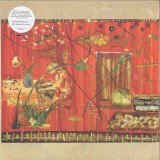
Steve Von Till has charted an extraordinary musical path over the last several decades, from his main duties as singer and guitarist of the boundary-breaking Neurosis to the psychedelic music of his Harvestman project and the gothic Americana he's released under his own name. But No Wilderness Deep Enough is truly like nothing you've ever heard from him before—an album that's devastatingly beautiful and overwhelming in its scope, reminiscent of the tragic ecstasy of Nick Cave and the Bad Seeds' recent work as well as the borderless ambient music pioneered by Brian Eno, late composer Jóhann Jóhannsson's glacial compositions, and the electronic mutations of Coil.
FOR FANS OF : MARK LANEGAN/MICHAEL GIRA/NICK CAVE.
Over the course of recent time, an aching, growing void has developed where our normal way of life has resided. Uncertainty abounds, and Steve Von Till's No Wilderness Deep Enough provides a voice of existential wisdom and experience to offer comfort and perspective in an era of uncharted territory. These six pieces of music shape a hallucinatory landscape of sound that plumbs the depths of the natural world's mysteries and uncertainties—questions that have vexed humanity since the dawn of time asked anew amidst a backdrop that's as haunting as it is holistic.
Von Till’s fifth solo album is a swirling and iridescent blend of ambient, neo-classical, and gothic Americana that swan-dives into the darkness of modern life, with the resulting emergence a sonic document of rural psychedelia that transcends the physical world—towards a greater spiritual acceptance that connects naturalism, spiritualism, and the corporeal form.
With a foundation of simple melancholy piano chord progressions embellished with mellotron, cello, french horn and electronic treatments Von Till's scorched ache spreads across the terrain of No Wilderness Deep Enough like a brushfire, adding a tactile level to his sonic creation as well as an inviting level of friction to the burning beauty painted across the album's framework.
With a foundation of simple melancholy piano chord progressions that came to fruition during jetlagged nights in his wife’s childhood home in Germany, No Wilderness Deep Enough was further embellished with mellotron and electronic treatments in Von Till’s home studio in North Idaho. Viewing the emerging result as an ambient instrumental album, he consulted friend and engineer Randall Dunn (Marissa Nadler, Earth) about adding live cello and french horn and piano in a proper studio. After enlisting Brent Arnold on cello and Aaron Korn on french horn, he challenged Von Till to sing over the music and make it his next solo album—which is exactly what happened, with final work being completed at Tucker Martine’s (the Decemberists, Neko Case) Flora Recording and Playback in Portland.
Поиск:j path
Все
For years, Frente Cumbiero has served as the torchbearer of a new wave of experimental exploration in the diverse modern-day cumbia canvas. Led by Mario Galeano Toro, a Colombian native and accomplished veteran of Bogotá's rich music scene, the group first connected with listeners outside of South America via their head-exploding 2010 debut on Names You Can Trust. "Pitchito" would become a cult favourite, a catalyst for the Brooklyn-based label, and soon after a bonafide rarity. Those beginnings of Frente Cumbiero focused on an honorary recognition of the massive musical impact that the many formations of cumbia have had over the decades within Colombia. Subgenres such as gaita, porro, vallenato, and caracolito, to name just a handful, have all played their part within the evolution of the country's tropical music lineage. That deep-digging determination coupled with a truly unique and talented musicianship has informed Frente's music, some of the most forward-thinking and reverential examples of the current tropical scene. It has led to some incredible opportunities and collaborations in Europe, Asia and the States, including genre-defying recordings with London's Mad Professor and Japan's Minyo Crusaders.
Still, Galeano Toro's assemblies with Frente Cumbiero have been scarce amongst his other exploits, splitting time as player and producer in other ground breaking projects like Ondatropica and Los Pirañas over the recent years. After three 45 single releases together with NYCT, the time away has left everybody wanting for more. Now, reassembled and seasoned with years of touring and gigging in a multitude of projects, the group's current quartet of Galeano Toro (keys and synths), Pedro Ojeda (timbales and percussion), Marco Fajardo (tenor sax) and Sebastián Rozo (bombardino) is a stripped down powerhouse of unadulterated psico-tropi swing, a beautiful Colombian musical stew, incorporating a host of flavors from the melting pots of the Pacific, Caribbean and Atlantic pathways. The final result is of course quite unclassifiable, simply a new breed of good music and a dancefloor delight.
The different seeds that have been planted throughout the life of Croatian Amor come to bloom on 'All In The Same Breath,' affirming an equilibrium that's all its own. Spiralling through the half-light electronics are gentle bumps and breaks that are layered into moments of elevation. A coarse edge remains just an arm's length away, but there is an unmistakable element of celebration throughout the album's 10 tracks. As the syncopated terrains ring out, their perpetual rhythmic motions call a medley of human voices that speak in security. They sing to everyone just as they sing to themselves. In the years since the seminal Croatian Amor album 'Love Means Taking Action' Loke Rahbek has strode a twofold path. There are the delicate, meditative compositions that he has made with Frederik Valentin; setting acoustic instrumentation against affecting digital treatments, each of their collaborative albums are an exercise in the magnificence of subtle restraint. And with the sharpest of turns you'll find Rahbek's parallel universe of rave-shocked rhythms and kinetic helixes that eddy through genre and tempo with few constraints. Collaborations with Varg²™ have yielded the wildest of this, and remain ongoing, yet the traces were already apparent across much of the previous Croatian Amor album 'Isa' with its treated vocalizations and cascading rhythmic mechanics. 'All In The Same Breath,' arrives as a steady handed synthesis of these divergent instincts. Elaborating the distinct techniques and themes that form the wistful essence of the project, the album's quiet composure is a sign that these familiarities have been set adrift to settle into their own private ecosystem.Small vessels travel in a perfect array. Light following shadows, following light. Every movement a signal, every second is camouflage. 'All In The Same Breath' is perhaps more than anything an invitation to be open to wonder.
THE KILIMANJARO DARKJAZZ ENSEMBLE are a project which has always been tied to films. Films are luxurious because they dispose of all these boring, unimportant, and trivial parts of our lives. This allows them to fully control our sensations, to put us in a very specific mood. Joy and sadness are occasionally OK, endless joy or endless sadness are clinical. But there is one sensation which can be persistent and unconditionally bearable at the same time. In the absence of a better alternative, let's call it "the mood". The mood is what TKDE are aiming at. The mood.
The mood is infinite and illimitable, but not uniform and unique. On "From The Stairwell", TKDE deliver eight new incarnations of the mood. Stairwells have always been intriguing. They appear to unavoidably lead you to your destination, but they only disclose the path bit by bit. What lies far ahead of you and far beyond you is hidden in the shadows. The stairwell could just as well be infinite. You climb up this murky stairwell, passing by many doors. Every door contains a variation of the mood, a short film, a song. You open the first one, "All Is One". The evaporating mist discloses a large and empty room with a barstool in the middle. On the barstool, a chanteuse from the roaring twenties. Her voice starts to trigger vibrations of the ground, the walls start spiralling around her, but she remains untouched in the eye of the storm. Second room, "Giallo". Sly guy, telling smile, nice suit. Walking down the streets in the dusk. The ambience starts to get out of phase, the guy stumbles in horror while blending with the surrounding to a brown soup. Fourth room. "Cocaine". Naked people with pig heads crawl on the floor, on the walls, on the ceiling. They try to hopelessly suck up the white dust which covers every single piece of this room and is constantly spit out by tubes coming out of the walls. Dissonant sounds accompany the work of this desperate hive. As the people manage to counteract the tubes, fragile melodies start to overpower the dissonances. Sixth room, "Cotard Delusion". Baby morphing into a black fluid morphing into an old man which turns his eyes inwards and finds his inside to be completely empty. The journey up the stairwell, down the stairwell, continues. The pictures fill your head and make you forget where you wanted to go in the first place.
"From The Stairwell" is a surprise and a logical step at the same time. It is a surprise because the songs are far less beat-driven in comparison to TKDE's earlier works, and even contain a few hopeful tints here and there. It is a logical step because in the end each song turns to have a very diverse dramaturgic flow. This could raise the conjecture that TKDE, initially started out to make music for existing and non-existing films, wanted to incorporate the audiovisual impression completely into songs, making the films superfluous. At times, "From The Stairwell" makes you think of 60's soundtracks, but the organic feeling of those is always interwoven with mechanical elements. Altogether, every single of the numerous details present in TKDE's new songs feels to be at the right place and you can either just dive into the mood or pick one of the many aspects and enjoy it on its own - be it Gideon Kiers' beats & fx, Jason Köhnen's bass & piano, Hilary Jeffery's trombone, Charlotte Cegarra's voice & piano, Eelco Bosman's guitar, Nina Hitz' cello, Sarah Anderson's violin, or - appearing as guest musicians - Eiríkur Óli Ólafsson's trumpet and Coen Kaldeway's saxophone & bass clarinet.
Two high grade tracks by one of Grime’s greatest producers D.O.K. 06 is Grime at its purest; gliding synths, weird bleeps and a heavy bassline whilst the flip Look Uno continues on the Coolie Joyride path. Relentless beats, a heavy sub and catchy samples. Perfect. Out on the 19th of July on marbled purple vinyl
2x12"
Radio Matrix returns! In the strangest of times a somewhat prophetic message reached us. A message delivered by Immediate Proximity, a collaborative project by Diana Napirelly & Niels Luinenburg, known for his output as Delta Funktionen. Their message comes in the shape of an album called '2334'. It covers nine tracks that perfectly act as the soundtrack for our society during COVID-19 times. With tracks and titles like The Apocalyptic Techno Cult, Broken Ether, Clone Morph or Skynet Skanner, we find our self on the brink of a new era where machines and algorithms have taken over humanity. Metallic beats kick hard and eerie melodies are placed against rhythms that remember us of ancient tribes carrying out ritualistic dances in order to try to escape the machine world. Fortunately, behind this somewhat dark and apocalyptic mood a strong statement appears and calls for hope and experience. It gives the listener a path to look beyond the horizon. This release is limited to 150 copies. Printed on 350g incada silk paper with high UV gloss varnishing. Includes a sticker sheet.
The Bit is the second recorded collaboration between Aidan Baker (Nadja / Hypnodrone Ensemble), Simon Goff (Jóhann Johannsson / Hildur Gudnadottir) and Thor Harris (Swans, Shearwater, Thor & Friends).
Following on from 2017’s Noplace album, The Bit treads a similar path in terms of the recording process as the trio spent a day improvising at Voxton Studios in Berlin whilst on a European tour. The result was then edited and moulded into six hypnotic tracks that ebb and flow with beauty and ease.
The Bit finds the trio painting with a lighter touch than on its predecessor. Thor Harris’ motorik beats still underpin the music but the atmospherics take a more prominent role and there is a pure and cohesive path to be found throughout the record. Much like on Noplace, Baker’s guitar and Goff’s violin weave together beautifully, forming a deep bed of melody, ambience and reverb.
Given the trios credentials it’s not surprising they have created another immersive and stunning record.
Two years after he strikingly entered the world stage with Iron, a luminous track with a truly iconic video - Woodkid released The Golden Age, his first ever album, crafted and shaped in the utmost secrecy during the year 2012. While some might have just let the media hype do its work, Woodkid also known as Yoann Lemoine, chose to reverse the rules of the game. Following the release of a second single Run Boy Run, which became a classic in a matter of weeks - with the accompanying video nominated at the prestigious
Grammy Award in 2013, Woodkid decided to bring out his first album. A record with incredible ambition for this young Frenchman who America was already crazy about, picking up the momentum for his rise. The Golden Age is an epic quest, a beautiful and surprising adventure. The foundations of the Woodkid staple are of course all on display : percussions, string and brass arrangements, piano, programming and - of course - this powerful and sensitive voice that delicately runs through the melodies with great magnitude. A few months after its release The Golden Age was certified Platinum and
Woodkid went on to collect the Prize for “Best Live New Act” at the French Music Awards on February 14th 2014. As a multi-talented artist, Woodkid thought out his project with all aspects in mind. Initially working as a video director for the greatest (Lana Del Rey,
Drake and Rihanna), he then directs his own videos and starts creating the visuals and stage-design for his own live performances.
Since then, this gifted all-rounder has continued to explore multiple paths. In 2014 he works alongside contemporary artist JR on an original piece commissioned by the New York City Ballet (JR creating and Woodkid producing the music), takes the artistic reins of Pharrell Williams’ live shows and co-writes an original soundtrack with Hans Zimmer.
In 2015, Nils Frahm performs the soundtrack that Woodkid wrote for a
documentary on Ellis Island, directed by JR with commentaries from Robert De Niro.
The same year, cinematographer Jonas Cuaron (creator of gravity) asks him to write the music for his feature film “Desierto” a gruelling thriller set in the Mexican-American desert. Woodkid comes up with a radical and organic piece halfway between sound-design and film score, released in April 2016. He is to this day one of the most sought-after artists, a visionary and altruistic creator whose modern and powerful body of work continues to shape itself with every new encounter.
New album of one of the biggest Reggae/Dub french soundsystem starring MacGyver, Rooty Step & Pupajim (who worked with Alpha Steppa, Biga Ranx, High Tone, Mungo's Hi-Fi ...).
Available as super limited edition including 60x60cm Poster !
Since their inception at start of the 2000s, Stand High Patrol have rocked sound systems to their own riddim, assimilating and re-purposing the codes of the genre in their own unique style. From tiny bars in Brittany to huge festival stages, on independent radio or across national airwaves, the crew have quietly trod their own path, never compromising their core value of independence. Connoisseurs have long recognised Stand High’s credentials both as a dub group and a leading sound system, but they stand out from the crowd because of their ability to deliver the unexpected, whether live or on record. Their ability to draw such a diverse audience is testament to this atypical approach to making music.
In 2020, almost 20 years since their humble beginnings, the collective presents their fifth album, “Our Own Way”. As with their first two albums “Midnight Walkers” and “Matter Of Scale”, now considered as classics in their genre, this new opus asserts itself as the latest representation of the crew’s versatile approach to crafting sound. Their music, a blend of its own known as “Dubadub”, has always borrowed influences from multiple sources, and over the course of their career their roots in dub and reggae have intertwined with hip-hop, jazz, new wave, trip-hop and numerous other genres. The ‘Dubadub Musketeers’ have never ceased experimenting, forever seeking to increase the sonic territory they cover, day after day. Both live and recorded, they’ve made it a point of honour to never offer up the same thing twice. Any resemblance that “Our Own Way” might bear to those first two albums is a consequence of this obvious creative continuity, rather than of going “back to basics”.
In contrast to the last two Stand High Patrol records, the hip-hop inspired “The Shift”, or the Bristol indebted “Summer On Mars”, “Our Own Way” doesn’t have a unifying concept or theme. Rather than being limited to a single aesthetic, the LP pays respect to the entire canon of Jamaican music, all unified under Stand High’s inimitable production values. With the wealth of experience gained during the recording of their last two records, the collective decided to aim for a freer project, letting themselves be guided by their own music and their own instincts. The end result is a musical portrait of what Stand High Patrol is in the present moment.
The tracks that make up the new LP burst out of the studio, each born out of unbridled, impulsive creativity. Previously unheard compositions and specially re-tooled dub plates have been assembled into a tracklist that shifts and moves like a classic Dubadub Musketeer live set. Each step of the process has been refined by years of practice : composition, effects, and the final mix. Throughout “On Our Way”, the brutal dub stepper, though still a favourite for sound system sessions, is noticeable by its absence. Instead, it’s the full weight of the crew’s reggae heritage that’s expressed in the mix. It's not just the depth and weight of each tune that strikes the listener, but also the spaces heard between the notes that grab and hold their attention.. The sense of a trip, whether musical, internal or geographic, is omnipresent throughout the LP, linking each track to those before and after. “Our Own Way” finds Stand High Patrol exploring as usual, yet also narrating their journey as they’ve rarely done before
Chra is the artist moniker for Austrian Christina Nemec (Bray, Shampoo Boy). SEAMONS is the latest missive in her ongoing exploration of suffocating abstract audio. At once designed and falling apart SEAMONS is rough and crude, a stumbling and staggering electronic expedition where nothing presents itself explicit in intent. It’s a tense obscure record that teases you into it’s peculiar vortex from it’s suggestive nature of exploring the enigma beyond it’s haunted facade.
VICIOUS WATER REGIMES stutters along as an ‘ugly’ mass of grey electronica. CAST(O)RO shines from light from the depths with it’s occasional foray into glistening tones. COLONIA MARINA SERENELLA is a dank squelching backdrop for a dark age. CAST twists tension with flickering electronics chaotic in their perpetual design of order confronting inevitable collapse. LET SHARKS SLEEP is not only a great title but a mind tickling adventure of descending/rising digital dance that builds in intensity with it's relentless repetition. WIDOW WALKS gallops and creaks along a path veiled in whispers. ENGE lunges through time with an air of deep uncertainty. SEAMONS hovers on the outskirts, crawling out of the speakers with endless surprising turns, few of them comfortable.
SEAMONS is progressive ambient, not the kind that makes you escape, but rather one you can't escape from. SEAMONS crawls into the very guts of sound to uncover and unravel the uneasy and unsettling underbelly within.
Minyo Crusaders rework historic Japanese folk songs (min'yo) with Latin, African, Caribbean and Asian rhythms for their debut album 'Echoes of Japan'.
Releases from Ryuichi Sakamoto, Haruomi Hosono and Midori Takada have re-ignited global interest in Japanese music and 'Echoes of Japan' marks the arrival of a big band like no other.
'For Japanese people, min'yo is both the closest, and most distant, folk music' explains band-leader Katsumi Tanaka: 'We may not feel it in our daily, urban lives, yet the melodies, the style of singing and the rhythm of the taiko drums are engrained in our DNA'. Initially indifferent to min'yo, a tragic event in recent Japanese history set Tanaka on his current path: 'Following the Tohoku earthquake of 2011, I reflected on my life, work and identity. A fan of world music, I began searching for Japanese roots music I could identify
with. Discovering mid-late 20th century acts Hibari Misora, Chiemi Eri and the Tokyo Cuban Boys, I was
captivated by their eccentric arrangements and how they mixed min'yo with Latin and jazz.'
Originally sung by fishermen (Kushimoto Bushi; Mamurogawa Ondo), coal miners (Tanko Bushi) and sumo wrestlers (Sumo Jinku), these songs deal with topics such as the returning spirits of ancestors (Hohai Bushi), Japan's smallest bird (Toichin Bushi) and a bride's love for her husband's pockmarked face (Otemoyan).
Minyo Crusaders are one of the most hyped acts on the Tokyo music scene that went national in 2018 through festivals such as Fuji Rock. The band features veterans of the Tokyo roots music scene such as bassist DADDY U (Ska Flames), keyboardist Moe (Kidlat), sax player Koichiro Osawa (Matt Sounds/ J.J. Session), Yamauchi Stephan (J.J. Session), percussionist Mutsumi Kobayashi (Banda de la Mumbia), conga player Irochi (Cubatumb) and vocalist Meg (DJ collective Tokyo Sabroso).
- Wild blend of Japanese folk music with cumbia, boogaloo, Ethio jazz, Afro funk + more
- Ry Cooder, Mario Galeano (Ondatropica/Frente Cumbiero), Clap! Clap! are all fans
- European touring plans for autumn/fall 2019
- Includes Japanese lyrics + English translations
- Lacquers cut @ The Carvery
DJ/producer Don Pascal has long been an advocate of fusing London’s sound system aesthetic with more traditional music from around the globe.
Following on from his 2014 release The Cali Experiment, (fusing Latin influences with the sounds of London’s underground club scene) we are happy to announce his forthcoming album The Dakar Experiment.
Featuring musicians from Senegal’s legendary evolving band Xalam, The Dakar Experiment is a sonic exploration fusing Senegalese musicianship and London’s Broken Beat scene.
As the homogenised sound of western pop permeates traditional music the world over, The Dakar Experiment offers an alternate pallet of influence, retaining tradition yet suggesting other possible paths.
The foundations of the album were laid at Henri Guillabert’s studio in Dakar over most of 2016 with Moustapha - Taffa – Cisse, Yahael Camara Onono and of course Henri and Don, then completed in London with an array of musicians, pulling on the city’s vibrant and re-emergent Broken Beat scene.
Featuring vocals by Lyric L, Rich BLK and Niara Scarlett, and remixes by EVM128, Trev and Xtra Brux, The Dakar Experiment is an exercise in finding what connects us in an increasingly divisive world.
Berlin-based Swedish saxophonist Otis Sandsjö returns with the eagerly-awaited sequel to "Y-OTIS". On "Y-OTIS 2", released by Helsinki's We Jazz Records on July 24, Sandsjö and his close associate, bassist/producer Petter Eldh (of Koma Saxo), deepen their vision of genre-bending, forward-looking "liquid jazz" of tomorrow. The core group also includes Dan Nicholls on keys and Tilo Weber on drums, and also featured on the album are Swedish jazz greats Jonas Kullhammar (of Koma Saxo) and Per "Texas" Johansson, cellist Lucy Railton and trumpeter Ruhi-Deniz Erdogan.
Diving deeper into "Y-OTIS 2", you'll find details and ideas galore. The album is an inviting and inspiring audio mosaic, which links back into the previous Sandsjö/Eldh collaborations, namely "Y-OTIS" and "Koma Saxo". The result is a balanced album which quenches your thirst while making you more thirsty in the process. In other words, the many micro moods and sonic levels herein invite repeated listening, while the underlying rhythmic approach is informed as much by hip hop and electronica as by jazz, making the music approachable in a very natural way.
It seems unnecessary to pull the album apart by name-checking individual tracks but just for the sake of easy introduction, the single cuts "tremendoce", "ity bity" and "abysmal" offer one idea of signposts along which to navigate. "tremendoce" brings in Swedish jazz great Jonas Kullhammar (of Koma Saxo) and Per "Texas" Johansson, introducing an infectious flute loop integrating into the Y-OTIS sound, making it organic to the bone. "ity bity" could be built on a new wave synth sample (but it's not) and "abysmal" brings more serene, even ambient-sounding sonic pathways onto the map. It all belongs together, and makes for a sound that is instantly recognisable and constantly fresh. This is "Mauerpark liquid jazz" for the new decade.
- 1: Waldo (Feat. Petter Eldh, Dan Nicholls & Tilo Weber)
- 2: Tremendoce (Feat. Petter Eldh, Dan Nicholls, Tilo Weber, Jonas Kullhammar & Per "Texas" Johansson)
- 3: Oisters (Feat. Petter Eldh, Dan Nicholls & Tilo Weber)
- 4: Abysmal (Feat. Petter Eldh, Dan Nicholls & Tilo Weber)
- 5: Koppom (Feat. Petter Eldh, Dan Nicholls & Tilo Weber)
- 6: Ity Bity (Feat. Petter Eldh, Dan Nicholls & Tilo Weber)
- 7: Sapiens (Feat. Petter Eldh, Dan Nicholls & Tilo Weber)
- 8: Bobby (Feat. Petter Eldh, Dan Nicholls, Tilo Weber & Ruhi Erdogan)
- 9: Fruehling (Feat. Petter Eldh, Dan Nicholls & Tilo Weber)
- 10: Atombahn (Feat. Petter Eldh, Dan Nicholls & Tilo Weber)
Berlin-based Swedish saxophonist Otis Sandsjö returns with the eagerly-awaited sequel to "Y-OTIS". On "Y-OTIS 2", released by Helsinki's We Jazz Records on July 24, Sandsjö and his close associate, bassist/producer Petter Eldh (of Koma Saxo), deepen their vision of genre-bending, forward-looking "liquid jazz" of tomorrow. The core group also includes Dan Nicholls on keys and Tilo Weber on drums, and also featured on the album are Swedish jazz greats Jonas Kullhammar (of Koma Saxo) and Per "Texas" Johansson, cellist Lucy Railton and trumpeter Ruhi-Deniz Erdogan.
Diving deeper into "Y-OTIS 2", you'll find details and ideas galore. The album is an inviting and inspiring audio mosaic, which links back into the previous Sandsjö/Eldh collaborations, namely "Y-OTIS" and "Koma Saxo". The result is a balanced album which quenches your thirst while making you more thirsty in the process. In other words, the many micro moods and sonic levels herein invite repeated listening, while the underlying rhythmic approach is informed as much by hip hop and electronica as by jazz, making the music approachable in a very natural way.
It seems unnecessary to pull the album apart by name-checking individual tracks but just for the sake of easy introduction, the single cuts "tremendoce", "ity bity" and "abysmal" offer one idea of signposts along which to navigate. "tremendoce" brings in Swedish jazz great Jonas Kullhammar (of Koma Saxo) and Per "Texas" Johansson, introducing an infectious flute loop integrating into the Y-OTIS sound, making it organic to the bone. "ity bity" could be built on a new wave synth sample (but it's not) and "abysmal" brings more serene, even ambient-sounding sonic pathways onto the map. It all belongs together, and makes for a sound that is instantly recognisable and constantly fresh. This is "Mauerpark liquid jazz" for the new decade.
Vinyl reissue of the now classic 1971 album. Produced by Transamericas in collaboration
with the band from original master tapes, in a fully analog process at recording studios in María Pinto
(Chile), London and Haarlem (Holland).
Los Jaivas (“El Volantín”) is the first LP by Chilean rock band Los Jaivas, one of South America's biggest names in the fusion of folk roots and psychedelia during the 1970s. Los Jaivas were born in the city of Viña del Mar, with their five members determined to guide their initial sound through improvisation and experimentation, «trusting that in time a language would emerge that would give us our identity», in their own words.
This debut album (popularly known as El Volantín - The Kite -, because of its cover illustration) combined the free-flow of extended electrical pieces with more conventional three-minute songs filled with references to Chile's popular culture and the musicians’ own upbringing. Theirs was a solitary path, not just for the band but also for the beginnings of Chilean rock. Los Jaivas blazed a trail that was rich in musical references, with ideas inspired by Jimi Hendrix, the Congolese Missa Luba, Argentinian folk (Atahualpa Yupanqui, Ariel Ramírez), South American avant-garde composers (Ginastera, Villa-Lobos, Violeta Parra), the experimentation of pianist Henry Cowell, Caribbean rhythms and Miles Davis’ trumpet re-inventions.
Five years ago, Cute Heels brought his unique blend to Schrödinger’s Box with Nepotism. The Colombian now returns to the Glasgow label, this time with a mini-LP packed to the rim with stone cold quality.
Steady kicks give way to juddering bass and epic strings in the dynamic changeling that is “Beyond The War.” Shadows are cast by the EBM stained “Er Ist Nitch Du” and the smoky “Present Images” under the alias of Syndikat Komando Klub 98. Yet, despite these darker shades, the 12” is filled with brighter tones also. As Victor M Lenis R, “Breath of Freedom” beams with synth-disco laden lines. “Strange Forces” takes a similar path, chords shimmering against aquatic pads that bask in warmth. An italo streak enters with the playful melody and sun- soaked keys of “The Awake (Mexico City Mix), radiant notes countered by strong pulsing percussion.
Beyond The War is a record as diverse as its creator. Traversing a spread of styles, Cute Heels has created a 12” that blurs perceived genres whilst maintaining the energy and zeal of the club.
Black Vinyl Edition
The Log and the Leeway follows a 6 year journey of personal exploration and drastic change for Bram Bosteels and his singular Kaboom Karavan universe. What entails is a sound-curiosity of rare format, following a metamorphosis that goes beyond the musical.
Early in the process, Bram was struck by the word/concept of a Leeway : the gradual departure from an intented course due to external influences. Following a boyish fascination for explorers travel journals, logbooks and the far fetched corners of the world, he could not have forseen how fitting of a title he had chosen. Drastically all of a sudden one day, completely unexpectedly, Bram experienced his own father dying in front of him from a rare disease. Shocked and confused by this intense encounter, his perspectives and musical course departed from its original path. But at the same time it was an enlightenment and a necessary influence for him to realise the initial idea and finish this album, started over half a decade before.
The ones familiar with Kaboom Karavan already know that nothing really sounds quite like it. Bram’s musical (and non-musical) universe is of the rare breed that seems to be entirely his own. Self-contained, but never opaque. Quite the opposite actually. Bram never pushes us away, instead, by listening to his music we are given view to a synesthetic wunderkammer of images, places, objects and possibilities. Distant but magnetic, alien but intimately familiar, Kaboom is folk music from another dimension. Listening to The Log and the Leeway is like waking up next to a bonfire in the middle of a swamp wearing somebody else’s clothes: You may not know how you got here, but whatever is happening seems to very directly involve YOU. What will happen?
Note from Erik K Skodvin (Miasmah): All the sounds, fabrics, instrumentation and stories that binds The Log and the Leeway together go far beyond what can be touched up in this simple writeup. As someone who have followed this journey since the beginning, and seen it shift from lighthearted fun to the most crepuscular personal experience, heard the stories behind (almost) every field recording and gone through boundless amounts of clips, visual details, notes, and inspirations – I can only say that it is with great pleasure and certain nostalgia I can present this record in full through Miasmah and close this quite extraordinary chapter. Bram is without doubt the most fascinating person I know. Like I told him in April 2020 during a trying time: “If everything fails, we´ll open a Kaboom Karavan museum” - an idea that might not be as far-fetched as it sounds.
Featuring: Cover painting by John Lurie. 16 page booklet of Musical illustration / collagés by Walter Dhoogh & Erik K Skodvin that more or less connects (or confuses) the dots between the music and stories behind. Mastered by Lupo at Loop-O
"On this seven track album we hear MinaeMinae (alias Bastian Epple) playfully scurry through his dense soundscapes on a tightrope. The sounds lying somewhere on the crossroads of psychedelic trance, exotica, ambient and melodic dance music – veering further off orbit with nontypical rhythms and dystopian percussive patterns.
MinaeMinae understands musical material similar to documentary footage which he would cut up, repitch, and rearrange freely. Most of his tracks are a mix of analog, synthetic sounds and recordings of ethnic percussion and guitar. Recently Bastian began experimenting with modular synthesis and self made tape echoes - seeking a more reduced and minimal composition style compared to his earlier quite whimsical tunes.
Growing up in a small village in southern Germany, Bastian was never interested in kitschy folk sounds that everyone would mindlessly clap and sing along to, rather he took solace in the time he would spend delving into patterns and repetitions that pleased him. His guitar strumming and what sounded to his mother like a young Philip Glass on a cheap Casio keyboard encouraged little Epple to continue on this self-taught path of developing his musical language. He then started to experiment with a tape recorder and layering sounds with non-musical samples, which his former village friends found too weird – then to eventually working with a small freeware DAW. Bastian went on to study Media Art at the Center for Art and Media (ZKM) in Karlsruhe – initially enrolled in music but the frustration and doubt of not being able to produce the music he wanted led him into film and documentary media. During his studies, Bastian was living with Florian Meyers (Don’t DJ) for several years where they would philosophize life and music into the wee hours – he encouraged Bastian to start sharing what he’s been quietly working on all these years and slowly emerge from this anonymity which eventually led to his first release on Human Pitch last fall.
Disproportionate forms, color changes, backdrops weaved into the foreground, all lay the dense earth for Gestrüpp through Benjamin Kilchhofer’s artwork."
We all go through phases. We don’t always feel the way we felt yesterday. Despite all these phases, we’re always drawn to music. It accompanies, touches and feeds us. This debut album is the story of Austrian Apparel and their journey up to this day. “AAplus” stands for inclusion - it takes paths into the openness of sound. It shows two sides. light and dark. While the light side features tracks outside of the four-to-the-floor realm, the dark side showcases their club oriented material. Never leaving behind their signature sound forged from their expertise on stage and in the studio. In coherence with their previous work, Austrian Apparel continue to explore an unconventional approach with their audio equipment, departing from a habitual studio process and emerging with a carefully condensed sonic episode of their journey.
- A1: Carole Cole - Ethiopia
- A2: The Silvertones - Give Praises
- A3: The Inamans - How Deep Is Your Love
- A4: Lasksley Castell - Jah Love Is Sweeter
- B1: Bunny Rugs - Let Love Touch Us Now
- B2: Bunny Rugs - I Am... I Said
- B3: The Originals - Got To Be Irie
- B4: The Upsetters - Double Wine
- B5: Junior Byles - Mumbling & Grumbling
Black Ark Vol. 2 is another piece of Lee ‘Scratch’ Perry’s limitless musical puzzle. It’s a bedrock of deep and heavy rhythms recorded around Jamaica =just before the demise of Perry’s famed Black Ark Studio. Black Ark Vol. 2 is the follow up album to the acclaimed Black Ark In Dub that unsurprisingly for an Upsetter release, took a different path. More vocal oriented, the album features extended dubwise cuts of (former wife and co-producer) Carol Cole’s ‘Ethiopia’, The Originals ‘Got To Be Irie’, Junior Byles ‘Mumbling & Grumbling and The Inamans remake of the Bee Gees hit ‘How Deep Is your Love’, along with an alternate take of the Silvertones roots classic ‘Give Thanks’ with flute overdub and a couple of solid covers from Third World lead vocalist Bunny Rugs. Originally released in 1981 the hard to find Black Ark Vol. 2 remains a frozen sonic timepiece, captured at the beginning of the end of one era and poised at the start of another.