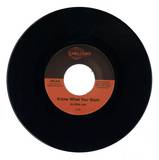
Melodies International proudly moves forward with an elusive piece of mid-tempo Chicago soul originally performed by Gloria J. Jennings in 1977.
Gloria was signed to Stage Productions as a gospel singer with pure and raw talent she had developed in the choir of her father's Southern Baptist Church. She was 16 years old at the time. To tutor her for R&B vocals, Willie C. Nance of Stage Productions spent 3 months taking the artist back and forth for vocal training 25 miles each way, 3 days per week.
At the time, Mr. Nance had made plans to work with singer and songwriter Theresa Eagins to record Know What You Want'. However, two days before the recording was set to begin, Ms. Eagins refused to move forward with the recording as she chose to take her religious faith more seriously and forgo the singing of secular music. Hence, Stage Productions turned to Gloria Jay to perform a song that would go on to move people thousands of miles away, many years later.
One of them was Patrick Forge: Back around 1990 I had a residency upstairs at the Wag Club on a Friday night alongside Paul Martin (he was Gilles P's A&R right hand man at Talkin Loud), the night was called Respect and we played mainly Soul, Boogie and Jazz-Funk. Many years later I bumped into Paul at a record shop and he quizzed me about a tune I used to play at the end of the night at Respect. Hhe described it as being an independent Soul seven inch on a red label, slow to mid tempo... and more to the point a bullet of a record. It piqued my curiosity so much I burrowed through my seven inches and even made Paul a compilation of likely contenders, his response was lovely selection, but it's not on there!'. Damn, a mystery! Many moons later whilst I was living in Japan, my tenant in my London flat said she'd found an old mixtape I'd done for her way back when and was desperate to know the identity of something she was calling the choo choo song'. Eventually when I was back in London she played the mixtape and I quickly identified her tune as Fabrica' by Cesar Mariano, however letting the tape play some time later a familiar descending chord sequence catapulted me back to those Friday nights at The Wag, and Gloria Jay's plaintive vocals reminded me of a record that had been absent from my life for far too long. I've no idea what happened to my original copy, I hunted another one down straight away, and I've kept it close ever since. Know What You Want' is a song that goes deep in such a simple, unaffected, almost naive way, Gloria's voice is both sweet and raw, it's built on simple chords and obvious instrumentation, but it's so much greater than the sum of its parts.
Know What You Want' is soul music, pure and unadulterated, there's nothing getting in the way of the feeling, it's straight from the heart.' Carefully re-mastered from the tapes, MEL008 comes forth in its original 7' format with a 14'x14' poster.
Buscar:jay la forge
- Turn Me On' by Jay W. McGee is the third release in a series of sought after boogie, disco and modern soul re-issues on Légère Recordings. The original 12inch vinyl single appeared on the tiny Canadian Indie label Love Productions in 1980 and is immensely hard to find these days.
- Turn Me On' is an unusual production for its time, grooving along unbelievably deep in a spartanic arrangement, and fuelled by vocals which are not too far away from Sylvester's iconic style of mixing soul, disco, funk and jazz.
Jay W. McGee has a strong opinion about disco music: - When disco came out, it had its own way of reaching people's hearts too. Being in a club, you know, it's escapism, like with soul music. Soul is addressing everyday life problems, disco is about how to forget and enjoy yourself. They each have their own unique place. I saw people railing on doing disco because they didn't understand the seriousness of it,' Jay W. McGee explains about - Turn Me On' when he officially commissioned this re-release: - The discrimination of disco was in reality a discrimination against black music.'
- Your Love', the flipside of this 12inch single, is an exciting ballad on the B-side and a surprise in itself. Both tracks feature a great combination of talents. Wayne Jackson, the trumpet player on - Turn Me On', played on Rick James' album 'Bustin' Out On L Seven', in the late Seventies. Glenn Johanson was the engineer on - Your Love'. He became Eddy Grant's house engineer at his studio in Barbados right after he mixed this tune. But there is also a little drama in the story. When Jay W. McGee returned to the studio where he recorded, "Turn Me On" he found out that the original version of - Turn Me On' was erased by another technician: - Everybody said it could have been a hit, and maybe the guy did it on purpose.' Nevertheless he recorded the song again with a now different arrangement and instrumentation. Maybe that is the reason why the production is so unique and also so different to - Your Love'.
Jay W. McGee could have been a solo artist on Philadelphia International Records, back in 1969, when he met Leon Huff of Gamble & Huff, in Philly for an audition, just before they recorded - Me And Mrs. Jones', - Bad Luck' and - Backstabbers' with Billy Paul, Harold Melvin and The O'Jays. They offered him a contract, but he refused, because he came with his whole group from Flint, Michigan and they wanted to be signed collectively.
Jay W. McGee kept just one of the original 12inches in his home: - Both songs were a profession of love to my wife. We are now married for 34 years.' Now if this ain't love, we don't know....'
Back in stock!
Some friends think that Shihab the man owes the balance of his soul to his beautiful Danish wife. They may be right; for Eros is the very essence of what Shihab plays.Yet Eros is a god with many a face. A tale of tender mournings Shihab's flute is telling in MAUVE - a piece that translates its title into delicately changing colors of sound. In UMA FITA DE TRES CORES he has his instrument wooing with the proud self-reliance of Latin grandezza. Calmly, softly, almost blandishly Shihab blows the solo flute in the Jimmy Woode composition MY KINDA WORLD. Serene and somewhat playful his own title ANOTHER SAMBA comes along - a most uncommon composition by the way: lasting for sixty bars as if growing independent out of itself, with solos that appear to be additional spinnings rather than improvised choruses; and yet; a perfect, self sustaining melody no element of which is superfluous. In the last of the pieces for flute, in Klook Clarke's THE WILD MAN, which is based on a flourish of trumpets, Shihab for the first time reminds of the sombre, the demon-like face of God Eros. He contrasts flawlessly intoned passages with challenging phrases, phrases raucously sung into the flute - really, he is a 'wild man' who is playing like that. This raucous challenging sound prevails throughout the four baritone-titles ('Shihab never withholds long to caress', Campi says). Shihab blows the instrument the same way he speaks: without any delay, directly coming to the point. And he treats it like a voice, not aiming at an artificially homogeneous sound in all the registers, but at their different modes of expression. In the high pitches the horn gains a brilliant tenor-like quality - for instance in PETER'S WALTZ, dedicated to Shihab's son Peter, and in Kenny Clarke's simple drum fills comprising theme JAY-JAY. In the deep register Shihab produces snotty sounds filling lady's ears with horrors like Pan - thus in JAY-JAY and in the boppy blues SET UP . Shihab's sense of a scurrilous humor breaks through in SEEDS (which reminds of the West-African heritage of jazz with its multiple rhythms and its renunciation of harmonious development - only the eight bars of the bridge base on a progression of chords): not only does he omit the notorious bombastic chord by the ensemble after his own final cadenza, he even ends with a minor second above the keynote. Seems as if Shihab now unrestrictedly conveys to his music all the experiences and emotions he formerly did not deal with in a musical way. Shihab the man need not be disturbed so that Shihab the musician may improvise passionate choruses. It would be unjust, however, to forget the choruses of the four other musicians for those by the 'born leader'. Francy Boland, taciturn and always introverted: he plays an extrovert, a masculine piano. Even with spare single note lines he produces a piercing and ringing sound that hitherto nobody except him has discovered, a bluesy sound bespeaking the very element of frustration that lies within the title of the trio number WHO'LL BUY MY DREAM. The unfailing feeling for rhythm the musicians of the CBBB praise with the arranger Boland, becomes manifest in the piano solo on SET UP. Francy's improvisation is rhythmically styled in a Monk-like manner, and yet no accent could be set differently. Maybe this is the secret of the Shihab-Combo. 'Rhythm is our business', this credo of Jimmy Lunceford could be the one of the five musicians as well. Sadi hits his vibes as dryly as if wanting to bring its ancestors to memory, the wooden chimes of West Africa's coastal tribes. To reach the fullest poignancy possible, he intentionally calms down even the resonance in MY KINDA WORLD. In UMA FITA DE TRES CORES Jimmy Woode bears out the crispy jazz beat against Sadi's Bongos and Klook's Latin-American percussion all by himself. Moreover - and that, too, is connected with the school of the Duke who was the first in the history of jazz to discover the instrument's potential as a melody instrument - Woode rips a marvelous counterpoint to the inventions of the other melody instruments, take for example PETER'S WALTZ. And then there is Kenny Clarke. Klook. On the entire record he only uses his brushes. Means by which different drummers only know to bring forward impressionistically blending noises: He drums a vigorous beat with them, fanciful fills, a solo, melodious and at once skillfully playing with cross rhythms in JAY-JAY. The 'born leader', the 'outstanding baritone saxophonist of modern jazz' (Joachim-Ernst Berendt), he could not wish himself different sidemen for this record overdue since some years.


